
| Category | |
|---|---|
| Additional Images |
|
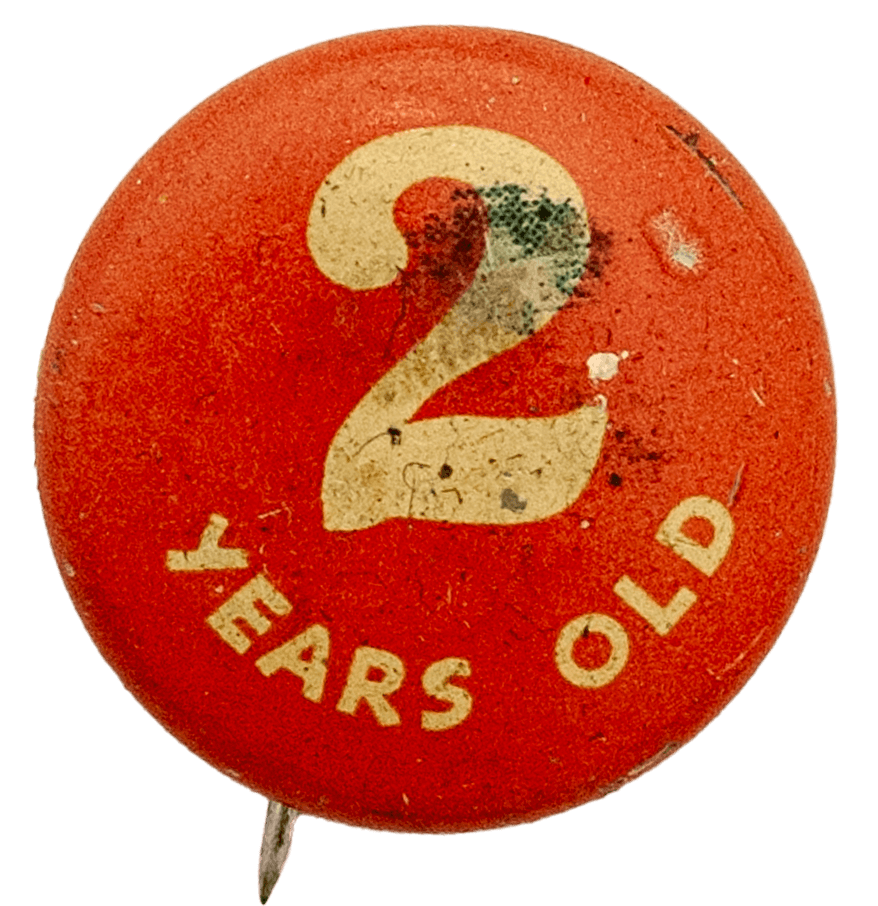
| Text on Button | 2 YEARS OLD |
| Image Description | White text on a red background. |
| Back Style | |
| The Shape | |
| The Size | |
| Additional Information | Although widely popular today, celebrating one's birthday was not always common in America. In the mid-19th century, amid a retinue of cultural and socio-economic changes, children shifted in their family dynamics from being viewed as laborers and economic providers to being more emotionally valued family members. Around this same period, the concept of passing time, and therefore age, became increasingly relevant to people, leading to greater emphasis on celebrating birthdays, particularly for children. It wouldn't be until the 20th century, in the wake of Puritanical influence, that birthday celebrations began to become something celebrated by the masses. Many traditions we associate with the birthday party draw inspiration from global cultures, with primary features including an emphasis on the person being celebrated as the guest of honor and their age, as shown here, which is highlighted as a milestone and accomplishment. |
| Sources |
Baselice, Vyta, Dante Burrichter, and Peter N Stearns. “Debating the Birthday: Innovation and Resistance in Celebrating Children.” Journal of the History of Childhood and Youth (Baltimore) 12, no. 2 (2019): 262–84. https://doi.org/10.1353/hcy.2019.0023. "Birthdays ." Encyclopedia of Recreation and Leisure in America. Encyclopedia.com. (February 2, 2026). https://www.encyclopedia.com/humanities/encyclopedias-almanacs-transcripts-and-maps/birthdaysNovember 2 Pinsker, Joe. “The Strange Origins of American Birthday Celebrations.” The Atlantic, November 2, 2021,www.theatlantic.com/family/archive/2021/11/history-birthday-celebration…. |
| Catalog ID | IB0842 |