
Back Papers
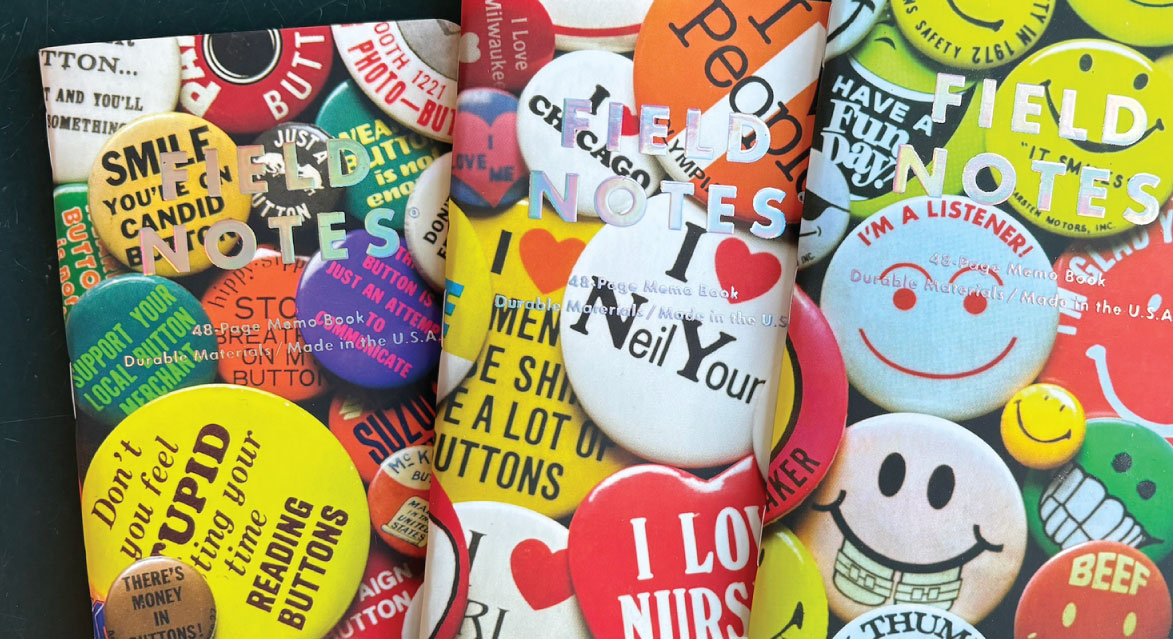
Back papers are the small slips of paper tucked inside the backs of pin-back buttons. A common practice in the early days of button making, they often carry the maker's name and address, and they can help us pinpoint when a button was produced.
Collectors and the Button Museum are always discovering new back papers and fresh details about them, so this guide is a living reference. It was last updated in 2026, and we'll keep adding to it as we learn more.
We hope you find it a helpful companion in your research!
With heartfelt thanks to Ted Hake, Benny Branvold, and John Vargo for generously sharing their knowledge.
Introduction: Dating Celluloid Buttons
By Ted Hake
The original concept of dating celluloid buttons by studying changes in the back paper designs of a given manufacturer was developed by Stewart and Emily Barr, who specialize in buttons issued for governors, senators and other "local" candidates. Since exact election dates for these candidates are known, the Barrs were able to determine which years various back paper designs were in use. Their original research was published in Collectibles Monthly (November, 1978). The study concentrated primarily on ¼" buttons from the 1894-1924 period and three manufacturers: Whitehead & Hoag, Bastian Brothers, and St. Louis Button Co.
To expand on the original research, hundreds of buttons carrying a specific date as part of the obverse inscription were assembled from the inventory of Hake's Americana & Collectibles. To make the study as broad as possible, buttons of every size, from all time periods and all manufacturers were included. The buttons were arranged by the year appearing on the obverse and then the back papers were examined.
Some obvious limitations to this dating method became apparent very quickly. Some companies did not use back papers at all, other companies used papers but never altered the design, and, as broad as the sample of dated buttons was, some companies were not represented by enough dated buttons to draw valid conclusions.
The sample of dated buttons was broad enough to draw conclusions about six button manufacturers. For a small company like C.J. Bainbridge, Syracuse, N.Y., about fifty dated buttons were studied while the sample for Whitehead & Hoag consisted of hundreds of buttons. Unfortunately, the companies did not consider the back papers important enough to cease using an "old" design immediately upon the adoption of a "new" design. Often a new design was introduced but the supply of papers with the old design was used until it ran out. This creates an overlapping time period when more than one back paper design was in use. For some companies, such as Western Badge and Novelty Co., the sample was large but did not cover every year. Thus, it is certain the Type II paper was used in 1910-1911 and the Type Ill paper was used in 1915-1916, but which design or designs were used from 1912-1914 remains a mystery.
The larger companies, Whitehead & Hoag, Bastian, and St. Louis, made many back paper design changes which are most helpful in drawing valid conclusions regarding dates. Still, these conclusions are certainly open to revision and refinement. Hopefully, readers will investigate their own collections to confirm the information offered here.
Manufacturer Shortcuts:
- The Whitehead & Hoag Co.
- St. Louis Button Co.
- Bastian Brothers
- Keystone Badge Co.
- Western Badge and Novelty Co.
- C.J. Bainbridge Badges and Buttons
- Donnoly Colt
- Green Duck Co.
- Walter N. Brunt Co.
The Whitehead & Hoag Co. (Newark, NJ)
7/8" or Smaller Lapel Studs and Buttons | ||
|---|---|---|
Image Coming Soon | 1894 Type I Lapel Stud | Usually ¾" with a white metal rim surrounding a thin layer of celluloid that covers the paper. The reverse has a stud back surrounded by four triangular prongs. The cap of the stud is inscribed: "WHITEHEAD & HOAG CO/NEWARK N.J./PAT. APP'D FOR". |
Image Coming Soon | 1895 Type II Lapel Stud | A major design change eliminated the need for the obverse metal rim. Now the celluloid and paper edges are tucked under the metal back. The design and inscription of the reverse remains the same as Type I. |
Image Coming Soon | 1896 Type III Lapel Stud | The reverse design is similar to Types I and II except the four pronged fasteners are replaced by three punched holes arranged in a triangle around the stud. |
Image Coming Soon | 1896 Type IV | The first pin-back buttons were produced in 1896. The first back papers are covered with a thin layer of celluloid. Enclosed in a black circle is a circular inscription "THE WHITEHEAD & HOAG CO. NEWARK, N.J." and within that is a single patent inscription also in a circular design "PATENTED JULY 11th 1894." |
Image Coming Soon | 1896 Type V | The celluloid covered Type IV paper was used very briefly and was replaced by a totally redesigned paper. The paper has a varnished finish rather than a celluloid covering and lists two patent dates as "JULY 17, 1894" and "APRIL 14, 1896." |
 | 1896-1898 Type VI | Similar to Type V except a third patent date of "JULY 21, 1896" is included. Some papers have a varnished finish while others do not. |
Image Coming Soon | 1898 Type VII | A briefly used, but very attractive, design featuring a light blue border surrounding a shield outlined in gold. The patent dates are the same as Types V ad VI. |
Image Coming Soon | 1898-1899 Type VIII | A thin black line separates the company name, city, and state information at the top from the three patent dates listed below. |
Image Coming Soon | 1900-1901 | Similar to Type VIII except at the center printed in red is a union label reading "TYPOGRAPHICAL/UNION LABEL/NEWARK NO 103." |
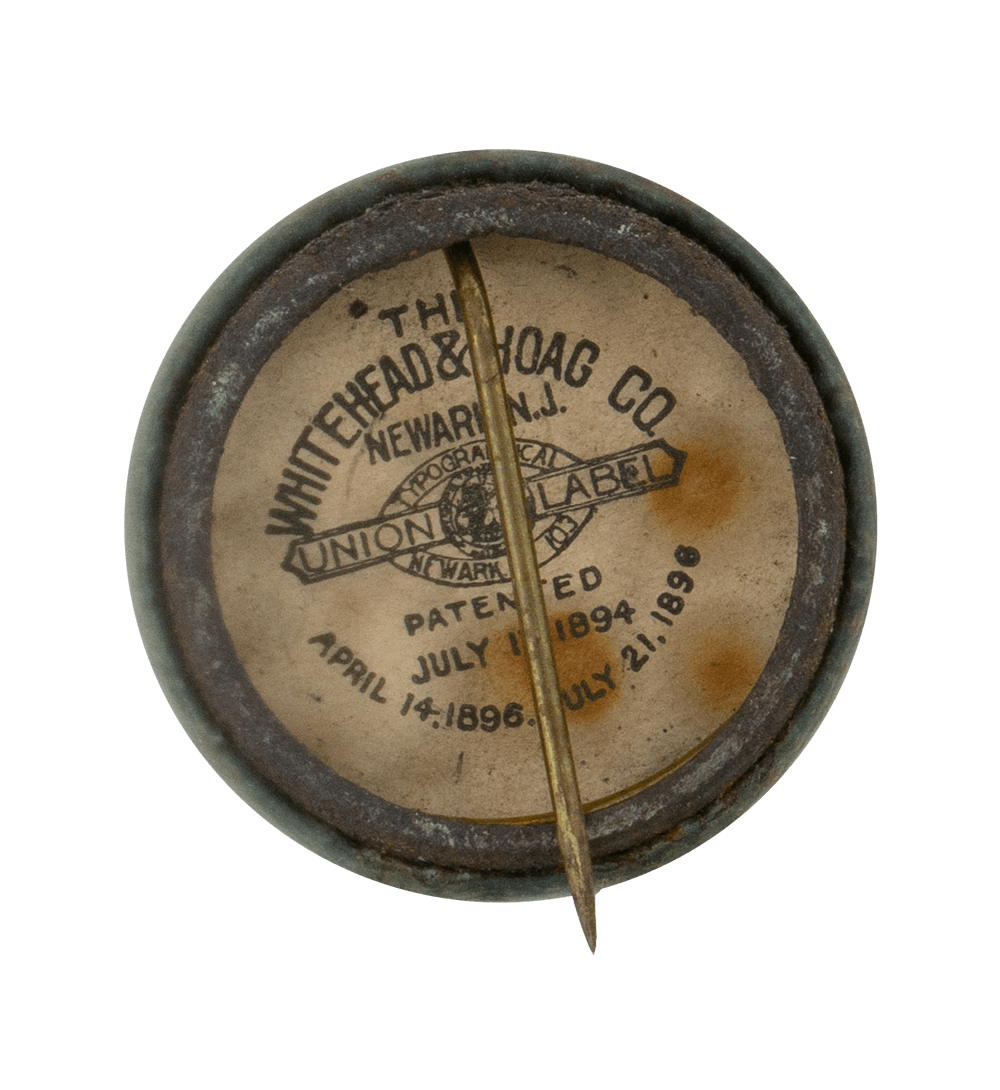 | 1900-1901 Type X | Similar to Types VIII and IX except the union label is in black and the patent dates are listed on two lines instead of three. |
Image Coming Soon | 1900-1902 Type XI | In 1900, the union label was totally redesigned and reads "ALLIED PRINTING/TRADES COUNCIL/UNION LABEL/NEWARK, N.J." A number "3" appears to the right. |
Image Coming Soon | 1912-1940s Type XII | The back paper was redesigned for the last time in 1912. The long-term use of this design ends the usefulness of this method for dating these buttons. |
1" and Larger Buttons | ||
|---|---|---|
Image Coming Soon | 1896 Type I | The obverse has a brass rim while the reverse has a tin cover with a pin soldered in a horizontal |
Image Coming Soon | 1896 Type II | Apparently the first open back button paper for the 14" size. The paper is beige with a lightly varnished surface. The inscription reads "PIN BACK/PAT. APRIL 14, 1896/THE WHITEHEAD & HOAG CO./BADGES/FLAGS/BANNERS/NEWARK, N.J." |
Image Coming Soon | 1896-1897 Type III | This paper is in a calendar button for January, 1897. A red rose with green leaves and stem is surrounded by a circle of red type "COMPLIMENTS OF THE WHITEHEAD & HOAG CO. |
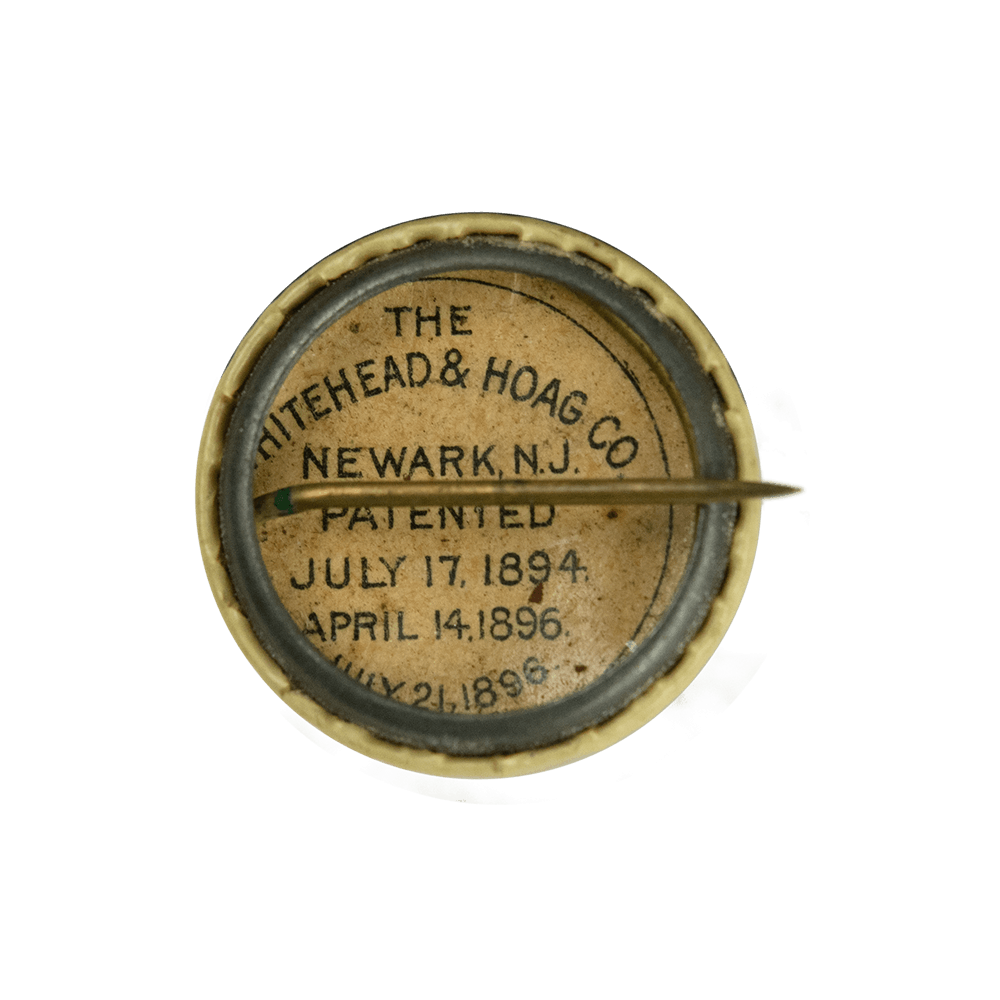 | 1896-1897 Type IV | A tan paper with a varnished surface has a double black line circle around the company name, city, state, and three patent dates. The first two dates, "JULY 17, 1894," and "APRIL 14, 1896." are on straight lines, while the third date "JULY 21, 1896." is a curved line. (Use of this paper started about December, 1896.) |
Image Coming Soon | 1897 Type V | Similar to Type IV except the paper may be unvarnished and at the center printed in red is a union label reading "TYPOGRAPHICAL/UNION LABLE/NEWARK NO 103." |
 | 1897 Type VI | A white paper with a single black line circle enclosing the company name, city, and state information above the three patent dates all on straight lines. Buttons over 1 1/4" do not have a black circle around the information. |
Image Coming Soon | 1898 Type VII | A briefly used, but very attractive, design featuring a light blue border surrounding a shield outlined in gold. The patent dates are the same as Types IV-VI. |
Image Coming Soon | 1898 Type VIII | A white paper with all black type in straight lines and a red union label at the center. The union label is the same as Type V. The inscription includes "WASHINGTON & WARREN/STREETS," and a single patent date "PAT. OCT. 26, '97." |
 | 1898-1900 Type IX | A white paper with all black type in straight lines except the first line "Made by" is curved, Lists the same three patent dates as on Type IV. |
 | 1900 Type X | Identical to Type IX except printed at the top is a light gray union label with an inscription identical to Type V. |
Image Coming Soon | 1900 Type XI | The company name and a single patent date "PAT. OCT. 26, '97." form curved lines at the top and bottom enclosing the other information. Included is a union label reading "ALLIED PRINTING/TRADES COUNCIL/UNION LABEL/NEWARK" with a "3" to the right. |
 | 1900-1901 Type XII | A union label at the top is inscribed "•L•I•P•&•B•A•" and reads "AMERICAN/MANUFACTURE/UNION/LABEL." There are two patent dates reading "PAT. APRIL 14, 1896/JULY 21, 1896." |
 | 1900-1912 Type XIII | The union label at the top reads "ALLIED PRINTING/TRADES COUNCIL/UNION LABEL/NEWARK" with a "3" to the right. The type is on straight lines and includes "Pat: April 14, 1896,/July 21, 1896." |
 | 1912-1948 Type XIV | The back paper was totally redesigned in 1912 and then used without further changes, with two exceptions: Type XV and Type XVI (below) |
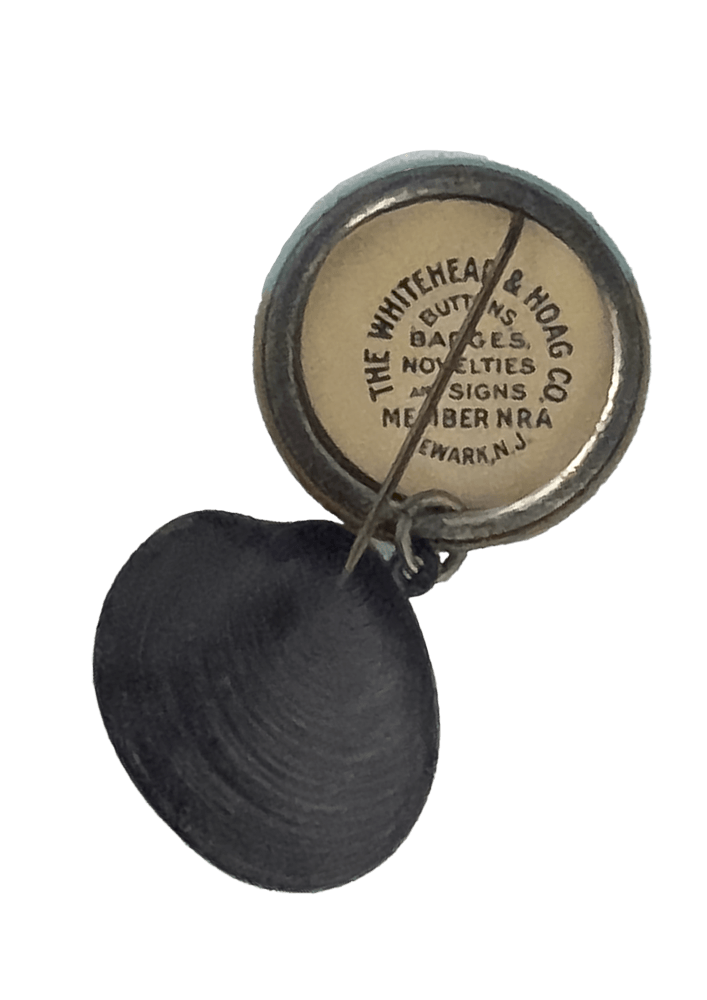 | 1933-1936 Type XV | Circular type with the company name, city, and state surrounds the other information. The tiny union label on Type XIV is replaced with the slogan "MEMBER NRA." |
 | 1932-1941; 1949; 1951 Type XVI | Similar to Type XV but has no union label and no "MEMBER NRA." |
St. Louis Button Co. (St. Louis, MO)
All Button Sizes (with variations as noted) | ||
|---|---|---|
 | 1899-1907 Type I | Metal covered back with a long pin protruding from a punched hole near the top of the metal cover. Stamped inscription reads "ST LOUIS BUTTON CO ST LOUIS." |
Image Coming Soon | 1899-1908 Type II | Same as Type I, but stamped inscription reads "ST LOUIS BUTON CO/620 N. BR.D.W.Y. ST LOUIS." 1904 buttons are known with the address at the center of the metal back. |
Image Coming Soon | 1900 Type III | The first open back St. Louis button seen is from 1900. The paper lists the company, name, city, and state between two black dots and two thin black lines at the top and bottom. |
Image Coming Soon | 1905-1919 Type IV | 1 1/4" and larger sizes have the number "105" to the right of the union label. The words "Manufactured By" are in the upper and lower case. Carries the patent inscription "Pat. Aug. 8, '99." |
 | 1908-1925 Type V | 1" and smaller sizes do not have any number to the right of the union label, but may have a number "15" below the union label. The words "MANUFACTURED BY" are in the upper case. Carries the patent inscription "Pat. Aug 8 [no comma as in Type IV] '99." A variation of this design without the patent date was also used circa 1924-1928. |
 | 1923-1928 Type VI | 1 1/4" and larger sizes have a "10" to the right of the union label. The words "Manufactured by" are in upper and lower case. Carries the patent inscription "Pat. Aug. 8, '99." |
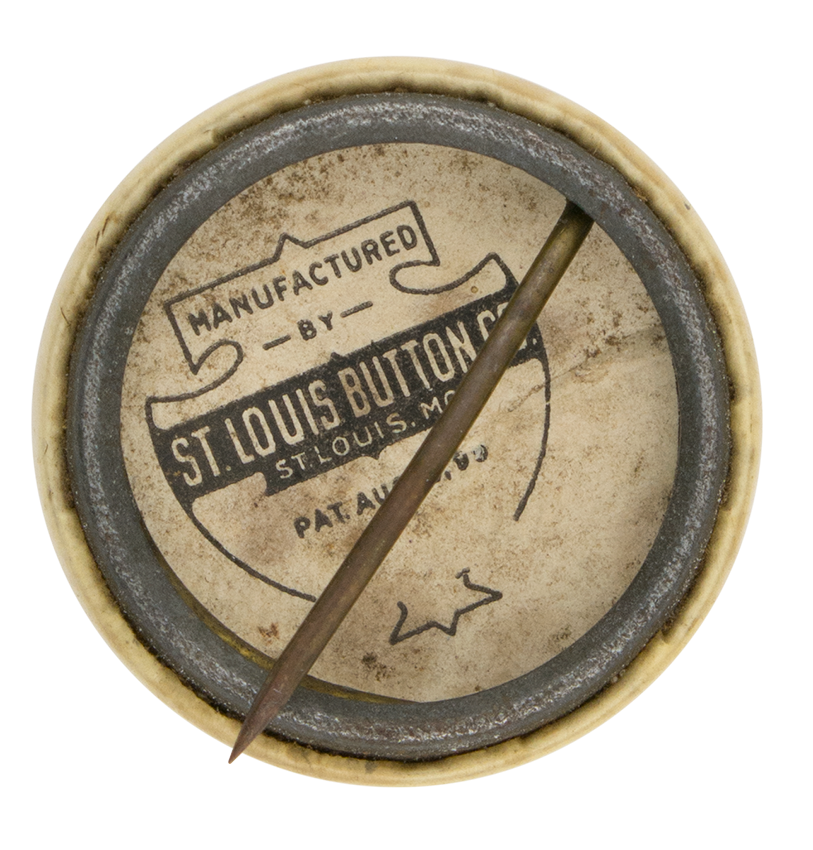 | 1912-1929 Type VII | The company imprint is enclosed in a stylized shield design. A number "28" appears below the union label. Carries the patent inscription "PAT. AUG. 8, '99." |
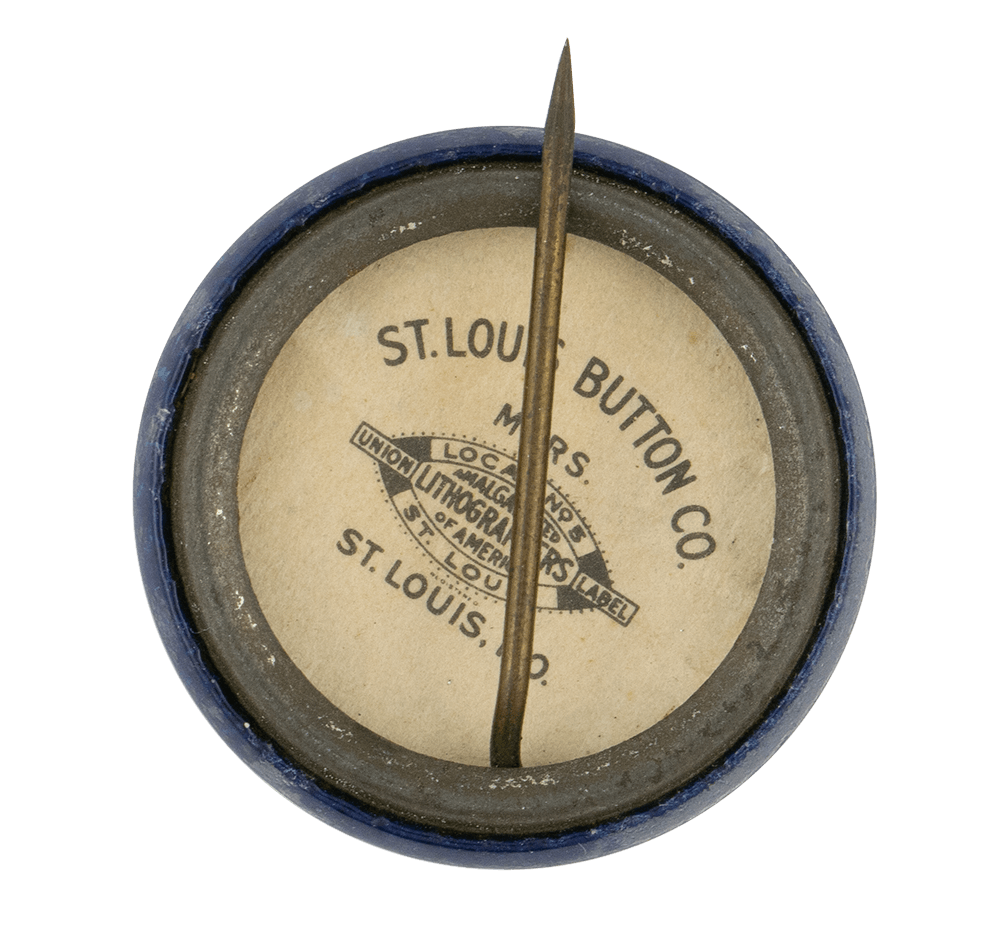
| 1924-1939 Type VIII | 7/8" and smaller sizes have "MFRS." above a union label inscribed at the center "AMALGAMATED LITHOGRAPHERS OF AMERICA." |
 | 1928-1949 Type IX | 1 1/4" and larger sizes have "MANUFACTURERS" spelled out in upper case. Otherwise, the design is identical to Type VIII. |
| 1944-1957 Type X | The inscription "ST. LOUIS BUTTON CO. MFRS., ST. LOUIS, MO." is repeated over the entire paper with no other design or inscription. |

Bastian Brothers (Rochester, NY)
All Button Sizes | ||
|---|---|---|
Image Coming Soon | 1905-1907 Type I | At the center is a 1/2" circular company imprint with a tiny union label. |
 | 1906-1907 Type II | Imprint includes the inscription "SEND FOR CATALOGUE GET A COLLECTION OF BUTTONS." |
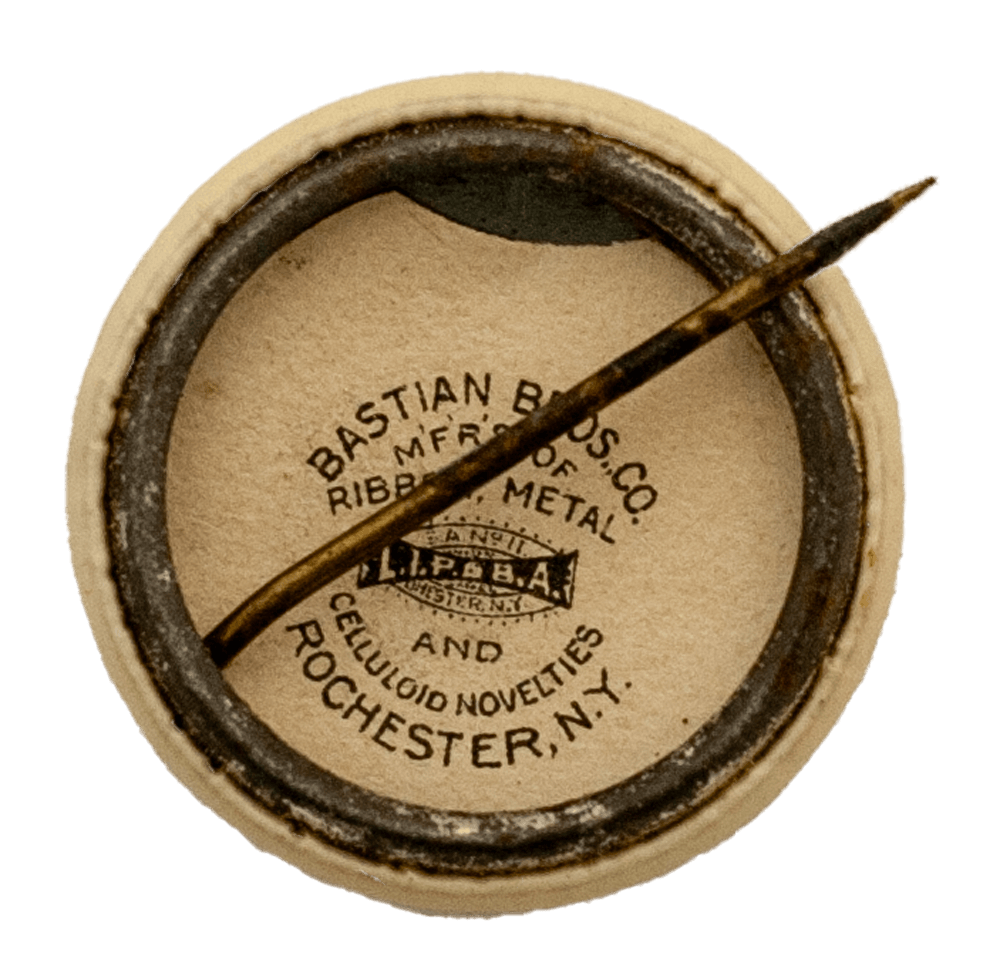 | 1907-1920 Type III | "•L•I•P•&•B•A•" is inscribed across the center of the union label. |
Image Coming Soon | 1908 Type IV | Use limited to 1908; includes a union label with the number "19" to the right. |
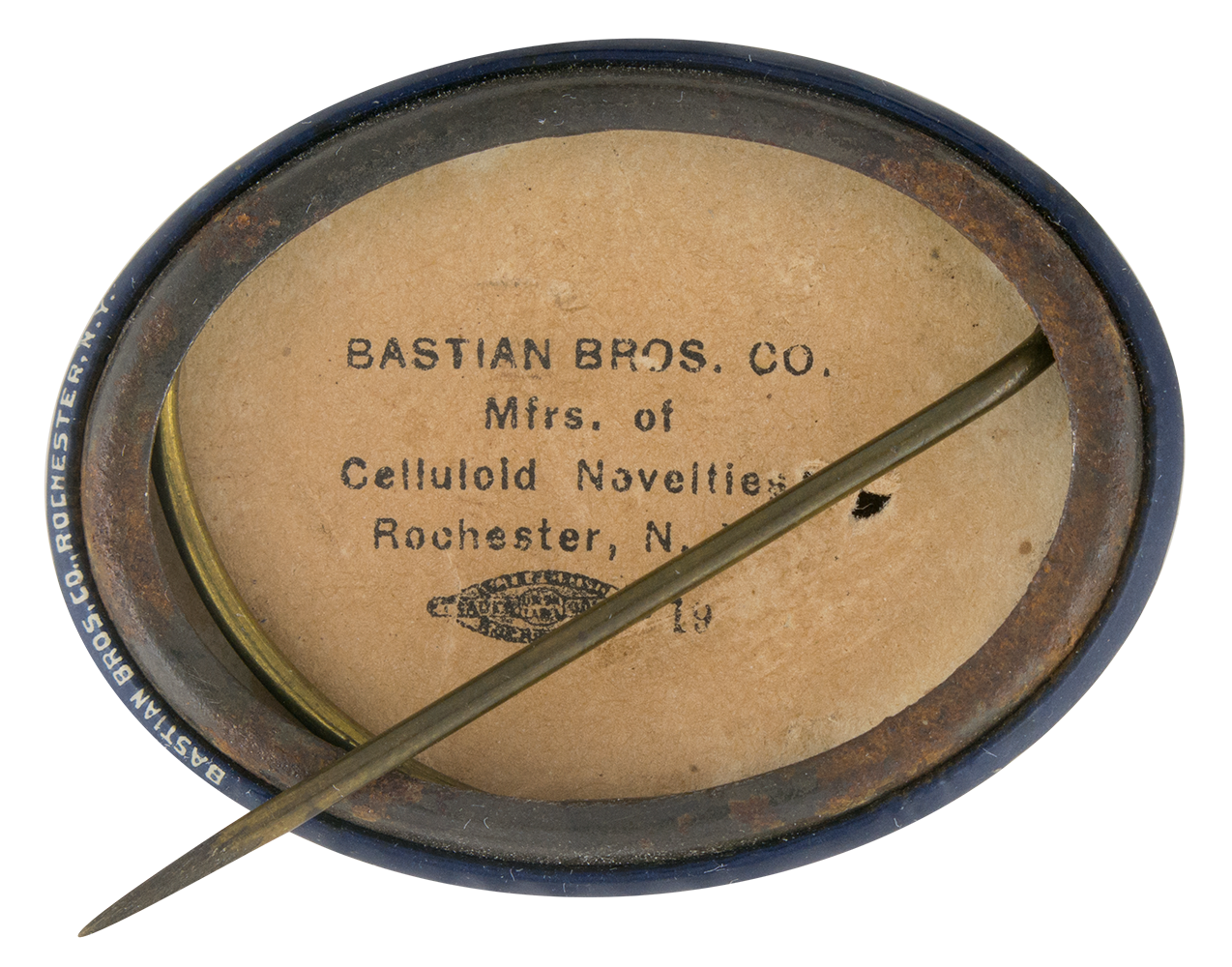 | 1913-1916 Type V | Similar to Type IV and includes a union label with the number "19" to the right. |
 | 1920-1946 Type VI | "AMALGAMATED LITHOGRAPHERS OF AMERICA" appears at the center of the union label. |
 | 1916-1940s Type VII | No Paper Beginning in 1916, Bastian eliminated the button paper from most of the 7/8" inch buttons and replaced it with a design stamped directly into the metal back. The design features crossed tongs and a tin snip. The words "UNION LABEL" are across the center with "B.B.C.O." above and "ROCH. N.Y." below. |
 | 1939-1941 Type VIII | Lithographed Tin Very few lithographed tin buttons carry the Bastian Bros. name. The only examples found are from 1939-1941 and feature a repeating design printed on the reverse. There are three union imprints. One pictures crossed tongs and a pair of tin snips; the second is inscribed "TRADES COUNCIL;" the third is inscribed at the center "AMALGAMATED LITHOGRAPHERS OF AMERICA." The words "BASTIAN BROS. CO./ROCHESTER, N.Y./MADE IN U.S.A." also appear. |
Keystone Badge Co. (Reading, PA)
All Button Sizes | ||
|---|---|---|
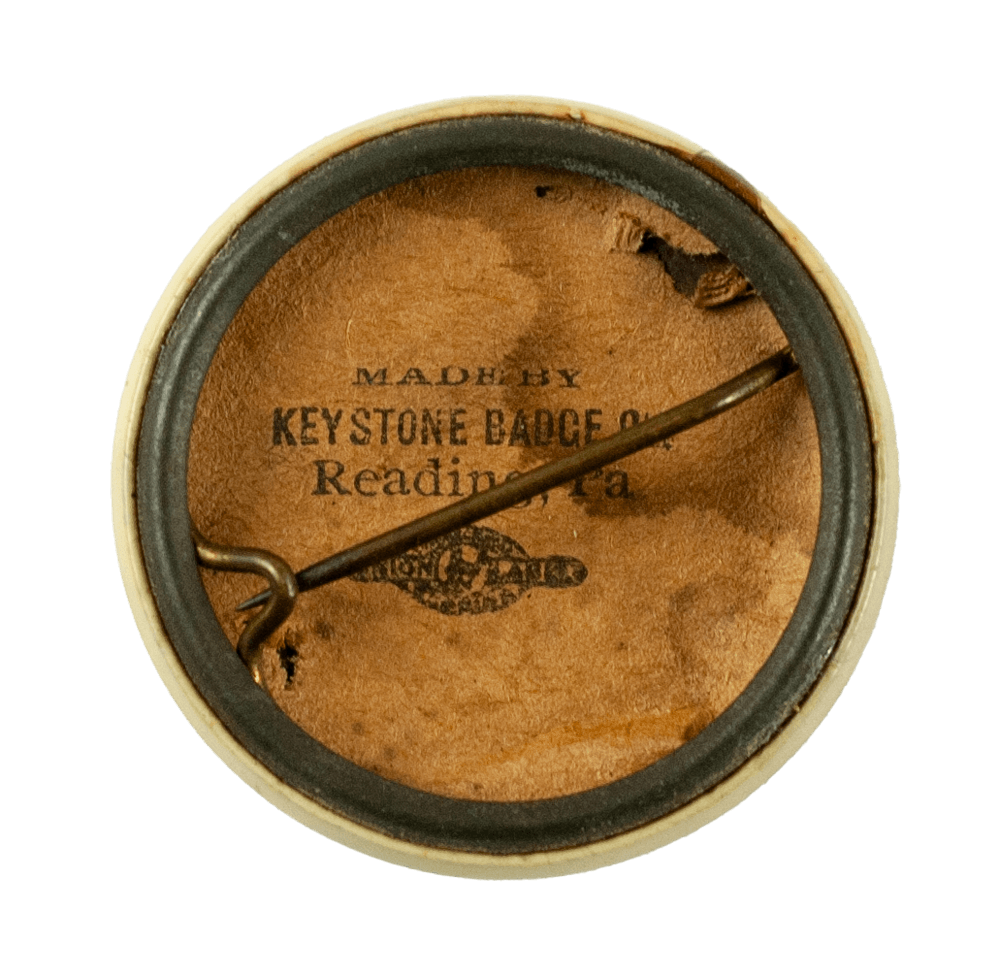 | 1902-1914 Type I | The union label imprint is prominent and says "UNION LABEL" on horizontal line |
Image Coming Soon | 1915-1936 Type II | A keystone trademark is prominent and the union label is very small. The label says "TRADES COUNCIL" on a horizontal line. |
Western Badge and Novelty Co. (St. Paul, MN)
All Button Sizes (with variations as noted) | ||
|---|---|---|
Image Coming Soon | 1903-1911 Type I | A number "27" is to the right of the union label. |
Image Coming Soon | 1910-1911 Type II | A number "54" is to the right of the union label. |
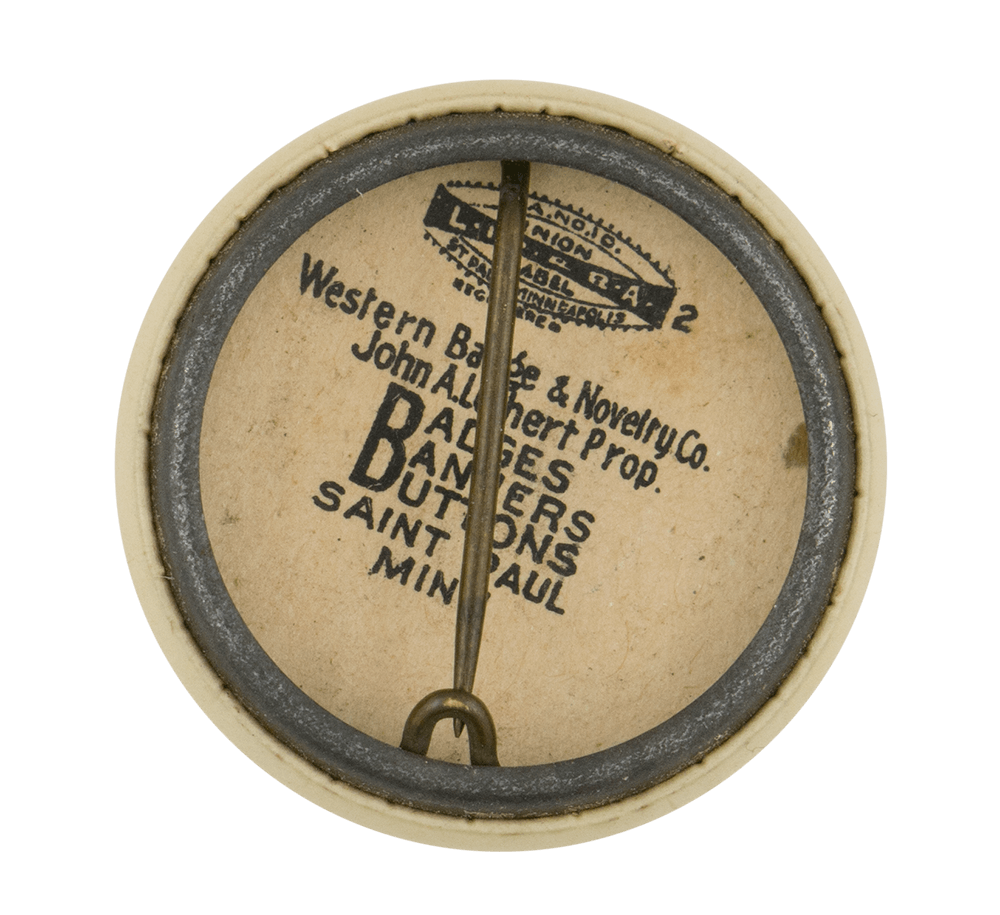 | 1915-1916 Type III | "•L•I•P•&•B•A•" is inscribed across the center of the union label. |
Image Coming Soon | 1921-1935 Type IV | A large letter "B" and larger letter "S" begin and end the slogan "BADGES/BANNERS/BUTTONS." A union label and number "27" also appear which are similar to the imprint used on the earliest papers (but on those papers, there is no large letter "S"). |
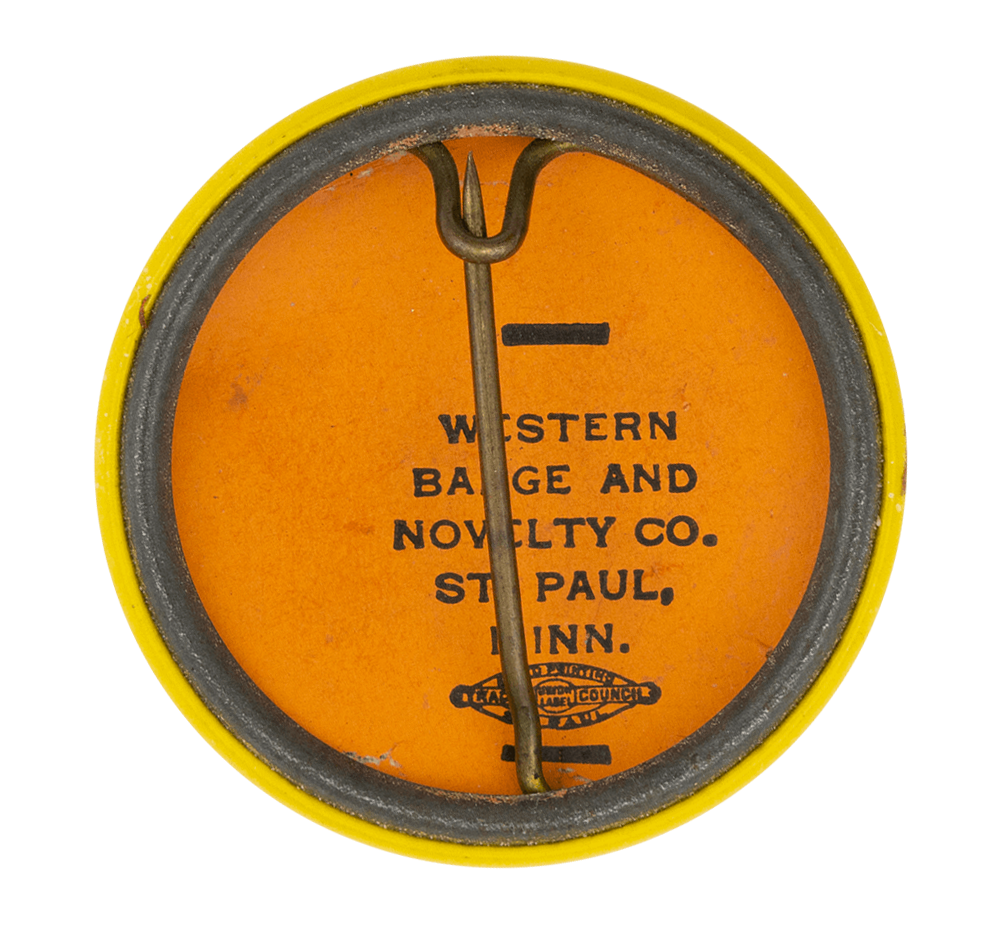 | 1924-1957 Type V | Black bars are above and below the company name, city, state, and union label. |
C.J. Bainbridge Badges and Buttons (Syracuse, NY)
All Button Sizes | ||
|---|---|---|
Image Coming Soon | 1907-1910 Type I | The initials "C.J." are used |
Image Coming Soon | 1910-1941 Type II | The name "Bainbridge" is used without initials. |
Donnoly Colt (New Jersey; Connecticut)
- 1975-1984: Buttons have a New Jersey address or a "201" area code
- 1985 or newer: Buttons have a Connecticut address
Green Duck (Chicago, IL)
Color can be used to date Green Duck litho buttons. John Vargo's hypothesis relates to the presidential campaign buttons from 1928-1944 to '44. In each of the campaign years 1928 through 1940, the backs had a similar circular logo with the image of a duck in the center. The major difference was in the color of the background on which they were printed.
Walter N. Brunt Co. (San Francisco, CA)
The following is an excerpt from the article "A Study of Western Button Manufacturers" by Benny Brandvold, originally published in 2017 on his website Montana and Presidential Election Memorabilia. Note that this was written as a blog post, and some references to online auctions are outdated.
We will start with California the largest western state and home to a number of button manufacturers responsible for many great pinbacks. The most prolific and well known California button maker was the Walter N. Brunt Company of San Francisco. The earliest reference I could find of the company’s operation is a patent application to produce “badges” in 1894. The company relocated on many occasions and the date of a pin’s production can be inferred by the address cited on the pin’s back paper (see list below). The first address on celluloids is 535 Clay St. which changed to 535-537 Clay St. in 1901 and then again in 1904 when they moved to 102-104 2nd St. The great earthquake and fire destroyed that building in 1906 and they reopened at a “temporary” location at 391 Jesse St. in 1907 and relocated to 860 Mission St in 1909. They remained there until 1910 when their address changed to 878-880 Mission St, though I have only seen backpapers with the 880 address. The style of the backpaper changed from simple printing (see photo of 860 backpaper) to the modern design (see 880 and 7th St photos) in approximately 1916. From 1919 to 1921 they used a 766 Mission address. 111 7th St. was then their business address through the remainder of their production.
The latest pinbacks I am aware of at this address are from the 1940 election. Sadly, this research proved that one of my early acquisitions, a “unique” photo pin of McKinley, must have been a commemorative item because it carries a 860 Mission back paper which would indicate a production date after 1909. A very rare gold TR rebus pin carries an 880 Mission paper which would suggest a 1911 or later manufacture despite a younger photo. There is a TR pin in his rough rider uniform on ebay which carries a 766 Mission backpaper implying distribution between 1919 an 1921; it may have used repinned papers for a later event or they may have purchased "new old stock" and put their papers over the Whitehead and Hoag papers
usually associated with this item–I would love the opportunity to check for myself. An enigma in attribution is the Harding “West Coast Tour” pin which is frequently ascribed to Brunt. The vast majority I have seen (including a sizable hoard) are usually devoid of backpaper. The ones I have seen with Brunt papers carry the 880 Mission address suggesting they continued to use papers after relocating until the supply was exhausted. I have also seen one of these pins with a Donaldson back paper. They were a San Francisco company which produced some labor pins in the early 1920’s but I have not seen any other presidentials with their label.
Brunt Addresses and Dates of Operation:
- Prior to 1901: 535 Clay St.
- 1901-1904: 535-537 Clay St.
- 1905-1906: 102-104 2nd. St.
- 1907-1909: 391 Jessie St.
- 1909-1910: 860 Mission St.
- 1910-1919: 878 or 880 Mission St.
- 1919-1921: 766 Mission St.
- Post 1921: 111 7th St.


