

| Category | |
|---|---|
| Additional Images |

|
| Sub Categories | |
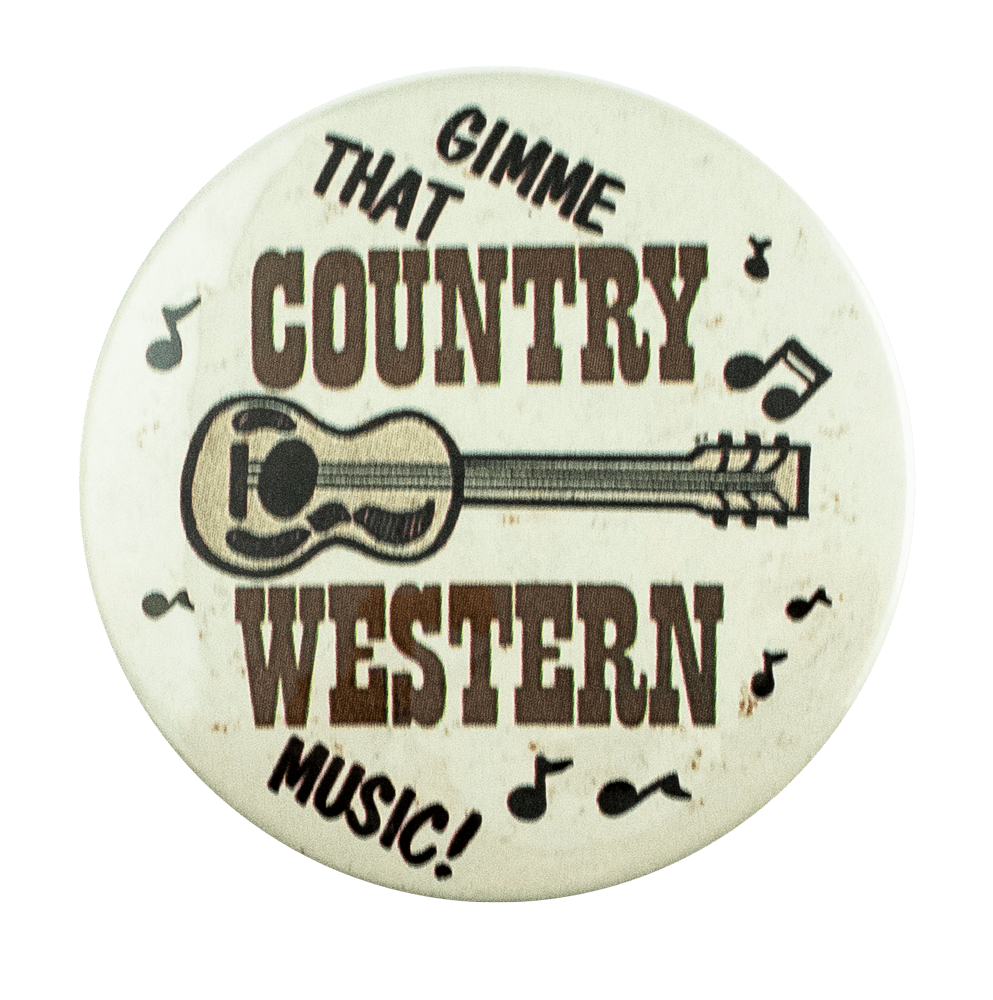
| Text on Button | GIMME THAT COUNTRY WESTERN MUSIC! |
| Image Description | Illustration of a brown acoustic guitar and black musical notes on a white background with black and brown text |
| Back Paper / Back Info |
BADGE-A-MINT LASALLE ILLINOIS |
| Back Style | |
| The Shape | |
| The Size | |
| Additional Information | The term “Country Western” arose in the mid-twentieth century as a replacement for a derogatory label that was often used to stereotype people of Appalachian or more rural descent. “Country” is generally understood to refer to rural folk music of the southeastern United States, with roots in African and African American songs and instrumentation, as well as Anglo-American ballads. “Western,” by comparison, drew far more influence from cowboy songs, frontier themes, and swing music associated with the American West. Although different in their imagery and regional emphasis, both styles shared elements of storytelling, string instrumentation, and dance rhythms. With the advent of the Grand Ole Opry radio program in the 1920s, both styles saw a rapid rise in popularity. While this success eventually led to their being combined into the single genre of “Country,” the term “Country Western” has persisted as a cultural motif in all manner of memorabilia. |
| Sources |
Birthplace of Country Music Museum. “‘Both Kinds of Music’: Country and Western.” Accessed February 13, 2026. https://birthplaceofcountrymusic.org/both-kinds-of-music/ Library of Congress. “Country Music Timeline.” In Dolly Parton and the Roots of Country Music. Accessed February 13, 2026. https://www.loc.gov/collections/dolly-parton-and-the-roots-of-country-m… |
| Catalog ID | IB0916 |