
A Brief History, Including the Invention of the Pin-Back Button
(Excerpt from Button Power: 125 Years of Saying It with Buttons by Christen Carter and Ted Hake)
After the Civil War, the pace of urbanization and industrialization quickened in the eastern United States while settlement of the vast western lands accelerated as the wagon train and, later, the transcontinental railroad came into use. By 1890, during what Mark Twain described as the Gilded Age, the United States’ population exceeded sixty million, roughly one-fifth of today’s total. US industrial production and per capita income exceeded that of all other nations. However, not all was rosy: the Panic of 1893 set off a depression that affected business owners, workers, and farmers nationwide. This downturn framed the backdrop to the bitterly contested presidential election of 1896, pitting Democratic nominee William Jennings Bryan against the Republican nominee, William McKinley.
At this auspicious moment, a Newark, New Jersey, advertising specialty manufacturer invented the pin-back button in the form that has survived for more than a century. With incredible efficiency, Whitehead & Hoag Co. introduced the pin-back nationwide in 1896 and quickly achieved the capacity to produce one million buttons per day. Button fever swept the nation and created a legion of first-generation button collectors.
The Founders
Benjamin S. Whitehead was born in Newark, New Jersey, on January 24, 1858, the son of Edmond B. and Elizabeth Whitehead. His family’s roots in the United States predated the Revolution. His father was a deputy collector in the Internal Revenue Service under Presidents Lincoln, Grant, and Garfield. By age twelve, Whitehead had decided to become a printer and spent time in Newark schools, the Cooper Union in New York City, and the New Jersey Business College. By age fifteen, he ran a modest printing business and achieved early success with an exhibition of his printing samples at the 1876 Centennial Exhibition in Philadelphia, apparently produced on a steam press in his parents’ home on Arlington Street.
Whitehead’s first listing as a printer appeared in the 1878–79 Newark Directory. In 1882, Whitehead married Fanny M. Thompson, and they had one son, Ray, and one daughter, Helen. Around this time, Whitehead moved his business from his parents’ home and opened a new print shop with Benjamin Clark at 96 Market Street in Newark under the name Whitehead and Clark. By 1888, their directory entry read “book, job printer’s [sic], badgemakers,” and the business had moved to 167 Halsey Street. Badgemaking referred to printing inscriptions on silk ribbons to be worn by means of a pin or stickpin; these decorations were popular with political candidates, volunteer fire departments, and fraternal lodges.
Whitehead was a Republican. His personal interests were wide, and his participation in public affairs extensive. He was a trustee of the Centenary Methodist Church and a member, president, or trustee of many other clubs, organizations, and businesses. Still, he found time to travel throughout the United States and to twenty-two other countries, all the while taking photos and recording ideas about novelties that his plant could produce. Whitehead enjoyed music, but his primary hobby was fishing. He collected more than two thousand rods and reels and spent his summers developing an estate on Whitehead’s Island, Maine, and at Kezar Lake near Lovell, Maine. In 1903, twelve advertising specialty firms decided to form an industry trade association named the National Association of Advertising Novelty Manufacturers, with Whitehead as the first president. The group continues today as Promotional Products Association International. Benjamin S. Whitehead died at age eighty-two on April 16, 1940.
Chester R. Hoag was born November 28, 1860, in Wellsboro, Pennsylvania. His formal education ended with grammar school, but he was a voracious reader. Hoag arrived in Newark in 1882 looking for work. Soon he was traversing Essex County on a high-wheel bicycle, selling paper and twine for a distributor who paid him eight dollars per week. Hoag made his first appearance in the Newark Directory with a partner, Charles Harrison, in 1886, listed as Harrison & Hoag, suppliers of paper and twine.
Coincidentally, the firm of Harrison & Hoag was just a few doors down the street from Whitehead and Clark, and it appears that this is how Whitehead and Hoag first met and became friends. By 1892, talk of a partnership became reality, and on March 8, the Whitehead & Hoag Co. was incorporated, with fifty thousand dollars authorized in capital stock. Charles Harrison continued in the paper and twine business, but Newark Directory listings for Benjamin Clark cease.
Hoag married Clara L. Osborne, a descendant of a Newark founding family, in 1896. He was very active in establishing the vocational school system in Essex County, was an elder in the Presbyterian Church, and served as a president of the Newark Museum, where he produced a 1928 exhibition Medals Made in Newark. The museum still holds many medals made by W&H and donated by Hoag. Like his partner, Hoag loved the outdoors, particularly shooting and fishing, and he traveled the states and abroad to enjoy his hobbies. He had a summer home at Clayton, New York, where he kept several speedboats. After a long illness, Hoag died of a heart ailment on February 28, 1935. Hoag and his wife had a daughter and four sons, with one son, Philip, serving as company president until he died in 1953.
The Company
W&H’s first business location in 1892 was in a third-floor loft at 167 Market Street, Newark. They soon moved to 163 Washington Street and expanded further to 161 Washington Street, with additional space on the intersecting Warren Street. Their chief product from 1892 to 1893 was the ribbon badge, but their 1894 Newark Directory ad included a reference to “celluloid badges.” These were not yet pin-back buttons but lapel studs consisting of a thin, clear celluloid sheet over a printed paper held in a 3/4-inch-diameter silvered metal circular frame with a slightly extending smaller circle of metal on the reverse, meant to be inserted into a jacket or shirt button hole.
After spending two decades constantly acquiring additional office and manufacturing space at their Washington and Warren Street locations, in March 1910 W&H announced plans to move the business from the city center to the city outskirts by purchasing a large land tract, formerly used as circus grounds, at the intersection of Sussex Avenue and First Street. In 1913, W&H moved into a new five-floor, 125,000- square-foot concrete building with a frontage of 260 feet on Sussex Street and 475 feet on First Street. This factory was a complete printing and lithography plant, with over fifty modern presses, a large art and photo engraving plant in which sketches and plates were made, a button making plant with a capacity exceeding one million buttons per day, and a machin- ery plant that produced in-house all the needed tools, dies, and special machinery. While the Washington and Warren Street buildings fell victim to urban renewal, the 272 Sussex Street building remains standing, although divided into rental storage units.
Button Patents
W&H, which eventually claimed that it could produce over five thousand advertising specialty products, constantly made submissions to the US Patent and Trademark Office. Three patents are most relevant to their 1896 introduction of the pin-back button. A December 3, 1893, patent was filed by Amanda M. Lougee of Boston. W&H apparently purchased rights to this patent to protect their other claims, although the patent was for a cloth and metal clothing button. The second patent, filed December 6, 1895, estab- lished the reverse design of celluloid-covered pin-back buttons. Issued as a “jewelry” patent to George B. Adams (Adams was a Newark jewelry manufacturer who patented forty-nine different novelty articles), assignor to W&H, it specified “a shell with a marginal rim to form a chamber and contain a continuous piece of wire with both a holding portion and a free end lying in the same plane.” The third patent was filed March 23, 1896, and issued July 21, 1896, again to Adams. Although W&H was making pin-back buttons prior to July 21, 1896 (the earliest dated button we know of is for an Indiana State Medical Society annual meeting May 28–29, 1896, in Fort Wayne), we view this as the pin-back button’s symbolic birthday. Six claims were made, each varying slightly, with Claim 1 reading:
In a badge pin or button, in combination, with a shell having a marginal rim or bead, a covering bearing an inscription, design, emblem, or the like, over said shell and having its edges turned down over said marginal rim, a ring or collet in said shell placed over the edge of said covering to hold or secure the latter in position, and a bar or pin having one of its ends bent to form a holding portion adapted to be secured in said ring or collet, substantially as and for the purposes set forth.
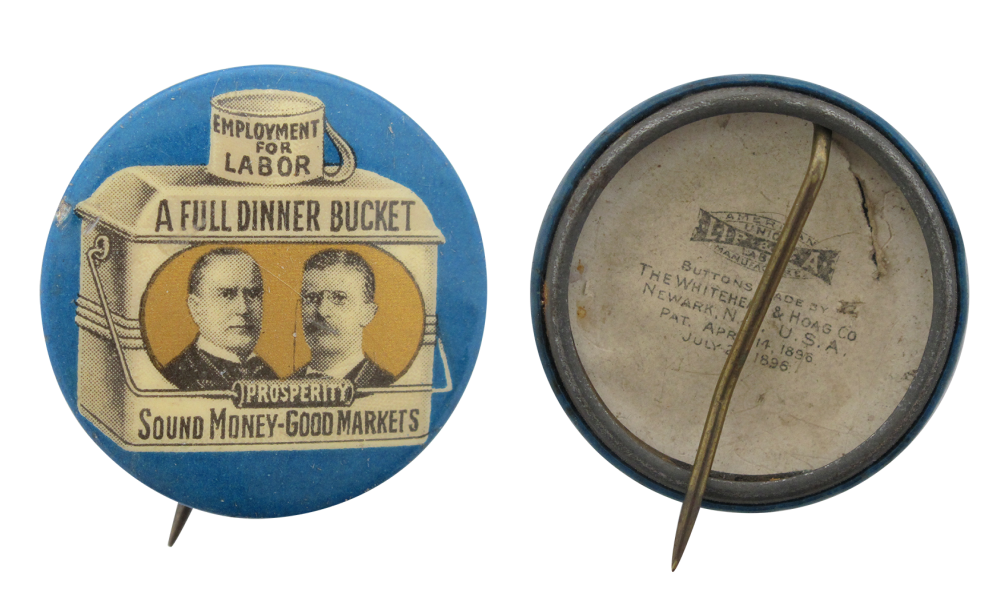
In other words, W&H succeeded in producing a low- cost, wearable, and visually appealing mass-produced novelty. The pin-back button consisted of a clear sheet of celluloid over a printed circular paper with a metal backing. The reverse edges of the celluloid and paper were secured by a circular metal ring and worn by means of a brass wire pin inserted into the open reverse, with a pointed end for attachment to a fabric garment or hat.
The Button Department
W&H immediately became the world’s largest button manufacturer, a title it held until its patents expired and the small printing press was developed. The immediate success of the button was astonishing. It debuted just a few months prior to the 1896 pres- idential nominating conventions and November’s Election Day; W&H created over two thousand distinct button designs for McKinley and Bryan. Meanwhile, the company landed its first gigantic order from the American Tobacco Company to produce millions of buttons for insertion into product packages. It also made the first product advertising buttons for nation- al firms and brands such as Heinz Baked Beans, King Arthur Flour, Wilbur’s Cocoa, and Gold Medal Flour.
Button making, while quite mechanized, still required the insertion of the brass pin and W&H’s pro- motional back paper into the button’s open reverse by hand. The company solved the problem by offering payment for the work to children and families living around the factory. Thus, every day after school, children would come to the factory to pick up a box of buttons, pins, and back papers.
More and more advertisers and organizations felt compelled to have their own buttons. The subsequent presidential elections saw no diminishment of variety or quantity of buttons, and local candidates for every office found buttons the ideal medium to spread their messages. The high-quality color lithographic print- ing of this era distinguishes 1896 to 1912 as a distinct golden age of the button.
Branch Offices
The button’s success naturally led to company ex- pansion. By 1899, W&H had established sales offices in Baltimore, Boston, Buffalo, Chicago, Cincinnati, Detroit, New York, Philadelphia, and Pittsburgh. Outside the United States, offices were established in Buenos Aires, London, Melbourne, and Toronto. While all production took place in Newark, the branch offices were supplied with sample buttons to show potential customers. They also received from the Newark office a list of conventions being held in each city. The branch office salesmen, working on commission, would follow these leads and contact local businesses, churches, fraternal organizations, and political parties to solicit orders.
Post-World War I
In 1919, on the heels of World War I, a major reorga- nization took place at W&H. Benjamin Whitehead left the presidency and became chairman of the board. At the same time, W&H became a nonunion company.
Beginning in 1900, W&H back papers for buttons of all sizes carried the “Union Label” symbol of the Allied Printing Trades Council, Newark, New Jersey. While no longer a union plant after 1919, the company did not remove that symbol from their back papers until the end of 1929.
W&H began to experience increasing competition from other button making firms. Some paid to license their patents, but others created their own innova- tions in the button’s construction to avoid paying W&H a licensing fee. Most important was the perfec- tion of the process to make buttons solely from lithographed tin, prompted by the government’s pub- lic relations effort to inspire patriotism and promote Liberty Loan bond sales during World War I. This type of button simply required printing repeating designs directly on a flat metal sheet. The design was then stamped out in the button shape, with a curved reverse edge capable of holding the spring pin. This eliminated the printed paper, the celluloid overlay, and the reverse collet, at a great savings of time, materials, and money. The result was a much nar- rower range of colors and a surface with paint that easily chipped and scratched. However, the process was ideal for many purposes, and while celluloid- covered buttons were clearly the higher-quality product, their use significantly decreased.
World War II
While World War II saw restrictions placed on the use of many metals, the button was largely exempted because of its usefulness in boosting home front patriotism, production, and morale. However, at W&H in Newark, normal button production ended, with few exceptions. Instead, using the material “Duroplastic,” W&H launched into producing the millions upon millions of employee-identification buttons required by state and federal law. At the war’s peak, W&H employed four hundred workers to produce these ID badges.
Sale to Bastian Brothers
Several factors led to W&H’s decline by the late 1950s. The company had a long history of having a few very successful years followed by several years of operat- ing at a loss. When Philip Hoag, Chester’s son, died in 1953, no family member remained on the board or in a policymaking role. And (surprisingly, for a com- pany that should have understood advertising) W&H refused to advertise any other place than on their own products.
In March 1959, W&H announced its upcoming sale. Bastian Brothers in Rochester, New York, was the firm’s logical successor. Bastian was founded in 1895 and had been a longtime rival of W&H. As a union company, Bastian could not compete with W&H prices; like many other agents and jobbers, it would buy parts from and subcontract some of its work to W&H. The W&H factory closed in May 1959, and Bastian’s president came to Newark to order its sale. Unusable machinery, dies, and tools were scrapped, and the W&H records of every item the company ever made were ordered destroyed. Most of the re- maining branch salesmen became Bastian employees. Bastian continued to use W&H’s name, eventually phasing it out by 1965.
Buttons in the museum manufactured by Whitehead & Hoag Company