We're On Line
| Category | |
|---|---|
| Additional Images |
|
| Sub Categories | |
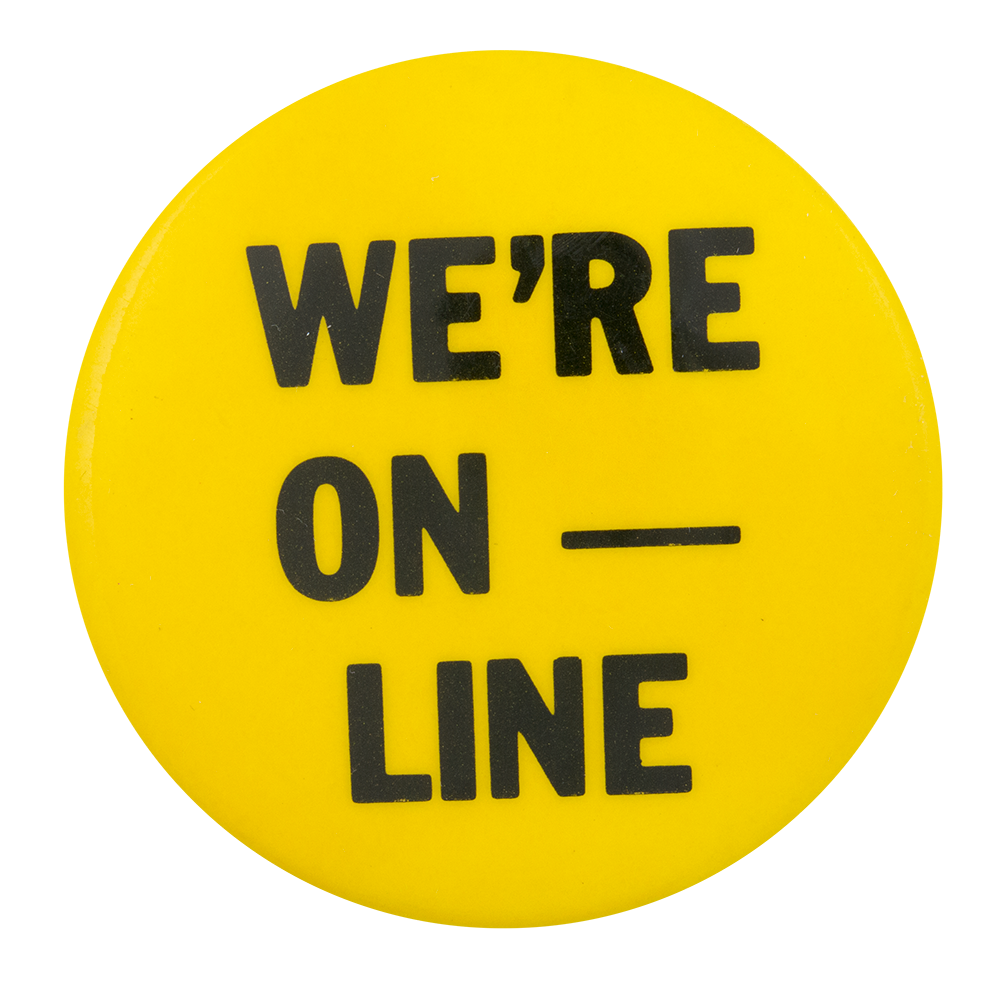
| Text on Button | WE'RE ON - LINE |
| Image Description | Black text on a yellow background |
| Back Style | |
| The Shape | |
| The Size | |
| Additional Information | |
| Catalog ID | CA0438 |

| Category | |
|---|---|
| Additional Images |
|
| Sub Categories | |
| Text on Button | WE'RE ON - LINE |
| Image Description | Black text on a yellow background |
| Back Style | |
| The Shape | |
| The Size | |
| Additional Information | |
| Catalog ID | CA0438 |

| Category | |
|---|---|
| Additional Images |
|
| Sub Categories | |
| Text on Button | PUT A BUFFALO IN YOUR LIBRARY |
| Image Description | Illustration of a buffalo with red and black text above and below on a white background |
| Back Paper / Back Info |
MADE IN U.S.A. |
| Back Style | |
| The Shape | |
| The Size | |
| Additional Information | This button refers to SUNY Buffalo’s Library and Information Science program, which began in 1972. The "Put a Buffalo in Your Library" theme was developed by Gerald Shields as a way to garner interest in recent graduates among potential employers. This slogan was also the title of a special publication that listed all the year’s graduates with their resumes. |
| Catalog ID | CA0437 |
| Category | |
|---|---|
| Additional Images |
|
| Sub Categories | |
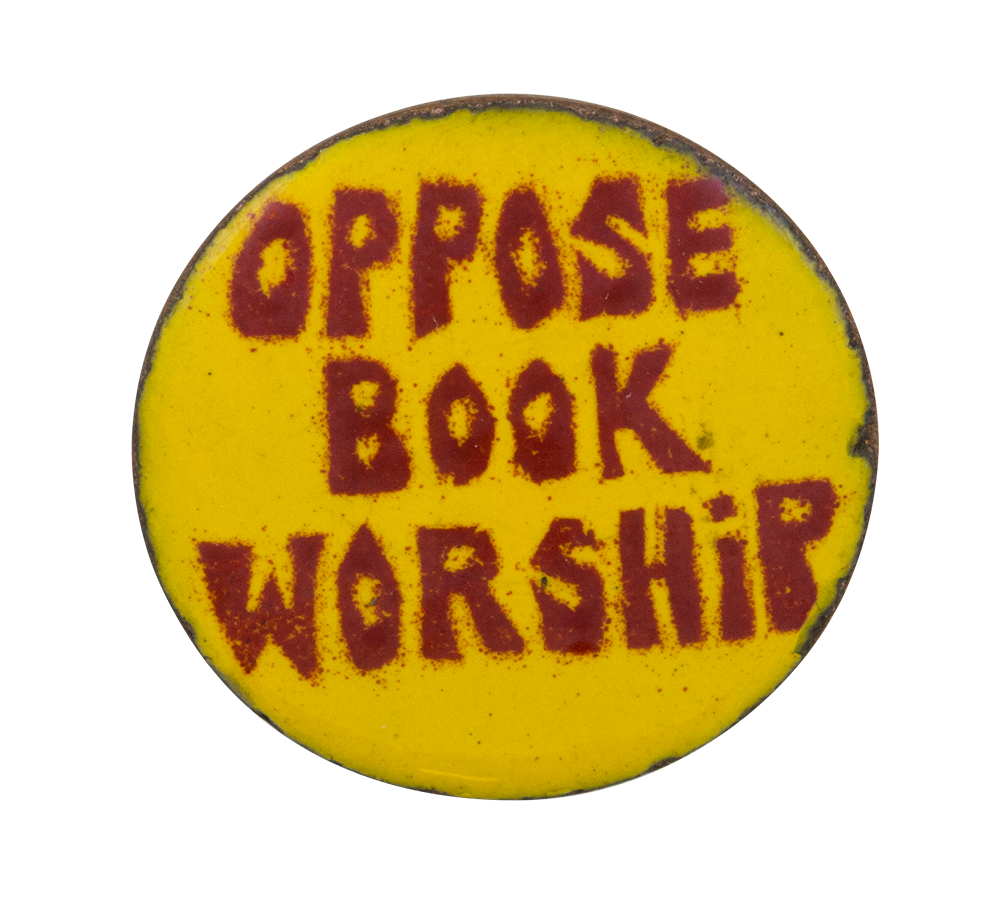
| Text on Button | OPPOSE BOOK WORSHIP |
| Image Description | Red text on a yellow background |
| Back Style | |
| The Shape | |
| The Size | |
| Additional Information | “Oppose Book Worship” refers to one of the articles written by Mao Tse-tung. Mao Tse-tung was a Chinese communist revolutionary and the founding father of the People’s Republic of China. He was a Chinese Marxist theorist, who led his nation’s Cultural Revolution. Mao Tse-tung wrote about the Revolutionary Civil Wars, the war against Japan, the Socialist Revolution, and other topics that interested him. Among these articles was his “Oppose Book Worship.” The article was written in 1930, and was to oppose dogmatism in the Red Army. The term dogmatism, at the time, was not used and instead they used the term “bookworship”. Mao Tse-tung uses the term “bookworship” to criticize those who believe that whatever is written in a book is right. |
| Catalog ID | CA0436 |
| Category | |
|---|---|
| Additional Images |

|
| Sub Categories | |
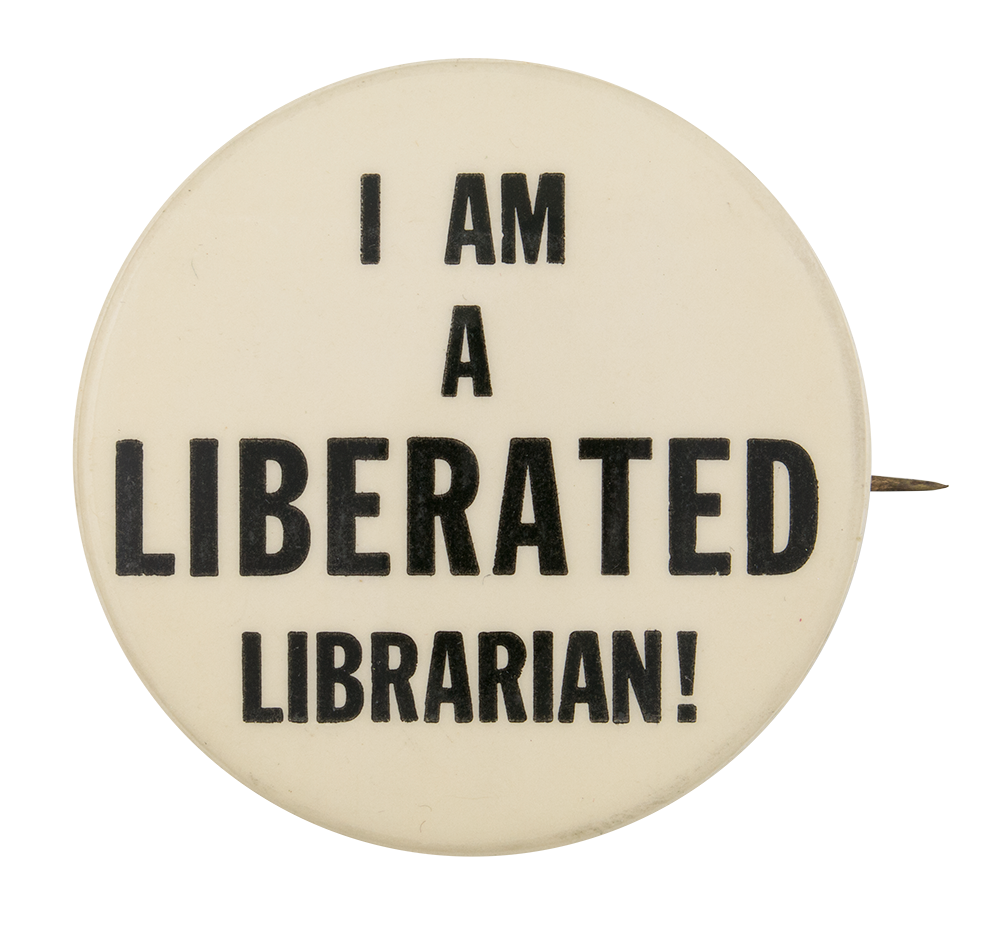
| Text on Button | I AM A LIBERATED LIBRARIAN! |
| Image Description | Black text on a white background |
| Back Style | |
| The Shape | |
| The Size | |
| Additional Information | The “liberated librarian” is a modern storytelling trope which can be applied to both men and women. If the character in question is a woman, she starts as naïve/repressed but discovers her sense of self either with the help of a man, or in the face of adventure and adversity. According to Reel Librarians, this character’s evolution is also illustrated through a change in wardrobe (away from conservative and restrictive clothing) and physical appearance (becoming more attractive). If the character is a man, he is often seen as a failure in the beginning of the story, who resorted to the profession for lack of other options. He eventually faces an outside attack or force to spur on liberation from his rut. For both sexes, the character is often young, though sometimes middle-aged, and often leave the profession at the end of the story, thanks to their newfound liberation. Off the screen, the liberated librarian represents a concerted effort to break from the cultural stereotypes; away from the image of the shushing, cardigan-wearing, tight-laced librarian to a more realistic view of the profession. This movement saw a boost in the early 2000s as the number of library jobs increased, but new entrants to the field remained constant. A more dynamic and engaging representation of librarians and libraries was not only a more accurate view of the modern landscape but would help encourage more interest in the industry. The liberated librarian can also refer to a movement beginning in the 1970s to deconstruct the gendered stereotypes that can be associated with the profession and the general imbalance of gender along the library’s leadership spectrum. Such efforts became more formalized in 1970 with the creation of the American Library Association’s Feminist Task Force. |
| Sources |
“Character Types.” Reel Librarians, May 4, 2019. https://reel-librarians.com/rolecall/charactertypes/#liberatedlibrarian. Ilett, Rosie. "Different for Girls? Feminism, Health Information and Librarianship." Health Information and Libraries Journal 19, no. 1 (2002): 33-41. Marvel, Bill. "Librarians are getting liberated - Not staid, they want to be free of stereotype." Seattle Times, The (WA), June 16, 2002: J1. NewsBank: Access World News. https://infoweb-newsbank-com.libezproxy2.syr.edu/apps/news/document-vie…. |
| Catalog ID | CA0435 |
| Category | |
|---|---|
| Additional Images |
|
| Sub Categories | |
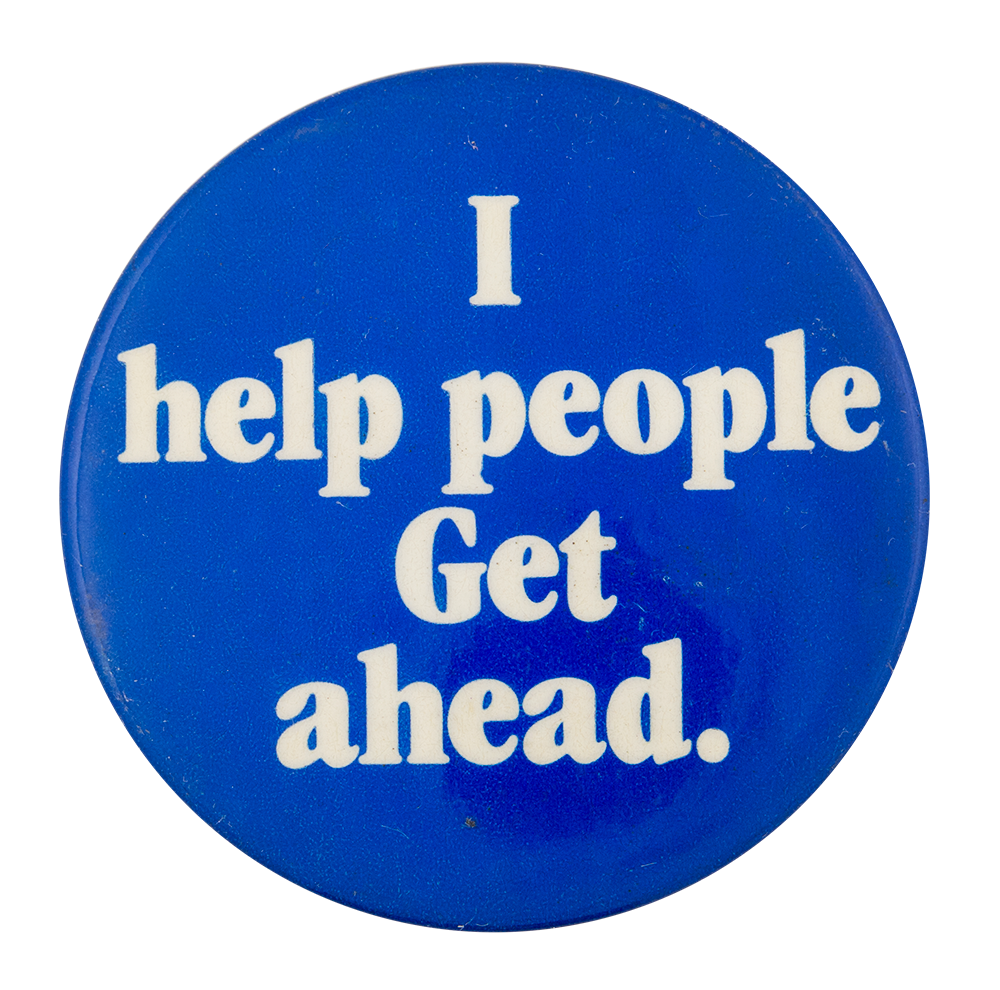
| Text on Button | I help people Get ahead. |
| Image Description | White text on a blue background |
| Back Style | |
| The Shape | |
| The Size | |
| Additional Information | Have info on this button? Contact us here. |
| Catalog ID | CA0434 |
| Additional Images |
|
|---|---|
| Sub Categories | |
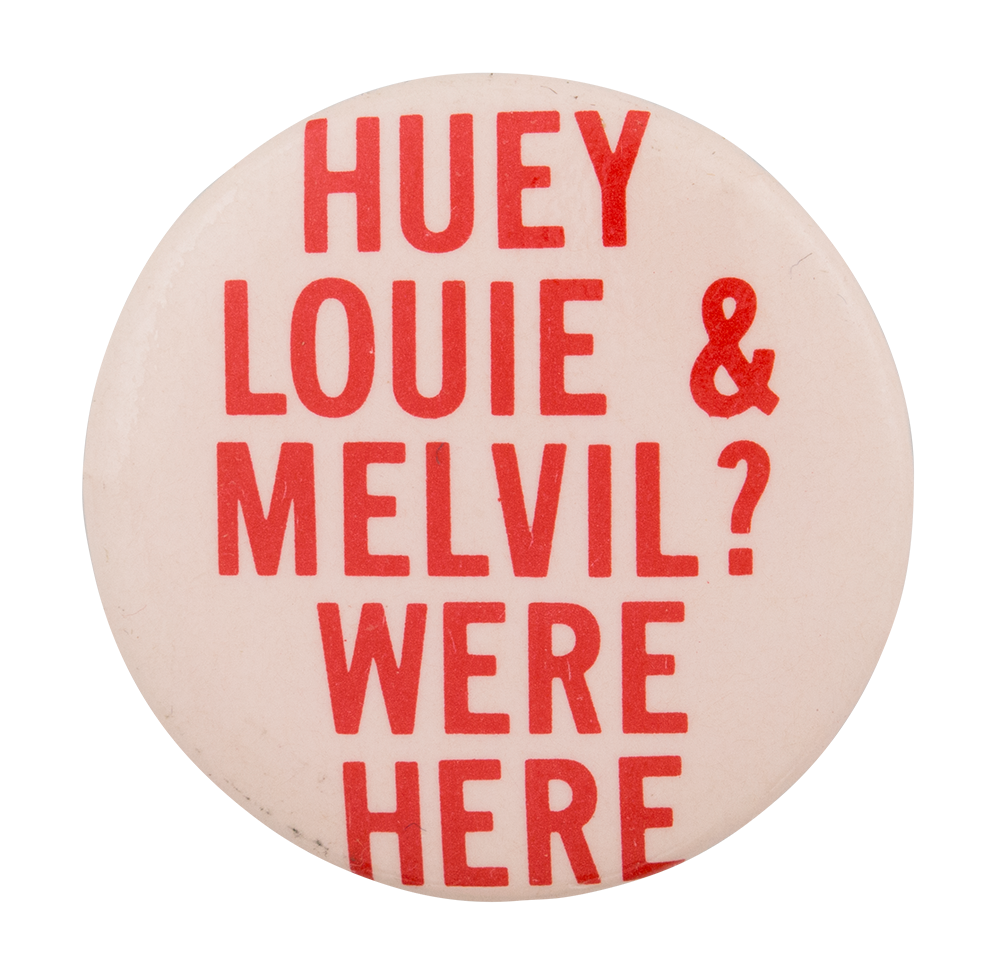
| Text on Button | HUEY LOUIE & MELVIL? WERE HERE |
| Image Description | Red text on a pink background |
| Back Style | |
| The Shape | |
| The Size | |
| Additional Information | “Huey, Louie, and Melvil?” is a wordplay on the names of Disney characters Huey, Dewey, and Louie - the nephews of Donald Duck. Dewey has been substituted for Melvil in reference to Melvil Dewey (1851 – 1931), the creator of the Dewey Decimal Classification (also known as the Dewey Decimal System). The Dewey Decimal System is the most widely used library classification scheme in the world. It uses a numbering system to divide books into basic classes organized by field of study. The Dewey Decimal System was developed in 1873 and continues to be used in libraries today. |
| Catalog ID | CA0433 |

| Category | |
|---|---|
| Additional Images |
|
| Sub Categories | |
| Text on Button | WE KNOW HOW |
| Image Description | Black text on a yellow background |
| Curl Text | HEWIG-MARVIC Brooklyn, N.Y. 11222 |
| Back Style | |
| The Shape | |
| The Size | |
| The Manufacturer | |
| Additional Information | |
| Catalog ID | CA0432 |

| Category | |
|---|---|
| Additional Images |
|
| Sub Categories | |
| Text on Button | YOU COULD PLAN A TRIP, BORROW A CLASSIC FILM, STAY IN SHAPE, GET FAST ANSWERS, TAKE RECORD ALBUMS HOME, ATTEND A CONCERT, SEE A PUPPET SHOW.... AT THE LIBRARY? At the library. |
| Image Description | Illustration of a peach colored bird with an orange beak and wearing an orange coat over a green shirt with two heads one on each out stretched wing on a rust background with white text bubbles above |
| Back Style | |
| The Shape | |
| The Size | |
| Year / Decade Made | |
| Additional Information | “Information power at the library? At the library.” was the theme of National Library Week in 1976. As part of the event, promotional materials such as this button were developed. Since 1958, National Library Week has been organized by the American Library Association to celebrate the role of libraries in society, recognize the work of librarians and promote library services. The event is held in April each year. |
| Catalog ID | CA0431 |
| Category | |
|---|---|
| Additional Images |

|
| Sub Categories | |
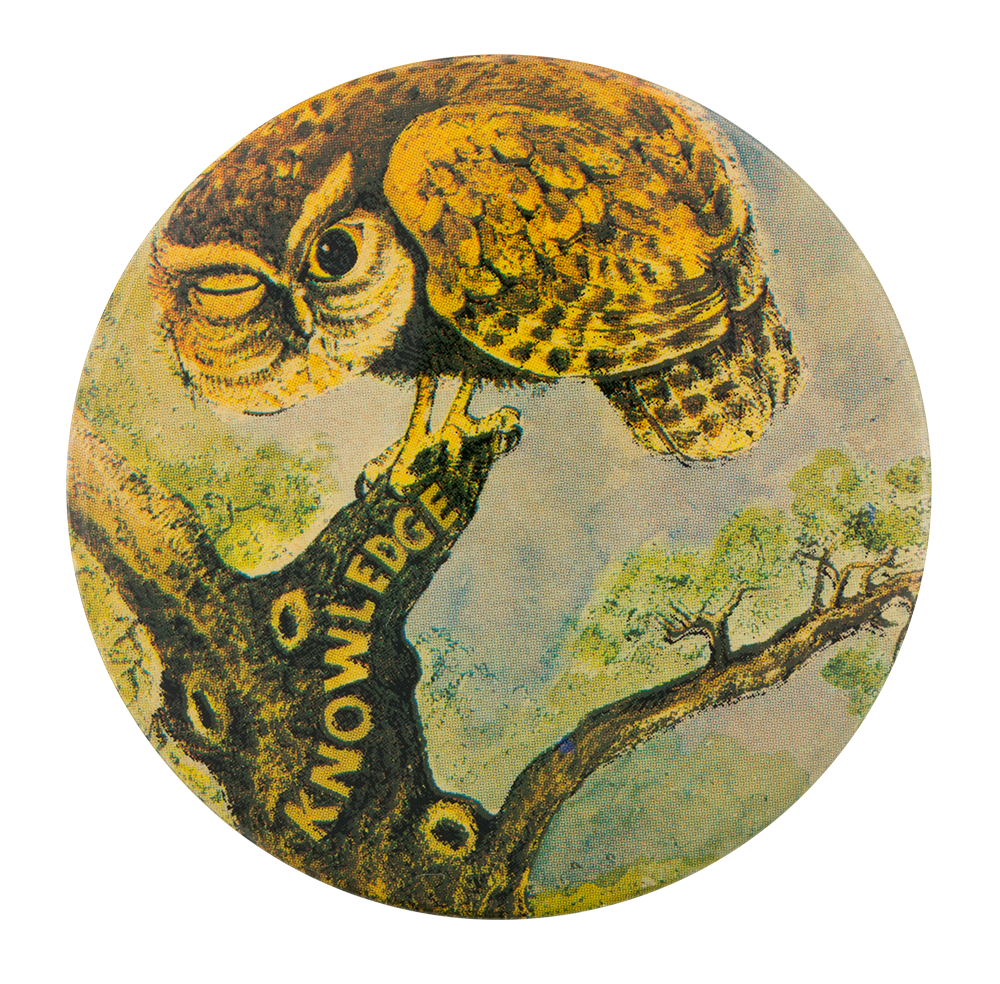
| Text on Button | KNOWLEDGE |
| Image Description | Illustration of an owl standing on top of a gree branch with yellow text on the tree trunk |
| Back Paper / Back Info |
PATRICK BROS MELBOURNE |
| Back Style | |
| The Shape | |
| The Size | |
| The Manufacturer | |
| Additional Information | Owls are associated with wisdom and knowledge. The owl appears in nursery stories, legends, and folk tales, and is seen as the wise old owl. Because of this, the image of the owl is used to represent knowledge, wisdom, intelligence, and other similar attributes. Because of the owls’ symbolism, it is used in education, libraries, and other places of knowledge. |
| Catalog ID | CA0430 |

| Category | |
|---|---|
| Additional Images |
|
| Sub Categories | |
| Text on Button | cacus goelach Leabharlainne |
| Image Description | Green text on a white background |
| Back Style | |
| The Shape | |
| The Size | |
| Additional Information | Have info on this button? Contact us here. |
| Catalog ID | CA0429 |