Stop The Squints with Electrohome

Category
Additional Images
Sub Categories
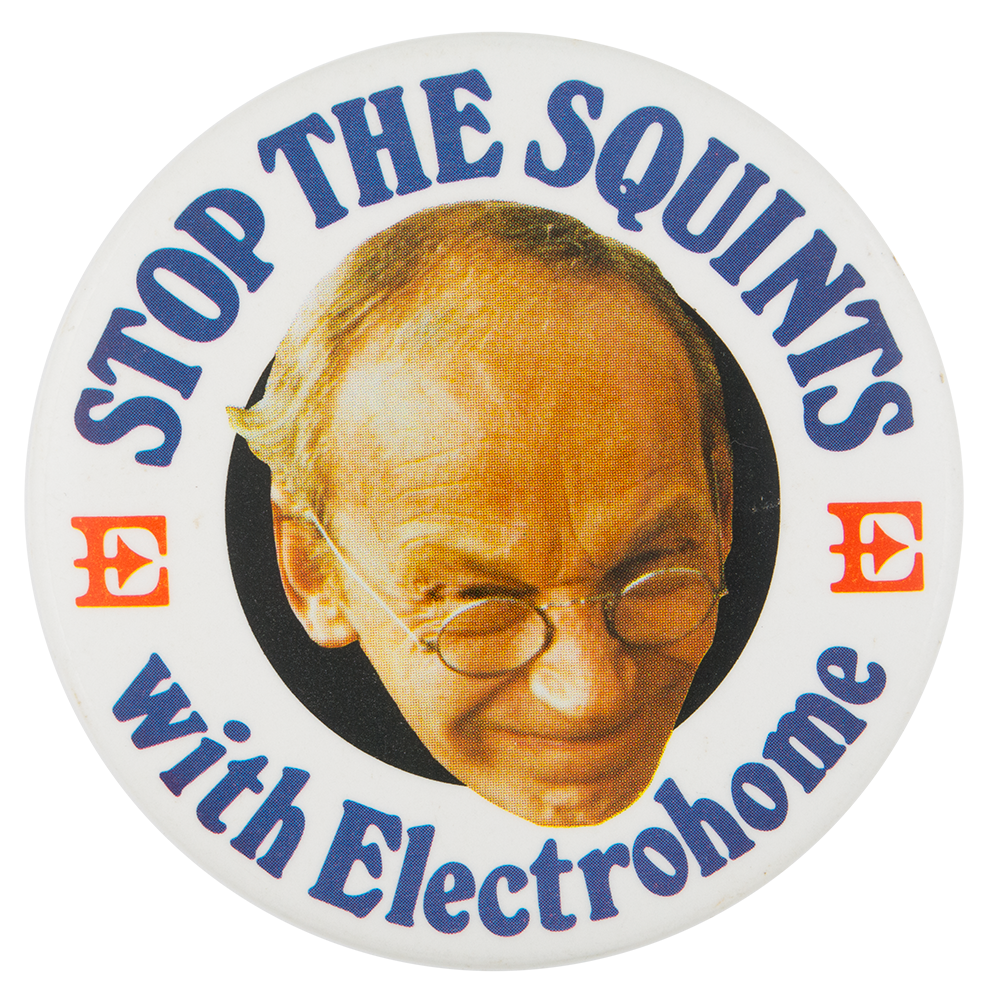
Text on Button STOP THE SQUINTS with Electrohome
Image Description

Photograph of a squinting older gentleman in the center of the button with blue text. Red logos on a white background.

Back Style
The Shape
The Size
Year / Decade Made
Additional Information

A 1987 Electrohome advertising campaign used imagery of people squinting to sell the Electrohome EDP-58XL Monochrome Computer Projection System. The ads promised it was a "real eye-opener" because of its higher resolution and other features that would make it easier to see what was being projected.

Catalog ID AD0277

Down With Pants

Category
Additional Images
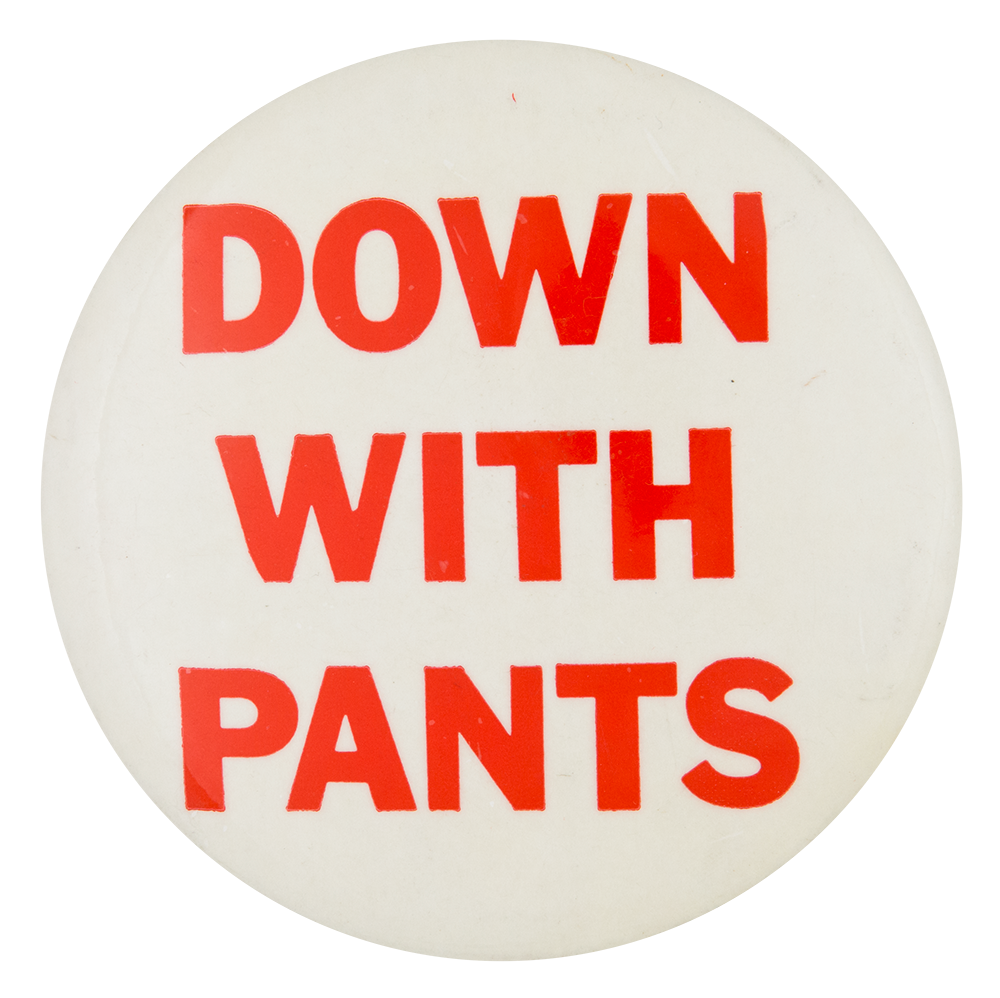
Text on Button DOWN WITH PANTS
Image Description

Red text on a white background. 

Back Paper / Back Info

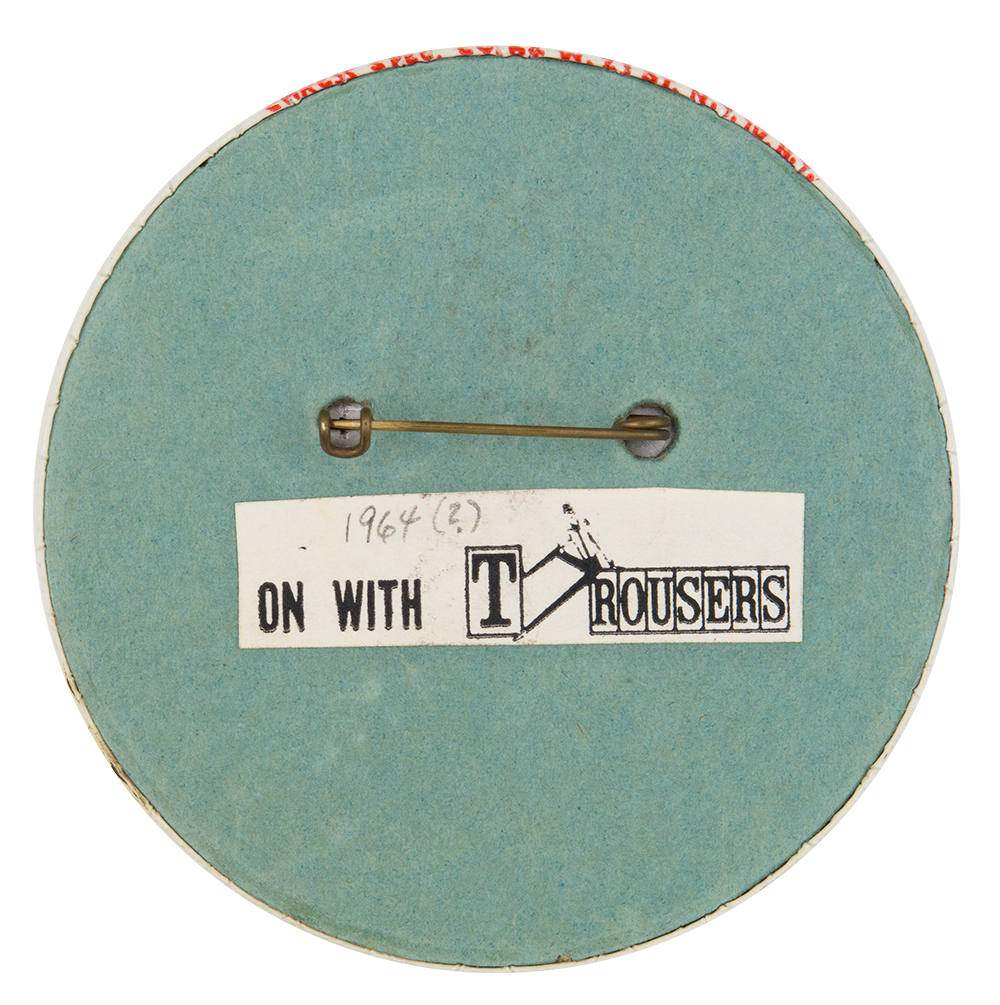
ON WITH TROUSERS

Curl Text EMRESS SPEC. 59.66 W. 23 ST. N.Y. 10 N.Y.
Back Style
The Shape
The Size
Year / Decade Made
The Manufacturer
Additional Information

In response to the cookie-cutter, conformist lifestyle of the 1950s, an emerging generation of post-war youth decided to turn American culture on its head. The 1960s and 1970s saw the counterculture unfold as new music, films, and recreational drugs helped shape the new era. Peace-loving hippies and the creative beats of The Beatles were all the rage at this time and helped fuel the counterculture movement. People were even famously urged to “turn on, tune in, and drop out” by psychologist Timothy Leary.

In addition to the hippie lifestyle, the counterculture was also characterized by the sexual revolution. Old behavioral codes related to sexuality saw a drastic change-up as more people were accepting of contraception, abortion, and public nudity. Though the United States generally condemns public nudity today, it fit the prevailing attitude of the 1960s that called for sexual liberation.

Humorous buttons related to free love and a host of other themes were manufactured by the Emress Specialty Company in the 1960s. The business was started a decade prior by New Yorker Emanuel “Manny” Ress in Atlantic City with the hopes of one day pinning his buttons on politicians.

Sources

Lardner, R. (1952, April 12). Alliteration is reputation. The New Yorker. https://www.newyorker.com/magazine/1952/04/19/alliteration-is-reputation

Queens man off to Atlantic City to push buttons (1964, August 25). New York Times. https://www.nytimes.com/1964/08/25/archives/queens-man-off-to-atlantic-…

Catalog ID HU0100

Dan McCarthy Ghost Buddies

Category
Additional Images
Sub Categories
Image Description

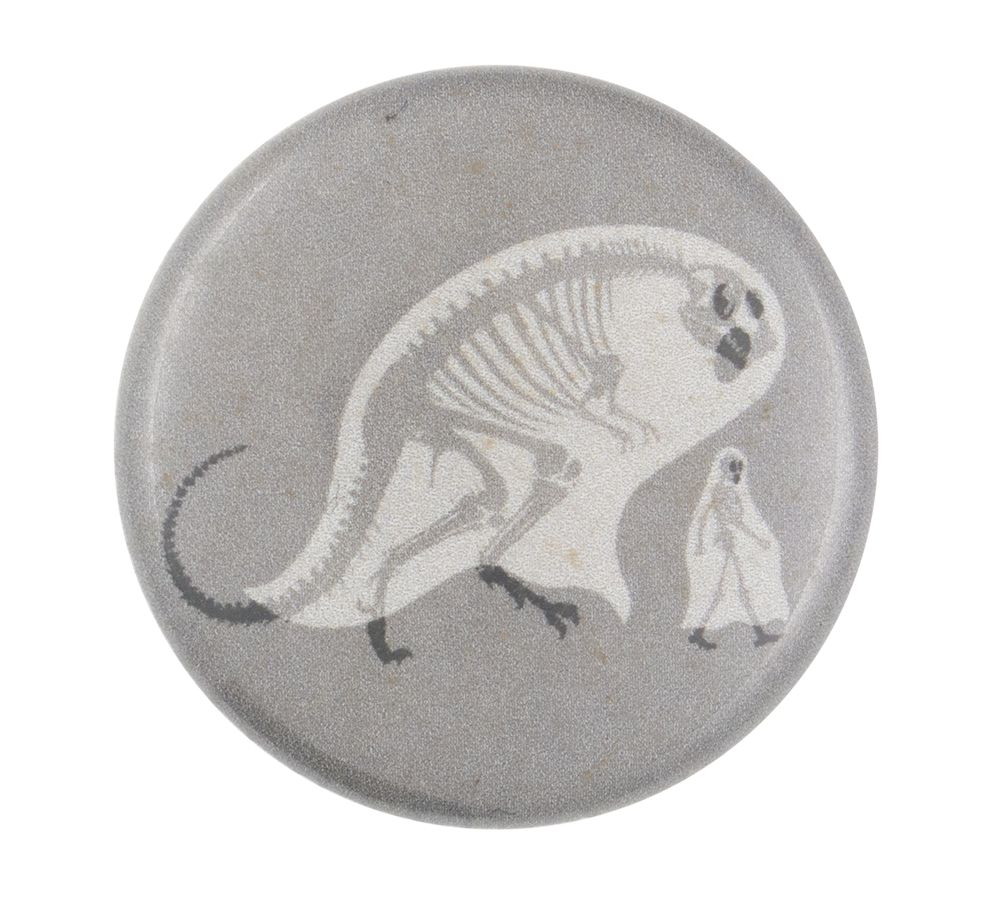
An illustration of the skeletons of a dinosaur walking behind a man facing the right. Both figures are dressed as white bed sheet ghosts. The skeletons are grey, and the dinosaur's tail and the feet of both figures are black. The background is grey.

Back Style
The Shape
The Size
Additional Information

Ghost Buddies is an illustration by Massachusetts based artist Dan McCarthy.  McCarthy is both a visual artist (working in design, screen printing, drawing, and painting) and a musician.

Catalog ID AR0119

Davidson's Prize Club

Category
Additional Images
Sub Categories
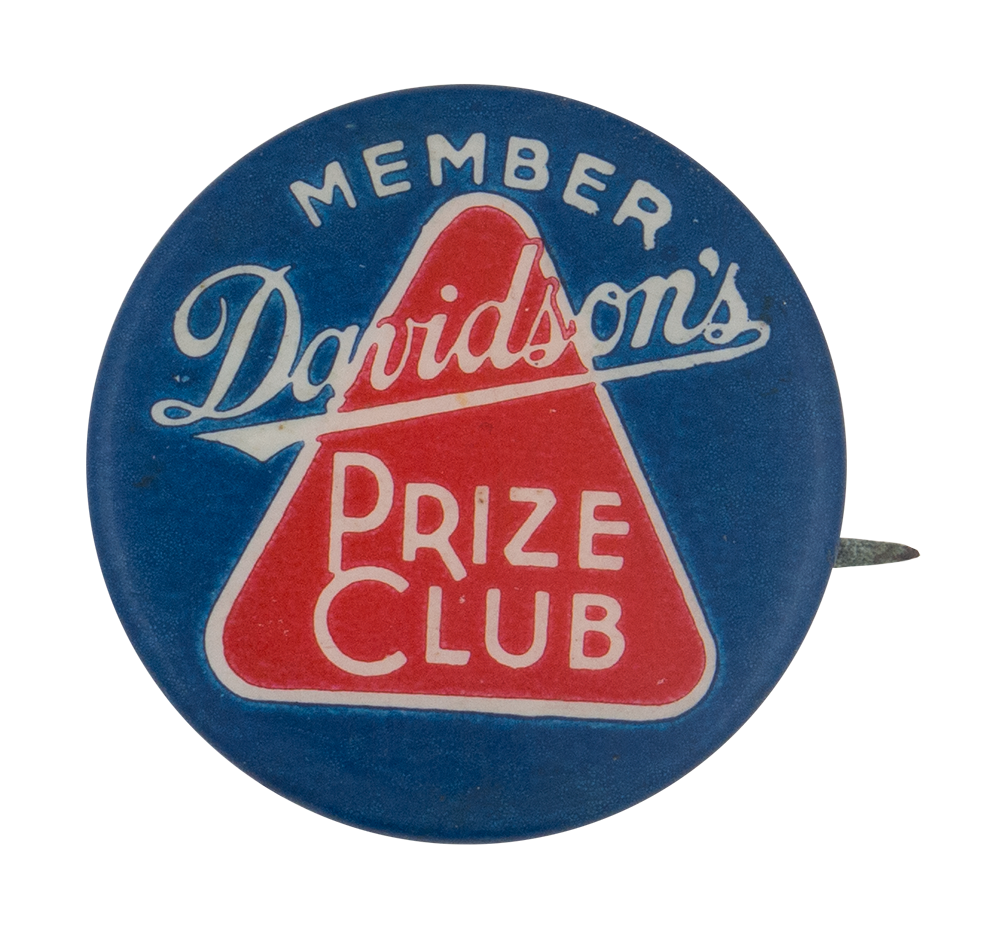
Text on Button MEMBER Davidson's PRIZE CLUB
Image Description

Red rounded cornered triangle with white text inside, white text over top and a white border on a blue background with white text across the top.

Back Style
The Shape
The Size
Additional Information

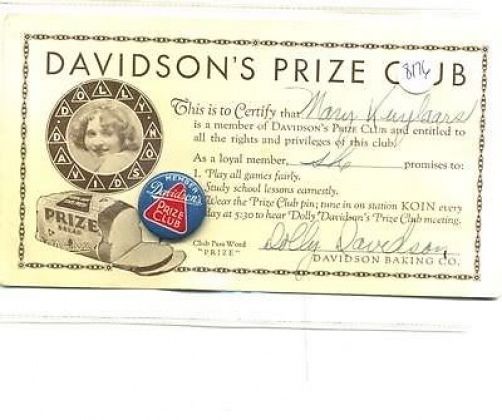
The Davidson’s Baking Company was founded in 1914 by Eugene F. Davidson and was one of the largest baking companies in the Northwest. The company’s first store was located in Portland, Oregon and their main product was “Liberty Bread” which was comprised of cornmeal, rye, rice, bran, whole wheat and white flour. The bread was comprised of so many ingredients because of the war and the conservation of wheat. This bread would later be known as Davidson’s Sunbeam Bread. The company marketed their bread with Little Miss Sunbeam and a corresponding national contest in which young girls would compete to locally represent the company. In 1964 the company was producing about six or seven loaves of bread per Oregonian (12.5 million loaves per year). The biggest competition for the Davidson’s Bakery was the other family owned Franz Bakery, inventor of the modern day hamburger bun.


Battistella, E. Davidson Baking Company (Sunbeam Bakery). The Oregon Encyclopedia. Retrieved from: http://www.oregonencyclopedia.org/entry/view/davidson_baking_company_sunbeam_bakery_/

Catalog ID CL0159

Cycle Trades Safety League

Category
Additional Images
Sub Categories
Text on Button Cycle Trades Safety League
Image Description

Red ring around outer edge of button with whitish yellow text. Inner circle has an illustration of a yellow bicycle on a gradient green to greenish white background.

Back Style
The Shape
The Size
Additional Information

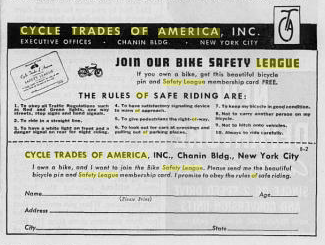
Cycle Trades of America (CTA) was founded in 1918 as a trade organization comprised of motorcycle and bicycle parts and accessory makers. Bicycle use in the United States had declined since its “Golden Age” in the 1890s and the CTA’s objective was to promote and publicize cycling. Headquartered in New York City, the CTA oversaw advertising, meetings, and trade shows. The organization was largely responsible for the successful marketing of cycling to boys through ad campaigns that emphasized independence, citizenship, and mobility. The CTA also promoted bicycle safety to address parents’ concerns that their children would be injured or killed by motorists. One of the programs it developed, the Cycle Trades Safety League, was heavily promoted in magazines such as Boys Life. In the ad pictured here from 1938, readers are offered a “beautiful bicycle pin and Safety League membership card FREE” for pledging to obey safety laws while cycling.

Sources

Cycle Trades of America [Advertisement]. (1938, October). Boys Life, 28(10), 31.

Herlihy, D. V. (2004). Bicycle: The history. New Haven: Yale University Press.

Catalog ID CL0130

Coal Cracker Booster Club

Category
Additional Images
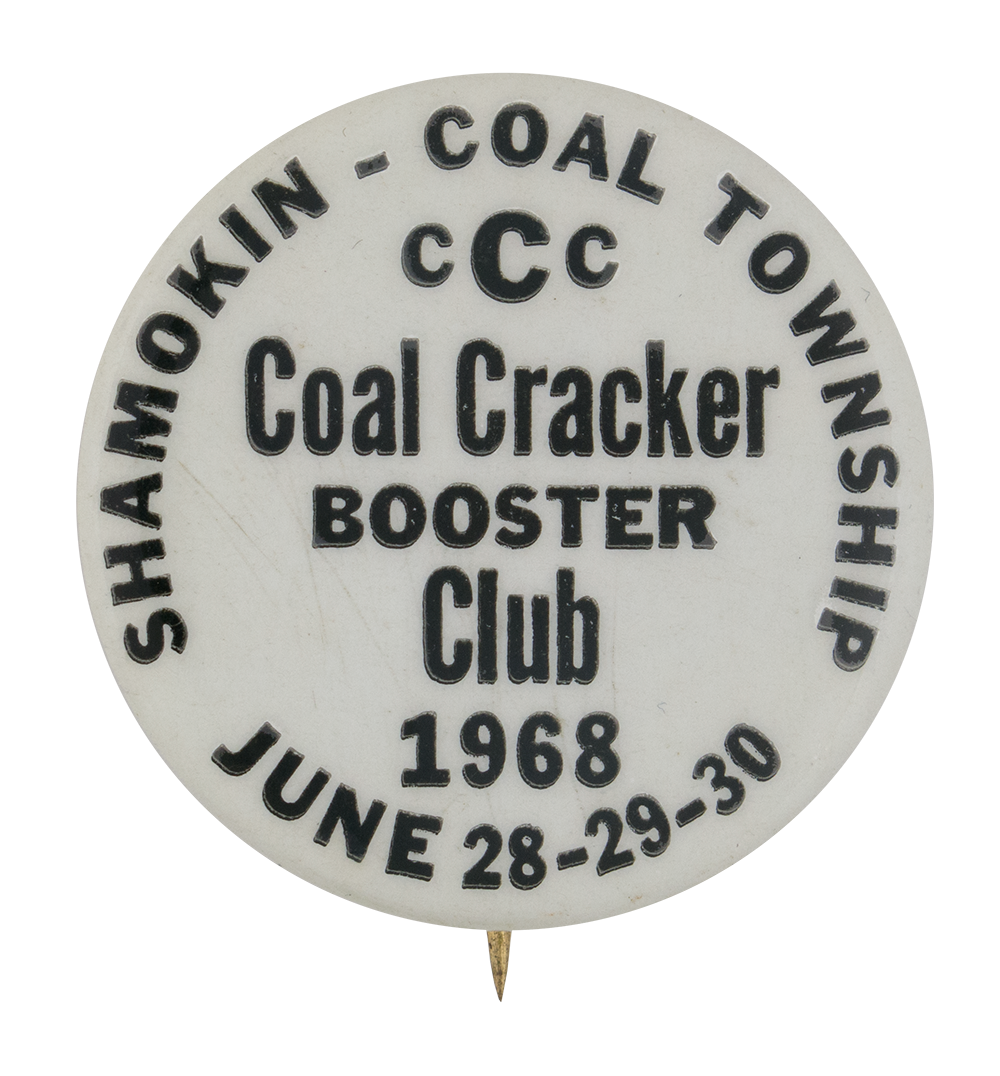
Text on Button cCc Coal Cracker BOOSTER Club 1968 SHAMOKIN- COAL TOWNSHIP JUNE 28-29-30
Image Description

Black text on white background. 

Back Style
The Shape
The Size
Year / Decade Made
Additional Information

This button was sold as part of a fundraiser/promotion for an event hosted by the Coal Cracker Booster Club (CCC). The Coal Cracker Booster Club was designed to be a group of civic-minded individuals who were devoted to continuing the annual observance of the role anthracite coal played in the development of the Shamokin area. Students/alumni of Shamokin high school are called 'Coal Crackers' and the name is a common colloquial for residents. Shamokin, PA (founded 1864) and its sister community, Coal Township, PA were founded and functioned as coal mining towns fo rmuch of their existence. Shamokin was made famous for the huge rush of Anthracite coal mining it felt early on,  the novel "Muder at Hickory Ridge" and, having the 'world's largest man-man mountain' - the Glen Burn Colliery Cameron Culm Bank.

The CCC involved event on June, 28th, 29th, and 30th (as seen on the button) was the annual 'Anthracite Days' which started as a one day event in 1964. The 1968 'Anthracite Days' featured street dancing, the Anthratones Barbershop Chorus, a huge celebratory parade, a fireworks display, a performance by the Holy Cross High School Band, and much more!

Catalog ID CL0153

Basil Wolverton Clock Watcher

Category
Additional Images
Sub Categories
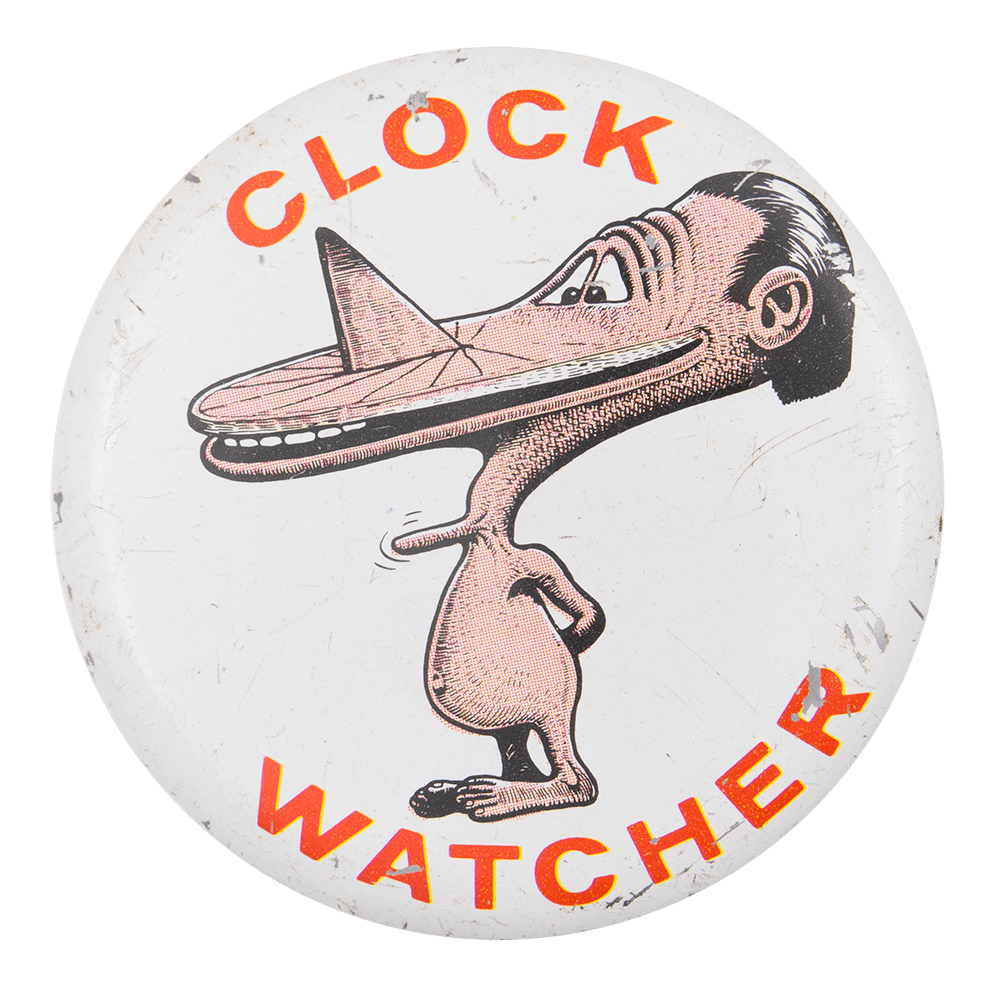
Text on Button CLOCK WATCHER
Image Description

Illustration of a person with a sun dial shaped face, with red text above and below on a white background.

Curl Text Made in Japan
Back Style
The Shape
The Size
Year / Decade Made
Additional Information

The 1965 series of LEAF "Fink Buttons" were illustrated by popular Mid-Century artist Basil Wolverton. Perhaps best known for his work at MAD Magazine, Basil Wolverton (July 9, 1909 – December 31, 1978) was an American cartoonist and illustrator famous for his humorously grotesque drawings. Wolverton worked in the "Golden Age" of comic books doing features like "Powerhouse Pepper" and "Spacehawk" in the 1940s. A 2009 New York Times article states that Wolverton’s drawings embodied the “sick-and-proud humor” of MAD magazine and were considered a “virtuoso exercise in bad taste, made all the weirder for being so meticulously executed."

Catalog ID AR0075

Cleveland Animal Protective League

Category
Additional Images
Sub Categories
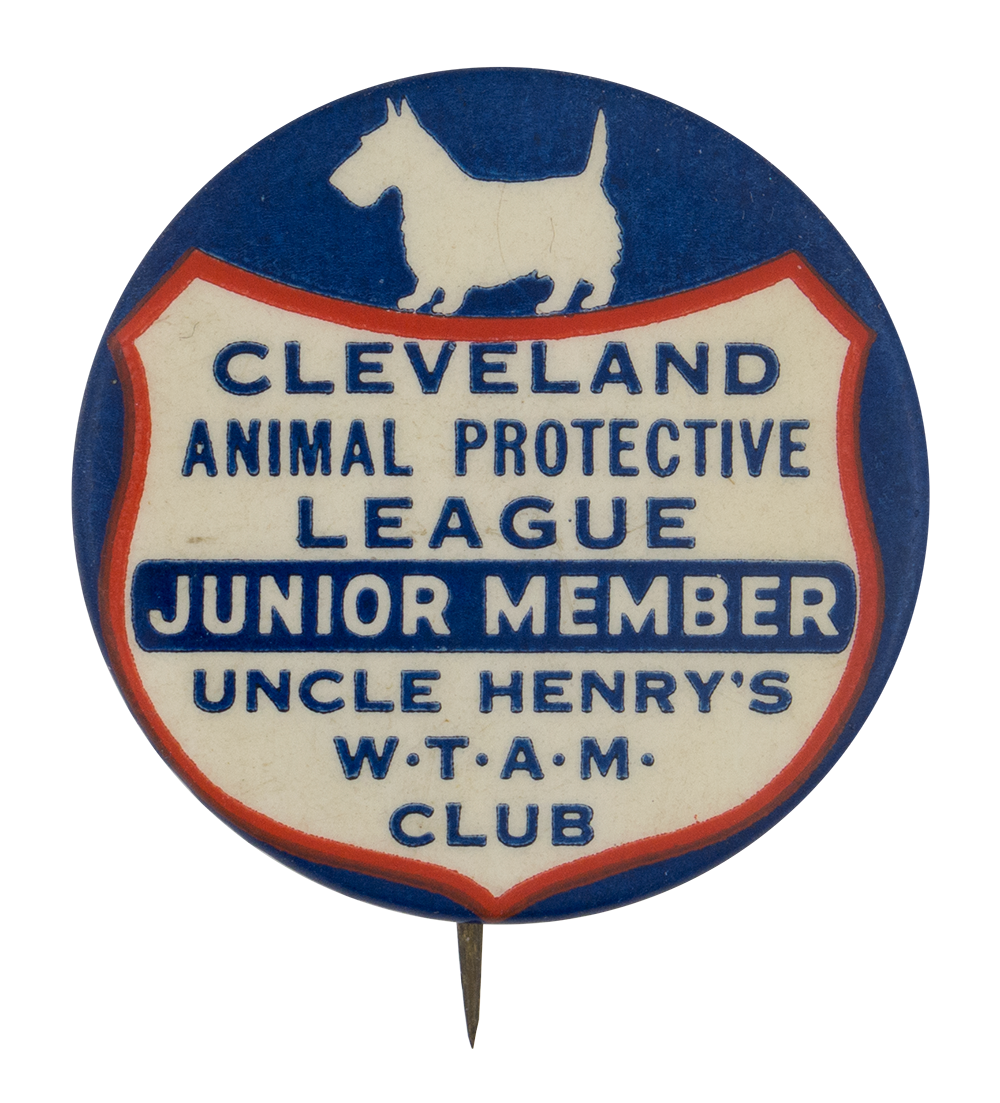
Text on Button CLEVELAND ANIMAL PROTECTIVE LEAGUE JUNIOR MEMBER UNCLE HENRY'S W.T.A.M. CLUB
Image Description

Blue background with a white shield with red outline and a white silhouette of a dog above it. There is blue text inside the white shield.

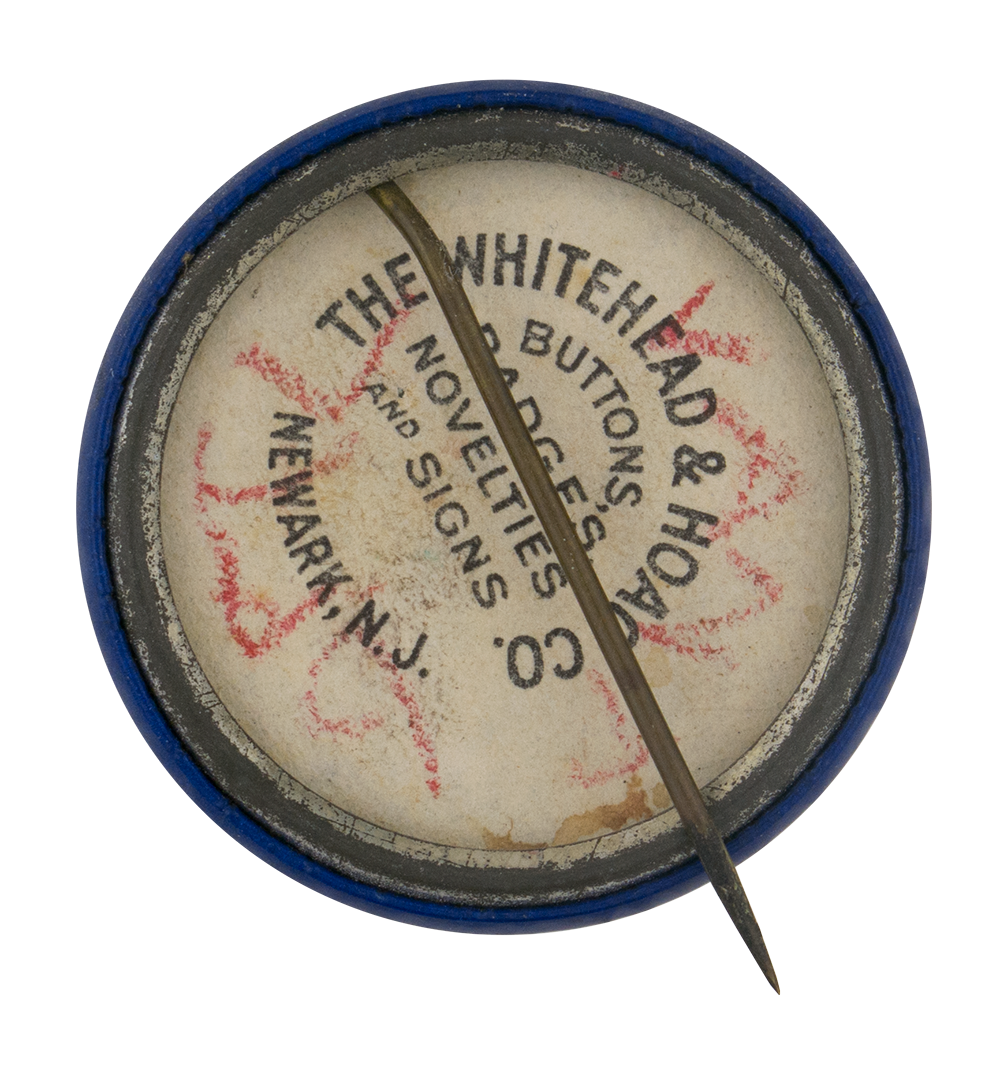
Back Paper / Back Info

The Whitehead & Hoag Co.
Buttons, Badges, Novelties and Signs 
Newark, N.J.

Back Style
The Shape
The Size
The Manufacturer
Additional Information

In the late 1930’s and early 1940’s, Cleveland-based radio station WTAM hosted a program called Uncle Henry’s Dog Club.  This button suggests that the program supported the Cleveland Animal Protective League and encouraged young listeners to do the same.  Incorporated in 1913, the Cleveland Animal Protective League is an independent, nonprofit humane society.  Even today, the organization continues to partner with a local radio station (Q104) in order to promote its cause.  

Catalog ID CL0040

Second National Bank Christmas Club

Category
Additional Images
Sub Categories
Text on Button SECOND NATIONAL BANK MEMBER F.D.I.C. Christmas Club Button Buddy 12520
Image Description

Three illustrations of holly leaves across the top of the button with a white semi circle underneath with green text and white text on an overall red background under the semi circle. There is a white oval at the bottom with green text in it.

Back Style
The Shape
The Size
Additional Information

This button would have been given to a Second National Bank Christmas Club member. The Christmas Club is a savings program that allows bank members to deposit a set amount of money every week into a special savings account, and receive the money back at the end of the year for Christmas shopping. There have been a variety of Second National Banks and the name continues to be used today. The first Christmas Clubs were established in the early 20th century. 

Catalog ID CL0041

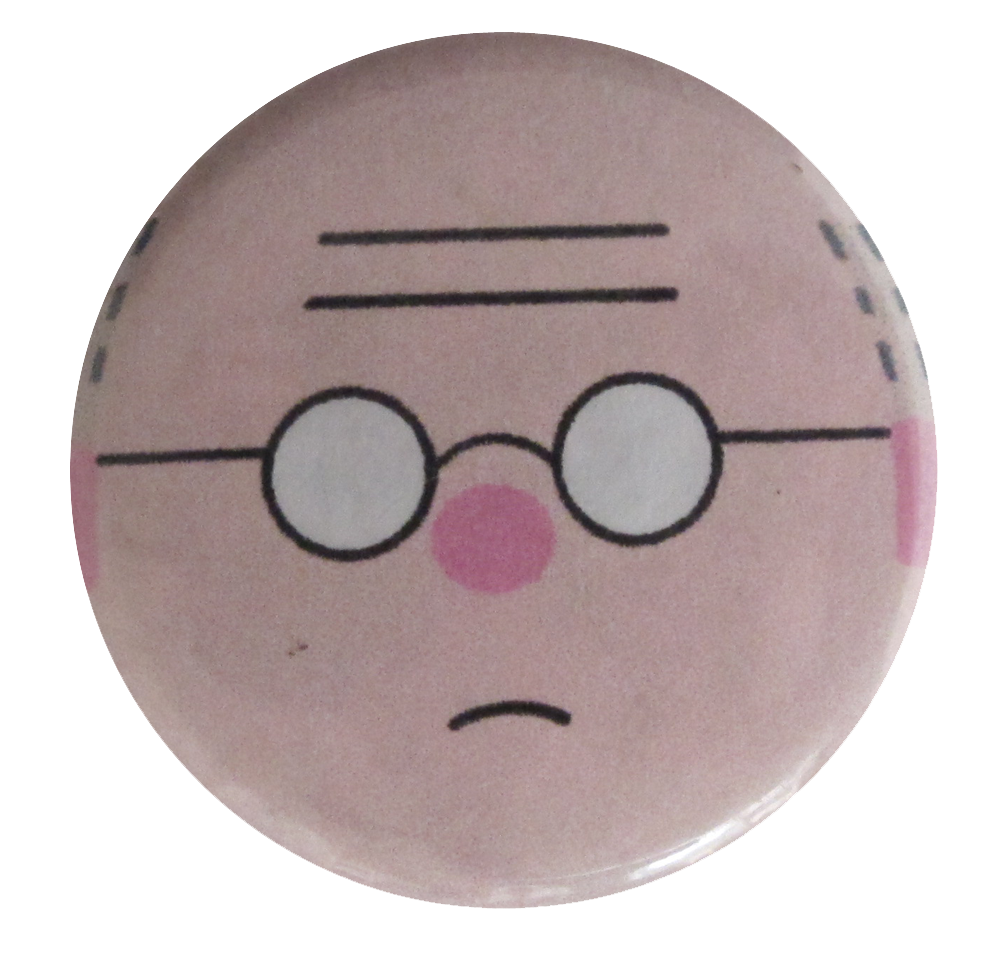
Chris Ware Face with Glasses

Category
Sub Categories
Image Description

An illustration of a frowning older man with round glasses and a furrowed brow. He is balding. His ears and nose are pink and his face is a peach color. The traces of hair are grey and the glasses are black.

Curl Text Rusty Brown 2003 C. Ware
Back Style
The Shape
The Size
Year / Decade Made
The Manufacturer
Additional Information

This button was designed by Chris Ware. He is a comic book artist and cartoonist. His most popular works include graphic novels Jimmy Corrigan, the Smartest Kid on Earth and Building Stories, and the comic book series Acme Novelty Library. The characters in his work are often depressed, melancholy, in despair, or facing some type of adversity.

Ware is one of the prominent artists who partners with Busy Beaver to create a special line of buttons. This button is part of the Button-O-Matic artist series in 2003 produced by Busy Beaver Button Company.

Catalog ID AR0103