Up With People Beat of the Future

Category
Additional Images
Sub Categories
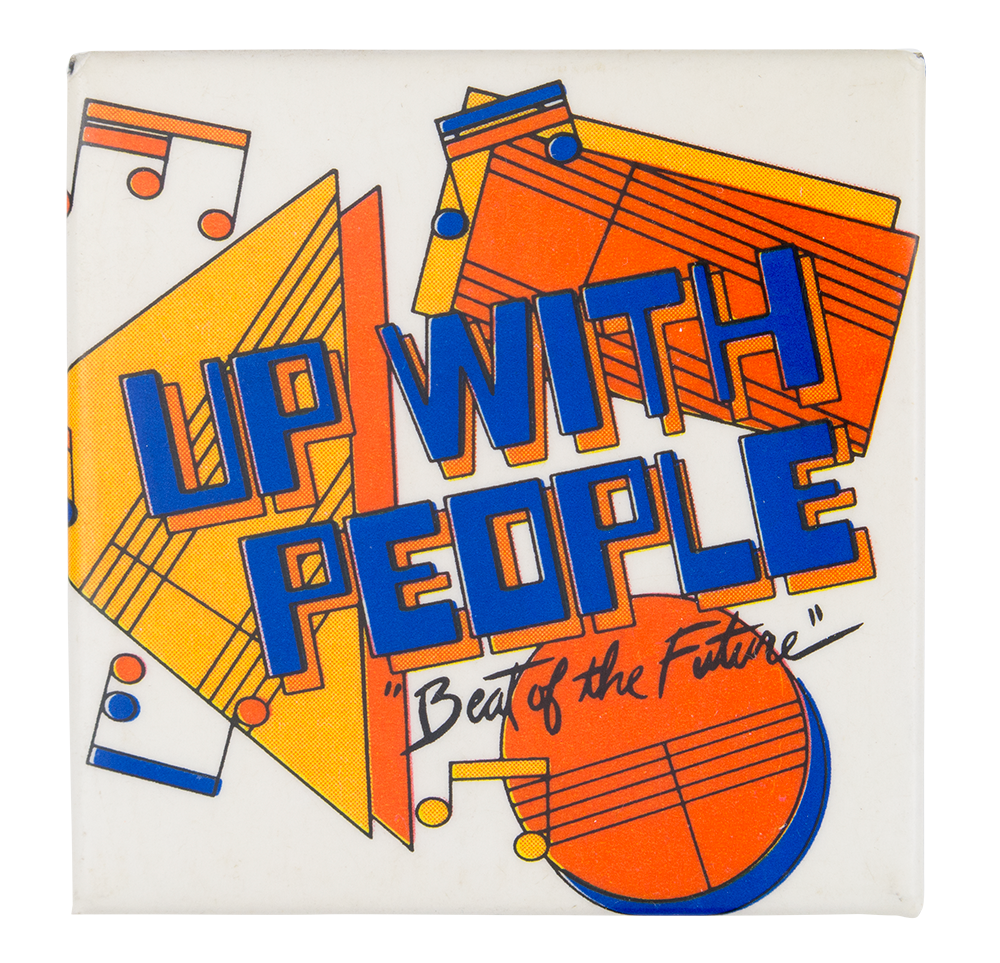
Text on Button Up With People "Beat of the Future"
Image Description

Red, orange and blue text, music notes and geometric shapes on off-white background.

Back Style
The Shape
The Size
Year / Decade Made
Additional Information

Up With People is a song-and-dance organization founded in 1965 that provides a "positive voice for young people during a turbulent period in the United States." The group travels and performs internationally and professes utopian ideals. The group headlined four Superbowl halftime shows. Up With People's "The Beat of the Future" was featured as the halftime show during Superbowl XX in 1986.

Critics of the group note government and mega-corporate funding, claiming that the group was propaganda intended to supress the counterculture movements of the 1960s and 1970s. 

Sources

Up with People. (n.d.). About us. Retrieved March 11, 2013 from https://upwithpeople.org/who-we-are/about-us/ 

Up with People at the Super Bowl. (2024, August 27). In Wikipedia. Retrieved November 5, 2024 https://en.wikipedia.org/wiki/Up_with_People_at_the_Super_Bowl 

Catalog ID MU0049

Turn To The Right

Category
Additional Images
Sub Categories
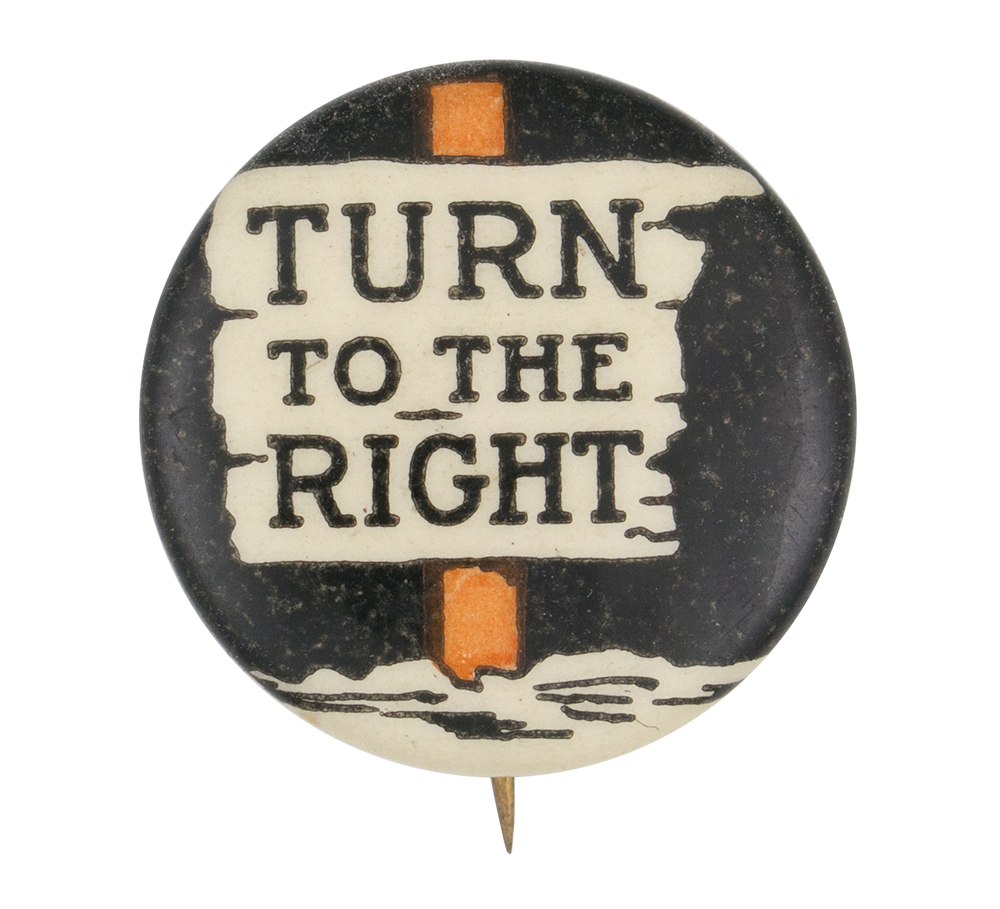
Text on Button TURN TO THE RIGHT
Image Description

White signpost with text on a black background.

Back Paper / Back Info

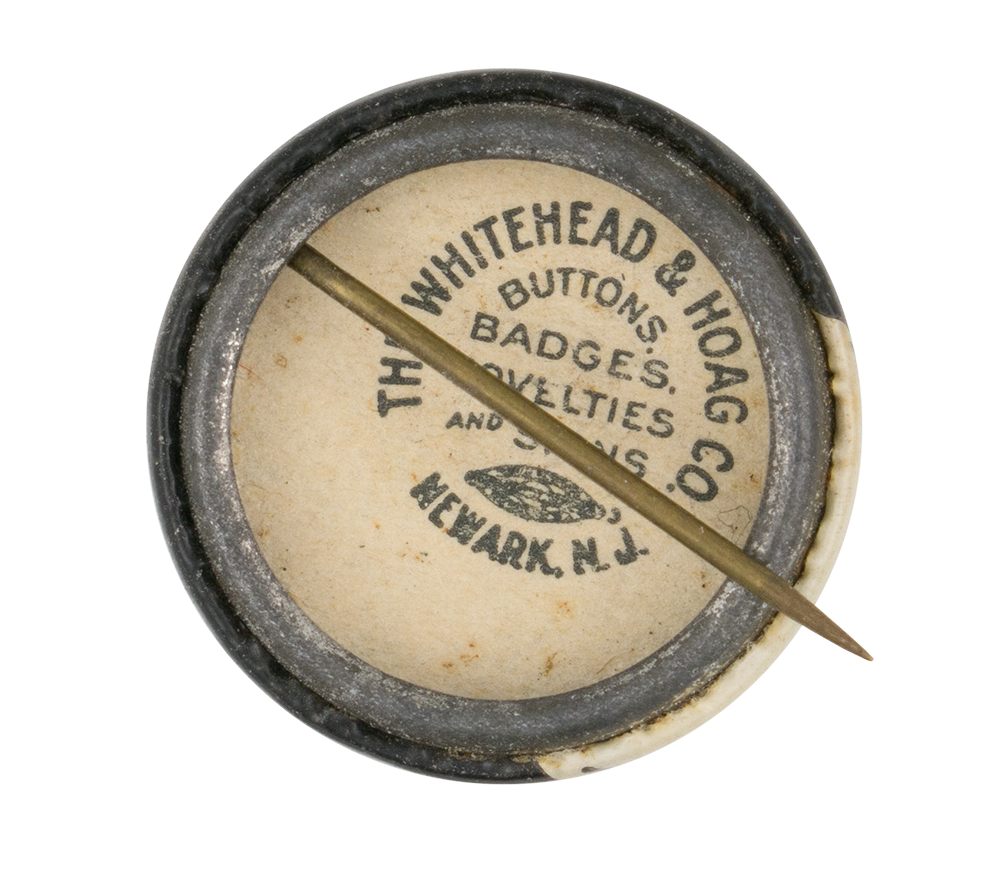
The Whitehead & Hoag Co. Buttons, badges, novelties and signs. Newark, NJ.

Back Style
The Shape
The Size
Year / Decade Made
The Manufacturer
Additional Information

Distributed for the release of the 1922 movie Turn to the Right. The film was released by the Metro Pictures Corporation and directed by Rex Ingram, who is better known for such films as "The Four Horsemen of the Apocalypse" and "The Prisoner of Zenda." This movie has been described as a "rural comedy/drama" and a "rural fairy tale" about a landlord trying to evict a widow, a country bumpkin who is actually a financial genius, and the Alger-like country lad who fights against adversity and eventually achieves vindication and success.

Sources

Mystery File. (2010, April 20). Turn to the Right. Retrieved from http://mysteryfile.com/blog/?p=1976

Catalog ID EN0014

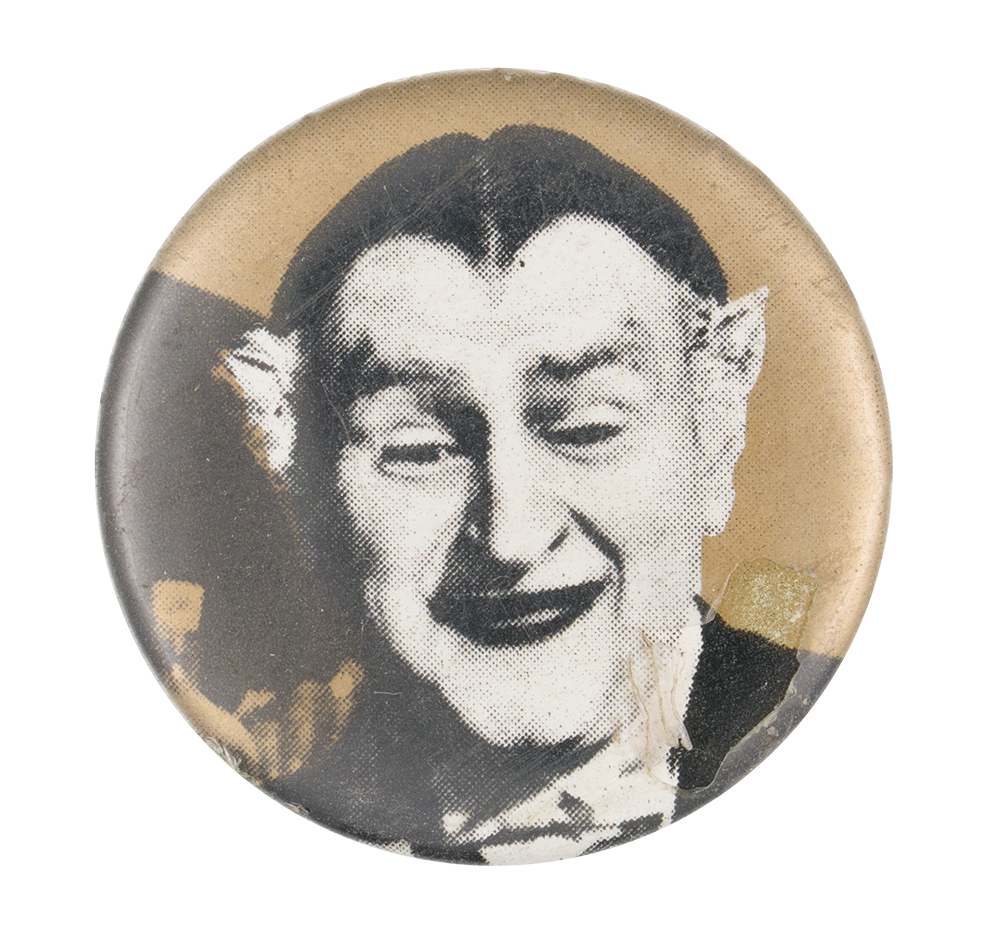
The Munsters Grandpa

Category
Additional Images
Sub Categories
Image Description

Black and white photograph of Grandpa Munster on a shiny background. 

Back Style
The Shape
The Size
Additional Information

Grandpa Munster was a fictional character (a vampire) in the CBS sitcom The Munsters, originally played by Al Lewis from 1964-1966.  The Munsters was a show about a family of monsters, and was a satire of both monster movies and family-oriented sitcoms being made at the time. 

Catalog ID EN0012

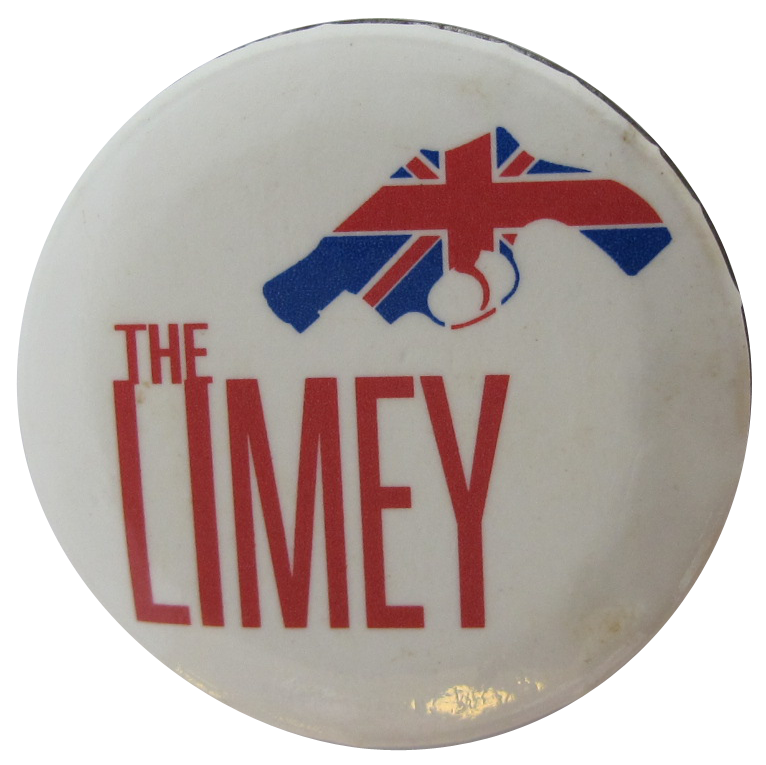
The Limey

Category
Additional Images
Sub Categories
Text on Button THE LIMEY
Image Description

Red text on white background with the Union Jack in the shape of a pistol.

Back Paper / Back Info


Back Style
The Shape
The Size
Year / Decade Made
Additional Information

Distributed for the release of the 1999 movie The Limey, a crime film directed by Steven Soderbergh and written by Lem Dobbs. The plot centers around a British man, recently released from prison, who travels to California to investigate the death of his daughter. 

Catalog ID EN0019

The Foreigner

Category
Additional Images
Sub Categories
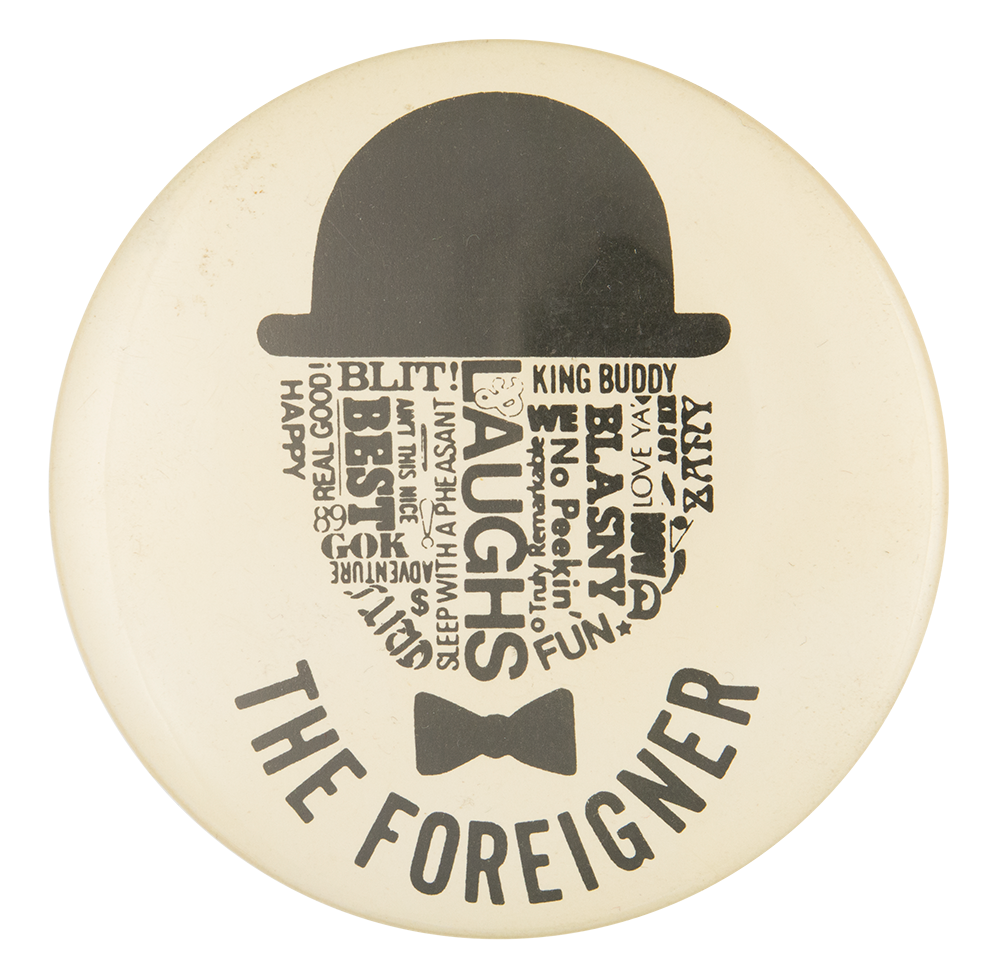
Text on Button THE FOREIGNER Laughs, Best, Blasny, Blit, Fun, Real Good, Happy, No Peekin', Sleep with a Pheasant, Truly Remarkable, King Buddy, Aint this Nice, Adventure, Love Ya!, Zany
Image Description

Black text on white background with many different words and fonts that make face shape. Derby hat on top on the face, with a bow tie below. Large black text below the face shape. 

Back Paper / Back Info


Back Style
The Shape
The Size
Year / Decade Made
Additional Information

The Foreigner was first presented at the Milwaukee (Wisconsin) Repertory Theatre in January of 1983.  The play was written by Larry Shue. It opened on November 1984 at New York City's Astor Palace Theater, where it ran for 686 performances. The opening night cast included Shue, Anthony Heald, and Patricia Kalember. It eventually won two Obie Awards and two Outer Critics Circle Awards , including Best New American Play and Best Off-Broadway Production. Larry Shue died in a plane crash the following year, not living to see the continued popularity of The Foreigner.  In 2004, the Roundabout Theatre Company revived the play, starring Matthew Broderick, Frances Sternhagen, and Neal Huff.

Catalog ID EN0007

Star Trek Spock

Category
Additional Images
Sub Categories
Text on Button Star Trek
Image Description

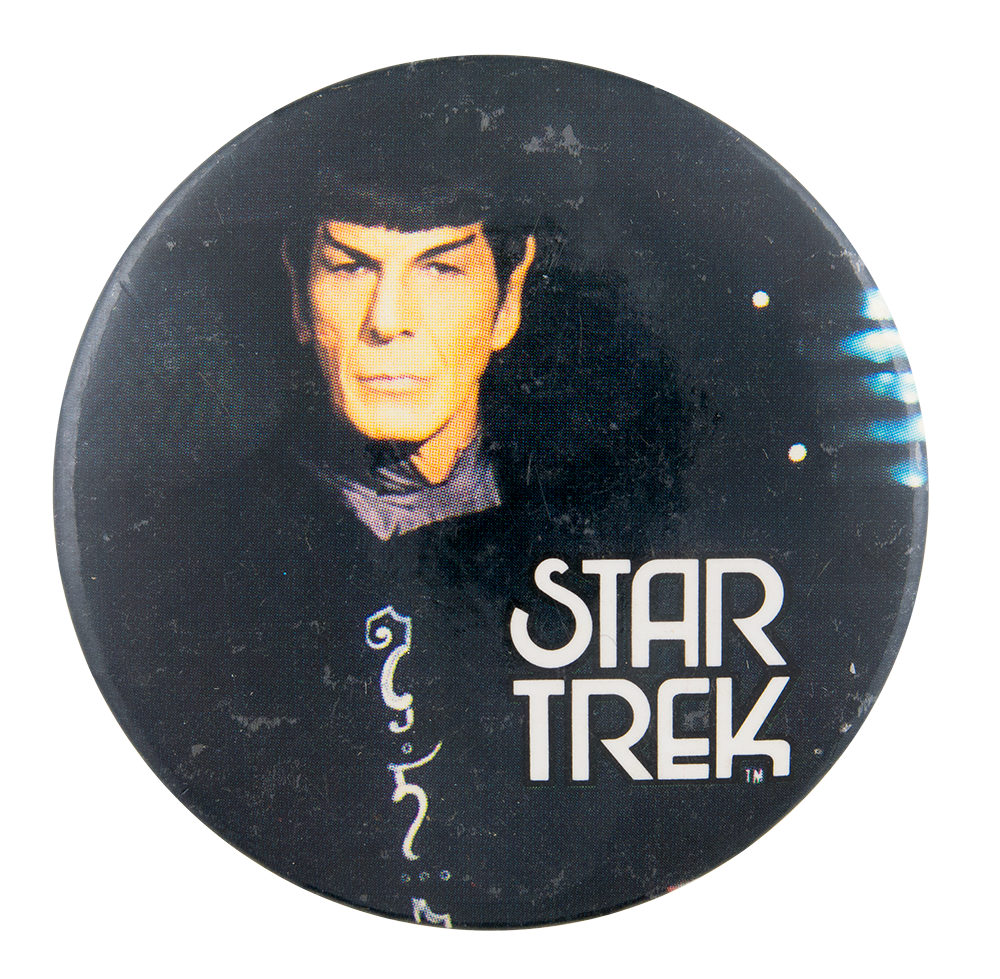
Color photograph of Leonard Nimoy as Spock on dark background with white text on lower right portion of button.

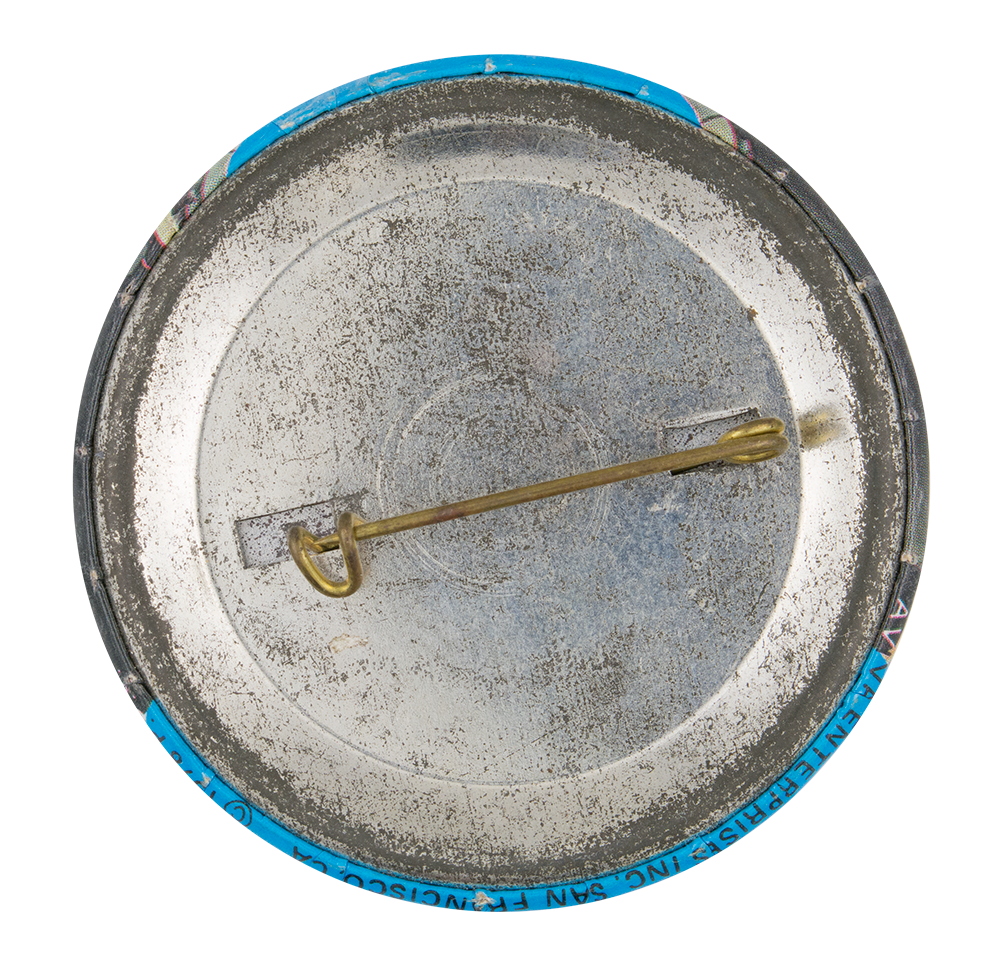
Curl Text AVIVA ENTERPRISES INC. SAN FRANCISCO, CA ©1978 P.P.C.
Back Style
The Shape
The Size
Year / Decade Made
Additional Information

Spock is the half-human, half-vulcan Science Officer and First Officer on the USS Enterprise, and later a Commanding Officer. The character was played by Leonard Nimoy from 1964-2010. Nimoy has written two autobiographies, I Am Not Spock (1977) and I Am Spock (1995). This is a promotional item for the 1979 film Star Trek: The Motion Picture.

Catalog ID EN0001

Star Trek: The Motion Picture

Category
Additional Images
Sub Categories
Text on Button STAR TREK
Image Description

Color photograph of the starship Enterprise crew on the bridge. Blue background above and below image with white text centered on bottom portion of button. 

Curl Text AVIVA ENTERPISES, INC. SAN FRANCISCO, CA ©1978 P.P.C.
Back Style
The Shape
The Size
Year / Decade Made
Additional Information

A promotional photo for the 1979 movie, Star Trek: The Motion Picture, based on the tv show Star Trek, created by Gene Roddenberry. The film was made ten years after the cancelation of the original series, but original cast of the show appears in the film. Although the film did reasonably well at the box office, it received poor reviews from critics.

Catalog ID EN0101

Star Of Vaudeville Charmion

Category
Additional Images
Sub Categories
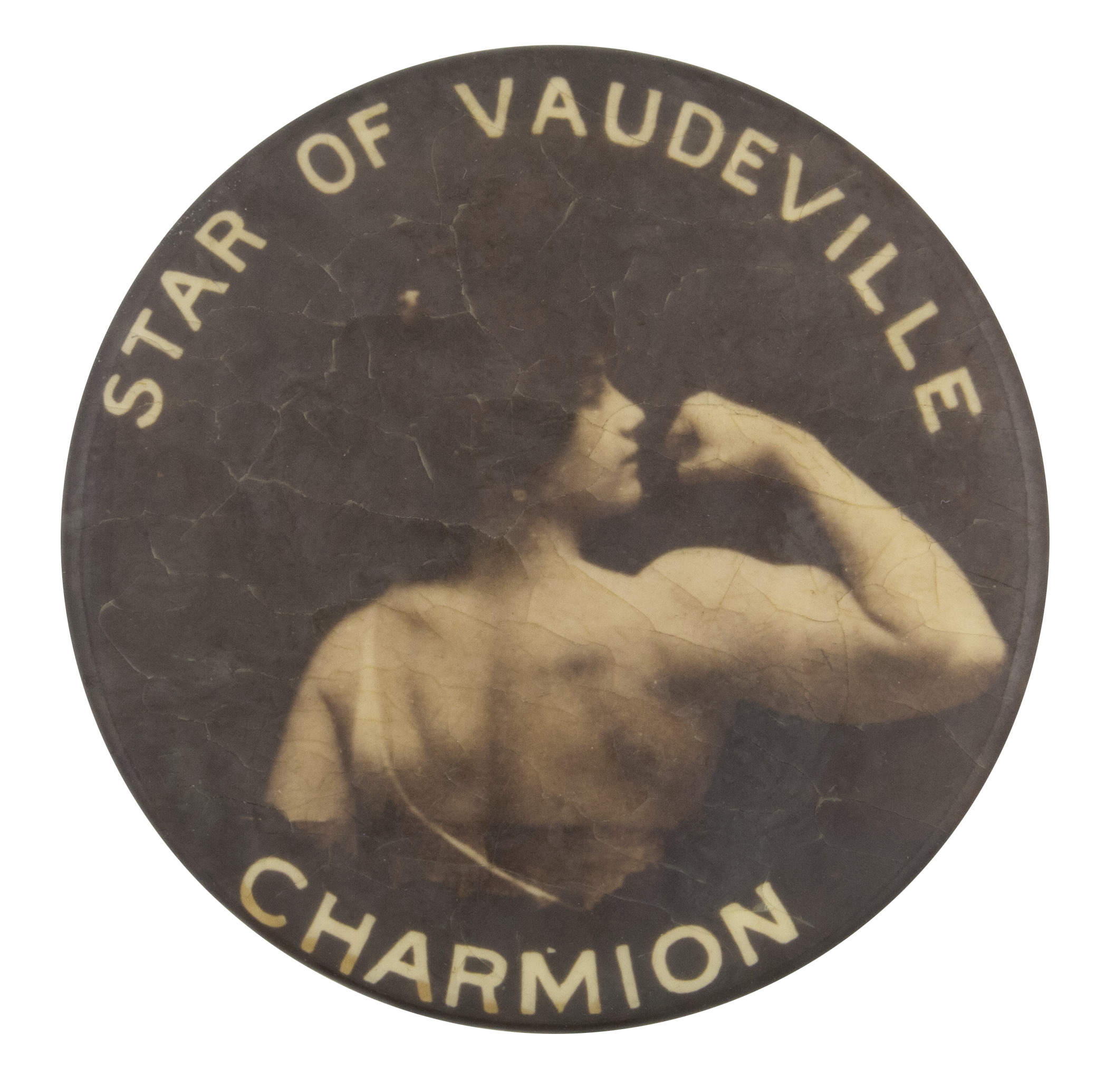
Text on Button STAR OF VAUDEVILLE - CHARMION
Image Description

Black and white photo of Charmion, the strong woman, from behind, flexing her right arm and baring her back to display her muscles, her head turned in profile, against a black background. White text curved around upper and lower portions of button. 

Back Paper / Back Info

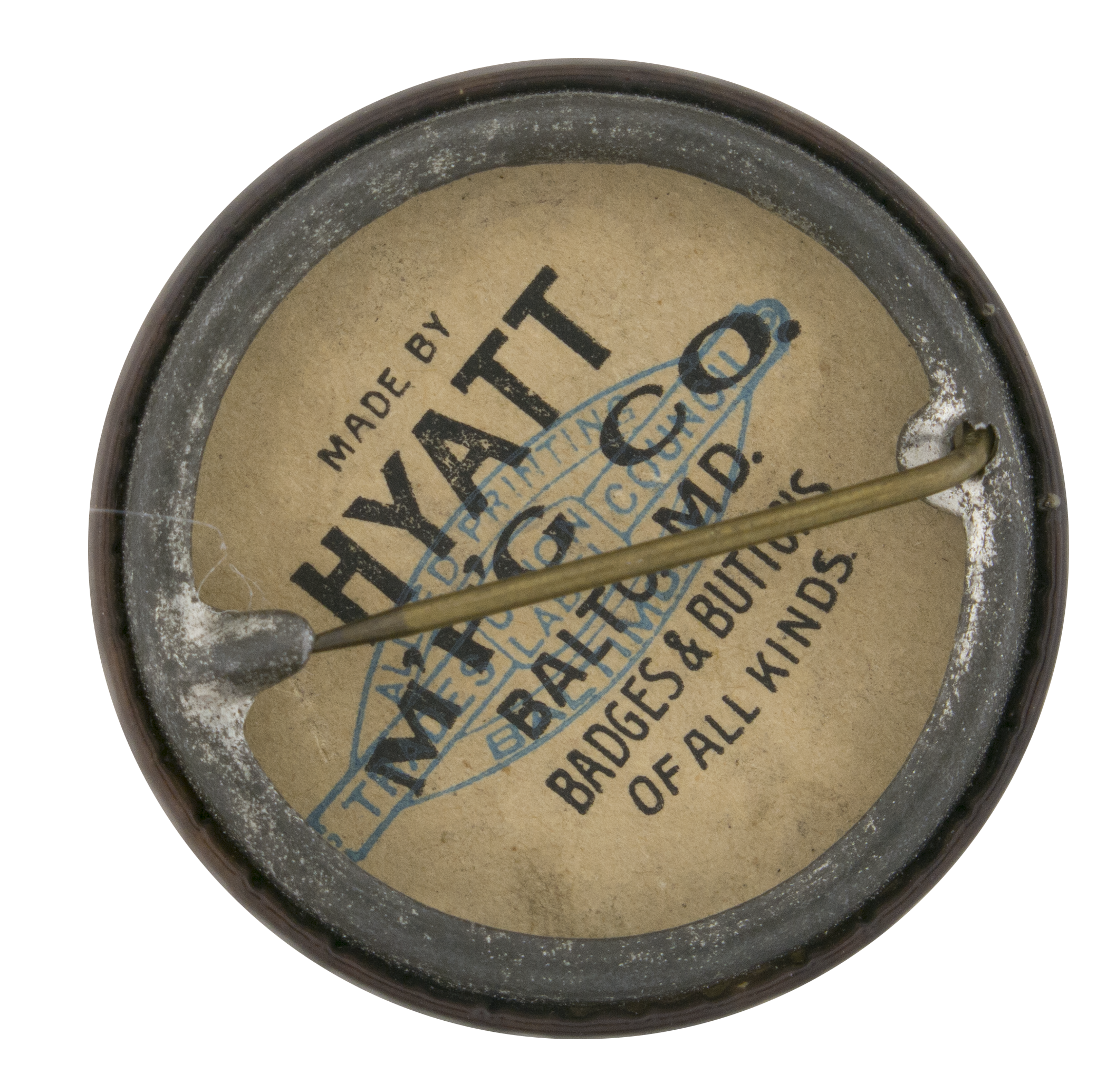
Made by HYATT MFG CO. BALTO. MD. BADGES & BUTTONS OF ALL KINDS

Back Style
The Shape
The Size
The Manufacturer
Additional Information

Charmion was the stage name of the American Vaudeville trapeze artist and strong-woman Laverie Vallee. Her most famous act consisted of her mounting the trapeze in full Victorian attire and stripping down to a leotard while swinging from the trapeze. This act was captured on film in 1901 for a short Edison film called "Trapeze Disrobing Act." Vallee lived from 1875 to 1949.

The Edison film can be viewed here.

Catalog ID EN0024

Rocky II

Category
Additional Images
Sub Categories
Text on Button ROCKY II
Image Description

White text on black background

Back Style
The Shape
The Size
Year / Decade Made
Additional Information

Distributed for the release of the 1979 movie Rocky II. The film was written, directed by, and starred Sylvester Stallone. There have been six Rocky movies, all of which follow the character Rocky, who begins the series as an unknown boxer who rises to fame. 

Catalog ID EN0020

Our Gang

Category
Additional Images
Sub Categories
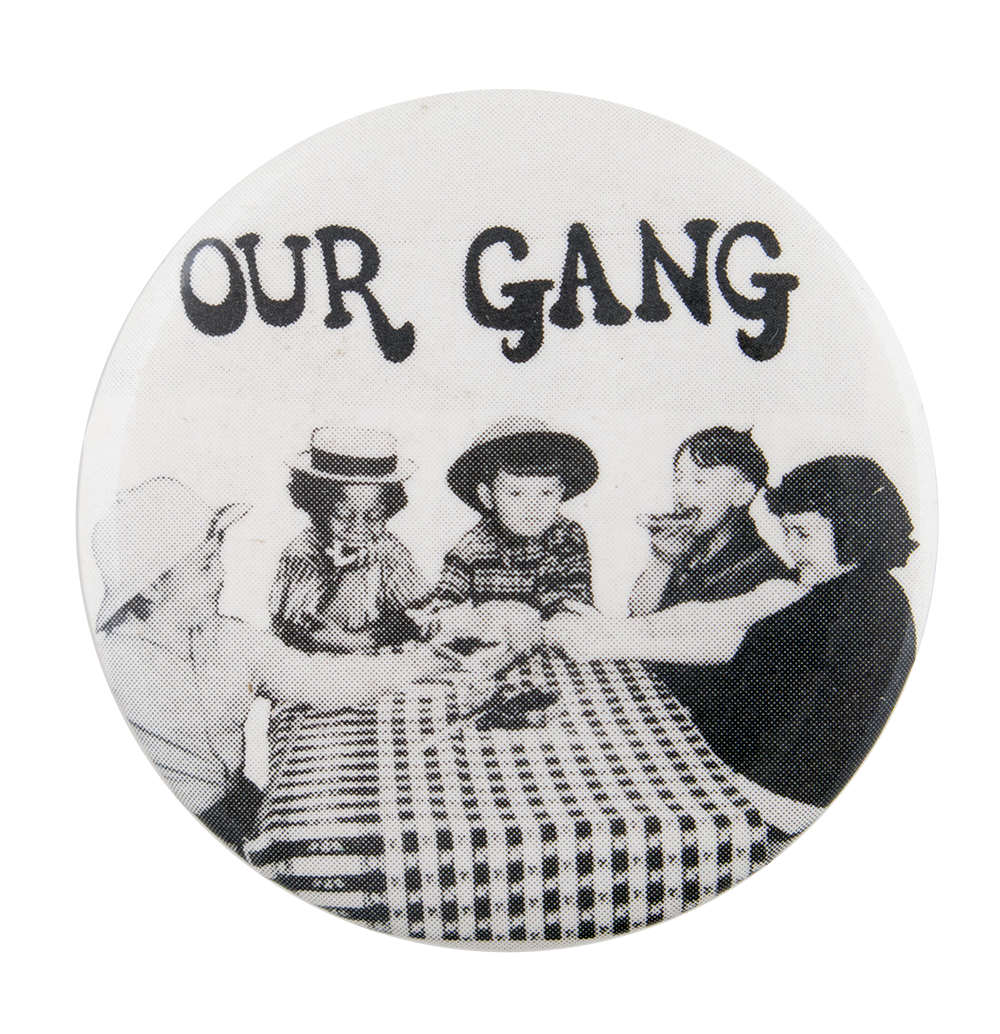
Text on Button Our Gang
Image Description

Black and white photograph of Our Gang (as known as The Little Rascals) from the American short comedy films. Black text on white background.  The photograph includes Spanky, Buckwheat, Porky, Alfalfa and Darla.

Back Style
The Shape
The Size
Additional Information

Our Gang, or the Little Rascals, was an American comedy series and pop culture phenomenon in the early-to-mid 20th century. Created by the comedy producer Hal Roach in 1922, Our Gang was a series of comedy shorts that showed the daily 'misadventures' of a group of poor neighborhood kids. Roach's work was groundbreaking in several respects, however. Firstly, as film historian Leonard Malkin observed, Our Gang was one of the first pieces of American cinema to portray black and white characters in a group as equals. Furthermore, instead of having the child actors imitate adult acting styles, which was the preferred method at the time, director Robert McGowan successfully filmed the children in a way that captured the raw, natural nuances of regular childhood life.

The series was produced until 1944, and includes 220 shorts and one feature film.

Catalog ID EN0041