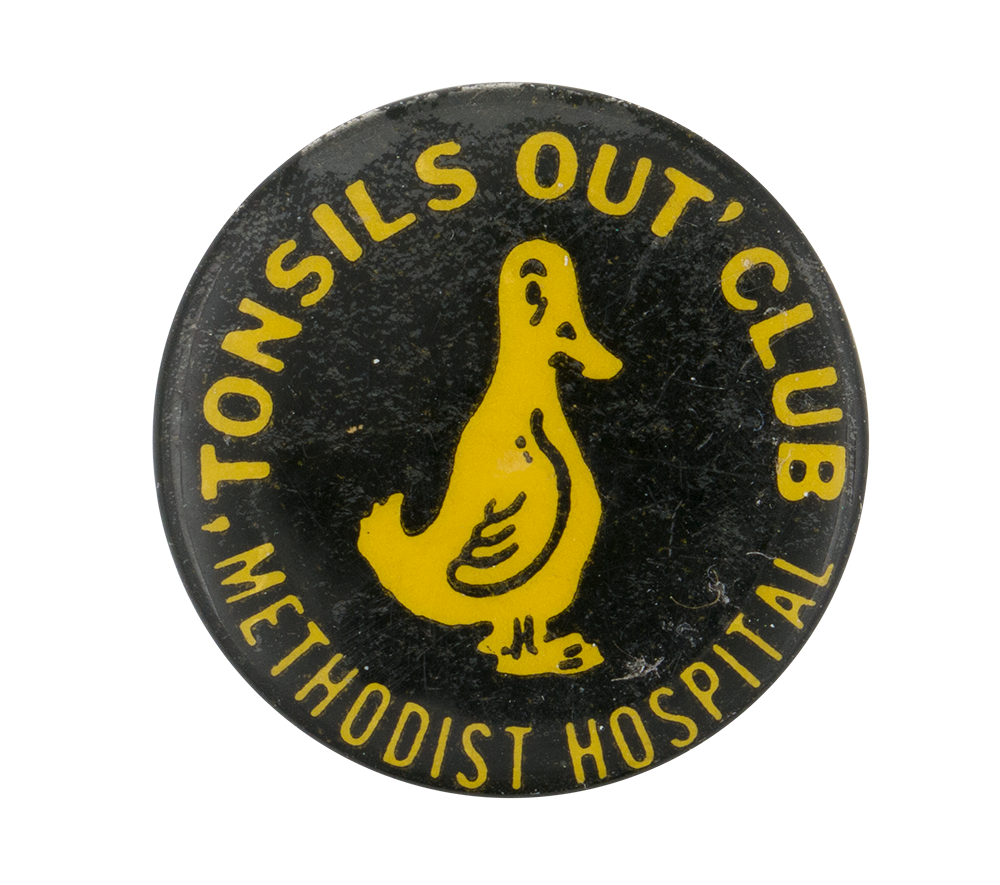
Tonsils Out Club Methodist Hospital

Category
Additional Images
Sub Categories
Text on Button 'TONSILS OUT' CLUB METHODIST HOSPITAL
Image Description

An illustration of a yellow duck with yellow text around outer edge of button

Back Style
The Shape
The Size
Additional Information

The term "Tonsils Out Club" appeared on pinback buttons and greeting cards in and around the mid-twentieth century. This was around the same time that tonsillectomy became the most commonly administered surgery in the United States. Institutions such as Methodist Hospital sometimes had special "Tonsils Out Club" pins made for patients, possibly as a means of advertising to other potential tonsillectomy patients.

Tonsillectomy is a procedure for the removal of the tonsils, or normally occurring tissue found near the opening to the throat. The surgery gained popularity in the years between 1915 and 1960, with physicians recommending tonsillectomy for everything from chronic sore throat to deafness and halitosis. The procedure's popularity peaked in 1959, when doctors in the US performed approximately 1.4 million tonsillectomies, mostly on children. Tonsillectomy lost popularity in the 1960s as evidence increasingly refuted the procedure's supposed benefits. Today, tonsillectomy is mostly recommended for the treatment of airway obstruction or chronic tonsillitis.

Sources

Grob, G. N. (2007, April 10). The rise and decline of tonsillectomy in twentieth-century America. <em>Journal of the History of Medicine and Allied Sciences, 62</em>(4), 383-421. https://doi.org/10.1093/jhmas/jrm003

​Kharodawala, M. (2005, April). <em>The modern tonsillectomy</em>. Grand rounds presentation, University of Texas. Retrieved from https://www.utmb.edu/otoref/grnds/Tonsillectomy-2005-0427/Tonsillectomy…

Catalog ID CL0485

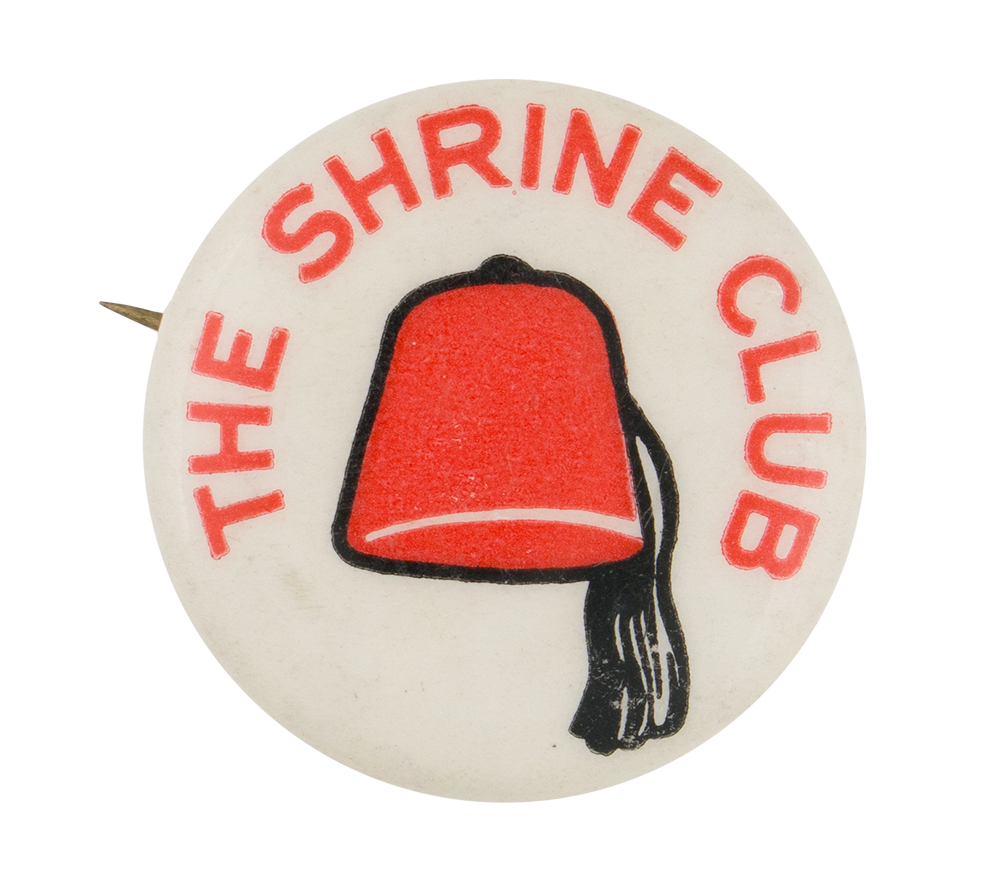
The Shrine Club

Category
Additional Images
Sub Categories
Text on Button THE SHRINE CLUB
Image Description

Illustration of a red fez bellow red text on a beige background.

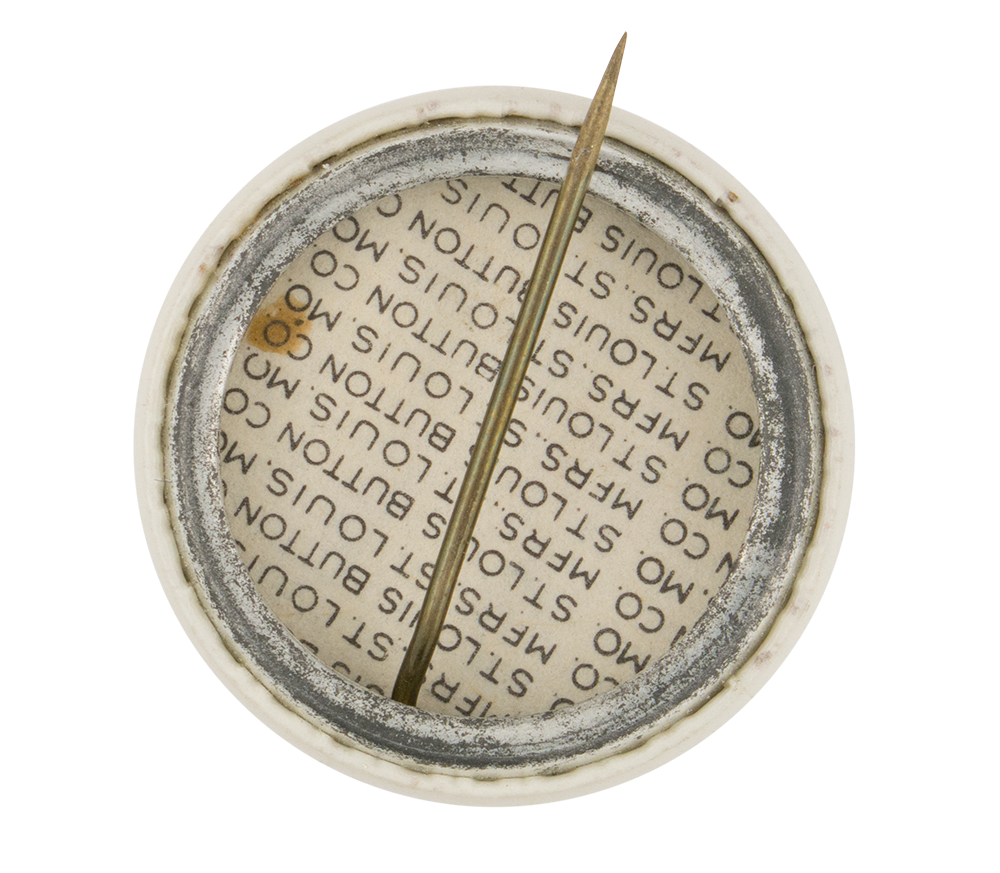
Back Paper / Back Info

ST. LOUIS BUTTON CO. MFRS., ST. LOUIS, MO

Back Style
The Shape
The Size
The Manufacturer
Additional Information

Shriners International, commonly known as The Shriners, were founded in 1870 by a group of Freemasons who wanted to form a fraternity based on fun and fellowship. The fez was adopted as the official headgear and symbol for The Shriners in 1872. In 1919, the fraternity decided to commit themselves to a philanthropic cause and there are now 22 Shriners Hospitals for Children throughout the United States, Canada and Mexico. Today they have more than 200 temples in North America, South America, Europe and Southeast Asia. 

Catalog ID CL0481

Sunny Jim Club

Category
Additional Images
Sub Categories
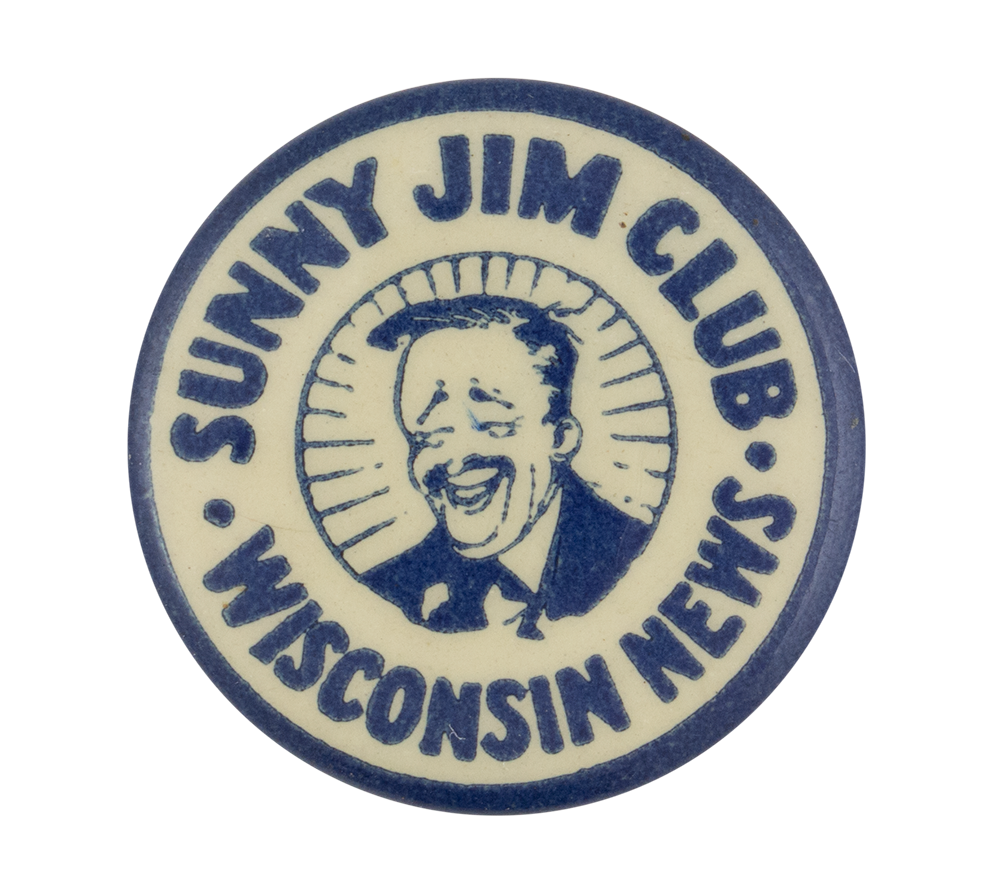
Text on Button SUNNY JIM CLUB WISCONSIN NEWS
Image Description

Illustration of a man on a white background with purple text and a purple outer edge

Back Style
The Shape
The Size
Year / Decade Made
Additional Information

The Sunny Jim Club was a fan club for Sunny Jim's Radio Hour on WISN in Milwaukee, Wisconsin. At that time, WISN served as a branch of the Wisconsin News, a major local paper. 

"Sunny Jim" was a pseudonym for J. Nash McCrea. At the time that the show aired, McCrea was also working as a sports writer for Wisconsin News and the Milwaukee Sentinel. Aside from his work in newspaper and radio, McCrea is more widely remembered as a champion bicyclist, who at the age of 17 entered the 1904 Olympic games in St. Louis, Missouri. McCrea did not win a medal, but he did earn the nickname "Crash McCrea" for his reckless riding habits. In his later years, McCrea became active in the Milwaukee Newspaper Guild, serving as both president and secretary.

Sources

J. Nash McCrea. (n.d.). Retrieved from https://www.sports-reference.com/olympics/athletes/mc/j-nash-mccrea-1.h…

Mallon, B. (1999) <em>The 1904 Olympic games: Results for all competitors in all events, with commentary.</em> Jefferson, NC: McFarland &amp; Company, Inc. Retrieved from https://books.google.com/

WISN (AM). (n.d.). Retrieved from https://en.wikipedia.org/wiki/WISN_(AM)

Catalog ID CL0489

Outer Drive Hero Drivers Club

Category
Additional Images
Sub Categories
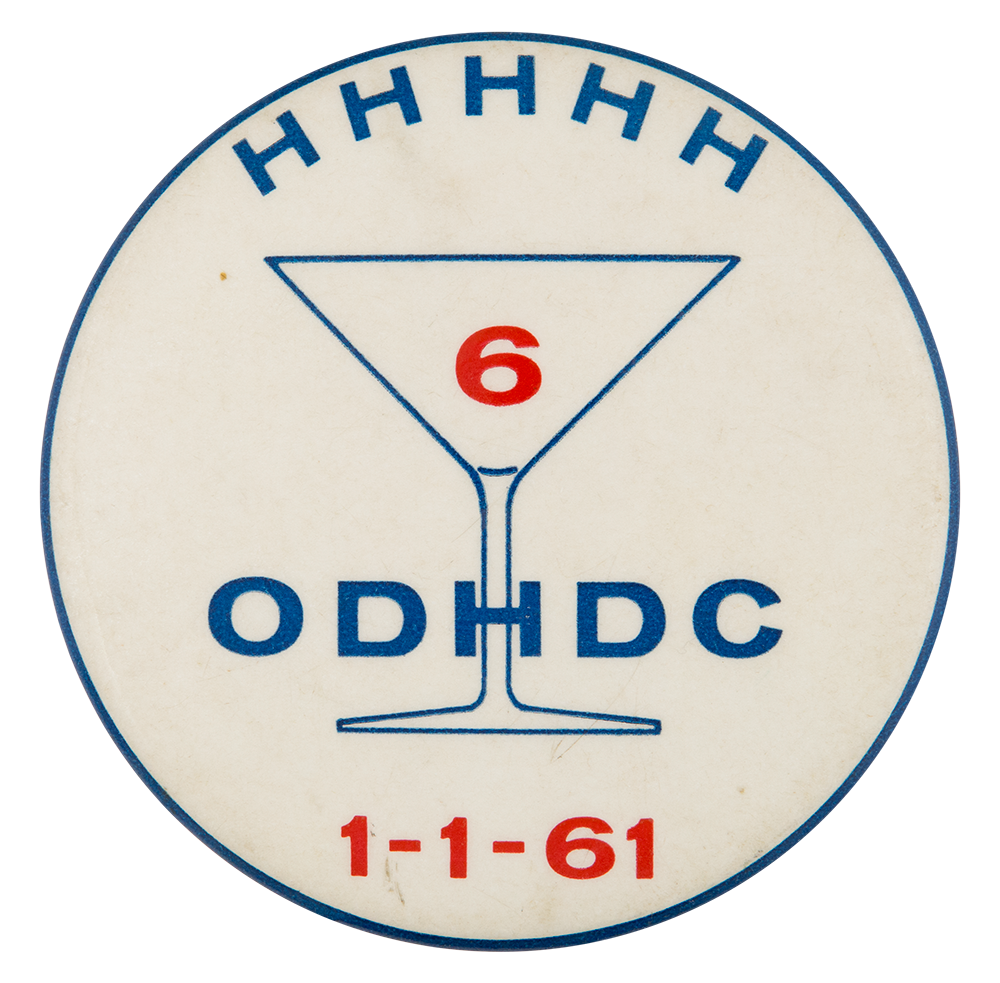
Text on Button HHHHH 6 ODHDC 1-1-61
Image Description

An illustration of a martini glass with blue and red text on a white background with an outer blue edge

Curl Text union bug
Back Style
The Shape
The Size
Year / Decade Made
Additional Information

The Outer Drive Hero Drivers Club, or ODHDC, is a Chicago-area club dedicated to "the serious sports car driver who has become too damn serious". With no charter and no regular meetings, the club's only official gathering is its annual New Year's Day scavenger hunt, the Heroes' Happy Holiday Hangover Hassle, or HHHHH. Anyone who attends the event becomes a de facto member of the club.

At the 1961 event, participants were required to turn in receipts from five separate bars; after which awards were bestowed including dark glasses, a hangover kit, and a bar stool with a seat belt attached. The winning team drove a hearse and was required -in keeping with a tradition that remains to this day- to plan the next year's HHHHH.

More recent events appear to have been less alchohol-fueled and more trivia-oriented. Focusing on Chicago-area history and culture, event themes have included railroads, public libraries, and terracotta buildings.

Sources

Carlisle, B. and J. (1961, May). Here's Happy Holiday Hangover Hassle. The Rallye Route, 56-59. Retrieved from http://www.odhdc.org/EarlyHistory.html&nbsp;

Laskow, S. (2016, December 22). Chicago's greatest New Year's Day tradition is a car rally scavenger hunt. Retrieved from https://www.atlasobscura.com/articles/chicagos-greatest-new-years-day-t…

Outer Drive Hero Drivers Club. (n.d.). Outer Drive Hero Drivers Club annually presents the Heroes' Happy Holiday Hangover Hassle each year on New Year's Day. Retrieved from http://www.odhdc.org/

Catalog ID CH0270

Military Order of the Cootie

Category
Additional Images
Sub Categories
Image Description

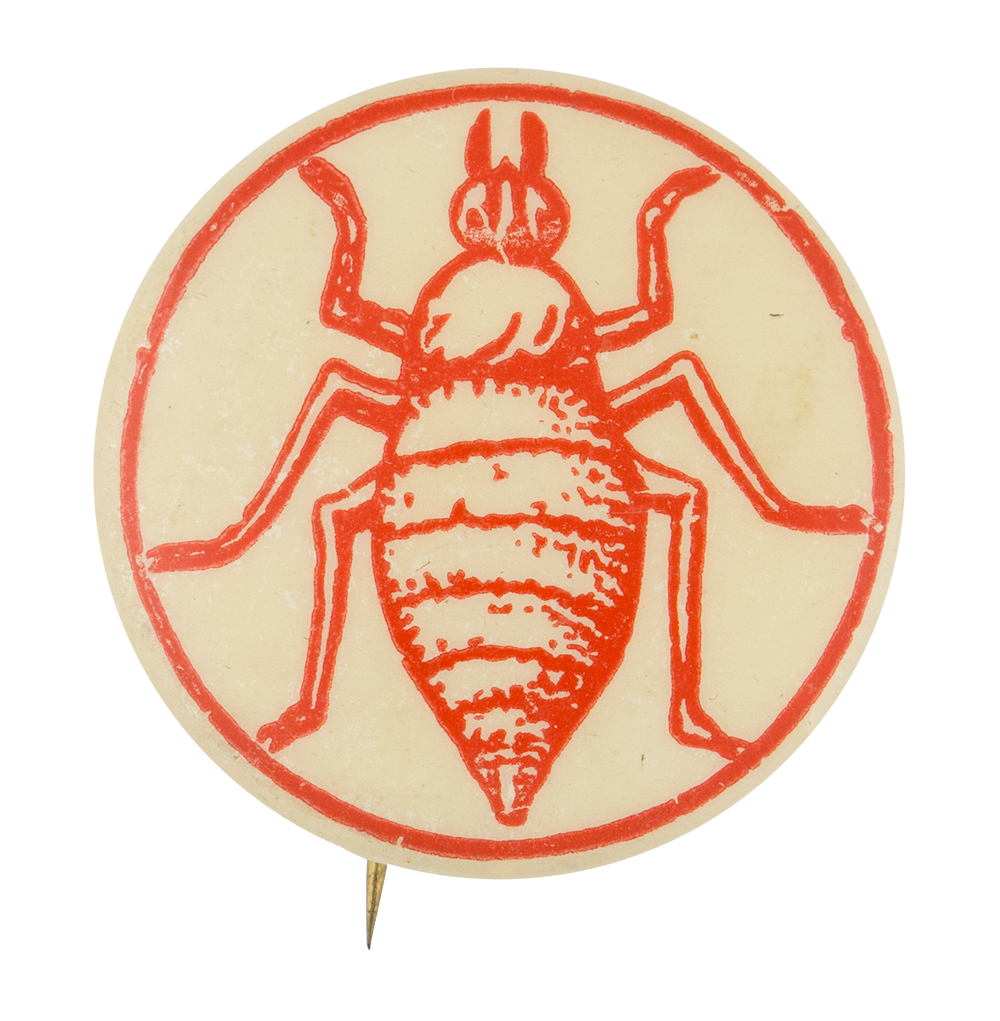
Red illustration of a cootie on a white background

Back Paper / Back Info

VETERANS ENTERPRISES, INC. 44 COURT ST. BROOKLYN, N.Y. union bug

Back Style
The Shape
The Size
Additional Information

The Military Order of the Cootie (MOC) is a national honor degree membership association under the Veterans of Foreign Wars (VFW).  Founded in 1920, the MOC provides social and entertainment programs to members of the VFW, and supports hospitals for veterans and their families. It aims to “Keep ‘em Smiling in Beds of White.” Membership in the MOC signifies exceptional service to the VFW and its affiliated programs. Notable members have included presidents Harry Truman and George H. W. Bush. 

The term “cootie” refers to the lice that afflicted many soldiers during World War I. These parasitic insects were credited to keeping soldiers’ heads down in the trenches. 

Sources

Military Order of the Cootie. (2022, September 29). In Wikipedia. https://en.wikipedia.org/wiki/Military_Order_of_the_Cootie

Nevada Department of Veterans Services. (n.d.). Military Order of the Cootie. https://veterans.nv.gov/resources/military-order-of-the-cootie/#:~:text=...

Catalog ID CL0392

I'm a Rolling Reader

Category
Additional Images
Sub Categories
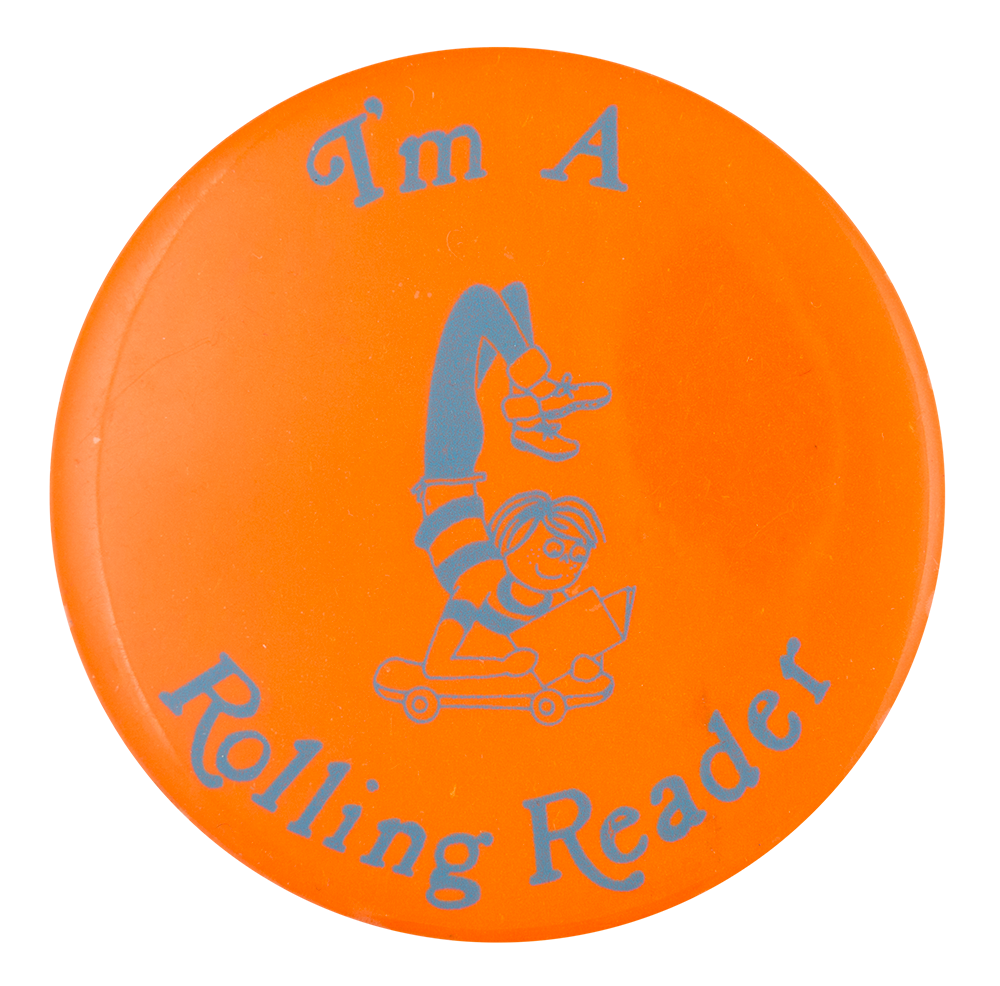
Text on Button I'm A Rolling Reader
Image Description

Blue and orange illustration of a person doing a sort of handstand on a skateboard reading a book on an orange background with blue text

Curl Text Jaes Distributors Amherstview Ontario 613 389 9185
Back Style
The Shape
The Size
Additional Information

"Rolling Readers" is the name for a variety of organizations with a shared mission to promote early literacy, typically for disadvantaged children. Most states participate in a Rolling Reader program that use "read alouds" or book giveaways to promote a love of reading. While each program varies, the overall mission is to promote literacy by engaging children and their families through fun activities.

Catalog ID CL0503

Friend

Category
Additional Images
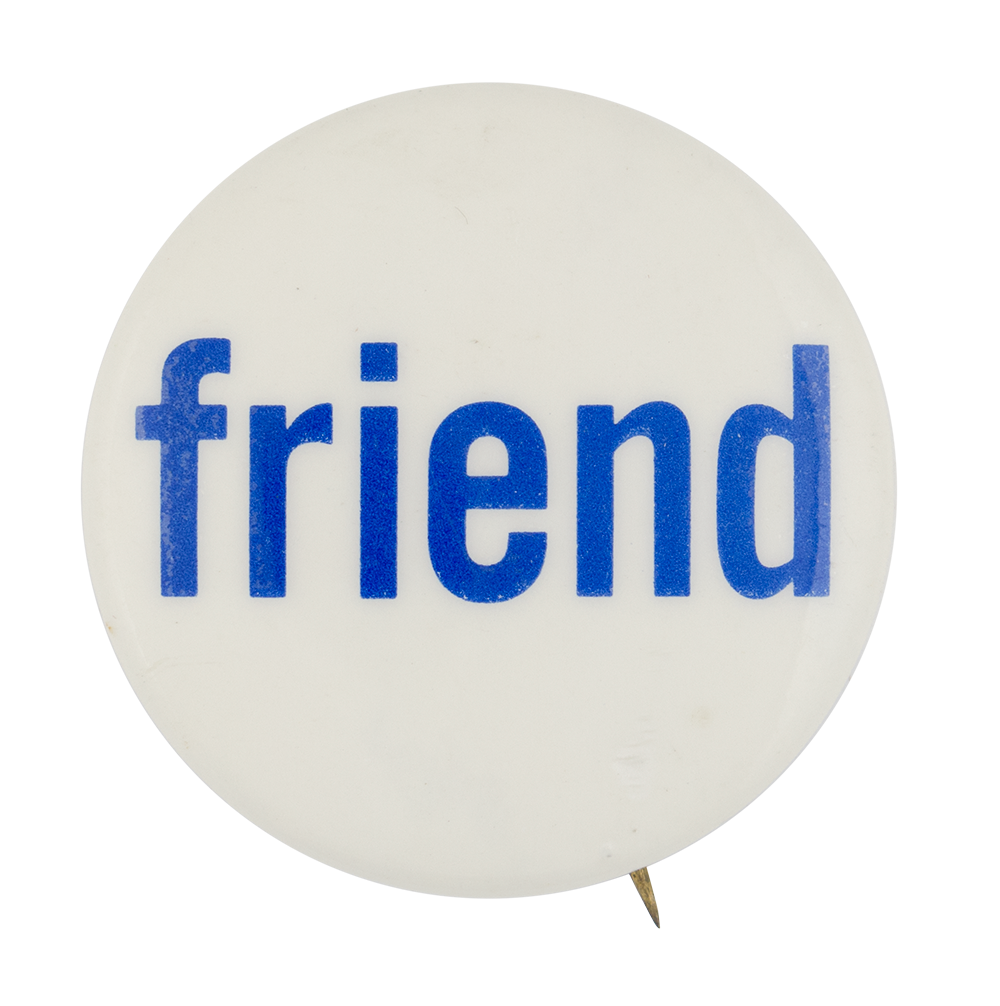
Text on Button friend
Image Description

Blue text on a white background

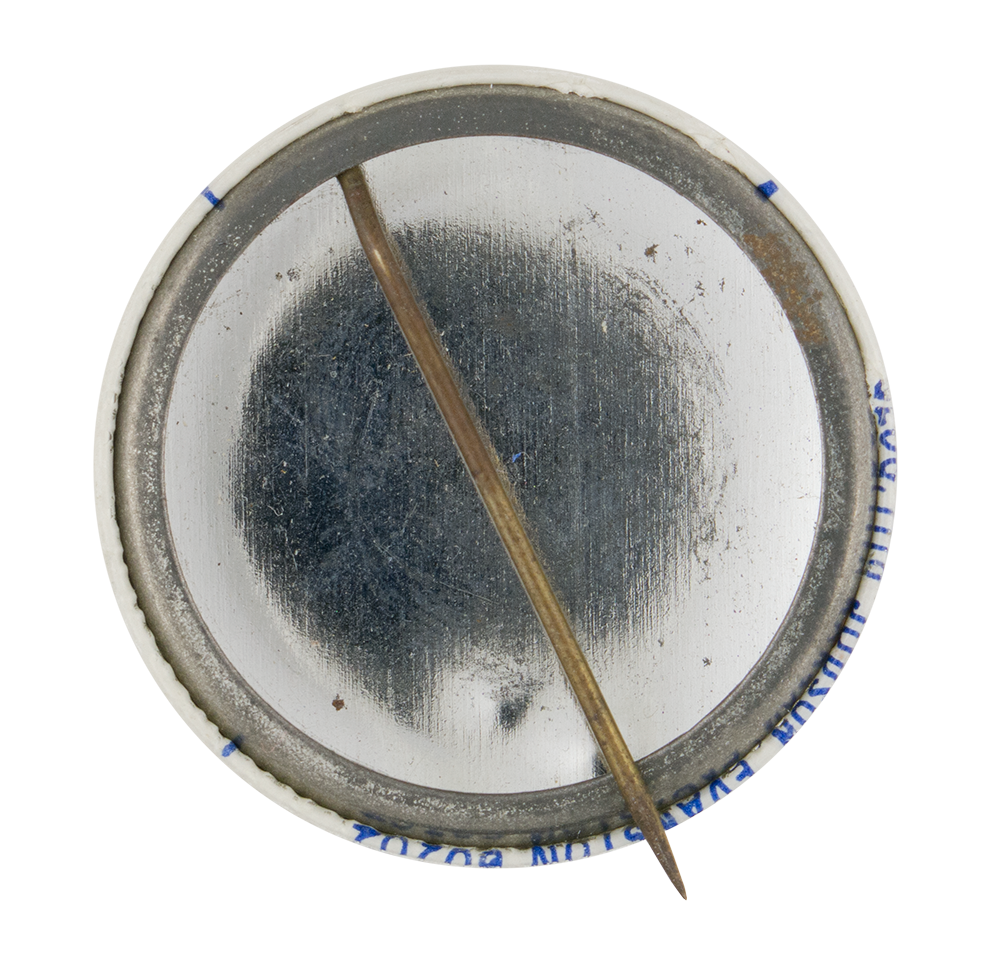
Curl Text GLUG 1110 JUDSON EVANSTON 60202
Back Style
The Shape
The Size
Additional Information

During the 1960s and 1970s, buttons with single-word designs gained popularity amid the counterculture, peace, and civil rights movements. These buttons featured simple, open-ended words like friendlove, or peace, intended to foster connection, show solidarity, or spread positivity without being confrontational. Unlike political buttons with specific slogans, these “statement buttons” were intentionally minimal, allowing people to assign their own meaning. They were produced widely during that era, serving as both affordable fashion accessories and symbols of broader social ideals.

Sources

Friend. (2025, September 7). In Wikipedia. Retrieved September 14, 2025, from https://en.wikipedia.org/wiki/Friend_(disambiguation)

Jones, P. (n.d.). Buttons. Roz Payne Sixties Archive. University of Nebraska-Lincoln. Retrieved September 14, 2025, from https://rozsixties.unl.edu/collections/show/2.html 

Otto, R. (2011, February 11). Busy Beaver Button Co. Atlas Obscura. Retrieved September 14, 2025, from https://www.atlasobscura.com/places/busy-beaver-button-co

Catalog ID CL0483

Camp Fire Girls Do Dad Marvelous Mom

Category
Additional Images
Sub Categories
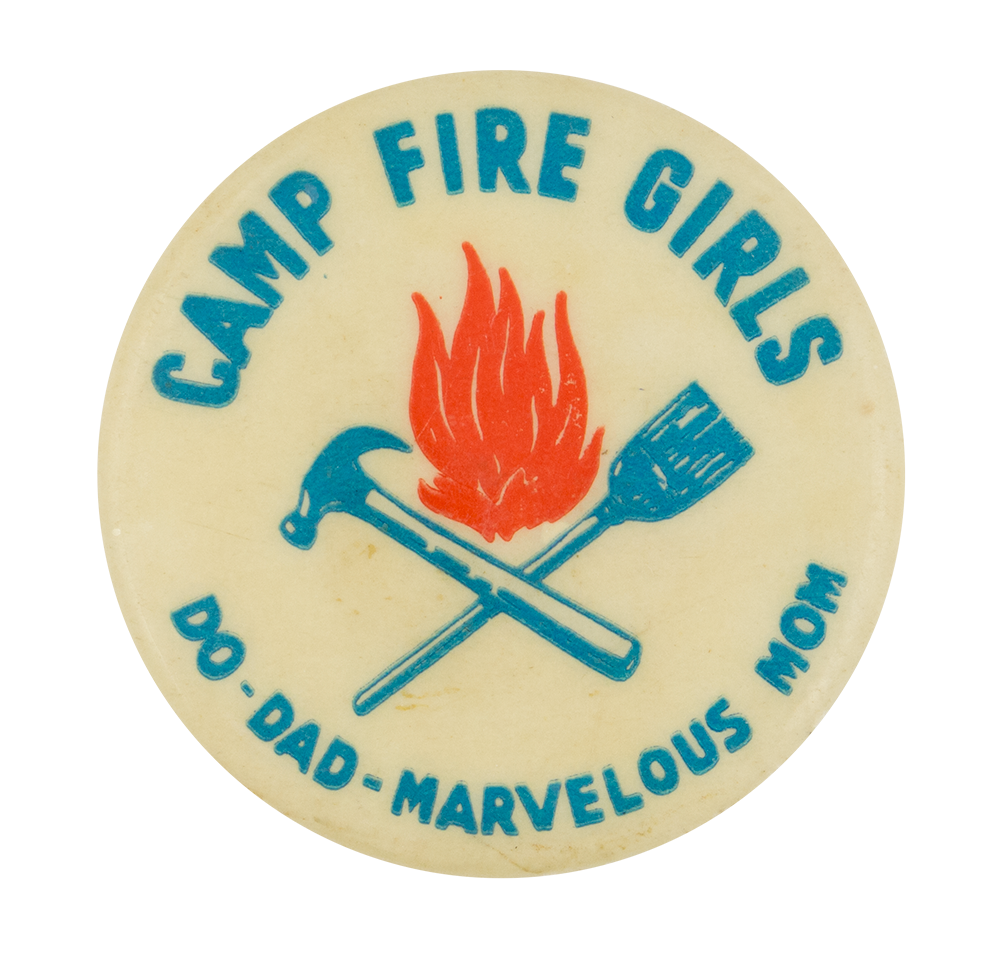
Text on Button CAMP FIRE GIRLS DO-DAD-MARVELOUS MOM
Image Description

Illustration of a fire over a hammer and a broom with blue text around the outer edge on a white background

Back Style
The Shape
The Size
Additional Information

The Camp Fire Girls of America organization was founded in 1910 by Dr. Luther Gulick and his wife Charlotte Gulick. The camp was created for youth to have experiences that would best influence how they learned to care for themselves, the environment, and other people around them. The camp program also thrives around family relationships with parents, grandparents and siblings. Camp Fire Girls was meant as a sister organization to the Boy Scouts of America. Membership was expanded to include boys in 1975 and the organization changed its name to Camp Fire USA and currently Camp Fire.

Catalog ID CL0505

Benevolent and Protective Order of Elks

Category
Additional Images
Sub Categories
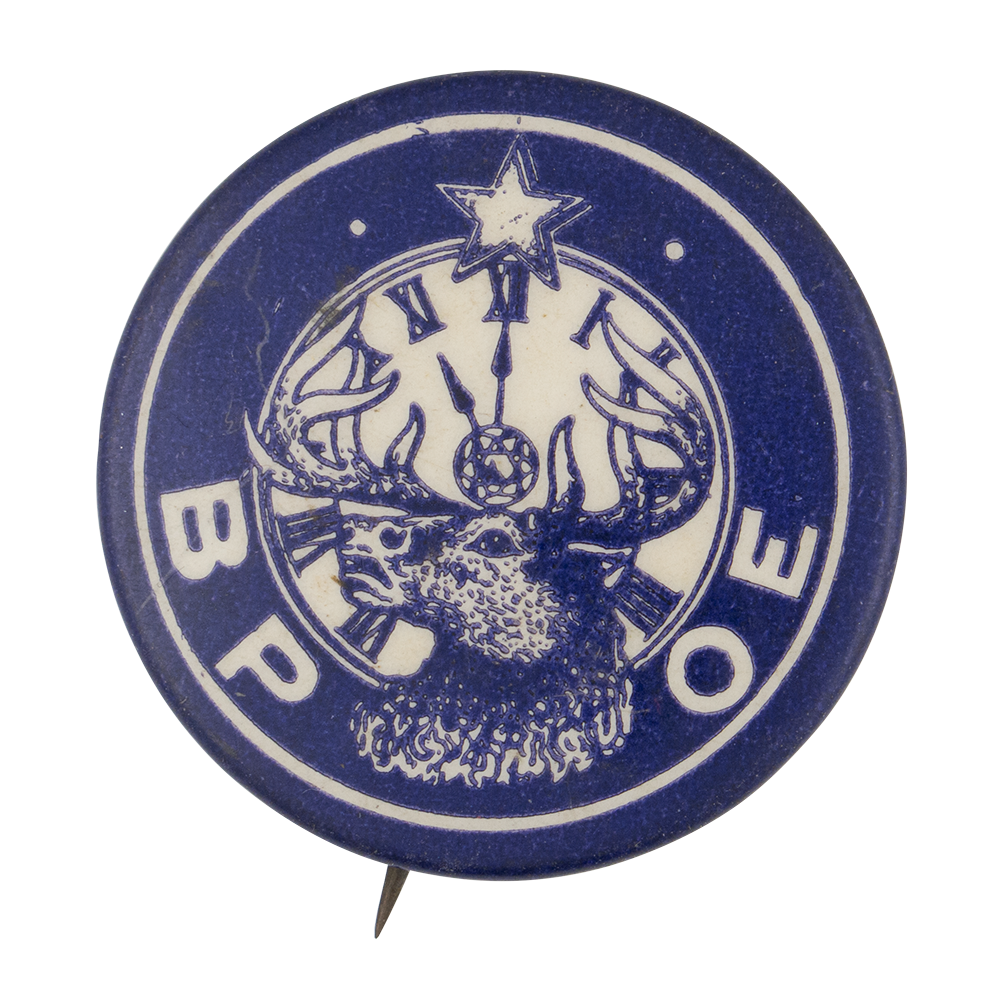
Text on Button B P O E
Image Description

Illustration of an elk over a clock face with a star above and white text on a purple outer background

Back Style
The Shape
The Size
Additional Information

The Benevolent and Protective Order of Elks of the United States of America was founded in New York City in 1868 as a fraternity for actors and entertainers. It is a non-political, non-sectarian society built on the virtues of charity, justice, brotherly love, and fidelity. They promote educational and patriotic community programs to enhance the welfare and happiness of both members of the fraternity and members of the community at large. As a charitable foundation, they also give millions of dollars to scholarships, athletic teams, veterans' programs, and other benevolent programs. 

Sources

BPO Elks. (2018). More information. Retrieved from https://www.elks.org/who/information.cfm.

Catalog ID CL0487

I Visited Bozo's Circus WGN TV

Category
Additional Images
Sub Categories
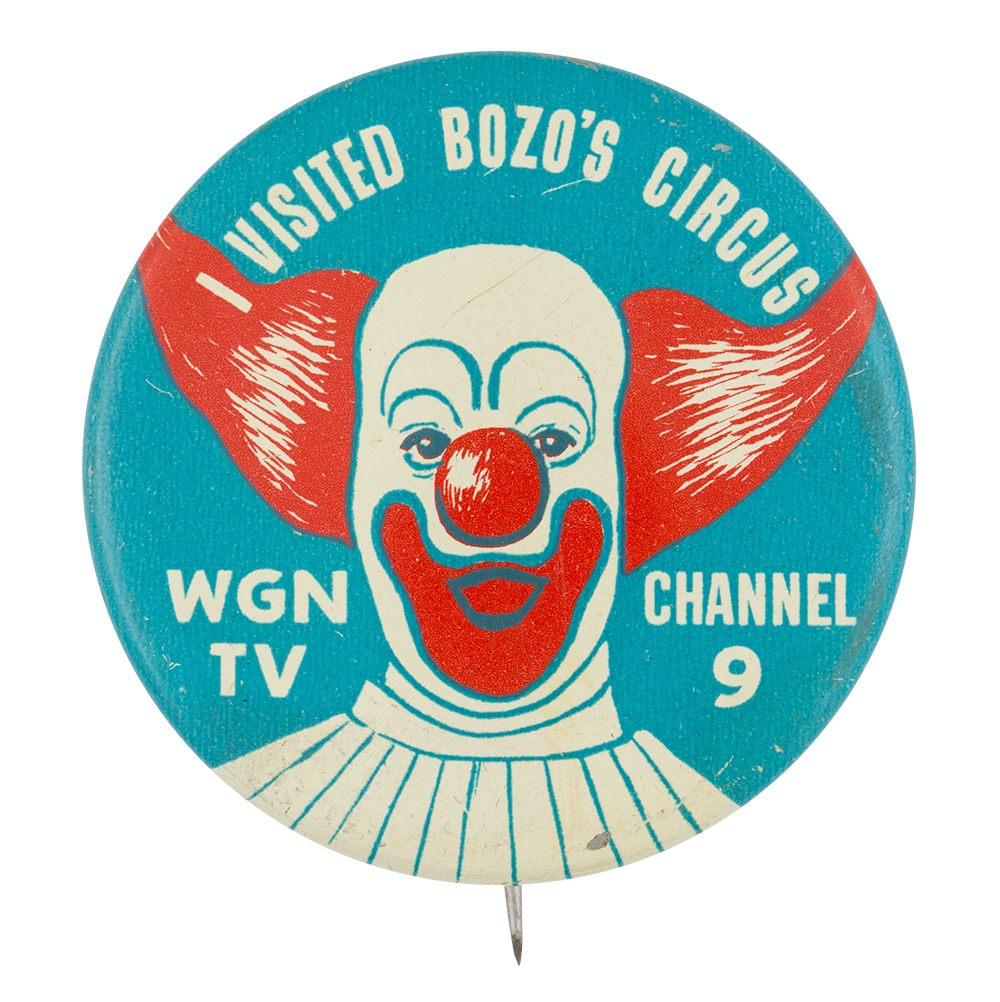
Text on Button I VISITED BOZO'S CIRCUS WGN TV CHANNEL 9
Image Description

Red, blue and white illustration of Bozo the Clown with white text on a blue background

Curl Text union bug
Back Style
The Shape
The Size
Additional Information

"Bozo’s Circus" was a children’s variety show produced in Chicago by WGN-TV, airing from 1961-1980. The show featured skits, circus performances, and games for a live studio audience. Buttons were given to audience members as souvenirs. The program and its alternate titles including "The Bozo Show" and "The Bozo Super Sunday Show" collectively aired from 1960-2001, marking it the most popular locally produced children’s program in the history of television. Bozo the Clown, the red-haired clown and show host, was played by Bob Bell from 1960-1984, then by Joey D’Auria from 1984-2001. 

Sources

Bozo's Circus (TV Series 1961–1980). (2018). Retrieved June 9, 2018, from https://www.imdb.com/title/tt0254011/

WGN KIDVID. (n.d.). Retrieved June 9, 2018, from http://www.chicagotelevision.com/wgntv.htm

(2016, May 15). Retrieved June 13, 2018, from https://youtu.be/1-w67OELBqs

Catalog ID CH0260