Reagan Schweiker A Winning Team

Category
Additional Images
Sub Categories
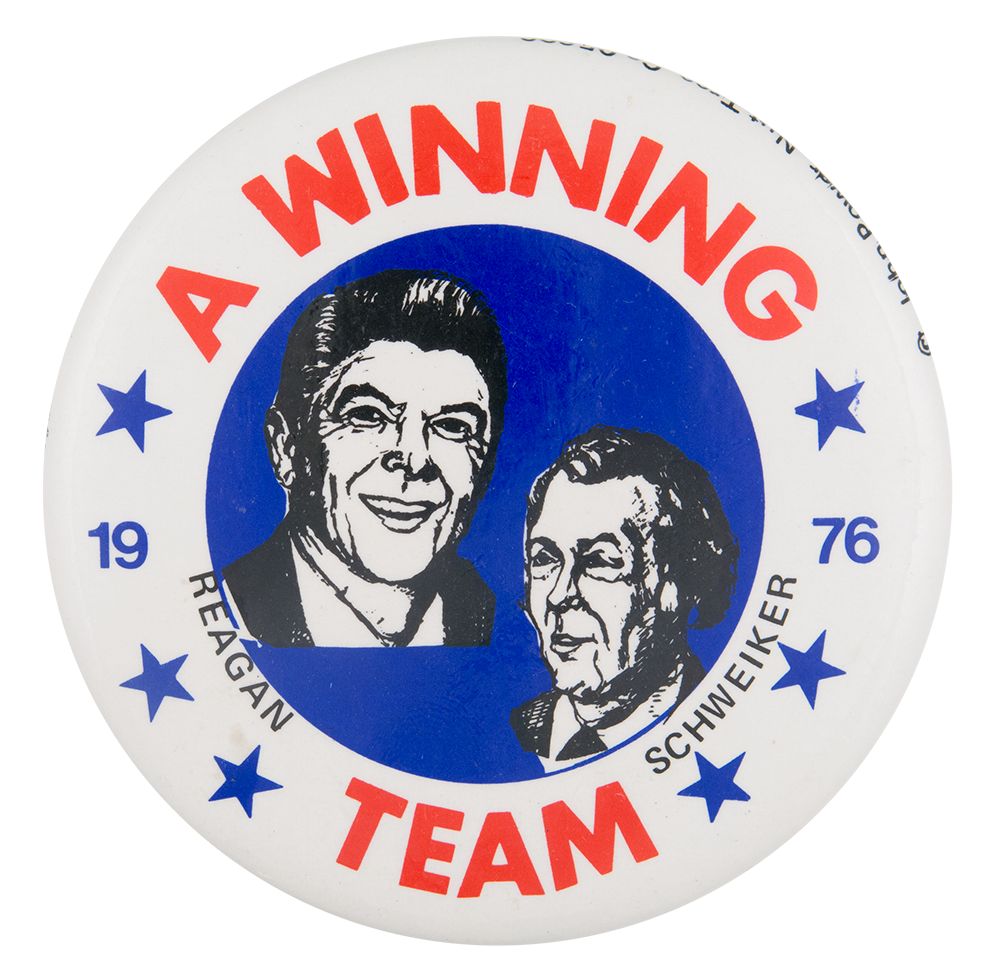
Text on Button A WINNING TEAM REAGAN SCHWEIKER 1976
Image Description

Illustrations of Ronald Reagan and Richard Schweiker inside a blue circle.  White outer border with red, black and blue text and blue 5-pointed stars.

Curl Text © John Power, Nut Tree, Ca 95688 (union bug) BUTTON WORKS 300 BROAD ST. NEVADA CITY, CA. 95959
Back Style
The Shape
The Size
Year / Decade Made
The Manufacturer
Additional Information

Ronald Reagan and Richard Schweiker ran for the Presidential and Vice Presidential Republican Party nomination in 1976. Before the opening of the Republican National Convention, Reagan named Richard Schweiker as his candidate for Vice President in an attempt to attract liberals and centrists. Schweiker was the senator of Pennsylvania with a moderate voting record in the Senate. When Reagan named Schweiker as his running mate it came as a surprise to Schweiker himself as the two did not known each other personally. Reagan and Schweiker lost the Presidential and Vice Presidential nominations to Gerald Ford and Bob Dole repsectively.

Catalog ID PO0763

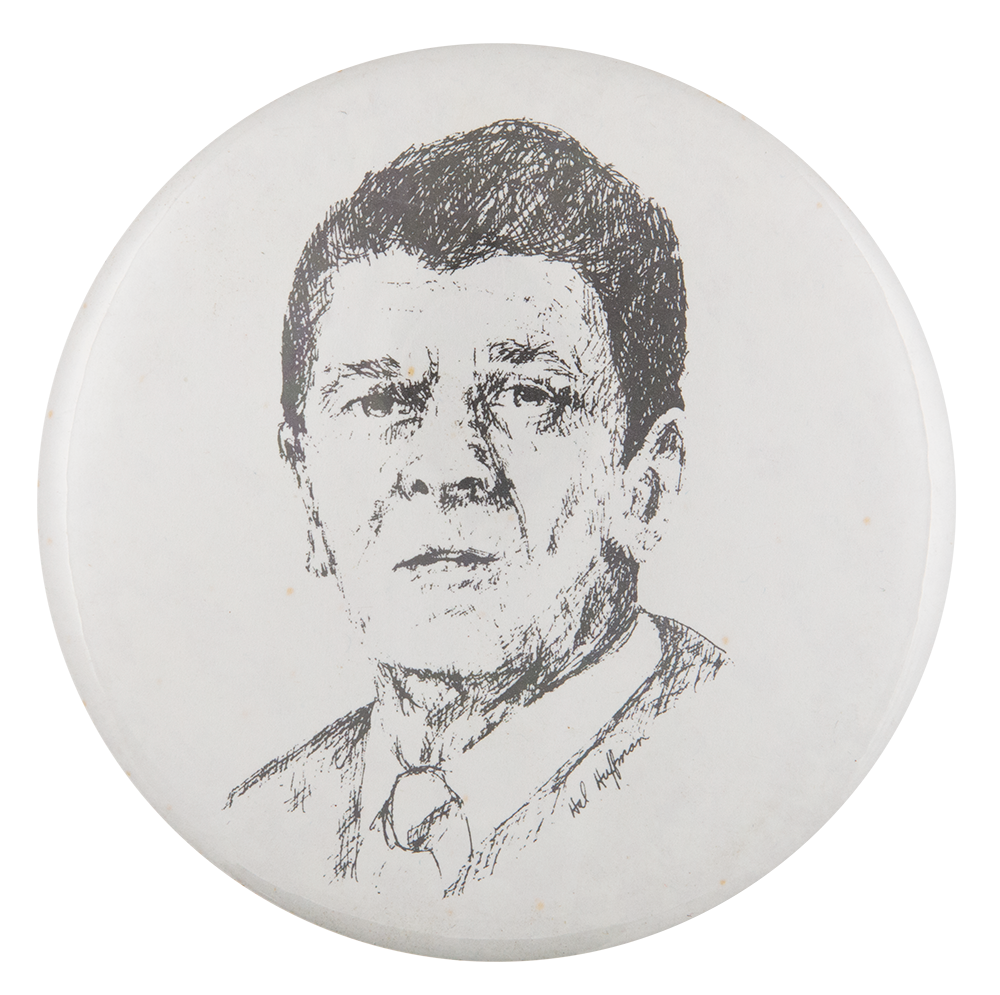
Reagan Illustration by Hal Huffman

Category
Additional Images
Sub Categories
Image Description

Black ink illustration of Ronald Reagan on a white background.

Curl Text Hal Huffman
Back Style
The Shape
The Size
Additional Information

Ronald Reagan was the 40th president of the United States. He served two terms from the years 1981-1989. Prior to becoming president, Reagan worked in Hollywood appearing in 53 films. His Hollywood career was put on hold when he was drafted after the bombing of Pearl Harbor in 1942. His film skills were put to use during his active duty as he assisted making air force training videos and documentaries.

His political views shifted from liberal to conservative after his time in active duty. This is when his political career began. In 1954, he became a television host for the General Electric Company. Off screen, General Electric had him give speeches about various conservative topics. He would travel to various General Electric plants to give speeches and connect with the employees on a personal level. This went on until 1962. In 1966, he was elected governor of California where he served two terms. He started campaigning for the Republican Party’s presidential candidate for the 1976 election. Reagan and his running-mate, George H. W. Bush, beat sitting president Jimmy Carter in a landslide victory in the 1980 election. Running as the incumbents in 1984, Reagan and Bush won 49 out of 50 states against former Vice President Walter Mondale. Reagan is remembered for his fiscal policies, also known as “Reaganomics,” and is often referenced as a hero-figure by the Republican Party.  

Sources

Life & times. Ronald Reagan Presidential Foundation & Institute. Retrieved from https://www.reaganfoundation.org/ronald-reagan/reagans-life-times/

Ronal Reagan. The White House. Retrieved from https://www.whitehouse.gov/about-the-white-house/presidents/ronald-reag…

Catalog ID PO0812

Reagan Dixon

Category
Additional Images
Sub Categories
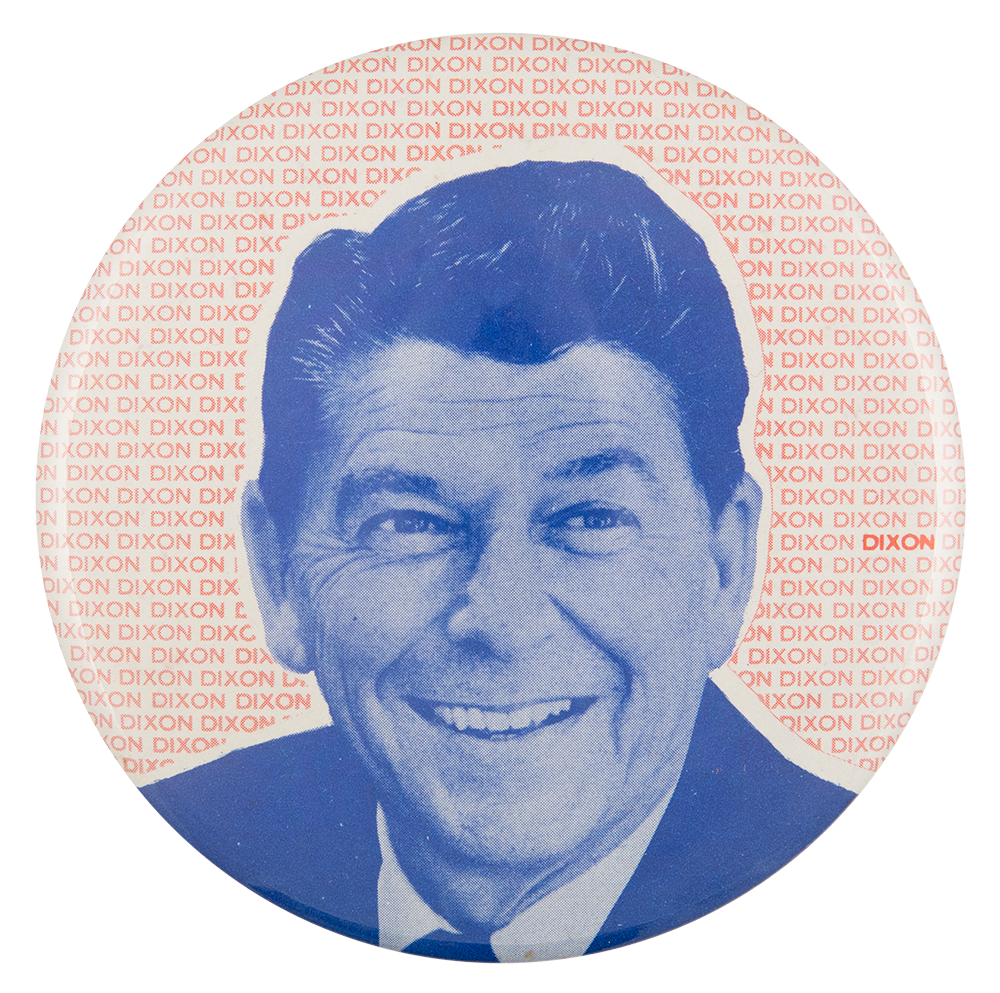
Text on Button DIXON
Image Description

Blue-tinted photograph of Ronald Reagan with the word 'DIXON' in red repeated over the entirety of the white background.

Back Style
The Shape
The Size
Additional Information

Before he was the 40th President of the United States, Governor of California, or even an actor, Ronald Reagan spent his time in Illinois. Born in 1911 in Tampico, Illinois, Reagan's poor family moved around the state many times. Finally, the family settled down in the town of Dixon in 1920. Reagan attended the local high school and graduated in 1928. He stuck around the area for college, attending Eureka University and graduating in 1932. Reagan finally left the area for Iowa, where he was hired to be a radio sports announcer.

Due to his origins in Illinois and the Presidency, many drew a comparison from Reagan to Abraham Lincoln during his campaigns. Lincoln served as a Senator for the state before rising to the Presidency. In 1955, the official state slogan of Illinois became "Land of Lincoln." Due to these similarities, the phrase was also applied to Ronald Reagan, resulting in "Illinois, Land of Reagan."

Sources

History. (2009, November 9). Ronald Reaganhttps://www.history.com/topics/us-presidents/ronald-reagan

State Symbols USA. (n.d.). Land of Lincolnhttps://statesymbolsusa.org/symbol-official-item/illinois/state-cultura…

Catalog ID PO0727

Reagan Country

Category
Additional Images
Sub Categories
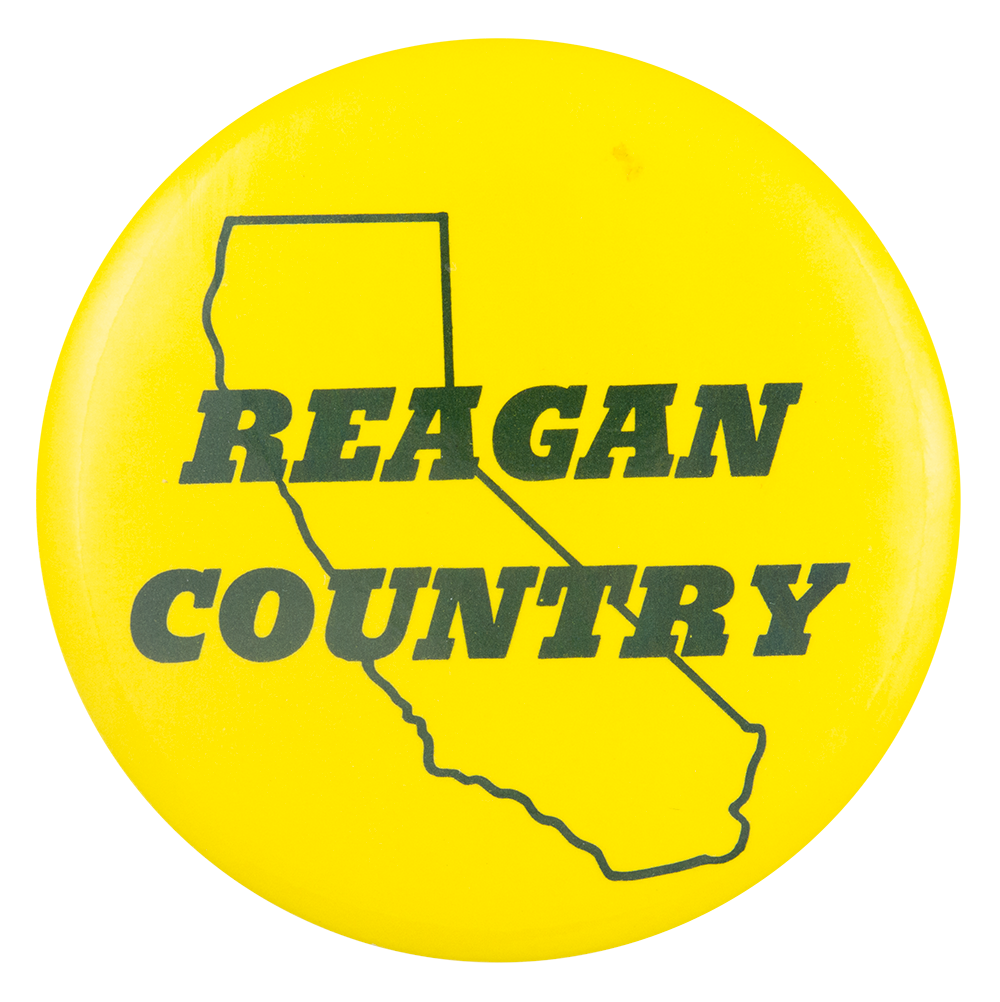
Text on Button REAGAN COUNTRY
Image Description

Outline of the state of California with superimposed text in dark green on a yellow background.

Back Style
The Shape
The Size
Additional Information

Before running for president, Ronald Reagan was the governor of California for two terms, from 1967-1975. Pat Brown, the incumbent and his opponent, tried to use Reagan’s career as an actor and lack of political experience against him. However, Reagan managed to win Californians over, promising to run the state more efficiently. In the 1980 and 1984 presidential elections, Reagan won more votes than his Democratic opponents and carried the state, though it was the last time a Republican presidential candidate would win the state. In later life, Reagan retired to his home in Los Angeles, which was no longer “Reagan Country.”

Sources

Krishnakumar, P., Emamdjomeh, A., and Moore, M. (2016, October 31). After decades of Republican victories, here’s how California became a blue state again. Los Angeles Times. Retrieved from https://www.latimes.com/projects/la-pol-ca-california-voting-history/

The Editors of Encyclopaedia Britannica. (2018). Ronald Reagan. Britannica Academic [database].  

Catalog ID PO0803

J.L.J. for the U.S.A.

Category
Additional Images
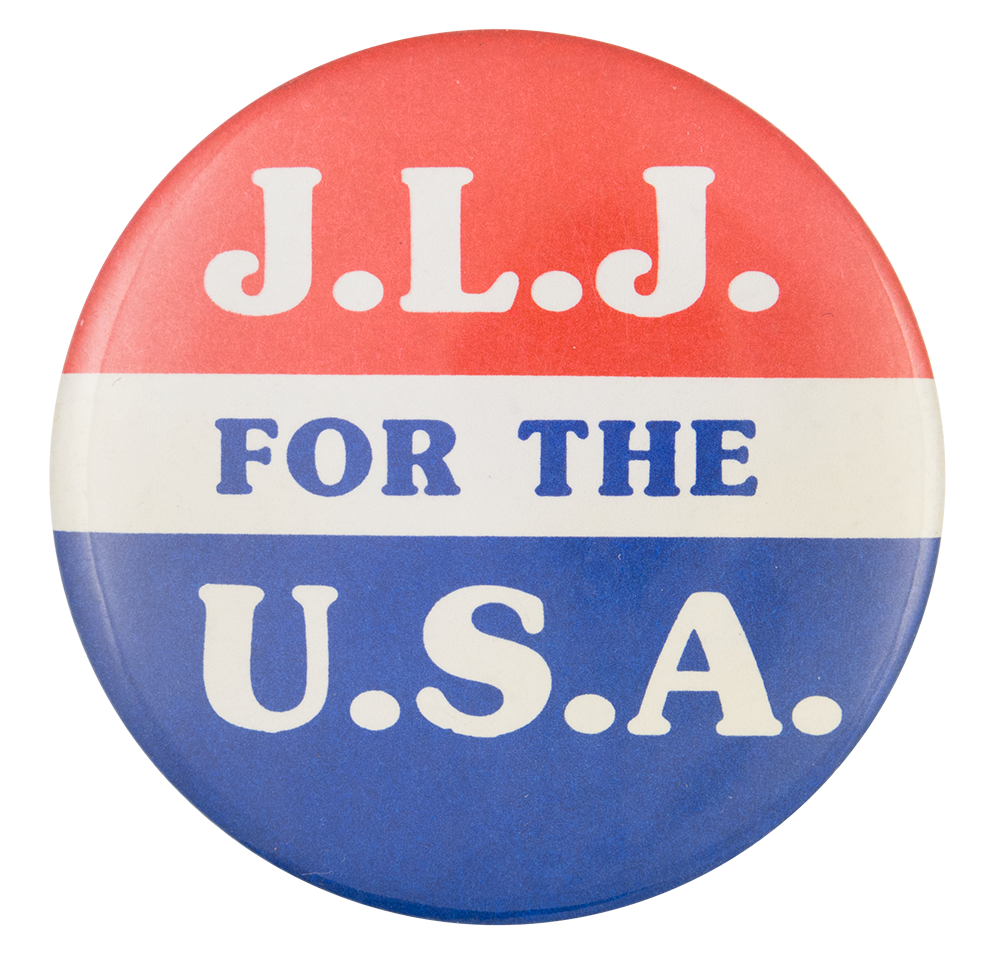
Text on Button J.L.J. FOR THE U.S.A.
Image Description

Red, white and blue horizontal stripes with white text.

Back Style
The Shape
The Size
Additional Information

Reverend Jesse Louis Jackson is a minister, civil rights activist, and politician who ran for President of the United States in 1984 and 1988 as a Democrat. He also founded organizations which became Rainbow/PUSH and hosted the show Both Sides with Jesse Jackson on CNN from 1992 to 2000. Jackson was also a U.S. Shadow Senator during the 1990s for the District of Columbia. He has garnered several awards related to this activism and public service work which includes the distinguished Presidential Medal of Freedom given by former President Bill Clinton. 

Sources

Jesse Jackson. (2018). Retrieved from https://en.wikipedia.org/wiki/Jesse_Jackson

Catalog ID PO0825

Jackson Cardiss Collins

Category
Additional Images
Sub Categories
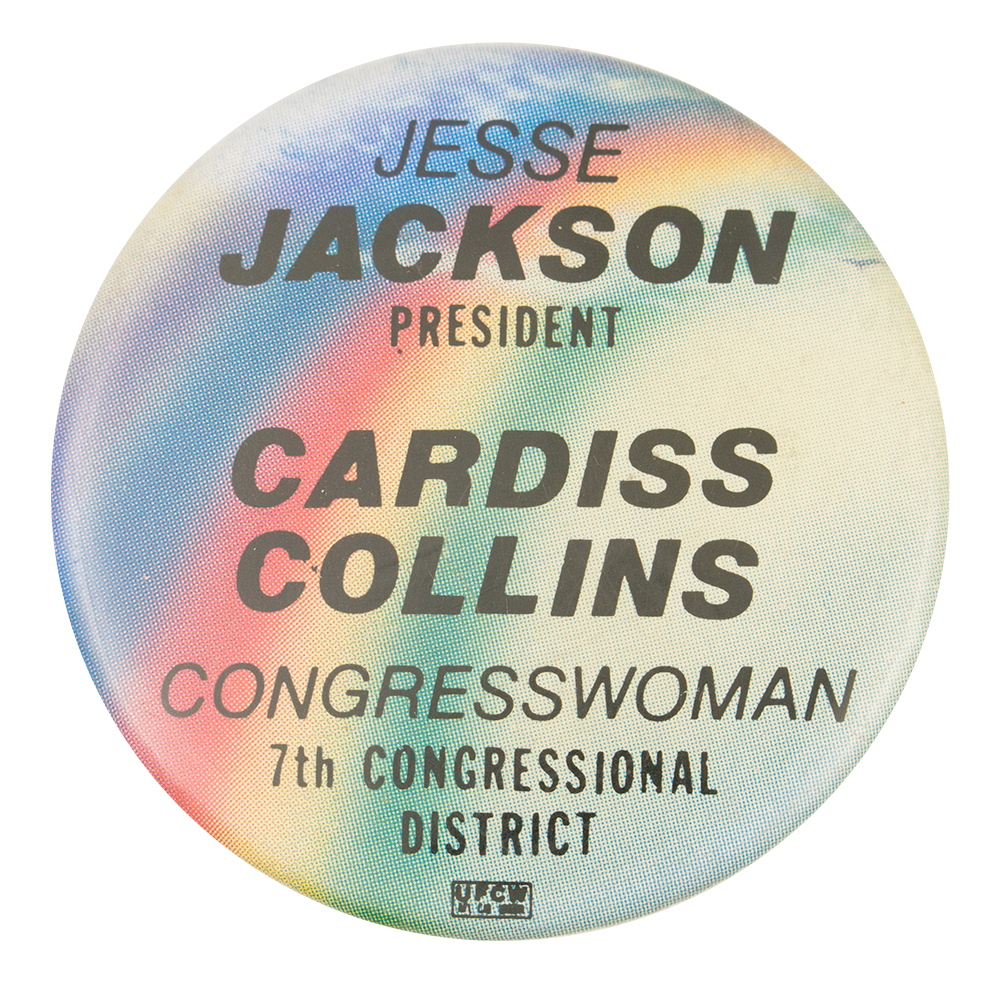
Text on Button JESSE JACKSON PRESIDENT CARDISS COLLINS CONGRESSWOMAN 7th CONGRESSIONAL DISTRICT (union bug)
Image Description

Black text on a rainbow gradient background.

Curl Text © 1982 GREENWOOD ENTERPRISES Magna-Buttons
Back Style
The Shape
The Size
Year / Decade Made
The Manufacturer
Additional Information

In 1988, Baptist minister and Democratic politician Jesse Jackson campaigned for the presidency for his second time. The noted activist’s first campaign in 1984 had put him in third place in the race for the Democratic Party’s nomination, which was much farther than many had believed he could go. Jackson’s 1988 platform was much the same as it had been in 1984, calling for a “Rainbow Coalition” of minorities, the LGBT community, and the poor. He also campaigned for an end to the War on Drugs, the creation of more jobs, and raising taxes on the wealthy. The campaign went well but was hindered by allegations of his brother’s criminal past. Jackson won second place in the race for the Democratic nomination, with first place going to Michael Dukakis who eventually lost the presidential election to George H. W. Bush. Jackson continued to serve in politics and social activism throughout the 2000s and 2010s. In 2023, he announced that he was stepping down from the Rainbow/PUSH organization—a non-profit founded by Jackson dedicated to promoting social justice and civil rights causes.

Sharing a similar message as Jackson, Illinois representative Cardiss Collins aligned herself with the presidential hopeful. Collins is a Democratic politician who served as a long-time representative for the state of Illinois. She was in office from 1973 to 1997 and became the first African-American congresswoman to represent the Midwest. She first entered the world of politics after she replaced her husband George, who died in a plane crash, as the representative of the state’s seventh congressional district. Throughout her time in Congress, she was a crusader for women’s rights and championed welfare issues.

Sources

Wikipedia. (2020, September 26). Cardiss Collins. https://en.wikipedia.org/wiki/Cardiss_Collins

Wikipedia. (2020, November 10). Jesse Jackson 1988 presidential campaign. https://en.wikipedia.org/wiki/Jesse_Jackson_1988_presidential_campaign

Catalog ID PO0844

Jimmy Carter Must Go

Category
Additional Images
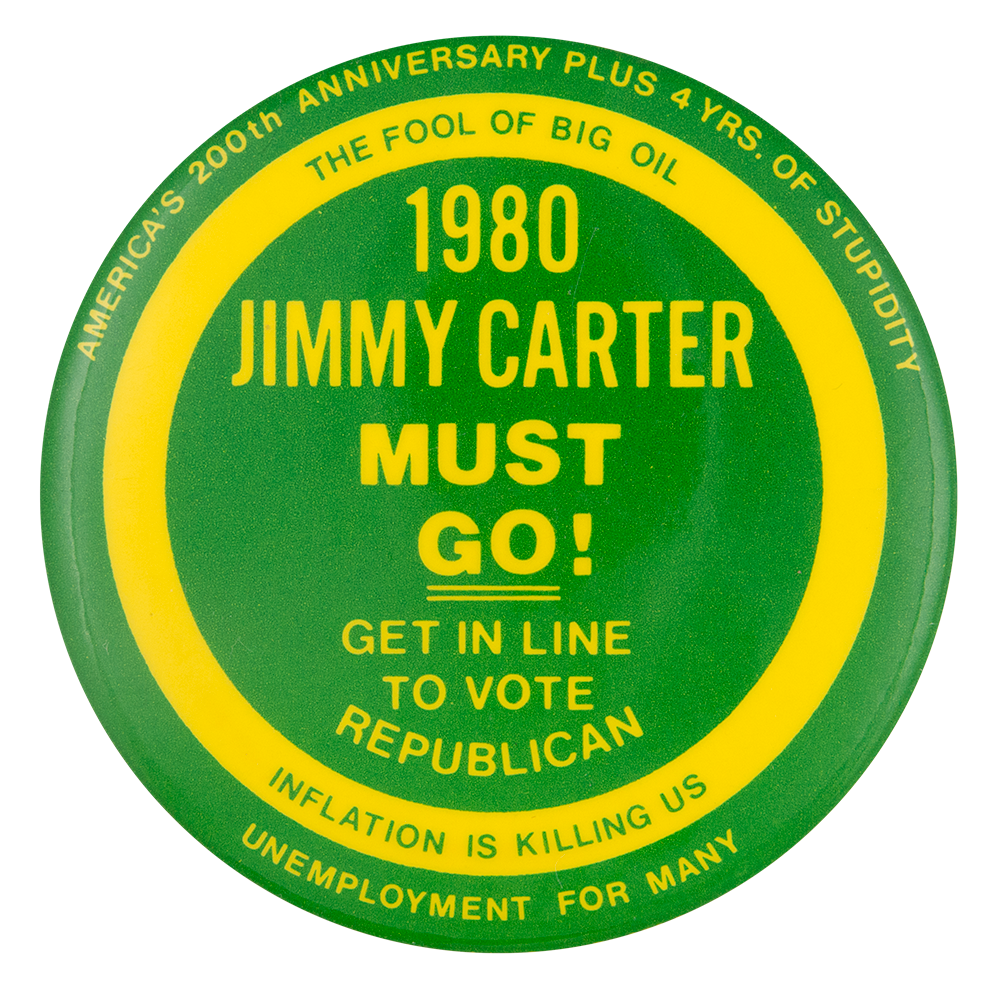
Text on Button 1980 JIMMY CARTER MUST GO! GET IN LINE TO VOTE REPUBLICAN THE FOOL OF BIG OIL INFLATION IS KILLING US AMERICA'S 200th ANNIVERSARY PLUS 4 YRS. OF STUPIDITY UNEMPLOYMENT FOR MANY
Image Description

Yellow text on a green background.  Green text inside yellow ring.

Curl Text Created by Dutchess Advt. Spec. Rt. 376 Poughkeepsie, N.Y. 12603
Back Style
The Shape
The Size
Year / Decade Made
The Manufacturer
Additional Information

The 1980 United States presidential election was a race between front-runner Ronald Reagan and incumbent president Jimmy Carter. “Carter Must Go” was a phrase used in promoting the Republican party, and the button seen here blatantly expresses qualms republican's had with decisions made during Carter’s presidency. Many republican advertisements didn’t promote a republican candidate, but rather presented a vote of no confidence in the current leadership at the time. Reagan went on to win the presidency in a landslide. 

Sources

Hibbs, D. A. Jr. (1982). President Reagan's mandate from the 1980 elections: a shift to the right? American Politics Quarterly, 10, 387-420. Retrieved from http://web.csulb.edu/~astevens/posc420/files/hibbs.html

Catalog ID PO0849

I'm for Me Senators' Party 1960

Category
Additional Images
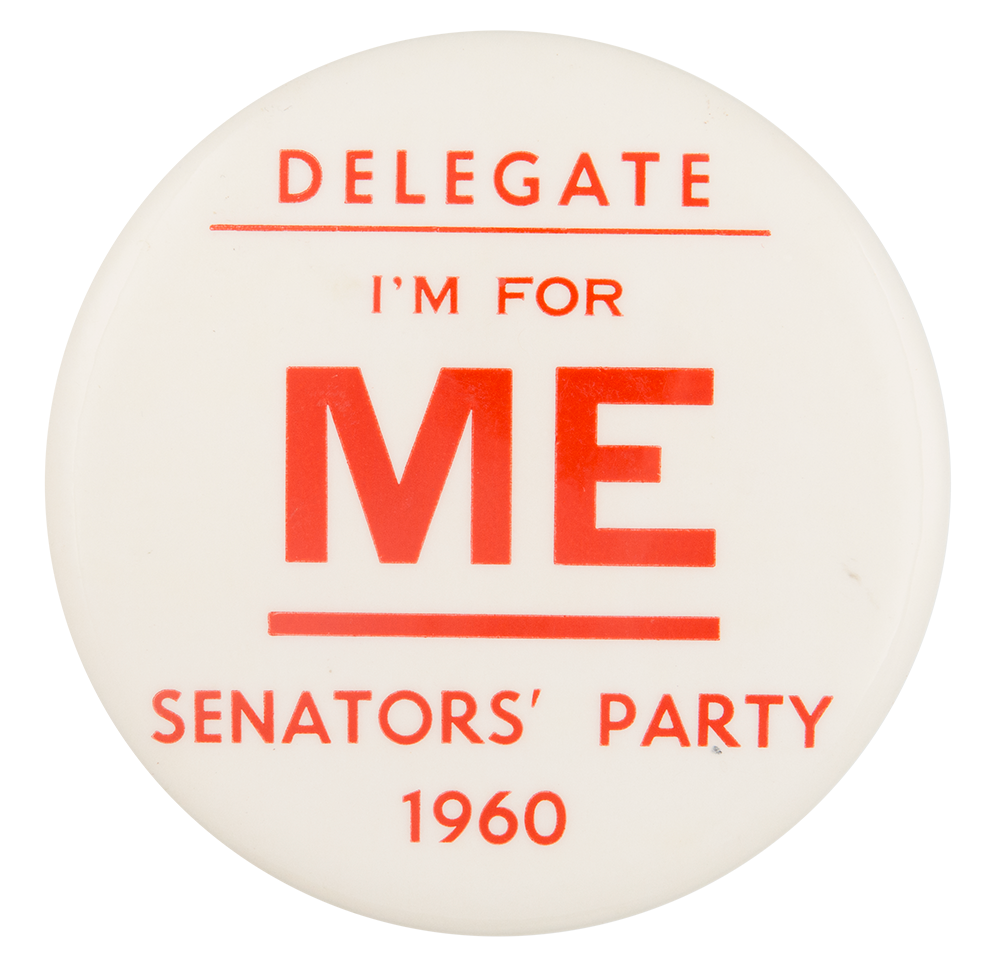
Text on Button DELEGATE I'M FOR ME SENATORS' PARTY 1960
Image Description

Red text on a white background.

Curl Text WENDELL - NORTHWESTERN INC. - MPLS MINN.
Back Style
The Shape
The Size
Year / Decade Made
Additional Information

The 1960 United States Senate election in Maine was historic. It was the first time in senate history that both major party candidates were women: popular Republican incumbent Margaret Chase Smith and Democratic contender Lucia Cormier. Smith had been elected in 1948, again in 1954, and was seeking her third term in 1960. That year Maine’s junior senator, Edmund Muskie, in a surprise twist, supported the opposing candidate. 

Cormier was a successful businesswoman and veteran state representative. She became Democratic floor leader in Maine’s State House of Representatives in 1959. The historic senate contest gained national attention when Senator Muskie escorted Cormier to the Senate Chamber, introduced her as “the next senator from Maine.” He urged her to take a seat at one of the historic desks. Smith complained it was a breach of Senate etiquette, and media frenzy began. 

Despite the accomplishments of both women, the press frequently derided their qualifications. They were pitted against each other as the “Widow v. Spinster.” However, the two women—who had worked together for years—were determined to be taken seriously. Referred to as the “Petticoat Race,” Margaret Chase Smith won the election by 62%.

Sources

U.S. Senate: Smith vs. Cormier, 1960. (n.d.) Smith vs. Cormier, 1960. Retrieved from  https://www.senate.gov/artandhistory/history/minute/Smith_vs_Cormier.ht….

Catalog ID PO0797

Gore Lieberman Hillary Liberal Party

Category
Additional Images
Sub Categories
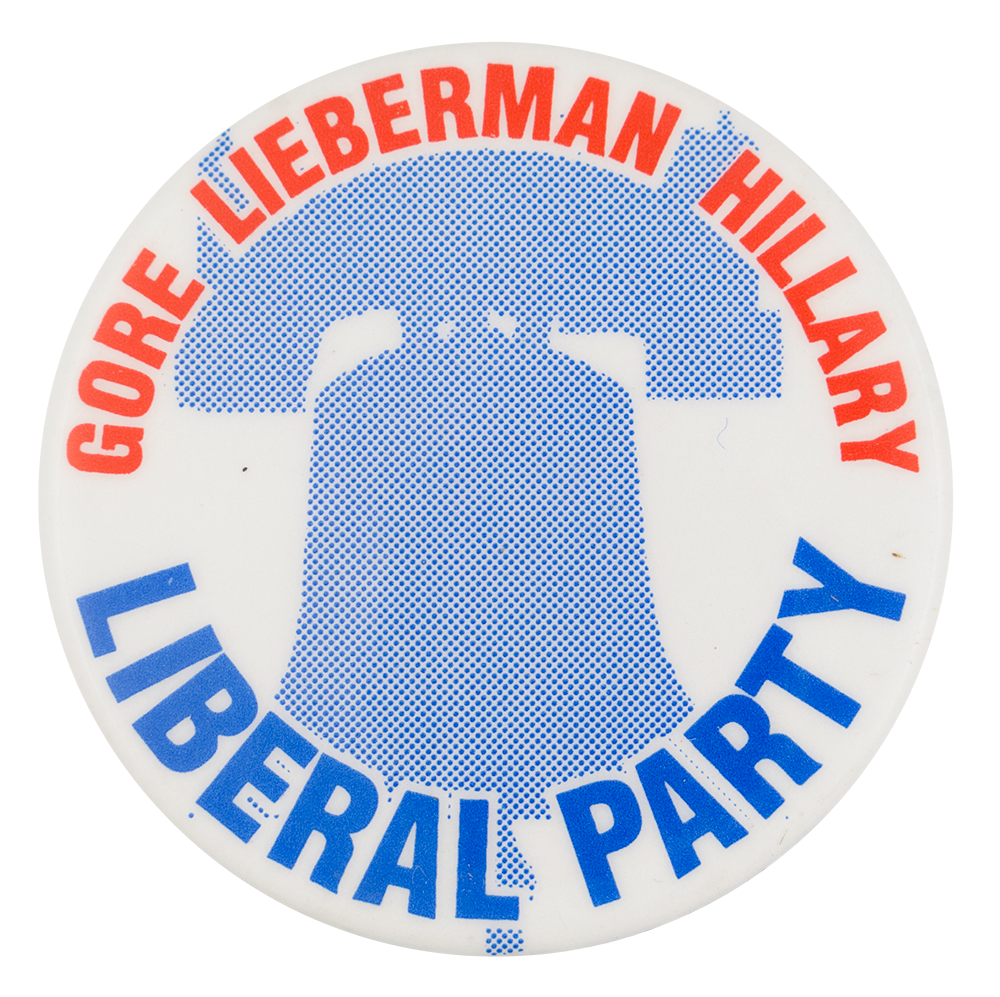
Text on Button GORE LIEBERMAN HILLARY LIBERAL PARTY
Image Description

Red and blue text on a white background.  Light blue silhouette illustration of the Liberty Bell.

Curl Text N.G. SLATER CORP. N.Y.C. 10011 (union bug)
Back Style
The Shape
The Size
Year / Decade Made
The Manufacturer
Additional Information

The Liberal Party, founded in 1944, is a minor political party in New York State. The party generally supports democratic candidates, but has been known to support more liberal republican candidates as well. In the case of the 2000 U.S. presidential election, the Liberal Party supported the democratic ticket of former vice president Al Gore and his running mate, Joe Lieberman—the first Jewish man to be on the presidential ticket for a major American political party. Gore and Lieberman campaigned along with former first lady Hillary Clinton (who was running to represent New York in the U.S. Senate), and regularly attended rallies and other election-related events together.

When Al Gore chose Lieberman—a more conservative democrat who would eventually become an Independent—as his running mate, there were great hopes the choice would boost democratic support in New York, and undermine republican George W. Bush’s efforts to make inroads in the traditionally democratic stronghold of the Northeast.

The election was one of the closest in U.S. presidential history, and sparked a months-long investigation into the legitimacy of the results that was eventually decided in favor of Bush by the U.S. Supreme Court. Gore and Lieberman received more popular votes, but were defeated 271 to 266 in the Electoral College. Hillary Clinton was elected as senator from New York on November 8, 2000.

Sources

2000 PRESIDENTIAL ELECTION PINS GORE,LIEBERMAN,HILLARY | eBay. Retrieved 16 February 2021, from https://www.ebay.com/itm/2000-PRESIDENTIAL-ELECTION-PINS-GORE-LIEBERMAN…

About 1199SEIU. Retrieved 16 February 2021, from https://www.1199seiu.org/about

Benson, J. (2000). Lieberman Choice Causes Big Tsouris in New York Race. The Observer. Retrieved from https://observer.com/2000/08/lieberman-choice-causes-big-tsouris-in-new…

Liberal Party | political party, United States. (2021). Retrieved 16 February 2021, from https://www.britannica.com/topic/Liberal-Party-political-party-United-S…

The New York Times. (2000). Hillary Clinton Elected to Senate From New York. Retrieved from https://www.nytimes.com/2000/11/08/politics/hillary-clinton-elected-to-…

Rauch, R. Joseph Lieberman | American politician. Retrieved 16 February 2021, from https://www.britannica.com/biography/Joseph-Lieberman

United Press International (UPI). (2021). GORE, HILLARY AND LIEBERMAN CAMPAIGN IN NEW YORK. Retrieved from https://www.upi.com/News_Photos/view/upi/38501a31f43d7381cf67997b5174c9…

Catalog ID PO0835

Give 'em Hell Hillary

Category
Additional Images
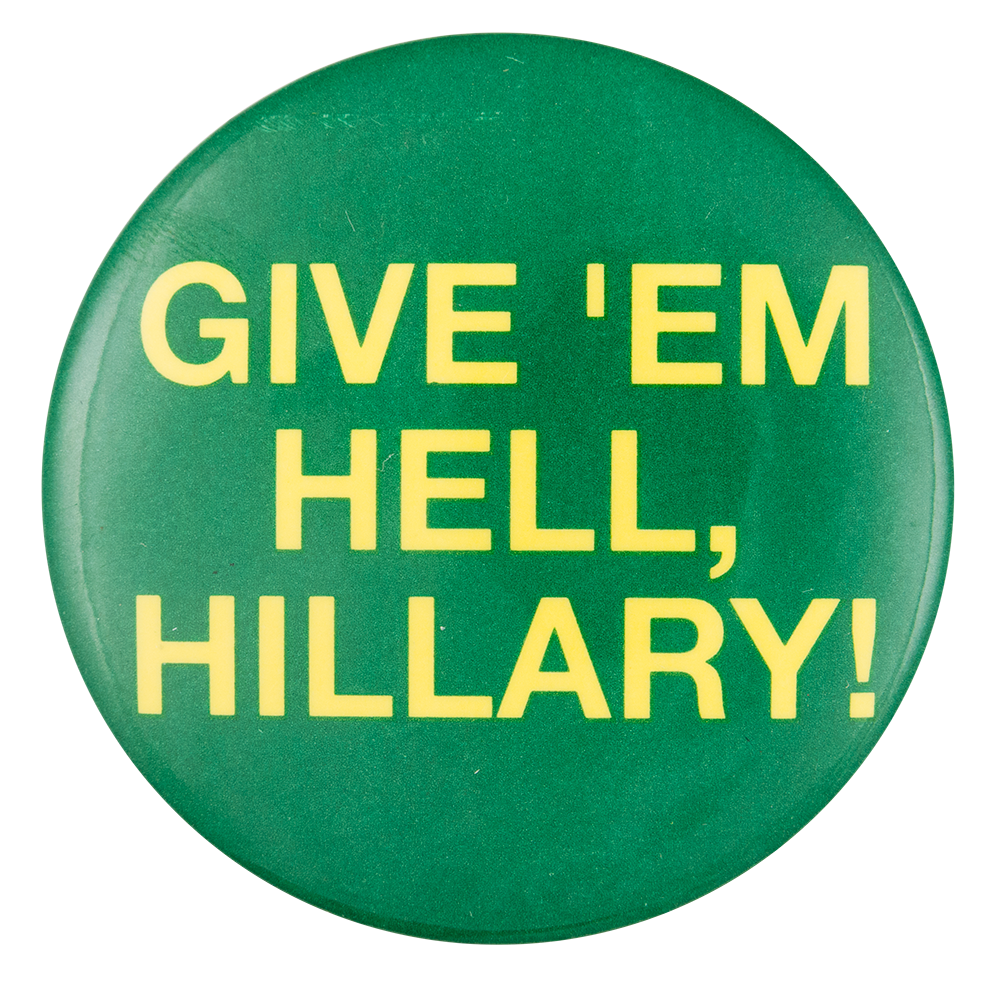
Text on Button GIVE 'EM HELL, HILLARY!
Image Description

Yellow text on a green background.

Curl Text 1-800-257-2340 OFFICIAL SOUVENIR © (union bug)
Back Style
The Shape
The Size
Additional Information

The slogan, "Give 'em Hell, Harry"  comes from Harry Truman's presidential campaign in 1948. The media was predicting that he would lose to his opponent, Dewey. Truman's approval rating when he was President after FDR died was low and newspapers were already printing issues with Dewey as the winner of the election on the front page, but Truman ended up winning. His win may have been due to his tactic of attacking the "do-nothing" Republican dominated Congress of that period. Instead of attacking his opponent during the campaign, he continuously brought up the shortcomings of Congress while he was President.

"Give 'em Hell, Hillary" was adapted as a slogan for Hillary Clinton's campaign for President in 2016. This suggests that Secretary Clinton was in a similar position as Truman and utilized the same campaign tactics.

Sources

Mende, B. (2016). Memo To Hillary Clinton: Forget Trump - Steal A Page From Truman, Instead. Retrieved from http://www.wbur.org/cognoscenti/2016/08/05/republican-congress-gridlock….

Catalog ID PO0813