Libertarian Republicans

Category
Additional Images
Sub Categories
Text on Button Libertarian Republicans DON'T TREAD ON ME
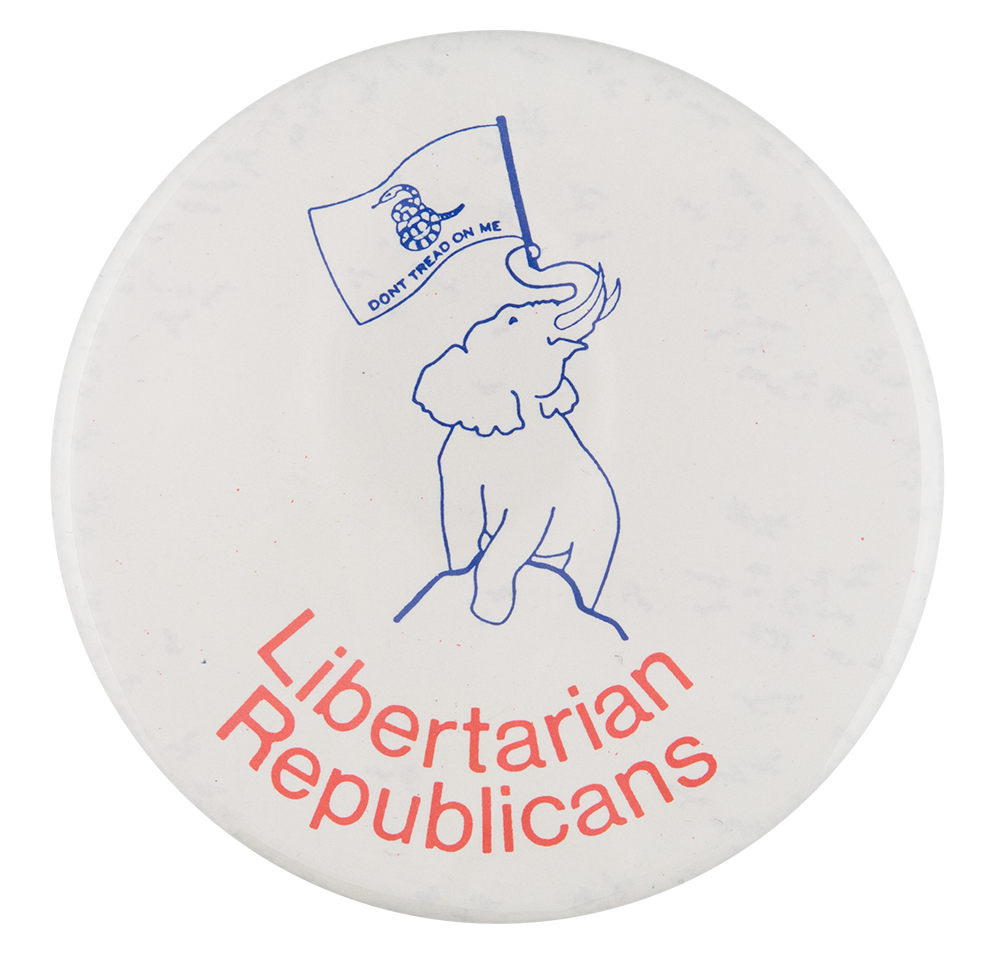
Image Description

Illustration of elephant cresting a hill while holding a flag in its trunk above its head.  Red text on white background.

Back Style
The Shape
The Size
Additional Information

Libertarian Republicans usually belong to the Republican Party and advocate libertarian policies. They may vote for Libertarians or Republicans in state and federal elections. Libertarian Republicans support cutting taxes, abortion rights, fewer regulations, the protection of gun rights, and they support repealing the Patriot Act and Affordable Care Act. Additionally they oppose the War on Drugs and the death penalty.

This button depicts an elephant, the Republican Party mascot, holding the Gadsden flag which shows a rattlesnake and the motto "Don't Tread on Me." This flag is a symbol of American patriotism, disagreement with government, and the support of civil liberties, a message that aligns with Libertarian Republican values of personal freedom.

Sources

Frequently Asked Questions. (n.d.). Retrieved March 22, 2019, from https://www.lp.org/faq/

Catalog ID PO0792

New York Democrats are for Al Gore

Category
Additional Images
Sub Categories
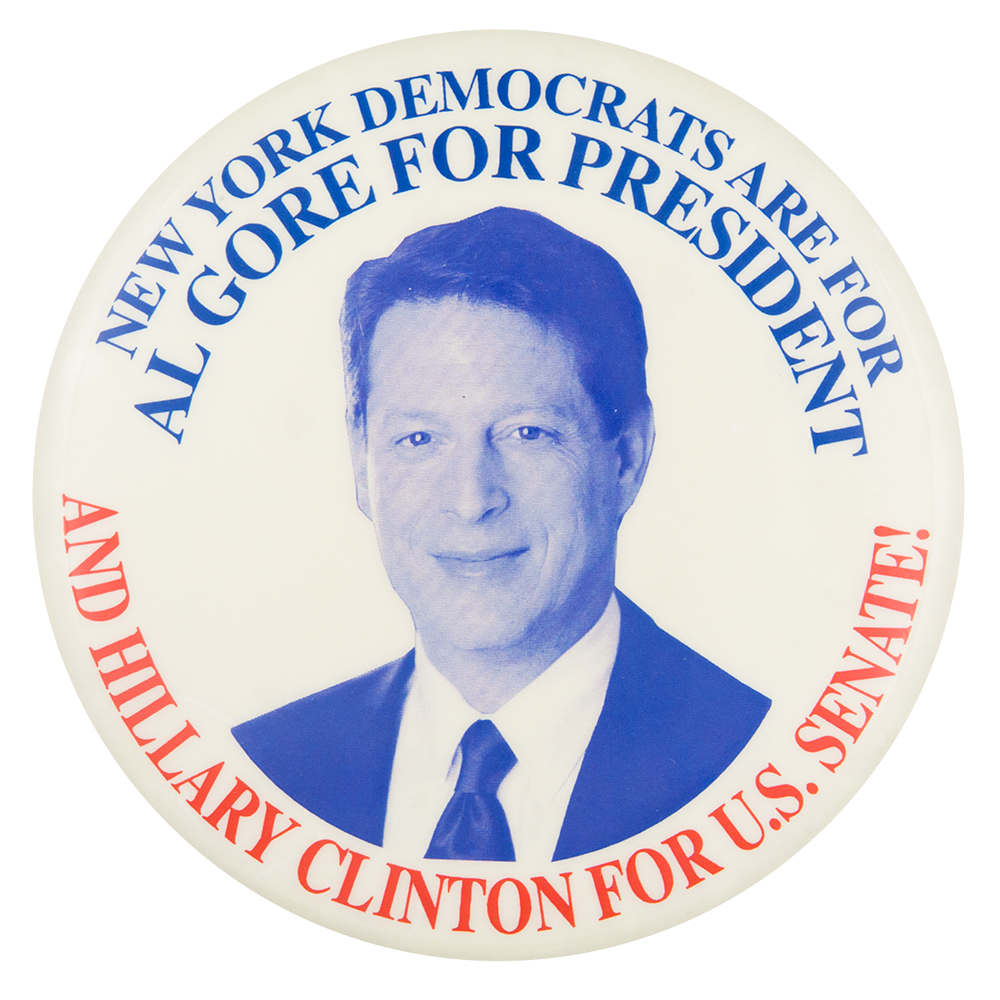
Text on Button NEW YORK DEMOCRATS ARE FOR AL GORE FOR PRESIDENT AND HILLARY CLINTON FOR U.S. SENATE!
Image Description

Blue-tinted photograph of Al Gore on a white background with blue and red text along edge of button.

Curl Text (union bug)
Back Style
The Shape
The Size
Year / Decade Made
Additional Information

In 2000, Democratic New Yorkers wanted Al Gore for President of the United States and Hillary Rodham Clinton as a U.S. Senator. Gore ultimately lost the election to George W. Bush by 5 electoral votes, but Clinton was successfully elected to the Senate. 

Catalog ID PO0794

Now is the Time Jesse Jackson

Category
Additional Images
Sub Categories
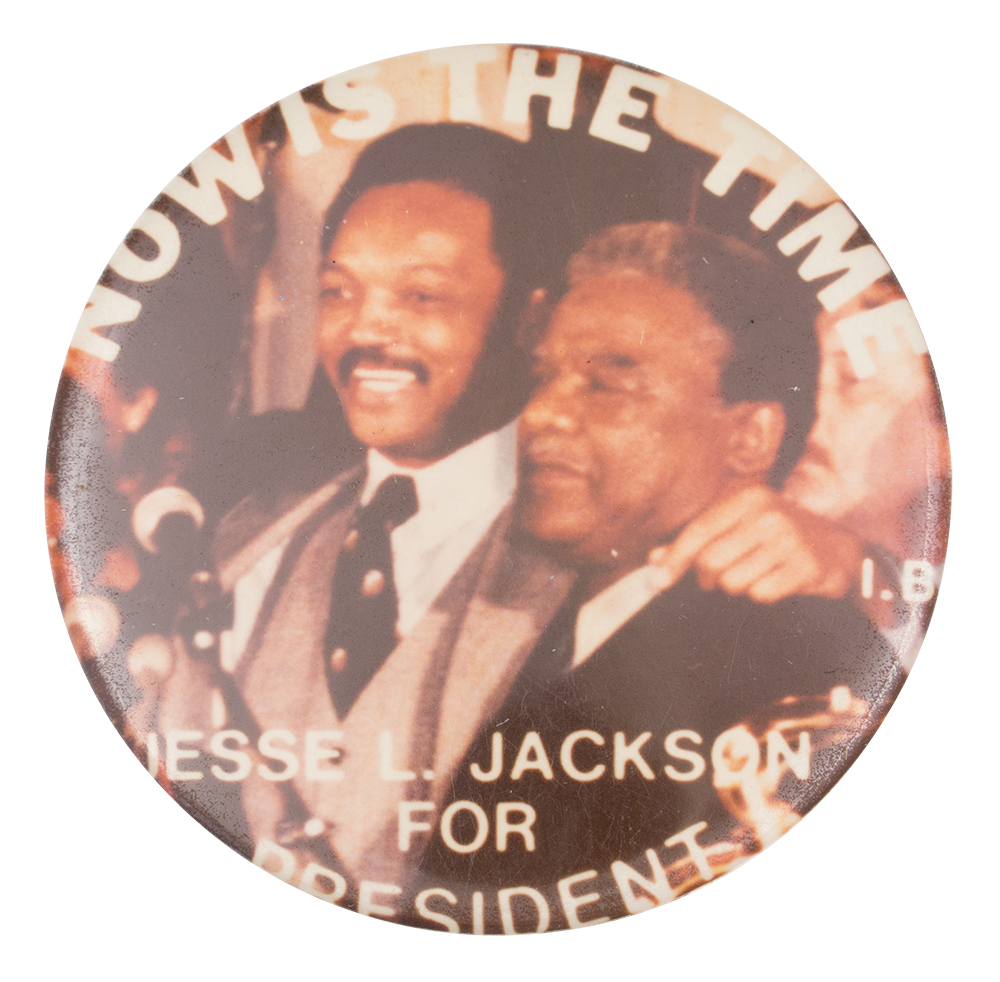
Text on Button NOW IS THE TIME JESSE L. JACKSON FOR PRESIDENT I.B.
Image Description

Photograph of Jesse Jackson smiling, with his arm around the shoulder of Harold Washington with superimposed white text.

Back Style
The Shape
The Size
Additional Information

Reverend Jesse Jackson in 1988 decided once again to get involved in politics and try to secure the Democratic nomination. He had tried once prior in 1984 and managed to secure 18 percent of the vote in the primaries. His 1988 campaign would also end in a loss, but he did win 11 primaries and secured 20 percent of the vote. In order to help him secure votes in Illinois, he secured the endorsement of Chicago Mayor, Harold Washington. Jackson struggled to gain a unified black vote in the 1984 primaries, with many politicians not aligning with him. This move by Washington helped to signify a change in black politicians' relationship with Jackson.

Sources

History. (2009, November 9). Jesse Jackson. https://www.history.com/topics/black-history/jesse-jackson

Oreskes, M. (1987, September 9). Chicago's mayor endorses Jackson. The New York Times. https://www.nytimes.com/1987/09/09/us/chicago-s-mayor-endorses-jackson…

Catalog ID PO0837

Public Service Integrity-Dedication

Category
Additional Images
Sub Categories
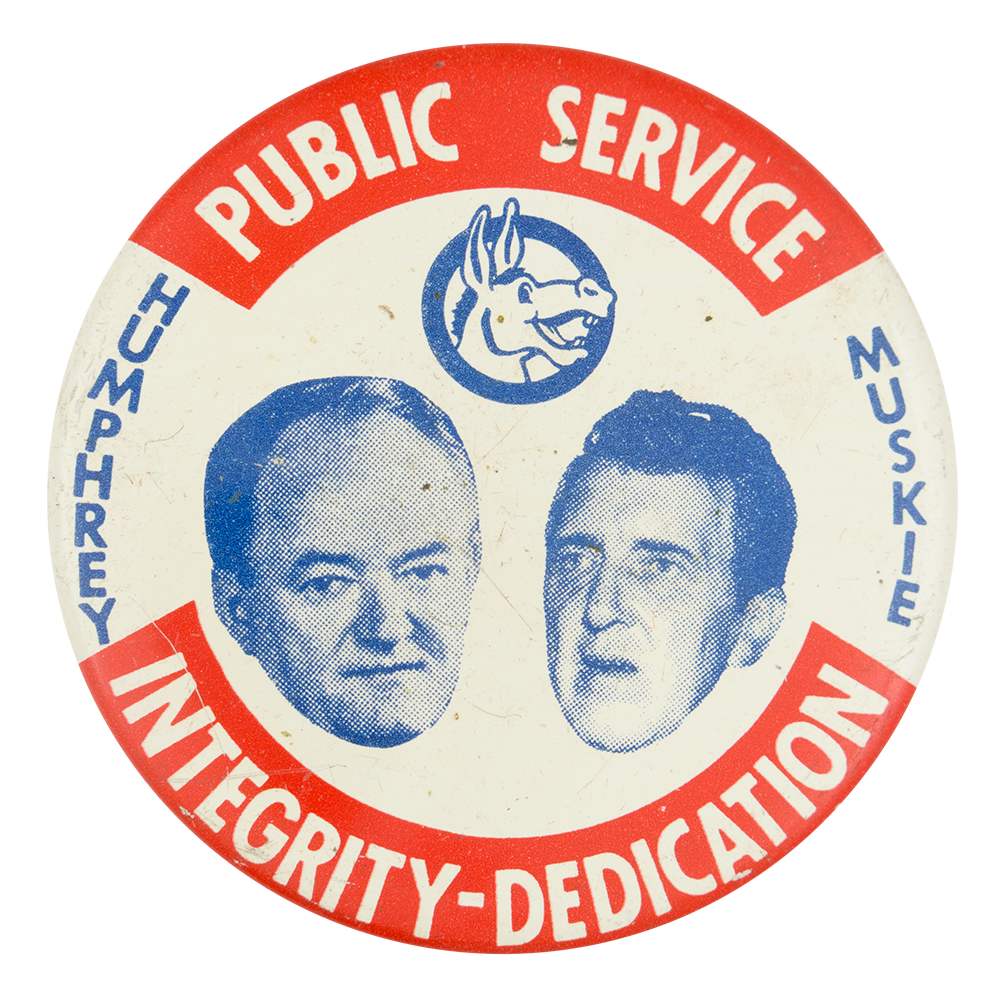
Text on Button PUBLIC SERVICE INTEGRITY - DEDICATION HUMPHREY MUSKIE
Image Description

Blue-tinted photographs of the heads of Hubert Humphrey and Edmund Muskie on a white background.  Illustration of a braying donkey's head inside a circle is above them.  Portions of the outer edge of button are red with white text, and white with blue text.

Curl Text (union bug)
Back Style
The Shape
The Size
Additional Information

After U.S. President Lyndon B. Johnson decided not to run for re-election in 1968, Hubert Humphrey launched his campaign and secured the Democratic Party's nomination for president. His running mate was Maine Senator Edmund Muskie. The assassinations of Robert Kennedy and civil rights leader Martin Luther King, Jr. combined with increased opposition to the Vietnam War were harmful to the Humphrey/Muskie ticket, and they ultimately lost to Richard Nixon in the general election. 

After the 1968 election, Humphrey taught at Macalester College and the University of Minnesota before returning to the Senate in 1976, where he remained until his death in 1978. Muskie was a candidate for the Democratic presidential primaries in 1972 and returned to the Senate in 1974 before serving as Secretary of State under President Jimmy Carter from 1980 to 1981. 

Sources

Brenes, M. (2018, March 23). The tragedy of Hubert Humphrey. New York Times. https://www.nytimes.com/2018/03/23/opinion/vietnam-hubert-humphrey.html

Catalog ID PO0807

Reagan Bush '84 with Lights

Category
Additional Images
Sub Categories
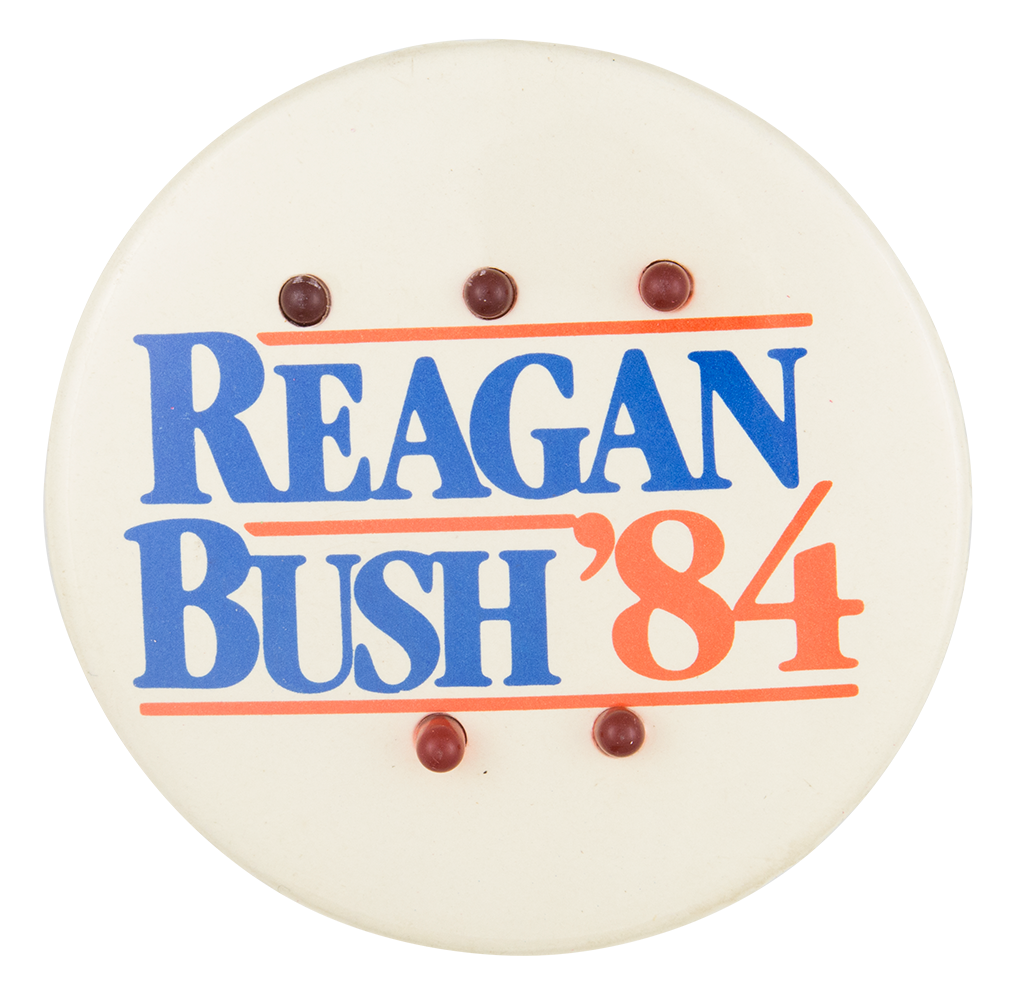
Text on Button REAGAN BUSH '84
Image Description

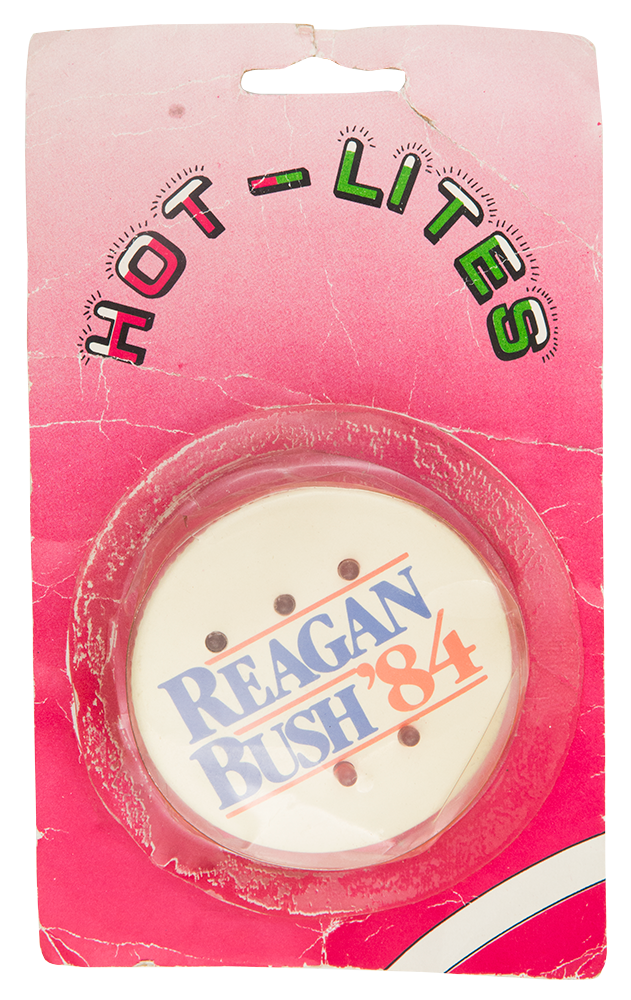
Blue and red text with red horizontal lines and 5 embedded LED lights on a white background.

Back Paper / Back Info

E/W NOV. INC.
P.O.B. 9251
VAN NUYS CA 91409
PAT. PEND.

Back Style
The Shape
The Size
Year / Decade Made
The Manufacturer
Additional Information

In the 1984 presidential election incumbent President Ronald Reagan and Vice President George H.W. Bush faced former Vice President Walter Mondale and New York Representative Geraldine Ferraro. President Reagan pointed to his strong economic recovery from stagflation and the 1981 recession and the renewed national confidence and prestige his presidency had overseen. The Reagan campaign advertised and effectively neutralized any concerns regarding Reagan’s age. Reagan and Bush were successful on Election Day and won 49 out of 50 states in a landslide victory against Mondale and Ferraro.

Catalog ID PO0871

Choose or Lose

Category
Additional Images
Sub Categories
Text on Button MTV CHOOSE OR LOSE 2004 20 MILLION LOUD MTV.COM
Image Description

Red and blue text and 5-pointed stars on a white background.  Black-colored illustration of an unfurled scroll with white text.

Back Style
The Shape
The Size
Year / Decade Made
Additional Information

On January 14, 2004, MTV launched the "Choose or Lose 2004" campaign to encourage 20 million people between the ages 18 and 30 to vote in the 2004 presidential election. They partnered with other organizations, such as Rock the Vote, Meetup.com, and the NAACP throughout the year to host events and educational forums to help voters learn more about the democratic process and make informed voting decisions. The event ended in Fall 2004 with the online "PRE-Lection", in which participants submitted votes to declare their choice for the President of the United States.

Sources

MTV News Staff. (2004, January 1). "20 Million Loud" launches today [weblog]. Retrieved from http://www.mtv.com/news/1484712/20-million-loud-launches-today/

Catalog ID PO0864

Carter Hartke '76

Category
Additional Images
Sub Categories
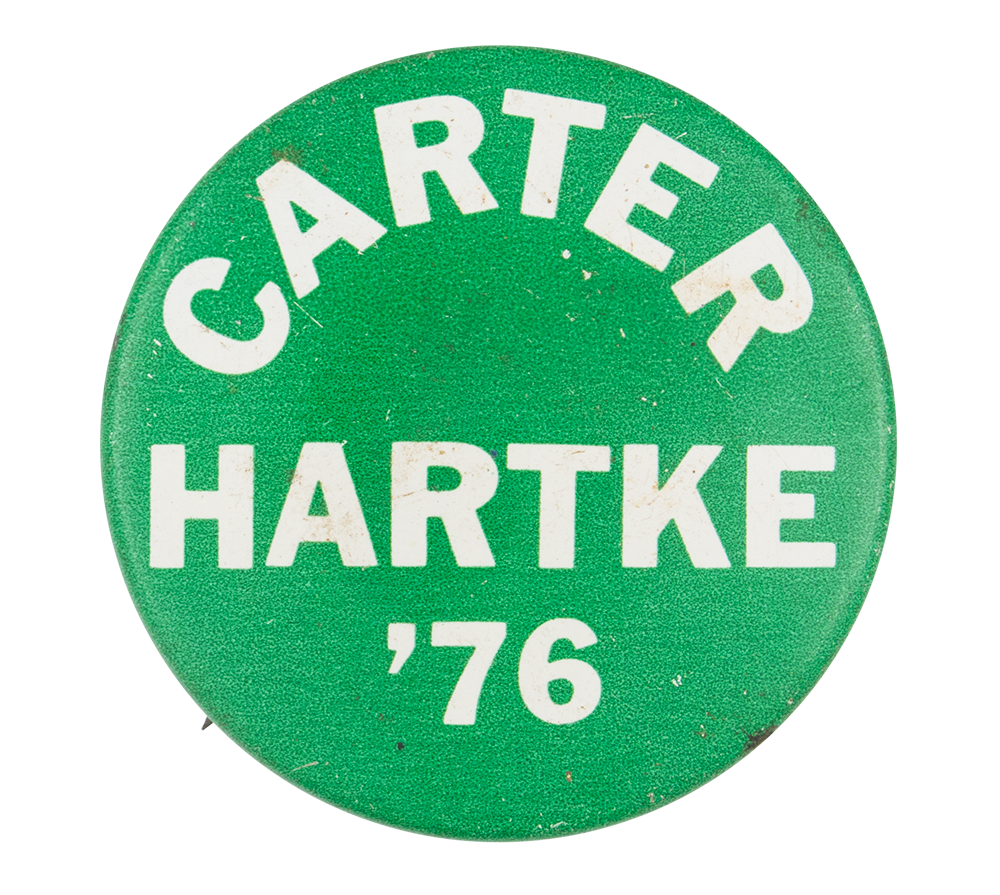
Text on Button CARTER HARTKE '76
Image Description

White text on the top edge of the button, white text across the center, white text on the bottom on a green background.

Curl Text (union bug) (union bug)
Back Style
The Shape
The Size
Year / Decade Made
Additional Information

Jimmy Carter was the Democratic nominee for the United States Presidency in 1976, and Democrat Vance Hartke from Indiana ran for re-election to the U.S. Senate in the same year.

Carter won the popular vote at 50.1 percent and took 297 electoral votes over Republican Gerald Ford. Carter served as the 39th president from 1977 to 1981. He lost the 1980 race to President Ronald Reagan. Prior to his first run for president, Carter grew up in Plains, Georgia, where his family had a peanut farm. He served in the U.S. Navy from 1943 to 1953. He was a Georgia State Senator from 1963 to 1967 and the Governor of Georgia from 1971 to 1975. Following their time in the White House, Carter and his wife, Rosalynn, returned to Plains. Carter was awarded the Nobel Peace Prize in 2002.

Hartke served as a U.S. Senator from Indiana from 1959 until 1977 and was known for his opposition to the Vietnam War. Richard Lugar defeated Hartke in the 1976 Senate race. Hartke also ran in the 1972 Democratic presidential primaries but withdrew.

Catalog ID PO0717

Another New Yorker for Hillary

Category
Sub Categories
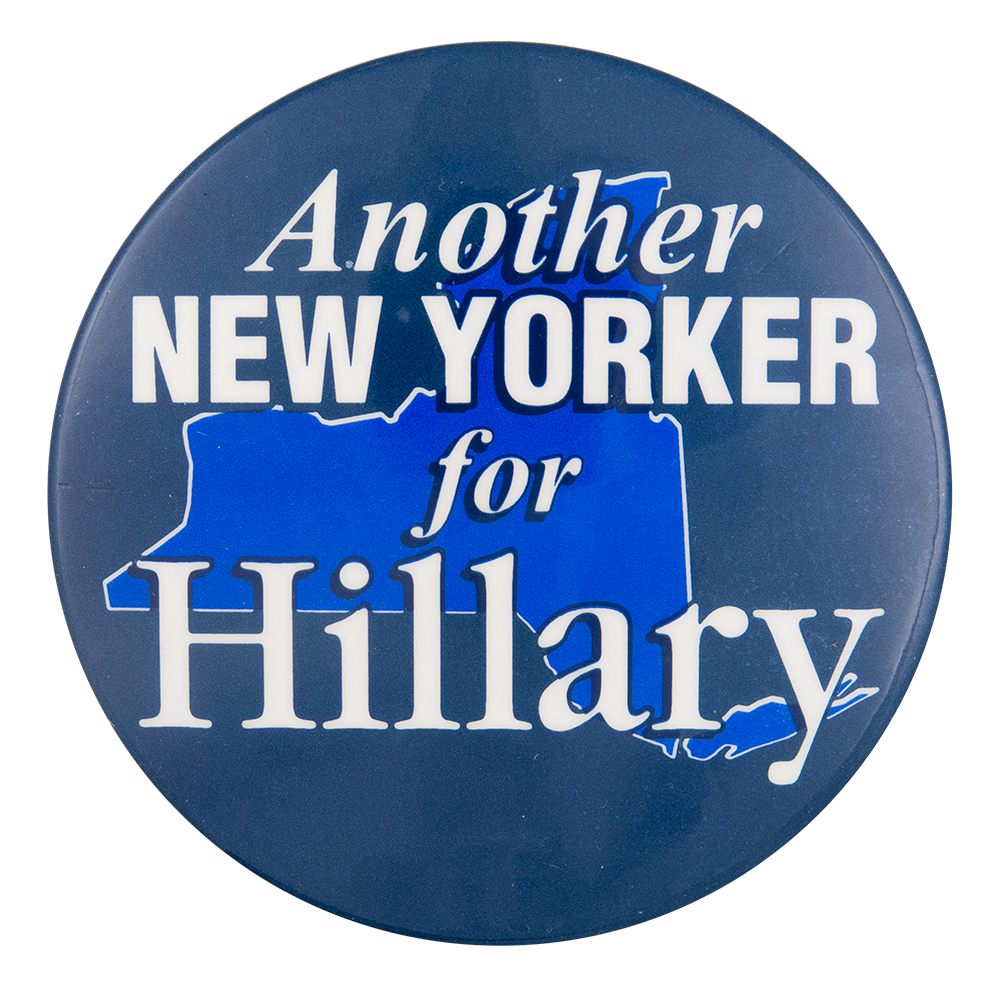
Text on Button Another NEW YORKER for Hillary
Image Description

Blue silhouette of New York state with dark blue background.  Superimposed white text.

Curl Text N.G. SLATER CORP. N.Y.C. 10011 (union bug)
Back Style
The Shape
The Size
The Manufacturer
Additional Information Hillary Rodham Clinton has served as secretary of state and senator in New York. She was born in Chicago and earned her law degree from Yale, practicing and teaching law before being elected into office. Clinton was first lady of Arkansas and first lady of the United States when her husband, Bill Clinton, was elected to office. During the 2016 presidential campaign, Clinton successfully became the first woman to earn a major party’s nomination for president. She ran against Donald Trump and lost despite winning the popular vote.
Sources
2016 Presidential Election. (n.d.). Retrieved March 18, 2019, from https://www.270towin.com/2016_Election/ Hillary Clinton. (2019, January 28). Retrieved March 18, 2019, from https://www.biography.com/people/hillary-clinton-9251306 The Office of Hillary Rodham Clinton. (n.d.). Retrieved March 18, 2019, from https://www.hillaryclinton.com/
Catalog ID PO0796

All the Way with LBJ Hat

Category
Additional Images
Sub Categories
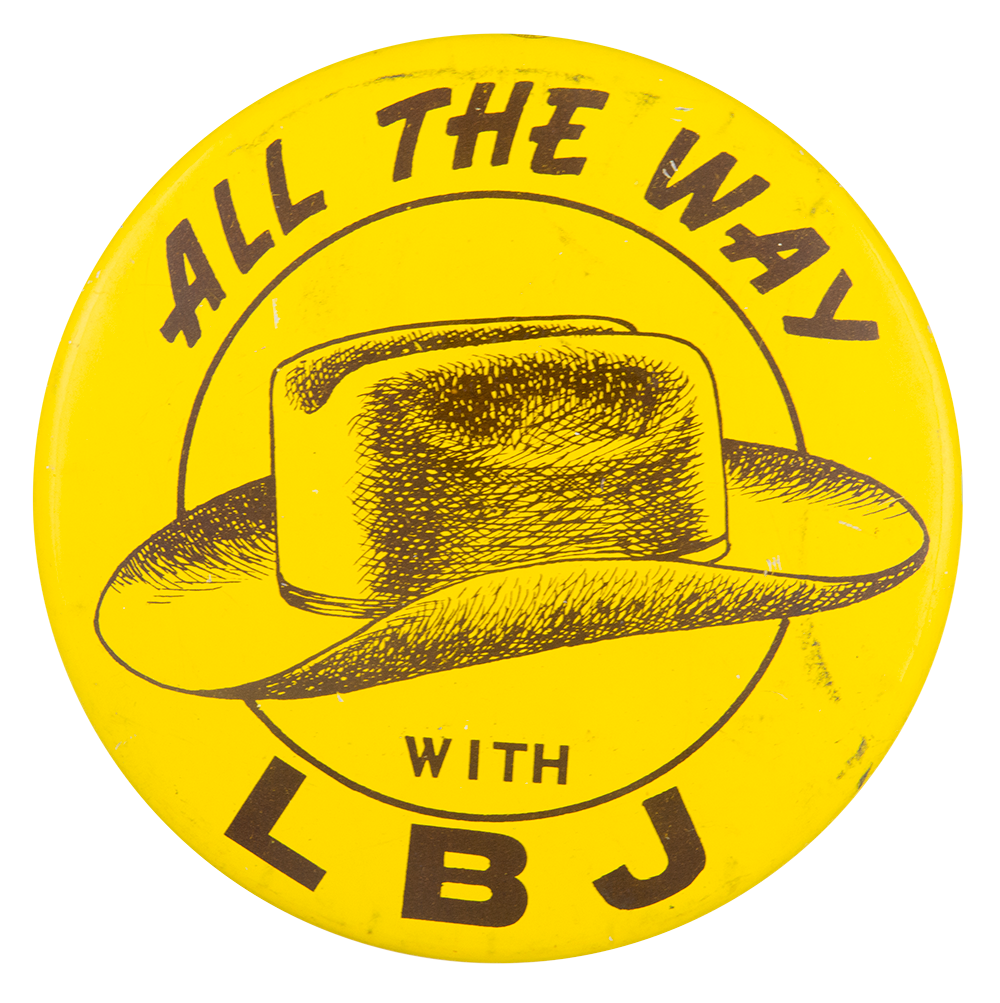
Text on Button ALL THE WAY WITH LBJ
Image Description

Illustration of cowboy hat in front of a circle with brown text on a yellow background.

Curl Text (union bug) 634 (union bug) (union bug) 313
Back Style
The Shape
The Size
Additional Information

Lyndon B. Johnson was born in Stonewall, Texas, on August 27th, 1908. He was a Representative for Texas from 1937 to 1949, Senator for Texas from 1949 to 1961, Vice President from 1961 to 1963, and the thirty-sixth president from 1963 to 1969. He first became president following the assassination of John F. Kennedy in 1963. 

Johnson continued Kennedy’s work with the civil rights issues at the time and passed the Civil Rights Act of 1964. He was against segregation and wanted to help those in poverty rise up.

1964 was also the year for the next presidential election. Johnson won and wanted to execute his “Great Society” program. It was “aid to education, attack on disease, Medicare, urban renewal, beautification, conservation, development of depressed regions, a wide-scale fight against poverty, control and prevention of crime and delinquency, removal of obstacles to the right to vote”. Johnson also continued the research into space exploration. A couple of months after he would leave the office, two men (a third in the space shuttle) would be the first to step on the moon. 

While in office, he dealt with the rising counter-culture of anti-war sentiment and other movements lead by the youth of America. He attempted peace talks with North Vietnam but did not live to see the success of them. He died on January 22, 1973, on his ranch in Texas.

Sources

Sidey, H., & Freidel, F. (2006). Lyndon B. Johnson. Retrieved July 21, 2020, from https://www.whitehouse.gov/about-the-white-house/presidents/lyndon-b-jo…

Catalog ID PO0702