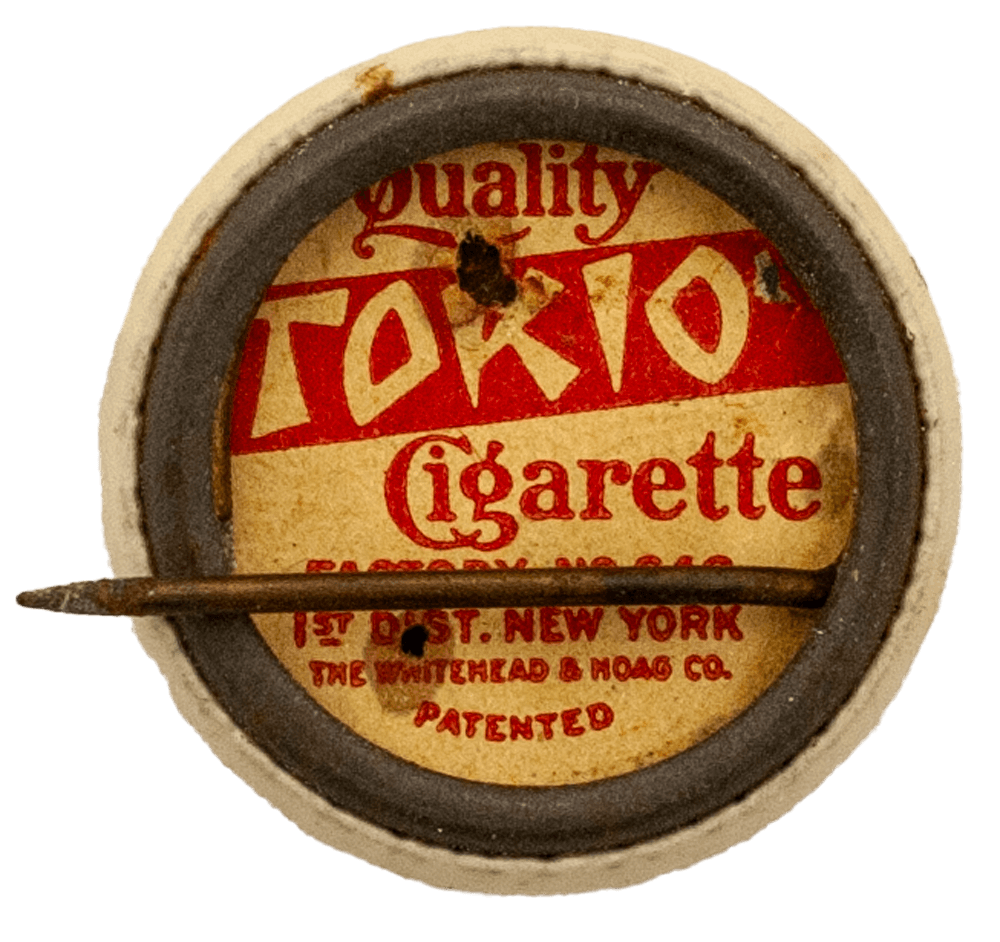
T.C. Bennett's "Paddy" Irish Intermezzo

Category
Additional Images
Sub Categories
Text on Button T.C. Bennett's "Paddy" Irish Intermezzo Pub. by Victor Kremer Co. New York, Chicago.
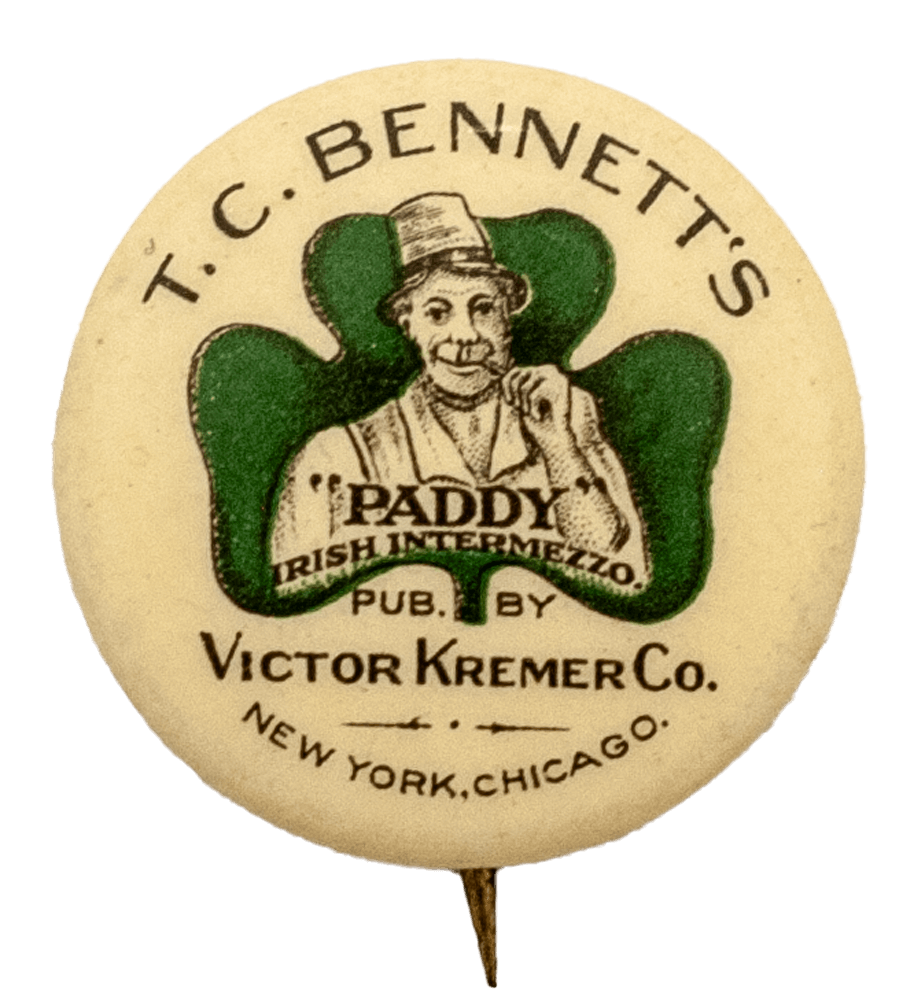
Image Description

An illustration of an adult man in a top hat pictured in front of green three leaf clover. Black text appears on a white background above, below, and on the illustration.

Back Paper / Back Info

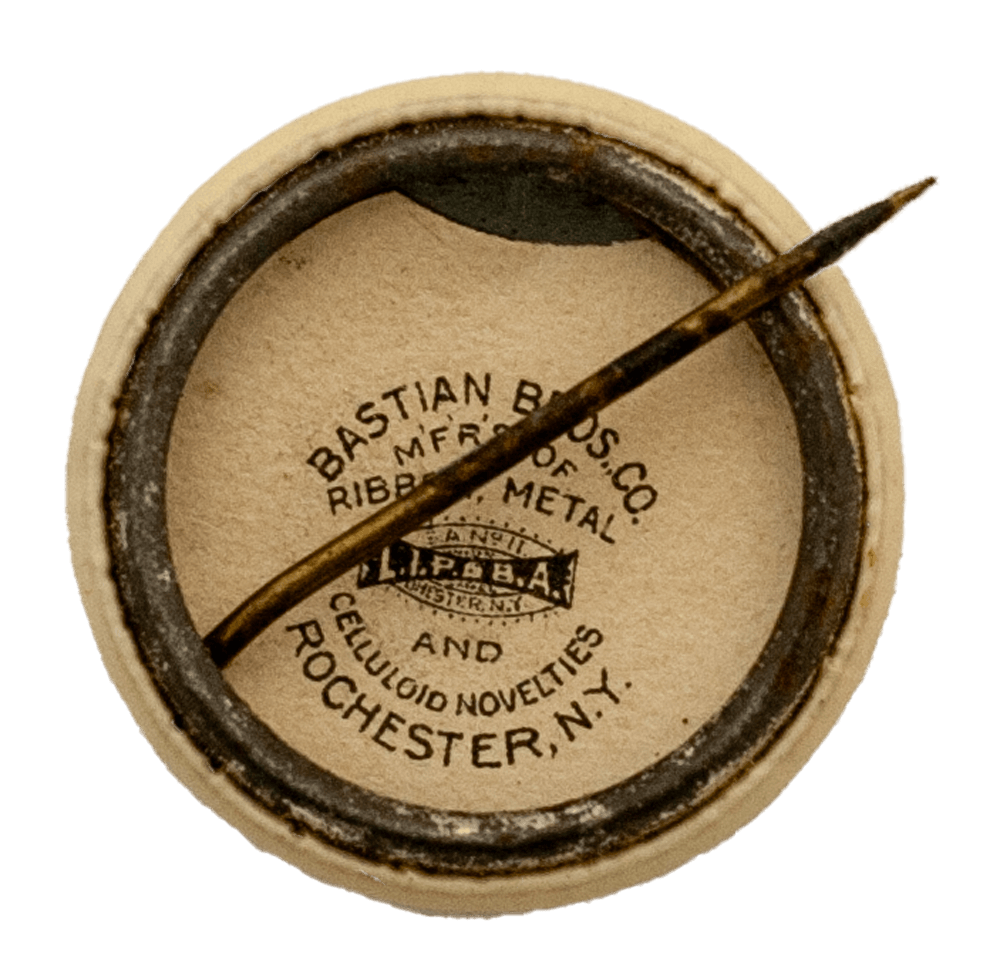
BASTIAN BROS. CO. MFR'S OF RIBBON METAL AND CELLULOID NOVELTIES ROCHESTER, N.Y. [union bug]

Back Style
The Shape
The Size
The Manufacturer
Additional Information

“Paddy” is a song written by T.C. Bennet, also known as Theron C. Bennett, and published in 1906 by Victor Kremer Co. in New York. The song was composed for piano and voice and features lyrics centered on an Irish railway worker. The term “Paddy” comes from a corruption of the common Irish boy’s name Patrick and is an outdated slang term for an Irish man, now considered offensive. 

Sources

Johns Hopkins University. (n.d.). Paddy Characteristic Two-Step. The Levy S. Levy Sheet Music Collection. https://levysheetmusic.mse.jhu.edu/collection/058/122 

Merriam-Webster. (n.d.). Paddy. In Merriam-Webster.com dictionary. Retrieved December 8, 2023, from https://www.merriam-webster.com/dictionary/paddy 

Catalog ID MU0575

Aged, Sick & Infirm Appeal

Category
Additional Images
Sub Categories
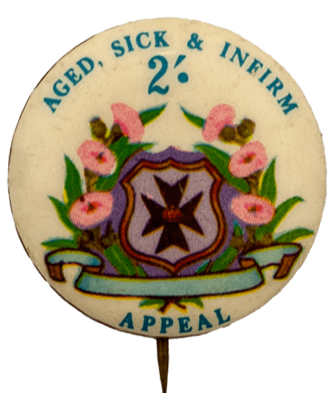
Text on Button Aged, Sick and Infirm Appeal 2
Image Description

An illustration of a cross on a shield surrounded by pink flowers. Blue text appears below and above it on a white background.  

Curl Text A.E. PATRICK PTY LTD. SUMMER HILL N.S.W.
Back Style
The Shape
The Size
The Manufacturer
Additional Information

The Aged, Sick, and Infirm Appeal, now known as St. Basil's Homes, is a Greek Orthodox nonprofit charity located in New South Wales, Australia. The organization was founded by Sister Mary Dorothea Flynn, a former Catholic nun, in 1954. The charity’s mission is to care and provide quality resources for the elderly. After leaving the Catholic Church, Sister Mary Dorothea Flynn aspired to open a home to fulfill her mission of starting a charitable cause. However, she faced financial setbacks and needed assistance to avoid selling her property. The Greek Orthodox Church contributed financial support and partnered with Sister Mary, becoming an established charity with a dedicated board. Today, the charity continues to serve the elderly community, housing 375 residents and offering a designated dementia wing, improving the lives of over 800 individuals.

Sources
St. Basil’s Homes (Australia) - OrthodoxWiki. (n.d.). https://orthodoxwiki.org/St._Basil%27s_Homes_(Australia)
Catalog ID CL0676

United Protestant Association

Category
Additional Images
Sub Categories
Text on Button United Protestant Association 10c
Image Description

An illustration of a two-toned green bird appears on a branch with red flowers on it. Black text circles the image on a white background

Back Style
The Shape
The Size
Additional Information

The United Protestant Association (UPA) was founded in Australia in 1940 during a time of division between Protestants and Roman Catholics by Thomas August, who began his work by providing homes for Protestant families and establishing care facilities for the elderly. August retired in 1962, and the UPA is now more focused on elderly care guided by Christian values. The UPA provides different types of care that allow older adults to maintain independence in the comfort and familiarity of their own homes or in assisted living. This button is a “testament to the past” of the UPA and “serves as a reminder of its impact” throughout history.

Sources

CollectibleTreats. (n.d.). Vintage United PROTESTANT Association 10c badge [Shopping listing]. eBay. https://www.ebay.com.au/itm/315259734348 

United Protestant Association. (n.d.). About UPA. https://www.upa.org.au/upa/ 

United Protestant Association. (n.d.). Care options. https://www.upa.org.au/home/aged-care/ 

United Protestant Association. (n.d.). History of UPA. https://www.upa.org.au/upa/history/ 

Catalog ID CL0675

Rescue Work Society Special Appeal

Category
Additional Images
Sub Categories
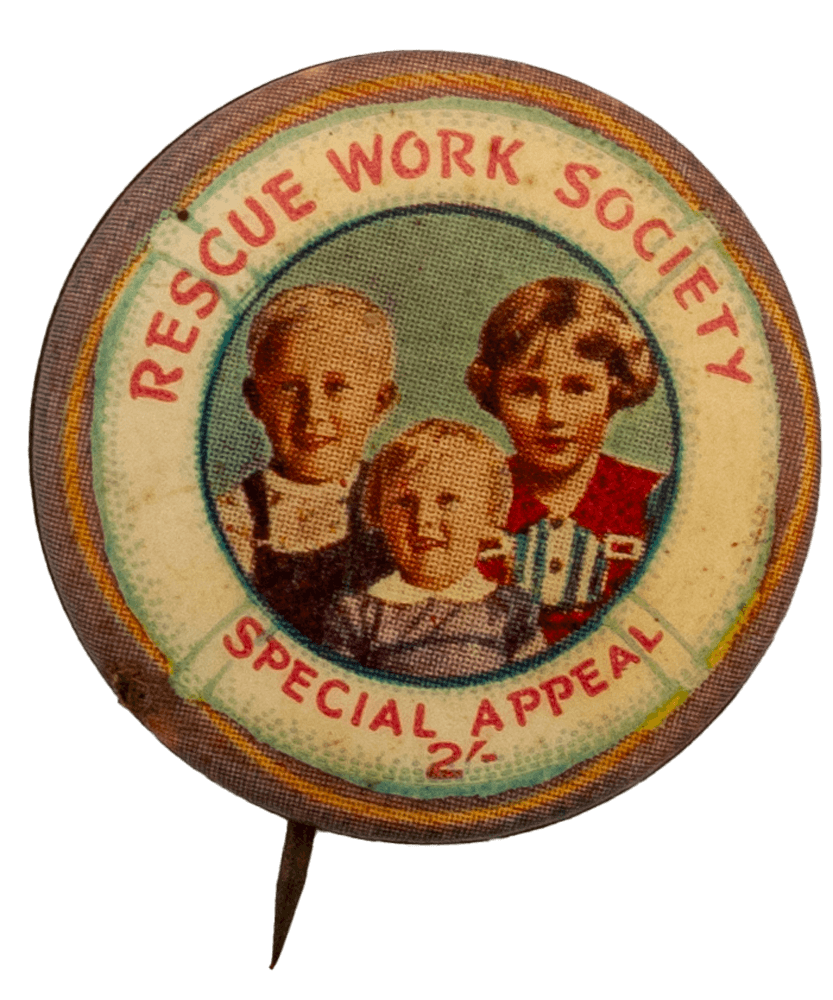
Text on Button RESCUE WORK SOCIETY SPECIAL APPEAL 2/-
Image Description

A photograph of three young children on a blue background. Red text circles the photograph on a white rim. 

Back Style
The Shape
The Size
Year / Decade Made
Additional Information

The Sydney Rescue Work Society was established in 1890 and founded by George Edward Ardill, a printer and Gospel preacher. The Rescue Work Society was a non-denominational organization, founded on New Testament principles, and advocated for the reform of alcoholics and sex workers, and the protection of infants, women, and girls. The organization grew rapidly, and by 1911, it managed a variety of agencies including the South Sydney Women’s Hospital, Bethesda Home for Waiting Mothers, a training school for midwifery nurses, an adoption agency, and several homes for women, children, and the needy. These institutions were funded through the operation of a commercial laundry and the midwife training fees. 

Another way that the organization raised money to fund its operations was by organizing fundraising appeals and holding “button days” to sell pinback buttons and badges. Button days would be held all over Sydney and in neighboring towns, often at railway stations, and buttons just like this one valued at 1/-, 2/-, or 3/- were sold to raise money for specific organizations within the Rescue Work Society umbrella. 

** /- is the sign for British Shilling 

Sources

Find & Connect Web Resource Project for the Commonwealth of Australia. (2011a). Sydney Rescue Work Society. Find and Connect. https://www.findandconnect.gov.au/entity/sydney-rescue-work-society/ 

Integricare. (2024, March 18). Our History Serving Sydney families since 1882. Integricare. https://integricare.org.au/about-us/our-history/ 

The Sydney Morning Herald, The Sun, The Daily Telegraph. (multiple, 1950s). Newspapers and Gazettes: Rescue Work Society buttons. Trove. https://trove.nla.gov.au/search/category/newspapers?keyword=rescue+work+society+button 

Catalog ID CL0674

Sydney Rescue Work Society

Category
Additional Images
Sub Categories
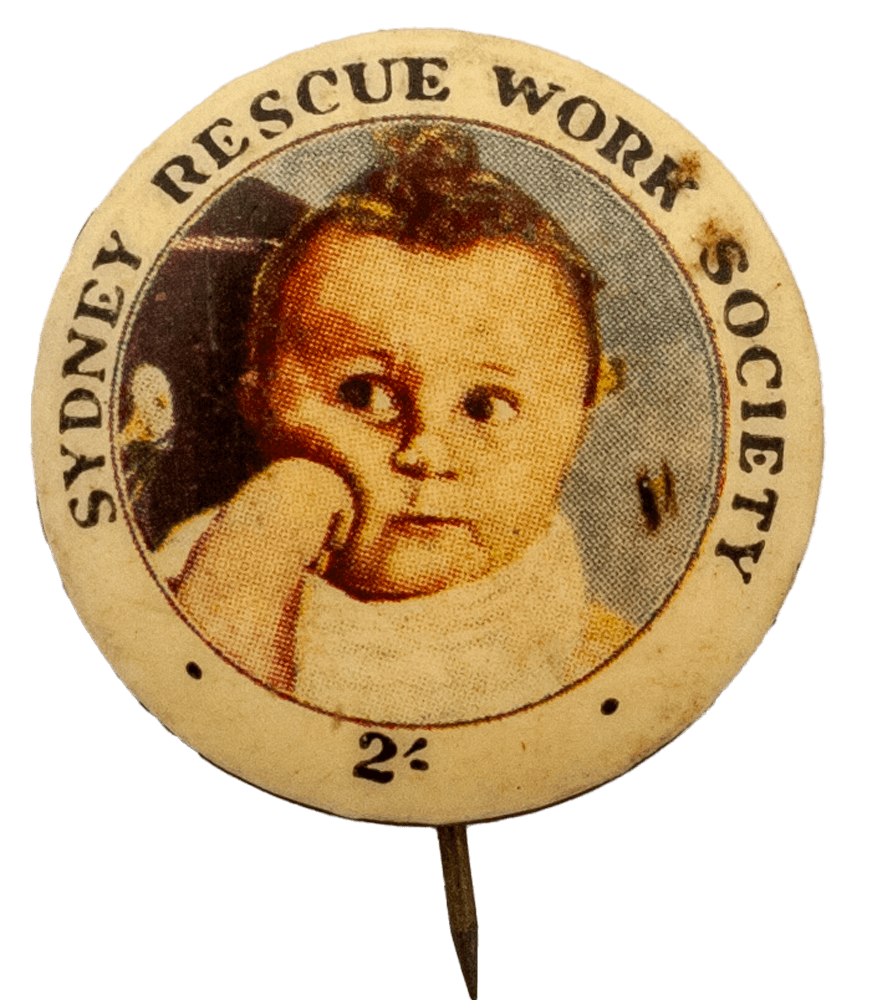
Text on Button SYDNEY RESCUE WORK SOCIETY 2
Image Description

A photograph of a baby on a white background. Black text cirlcles the photo. 

Back Style
The Shape
The Size
Additional Information

The Sydney Rescue Society, formed in 1890, was a philanthropic, non-denominational organization that ran refuges and homes for women and children in Sydney and its surrounding suburbs. The society formed eight years after the founder, G.E. Ardill, opened a Women’s Refuge  called 'Home of Hope for Friendless and Fallen Women’. The society was founded on the principles of the New Testament and campaigned for temperance, the reform of alcoholics and prostitutes, and the protection of infants, women, and girls. While the organization successfully helped many women and children, there was controversy surrounding Adrill’s use of pregnant women for labor in his commercial laundry facility. The profits from the laundry were used to finance Adrill’s other operations. Regardless of this criticism, the society is still in operation today albeit under a new name, Integricare Sydney, and has since identified other missions relevant to modern issues. 

Sources

Find And Connect. (2023, August 4). Sydney Rescue Work Society - Organisation - Find & Connect - New South Wales. https://www.findandconnect.gov.au/ref/nsw/biogs/NE00362b.htm 

Catalog ID CL0673

United Protestant Homes

Category
Additional Images
Sub Categories
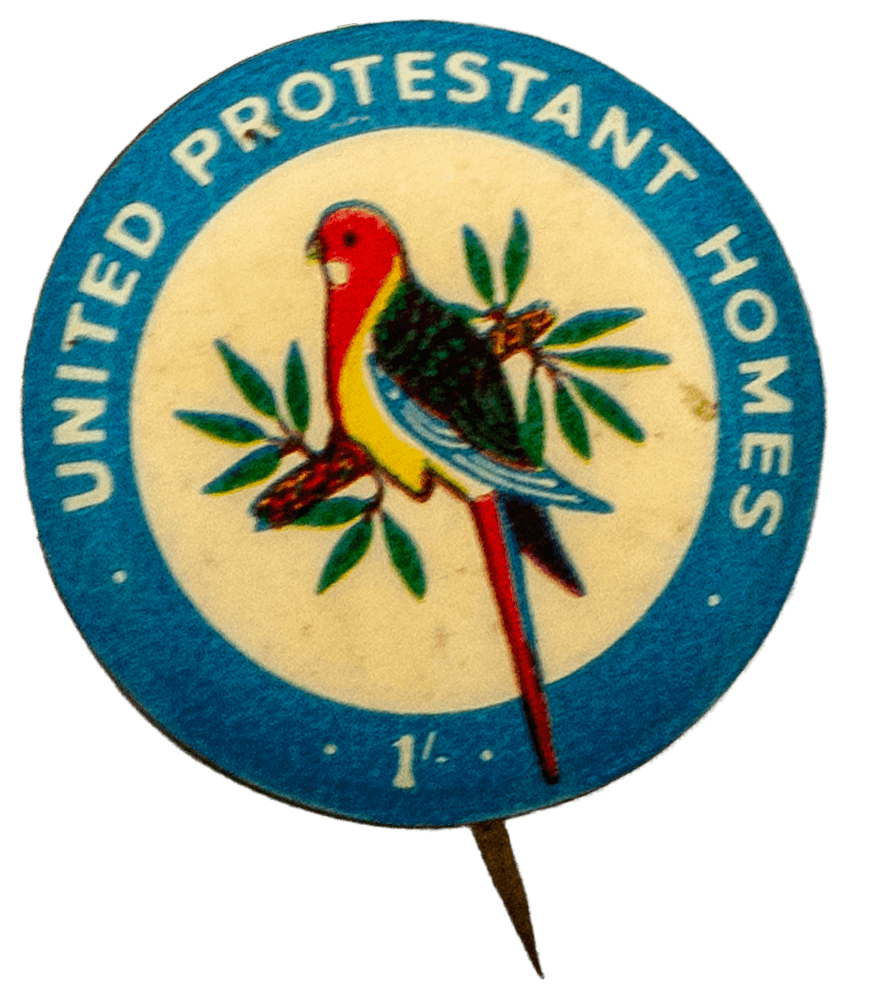
Text on Button UNITED PROTESTANT HOMES
Image Description

An illustration of a red bird with colorful wings perched atop a tree branch on a white background. A blue border with white text circles the illustration.

Back Style
The Shape
The Size
Additional Information

The United Protestant Association (UPA) of New South Wales was established in 1938 by Thomas and Rosetta Agst in response to the lack of homes available for impoverished Protestant children. Before the Agsts established the UPA, the nearby Roman Catholic Convent had taken in the protestant children. A bitter division had formed between Catholics and Protestants and the Angsts felt the need to open a home specifically for the protestant children. Many of the children were British migrants affected by the war. Between 1950 to 1990, the UPA had housed over 3,000 children in thirteen UPA homes. As of the 1990s, the homes have been converted to aged care facilities as the cost of providing residential care to children had become too much.

The UPA sold buttons, or “Tinnies”, to help raise funds. The UPA offered a variety of colorful designs, Some featuring the faces of children, while others displayed animals and birds.

Sources

History of UPA. UPA of NSW Ltd. (2023, December 11). https://www.upa.org.au/upa/history/ 

United Protestant Association of New South Wales Ltd (1938 - ). United Protestant Association of New South Wales Ltd - Summary | Find & Connect. (n.d.). https://www.findandconnect.gov.au/guide/nsw/NE00380 


Catalog ID CL0672

11 A.M.

Category
Additional Images
Sub Categories
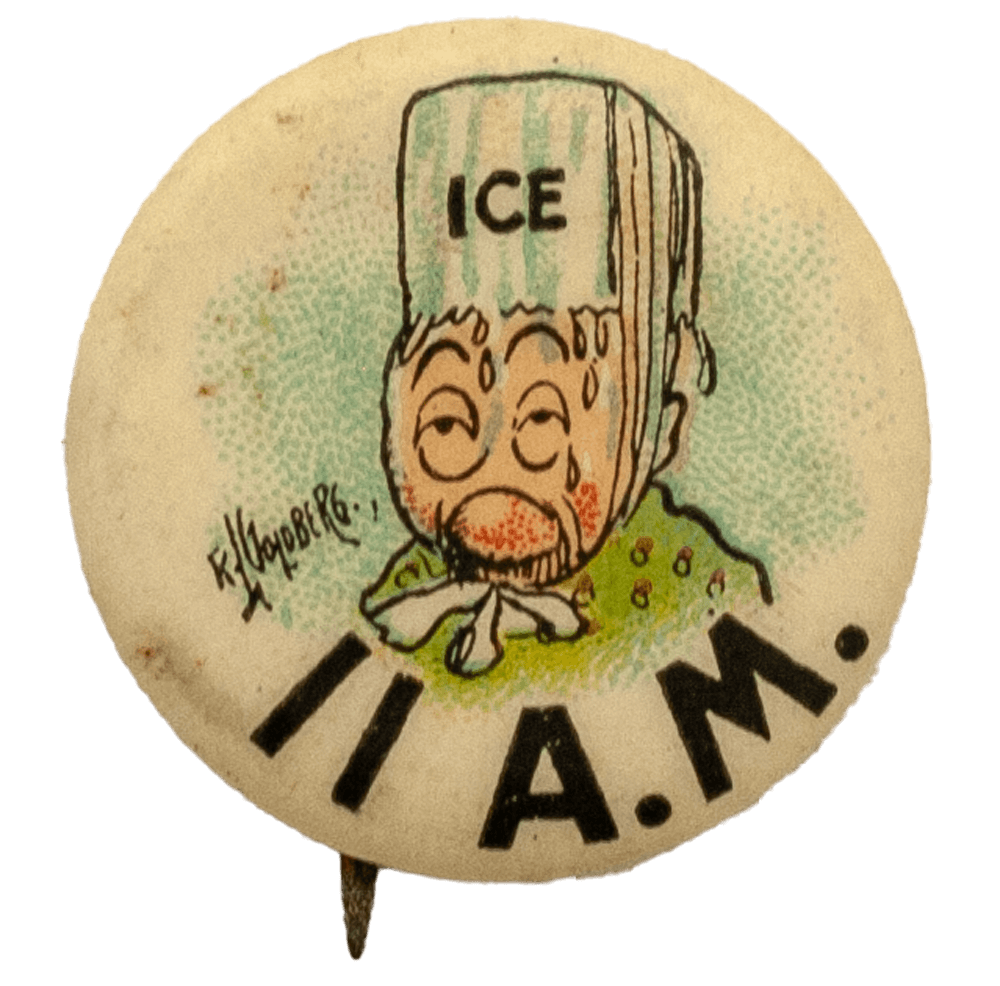
Text on Button ICE 11 A.M.
Image Description

On a white background appears an illustration of a sweating man with a large block of melting ice affixed atop his head. Text appears on the block of ice and bellow the man. 

Back Paper / Back Info

Quality TOKIO Cigarette
FACTORY No. 649 
1st DIST. NEW YORK 
THE WHITEHEAD & HOAG CO. 
PATENTED

Back Style
The Shape
The Size
Year / Decade Made
The Manufacturer
Additional Information

In the early 1900s, along with other tobacco companies, Tokio Cigarette issued many 7/8" cartoon pinback buttons displaying comic art by famous cartoonists of the day. They were given out as premiums with a purchase of Tokio Cigarettes.

Rube Goldberg (1883-1970) was an American cartoonist and inventor who is best known for his cartoon depictions of impossibly complicated machines to accomplish simple mundane tasks. Goldberg is the only person ever to be listed in the Merriam-Webster dictionary as an adjective.

Goldberg was a founding member and first president of the National Cartoonists Society, whose Reuben Award for cartoonist of the year is named after him. He received a Pulitzer Prize for his political cartooning in 1948, and in 1995 was honored with a commemorative stamp as part of the "Comic Strip Classics" series from the U.S. Postal Service.

Sources

Rube Goldberg Institute (n.d.). About Rube Goldberg. Retrieved February 6, 2024 from https://www.rubegoldberg.org/all-about-rube/a-cultural-icon/

National Cartoonists Society (n.d.). History of the NCS. Retrieved February 6, 2024 from https://nationalcartoonists.com/about/


Catalog ID AD1084

Walker's Lone Indian Camp-Fire Circle

Category
Additional Images
Sub Categories
Text on Button Walker's Lone Indian Camp-Fire Circle Back
Image Description

An illustration of a white tipi against a blue sky. A red banner runs across the center with white text on it. Black text appears avove and below the tipi.

Back Style
The Shape
The Size
Additional Information

The Lone Indian Camp-Fire Circle was the brain child of Robert E. Callahan, an actor, advertising agent, and self-proclaimed authority of Native American history. Upset with how Native Americans were represented in Hollywood and inspired by a book, Ramona, Callahan wrote and produced several syndicated radio programs celebrating Native American culture. One of the radio shows, The Lone Indian, featured Callahan as the narrater presenting stories of Native American life. 

The radio program, broadcasted by Warner Brothers, was sponsored by Walkers Department Store in Los Angeles, CA. Children were invited to the fifth floor of Walker’s store to explore a replica of a Native American lodge, win prizes, and receive a Lone Indian button.  Children could also attend events at Mission Village, a four acre piece of land which included several replica buildings, mining towns, pueblos, and a museum.

Sources

Lone Indian. Old Time Radio. (n.d.). https://www.otrcat.com/p/lone-indian 

Martin Grams. (2020, December 25). https://martingrams.blogspot.com/2020/  

Pollack, A. (2017). People: Robert E. Callahan turned Old West into tourist attraction: Story by dr. Alan Pollack. SCVHistory.com. https://scvhistory.com/scvhistory/pollack0517callahan.htm 

Catalog ID AD1083

The Brady Brunch Greg

Category
Additional Images
Sub Categories
Text on Button The Brady Bunch ™
Image Description

A photo of Greg from The Brady Bunch on a blue background. Red text appears to the right of Greg's head.

Curl Text ™ & © 1993 Par. Pic. BUTTON EXCHANGE LTD PART OF O.S.P. PUB, INC GROUP ROCHESTER, MI 48307
Back Style
The Shape
The Size
The Manufacturer
Additional Information

The Brady Bunch was an American sitcom which ran from 1969 to 1974. The series follows the blended Brady family as they learn to live under the same roof. The show remains both a pop cultural icon and a site of constant ridicule in its depiction of the American family.

Greg Brady is the eldest of the Brady kids on the show. Greg is the quintessential big brother, and generally leads the group in their shenanigans. Over the course of the show, Greg demonstrates a variety of talents from athletics to academics, as well as singing and songwriting, as demonstrated by his performance of, “Clowns Never Laughed Before,” in season one, episode 14.

Sources

Episode 14: Where There’s Smoke. (2017, May 12). Brady Brunch Reviewed. Retrieved April 29, 2024 from https://bradybunchreviewed.wordpress.com/2017/05/12/episode-14-where-th…

Greg Brady. (n.d.). The Brady Bunch Wiki. Retrieved April 29, 2024 from https://bradybunch.fandom.com/wiki/Greg_Brady

The Brady Bunch. (n.d.). Encyclopedia Britannica. https://www.britannica.com/topic/The-Brady-Bunch

Catalog ID EN0664