Come Fly a Kite

Category
Additional Images
Sub Categories
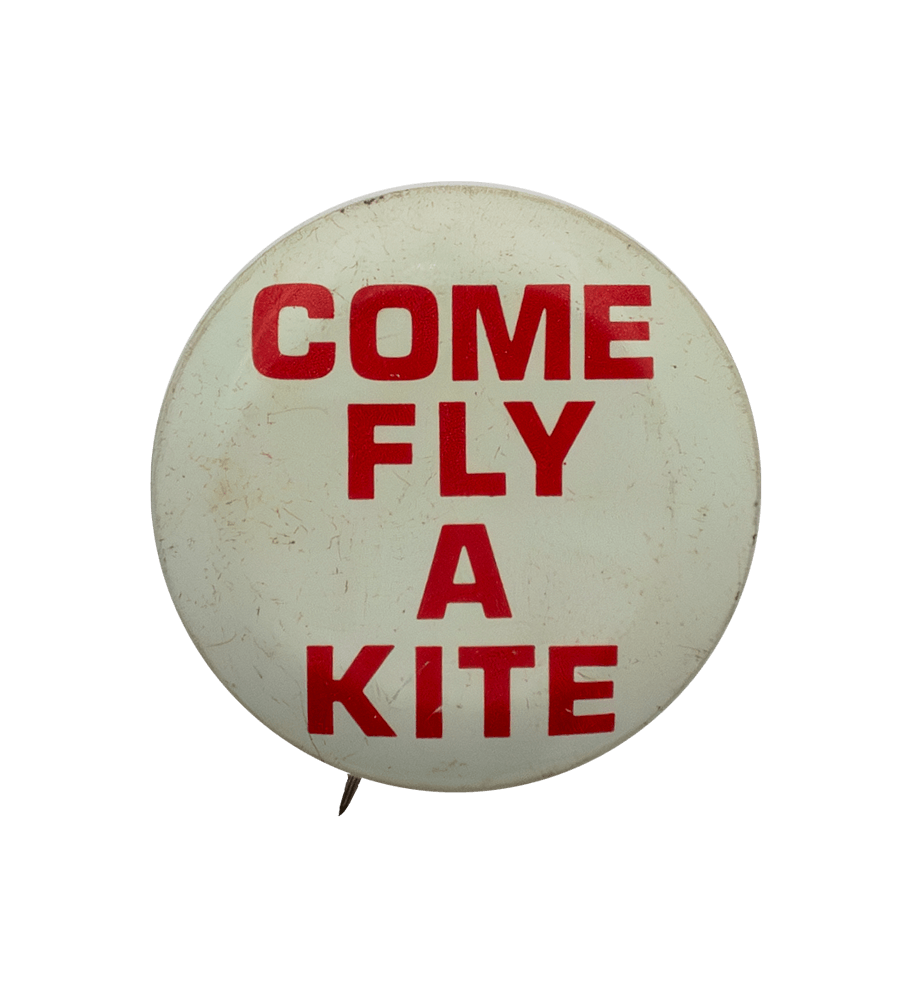
Text on Button COME FLY A KITE
Image Description

Red text on a white background

Back Paper / Back Info

[sticker: 61]

Curl Text 900 N. POINT ST. S.F. 441-2965
Back Style
The Shape
The Size
Additional Information

While the earliest written record of kite flying comes from China in 200 BCE, kite flying for fun and for sport became popular in the U.S. in the 1970s. The growth in the  popularity of kite flying has been attributed to Peter Powell and his introduction of the toy dual-liner stunt kite. In the 1970s, stores specializing in various types of kites could be found throughout the U.S. Come Fly a Kite, Inc. was one of those shops. The company opened in 1974 and featured various types of beautifully colored kites, including a kite made of mylar called the California Dragon Sunshine. While Come Fly a Kite, Inc is now a defunct corporation, many adults still recall fond memories of shopping for their colorful kites at the store located in San Francisco, CA. 

Sources

Bizapedia Pro Search subscription. Bizapedia.com – Company Information Search. (n.d.). https://www.bizapedia.com/ca/come-fly-a-kite-inc.html 

History of kites: Aka American Kitefliers Association. AKA American Kitefliers Association | Share the Joy of Kites. (2021, March 10). https://www.kite.org/about-kites/history-of-kites/ 

Kitelife.com. (2012). Kite Lines - vol.2 no. 1 - kitelife. http://www.kitelife.com/wp-content/uploads/2012/01/Kite-Lines-v2-1.pdf&…;


Catalog ID IB0847

High Admiral Cigarettes Serenade

Category
Additional Images
Sub Categories
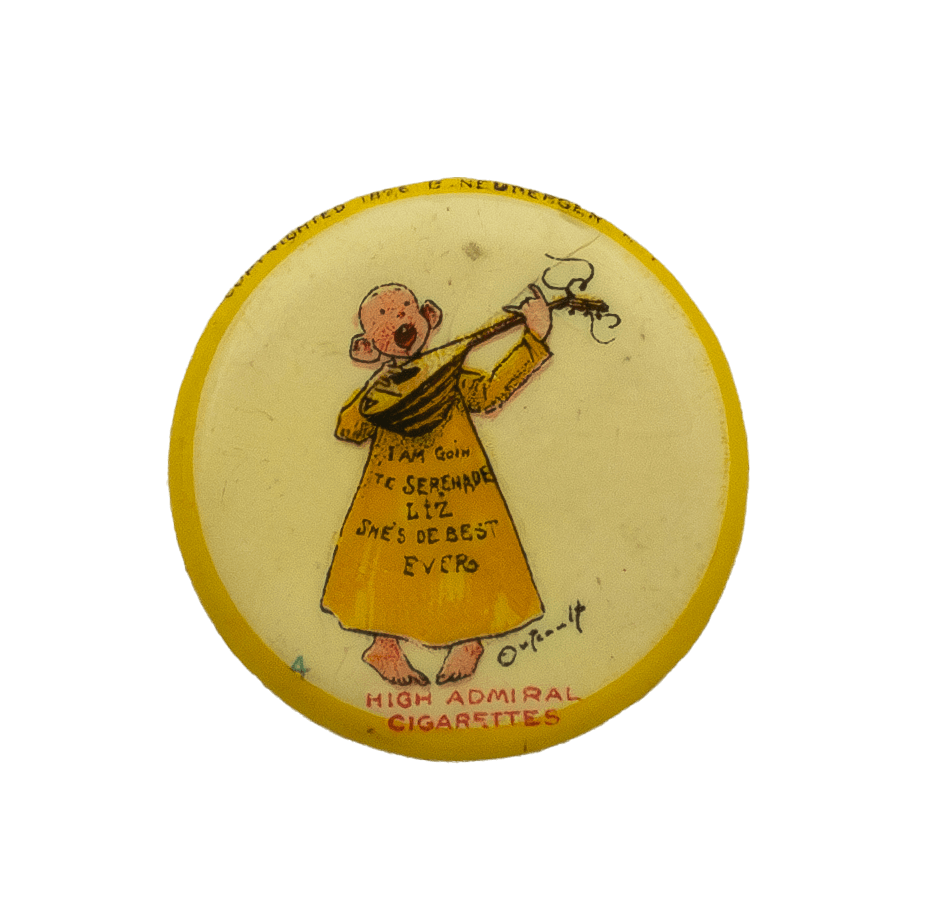
Text on Button I AM GOIN TO SERENADE LIZ SHE'S DE BEST EVER Outcault [signature] 4 HIGH ADMIRAL CIGARETTES
Image Description

Dark yellow rim with a light yellow background and an illustration of cartoonist Outcault's "The Yellow Kid" character playing a lute and singing in the center. Black text is on the character's clothes, with a black signature and red text below. 

Back Paper / Back Info

[illegible, embossed]

Curl Text COPYRIGHTED 1896 B. NEUBERGER, N.Y.
Back Style
The Shape
The Size
Year / Decade Made
Additional Information

High Admiral Cigarettes was a cigarette brand popular in the late 19th and early 20th centuries. The company employed pin-back buttons featuring images and slogans of presidents, pugilists, and in one series of over one hundred pins, Richard F. Outcault’s popular cartoon, the Yellow Kid. Each pin in the series was numbered one to one hundred and sixty. They were given out with packs of High Admiral Cigarettes in order to advertise the brand. Like High Admiral, other companies displayed the Yellow Kid character on their products, including Pulver Co., Davis S. Brown & Co., and Gusky’s Shoes. 

Sources
Catalog ID AD1091

White House Ace of Spades

Category
Additional Images
Sub Categories
Image Description

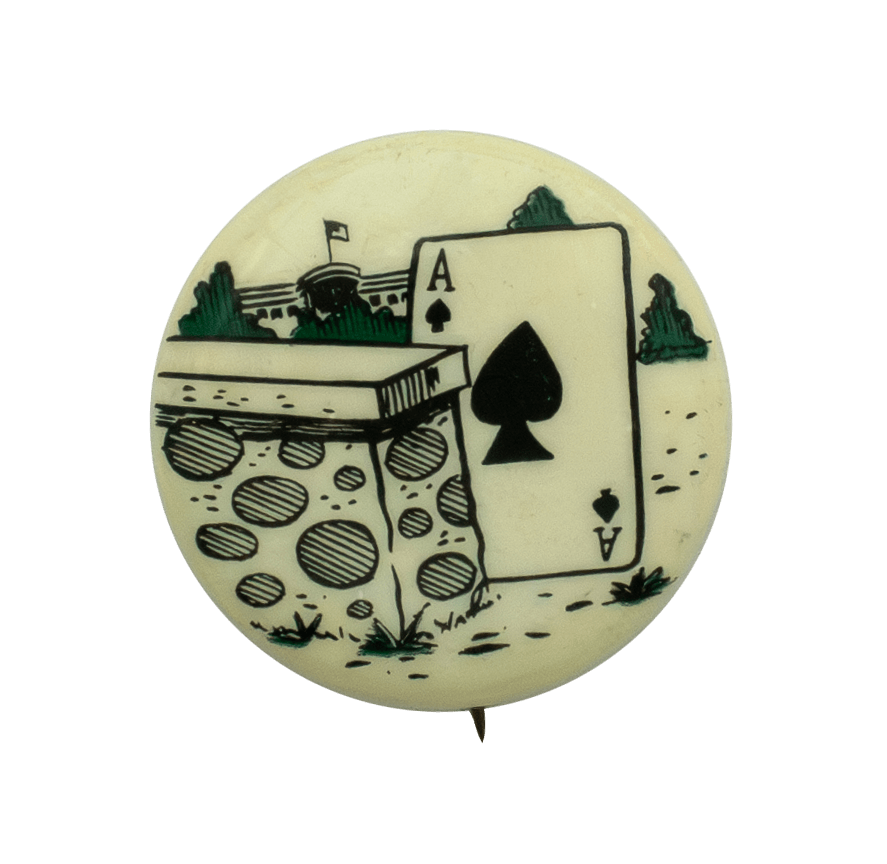
Black, white, and green line illustration of a stone wall in front of a large ace of spades playing card; four green bushes are behind the card and just behind them in the background—just visible—is the top of the White House.

Curl Text © 1968 A.G. Trimble Co., Pgh., Pa 15222 [union bug]
Back Style
The Shape
The Size
Year / Decade Made
The Manufacturer
Additional Information

George Wallace was a Democratic politician who was infamous for his strong support of segregation and who took credit for many opinions that became common in populist conservative platforms, such as those of Richard Nixon and Ronald Regan. He served as governor of Alabama for three non-consecutive terms between 1963 and 1987 and made several unsuccessful presidential runs. This particular button is from his 1968 campaign, with an abstract depiction of Wallace (as a “Wall Ace”) in front of the White House. 

Sources

blairconsignments. (2025). George Wallace 1968 campaign pin button political. Ebay.

https://www.ebay.com/itm/396135518581?itmmeta=01JKPEF20ZM64R6YTFXBMECRF…

Raines, H. (1998, September 14). George Wallace, Segregation Symbol, Dies at 79. The New York Timeshttps://www.nytimes.com/1998/09/14/us/george-wallace-segregation-symbol-dies-at-79.html

Catalog ID PO1260

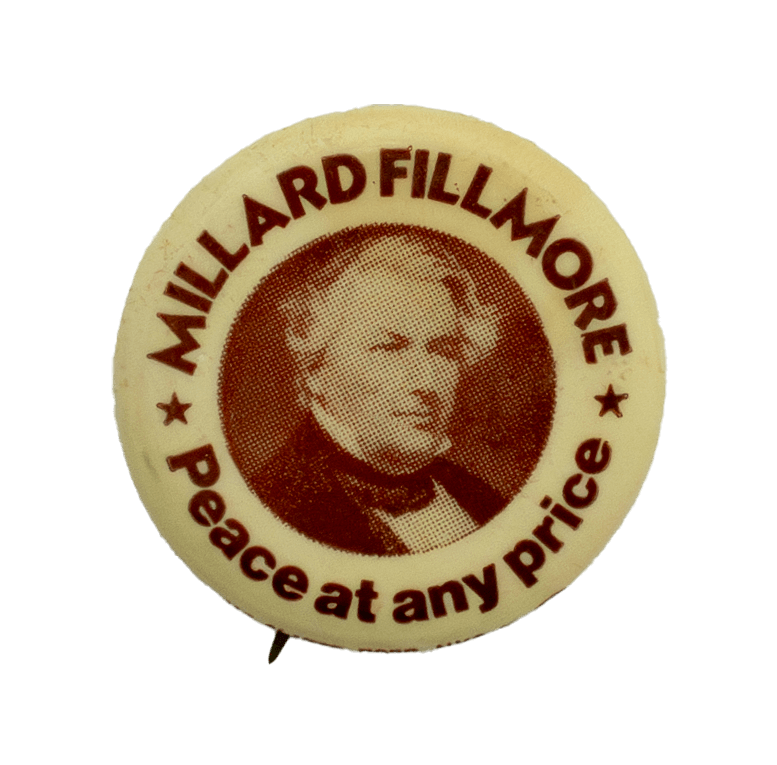
Millard Fillmore Peace At Any Price

Category
Additional Images
Sub Categories
Text on Button MILLARD FILLMORE Peace at any price
Image Description

Off-white background with dark brown text around the rim, separated in the middle on each side by small brown stars. A brown-toned portrait of Millard Fillmore is in the center of the button.

Back Paper / Back Info

[sticker: 185]

Curl Text N.G. SLATER CORP., N.Y.C. 11 [union bug]
Back Style
The Shape
The Size
Additional Information

Millard Fillmore became the 13th president of the United States serving from 1850-1853, after succeeding to presidency due to the death of his predecessor, Zachery Taylor. As a member of the Whig party, he was the last president to not be affiliated with either the Democratic or Republican parties. As president, Fillmore inherited the controversial task of addressing the future of slavery. Regardless of opposing slavery, he supported and was instrumental in the passing of the Compromise of 1850. The Compromise also included the Fugitive Slave Act which Fillmore vigorously enforced. This gave power to federal officials to seize runaway slaves; those assisting any runaway slaves also faced severe consequences. 

Fillmore became an unpopular president as both the North and South took issue with his politics. He believed he could create a truce between the two sides with the passing of the Compromise and delay the inevitable Civil war. Fillmore wanted to bring peace even at an unconscionable price as he took slavery as a political issue and not a moral one. He is quoted saying: 

God knows I detest slavery, but it is an existing evil, for which we are not responsible, and we must endure it and give it such protection as is guaranteed by the constitution, till we get rid of it without destroying the last hope of free government in the world

In 1856, Fillmore ran for president for a second term under the American party—more popularly know as the “Know Nothings” party. As his campaign progressed, his supporters adopted the slogan, “Peace at any Price” aimed at those willing to pay the price of slavery to avoid civil war. He did not get reelected. 

In 1968, the “Peace at any Price” slogan was co-opted by some anti-war student groups who issued buttons bearing Fillmore’s image. 

Sources

Dkramer3 [@naz.edu]. (2018, March 4). Millard who? Talker of the Town. https://talkerofthetown.com/2018/03/04/millard-who/

NCC Staff. (2020, January 7). Millard Fillmore’s brief time in the national spotlight. National Constitutional Center. https://constitutioncenter.org/blog/millard-fillmore-misunderstood-or-a-disaster-as-president

The Editors of Encyclopedia Britannica. (2024, March 13). Millard Fillmore. Encyclopedia Britannica. https://www.britannica.com/biography/Millard-Fillmore

Tolsen, J. (2007, February 16). Worst Presidents: Millard Filmore (1850-1853). U.S. News & World Report. https://www.usnews.com/news/special-reports/the-worst-presidents/articl…

Catalog ID PO1259

Anarchy SRAF

Category
Additional Images
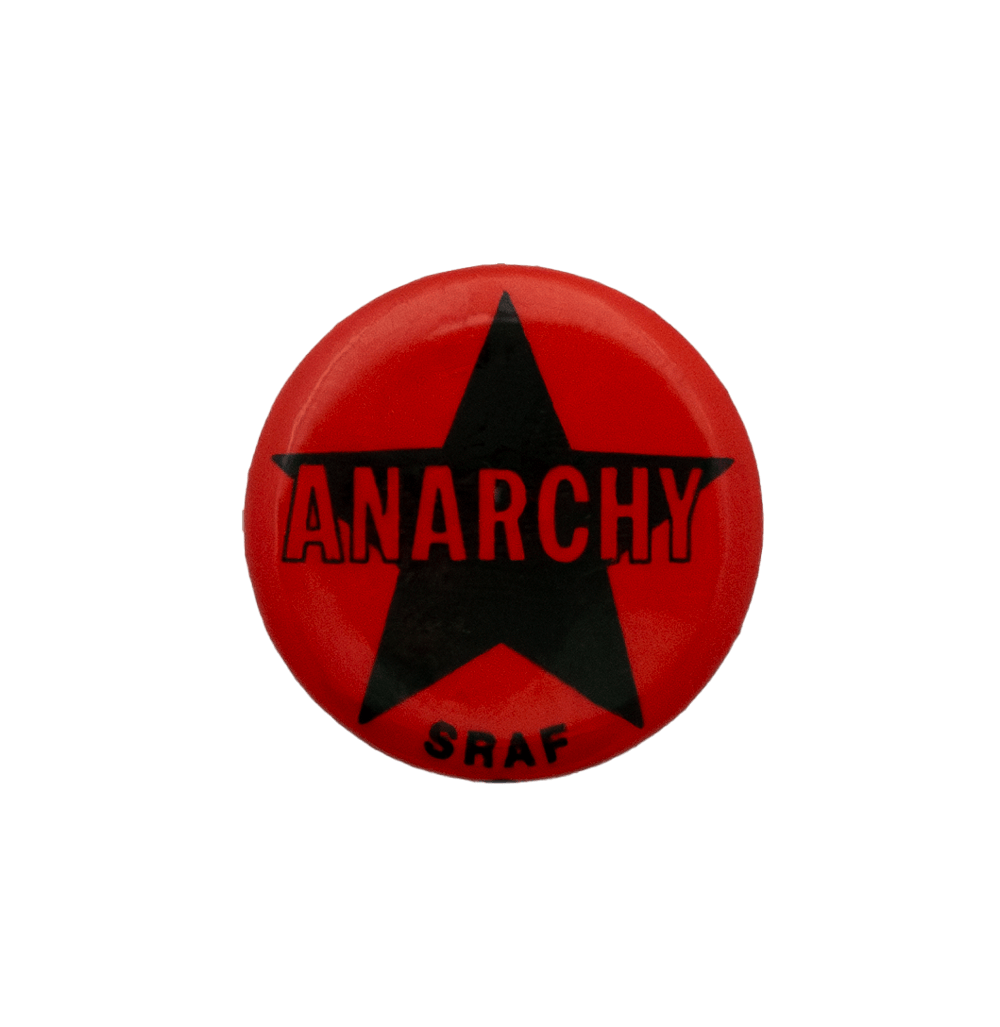
Text on Button ANARCHY SRAF
Image Description

Red background with a large, black five-pointed star in the center. Over the star are red letters with a black outline; small black text appears under the star around the rim. 

Back Paper / Back Info

[sticker: 7]

Curl Text [union bug]
Back Style
The Shape
The Size
Additional Information

In the early 1970s, the Social Revolutionary Anarchist Federation (SRAF) was formed, existing until the late 1980s. This network allowed any organization in North America that identified as an anarchist group to join. The network included an interesting mix of communist, capitalist, individualist, and “yippie” groups from various North American cities. While the larger network agreed upon anarchist ideas, each smaller group held wildly different opinions about politics and life. This created a less than ideal situation for joint gatherings. However, individuals found comfort and acceptance within their chosen groups, which gave them a sense of belonging and a place to discuss issues important to them. The network published pamphlets, bulletins, and magazines created by the various groups, which allowed for back and forth debates. These publications can still be found in archives, such as the Kate Sharpley Library, and provide an interesting glimpse into the issues anarchists found important in the 1970s and 80s. 

Sources

Anarchist Publishers. (2009, July 13). The Social Revolutionary Anarchist Federation: Revolution by the book. Revolution by the Book | The AK Press Blog. https://revolutionbythebook.akpress.org/2009/07/the-social-revolutionar…;

1972: Social Revolutionary Anarchist Federation declaration. libcom.org. (2010). https://libcom.org/article/1972-social-revolutionary-anarchist-federati…;


Catalog ID PO0841

Operation Osprey

Category
Additional Images
Sub Categories
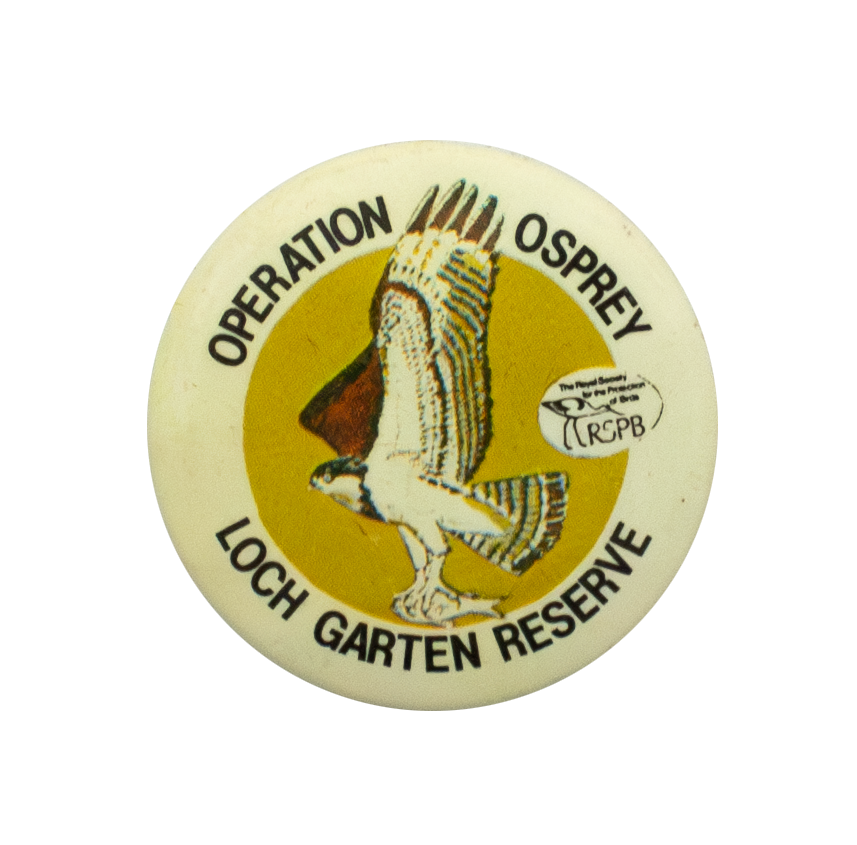
Text on Button OPERATION OSPREY LOCH GARTEN RESERVE The Royal Society for the Protection of Birds RSPB
Image Description

Off-white border and black text with a dark yellow center and a brown and white illustration of an osprey in the center foreground

Curl Text AMALCO made in Britain THE ROYAL SOCIETY FOR THE PROTECTION OF BIRDS
Back Style
The Shape
The Size
Additional Information

Originally founded as the Plumage League in 1889 by Emily Williamson, the Royal Society for the Protection of Birds (RSPB) started as a campaign against the use of feathers in fashion that were driving birds to extinction. The all-women movement was born out frustration that the male-only British Ornithologists Union was not taking the issue seriously. In 1904, the group was officially awarded the Royal Charter, making it a Royal Society and marking the name change to RSPB. In 1921, the Importation of Plumage (Prohibition) Act was instated in the United Kingdom making it the first successful nature campaign for RSPB. RSPB works to promote the conservation and protection of birds and the environment through the operation of nature reserves throughout the UK. Today, it is one of the world’s largest conservation organizations with over a million members. 

The Loch Garten Reserve located in Scotland, houses the Osprey Center and was purchased by charity through the RSPB. It is a bird-watching facility that focuses on a nesting pair of ospreys. An osprey is a large, long-winged hawk that lives near seacoasts or large waterways where it flies over the water to hunt fish. They are also nicknamed the fish hawk. Ospreys are just one bird that was almost wiped out to extinction due to careless behavior of humans in the UK (and around the world) in the 19th and 20th century. However, in 1954, out of their own accord two Ospreys began nesting in the Loch Garten Reserve and slowly helped recolonize the species in Scotland. In 1959, the pair successfully began breeding which was also the birth of RSPB’s Operation Osprey. The goal was to raise awareness and support to monitor and protect the pair (and other Ospreys). In 2019, the original pair were no longer breeding in the reserve. However, good news came in 2022, when a new pair took over the reserve to nest and successfully began to raising their young. 

Sources

Britannica, T. Editors of Encyclopedia (2024, January 3). Osprey. Encyclopedia Britannica. https://www.britannica.com/animal/osprey-bird

Ramage, T. (2022, July 15). Delight as new osprey chicks ringed at RSPB Loch Garten Nature Centre. The Northern Times. https://www.northern-times.co.uk/news/osprey-chicks-delight-at-loch-garten-281568//

Rare Bird Alert. (2019, July 10). RSPB Scotland celebrates 60 years of Loch Garten Ospreys - and you are invited. Rare Bird Alert. https://www.rarebirdalert.co.uk/v2/Content/RSPB_Scotland_celebrates_60_years_of_Loch_Garten_Osprey_Centre_and_you_are_invited.aspx?s_id=868417882#:~:text=This%20protection%20and%20public%20engagement,the%20UK%20would%20be%20secured.

Royal Protection Of Birds. (n.d.). Our History. RSPB UK. https://www.rspb.org.uk/about-us/our-history

Catalog ID CA0924

McG & Sarge

Category
Additional Images
Sub Categories
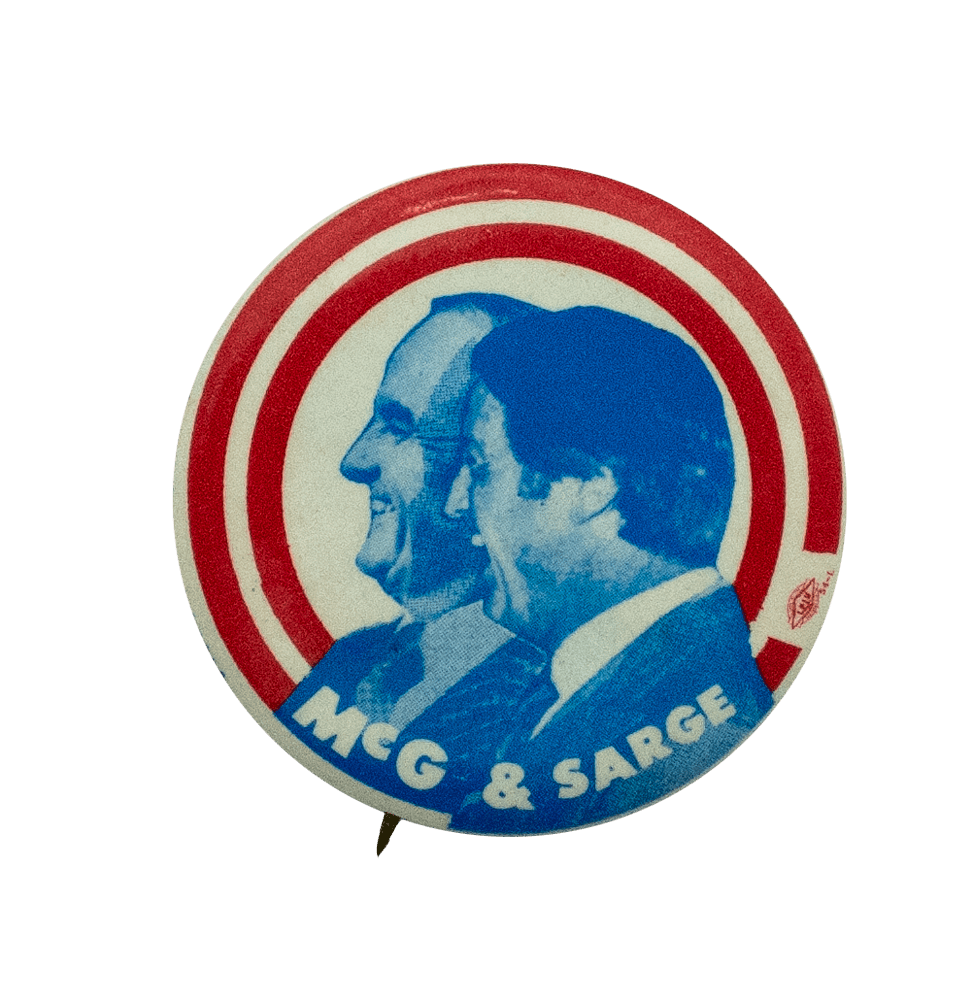
Text on Button McG & SARGE
Image Description

Two red stripes on a white background around the rim with a red union bug; blue-tinted photographs of George McGovern and R. Sargent Shriver—both laughing—are in the center on a white background

Back Paper / Back Info

[sticker: 51]

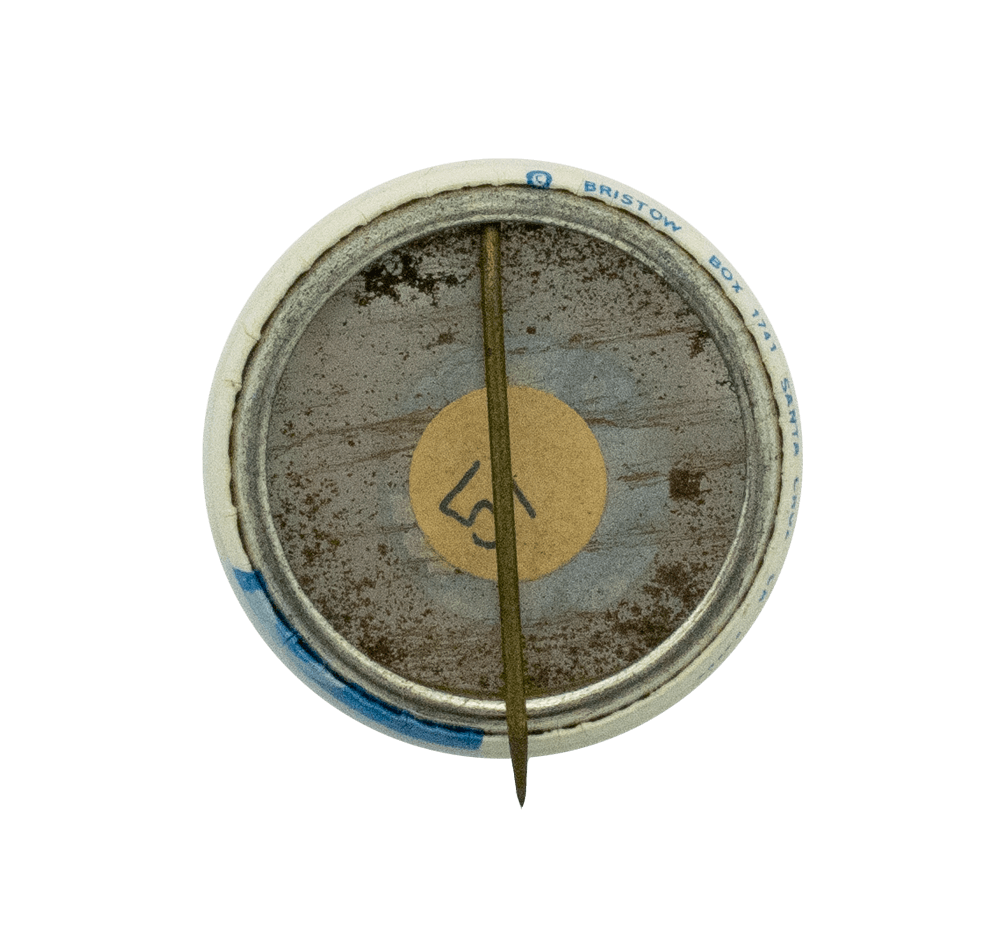
Curl Text © BRISTOW BOX 1741 SANTA CRUZ CA 95060
Back Style
The Shape
The Size
Year / Decade Made
Additional Information

George McGovern and Sargent Shriver ran as the democratic presidential and vice presidential candidates in 1972 against their republican counterparts Nixon and Agnew. Both candidates fought against racial and class inequalities well before the 1972 election. McGovern, director of Food for Peace in 1961, expanded the program’s school lunch initiative that helped feed tens of millions of hungry children around the world. Shriver created the Peace Corps and fought for the War on Poverty by establishing programs and encouraging others to join the initiative. 

Despite their landslide loss to Nixon and Agnew, McGovern and Shriver garnered widespread support from students, anti-war activists, and reform liberals who aided in the grassroots approach by campaigning door-to-door for the democratic candidates. Their campaign has been considered as one of the most memorable due to the number and quality of campaign posters and memorabilia produced by the artistic community. Famous artists, such as Andy Warhol and Sister Corita Kent, produced artwork in support of McGovern and Shriver.

Sources

Knock, T. J. (2016). Rise of a prairie statesman - the life and Times of George McGovern. Princeton University Press. 

R. Sargent Shriver. John F. Kennedy Presidential Library and Museum. (n.d.). https://www.jfklibrary.org/learn/about-jfk/the-kennedy-family/r-sargent…;

Wert, H. E., & Heishman, R. (2015). George McGovern and the Democratic insurgents: The best campaign and political posters of the last fifty years. University of Nebraska Press. 


Catalog ID PO1258

Kiss My Whip

Category
Additional Images
Sub Categories
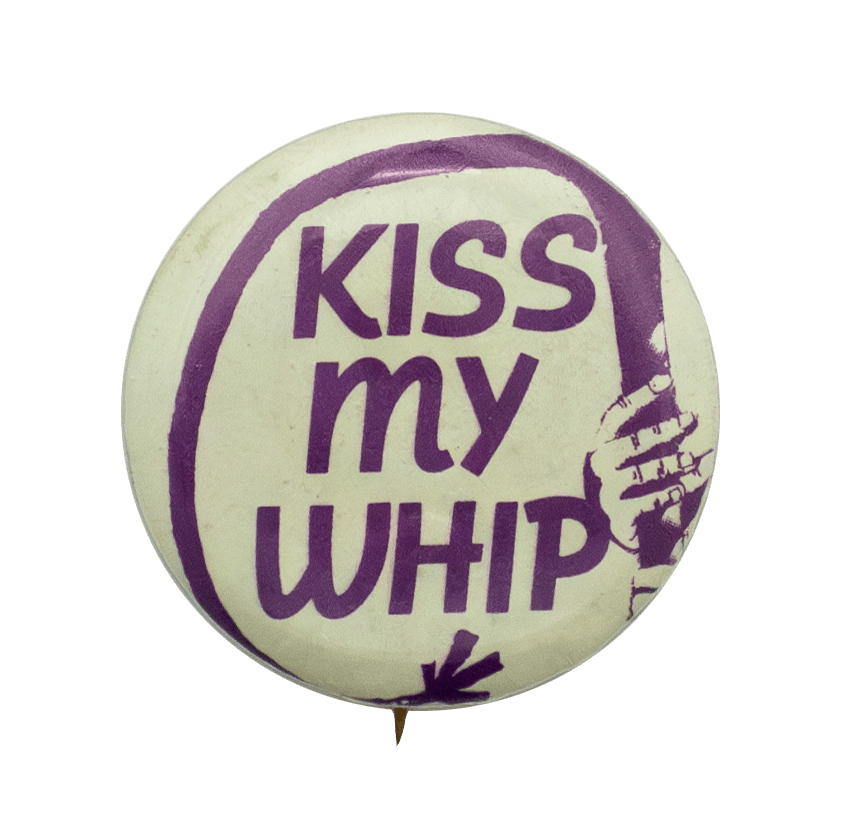
Text on Button KISS MY WHIP
Image Description

Purple text on a white background; an illustrated hand on the right-hand side is holding a purple whip that encirlcles the text

Curl Text CBC Box 521 Santa Cruz, CA 95061
Back Style
The Shape
The Size
The Manufacturer
Additional Information

Kiss My Whip is a BDSM fetish slogan associated with the queer icon, Carole Pope. Pope is a new wave rockstar and pioneer in the lesbian community who reached peak fame in the UK and Canada in the late 1970s and ‘80s. Fronting the band, Rough Trade—known for its bondage-themed stage attire—Pope showcased leather gear and erotic lyrics in their performances. In 1978, the Canadian band Goddo, led by Greg Godovitz, released the song “Oh Carole (Kiss My Whip),” as an ode to Pope after seeing Rough Trade perform at The Gasworks venue in Toronto.

Sources

Arquives. (2002). Carole Pope (1952- ). The Arquives: Canada’s LBGTQ2+ Archives. https://digitalexhibitions.arquives.ca/items/show/122

Evil Vintage Etsy. (n.d.). Badge brooch button pinback 25mm she demons kiss my whip how about a quickie sad girl she devil skull techno cool & crazy minx Confucius say [Etsy listing]. Etsy. https://www.etsy.com/listing/1860738901/badge-brooch-button-pinback-25mm-she

Goddo. (2024). The history of Goddo: Rocking the world for 50 years. Greg Godovitz.com. https://greggodovitz.com/history/

Levy, J. (2014). A brief history of Rough Trade with Carole Pope and Kevan Staples. La Venture. http://www.laventure.net/tourist/rt_hist.htm#A1

Prim, K. (2025). Carole Pope on Rough Trade, Feminism, and Pioneering Queer. Noir. https://noirpourfemmes.fr/inconversation/carolepope

Vancouver Folk Music Festival. (n.d.). Carole Pope. The Festival. https://thefestival.bc.ca/artists/carole-pope/

Catalog ID IB0845

Linda Ronstadt for First Old Lady

Category
Additional Images
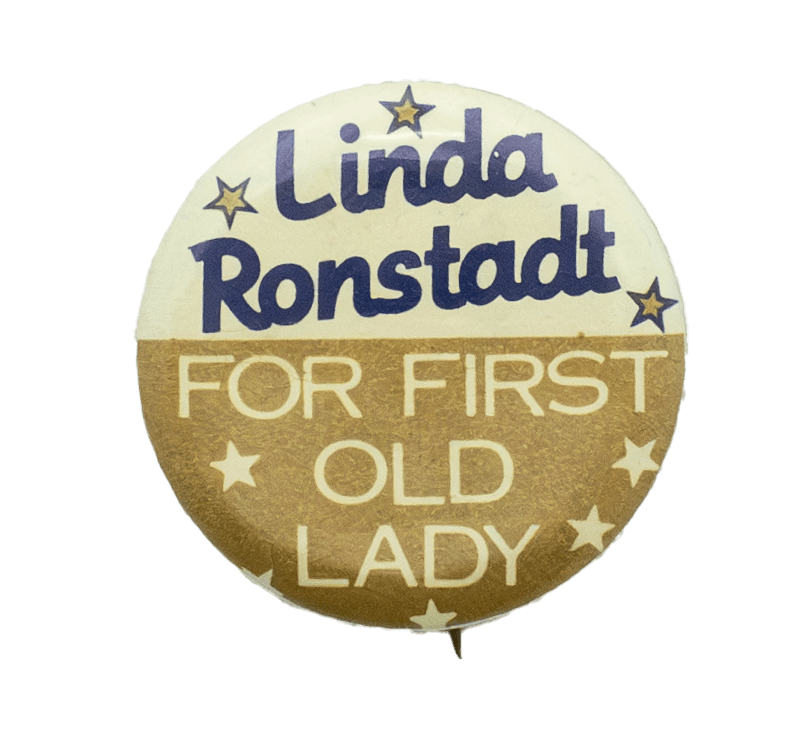
Text on Button Linda Ronstadt FOR FIRST OLD LADY
Image Description

Off-white text and stars on a gold background on the bottom half of the button; dark blue cursive text and gold stars with blue outlines on an off-white background on the top half of the button

Curl Text © 1979 CBC Box 521 Santa Cruz, CA 95061
Back Style
The Shape
The Size
Year / Decade Made
The Manufacturer
Additional Information

Linda Ronstadt met Jerry Brown in 1971. At the time, he was California's Secretary of State, and her career in music had not yet made her famous. By 1975, Ronstadt's album Heart Like a Wheel was climbing the charts. Brown announced his candidacy for President of the United States in March, 1976. His bid for the presidency was unsuccessful, but in November, 1979, he announced he would again seek the Democratic nomination in 1980. Ronstadt performed several benefit concerts for Brown, and the public began referring to her as the First Lady. Brown ended his campaign on April 1, 1980, after falling behind in the nomination process. The pair remained friends, eventually parting ways as their careers took them in different directions.

While the term “Old Lady,” seems derogatory, it was actually a term of endearment for a long-time girlfriend in the 1970s. Describing Ronstadt as “First Old Lady” was an appeal to elect Brown to make the rock superstar the First Lady of the White House.

Sources

Linda & Jerry 1971-1983. (n.d.). The Pop History Dig. Retrieved March 12, 2024 from https://pophistorydig.com/topics/linda-ronstadt-jerry-brown/

Catalog ID MU0576

Free Karl October 27

Category
Additional Images
Sub Categories
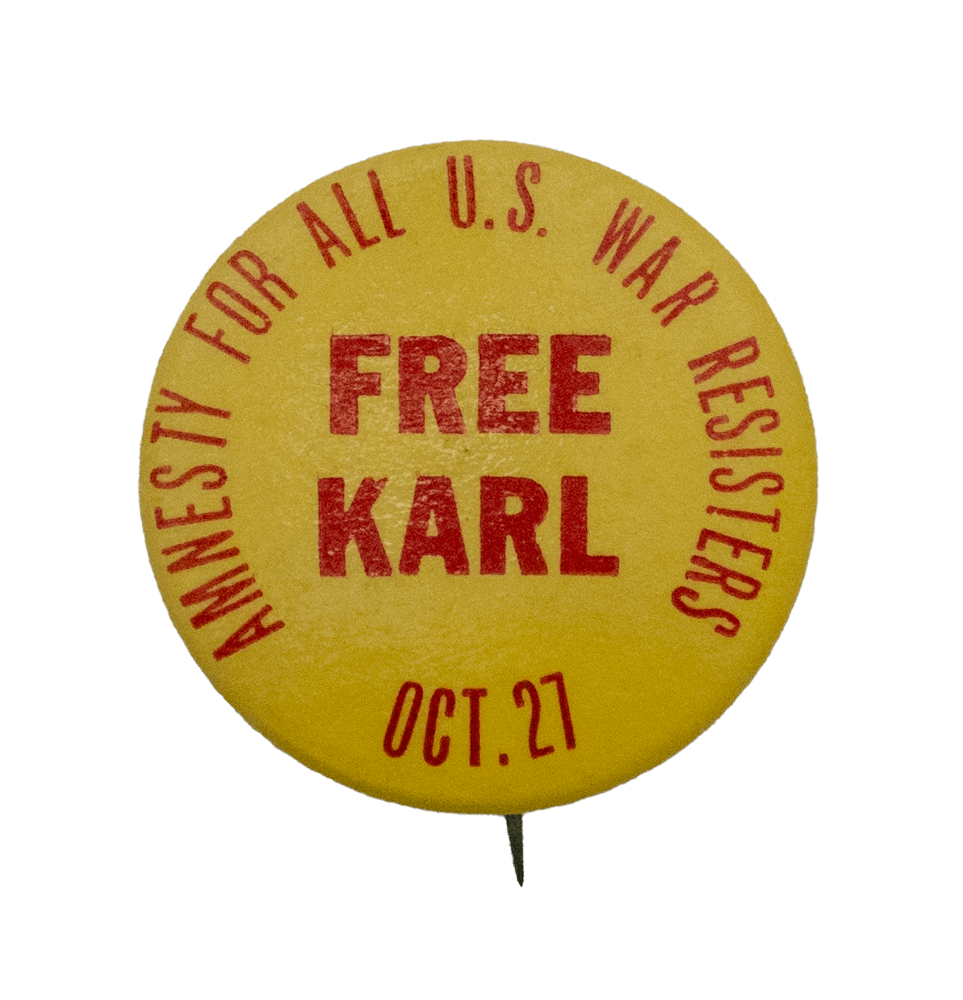
Text on Button FREE KARL OCT. 27 AMNESTY FOR ALL U.S. WAR RESISTERS
Image Description

Red text on a yellow background

Back Paper / Back Info

[sticker: 5]

Back Style
The Shape
The Size
Additional Information

During the Vietnam War, university campuses became a hotbed of revolt. “Free Karl” was an anti-war sentiment on the University of Wisconsin-Madison campus in 1973, calling for the withdrawal of the life sentence UWM student Karleton Armstrong was facing for the campus bombing of the Army Mathematics Research Center (AMRC). The October 27th rally held at UW-Madison Library Mall was one of many in an attempt to decrease Armstrong’s sentencing.

The AMRC was the only mathematics research center funded by the U.S. Government, receiving millions of dollars a year to assist the war effort. The center also worked on “Project Michigan,” which improved infra-red aerial photography and was later used to track down and kill rebel freedom fighters throughout South America.

Armstrong was a part of “The New Year’s Gang,” and their intention for bombing the AMRC was for no casualties: They bombed the building during their summer recess and called campus police to evacuate the area, which was never carried out. As a result, the demonstration killed Robert Fassnacht, a post-doctoral student who had no connection to the AMRC facility.

This event, called the Sterling Hall bombing, changed the way the anti-war movement existed throughout campuses across America – bringing the anti-war revolts to a tragic end.


Brown B., Sibler, G. 1979. The War at Home. Stadium Media LLC Studio. 

Glines, T. (2006). Review of Resistance or Terrorism? The 1970 Sterling Hall Bombing. The Journal of American History. 93(1), 156–158. https://doi.org/10.2307/4486066 

Karl Armstrong Defense Committee, Vietnam Veterans Against the War, Winter Soldier Organization. (1973, October 27). Amnesty For All War Resisters. Madison, WI, USA. https://www.dpvintageposters.com/posters/political-and-protest/protest/amnesty-for-all-war-resisters-free-karl-smash-army-math-original-american-anti-vietman-war-protest-poster_10493 

The Karl Armstrong Defense Committee. (1973). Karl Armstrong and the AMRC: A Review of the Case, A History of Protest. https://content.wisconsinhistory.org/digital/collection/p15932coll8/id/80930 

Catalog ID CA0923