Erin Go Bragh Shamrock

Category
Additional Images
Sub Categories
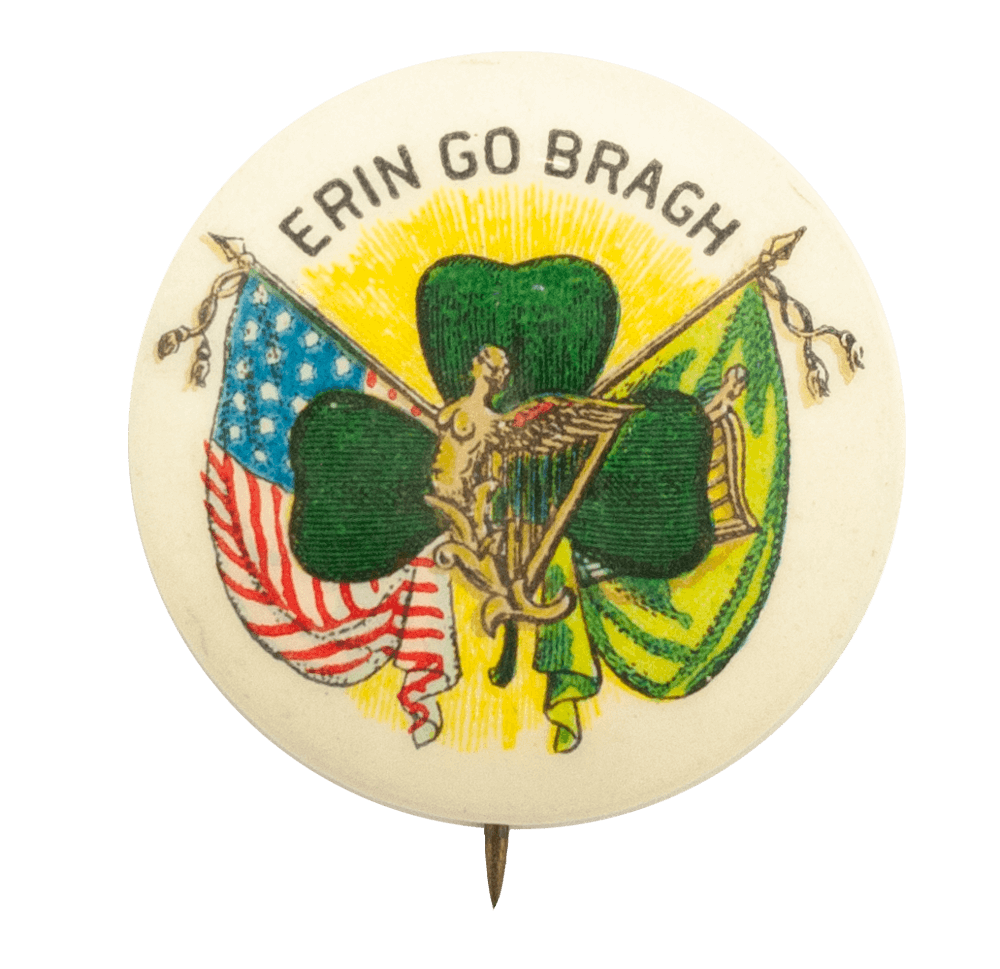
Text on Button ERIN GO BRAGH
Image Description

Black text on a white background above an illustration of an two flags, a shamrock, and a harp atop a glowing yellow background

Back Paper / Back Info

[price tag 1.00]

Back Style
The Shape
The Size
Additional Information

“Erin Go Bragh” is a phrase often heard on St. Patrick’s Day. In the original Irish, “Éirinn go Brách” is roughly translated to mean “Ireland Forever.” The phrase was coined as a rallying cry during the Irish Rebellion of 1798, a revolt of the Irish against British rule. Although they were unable to obtain their independence at that time, the phrase was picked up by the Irish people as a sign of their allegiance to Ireland. The phrase found its way to the United States through its use by a unit of Irish-American volunteers fighting for Mexico in the Mexican-American War in the 1840s. Today the phrase is used by Irish-Americans to celebrate their heritage.

Sources

Dempsey, Bobbi. (2024, March 13). What Does “Erin Go Bragh” Mean? Reader’s Digest. Retrieved from https://www.rd.com/article/what-does-erin-go-bragh-mean/

Catalog ID IB0853

McLaughlin Brothers Horse Importers

Category
Additional Images
Sub Categories
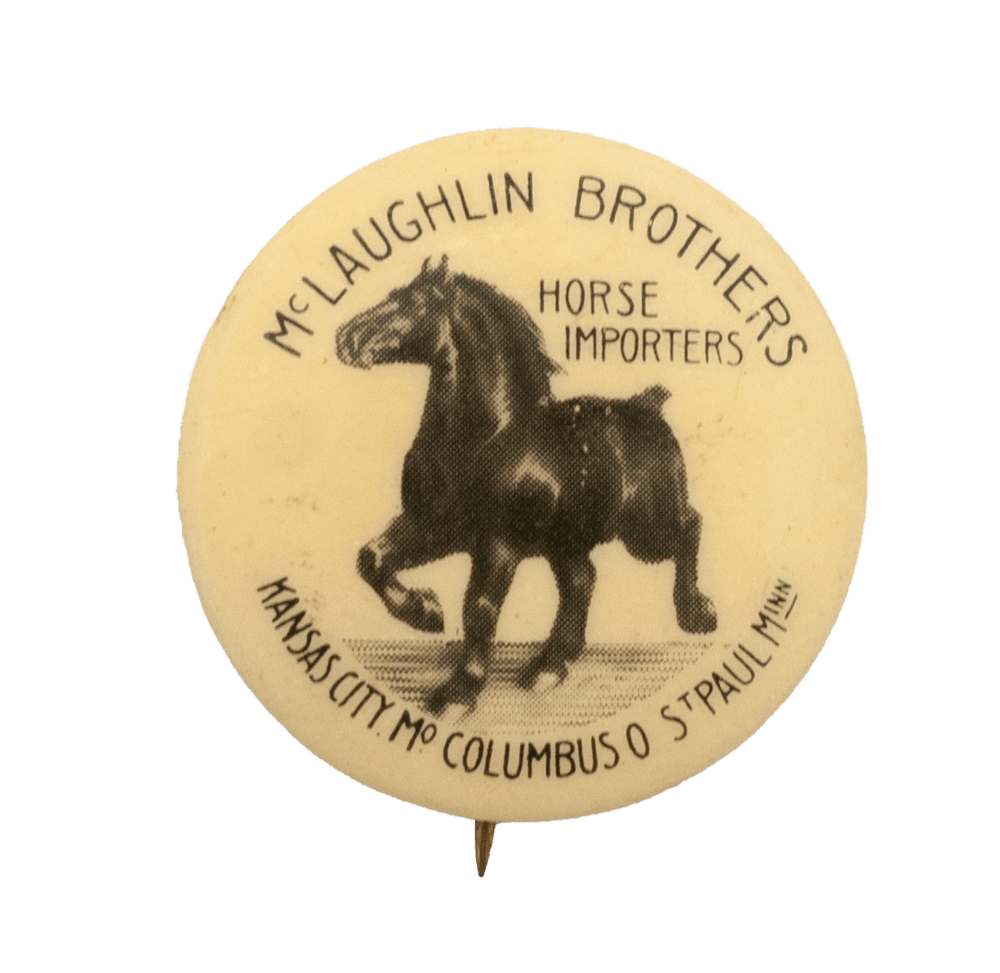
Text on Button McLAUGHLIN BROTHERS HORSE IMPORTERS KANSAS CITY MO COLUMBUS O StPAUL MINN
Image Description

Black illustration of a horse in motion with black text on an off-white background

Back Paper / Back Info

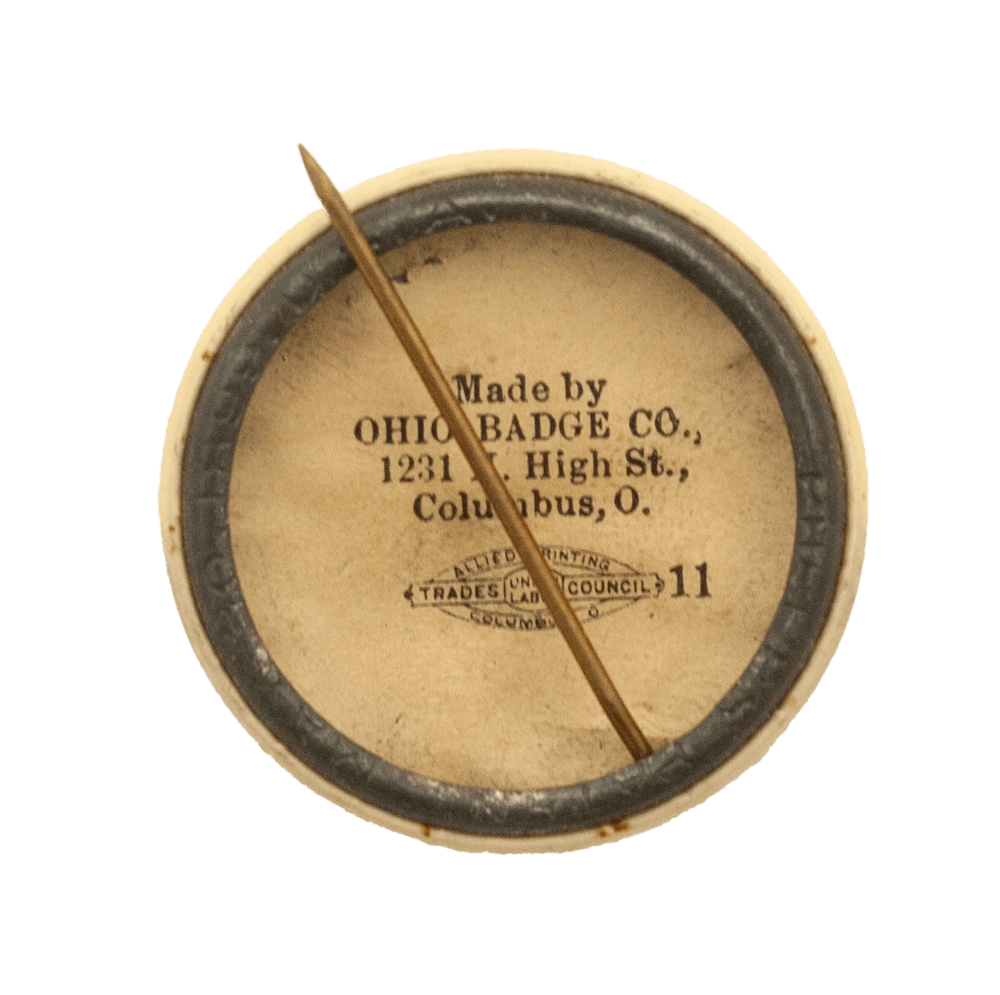
Made by OHIO BADGE CO. 1231 N. High St., Columbus, O. [union bug]

Back Style
The Shape
The Size
The Manufacturer
Additional Information

James B. McLaughlin and John McLaughlin were horse importers operating from 1890 to 1913. They founded the McLaughlin Brothers Livery and specialized in Percheron coach horses. One early business card had their location listed as Columbus, Ohio and their specialty as both Percheron and French coach horses. 


Sources
Catalog ID AD1096

I'm a Husky

Category
Additional Images
Sub Categories
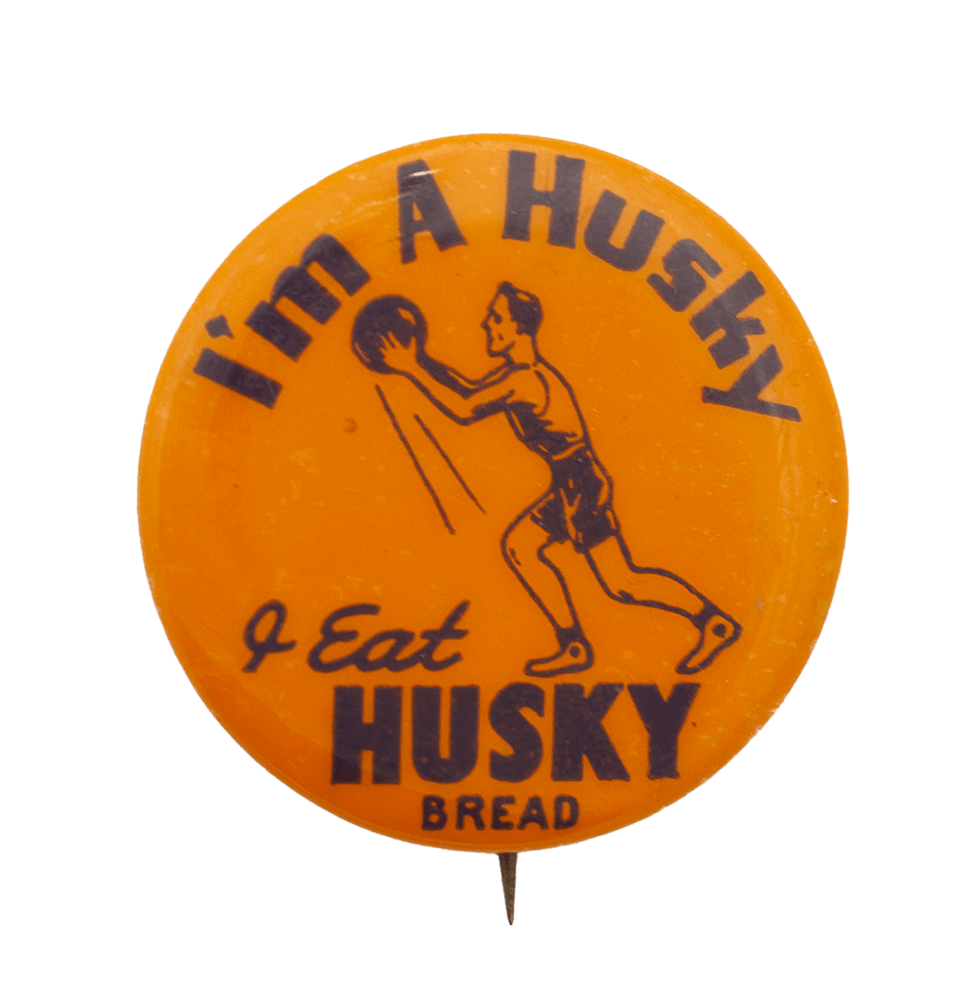
Text on Button I'm A Husky I Eat HUSKY BREAD
Image Description

Illustration of a man shooting a basketball with black text on an orange background 

Back Style
The Shape
The Size
Additional Information

The University of Washington in Seattle was established in 1861. Before 1922 the university experimented with a number of different school mascots including Vikings, Indians, and the Sundogger. In 1922, after calls for a different mascot, the Associated Students of the University of Washington formed a committee to select a new mascot. They landed on the Husky as the school’s official mascot and it has remained the mascot to this day. 

Sources

Colors  (2022, November 18). UW Brand. https://www.washington.edu/brand/brand-elements/colors/


Timeline 150. (n.d.). University of Washington. https://www.washington.edu/150/timeline/


University of Washington. (n.d.). Washington Huskies. https://gohuskies.com/sports/2013/4/18/208229209.aspx

Catalog ID SP0188

Pennies Don't Come From Heaven

Category
Additional Images
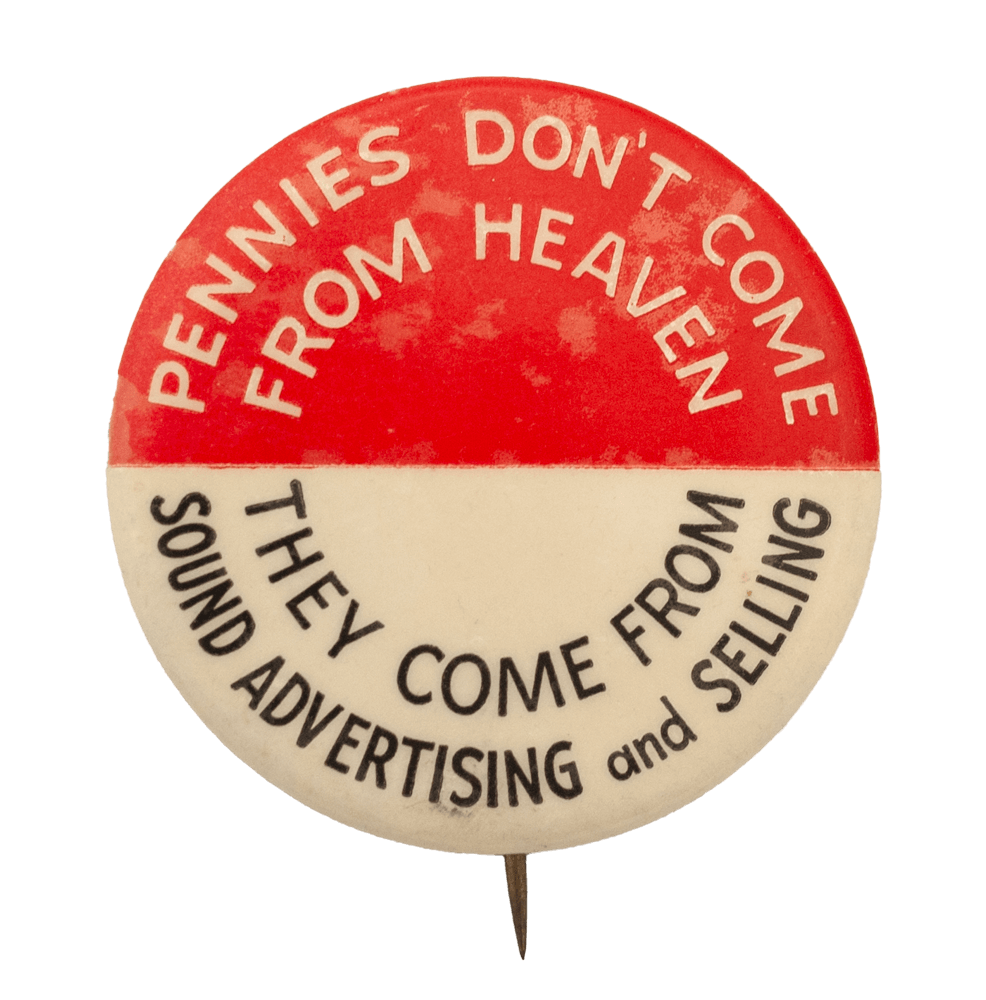
Text on Button PENNIES DON'T COME FROM HEAVEN THEY COME FROM SOUND ADVERTISING and SELLING
Image Description

White text on a red background on the top half; black text on a white background on the bottom half

Back Style
The Shape
The Size
Additional Information

“Pennies from heaven” is a phrase from a song by singer Bing Crosby, as well as a 1936 film by the same title that Crosby starred in. The song, which remained on popular music charts for over ten weeks, has lyrics speaking metaphorically of how hardships will pass and riches will return to life as a matter of course. The phrase and the notion has remained colloquially in American culture, and used for perhaps humorous purposes such as discouraging the idea of beneficence appearing from the sky and encouraging a work ethic instead. 

Sources

Joel Whitburn’s Pop memories, 1890-1954 : the history of American popular music : compiled from America's popular music charts 1890-1954 : Whitburn, Joel : Free Download, Borrow, and Streaming : (1986). Internet Archive; Menomonee Falls, Wis. https://archive.org/details/joelwpopmemories00whit/page/104/mode/2up

Pennies from Heaven. (n.d.). IMDB. https://www.imdb.com/title/tt0028092/

Catalog ID AD1095

Rally Day Horns

Category
Additional Images
Sub Categories
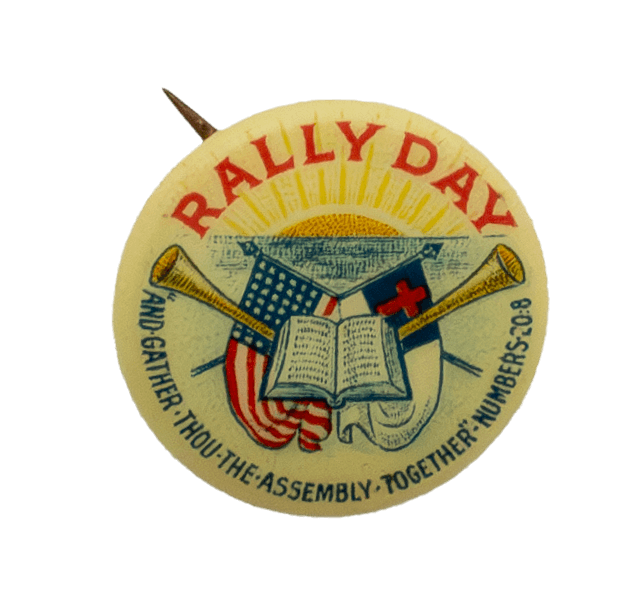
Text on Button RALLY DAY "AND GATHER THOU THE ASSEMBLY TOGETHER" - NUMBERS 20:8
Image Description

Illustration of a rising sun above an illustration of two crossed flags behind two horns with an open book in the center; large red text on the top of the button and small blue text on the bottom

Back Paper / Back Info

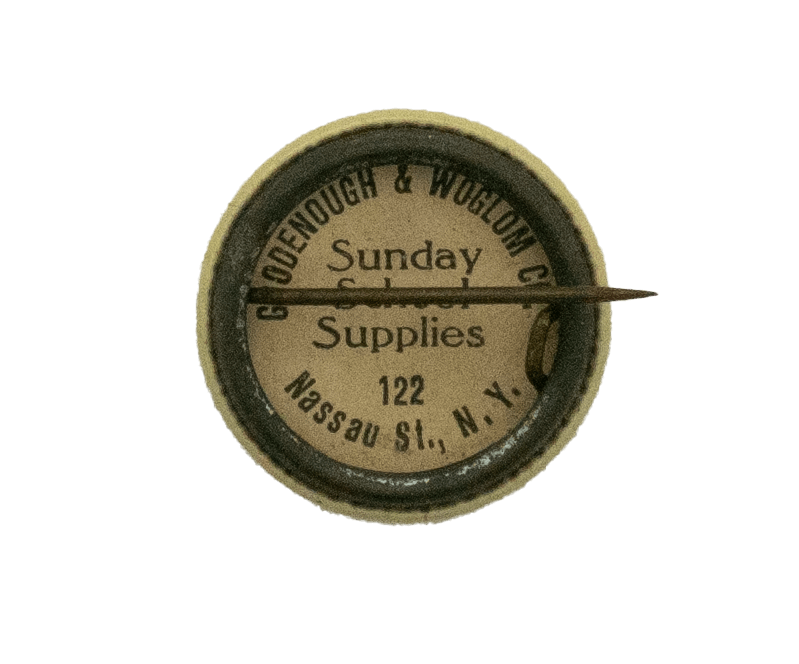
GOODENOUGH & WOGLOM CO. Sunday School Supplies 122 Nassau St., N.Y.

Back Style
The Shape
The Size
The Manufacturer
Additional Information

Rally Day is a celebration that marks the beginning of the church calendar for many Protestant practitioners. It happens in late September or early October. The church welcomes newcomers, gives bibles to children and recognizes their promotion to the next Sunday School grade, and presents the church goals for the next year.

Sources

Rally Day. (n.d.) Holidays, Festivals, and Celebrations of the World Dictionary, Fourth Edition. (2010). Retrieved April 17 2024 from https://encyclopedia2.thefreedictionary.com/Rally+Day

Catalog ID EV0972

Ricordo de la Festa Nazionale

Category
Additional Images
Sub Categories
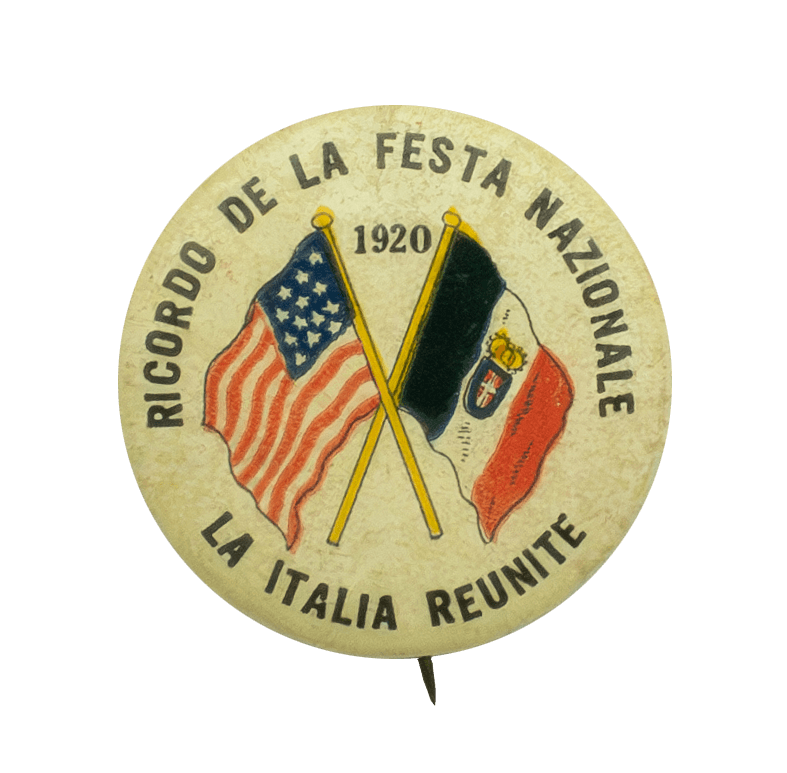
Text on Button RICORDO DE LA FESTA NAZIONALE 1920 LA ITALIA REUNITE
Image Description

Black text on a white background with a color illustration of the flags of Italy and the United States attached to crossed yellow flag poles

Back Paper / Back Info

[sticker: 70]

Back Style
The Shape
The Size
Year / Decade Made
Additional Information

Ricordo de la Festa Nazionale, also known as National Unity and Armed Forces Day, is an Italian national holiday first recognized on November 3, 1918, in honor of Italy's defeat of the Austro-Hungarian Empire and the end of WWI; the holiday is celebrated on the following day, November 4th. On its first anniversary in 1919, protests broke out due to the clash of fascists and socialists. In response to the violence from the previous year, a Flag Festival was held in 1920. Participating in the Flag Festival were Italy's flags along with those of their allies, including the United States. In 1941, Italy paused the celebration (along with other Italian holidays) due to World War II. After WWII the holiday resumed, and throughout the 1950s to the 1970s, the event experienced violent and deadly riots. These events contributed to the transition to National Unity Day and is no longer a public nor a widely known holiday anymore. 

Sources
contributori di Wikipedia. (2024, May 31). Giorno dell’Unità nazionale. Wikipedia. https://it.wikipedia.org/wiki/Giorno_dell%27Unit%C3%A0_nazionale
 
Catalog ID EV0971

Swift's Golden Neck Layer

Category
Additional Images
Sub Categories
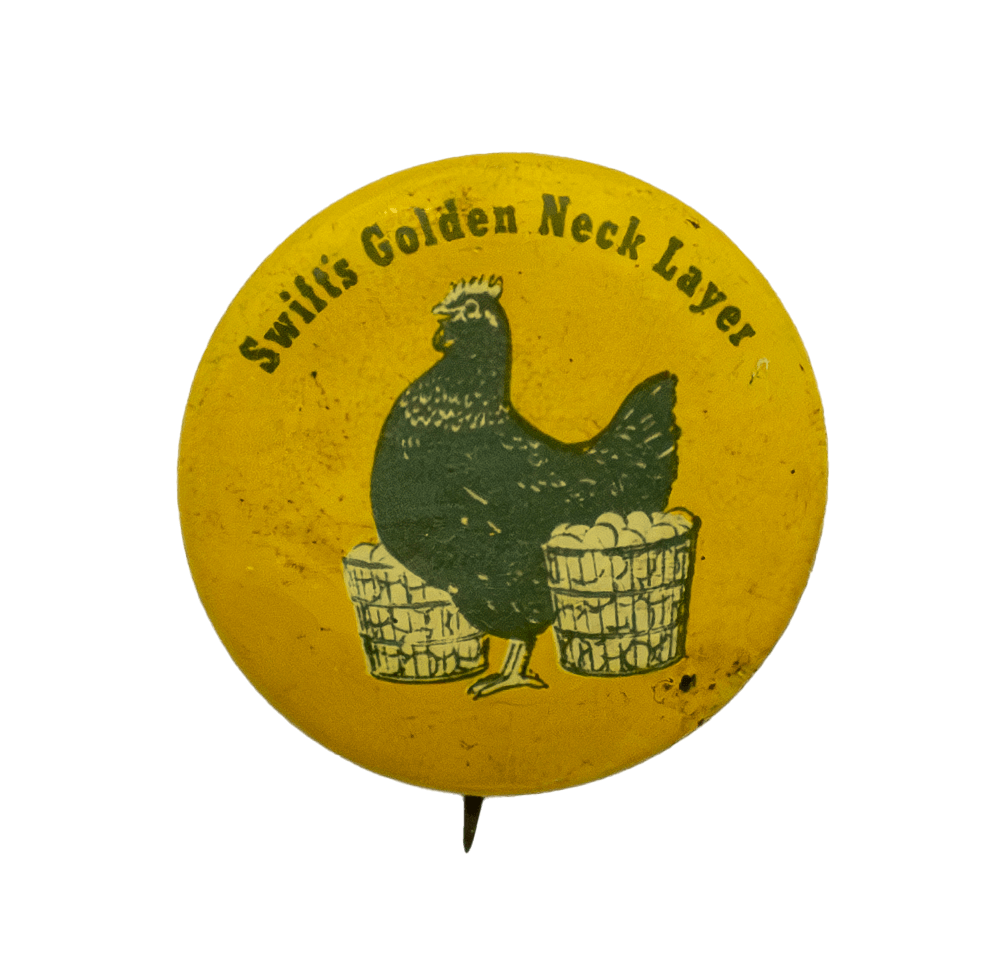
Text on Button Swift's Golden Neck Layer
Image Description

Yellow background with black text on the top above a large black and white illustration of a chicken in between two large baskets filled with eggs

Back Paper / Back Info

[sticker: 161]

Back Style
The Shape
The Size
Year / Decade Made
Additional Information

Swift Hatchery did business in Iowa in the 1940s and 1950s. In a 1949 newspaper ad, the chicks "Husky, Hearty, and Healthy" are proud to present “Swift’s Golden Neck Layer.” The breed was being offered in Iowa for the first time, and was described as a golden opportunity for poultry raisers! [emphasis taken from ad]

Sources

Swift’s Golden Neck Layer. (1949 January 20). The Algona Upper Des Moines (Algona, Iowa). p. 14.

Catalog ID AD1094

Nuke the Whales

Category
Additional Images
Sub Categories
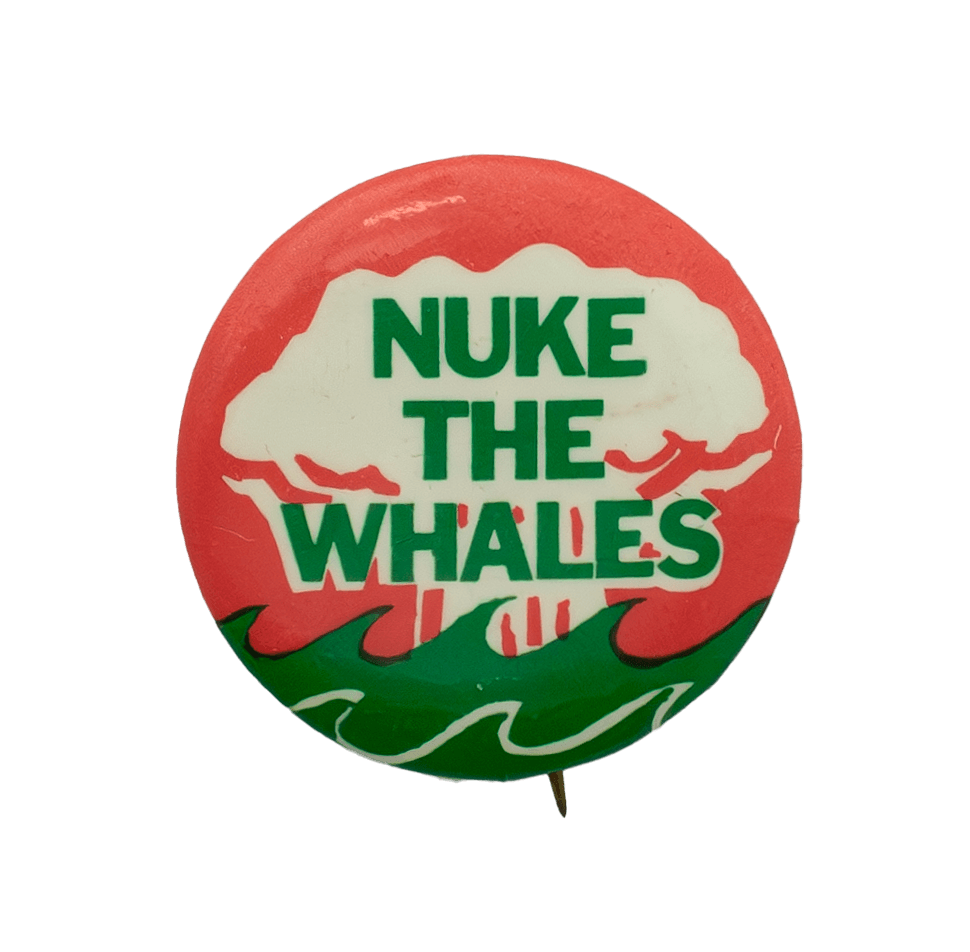
Text on Button NUKE THE WHALES
Image Description

Red background with an illustration of green waves and a white mushroom cloud; green text is overlaid over the illustration. 

Curl Text CBC Box 521 Santa Cruz, CA 95061
Back Style
The Shape
The Size
The Manufacturer
Additional Information

In November 1970, the community of Florence, Oregon faced a problem: a dead sperm whale, eight tons heavy and forty-five feet long, had washed up on the beach shore and was decomposing. The Oregon State Highway Division considered multiple options, but decided that using dynamite to vaporize the whale would be the correct course of action. Unfortunately, for the community and the spectators who came to witness the event, not enough explosives were used, resulting in an eruption of whale blubber and viscera landing in the area, even crushing a car. As no one was injured, the event became a humorous misstep that may have been the inspiration for cultural references such as in an episode of the television show The Simpsons and whose anniversary prompts interviews with the reporter who was present, reporting the case, and caught the footage for the news. 

Sources

Carlson, L. (n.d.). Florence Whale Explosion. Retrieved February 1, 2024, from https://www.oregonencyclopedia.org/articles/florence_whale_explosion/

FROM THE ARCHIVES The Exploding Whale Of Florence, Oregon : ABC7 News Bay Area : Free Download, Borrow, and Streaming : Internet Archive. (n.d.). https://archive.org/details/from-the-archives-the-exploding-whale-of-fl…

Catalog ID IB0852

Fight Racism Overturn Bakke

Category
Additional Images
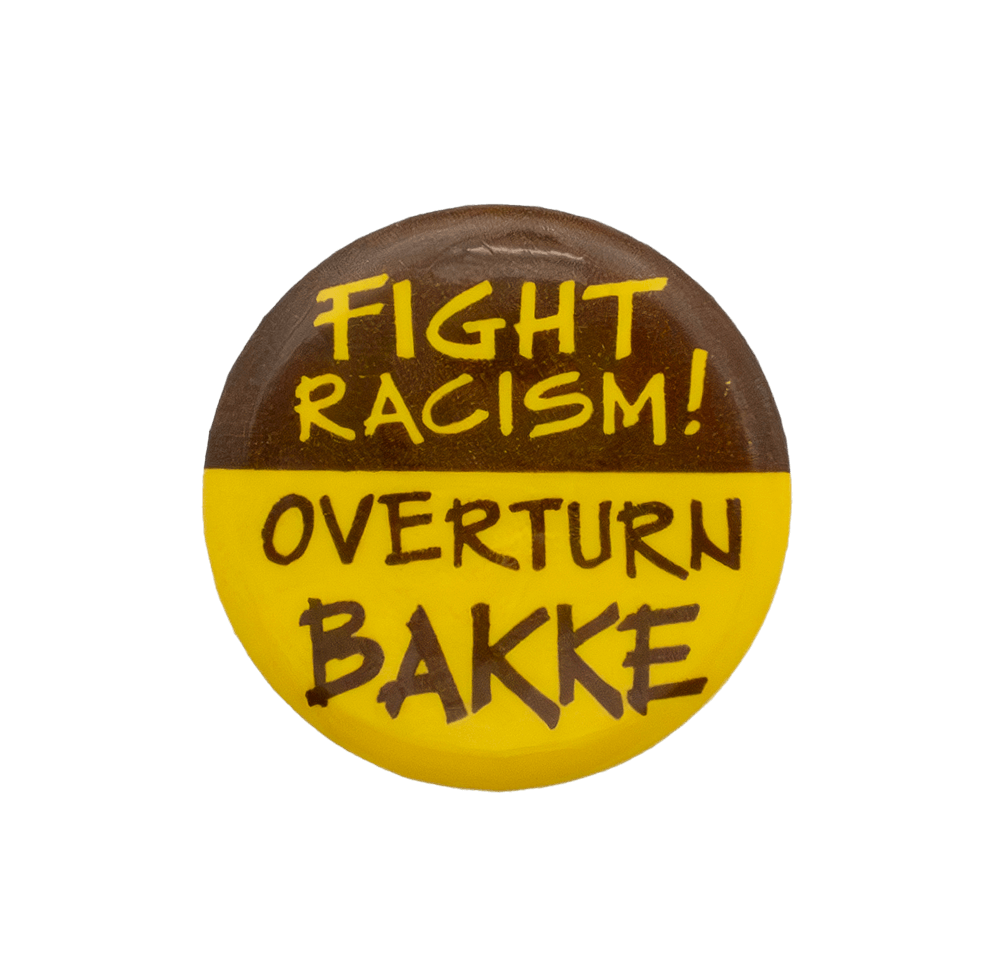
Text on Button FIGHT RACISM! OVERTURN BAKKE
Image Description

Background is divided in half with  brown on the top and yellow on the bottom, with yellow and brown text

Curl Text union bug
Back Style
The Shape
The Size
Year / Decade Made
Additional Information

In the Bakke decision of 1978 the United States Supreme Court ruled that while racial quotas were not constitutional, consideration of an applicant’s race was constitutionally allowed on college applications.

Allan Bakke brought his case against the University of California Davis because he was denied admission to their medical school due to what he called “reverse discrimination.” At the time, UC Davis had a policy of reserving 16% of their admissions for minority students. The court ruled that while race could be a consideration on a college application, it was unconstitutional to set an exact number of slots. With the ruling, precedence was set to uphold affirmative action in future cases.

Sources

Bakke decision. (n.d.). Britannica. Retrieved from https://www.britannica.com/event/Bakke-decision

When the Supreme Court first ruled on affirmative action. (n.d.). National Constitution Center. Retrieved from https://constitutioncenter.org/blog/when-the-supreme-court-first-ruled-on-affirmative-action

Catalog ID CA0925

McGovern Our Next President

Category
Additional Images
Sub Categories
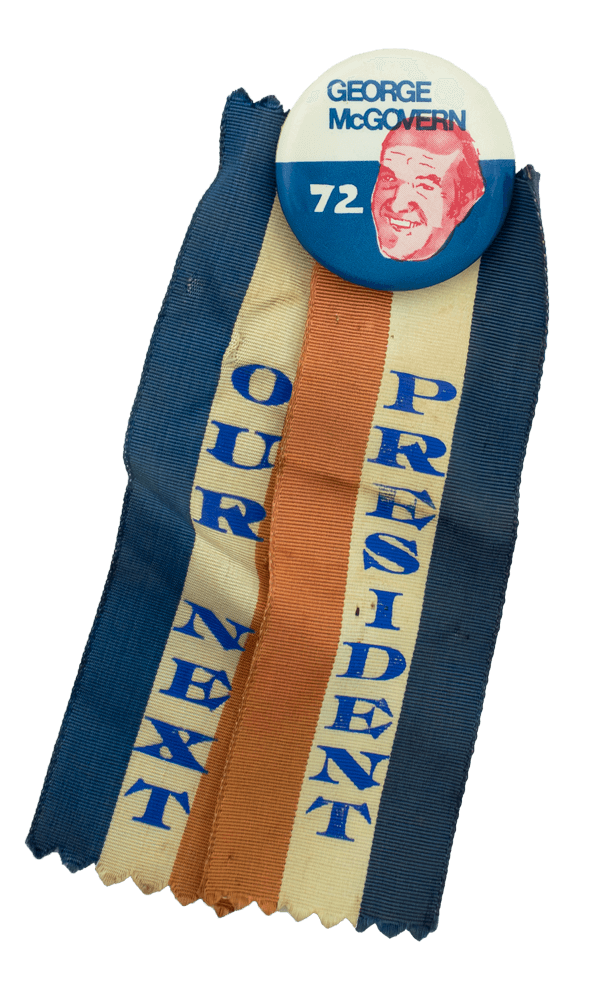
Text on Button GEORGE McGOVERN 72
Image Description

Button is white on the top half and blue on the bottom half with blue text on white and white text on blue; a large, red illustration of McGovern's face is overlaid on the right-hand side. The button is attached to a red, white, and blue ribbon with blue text that reads "OUR NEXT PRESIDENT."

Back Paper / Back Info

[sticker: 80]

Back Style
The Shape
The Size
Year / Decade Made
Additional Information

George McGovern (1922–2012) was a Democratic senator from South Dakota from 1963 to 1981. During his time as senator, he ran for president twice. McGovern was the Democratic nominee in 1972, running against then Republican president, Richard Nixon. In 1968, he ran for president in place of the assassinated candidate, Robert F. Kennedy. McGovern's views were progressive for his time; he supported the decriminalization of marijuana, reproductive rights, and withdrawing from the Vietnam War. Some consider McGovern to be the Bernie Sanders of his time due to his grassroots support, advocacy for equal rights, and being the underdog candidate. McGovern received 37.5% of the popular vote, losing the election to Nixon, who won with 60.7% of the votes. The 1972 election is considered to have the lowest voter turnout since 1948.

Sources
The Editors of Encyclopaedia Britannica. (2009, December 8). U.S. presidential election of 1972 | Richard Nixon vs. George McGovern, Candidates, Results, & Facts. Encyclopedia Britannica. https://www.britannica.com/event/United-States-presidential-election-of-1972
Npr. (2022, February 15). The presidential campaign that changed American politics. NPR. https://www.npr.org/2022/02/14/1080672768/the-presidential-campaign-tha…
 
Catalog ID PO1267