Got Milk?

Category
Additional Images
Sub Categories
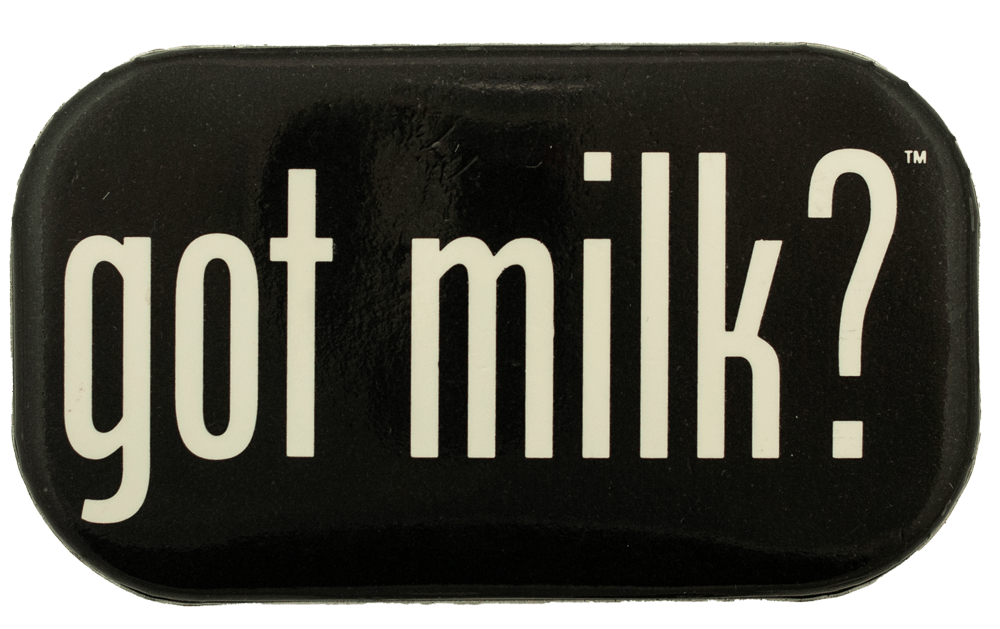
Text on Button got milk?
Image Description

White text on a black background.

Back Style
The Shape
The Size
Additional Information

The ad campaign “Got Milk” is said to be one of the most successful campaigns in U.S. history. What caused this sudden need to sell more milk? Well, a look back at the history of milk consumption will give us the answer! Until the invention of refrigeration and pasteurization, drinking milk was not as popular as it is today. Once the invention of these technologies, plus government intervention was implemented, the milk industry began to boom. By WWII, Americans were drinking two to three glasses of milk a day. However, farmers were producing so much milk that the government began using the surplus for school lunches and government supplied cheese.

Milk consumption began to shift again, and by the 1990s, it had decreased by twenty percent. Reasons for the decrease in milk drinkers include the fact that Americans dined out more often, and the idea that milk was perceived as a child’s beverage and the population under eighteen was shrinking as it was the post-Baby Boomer years. Another major influence was the marketing and design of other bottled beverages, which began being produced in the 1960s and 70s. The marketing for these beverages were incredibly successful. The bottles were shaped differently, they were more colorful and exciting, and they traveled well. Milk became known as a boring beverage associated with domesticity. It was clear that milk needed an image change. 

The “Got Milk?” campaign was created to increase the consumption of milk in those who already drank milk since research had shown that it is easier than converting new customers. The campaign produced commercials showing people running out of milk during moments when having milk was crucial for success. Another strategy was to make drinking milk cool. More commercials as well as ads were produced to specifically target a young audience. The ads, photographed by Annie Leibovitz, featured celebrities at the peak of their popularity with milk mustaches. The “Got Milk?” Ad became so popular by 2000 that national awareness of the ad was between 80 to 90%. While the campaign was successful in the 1990s, American’s drink preferences have since shifted due to many reasons including climate change, demographic shifts, and veganism. Now, the focus has shifted to marketing other dairy products such as yogurt and cheese. 

Sources

Holt, D. B. (2019, February 12). Got milk?. ANA Educational Foundation. https://aef.com/classroom-resources/case-histories/got-milk/ 

Kauffman, J. (2022, December 1). Why “got milk?” is one of the greatest ad campaigns of all time. Saveur. https://www.saveur.com/culture/got-milk-greatest-ad-campaign/ 


Catalog ID AD1075

Johnny Cupcake

Category
Additional Images
Sub Categories
Image Description

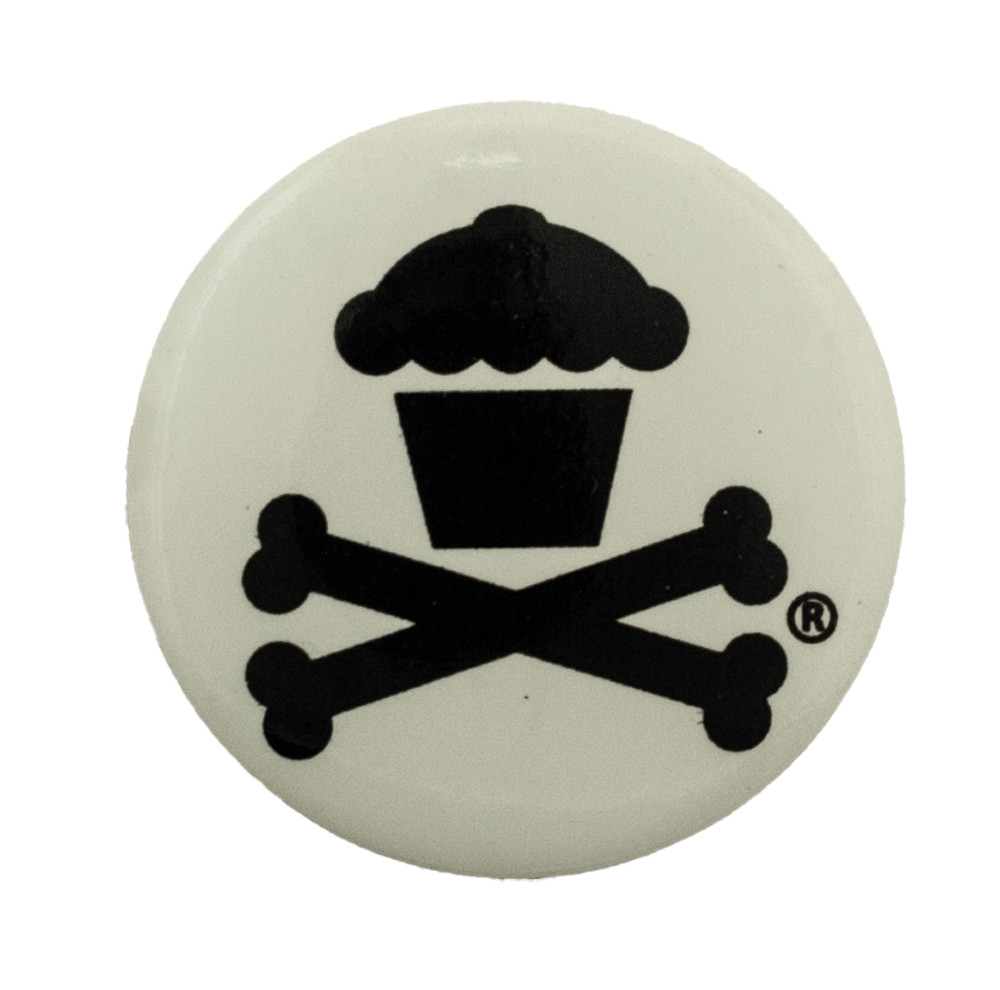
A black silhouette of a cupcake with two crossed bones below it on a white background. 

Curl Text www.johnnycupcakes.com
Back Style
The Shape
The Size
Additional Information

At age 19, Bostonian John Earl took his nickname—Johnny Cupcakes—and created a t-shirt as a joke amongst friends. When he began receiving requests to purchase the t-shirt, he started selling his creations out of his car and on tour with his band. From this, the entrepreneur expanded, creating Johnny Cupcakes in 2001: a clothing company with a very specific design. The aesthetic of the stores are to look and smell like a bakery, with clothing displayed on trays in glass display cases and orders packaged in pastry boxes. The brand's simple logo—a cupcake over crossbones—is very distinctive and the clothier has branched out into other designs and now includes items such as hats, socks, stickers, and buttons. The company is known for their irreverant sense of humor, and has spoofed and collaborated with other popular brands, swapped out logos of other businesses with the Johnny Cupcakes logo, and redesigning characters from video games, television shows, and films. As of 2024, Johnny Cupcakes has eight store locations throughout the United States. 

Sources

About. (n.d.). Johnny Cupcakes. Retrieved February 9, 2024, from https://johnnycup

cakes.com/pages/about


Smith, T. (2006, August 19). Johnny Cupcakes Finds Sweet Success in T-Shirts. NPR. https://www.npr.org/2006/08/19/5618417/johnny-cupcakes-finds-sweet-succ…


Stickers + Pins. (n.d.). Johnny Cupcakes. https://johnnycupcakes.com/collections/stickers-pins

Catalog ID AD1074

Farrell's Ice Cream Parlor

Category
Additional Images
Sub Categories
Image Description

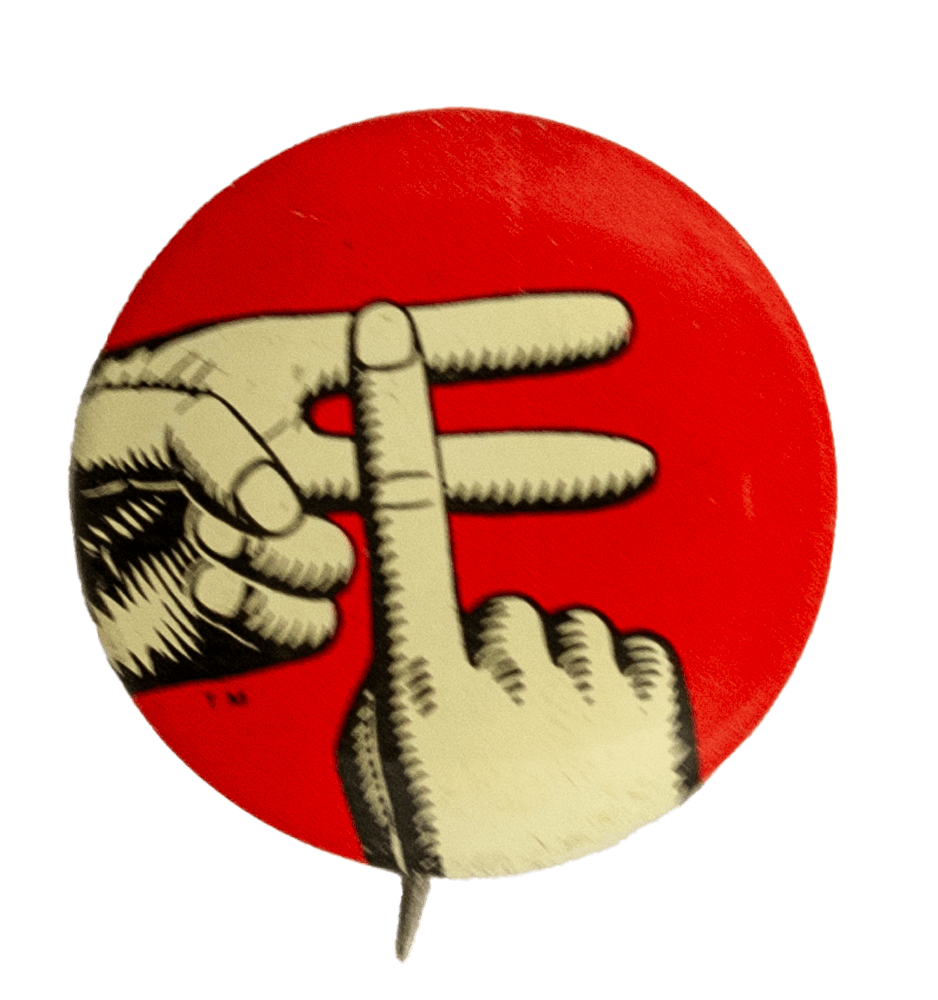
An illustration of two hands making the letter F on a red background. 

Back Style
The Shape
The Size
Year / Decade Made
Additional Information

Bob Farrell and Ken McCarthy opened Farrell’s Ice Cream Parlour in Portland, Oregon in 1963. Built from Farrell’s desire to bring his wife to ice cream parlors fashioned like those from his childhood, it became known for giving free sundaes to children on their birthday, distinct straw-hat uniformed staff, and a player piano. Farrell’s franchised and spread across the country, selling not just ice cream but food and merchandise such as buttons and ice cream scoops. Farrell sold the company to Marriott in 1971 and the company changed owners multiple times in the following decades. In 2009 the owner attempted to revamp the business, but Farrell’s Ice Cream Parlor struggled with locations closing around the country until its final location closed in California in 2019. 

Sources

Farrell’s USA. (n.d.). Farrell’s - Ice Cream Parlour Restaurants - Shop Online. https://web.archive.org/web/20140711014047/http://www.farrellsusa.com/s…;

Farrell’s USA. (n.d.). The Farrell’s Story. Farrell’s Franchise Information. https://web.archive.org/web/20140606232904/http://www.farrellsusa.com/f…;

Jennings, L. (2010, August 31). Farrell’s looks to restart growth. Nation’s Restaurant News. https://www.nrn.com/corporate/farrells-looks-restart-growth 

Rozek, J. (2021, March 19). Farrell’s Ice Cream Parlour Restaurant at Woodfield Mall. History of Schaumburg Township. https://ourlocalhistory.wordpress.com/2021/03/21/farrells/ 

Catalog ID AD1073

Angry Donald Duck

Category
Additional Images
Sub Categories
Image Description

Extreme close-up of an angry Donald Duck's face on a red background. 

Curl Text © DISNEY MFG OSP PUBLISHING
Back Style
The Shape
The Size
The Manufacturer
Additional Information

Known for having a quick temper, Donald Duck is considered one of Walt Disney’s most popular cartoon characters. He was first introduced in the Silly Symphony, The Wise Little Hen, on June 9, 1934. Although he has done plenty of solo work, many people associate the irascible duck with Mickey Mouse, Walt Disney’s company mascot. He is often depicted alongside the Mickey Mouse crew, his girlfriend Daisy Duck, and his three mischievous nephews.

Sources

The Official Disney Fan Club. (2024). Donald Duck. Retrieved from https://d23.com/a-to-z/donald-duck/

Catalog ID EN0653

Pirate Mickey and Friends

Category
Additional Images
Sub Categories
Image Description

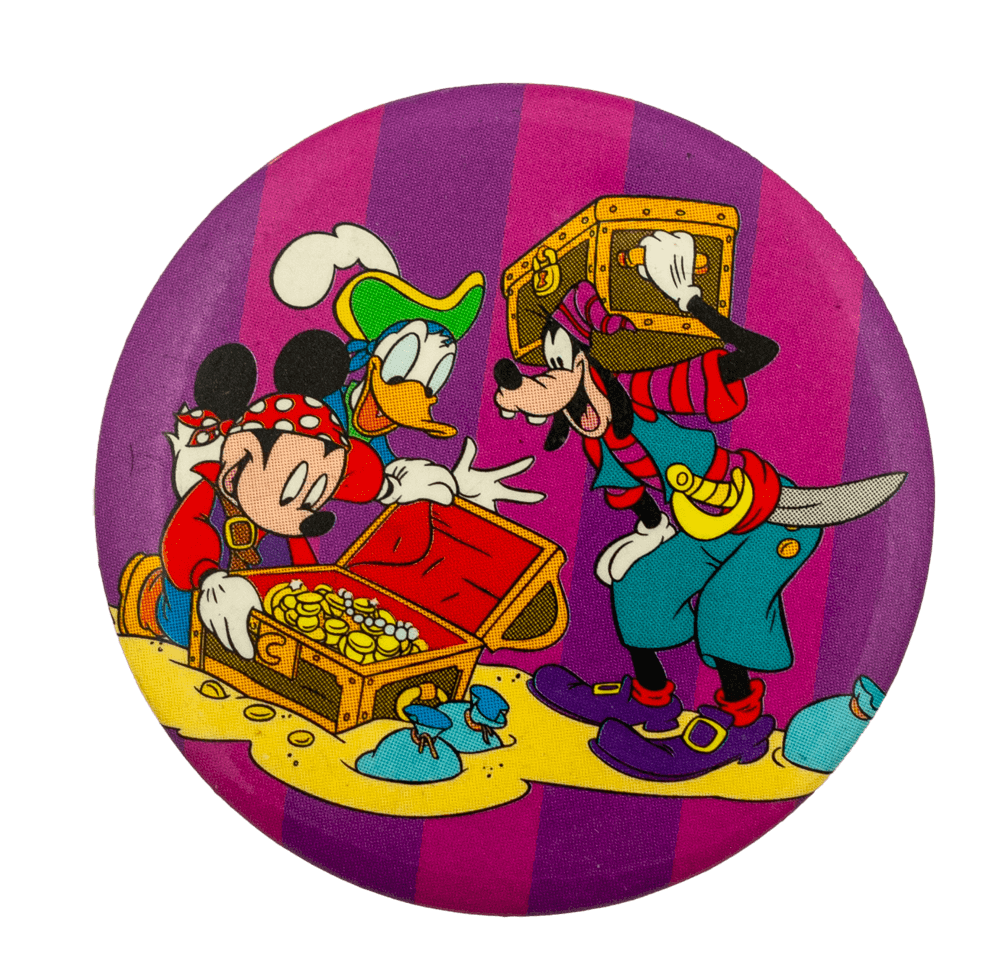
Dressed in pirate gear, Mickey, Donald, and Goofy surround a treasure box filled with gold. The scene is set against a background of purple and pink stripes.

Curl Text © DISNEY MFG O.S.P. PUB., INC GROUP MONTEREY PARK, CA 91754
Back Style
The Shape
The Size
Additional Information

Mickey Mouse is one of Disney’s most recognizable characters. His companions Donald Duck and Goofy are other members of what’s known as the “Sensational Six”: the main group of characters crafted by Walt Disney. Pirate attire has been linked to Mickey Mouse in a number of narratives, including an episode called “Pirate Adventure” in the children’s television show Mickey Mouse Funhouse in 2022. This particular image and outfit are from a series of multiple buttons  that collectors attribute to being created in the 1990s. The illustration of Mickey in the polka dotted bandana and red poet shirt was revived for a limited edition Pirates of the Caribbean silk screen printed piece of art for the Walt Disney Art Classics Convention held in 2000 at Walt Disney World. 

Sources

A Pirate’s Life For Mickey Limited Edition Sericel - ID: decmickey19030. (2020, February 1). Van Eaton Galleries. https://vegalleries.com/art/walt-disney/1384/mickey-mouse-1928-present/…


Henderson, D. (2000). A Celebration of Walt Disney’s Art Classics March 23-25 2000. The Duckman’s Inside Report. http://www.wdccduckman.com/conv2000.htm


Mickey Mouse & Pegleg Pete pirates button from our Buttons collection. (n.d.). Retrieved February 11, 2024, from https://www.fantasiescometrue.com/product/mickey_mouse_pegleg_pete_pira…


O’Callaghan, M., Weinstein, P., & Dias, A. (2022, August 19). Pirate Adventure [Television]. Disney Television Animation. https://www.imdb.com/title/tt21221806/

Catalog ID EN0652

Moss Will Grow on You

Category
Additional Images
Text on Button MOSS WILL GROW ON YOU
Image Description

Green and black text on white background. Background has a green border resembling moss. 

Back Style
The Shape
The Size
Additional Information

Though the exact origins of the phrase “moss will grow on you” are unclear, it is reminiscent of two well-known idioms: “a rolling stone gathers no moss” and “don’t let the grass grow under your feet”.

The phrase a rolling stone gathers no moss” has historically carried multiple meanings. Traditionally, it warns that someone who constantly moves or shifts focus may fail to establish roots, responsibilities, or lasting achievements. However, it can also be read more positively as a reminder that someone engaging with diverse activities and constant change will not grow obsolete by staying in one place.

Similarly, “don’t let grass grow under your feet,” originally traced back to print from 1607, usually means that one should act quickly and avoid hesitation. It suggests that those who remain active and responsive will seize opportunities rather than allowing life to pass them by and gathering metaphorical dust, or in this case, grass.

Therefore, the phrase “moss will grow on you” likely implies a similar sentiment that if you stay in one place, you’ll metaphorically “grow moss”. The phrase serves as a humorous warning of the consequences of staying still for too long. To say that moss will grow on someone suggests they have become stagnant and unwilling to change.

Sources

Cambridge University Press & Assessment. (n.d.). A Rolling Stone (Gathers no Moss) Definition. Cambridge Dictionary . https://dictionary.cambridge.org/us/dictionary/english/rolling-stone-ga….

Farlex Inc. (n.d.). Don’t let the Grass Grow Under Your Feet. The Free Dictionary. https://idioms.thefreedictionary.com/don%27t+let+the+grass+grow+under+y….

Catalog ID IB0836