I Wear My Seatbelt

Category
Additional Images
Sub Categories
Text on Button I WEAR MY SEATBELT
Image Description

White text on a red background

Back Style
The Shape
The Size
Additional Information

The first automotive seat belts were patented in the late 19th century for use in New York City taxi cabs. Originally meant to keep the driver and passengers from sliding around in their seats, seat belts for safety from accidents weren't a concern until the 1930s. Physicians across the country began to urge auto manufacturers to provide lap seat belts in all cars. The three-point seat belt was invented in 1958; Swedish carmaker Volvo was the first to implement a simple and effective design. By the late 1960s, all American vehicles were required to provide seat belts; however, getting people to wear them was difficult. 

Despite scientific research in the 1940s and 1950s, the use of seat belts aroused heated debate. Many felt it should be up to the individual to decide to use a seat belt. The National Ad Council ran advertisements for decades encouraging divers to "Buckle Up." It took over thirty years for seat belt laws to be enacted across all fifty states. Slogans like "I wear my seat belt," showed support for safety and promoted the use of seat belts.

Click here to see another version of this button held by the museum

Sources

Encyclopædia Britannica. (n.d.). Vehicular safety devices. Britannica Library. https://library-eb-com.resources.skokielibrary.info/levels/referencecenter/article/vehicular-safety-devices/74956

NatlSafetyCouncil. (2016, July 15). Buckle up for safety | National Safety Council. Youtube. https://www.youtube.com/watch?v=5WYWOc4L9_0

NHTSA - A Drive Through Time. (n.d.). National Highway Traffic Safety Administration. https://one.nhtsa.gov/nhtsa/timeline/index.html

Nichols, J. L., Tippetts, S., Fell, J. C., Auld-Owens, A., Wiliszowski, C. H., Haseltine, P. W., & Eichelberger, A. (2010). Strategies to Increase Seat Belt Use: An Analysis of Levels of Fines And the Type of Law (DOT HS 811 413). National Highway Traffic Safety Administration. https://www.nhtsa.gov/sites/nhtsa.gov/files/811413.pdf

Roos, D. (2020, August 31). When New Seat Belt Laws Drew Fire as a Violation of Personal Freedom. HISTORY. https://www.history.com/news/seat-belt-laws-resistance

Vehicular safety devices. (n.d.). Britannica Library. https://library-eb-com.resources.skokielibrary.info/levels/referencecen…

Catalog ID IB0832

Abortion is My Baby

Category
Additional Images
Sub Categories
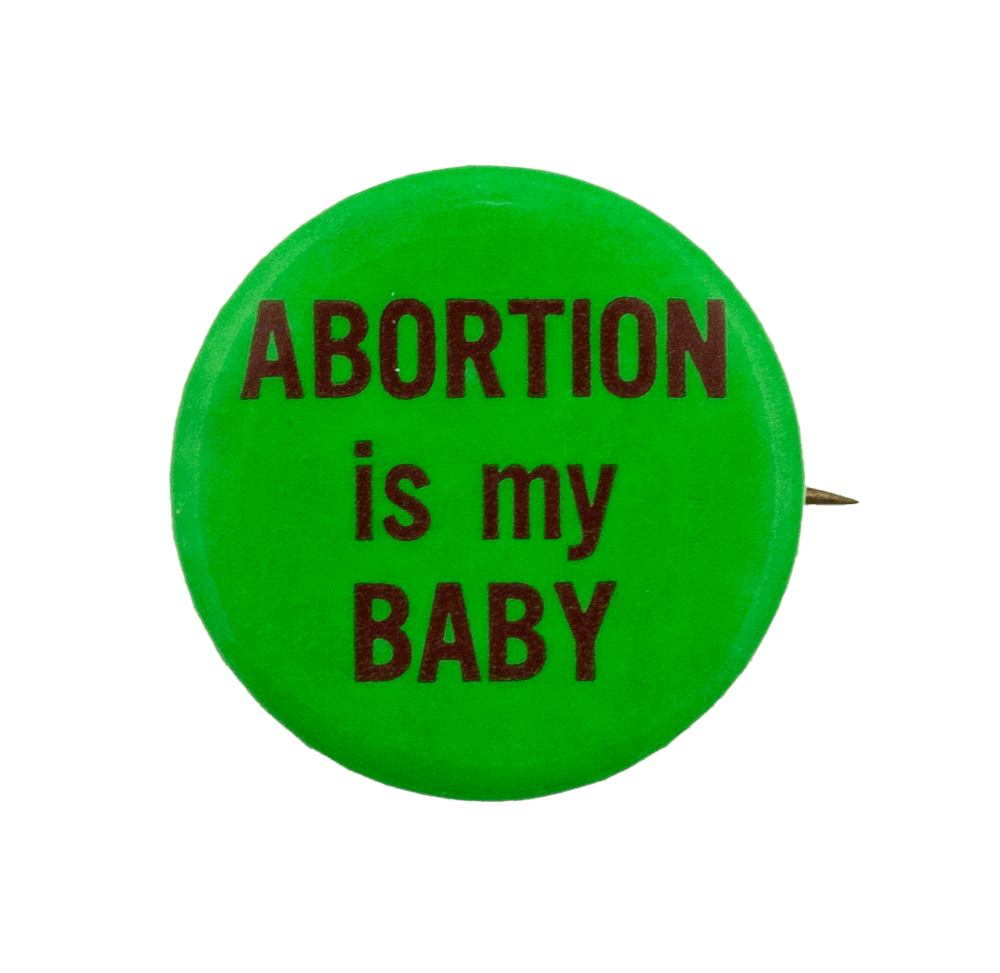
Text on Button Abortion is my Baby
Image Description

Black text on neon green background

Back Style
The Shape
The Size
Additional Information

In January of 1973, one of the most controversial decisions in U.S. history was made when the supreme court voted for a woman’s right to an abortion. American women could legally obtain an abortion when the United States was established as a country. By 1900 every state had made the procedure illegal. Because of the lack of abortion access, many woman in the 1950s and 60s were forced to give birth to babies with severe birth defects in part due to the use of a prescribed drug called thalidomide. The rubella and measles epidemics of the time also caused the babies in utero to suffer severe defects. Lack of access to abortion had negative effects on the lives of the pregnant women, as well. Women who did not have the means to fly to other countries to access safe abortions suffered complications from illegal procedures performed in the U.S. These complications affected women of color the most. Arguments such as those mentioned here helped pave the way for women to fight and win the right to abortion access in 1973.

However, the road to the legalization of abortion was a complicated journey which included those fighting for medical and civil rights. In the 1960s, physicians began arguing that the criminalization of the procedure created a public health crisis. Pro-choice republicans disagreed with the pro-life republicans, and pro-life democrats did not see eye to eye with the pro-choice democrats. Feminists of all cultures and races wanted control of their bodies and access to safe healthcare. However, Black Power activists perceived abortions as another method for the government to commit genocide. Others felt that abortion access would be a step towards racial justice. This button represents the pro-choice individuals who fought for choice. There may only be three words printed on this button, but it tells us much about our country’s complicated history. 

Sources

Cole, George; Frankowski, Stanislaw (1987). Abortion and Protection of the Human Fetus: Legal Problems in a Cross-Cultural Perspective. Leiden, the Netherlands: Martinus Nijhoff Publishers.

Exhibition: The age of roe: The past, present, and future of abortion in America. Radcliffe Institute for Advanced Study at Harvard University. (n.d.). https://www.radcliffe.harvard.edu/event/2022-the-age-of-roe-the-past-pr…;

Nunn, J., Ahearn, J., & Efrati, M. (2022, April 21). Roe v. Wade and Supreme Court abortion cases. Brennan Center for Justice. https://www.brennancenter.org/our-work/research-reports/roe-v-wade-and-…;


Catalog ID CA0911

Straight But Not Narrow

Category
Additional Images
Sub Categories
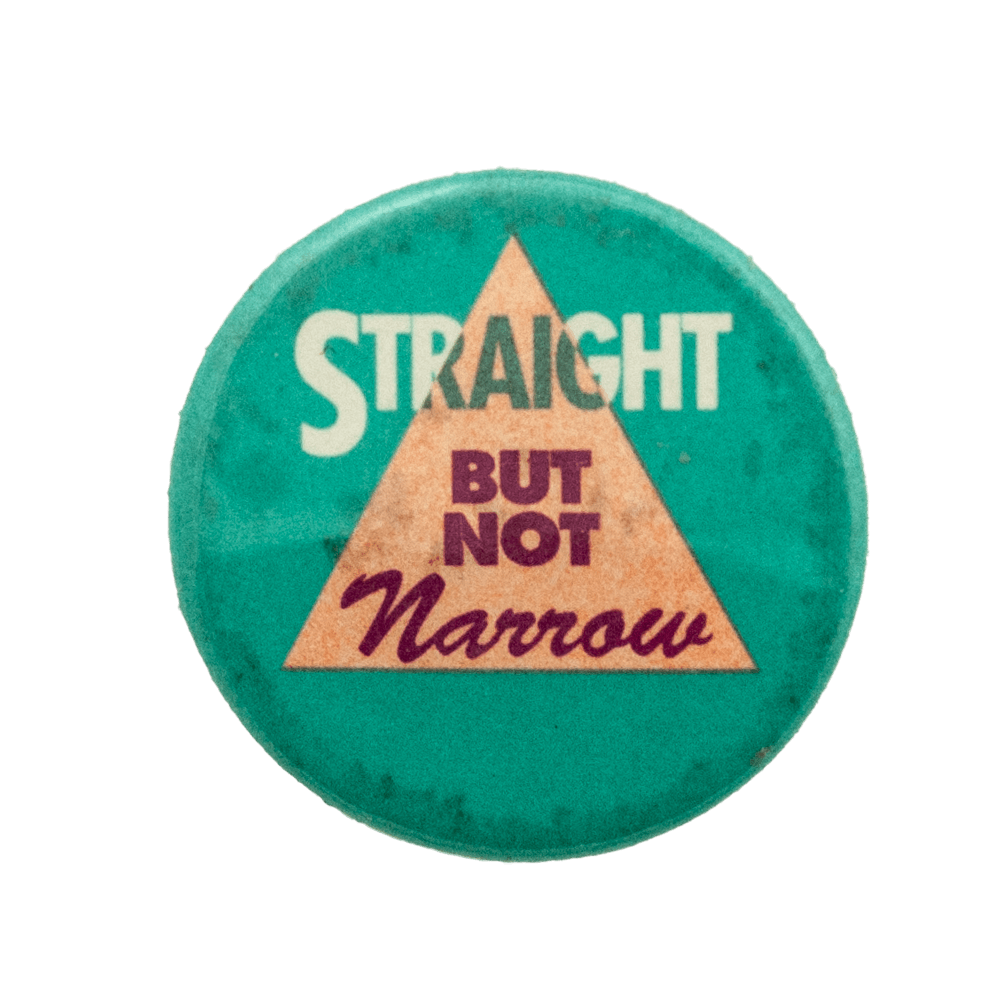
Text on Button STRAIGHT BUT NOT Narrow
Image Description

Teal background with a pink triangle and white, teal, and marroon text

Back Style
The Shape
The Size
Additional Information

“Straight But Not Narrow” is a play on words that indicates a person identifying as heterosexual is an ally of the LGBT community. In other words, the person is “straight,” but not narrow-minded. There is a grassroots group entitled “Straight But Not Narrow” who encourage straight allies to be vocal about their support for the LGBT community in order to combat hate and prejudice. The pink triangle, often inverted, is a symbol of LGBT pride. It is a symbol that homosexuals were forced to wear by Nazis during World War 2, similarly to the Star of David. Many buttons denoting LGBT allyship and support also have a pink star. This became popular in America during the 1980s, as gay rights activists sought to make sure that this history of prejudice did not repeat itself. 

Sources

“Straight but Not Narrow | Definition by Lexicon Library.LGBT.” Lexicon.library.lgbt, lexicon.library.lgbt/definitions/straight-but-not-narrow/. Accessed 16 Sept. 2023.

“Straight but Not Narrow | NOH8 Campaign.” Www.noh8campaign.com, www.noh8campaign.com/article/straight-but-not-narrow. Accessed 16 Sept. 2023.

Waxman, Olivia B. “How the Nazi Regime’s Pink Triangle Symbol Was Repurposed for LGBTQ Pride.” Time, Time, 31 May 2018, time.com/5295476/gay-pride-pink-triangle-history/.

Catalog ID CA0910

Teke is Unique

Category
Additional Images
Sub Categories
Text on Button TeKe iS Unique
Image Description

Red text on a white background

Back Style
The Shape
The Size
Additional Information

Tau Kappa Epsilon, also known as TKE or Teke, is a college fraternity with chapters across the United States and Canada. The fraternity was founded in 1899 at Illinois Wesleyan University. Notable Teke alumni include former United States president Ronald Reagan, country singer Willie Nelson, and “King of Rock and Roll” Elvis Presley. The motto “Teke is Unique” has appeared on some of the fraternity’s recruitment flyers and memorabilia. 

Sources

Bowling Green State University. (1974). The BG News October 15, 1974. BG News (Student Newspaper), p. 6. https://scholarworks.bgsu.edu/bg-news/3014

Southwest Texas State University. (1980). The Pedagog 1980, p. 84https://exhibits.library.txstate.edu/univarchives/viewer/show/448

Tau Kappa Epsilon. (n.d.). Distinguished alumni. Tau Kappa Epsilon Fraternity. https://www.tke.org/about/distinguished-alumni

Catalog ID SC0069

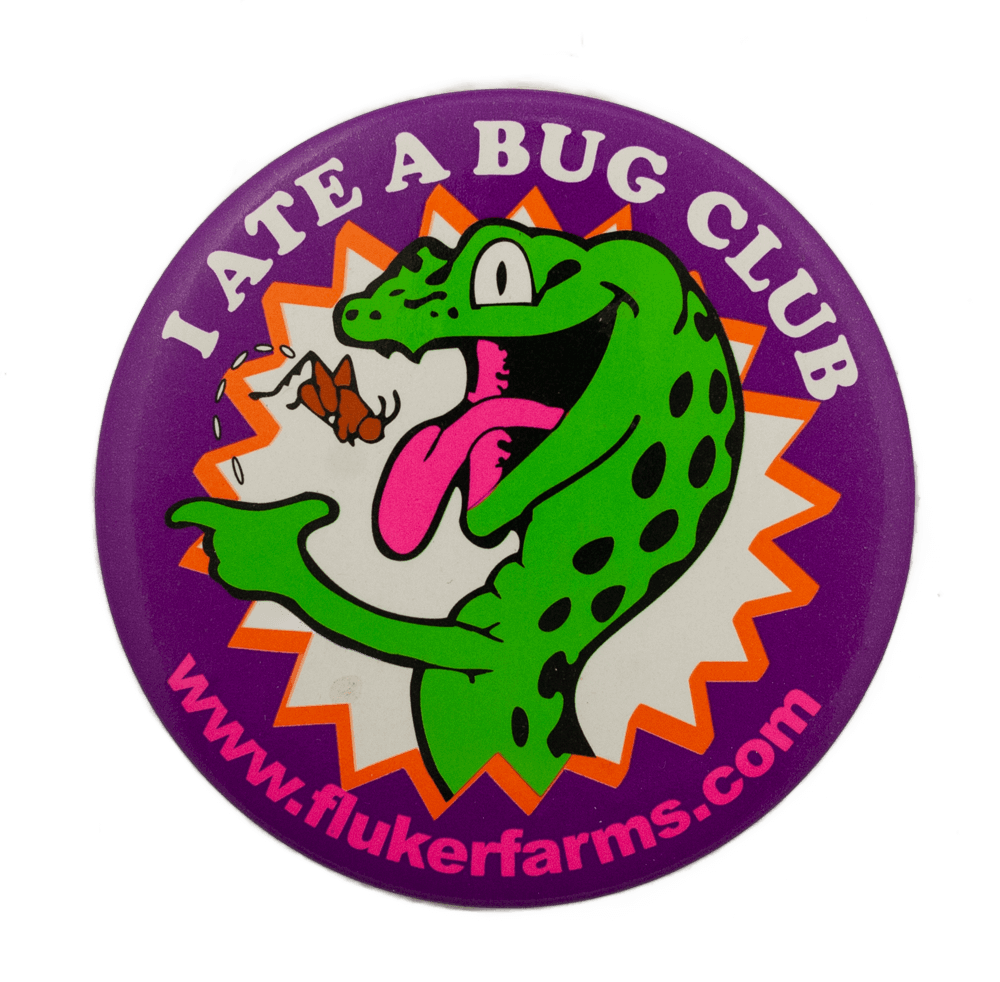
I Ate a Bug Club

Category
Additional Images
Sub Categories
Text on Button I ATE A BUG CLUB www.flukerfarms.com
Image Description

Purple, white, and orange background with white and pink letter and an illustration of a green cartoon-style reptilian animal sticking out its pink tongue about to eat a brown cricket

Back Style
The Shape
The Size
Year / Decade Made
Additional Information

The Fluker Farms “I Ate a Bug Club” pinback button came as a prize with the Fluker Farms product “Chocolate Covered Crickets” from 2005-2009. 

In 1953 Richard Fluker started Fluker's Cricket Farm in Southern Louisiana which provided live bait to local fishermen. Today Fluker Farms breeds a wide variety of feeder insects for fishing bait and reptile food throughout the United States. They also provide supplies for reptiles kept domestically. 

Sources

 Products: Chocolate Covered Crickets. Fluker’s Farm. (2005, April 2). https://web.archive.org/web/20050402020429/https://flukerfarms.com/index.asp?PageAction=VIEWPROD&ProdID=13  

Product: Chocolate Covered Crickets. Fluker’s Farm. (2009, June 25). https://web.archive.org/web/20090625082854/https://flukerfarms.com/chocolatecoveredcrickets.aspx  

WHO WE ARE. Fluker’s Farms. (n.d.). https://flukerfarms.com/who-we-are/  

Catalog ID CL0665

I'm Too Busy to Think Smurf

Category
Additional Images
Sub Categories
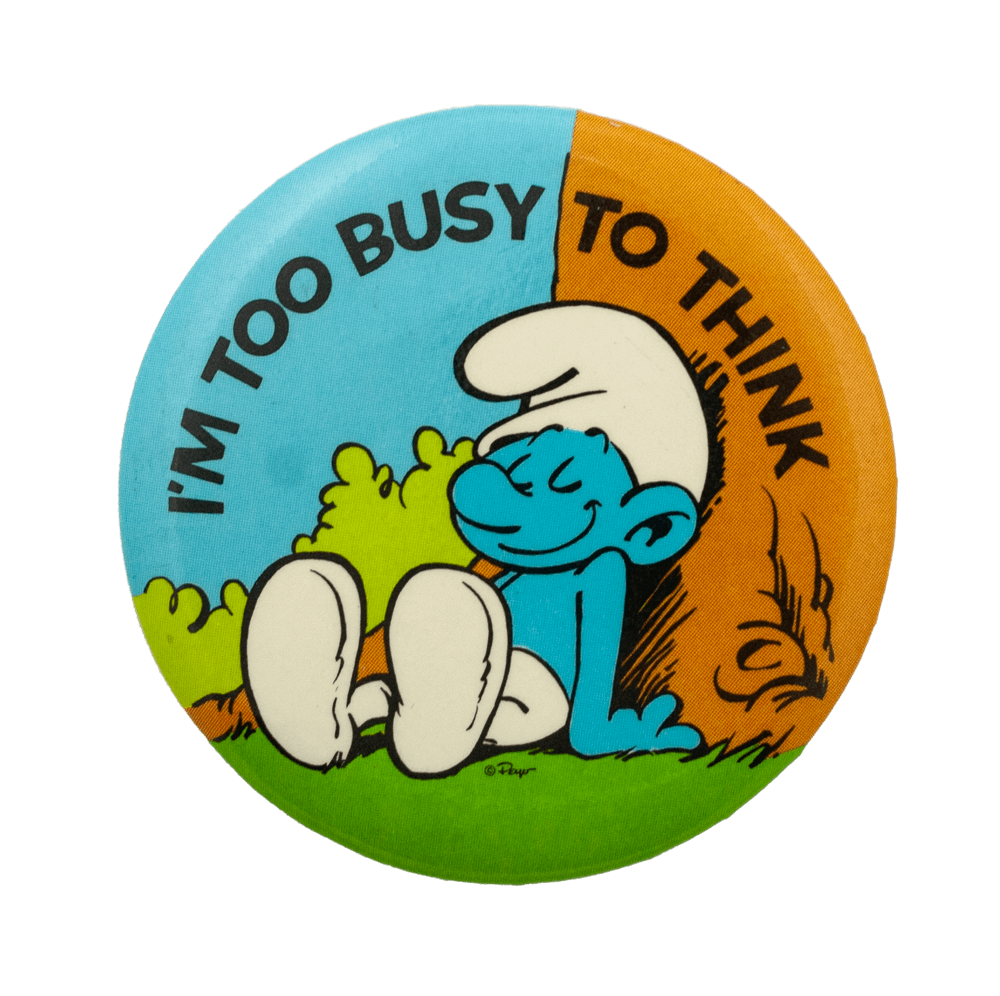
Text on Button I'M TOO BUSY TO THINK
Image Description

Black text above a color illustration of a Smurf character with its eyes closed leaning up against a tree 

Curl Text © Pevo 1980 W Berrie Co. S.F.P.P. Made in USA E.V.A.
Back Style
The Shape
The Size
Year / Decade Made
Additional Information

In 1958, Pierre Culliford (or Peyo) created a series of comics featuring little blue individuals who lived in mushroom houses, where no humans could find them. These “three-apple tall” beings who could live hundreds of years were originally called “Les Schtroumpfs” by Culliford, who was Belgian. The name came to be when Culliford forgot the French word for “salt” while dining with his French friend and fellow cartoonist, Andre Franquin. Culliford made up a French word for salt, Schtroumpfs, and later named his blue characters the same name. Eventually, the Schtroumpfs became known as “The Smurfs”.

In the 1960s and 70s, two animated films and ten animated shorts were released in Belgium, then in several other European countries. In 1981, Hanna-Barbera adapted the comic into an animated series, which became an instant hit in the United States. Due to its popularity, a variety of merchandising was created, including this 1980s button featuring Lazy Smurf napping against a tree. Smurfs enthusiasts enjoyed another revival in 2011, when another animated film was released in theaters. Since then, two more films were released in 2013 and 2017.

Fun fact: While Americans refer to these blue creatures as “The Smurfs”,  they are known as “Pitufos” in Spanish and “Dardasim” in Hebrew!

Sources

Muraille, E. (2007). Une oeuvre - les Amis - Peyo. Franquin. http://www.franquin.com/amis/peyo_amis.php 

Amela, Victor; Ima, Sanchis; Lluis, Amiguet (August 1, 2016). "Acuñé la palabra 'pitufo' inspirándome en 'Patufet'"La Vanguardia. Retrieved November 21, 2017.

Peterson, J. (2013, August 6). 20 little-known facts about the Smurfs. Deseret News. https://www.deseret.com/2013/8/5/20523456/20-little-known-facts-about-t…;

Cendrowicz, L. (2008, January 14). The Smurfs are off to conquer the world — again. Time. https://content.time.com/time/world/article/0,8599,1703303,00.html 

Catalog ID HU0230

Chicago Pride '98

Category
Additional Images
Sub Categories
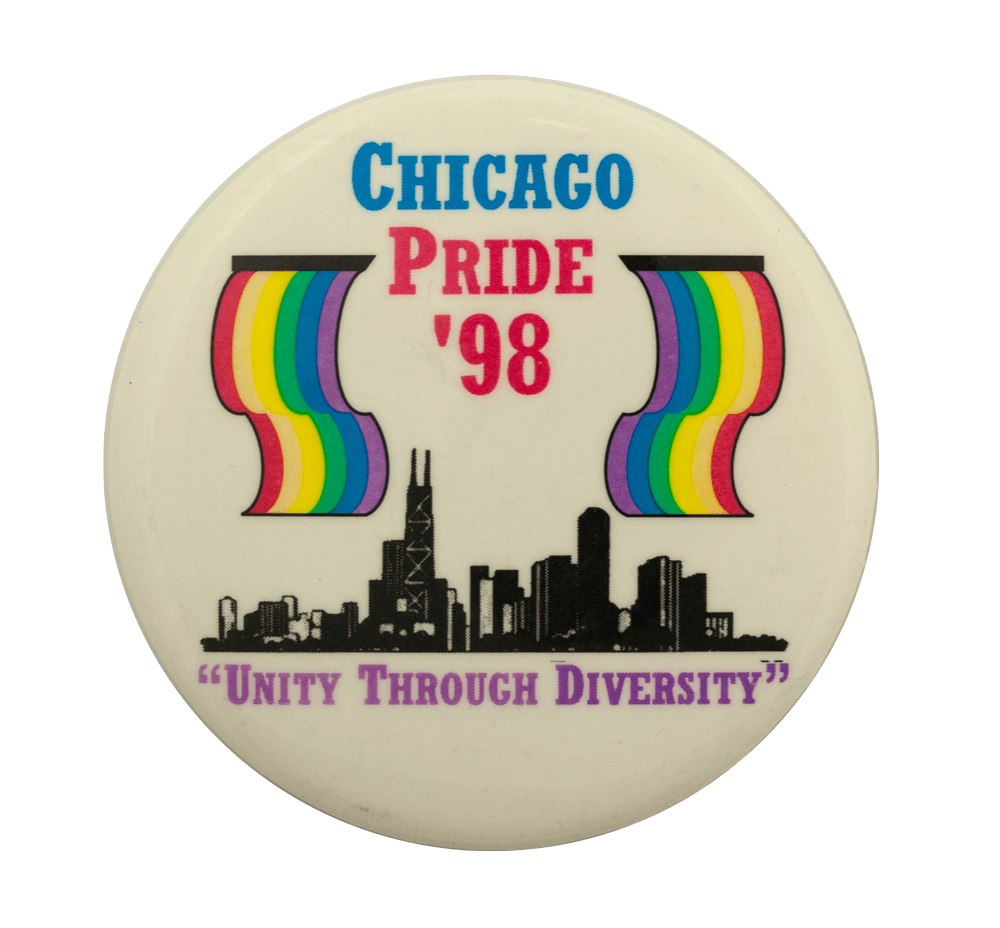
Text on Button CHICAGO PRIDE '98 "UNITY THROUGH DIVERSITY"
Image Description

Blue, red, and purple text on a white background with two illustrated rainbow flags above a black and white illustration of the Chicago skyline  

Curl Text AMAZING PROMOTIONS 773-334-1018
Back Style
The Shape
The Size
Year / Decade Made
The Manufacturer
Additional Information

The 1998 Chicago Pride Parade commemorated the 1969 Stonewall Uprising in New York. It was the 28th Annual Chicago Pride celebration and the largest Pride Parade in its history. 

The parade’s aims were community engagement, empowerment, and acceptance rather than petitioning for specific LGBTQ2+ rights and issues. The parade focused on showing the diverse Chicago queer community with lawyers, doctors, and 50+ politicians in participation, floats from Chicago Leather groups and Drag Queens, and many LGBTQ2+ allies with floats, signs, and literature. 

1998 Pride celebrations in San Diego and Atlanta also sported merchandise with the slogan “Unity in Diversity”.

Sources

Galloway, P., & Tribune Staff Writer. (1998, June 29). Pride on Parade. Chicago Tribune. https://www.chicagotribune.com/news/ct-xpm-1998-06-29-9806290090-story.html

Lambda Archives of San Diego. (n.d.). Unity in diversity, San Diego parade theme, 1998. SDSU University Library. Retrieved August 28, 2023, from https://digitallibrary.sdsu.edu/islandora/object/sdsu%3A35386.   

Lambda Archives of San Diego. (n.d.). Unity through diversity, Atlanta Pride Celebration, 1998. SDSU University Library. Retrieved August 28, 2023, from https://digitallibrary.sdsu.edu/islandora/object/sdsu%3A35419

Catalog ID EV0966

Hope for President

Category
Additional Images
Sub Categories
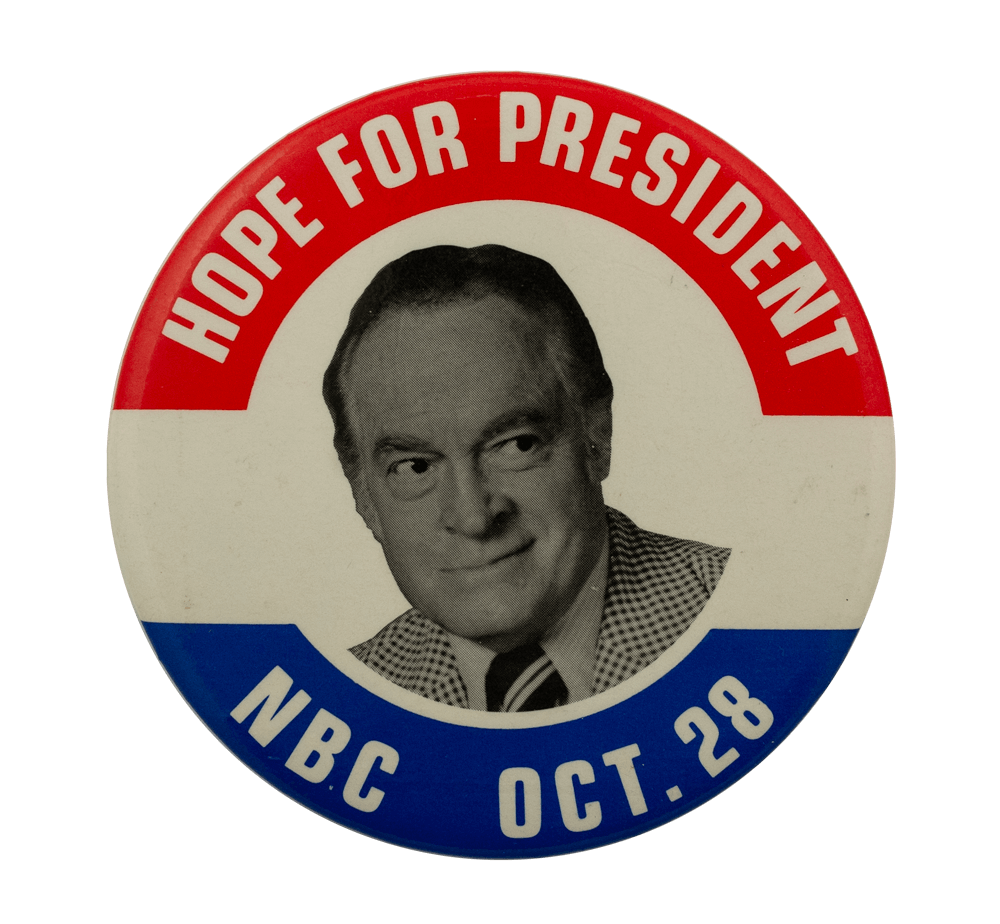
Text on Button HOPE FOR PRESIDENT NBC OCT. 28
Image Description

White background with white text on red and blue outside rims and a black and white photograph of Bob Hope in the center

Back Style
The Shape
The Size
Year / Decade Made
Additional Information

Bob Hope for President was the name of an NBC special that ran in 1980 prior to the United States presidential election between Ronald Regan and Jimmy Carter. The hour-long special included sketches where Hope pretended to be running for president, and featured a lengthy list of celebrities like Sammy Davis Jr., Johnny Carson, and Lou Ferringo. 

Bob Hope was a well-known actor, comedian, and host, best known for hosting hundreds of comedy specials. He also holds the record for hosting the Academy Awards: 19 times, more than any other performer. 

Sources

Cannizzaro, A. (2013, March 19). Bob Hope: King of the Oscars. Biography. 

Turner Classic Movies. (n.d.). Bob Hope special: Bob Hope for president. Turner Classic Movies. https://prod-www.tcm.com/tcmdb/title/455892/bob-hope-special-bob-hope-f…;

Catalog ID EV0965

Kaypro the Compleat Computer

Category
Additional Images
Sub Categories
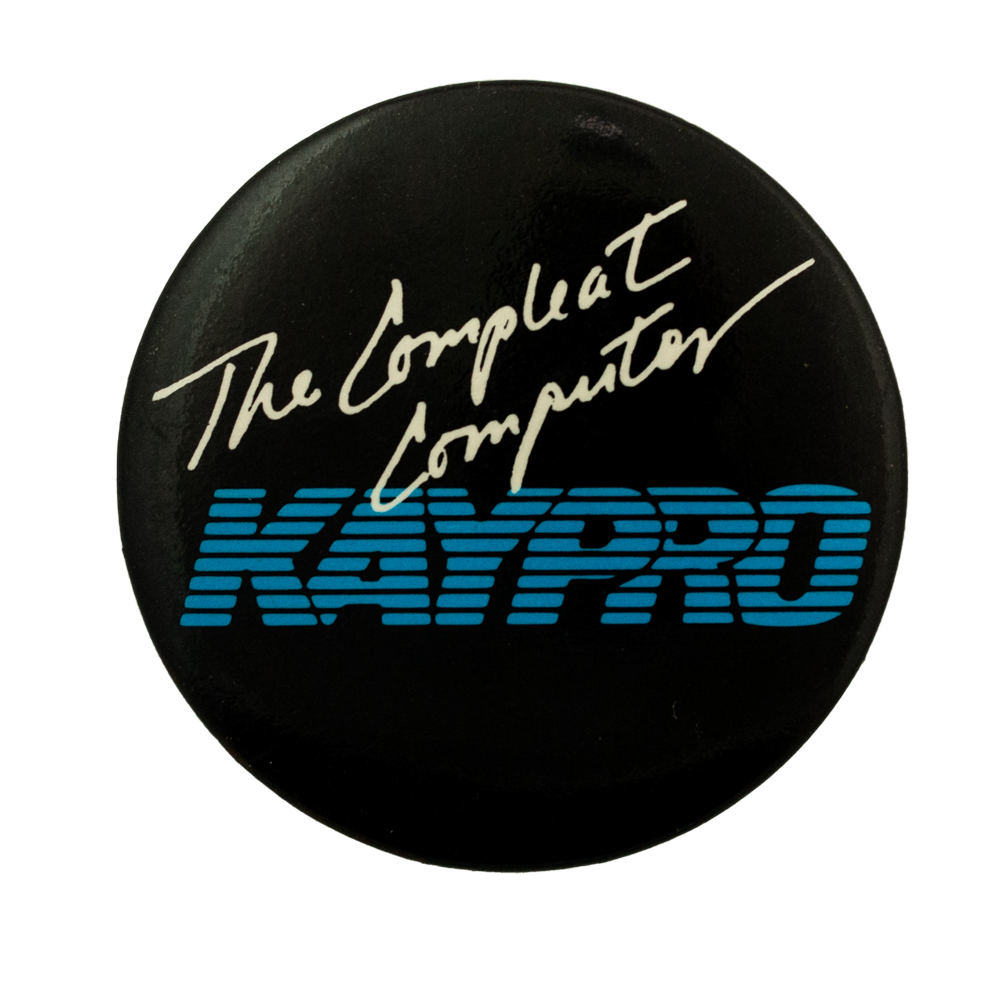
Text on Button KAYPRO The Compleat Computer
Image Description

Black background with blue retro-tech text in the center and white cursive-style text on the top half

Back Style
The Shape
The Size
Year / Decade Made
Additional Information

Before Macs and PCs, there was Kaypro and Osbourne. These microcomputers are the ancestors of the laptops and desktops used today. The Kaypro II was launched by Non-Linear Systems in 1982. Non-Linear Systems was headed at the time by the Kaypro’s namesake, Andrew Kay. Non-Linear Systems went on to produce the Kaypro IV and the Kaypro 10. Due to its higher storage specs and larger screen as well as its price point, the Kaypro II crushed the Osbourne I in the market. In 1982, a Kaypro II cost $1,795, which is equivalent to $5,711 in 2023. In 1983, Non-Linear Systems changed its name to the Kaypro Corporation, and later that year it was named the 5th largest personal computer manufacturer in the world. Kaypro’s reign ended in March of 1990, when the company filed for Chapter 11 bankruptcy. Kaypro officially sold its last assets and property in 1995, and the business shut its doors for good. 

Sources

“Before the PC: Remembering Kaypro and Osborne Computers | | InformIT.” Www.informit.com, www.informit.com/articles/article.aspx?p=2176003. Accessed 27 Sept. 2023.

“DAVES OLD COMPUTERS- Kaypro.” Dunfield.classiccmp.org, dunfield.classiccmp.org/kaypro/index.htm. Accessed 27 Sept. 2023.


“Kaypro 2000 Computer.” Oldcomputers.net, oldcomputers.net/kaypro2000.html#:~:text=History%20of%20Kaypro%20Computers. Accessed 27 Sept. 2023.
 

Catalog ID AD1071

El Al Airlines

Category
Additional Images
Sub Categories
Text on Button EL AL BOSTON! THE ONLY NONSTOP FLIGHTS TO ISRAEL
Image Description

White text on a black background around the rim and an illustration of a red heart with a black and white EL AL airlines plane tail fin in the center

Back Paper / Back Info

MADE IN U.S.A.

Back Style
The Shape
The Size
Additional Information

EL AL, roughly translating to "toward the skies," is the official airline of Israel. Founded in 1948, the airline primarily worked to fly supplies during the Arab-Israeli War. Now, it is most famous for its nonstop flight from Boston to Tel Aviv, first introduced in 1961. It is one of the longest nonstop flights offered on the market. 

Sources

“El Al Brief History.” Israel Airline Museum, 2 Aug. 2023, www.israelairlinemuseum.org/el-al-brief-history-2/#:~:text=Founded%20in…’to%20the%20skies’.

Catalog ID AD1070