Dynamite

Category
Additional Images
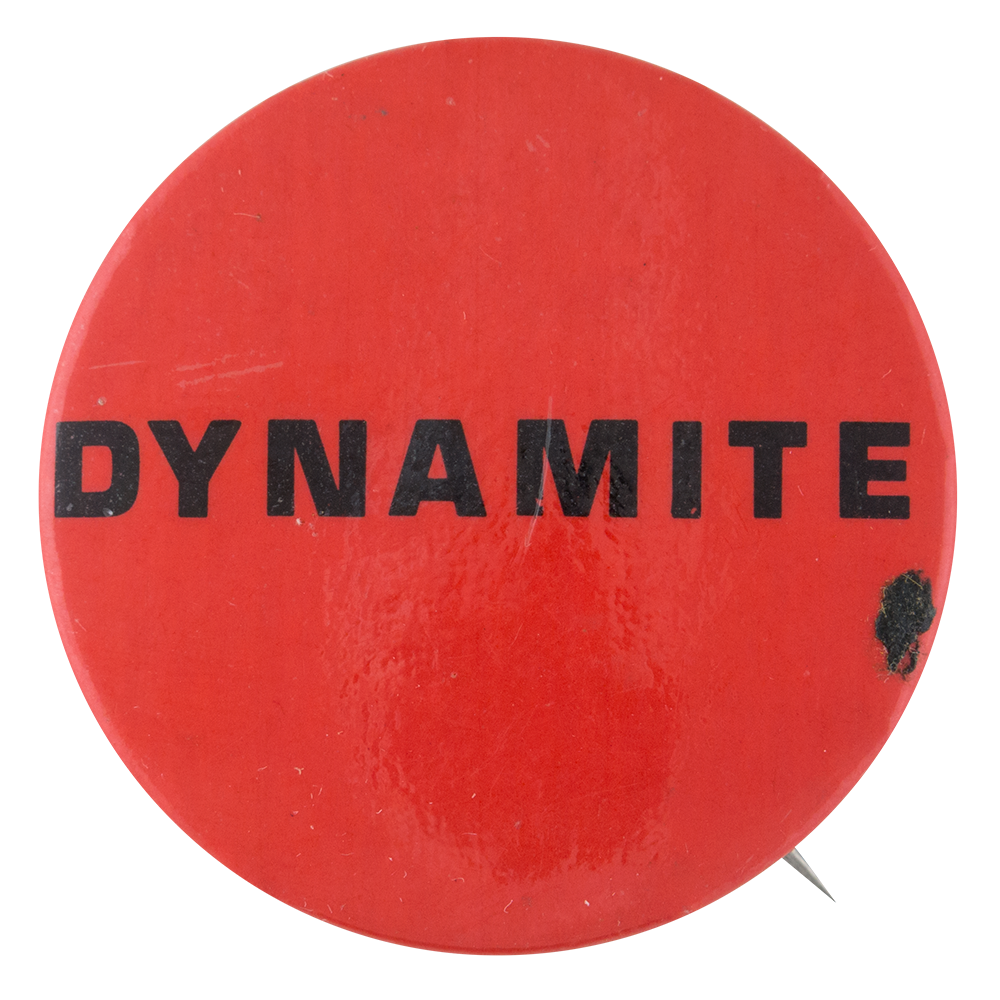
Text on Button DYNAMITE
Image Description

Black text on red background

Back Style
The Shape
The Size
Additional Information

Dynamite is an explosive. To describe a person or a thing as "dynamite" means that they or it are exciting.

Have info on this button? Contact us here.

Catalog ID IB0506

Do It Now

Category
Additional Images
Sub Categories
Text on Button DO IT NOW!
Image Description

Red text on a white background

Curl Text THE AMERICAN BADGE CO, CHICAGO ILL.
Back Style
The Shape
The Size
The Manufacturer
Additional Information

The bold and forward message: “DO IT NOW” in red lettering on a white background conveys a sense of urgency and is a catch-all prompt. Examples with this exact phrase often appear as generic messages rather than being tied to a single organization, reflecting the late-1960s through 1980s rise in inexpensive slogan buttons. The phrase “Do it now” predates these buttons and has been reused in various contexts, from pep talks to public-awareness campaigns, which is why it cannot be linked to one specific cause. Some sources mention that the phrase became popular in early-20th-century culture (e.g., Berton Braley’s widely reprinted poem “Do It Now,” after 1915) and later appeared in public-awareness efforts like the Do It Now Foundation’s anti-drug media campaigns in the early 1970s. 

Sources

Berton Braley. (2025, June 7). In Wikipedia. Retrieved October 19, 2025, from  https://en.wikipedia.org/wiki/Berton_Braley 

Berton Braley Cyber Museum. (n.d.). Do it now. Retrieved October 19, 2025, from https://bertonbraley.com/do_it_now.htm 

National Museum of American History, Behring Center. (n.d.). Pin-back democracy. Retrieved October 18, 2025, from https://americanhistory.si.edu/explore/exhibitions/american-democracy/online/machinery-democracy/democratic-outfitting/pin-back-democracy 

Catalog ID IB0497

Dat Bill

Category
Additional Images
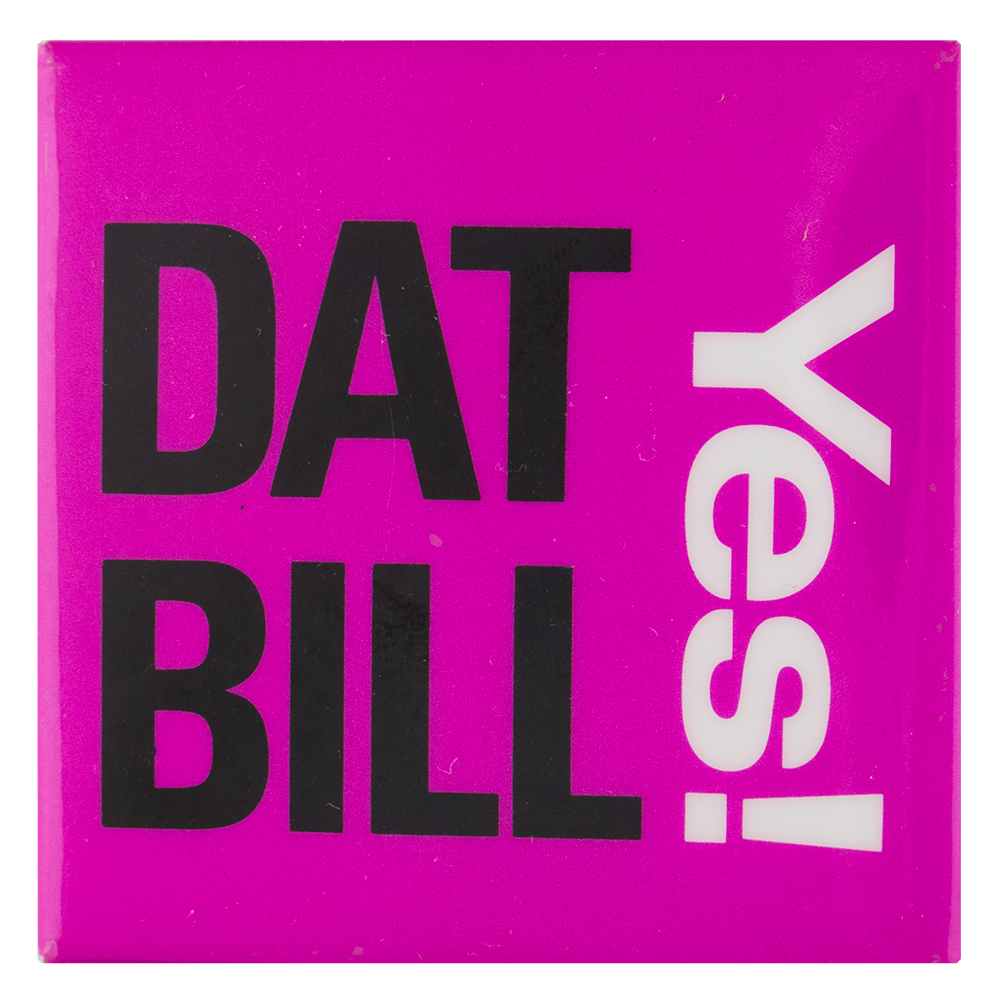
Text on Button Yes! DAT BILL
Image Description

White and black text on a hot pink background

Back Style
The Shape
The Size
Year / Decade Made
Additional Information

The Digital Audio Tape Recorder, or DAT, Bill was introduced to Congress in 1990 by Arizona Senator Dennis DeConcini. The aim of the bill was to prohibit the manufacture of digital audio tape recorders that did not have the copy management systems circulatory chips. More simply, its intention was to limit serial copying of DATs. The recording industry was a primary supporter of the bill to reduce the number of copyright infringements and stop lost sales that occurred from illegal copying. However, songwriters and music producers—unhappy with the absence of royalty taxes—initially opposed it. Only after Sony and other giants in the recording industry agreed to royalty provisions did the dissenters come around. With both parties satisfied, President George H. W. Bush signed the bill into law in 1992.

Sources

Committee on Commerce, Science, and Transportation. (1990). Hearing before the Subcommittee on Communications of the Committee on Commerce, Science, and Transportation on S.2358 entitled the Digital Audio Tape Recorder Act of 1990. https://www.ipmall.info/sites/default/files/hosted_resources/lipa/copyr…

Home Recording Rights Coalition. (1990). The DAT bill. Now's the time. https://worldradiohistory.com/hd2/IDX-Audio/Archive-Stereo-Review-IDX/I…

Catalog ID IB0510

Blue Ribbon Smile

Category
Additional Images
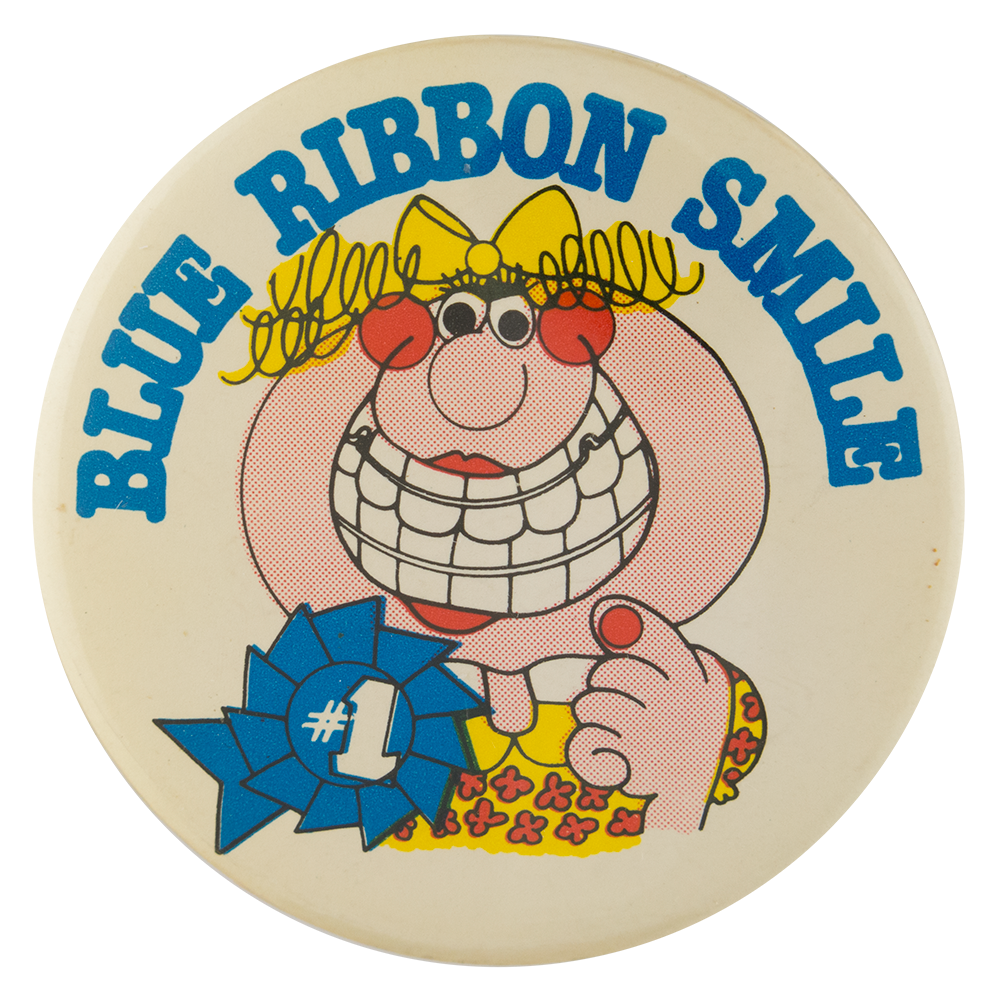
Text on Button BLUE RIBBON SMILE
Image Description

Illustration of a person with yellow hair and a huge toothy grin and a blue ribbon on their shirt with blue text above on a white background

Back Style
The Shape
The Size
Additional Information

A blue ribbon is used to designate that something is of the highest quality and is often awarded in competitions. The term blue ribbon originates from The Blue Riband, an unofficial award given to the fastest passenger ships to cross the Atlantic Ocean. 

The word “riband” is the archaic form of the word “ribbon.” The name Blue Riband is taken from the French cordon bleu, which dates back to the late 1500s. During this time, Henry III of France created The Order of the Holy Spirit, a group of knights who bore crosses that hung on blue ribbons. 

Sources

Taylor, A. (2018, February 16). Blue Ribbon Origins. Manhattan Saddlery. https://manhattansaddlery.com/blogs/news/blue-ribbon-origins 

Yisela. (n.d.). The Order of the Holy Spirit. Identify Medals. https://www.identifymedals.com/database/medals-by-period/pre-ww1-medals…;

Catalog ID IB0498

Aggie Culture

Category
Additional Images
Sub Categories
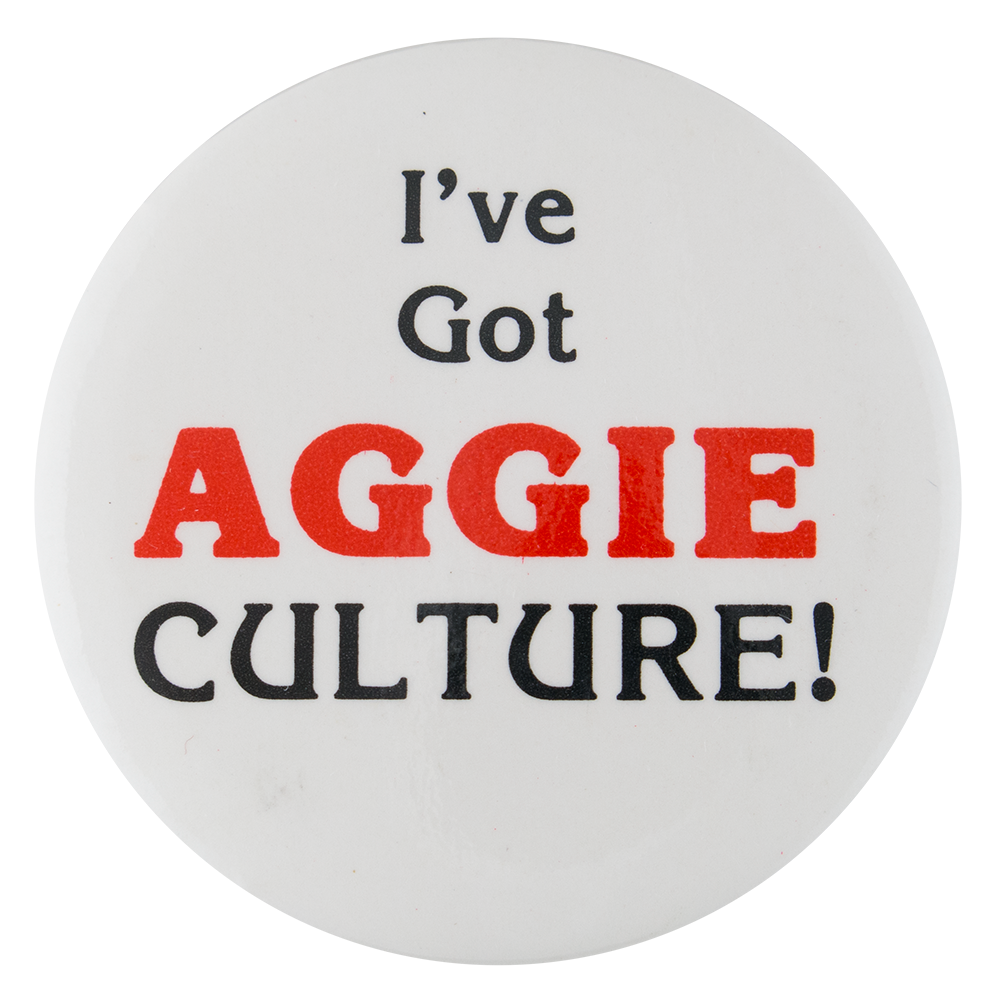
Text on Button I've Got AGGIE CULTURE!
Image Description

Red and black text on a white background

Curl Text 3 B Promotions (519) 824*0834
Back Style
The Shape
The Size
The Manufacturer
Additional Information

This button is likely referring to the Ontario Agricultural College (OAC) in Guelph, Canada. Students, staff and alums are referred to as "the aggies," because of the agricultural heritage.

"Aggie" is derived from the word "agricultural." Many affliates of the land-grant univeristies and schools in the U.S. also call themselves "aggies."

Catalog ID CL0381

West Point

Category
Additional Images
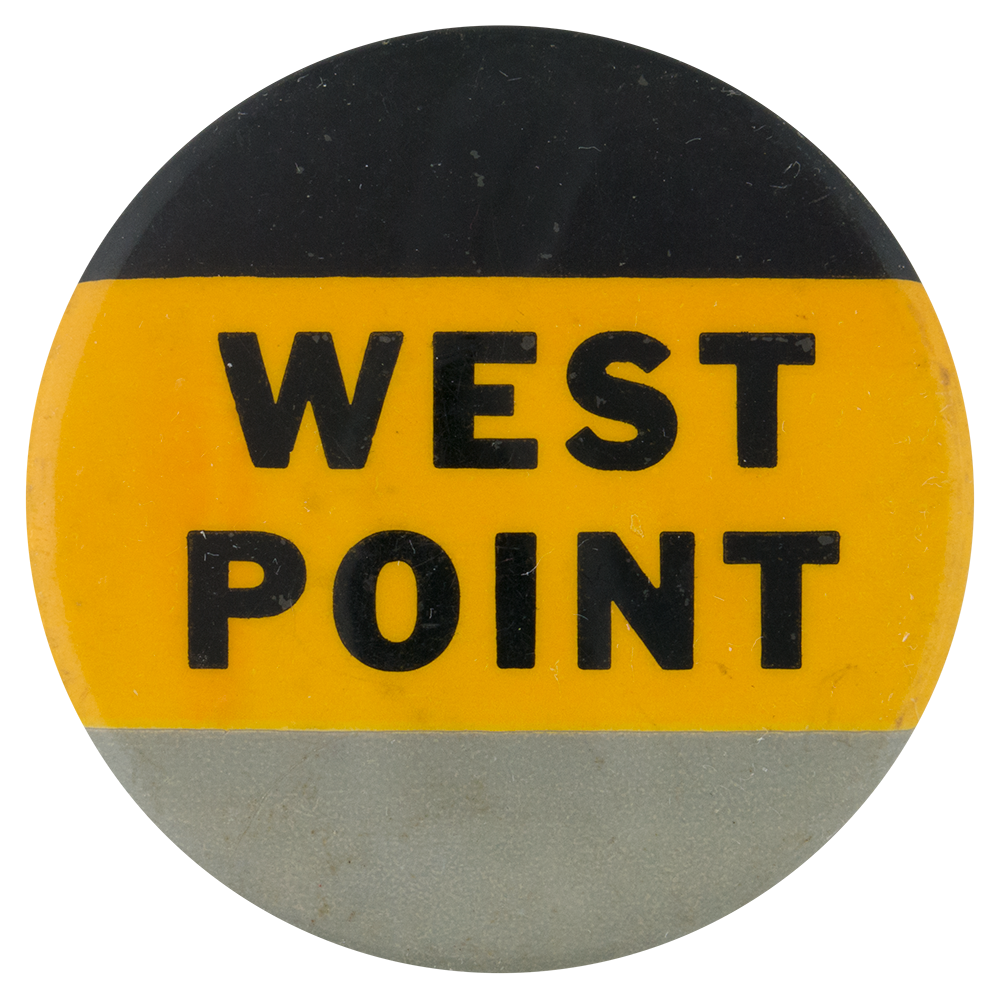
Text on Button WEST POINT
Image Description

Black, yellow and grey striped background with black text on the yellow

Back Style
The Shape
The Size
Additional Information

Officially titled the United States Military Academy at West Point, the institution is more commonly referred to as simply "West Point", amongst other nicknames. Founded in 1802 at the site of a Continental Army camp, it is the oldest continuously operating army post in the United States. The official colors of the school are black and gold, however due to the majority of the school being constructed out of granite, grey is an important color in the school psyche. The uniforms of West Point cadets are grey, the color being approved by 1816 by the Secretary of War. Collectively, the graduates of West Point are called 'the long grey line'.

Catalog ID SC0004

Brookwood Intermediate Honor Student

Category
Additional Images
Sub Categories
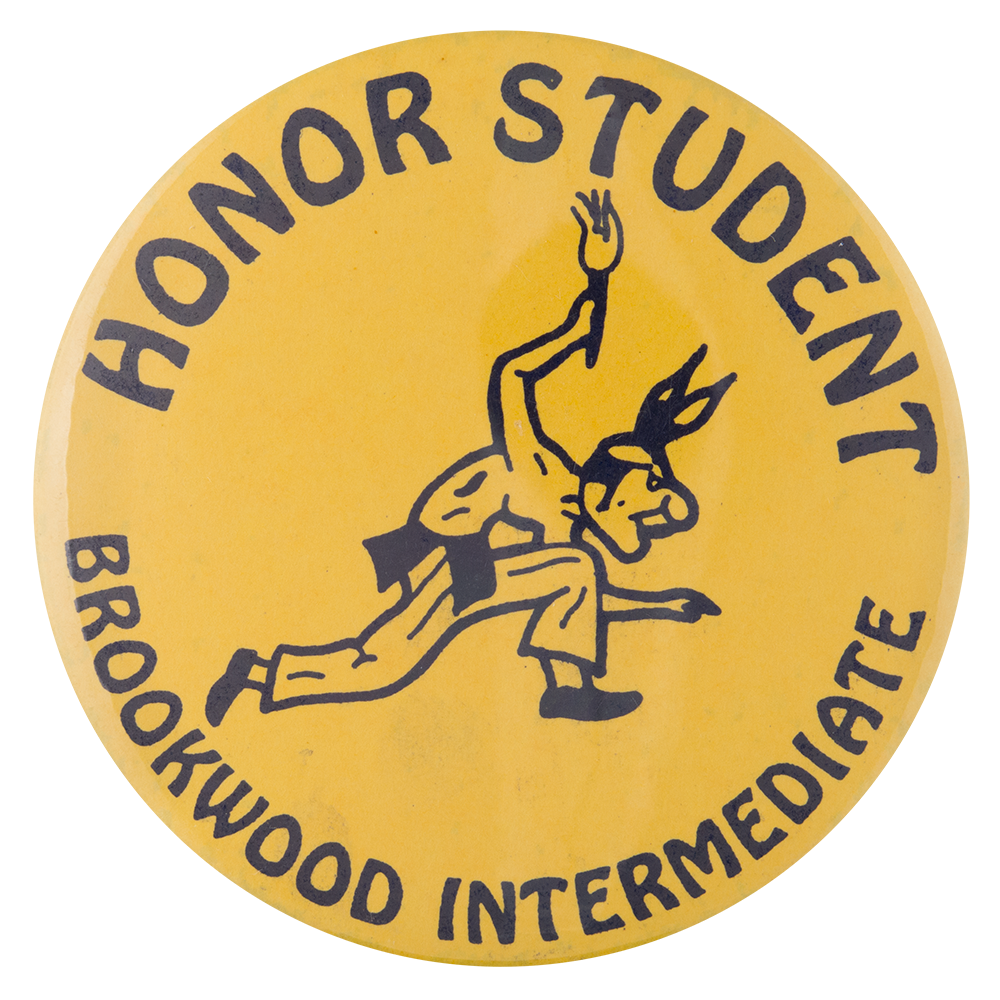
Text on Button HONOR STUDENT BROOKWOOD INTERMEDIATE
Image Description

Black text and an illustration of a person in pants holding something over their head and wearing feathers on their head on a yellow background

Curl Text SPORTDECALS P.O. BOX 358 CRYSTAL LAKE ILL 60014
Back Style
The Shape
The Size
The Manufacturer
Additional Information

Have info on this button? Contact us here.

Catalog ID SC0014

Wallace for President

Category
Additional Images
Sub Categories
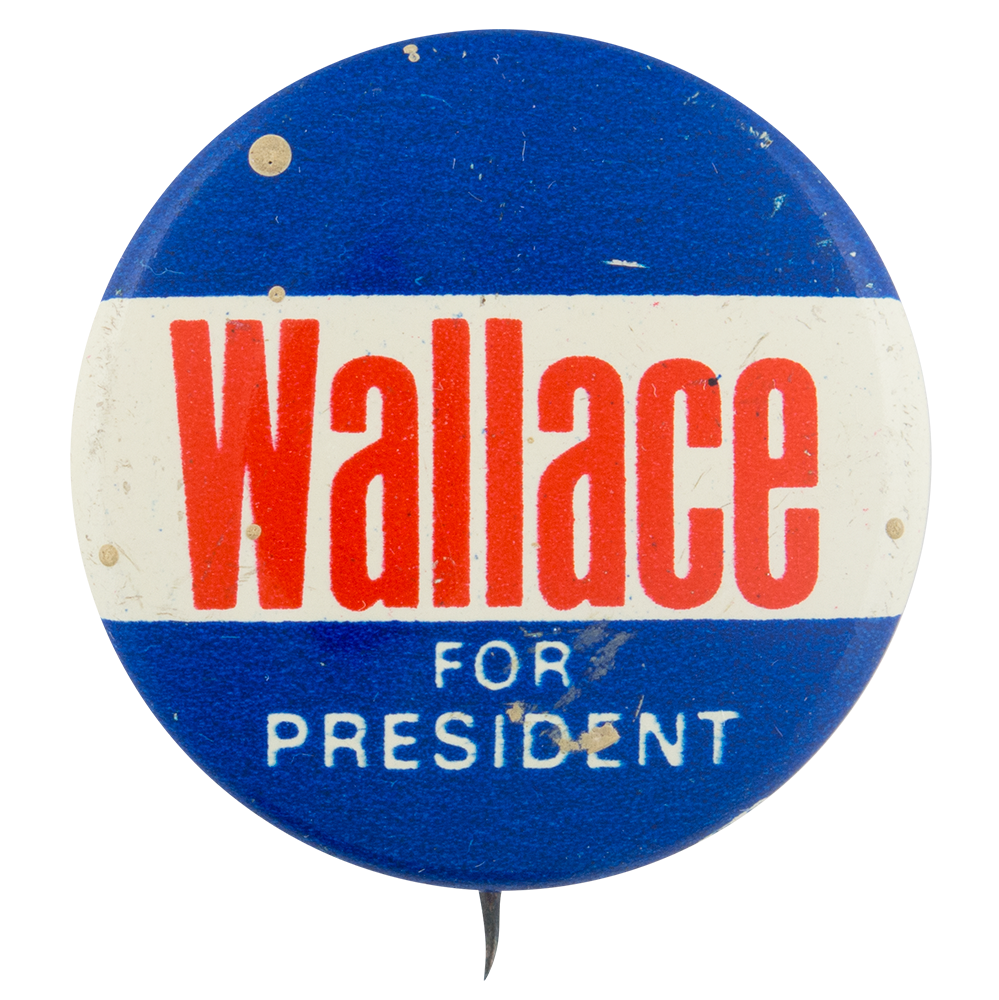
Text on Button Wallace FOR PRESIDENT
Image Description

Red text on a white stripe across a blue background with white text on the bottom

Back Style
The Shape
The Size
Additional Information

George Corley Wallace, Jr. is a former governor, 4 time presidential candidate, and First Gentleman of Alabama. Serving four terms as Governor of Alabama, Wallace holds the record for most days served as governor in American history. Known for his populist views, originally Wallace supported segregation, but later changed his position and supported its disillusion.

After serving one term as governor of Alabama, Wallace ran for president in 1964, but lost the Democratic bid to Lyndon B. Johnson. Because of term limits, his was unable to seek a second term as governor in 1966, however his wife Lurleen Burns Wallace successfully ran instead. Wallace was influential during his wife's governorship, with many feeling she was just a proxy for him. Wallace ran for president again in 1968 as an independent and lost to Richard Nixon. In 1970, he sucessfully ran for his second term as governer of Alabama, but that did not stop him from running for president again in 1972—once again as a democrat. On May 15, 1972, Wallace was the victim of an assassination attempt that left him paralyzed. Wallace remained in politics after the assasination attempt, running for president a fourth time in 1976 and serving one more term as governer of Alabama in 1982. Following his 1982 gubernatorial term, Wallace retired from politics. 

Catalog ID PO0053

Harvey Milk I Am All Of Us

Category
Additional Images
Sub Categories
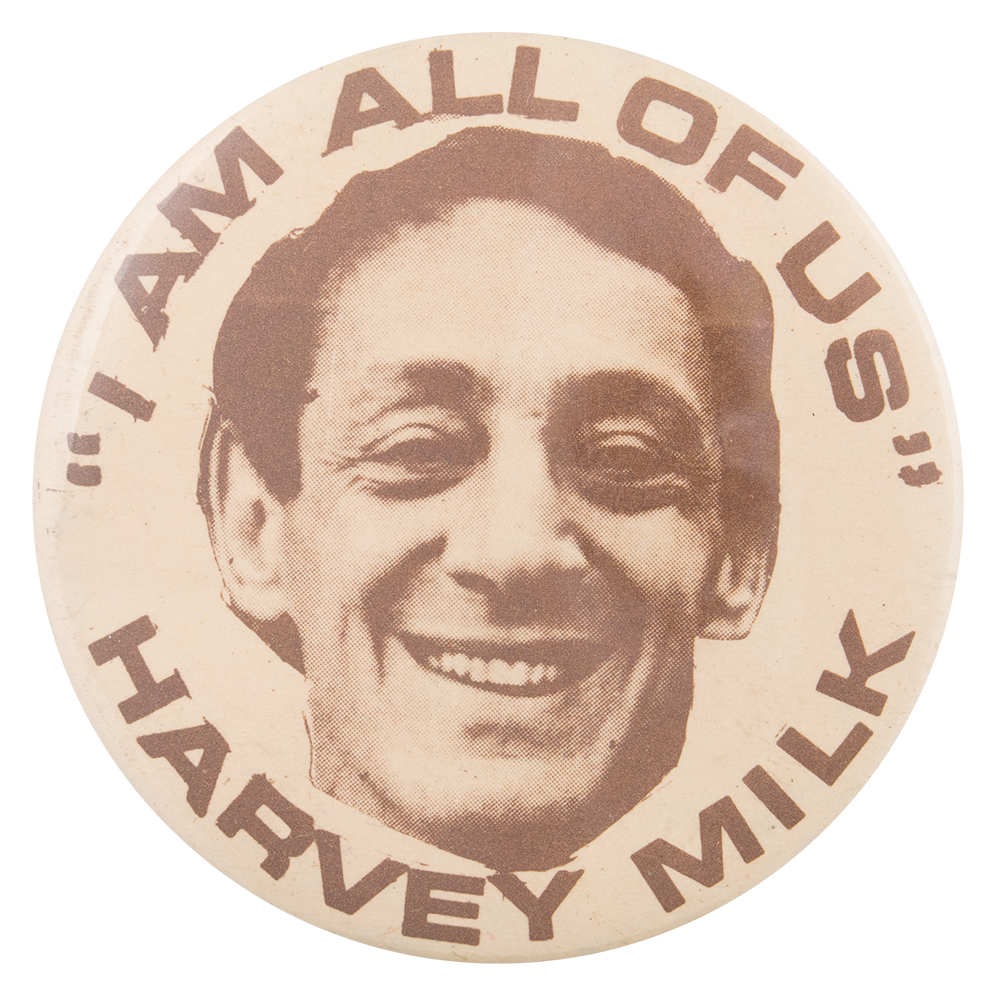
Text on Button "I AM ALL OF US" HARVEY MILK
Image Description

Photograph of a man's head in brown and light brown in the center of the button with brown text around the outer edges on a light brown background

Back Style
The Shape
The Size
Additional Information

Harvey Milk was an iconic lesbian and gay rights activist, and the first openly gay elected government official in California. He was known for his dedication to the advancement of lesbian and gay rights and his theatrical campaign strategies. He was famous in rallying support from the gay community using his soap-box and bullhorn. During his campaign for the mayoral election, he would march with thousands of people through the city of San Francisco, chanting his slogan “My name is Harvey Milk and I’m here to recruit you." Milk was assassinated  in 1978 by Dan White, a resigned city supervisor trying to get his job back. 

The quote on the button "I Am All Of Us" was from a poem he had written during the height of his fight against the Briggs initiative, which, sponsored by John Briggs, would have banned gays and anyone supporting gay rights to work in California's public schools. The poem reads:

I can be killed with ease/I can be cut right down/But I can not fall back to my closet/I have grown/I am not by myself/I am too many/I am all of us

Catalog ID PO0186

Harvey Milk

Category
Additional Images
Sub Categories
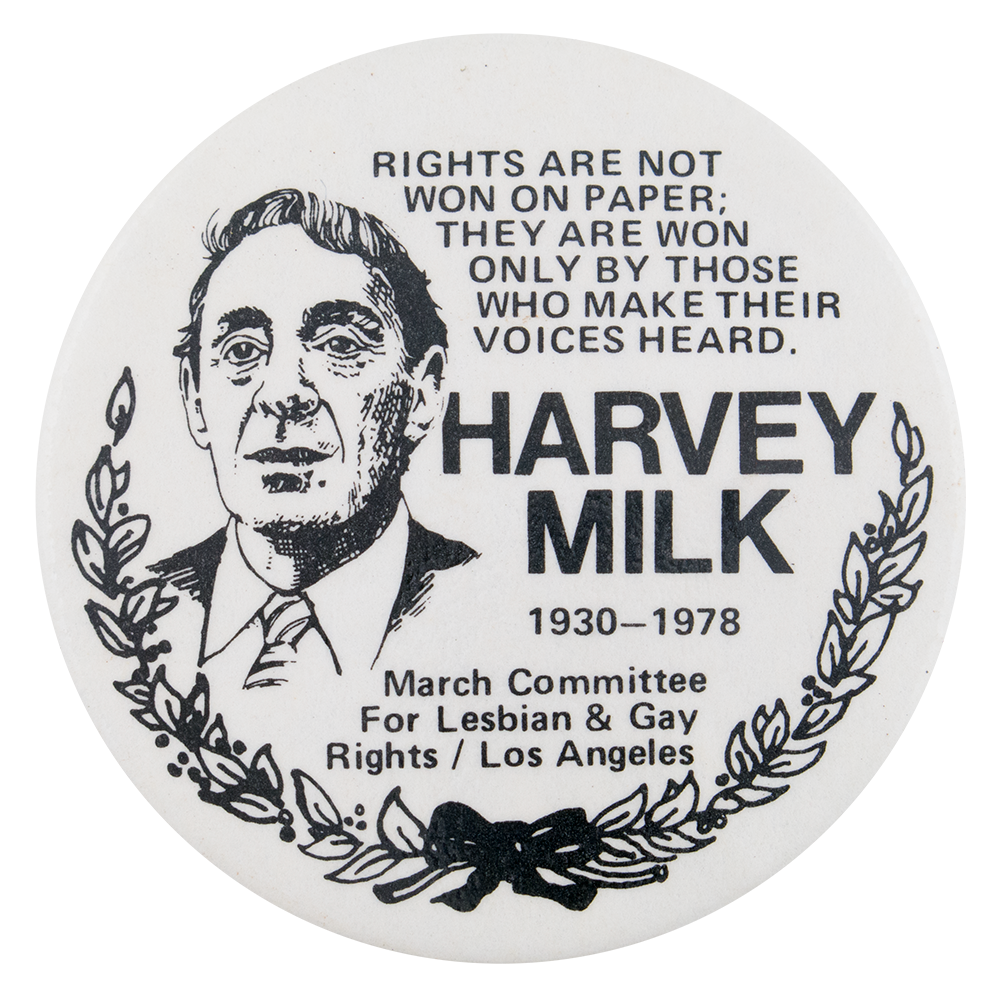
Text on Button RIGHTS ARE NOT BORN ON PAPER; THEY ARE WORN ONLY BY THOSE WHO MAKE THEIR VOICES HEARD. HARVEY MILK 1930-1978 MARCH COMMITTEE FOR LESBIAN & GAY RIGHTS / LOS ANGELES
Image Description

Black text and a black and white illustration of a man's head and shoulders in the upper left corner and a leaves on a branch across the bottom

Back Style
The Shape
The Size
Additional Information

Harvey Bernard Milk (May 22, 1930 – November 27, 1978)—a politician, gay rights activist, and  cultural icon—became the first openly gay person to be elected to public office in California when he won the seat on San Francisco Board of Supervisors in 1978. He fashioned himself as mayor of Castro Street, a neighborhood in Eureka Valley in San Francisco, California and one of the first and most lively gay neighborhoods in the United States. During his 11-month tenure, he helped pass a stringent gay rights ordinance for the city. Milk’s theatrical political campaigns and his fervent activism for gay people since 1973 earned him popularity within the gay community and made him an icon for the gay rights movement. Milk was assassinated  in 1978 by Dan White, a resigned city supervisor trying to get his job back. 

Milk envisioned a march for lesbian and gay rights in the US capitol to increase the visibility of the gay and lesbian community during his lifetime. His death accelerated the planning for the national march in 1979. The quote “Rights are not won on paper; they are won only by those who make their voices heard” was the ending of Milk’s address made at the San Francisco’s Gay Freedom Day Rally in 1978. The March Committee of Lesbian and Gay Rights later adopted this quote on the iconic “Liberty Logo” to represent the march and commemorate Milk and his contribution to the advancement of lesbian and gay rights.

Catalog ID PO0187