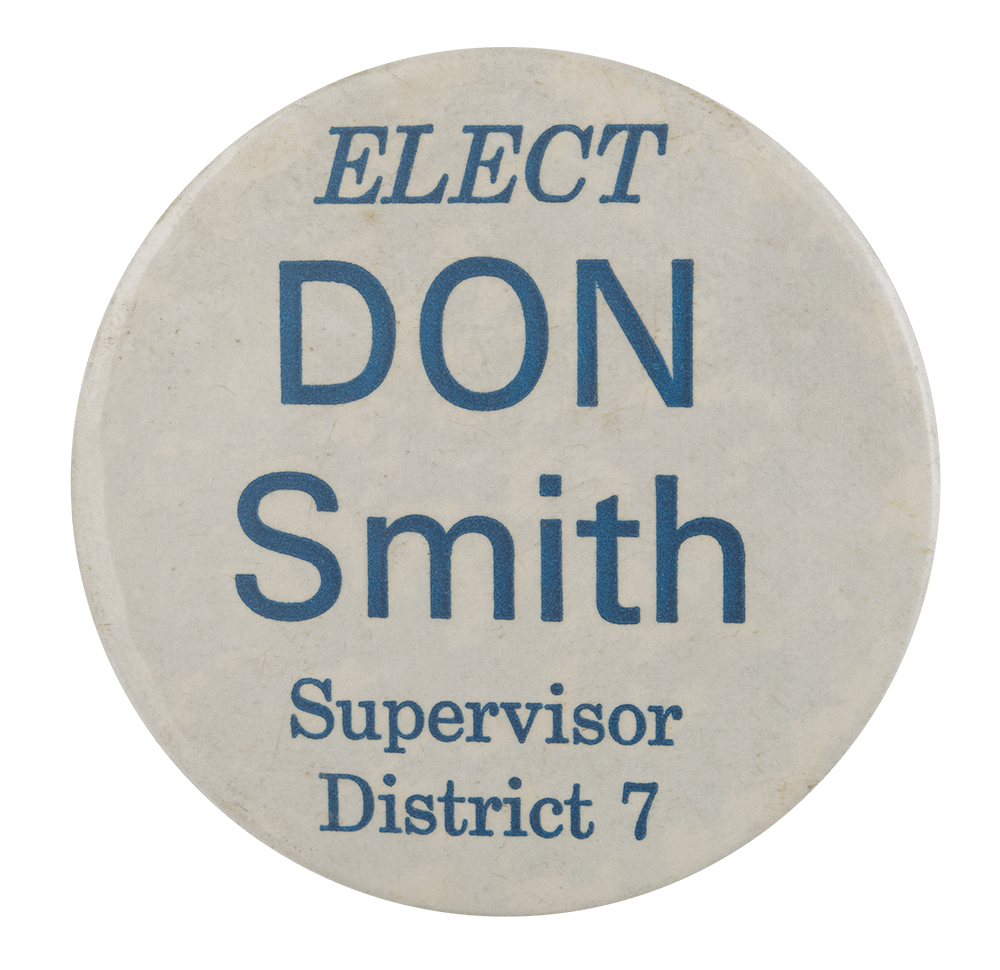
Don Smith Supervisor

Category
Additional Images
Text on Button ELECT DON Smith Supervisor District 7
Image Description

Blue text on white background

Back Paper / Back Info

BADGE-A-MINIT LASALLE ILL. 61301

Back Style
The Shape
The Size
The Manufacturer
Additional Information

Have info on this button? Contact us here.

Catalog ID PO1032

Dewey Bricker

Category
Additional Images
Sub Categories
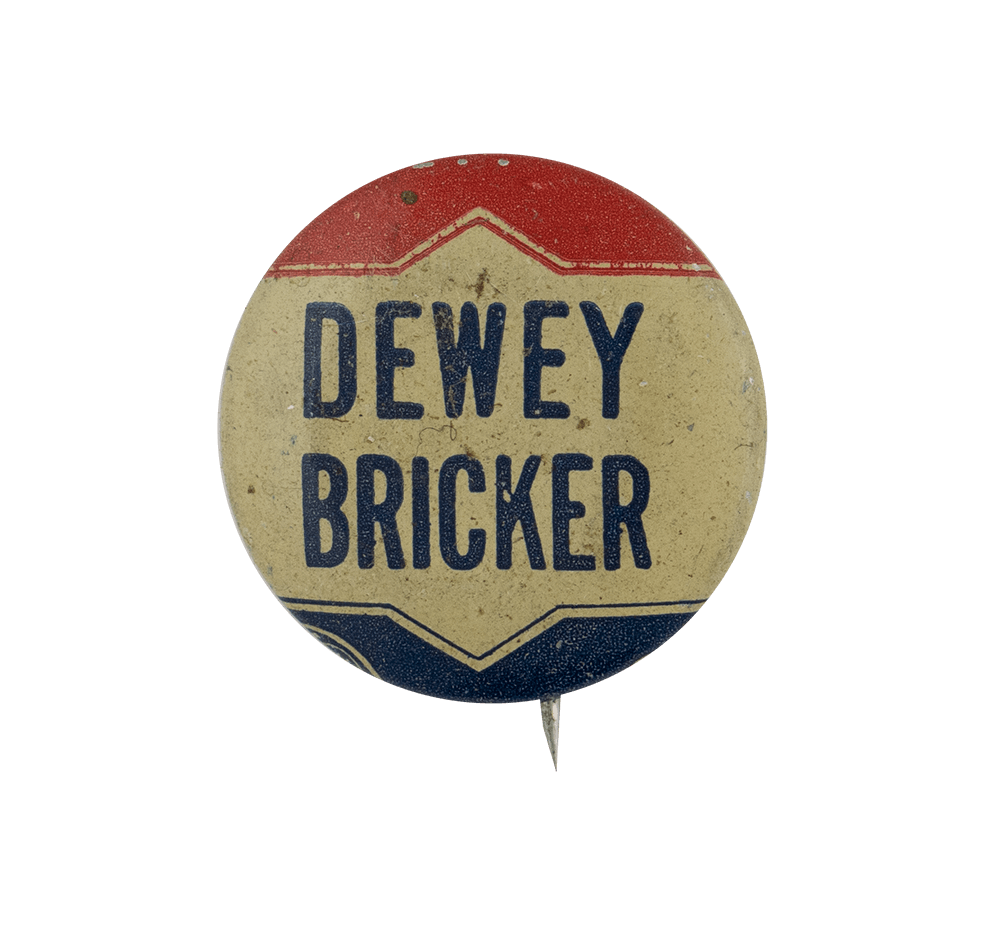
Text on Button DEWEY BRICKER
Image Description

Blue text on white band in center with red upper background and blue lower background.

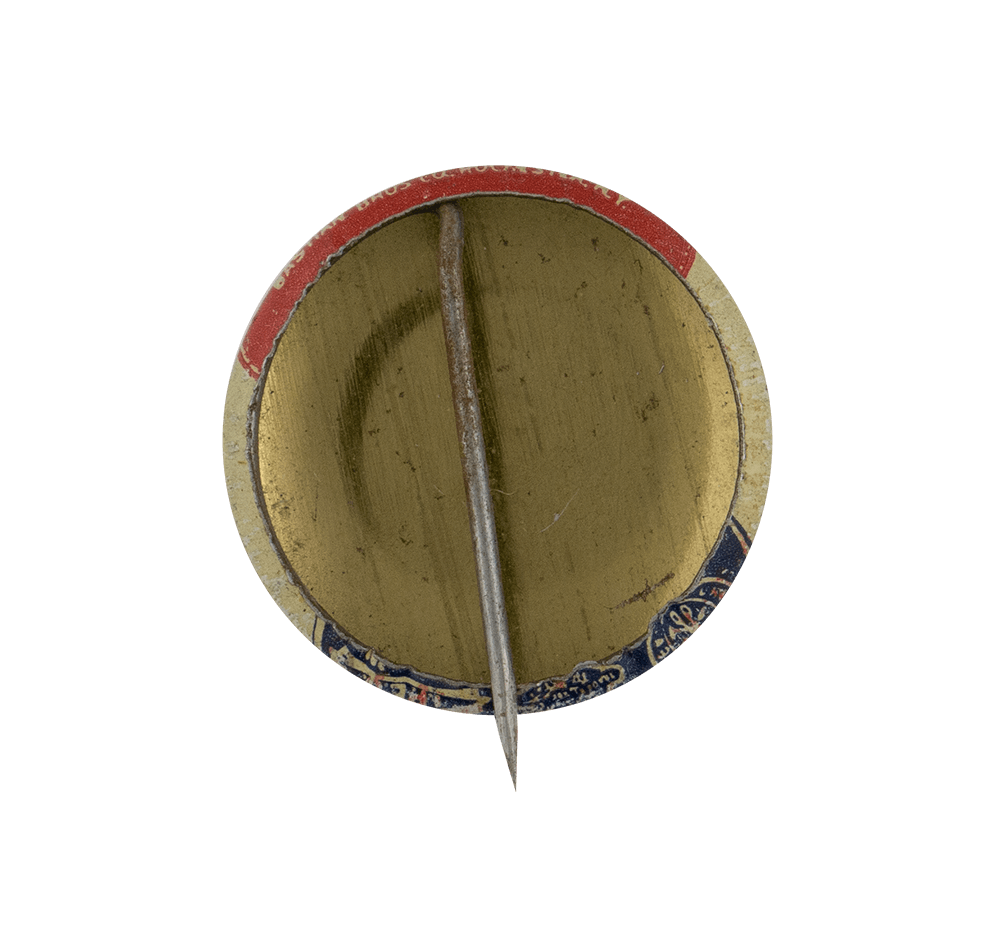
Curl Text Union bug Union bug Union bug BASTIAN BROS CO ROCHESTER, N.Y.
Back Style
The Shape
The Size
Additional Information

Thomas E. Dewey was a Republican and the governor of New York from 1942 to 1950. In 1944, in the middle of his first term as governor, he ran for president with John W. Bricker as his running mate. Dewey lost to Franklin D. Roosevelt. Dewey ran again in 1948 during his second term as governor, but lost to Harry Truman. During his time as governor, he disbanded employment discrimination and advanced disability benefits. 

John W. Bricker was the running mate of Dewey in 1944. He was the U.S. State Attorney General from 1933 to 1937, then Governor of Ohio from 1938 to 1946. and finally Senator of Ohio from 1946 to 1958. He disagreed with the power the president has when it comes to international affairs and attempted many times to pass amendments to limit it. He also was a Republican, favoring isolationist views and opposing communism. 

Sources

John W. Bricker. (n.d.). Retrieved July 12, 2020, from https://www.oxfordreference.com/view/10.1093/oi/authority.2011080309552…

Thomas Edmund Dewey. (n.d.). Retrieved July 12, 2020, from https://www.nga.org/governor/thomas-edmund-dewey/

Catalog ID PO1031

Dan Quayle is a Mother

Category
Additional Images
Sub Categories
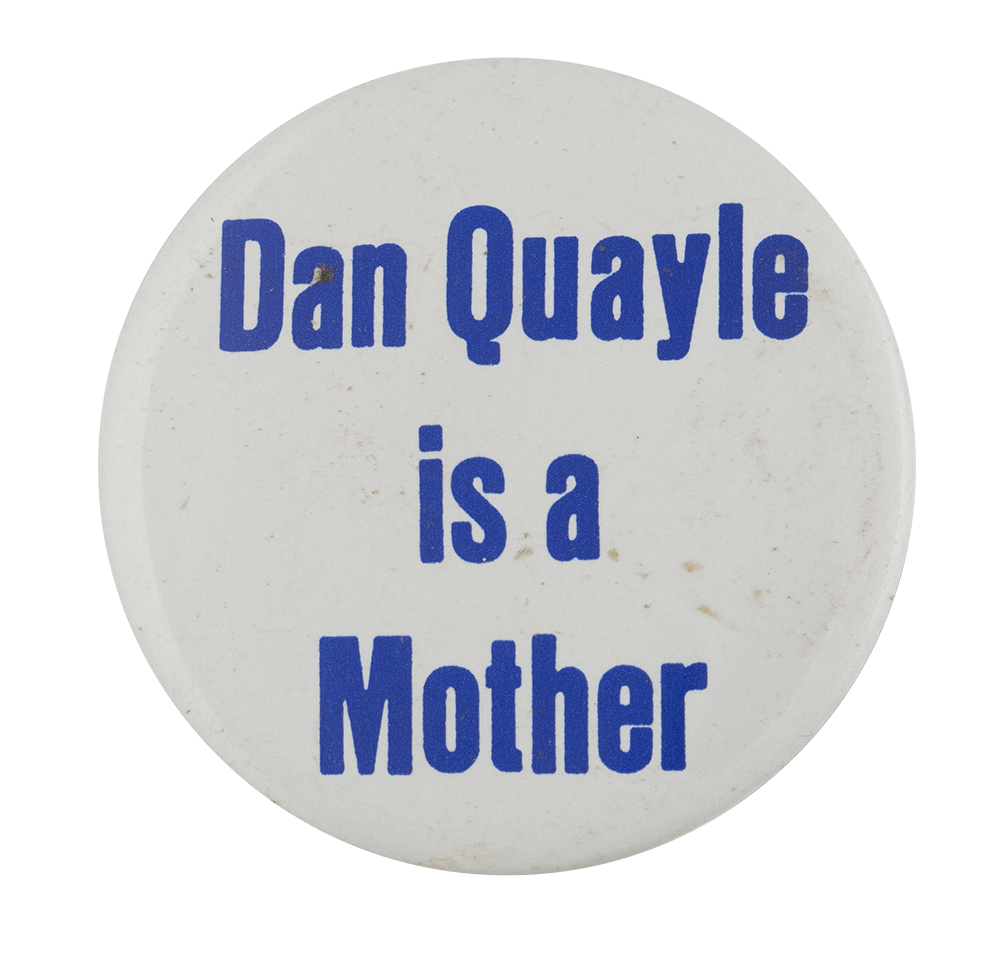
Text on Button Dan Quayle is a Mother
Image Description

Blue text on white background

Back Style
The Shape
The Size
Year / Decade Made
Additional Information

Vice President Dan Quayle gave a speech on May 19, 1992 that was titled Reflection on Urban America, but became widely known as the “Murphy Brown" speech. The speech came after the Los Angeles riots, which began after a jury acquitted four police officers of excessive force in the arrest of Rodney King. Quayle reflected that the unrest and poverty in the United States was linked to the breakdown of the family unit. He specifically referenced Murphy Brown, a popular TV show character of the time depicted as an intelligent journalist and single mother, in a negative fashion. Reactions both in favor of and against the message of the speech poured in from the American people afterwards. Many public figures and newspapers at the time reproached Quayle for condemning single mothers. The speech had long lasting effects for nearly a decade as people continued to lament the deterioration of the family unit. The reference to call someone "a mother" in this way is an inference to a swear word.

Sources

Bergesen, A., & Herman, M. (1998). Immigration, Race, and Riot: The 1992 Los Angeles Uprising. American Sociological Review, 63(1), 39-54. Retrieved February 2, 2021, from http://www.jstor.org/stable/2657476

Brockell, G. (2018). How ‘Murphy Brown’ became a target for Dan Quayle’s moralizing. Washington Post. Retrieved from https://www.washingtonpost.com/history/2018/09/27/how-dan-quayles-speec…

Coontz, S. (2005). For Better, For Worse. Washington Post. Retrieved from https://www.washingtonpost.com/wp-dyn/content/article/2005/04/30/AR2005…

Fortin, J. (2018). That Time ‘Murphy Brown’ and Dan Quayle Topped the Front Page. The New York Times. Retrieved from https://www.nytimes.com/2018/01/26/arts/television/murphy-brown-dan-qua…

Hartman, A. (1992). Editorial: Murphy Brown, Dan Quayle, and the American Family. Social Work, 37(5), 387-388. Retrieved February 2, 2021, from http://www.jstor.org/stable/23716842

Quayle, "Murphy Brown," Speech Text - Voices of Democracy. Retrieved 2 February 2021, from https://voicesofdemocracy.umd.edu/quayle-murphy-brown-speech-text/

Catalog ID PO1030

Carter Mondale

Category
Additional Images
Sub Categories
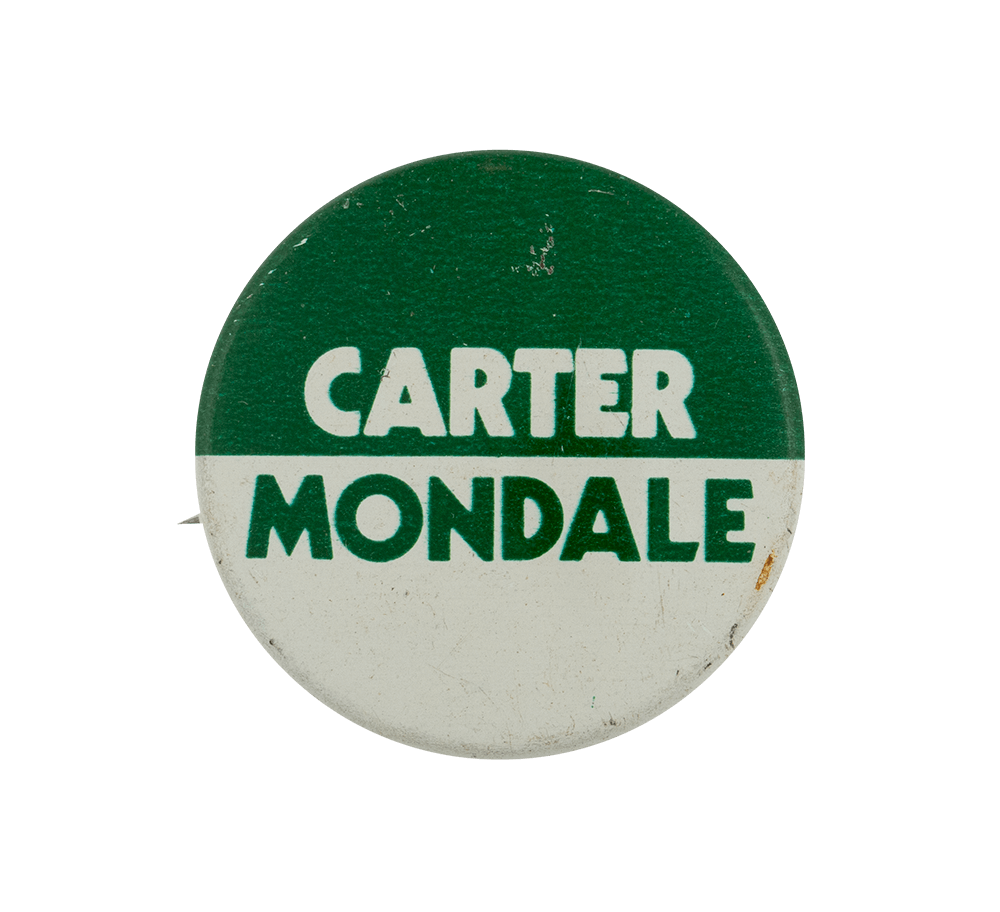
Text on Button CARTER MONDALE
Image Description

Button is bisected horizontally. White text with green background over green text with white background.

Curl Text Union bug
Back Style
The Shape
The Size
Additional Information

Jimmy Carter was Georgia’s Governor from 1971-1975 before running for president in 1976. Though he was unknown and an underdog, Carter campaigned hard and was able to secure the Iowa Caucus, earning himself many supporters, media attention, and the Democratic nomination. He selected Walter Mondale, a Senator representing Minnesota from 1964-1975 to be his running-mate and vice president. Carter’s campaign buttons were uniquely green instead of the typical red white and blue—this was in homage to his history as a peanut farmer. Carter and Mondale won the 1976 election and served four years in office. They campaigned together again in 1980, but were defeated by Republican candidate Ronald Reagan.

Catalog ID PO1029

Carroll Witten Mayor

Category
Additional Images
Sub Categories
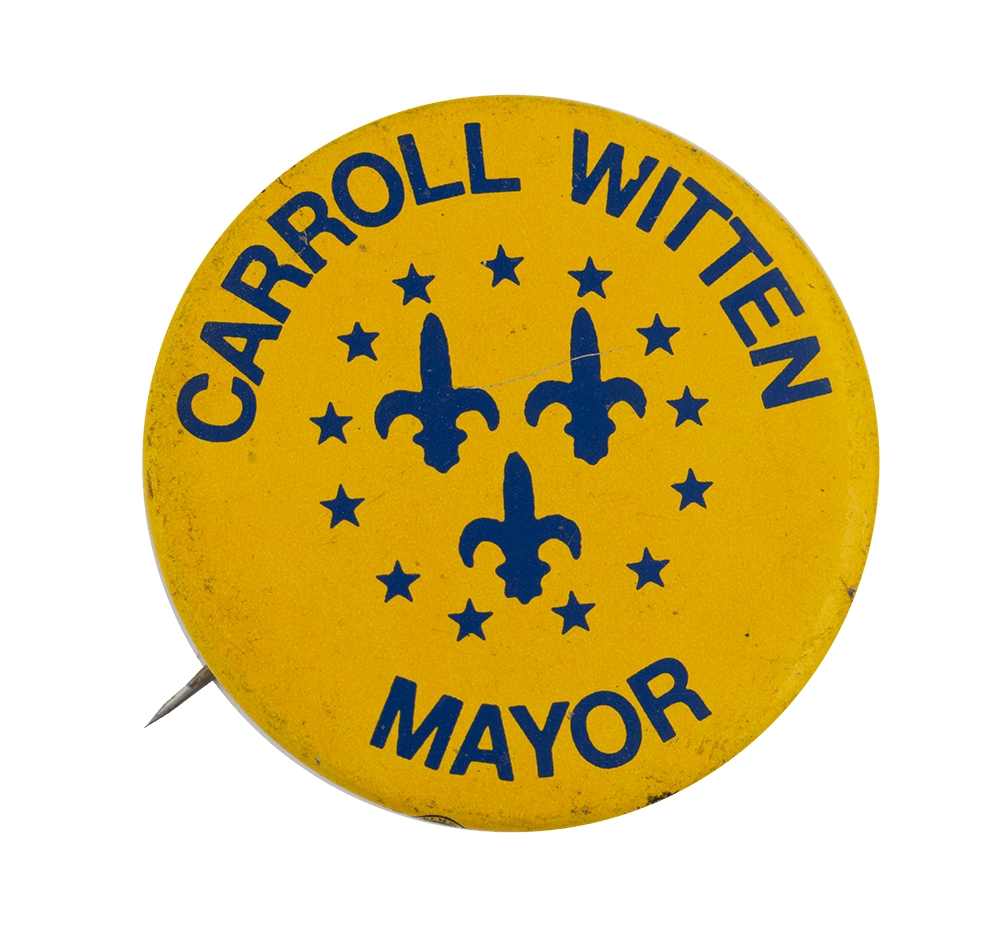
Text on Button CARROLL WITTEN MAYOR
Image Description

Blue text with 3 images of fleur de lis encircled by small stars on yellow background.

Curl Text Union bug Union bug
Back Style
The Shape
The Size
Year / Decade Made
Additional Information

Caroll Witten unsuccessfully ran for the Democratic Party nomination for Mayor of Louisville, Kentucky in 1973. A white doctor and President of the Board of Aldermen, he was a proponent of civil rights and very popular among African American voters. He would ultimately lose the nomination to eventual winner Harvey I. Sloane. 

Witten was an Air Force navigator in WWII who was held as a prisoner of war after his plane was shot down over Germany. After the war, he completed medical school and practiced as a family physician. He was a staunch supporter of affordable health care and led an experimental program to offer Medicaid to 40,000 Jefferson County citizens. He died in 1993 at age 69.

Catalog ID PO1028

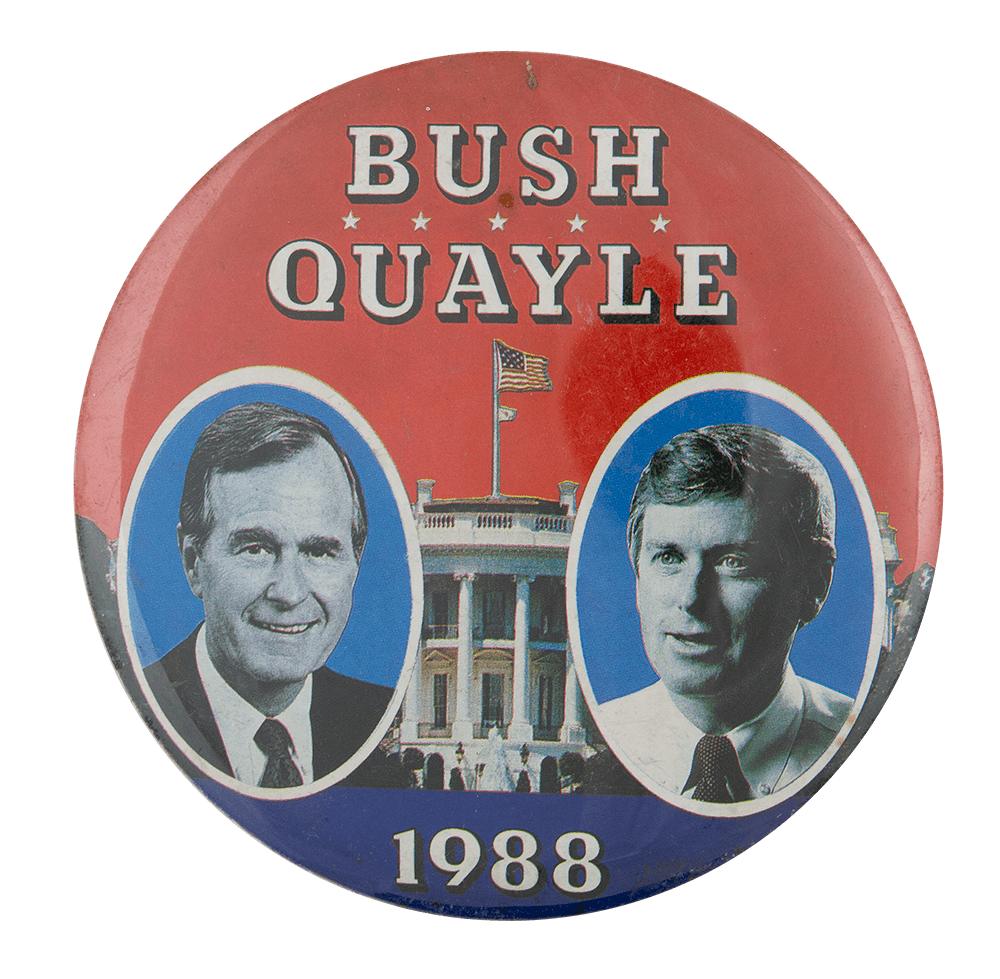
Bush Quayle 1988

Category
Additional Images
Sub Categories
Text on Button BUSH QUAYLE 1988
Image Description

Photos of Bush and Quayle in blue vignettes in front of photograph of White House. White text on red upper and blue lower background.

Curl Text (410)691-0493
Back Style
The Shape
The Size
Year / Decade Made
Additional Information

The 1988 Presidential election saw former Vice President George Bush and Indiana Senator Dan Quayle defeat Democratic nominee Michael Dukakis. Bush defeated him easily in the electoral college, taking in 426 votes to his opponents 111. Bush benefited tremendously from the popularity of the Reagan administration and this helped him clinch the nomination by association. 

The 1988 election from the Bush campaign is notable for lacking a strong message or vision for what his presidency would look like. Instead, the campaign focused on the weaknesses of Dukakis and portrayed the moderate governor as a radical liberal. The Dukakis campaign was unprepared to deal with this bombardment of attacks and often reacted slowly. Bush would continue this momentum and frequently lead by large margins in polls. This culminated in a massive victory for Bush.

Sources

Morrison, D. (2009, August 17). United States presidential election of 1988. Encyclopedia Britannica. https://www.britannica.com/event/United-States-presidential-election-of…

Catalog ID PO1027

Adlai III

Category
Additional Images
Sub Categories
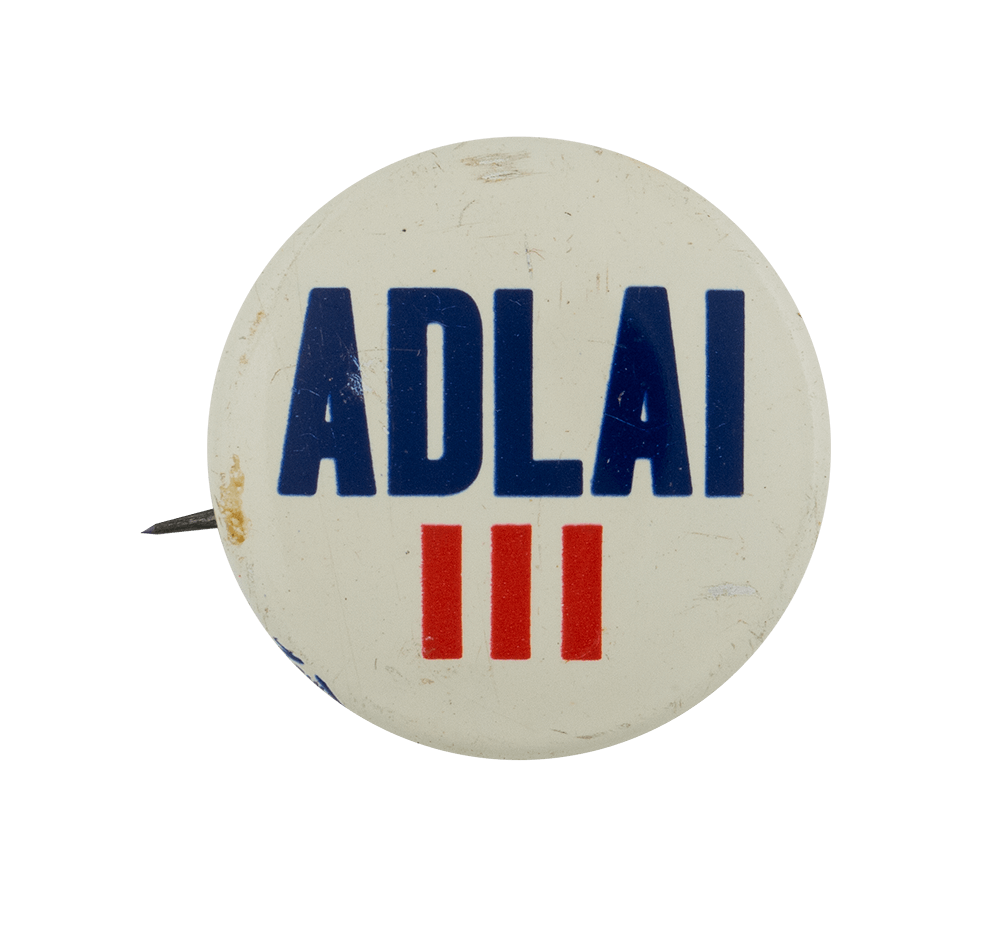
Text on Button ADLAI III
Image Description

Blue text and red text on white background.

Curl Text Union bug Union bug
Back Style
The Shape
The Size
Year / Decade Made
Additional Information

Adlai Stevenson III campaigned to be U.S. Senator for Illinois. Ralph Tyler Smith had been appointed to fill the Senate seat held by Everett Dirksen, who died in office in 1969. Stevenson defeated Smith in a special election in 1970 and was re-elected in 1974. He decided not to run in 1980. Stevenson, a Democrat, had been Illinois Treasurer from 1967-1970. Stevenson is the son of former U.S. Ambassador to the United Nations and Illinois Governor Adlai Stevenson II, who lost the U.S. Presidential election to Dwight D. Eisenhower in 1952 and 1956.

The button is likely from the 1974 election campaign.

Catalog ID PO1025

Iceburg Millersburg

Category
Additional Images
Sub Categories
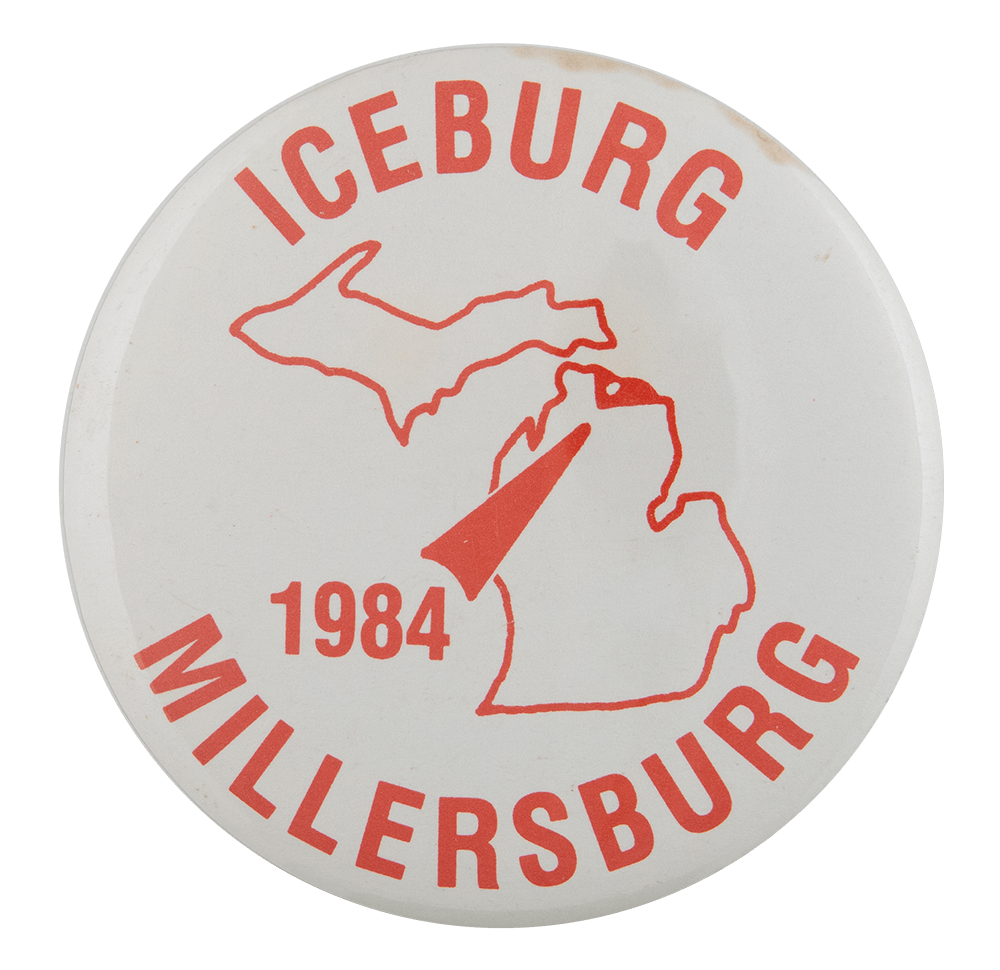
Text on Button ICEBURG 1984 MILLERSBURG
Image Description

Illustration of Michigan and red text on white background

Curl Text MADE IN USA.
Back Style
The Shape
The Size
Year / Decade Made
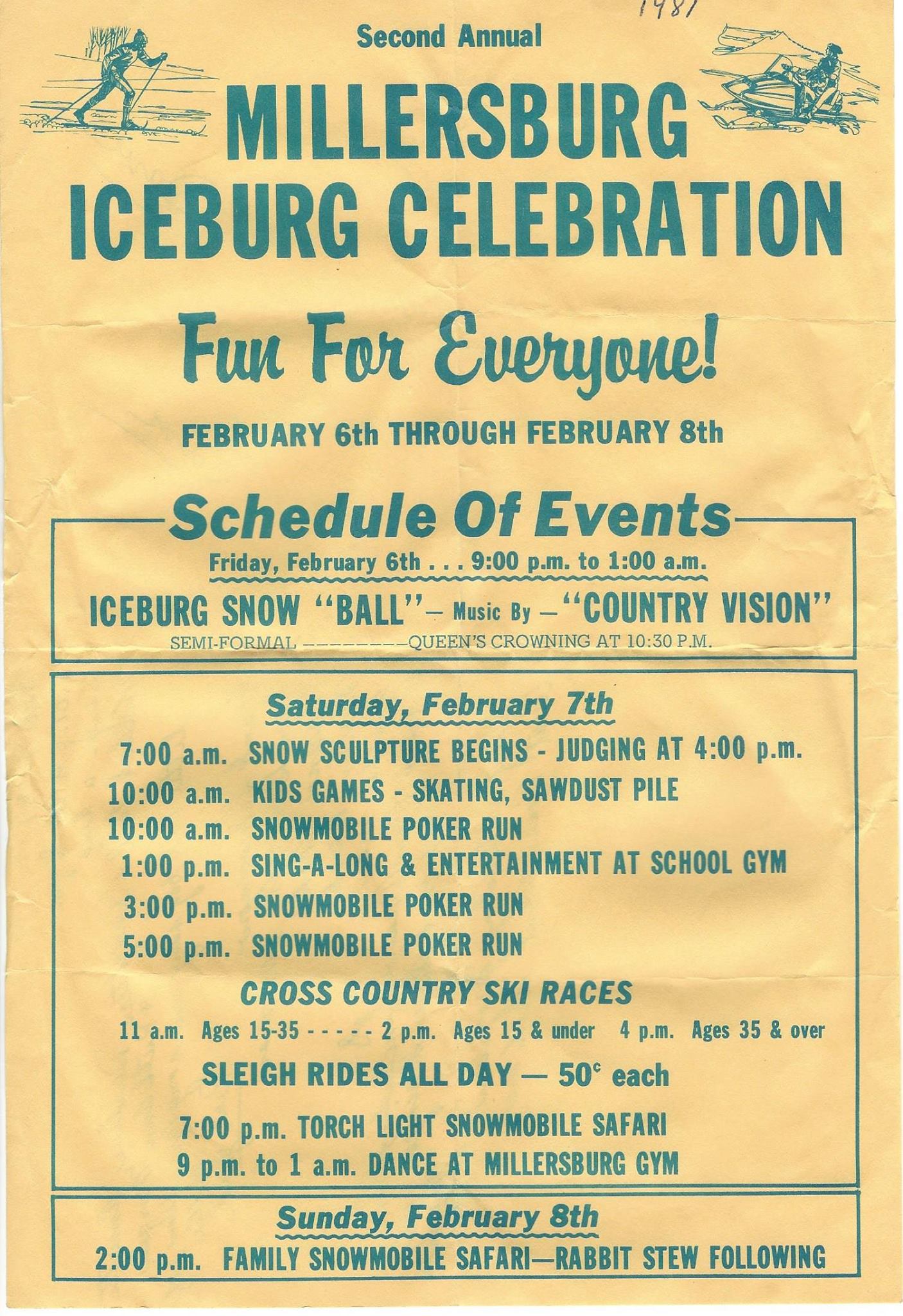
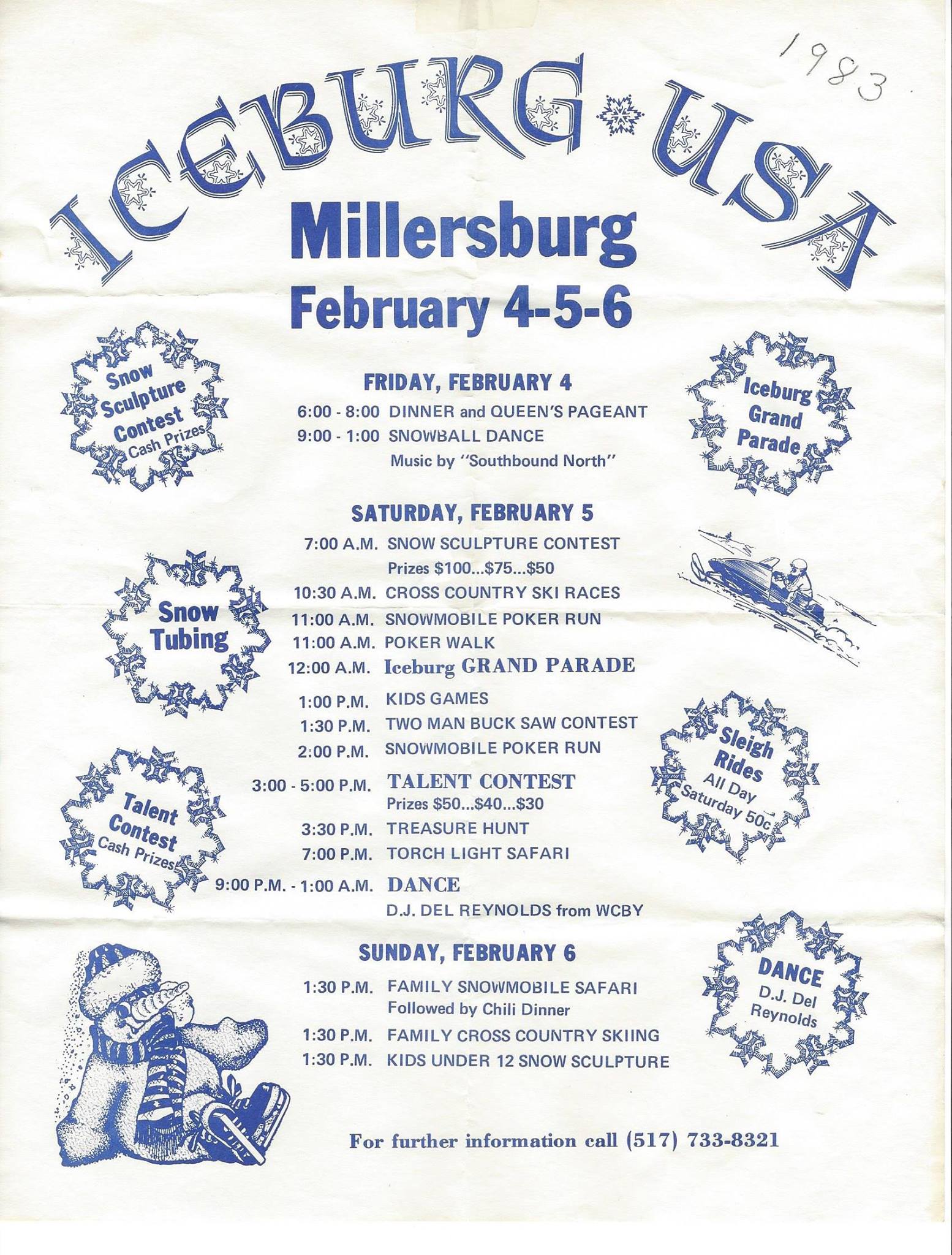
Additional Information Millersburg, Michigan is a village in Presque Isle County within Case Township. According to the 2010 census, the village had a population of 206. There were 86 households, and 54 families. The Iceberg USA Festival was an annual event that began in 1980, which was comprised of many winter-themed activities and was intended to give people a reason to get together during the winter months. The 1984 festival included a Snowball Dance, a Queen's Pageant, a snow sculpture contest, cross country ski races, a snowmobile run, a snowmobile safari, a talent contest, family cross-country skiing, a bonfire with homemade chili, and the Iceberg Grand Parade. During the 1984 festival, Lori Lail was crowned Miss Millersburg. The $1 Iceburg button had to be purchased and worn in order to be admitted to most of the festival's events. Those not wearing the button were subject to “jailing” by Iceburg Cops. Due to a lack of volunteers, few willing pageant contestants, and a decline in snowfall , the festival was last held in 1998.
Sources
Millersburg, Michigan. (2020, August 07). Retrieved September 01, 2020, from https://en.wikipedia.org/wiki/Millersburg,_Michigan
Catalog ID EV0832

Tiny Equals

Category
Additional Images
Sub Categories
Image Description

Light purple equals sign on off white background

Back Style
The Shape
The Size
Additional Information

Purple was one of a trifecta of colors used by the Women’s Suffrage and Political Union in England at the turn of 20th century. The colors were brought to the United States suffrage movement by women who had worked for British suffrage. The three colors—purple, white, and gold—originally symbolized loyalty, purity, and hope, and have remained symbolic to the modern-day feminist movement. The equals sign with regard to feminism is a statement indicating that women should be equal to men.

Since the mid-1990s, the equals sign has become primarily associated with the LGBT rights movement. This is in large part due to the Human Rights Campaign—an LGBT advocacy group—who adopted the symbol as its logo in 1995. Lavender, similar to the color of the equals sign on this button, has also been historically associated with lesbian rights. 

Catalog ID CA0753

Reach for a Rainbow Today

Category
Additional Images
Sub Categories
Text on Button Reach for a rainbow today
Image Description

Image of a sunshine and rainbow in center with white cloud at bottom. Black text on white area.

Curl Text ALVERNO·CHICAGO, IL 60641
Back Style
The Shape
The Size
Year / Decade Made
The Manufacturer
Additional Information

Rainbows are often celebrated LGBTQIA symbols since the 1970s, although origins in mythology date to Hebrew text, The Bible, and Norse texts, regarding the Bifrost. Apple computers also used a rainbow in their logo from 1977-1998. LGBTQ Institutions such as the Mazer Lesbian Archives house this button in their Button Collection under LGBT (miscellaneous). The phrase “reach for a rainbow” echo’s the motivational phrase “reach for the stars” and can be interpreted as a call to embrace queer identities.

Russ Berrie & Company is a novelty gift retailer known for its plush bears and figurines.

Sources

June L. Mazer Archives. (2019). The Mazer Button Collection. Mazer Lesbian Archives. Retrieved October 2, 2020, from https://www.mazerlesbianarchives.org/buttons-collection.

Catalog ID IB0678