Brookfield Zoo Parent 1993

Category
Additional Images
Sub Categories
Text on Button Brookfield Zoo Parent 1993
Image Description

Yellow text on an outer black edge with grey and yellow stars with a yellow innter circle with a grey star and black silhouette of a bird, turtle, dolphin and giraffe.

Back Style
The Shape
The Size
Year / Decade Made
Additional Information

The Chicago Zoological Society's Brookfield Zoo is located in Brookfield, Illinois, a suburb of Chicago. The zoo opened in 1934 and currently cares for over 450 species of animals. Animal Adoption is a program where people can sponsor an animal through a monetary gift. The animal would remain at the zoo and be cared for by zookeepers and staff in their habitats. When an animal is adopted and the person has gifted a specific amount of money towards the upkeep of that animal, the person becomes an animal parent. Money not only goes towards upkeep, but also towards research and conservation of the species.

Sources

Chicago Zoological Society - Brookfield Zoo & The Chicago Zoological Society. (2019). Retrieved 2 April 2020, from https://www.czs.org/AnimalAdoption

Catalog ID CL0540

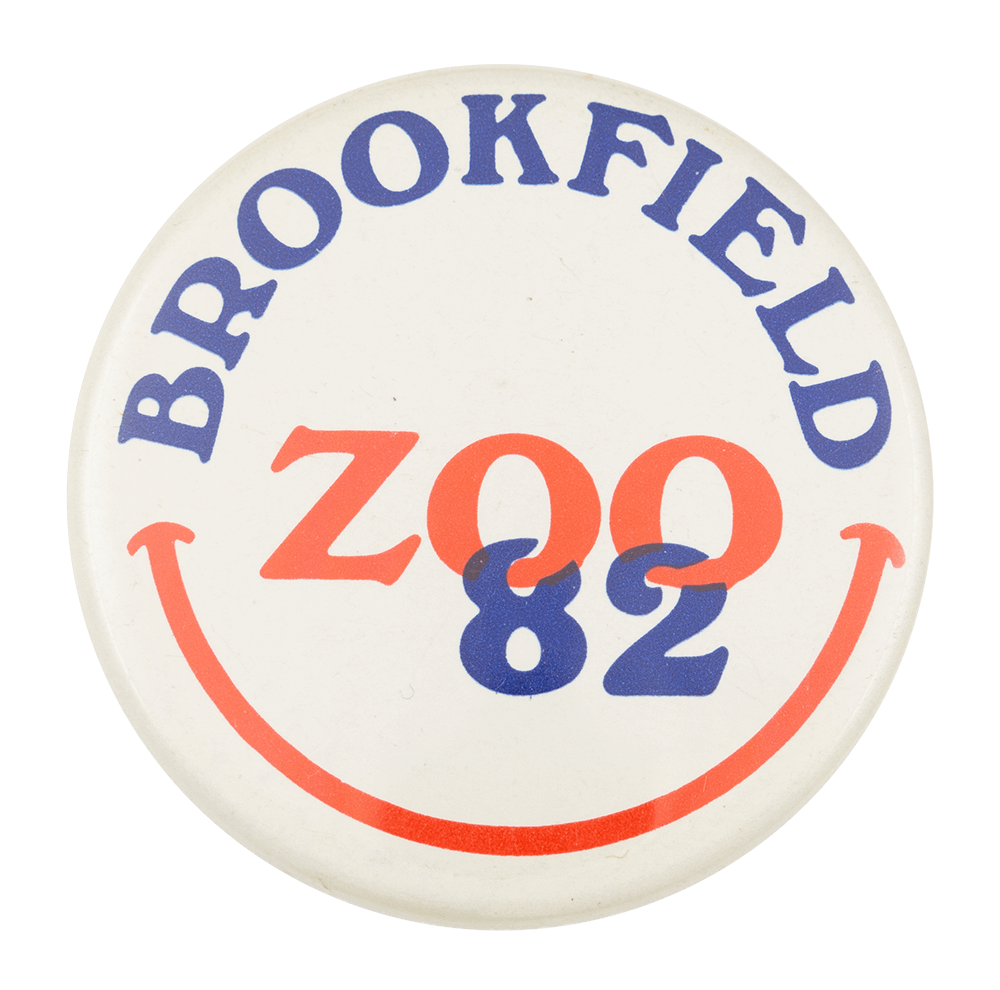
Brookfield Zoo 82

Category
Additional Images
Sub Categories
Text on Button BROOKFIELD ZOO 82
Image Description

Blue and red text with an illustration of a smile on a white background

Back Style
The Shape
The Size
Year / Decade Made
Additional Information

Brookfield Zoo, or Chicago Zoological Park, is located in a suburb of Chicago, IL. It originally opened in 1934 and was highly regarded for using moats instead of fences to separate the animals from human traffic. In 1982, the zoo began opening the then-largest indoor rainforest exhibit Tropic World. The exhibit would eventually encompass three continents, but only Africa was opened in 1982 featuring the gorilla enclosure with Samson, Alpha, and Babs.

Sources

Brookfield Zoo (2020, June 4). In Wikipedia. Retrieved June 20, 2020, from https://en.wikipedia.org/wiki/Brookfield_Zoo

Brookfield Zoo. (n.d.). A History of Tropic World's Gorillas. Retrieved June 20, 2020, from https://www.czs.org/custom.czs/media/CenterAnimalWelfare/Tropic-World-f…

Brookfield Zoo - Tropic World - "It's A Jungle In There" (Commercial, 1982) [Online video]. (1982). Chicago: The Museum of Classic Chicago Television. Retrieved June 20, 2020, from https://www.youtube.com/watch?v=K9UM95B3tks

Catalog ID SM0200

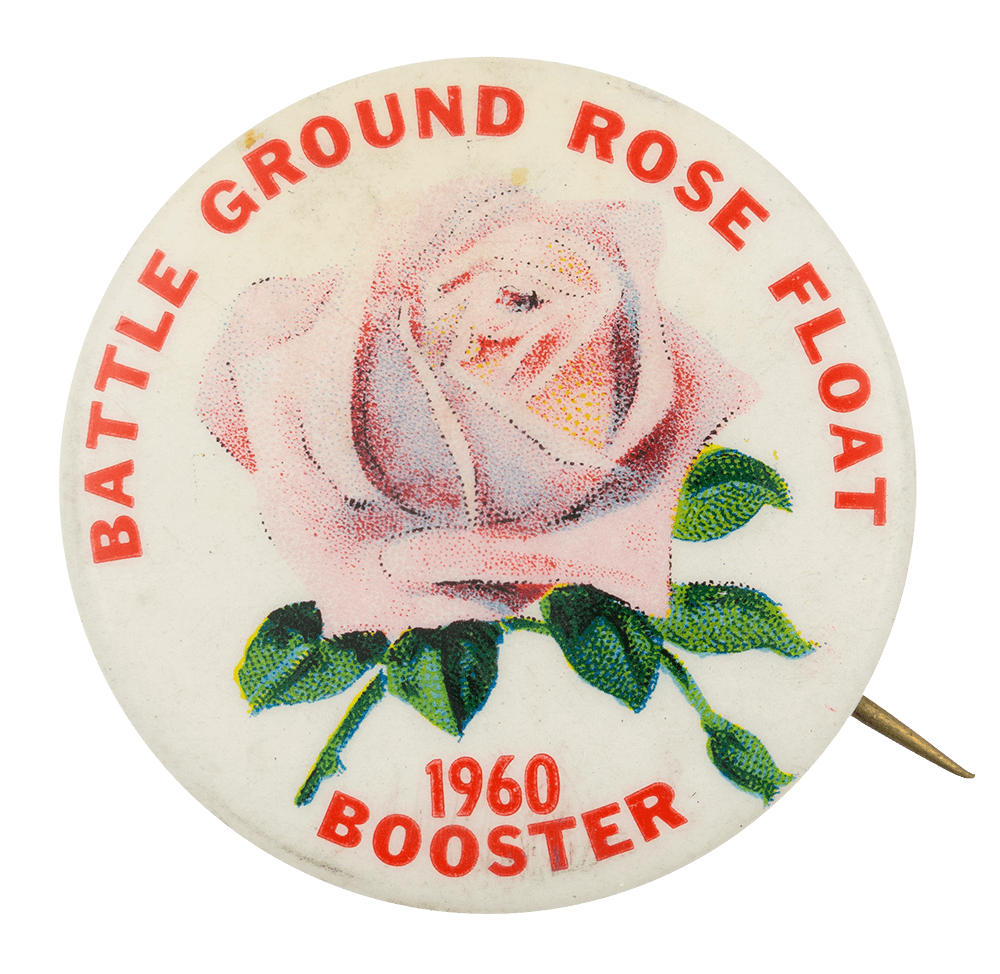
Battle Ground Rose Float Booster 1960

Category
Additional Images
Sub Categories
Text on Button BATTLE GROUND ROSE FLOAT 1960 BOOSTER
Image Description

Red text around an illustration of a pink rose on a white background

The Shape
The Size
Additional Information

The Battle Ground Rose Float was designed in 1955 by the Battle Ground High School marching band for Portland, Oregon’s Grand Floral Parade, which is held every year in June. Local residents who were part of the Battle Ground Rose Float boosters would encourage people to donate time and funds to the creation of the float each year.

The Battle Ground Rose Float is constructed and designed by volunteers, and every year a different theme is used. In 1960, that theme was “Honolulu,” and the Battle Ground marching band took first place in the “Cities outside of Oregon under 5000” category. After the Grand Floral Parade is over, the Rose Float is used in the Harvest Days Parade in July in Battle Ground before being broken down. Once the float is deconstructed, its parts are moved to the Battle Ground Rose Float Museum. 

Source:
History. (n.d.) Battle Ground Rose Float. Retrieved from http://battlegroundrosefloat.com/history/

Catalog ID CL0552

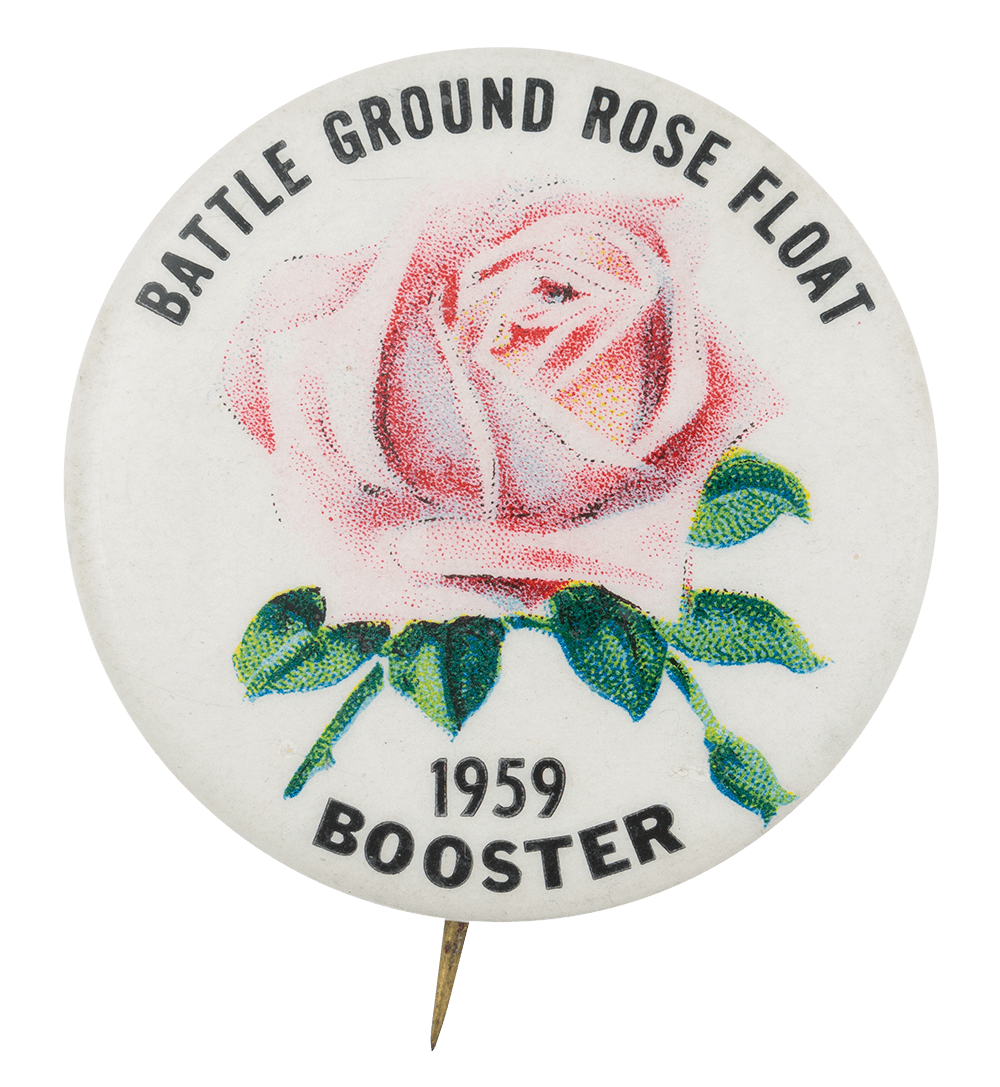
Battle Ground Rose Float Booster 1959

Category
Additional Images
Sub Categories
Text on Button BATTLE GROUND ROSE FLOAT 1959 BOOSTER
Image Description

Black text around an illustration of a pink rose on a white background

Back Style
The Shape
The Size
Year / Decade Made
Additional Information

The Battle Ground Rose Float was designed in 1955 by the Battle Ground High School marching band for Portland, Oregon’s Grand Floral Parade, which is held every year in June. Local residents who were part of the Battle Ground Rose Float boosters would encourage people to donate time and funds to the creation of the float each year. 

The Battle Ground Rose Float is constructed and designed by volunteers, and every year a different theme is used. In 1959, that theme was “Lewis & Clark Expedition,” and the Battle Ground marching band took first place in the “Cities outside of Oregon under 5000” category. After the Grand Floral Parade is over, the Rose Float is used in the Harvest Days Parade in July in Battle Ground before being broken down. Once the float is deconstructed, its parts are moved to the Battle Ground Rose Float Museum. 

Sources

History. (n.d.) Battle Ground Rose Float. Retrieved from http://battlegroundrosefloat.com/history/

Catalog ID CL0551

American Retail Coal Association Exhibitor

Category
Additional Images
Sub Categories
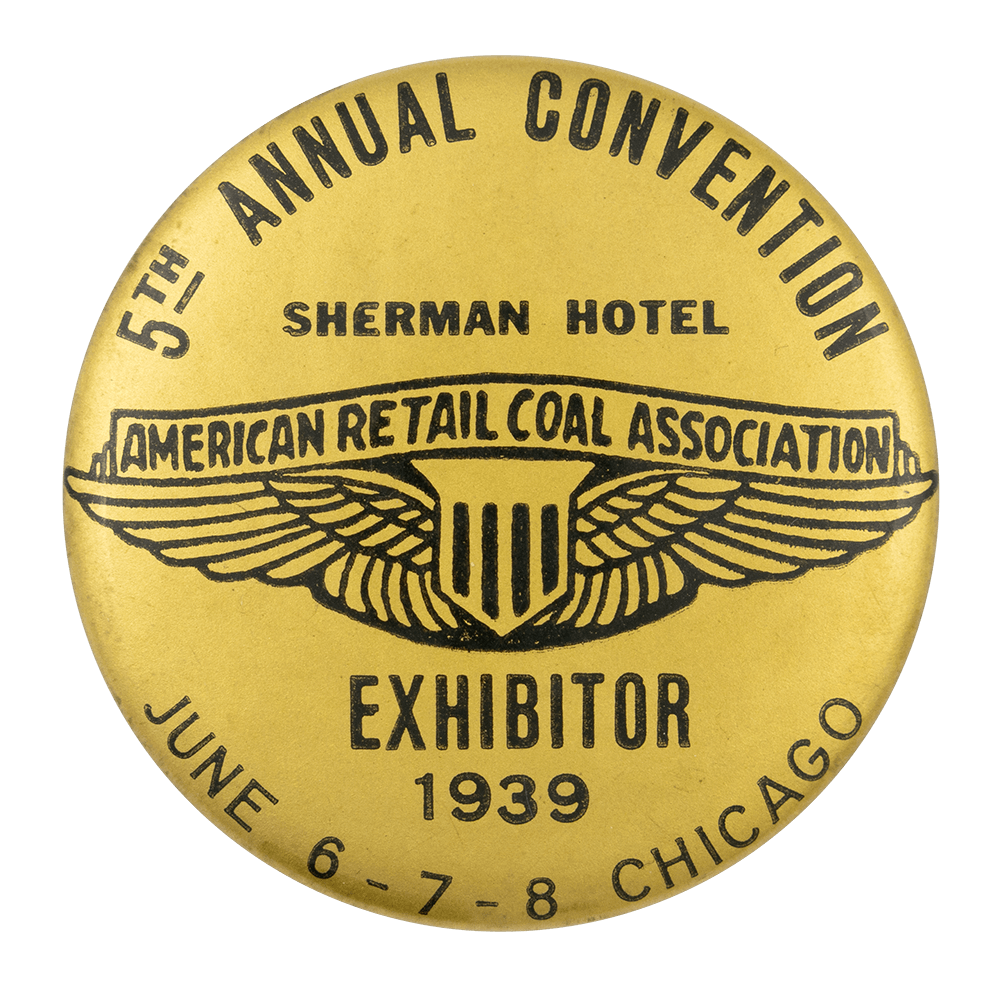
Text on Button 5TH ANNUAL CONVENTION SHERMAN HOTEL AMERICAN RETAIL COAL ASSOCIATION EXHIBITOR 1939 JUNE 6 -7 -78 CHICAGO
Image Description

Black text and an illustration of a winged emblem in the middle on a gold background

Back Paper / Back Info

Made by AMERICAN BADGE CO. CHICAGO, ILLS.

Back Style
The Shape
The Size
Year / Decade Made
The Manufacturer
Additional Information

The fifth convention of the American Retail Coal Association was held at the the Sherman Hotel in Chicago in June of 1939. The ARCA was a group of local, state, and regional coal associations located in 27 states across the U.S. and represented coal merchants who marketed the majority of retail coal each year.  During the 1939 convention, Lee Attridge of Flint, Michigan was elected as the association’s President.

In the first half of the 20th century, the retail coal industry, which included all coal that was used for residential and commercial use, made up approximately 20% of the coal market. The Chicago-based association was also part of the American Retail Federation, which was made up of more than 800,000 retail outlets across the country.

Sources

Flint Man Elected. (1939 June). Battle Creek Enquirer. Retrieved from https://www.newspapers.com/newspage/204632400/

McCamant, W. (1960 May). Pension Plans of Owner-Managers of Corporations. Hearings Before the Committee on Finance. Retrieved from https://www.finance.senate.gov/imo/media/doc/86HrgPension.pdf

Urheim, B.E. (1950 June) Causes of Unemployment in Coal and Other Unspecified Industries. Statistical Abstract of the United States. Retrieved from https://books.google.com/books?id=vk-WoazzhwsC&pg=RA3-PA287&lpg=RA3-PA2…

Catalog ID CL0553

44th Ward Fair Volunteer

Category
Additional Images
Sub Categories
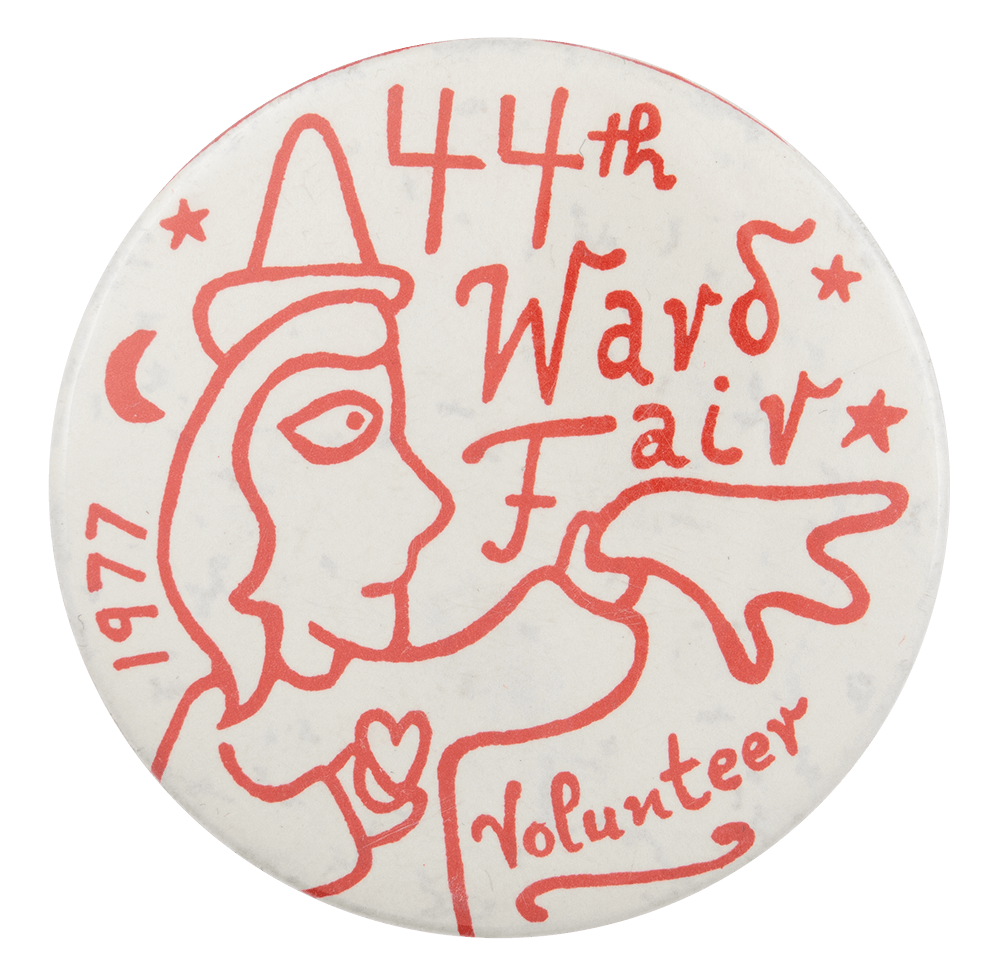
Text on Button 44th Ward Fair Volunteer 1977
Image Description

Red text and a red illustration of a person in a pointy hat and robe holding a heart on a white background

Back Style
The Shape
The Size
Year / Decade Made
Additional Information

The 44th Ward Fair was an outdoor celebration event held in Chicago from the early 1970s until 1985. The 44th Ward constitutes the area of downtown Chicago including the Boystown and Wrigleyville neighborhoods. The first fair likely took place in 1972 as a way for Alderman Richard Simpson to raise money for projects and services in his ward. Events included ethnic food, concerts, carnival games, and more. For the 1979 fair, members of the Chicago Hustle, a women’s professional basketball team, were showcased in a free throw competition. 

The fair holds significance in local gay rights history. The initial 1972 fair welcomed an exhibit by the ward’s gay organizations. The following year, however, the clergy of the host church refused to rent the space out to fair organizers unless contract language expressly forbade exhibitions in direct contradiction to church policy. In response, a group of more than 30 protested the exclusion of the gay organizations. Local author, historian, and actor Studs Terkel happened to walk by the protest and asked its purpose. Once he learned why they were excluded, Terkel stormed the stage and gave a fiery speech denouncing the exclusion of gay people.

Sources

Croix, S. (2003, October 15). Gay history: Chicago whispers. In Windy City Times. Retrieved from http://www.windycitymediagroup.com/lgbt/Gay-History-Chicago-Whispers/14…

Fun to do. (1979, July 15). Chicago Tribune, p. 38.

Catalog ID EV0589

Pulaski Day

Category
Additional Images
Sub Categories
Text on Button PULASKI DAY
Image Description

Black text and an illustration of a man's head on a white background

Back Paper / Back Info

THE WHITEHEAD & HOAG CO. 
BUTTONS BADGES NOVELTIES AND SIGNS 
NEWARK, N.J.

Back Style
The Shape
The Size
The Manufacturer
Additional Information

Casimir Pulaski Day is a holiday that is observed in various cities throughout Illinois, Wisconsin, Michigan, and New York. Pulaski Days celebrate Polish culture through the remembrance of heroic nobleman, soldier, and military commander Kazimierz Michał Władysław Wiktor Pułaski (1745 – 1779), also known as Casimir Pulaski.  

After failing to lead an uprising against Russian domination in the Polish-Lithuanian Commonwealth, Casimir Pulaski traveled to North America in 1777 to fight in the American Revolutionary war. While fighting for the Americans as a general in the continental army, Pulaski distinguished himself as a war hero, most notably by saving the life of George Washington. Pulaski has been deemed "the father of the American calvary" for his significant contributions to U.S. military history. In November 2006, President Barack Obama signed a joint resolution of the United States House and Senate officially making Pulaski an honorary U.S. citizen. Casimir Pulaski is one of only eight people to be awarded honorary U.S. citizenship. 

Catalog ID CH0287

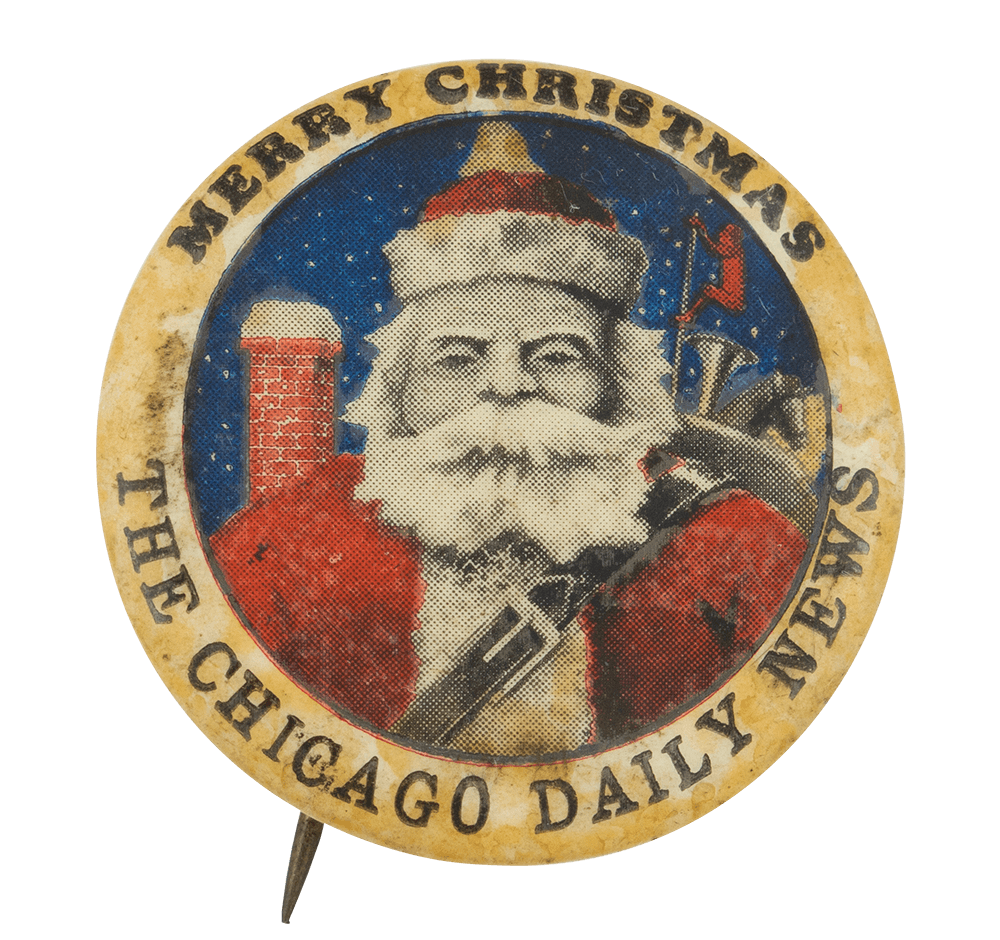
Merry Christmas The Chicago Daily News

Category
Additional Images
Sub Categories
Text on Button MERRY CHRISTMAS THE CHICAGO DAILY NEWS
Image Description

Black text on an outer white edge with an illustration of Santa in front of a chiminey and starry night sky

Back Style
The Shape
The Size
Additional Information

The Chicago Daily News was an afternoon newspaper published between 1875 and 1978. It was founded by Melville E. Stone, Percy Meggy, and William Dougherty to serve as a competitor to the Chicago Tribune. Initially, Chicago Daily News experienced low sales and was considered unsuccessful. To get it off the ground, Stone urged local merchants to sell his paper for 99 cents—rather than a dollar—to boost its circulation. His strategy worked, leading to greater sales for the remainder of the nineteenth century.

The newspaper was in its heyday from the 1930s to the 1950s. What contributed to its heightened popularity was its distinctive style of writing, which was likened to a “daily novel” by editor Henry Justin Smith. The concise paragraphs of the Chicago Daily News were short enough to be read by busy people who were on the go. The paper dissolved when the rights to the Chicago Daily News trademark were sold to Australian millionaire Rupert Murdoch in 1984.

Sources

Scott, F. W., & James, E. J. (1910). Newspapers and periodicals of Illinois, 1814-1879. Harvard University. https://books.google.com/books?id=x2wPAAAAYAAJ&printsec=frontcover#v=on…

Wilson, M. R., Porter, S. R., & Reiff, J. L. (2005). Chicago Daily News Inc. Encyclopedia of Chicago. http://www.encyclopedia.chicagohistory.org/pages/2598.html

Catalog ID CH0290

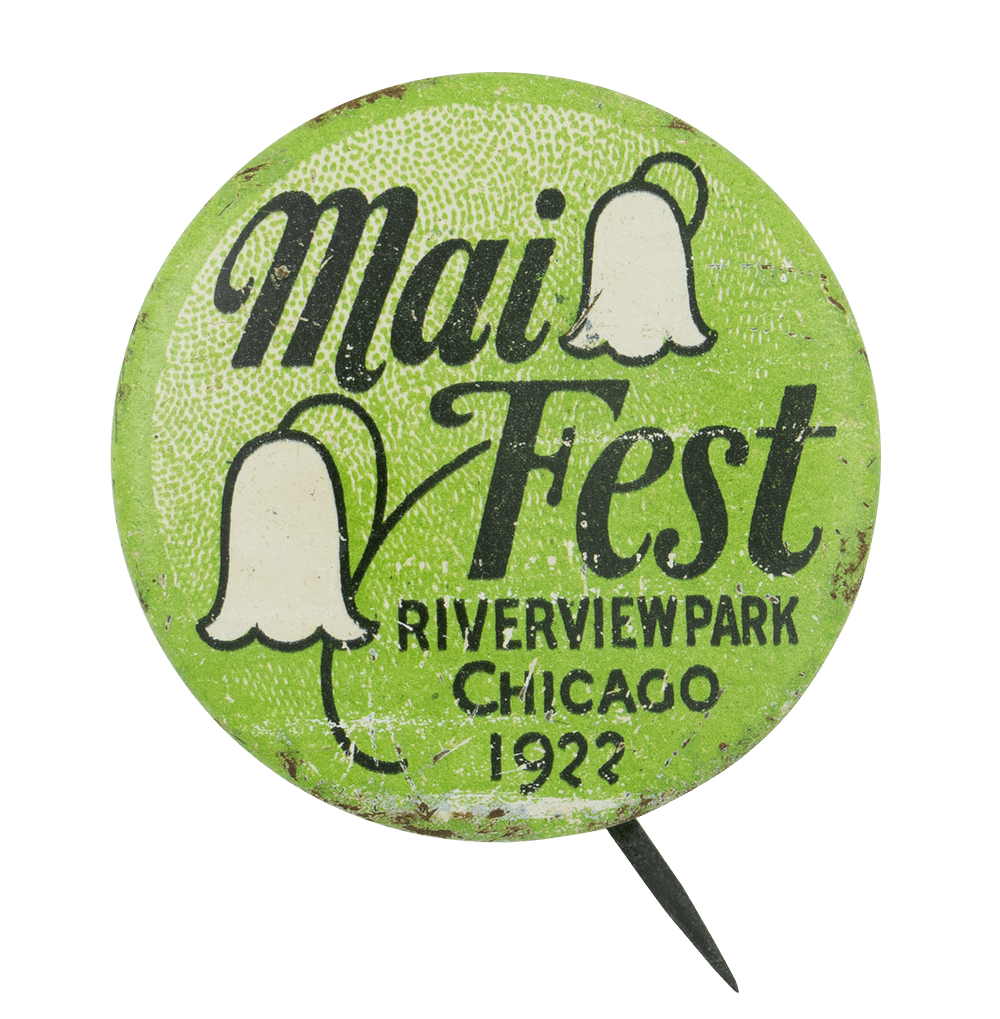
Mai Fest Riverview Park Chicago

Category
Additional Images
Sub Categories
Text on Button Mai Fest RIVERVIEW PARK CHICAGO 1922
Image Description

Black text with an illustration of white flowers on a green background

Back Style
The Shape
The Size
Year / Decade Made
Additional Information

Riverview Park was an amusement park located on the north side of Chicago and it was open from 1904 to 1967. It started out as Schuetzen Park, which was a shooting range park created by Wilhelm A. Schmidt. In 1903, Schmidt's son encouraged him to build rides on the property to attract more people. The amusement park eventually had over 120 rides including Ferris wheels, carousels, and wooden roller coasters. Admission to the park was cheap and people paid separately for each ride. The Schmidt family sold the park in October of 1967 because of increasing crime in the area and the rising costs to maintain the park. 

Maifest is a German festival that celebrates the beginning of spring. It is traditionally celebrated with the decorated maypole which shows off the crafts and history of the local culture. Maifest is currently celebrated in Lincoln Square every year in Chicago.

Sources

Maifest Chicago. (2018). Retrieved from http://www.mayfestchicago.com/about.html

Riverview Amusement Park, Chicago, illinois. (2015, October 19). Retrieved from http://www.defunctparks.com/abandoned/il/chicago-illinois-riverview-amu…

Catalog ID CH0291

Chicago Take Back the Night

Category
Additional Images
Sub Categories
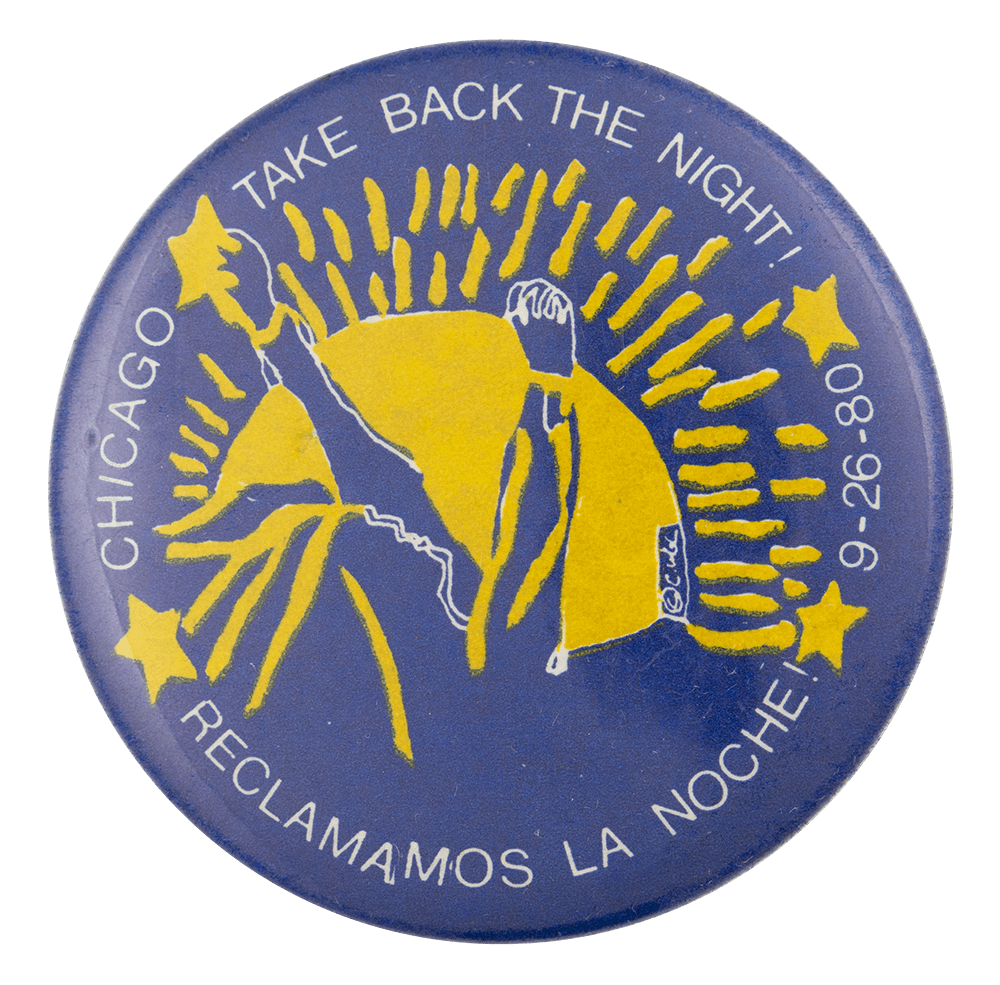
Text on Button CHICAGO TAKE BACK THE NIGHT! RECLAMAMOS LA NOCHE! 9-26-80
Image Description

White text around the outer edge with a gold and blue illustration in the center.

Back Style
The Shape
The Size
Year / Decade Made
Additional Information

On September 26, 1980, men and women in Chicago participated in a “Take Back the Night” rally at the Daley Center. The purpose was to protest sexual violence and violence against women, specifically on college campuses, because it was believed many universities had inefficient protocols in place to deal with reports of sexual assault.

“Take Back the Night” became part of a global effort to combat sexual violence starting in 1978. In 2001, a number of women who started the movement banded together and created the Take Back the Night Foundation. This is a nonprofit organization that aims to be a hub of information sharing, resources, and support for women who have been the victims of sexual violence.

Sources

‘Afraid to go out at night’--women hold Loop rally (1980 September) Chicago Tribune. Retrieved from https://www.newspapers.com/image/386982072/?terms=take%2Bback%2Bthe%2Bn…

History. (n.d.) Take Back the Night. Retrieved from https://takebackthenight.org/history/

Trammel, A. (2016 March). Dissonance & Disinterest: Sexual Assault and the University of Illinois at Urbana-Champaign. Student Life and Culture Archives at the University of Illinois Archives. Retrieved from https://archives.library.illinois.edu/slc/srscassidyburke/

Catalog ID CH0283