Today Is the First Day

Category
Additional Images
Sub Categories
Text on Button TODAY IS THE FIRST DAY OF THE REST OF YOUR LIFE
Image Description

Black text on an illustration of a person with very long curly hair and holding a yellow flower on a light blue background

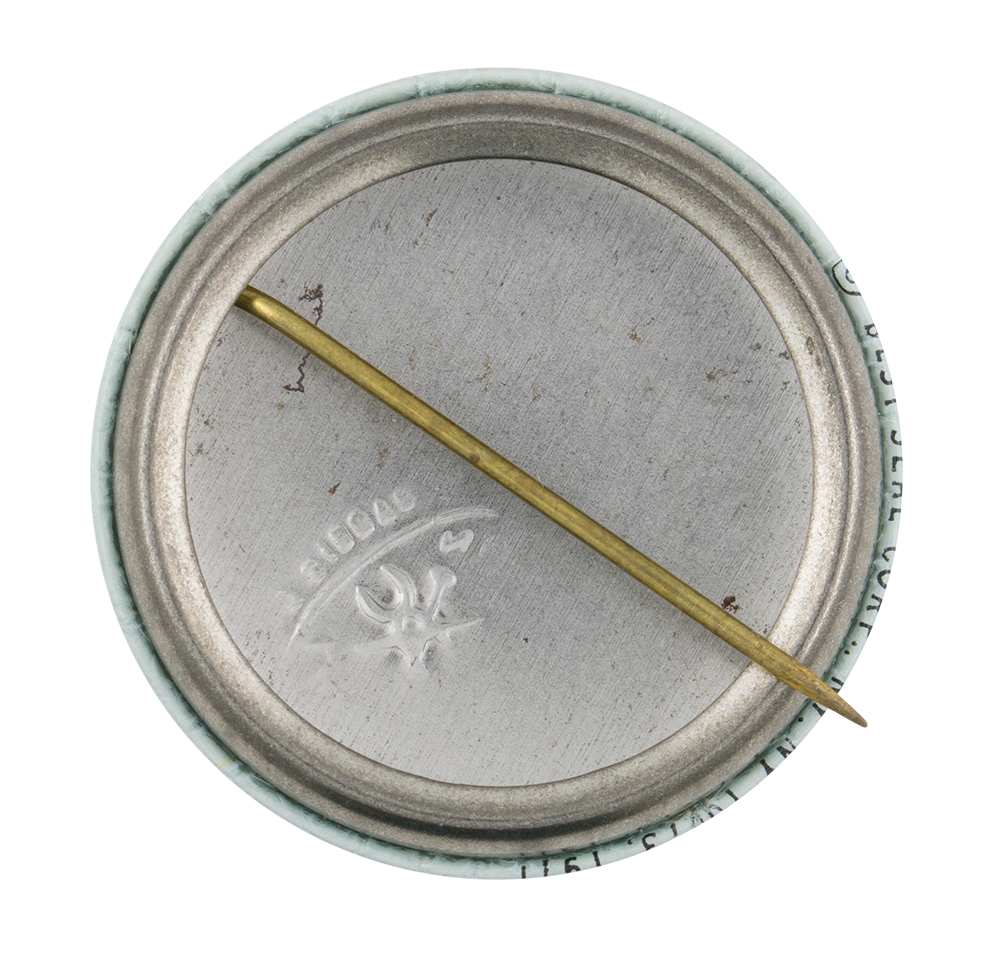
Curl Text ©BEST SEAL CORP NY, NY 10013 1971
Back Style
The Shape
The Size
Year / Decade Made
The Manufacturer
Additional Information

The quote, "Today is the first day of the rest of your life" originated in the San Francisco countercultural movement of the late 1960s. The quote is often attributed to Charles Dederich, the founder of Synanon, a drug recovery program turned religious movement. Dederich's use of the phrase, however, only dates as far back as 1968, the same year in which Abbie Hoffman used it in his book, Revolution for the Hell of It.

Hoffman, in turn, borrowed the phrase from a San Francisco activist group called The Diggers, from whom he also borrowed many of his philosophical teachings. As early as 1967, The Diggers published fliers bearing the quote. One eyewitness recalls the group's leader using the phrase in a speech. Some scholars claim that The Diggers, in turn, borrowed the phrase from the beat poet Gregory Corso.

Sources


Cryer, M. (2010). Common phrases: And the amazing stories behind them. New York, NY: Skyhorse Publishing. Retrieved from https://books.google.com/

Gitlin, T. (1993). The sixties: Years of hope, days of rage. New York, NY: Bantam. Retrieved from https://books.google.com/

Shapiro, F. R. (Ed.). (2006). The Yale book of quotations. New Haven, CT: Yale University Press. Retrieved from https://books.google.com/

Weller, S. (2012, July). LSD, ecstasy, and a blast of utopianism: How 1967's "summer of love" all began. Vanity Fair. Retrieved from https://www.vanityfair.com/
 

Catalog ID IB0584

Try It You'll like It White and Red

Category
Additional Images
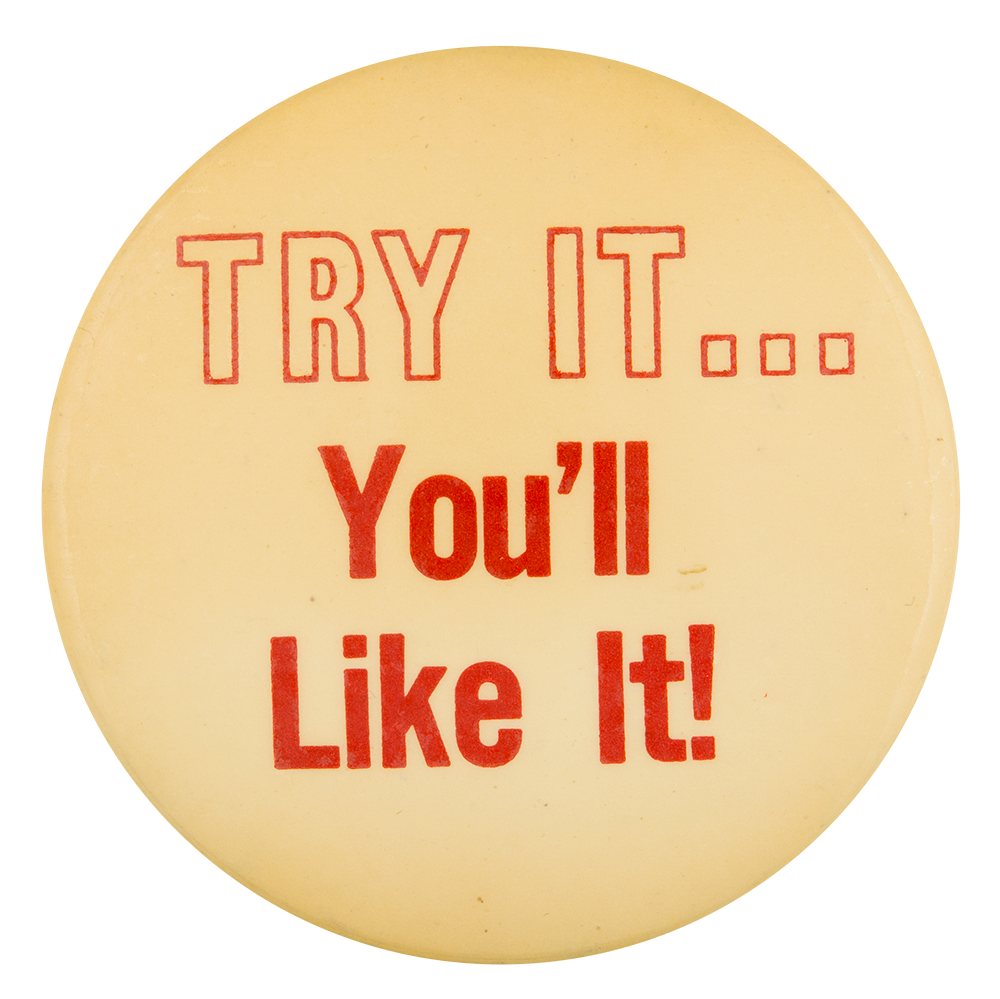
Text on Button TRY IT... You'll Like It!
Image Description

Red text on a white background

Back Style
The Shape
The Size
Year / Decade Made
Additional Information

The saying "Try it...you'll like it!" became immensely popular as a catch-phrase after the release of a commercial for Alka-Seltzer in 1971. The advertisement, which now holds a place in the CLIO Hall of Fame, comically depicts a gentleman explaining how his waiter repeatedly pushed him to try a dish which inevitably led to his need for the medicine's relief. After initially seeping into the minds of viewers via its association with the effervescent tablets, the commercial's catchy tagline later evolved into a stand-alone saying that was put on everything from buttons and t-shirts to coffee mugs and cookie jars. The term became a general offering of advice to keep an open mind -- an idea that was important among the younger generations of the 60s and 70s. 

Sources

Kovalchik, Kara (2014, May 13). 11 Advertising Slogans That Became Catch-Phrases. Retrieved from http://mentalfloss.com/article/56711/11-advertising-slogans-became-catc…

Catalog ID IB0569

What Will It Be

Category
Additional Images
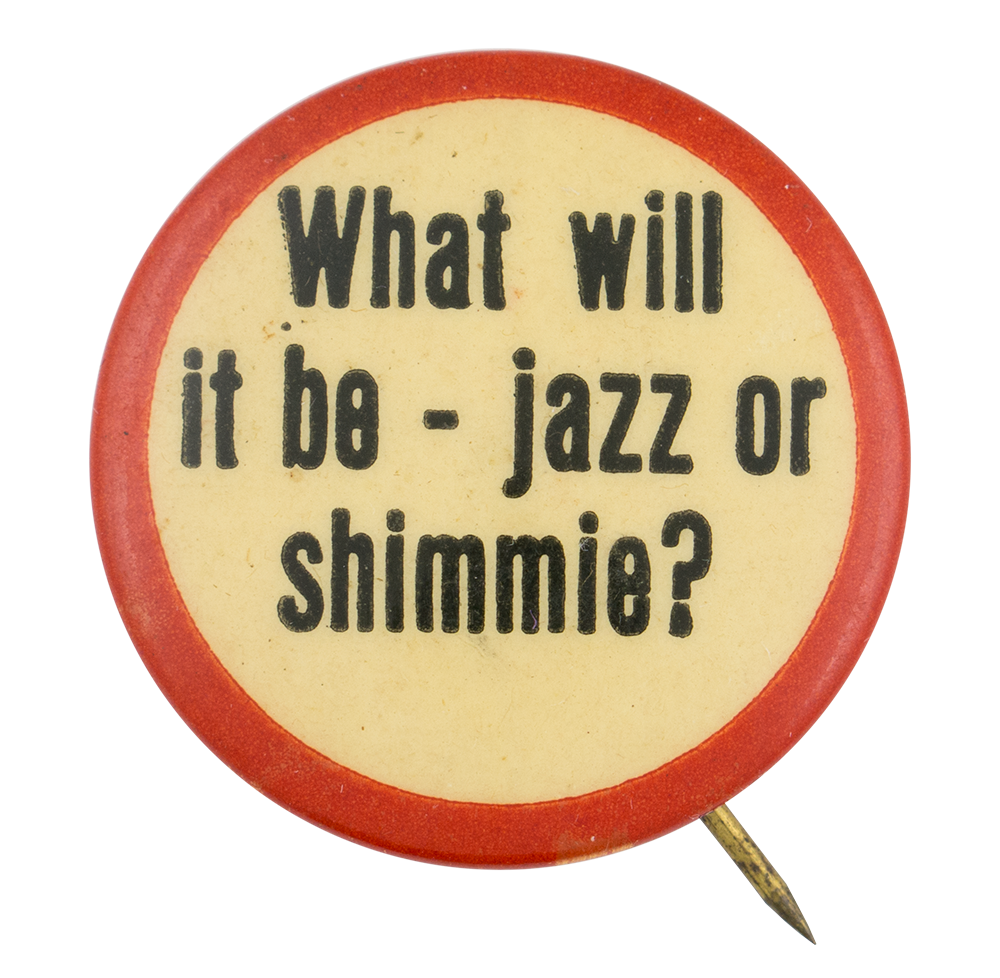
Text on Button What will it be - jazz or shimmy?
Image Description

Black text on a white background with an outer red edge

Back Style
The Shape
The Size
Year / Decade Made
Additional Information

The jazz and shimmy (sometimes seen as ‘shimmie’) were popular dances in the 1910s and 1920s. Jazz refers to a style of music as well as a number of specific dances including the Charleston and the Black Bottom. The shimmy was a specific dance that involved small steps, a close embrace, and a “wiggling” of the upper body.

Sources

McFarland, M. (n.d.). What is the History of Jazz Dance? Retrieved June 26, 2018, from https://dance.lovetoknow.com/History_of_Jazz_Dance

(2014, November 13). Retrieved June 27, 2018, from https://youtu.be/kGEksQvMeY

Catalog ID IB0582

Your the One

Category
Additional Images
Sub Categories
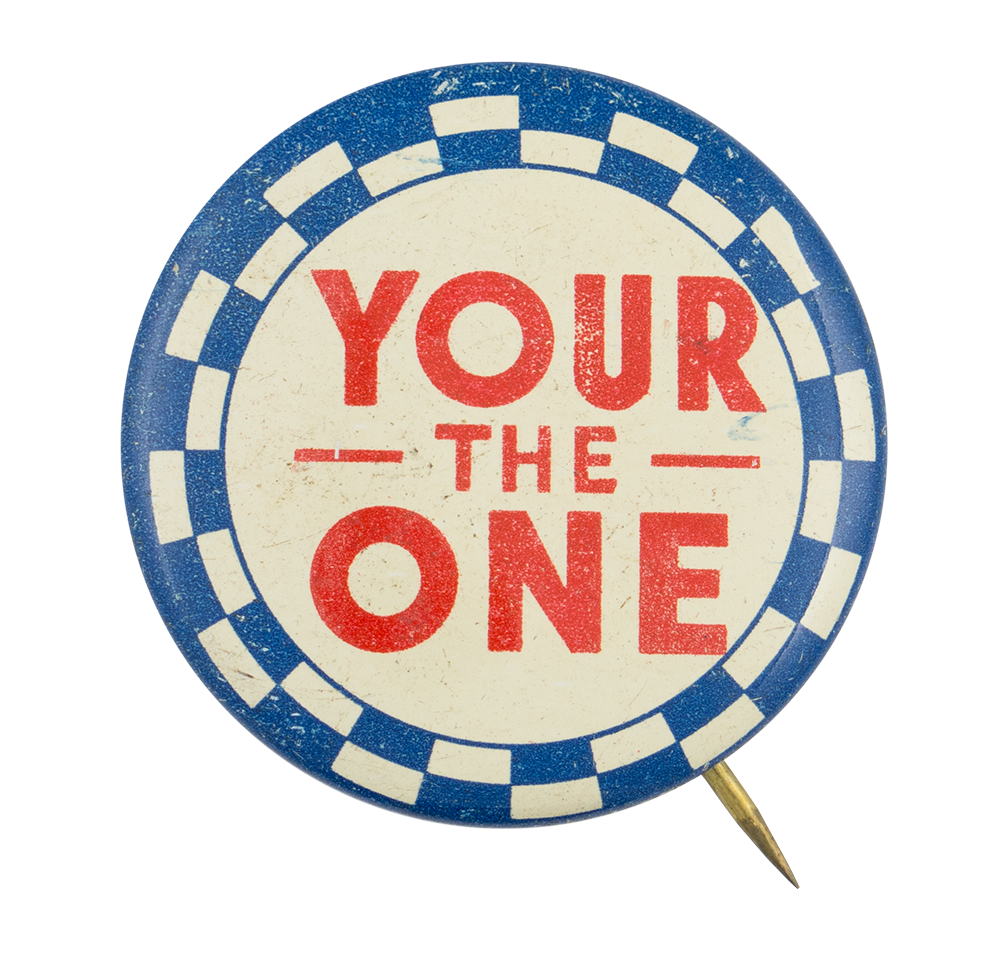
Text on Button YOUR THE ONE
Image Description

Red text on a white background with an outer blue and white checkered outer edge

Back Style
The Shape
The Size
The Manufacturer
Additional Information

The phrase "You're the one" is commonly used to express that someone is the proverbial love of your life. Its history is intertwined with its application in both casual conversation and various forms of media, particularly in the realm of romance. 

The confusion between "your" and "you're" in phrases like "your the one" is a common and persistent error rooted in the identical pronunciation of these homophones. While the misuse isn't exclusive to the early 20th century, the period's lack of focused grammatical instruction on distinguishing these sound-alike words, coupled with the variance of American English spellings and the obvious intended meaning, may have also contributed to the persistence of the error. Today, despite wider access to educational resources, this grammatical mix-up remains a prevalent challenge in written English.

Comic Motto Buttons, as they became known sometime in the 1940s (previously known as Comic Celluloid Buttons), hailed from Johnson Smith & Co. catalogues and became popular in the early to mid-20th century. Recognized by their iconic checkered border, featuring salacious slogans and witty banter, the catalogue promised, “Get acquainted – wear these comic celluloid buttons. Slip one or two of these buttons on your lapel and then wait for the wisecracks to begin. The girls get lots of fun out of them. At parties, you break the ice right from the start. Just give one of these to your guest, and it gives the party a flying start.” 

Johnson Smith & Company began in Chicago, Illinois in 1914 as a mail-order novelty and gag gift supplier, settling in Racine, Wisconsin in 1926. Johnson Smith & Co. or Johnson Smith Company sold an array of toys including pinback buttons with suggestive slogans meant as ice breakers.


Sources

Birnkrant, M. (n.d.). Small things: Remembering Johnson Smith & Company [blog post]. Mel Birnkrant.com. https://melbirnkrant.com/recollections/page49.html

Johnson Smith & Co. (1938). Johnson Smith & Company Catalog No. 148. Internet Archive. https://archive.org/details/johnson-smith-company-catalog-no.-148-1938

Johnson Smith & Co. (1951). Novelties Johnson Smith and co 1951 catalog. Internet Archive. https://ia803405.us.archive.org/5/items/novelties-johnson-smith-and-co-1951-catalog/Novelties%20Johnson%20%20Smith%20and%20Co%201951%20catalog_text.pdf

Johnson Smith Co. (2017). About Our Company. Johnson Smith Company. https://web.archive.org/web/20170929033510/http://www.johnsonsmith.com/aboutus/   

Ted Hake. (n.d.). Johnson Smith famous novelty supply house 1930s funny saying button with rebus [auction listing]. TedHake.com. https://www.tedhake.com/JOHNSON_SMITH_FAMOUS_NOVELTY_SUPPLY_HOUSE_1930s_FUNNY_SAYING_BUTTON_WITH_REBUS_-ITEM804.aspx

Ted Hake Vintage Buttons & More. (2019a). Johnson Smith famous novelty supply house 1930s suggestive slogan button [Make it hot for me] [eBay listing]. eBay. https://www.ebay.com/itm/141168405871

Ted Hake Vintage Buttons & More. (2019b). Johnson Smith famous novelty supply house 1930s suggestive slogan button [I’m a red hot mama] [eBay listing]. eBay. https://www.ebay.com/itm/141168405896

Tim’s Treasure Trunk. (2025). 1940s “I’m simply WILD about YOU” tin litho humor pinback button [eBay listing]. eBay. https://ebay.us/m/7O3wYl 

Catalog ID IB0586

I Love the Net

Category
Additional Images
Sub Categories
Text on Button I (heart) the net ULTIMATE INTERNET GUIDE where to go how to get there www.thenet-usa.com www.thenet-usa.com www.thenet-usa.com
Image Description

White text on an outer red edge with black text and a red heart on a white background

Back Style
The Shape
The Size
Additional Information

The Net was a print magazine that started in the UK in 1994. The magazine originally began as a guide for basic internet users, but eventually evolved a focus its content to web developers. The original website, thenet-usa.com, was a gateway for the average internet user to access different web sites—search engines, directories, classified ads, magazines, and more—and learn how to become more internet-savvy. The domain thenet-usa.com was no longer in use by mid-2000; June, 2020 marked the end of publication for the print magazine.

Catalog ID IL0112

Draft Kennedy for President

Category
Additional Images
Sub Categories
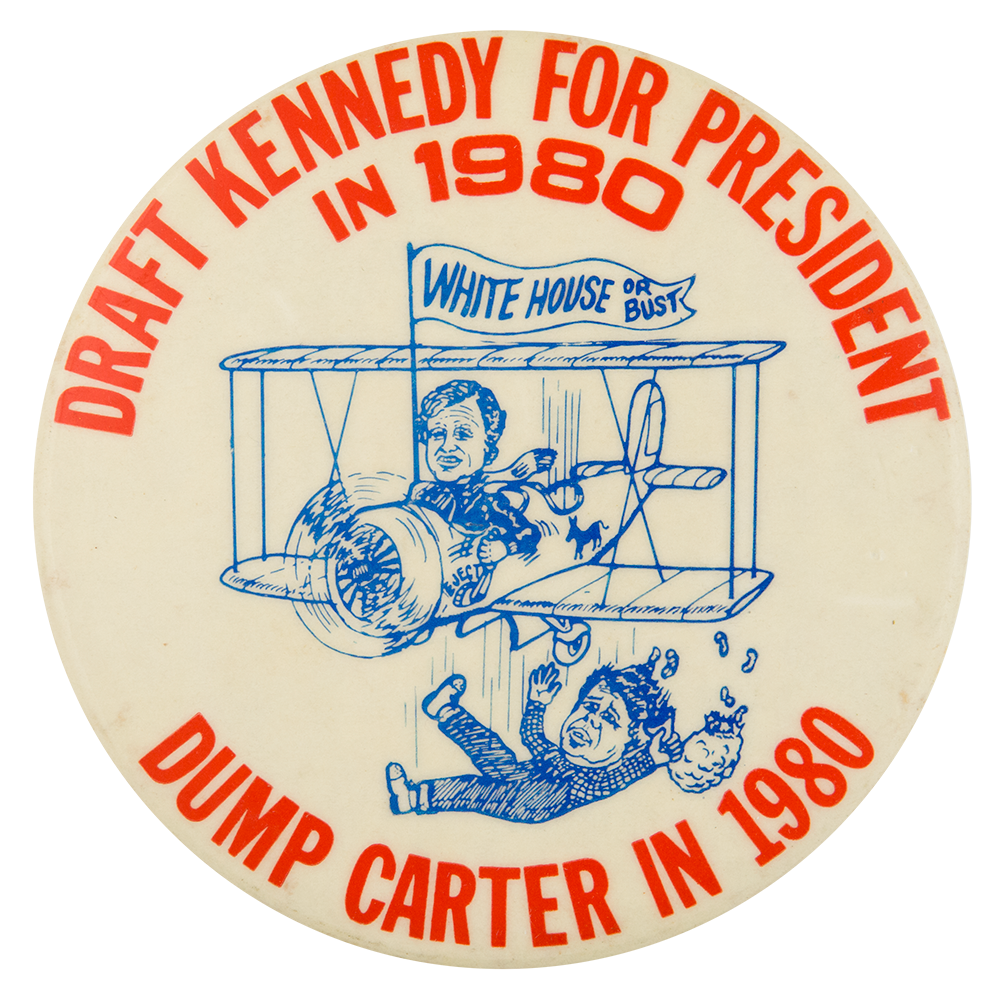
Text on Button DRAFT KENNEDY FOR PRESIDENT IN 1980 DUMP CARTER IN 1980
Image Description

Red text around an illustration of an airplane with Kennedy flying it over Carter on a white background

Curl Text union bug
Back Style
The Shape
The Size
Year / Decade Made
Additional Information

The Draft Kennedy movement was initiated by democratic supporters of Senator Ted Kennedy to convince him to enter into the race because he seemed indecisive about whether he would run. The supporters felt President Jimmy Carter’s leadership was taking the country in a more conservative direction and that Kennedy would maintain the Democratic Party ideals. Kennedy did decide to run for the democratic nomination but lost to Jimmy Carter. Kennedy remained a U.S. senator from Massachusetts from 1962 until his death in 2009, making him one of the longest-serving senators in American history.

Catalog ID PO0959

General Dwight D. Eisenhower

Category
Additional Images
Sub Categories
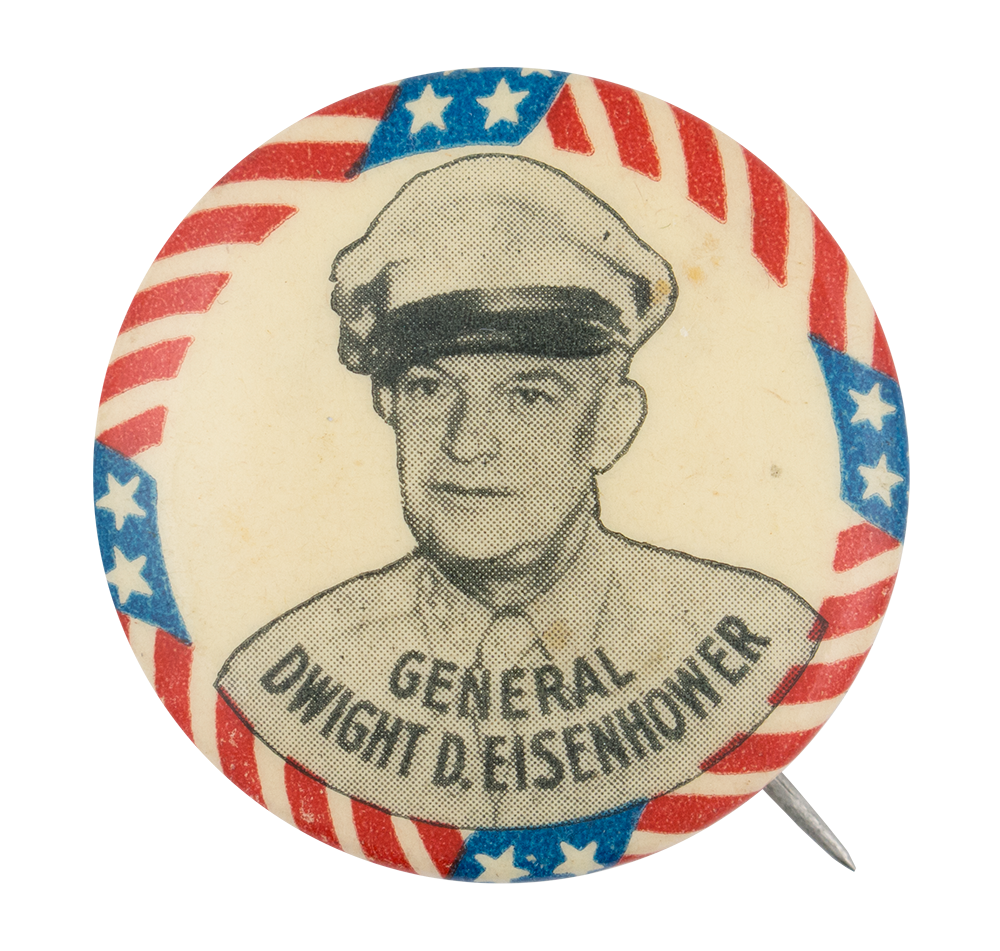
Text on Button GENERAL DWIGHT D. EISENHOWER
Image Description

Black text over an image of Eisenhower on a white background with an outer edge of red and white stripes and blue with white stars

Back Style
The Shape
The Size
Additional Information

General Dwight David Eisenhower (1890-1969) was the 34th President of the United States and led the Allied Forces in World War II. After graduating from West Point Military Academy in New York in 1915, Eisenhower soon put his training to use in World War I and quickly climbed the ranks. By 1942, Eisenhower had become a Lieutenant General and was well-liked and respected for his military expertise and approachability. His popularity was coined in the phrase, “I Like Ike,” and continued after World War II, leading up to his presidential run and subsequent win in 1953 and reelection in 1956. 

Catalog ID PO0966

I am Not a Centrist

Category
Additional Images
Text on Button I AM NOT A CENTRIST
Image Description

Blue text on a white background

Back Style
The Shape
The Size
Additional Information

U.S. Congresswoman Bella Abzug was a self-described radical, fighting for women’s rights and opposing the Vietnam War. Running for Congress in 1986, Abzug was quoted by the New York Times as saying “I Am Not a Centrist.” Abzug was considered a founding feminist with liberal views of women’s rights. 

A centrist is defined as a person whose  political views fall in the center or between the conservative Republican right and the liberal Democratic left. Centrists may also be considered as Independent voters who do not affiliate with one particular party.

Catalog ID PO0968

Hebrew Reagan

Category
Additional Images
Sub Categories
Text on Button Reagan
Image Description

White text on a blue background

Curl Text Paid for by Reagan Bush '84 Paul Laxalt, Chairman Angela M. Buchanan Jackson, Treasurer
Back Style
The Shape
The Size
Year / Decade Made
Additional Information

Ronald Reagan served as the president of the president of the United States from 1981 - 1989. Reagan's presidential campaign used promotional tools like his name in Hebrew and English to recapture the Jewish vote. Many people in the Jewish community were not satisfied with the Carter presidency, which includes its mediocre support for Israel. In 1980 Reagan received 36 percent of the Jewish vote and the Republican party wanted to continue that support and to bring more Jewish support for his 1984 re-election by using other methods like cold calling to do so.

Sources

Troy, G. The Jewish Vote: Political Power and Identity in US Elections. The University of Halifa. Retrieved from:The-Jewish-Vote-Political-Power-and-Identity-in-US-Elections.pdf

Weisberg, H. F. Jewish American Voting Patterns. Retrieved from: https://quod.lib.umich.edu/cgi/p/pod/dod-idx/jewish-american-voting-pat…

Catalog ID PO0961