Shy Guy

Category
Additional Images
Sub Categories
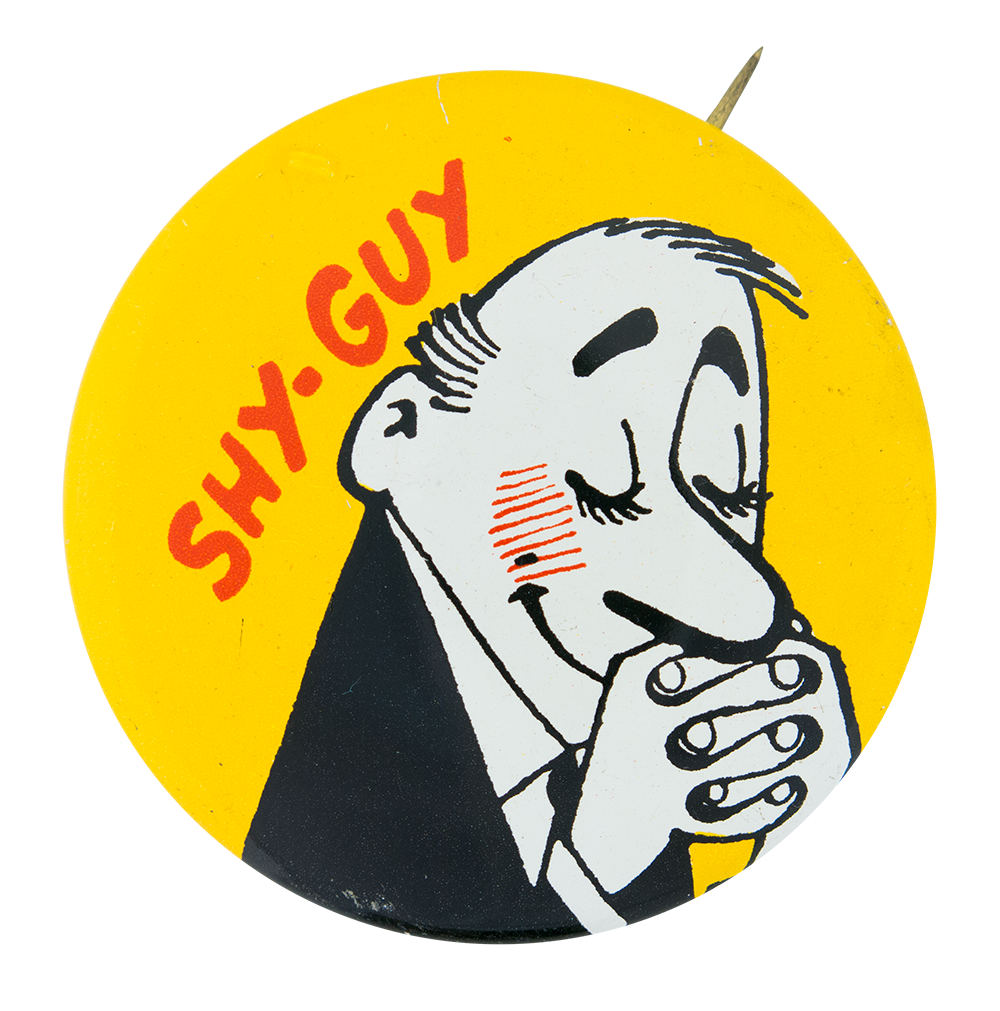
Text on Button SHY-GUY
Image Description

Yellow background with an illustration of a man clasping his hands together, resting his nose on top of them and his eyes closed, with blush on his cheeks. The red text is above the illustration and to the left

Back Style
The Shape
The Size
Additional Information

This button is part of a set that features cartoon images of men's behaviors. There are at least five pins in the series, each depicting a different man. They are "Shy-Guy," "Loudmouth," "Freeloader," "Lush," and "Wolf." Each man's illustrations accentuate their particular title with small details; the "Shy-Guy" has blushing cheeks and keeps his eyes closed. The term "Shy-Guy" in this context refers to a man who is not comfortable around people; he is bashful, coy, and sheepish. Stylistically, the drawings are similar to mid-century cartoons found in adult magazines or illustrations on cocktail napkins.

Catalog ID IB0057

SDS Students for a Democratic Society

Category
Additional Images
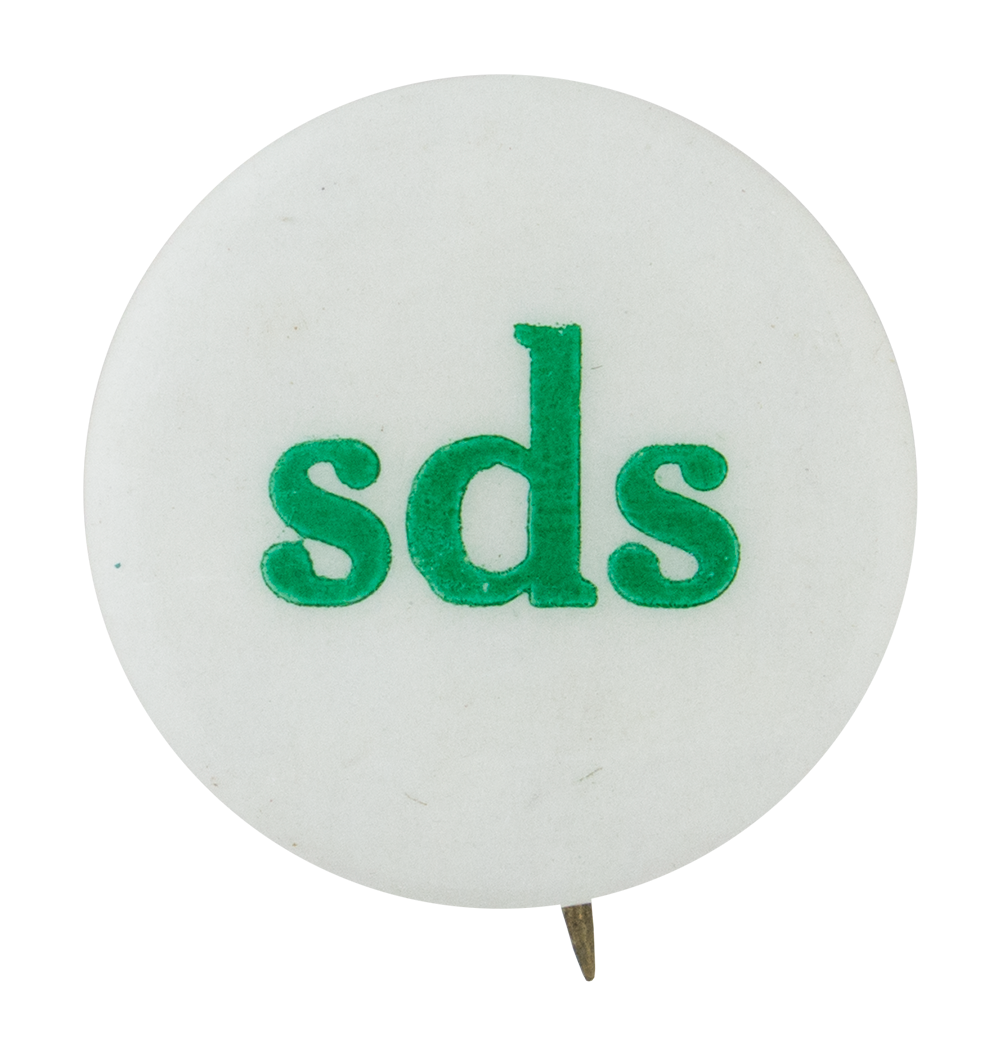
Text on Button sds
Image Description

White background with green text

Back Style
The Shape
The Size
Year / Decade Made
Additional Information

SDS, or Students for a Democratic Society, was one of the largest national student activist organizations of the1960s with over 300 college campus chapters by 1965. This influential New Left group was founded in 1960 as a student offshoot of the socialist League of Industrial Democracy (LID). With the publication of their manifesto The Port Huron Statement in 1962, SDS outlined their belief in participatory democracy and their goal to right social injustices through non-violent means. Initially the group focused on promoting citizen engagement with politics and the civil rights movement but pivoted to anti-war demonstrations and protests of the Vietnam War and the draft in 1965. Ultimately the group splintered and disbanded in 1969.

Sources

Riggs, W. (2009). Students for a Democratic Society. Retrieved 5 June 2021, from https://mtsu.edu/first-amendment/article/1201/students-for-a-democratic…

Catalog ID IB0493

Nuclear Scram

Category
Additional Images
Sub Categories
Text on Button SCRAM
Image Description

Red background with white text at top. Underneath the text is an illustration of trees and structures

Curl Text Union bug
Back Style
The Shape
The Size
Additional Information

Scram is an emergency shutdown of a nuclear reactor and is sometimes used as a verb meaning "to shut down." The term has been extended to refer to shutdowns of other complex operations, such as server farms and even large model railroads. The button may have also played on the word's more conventional meaning "to go away quickly," which was originated colloquially in the US in 1920s.

Folk etymology dictates that the term comes from the acronym for safety control rod axe man and was coined by Enrico Fermi when the world's first nuclear reactor was built. But the axe-man story has been debunked by historian Tom Wellock. However, the use of the word to mean "rapid shutdown" was indeed originated in nuclear physics. 

Catalog ID EV0144

Report of My Death

Category
Additional Images
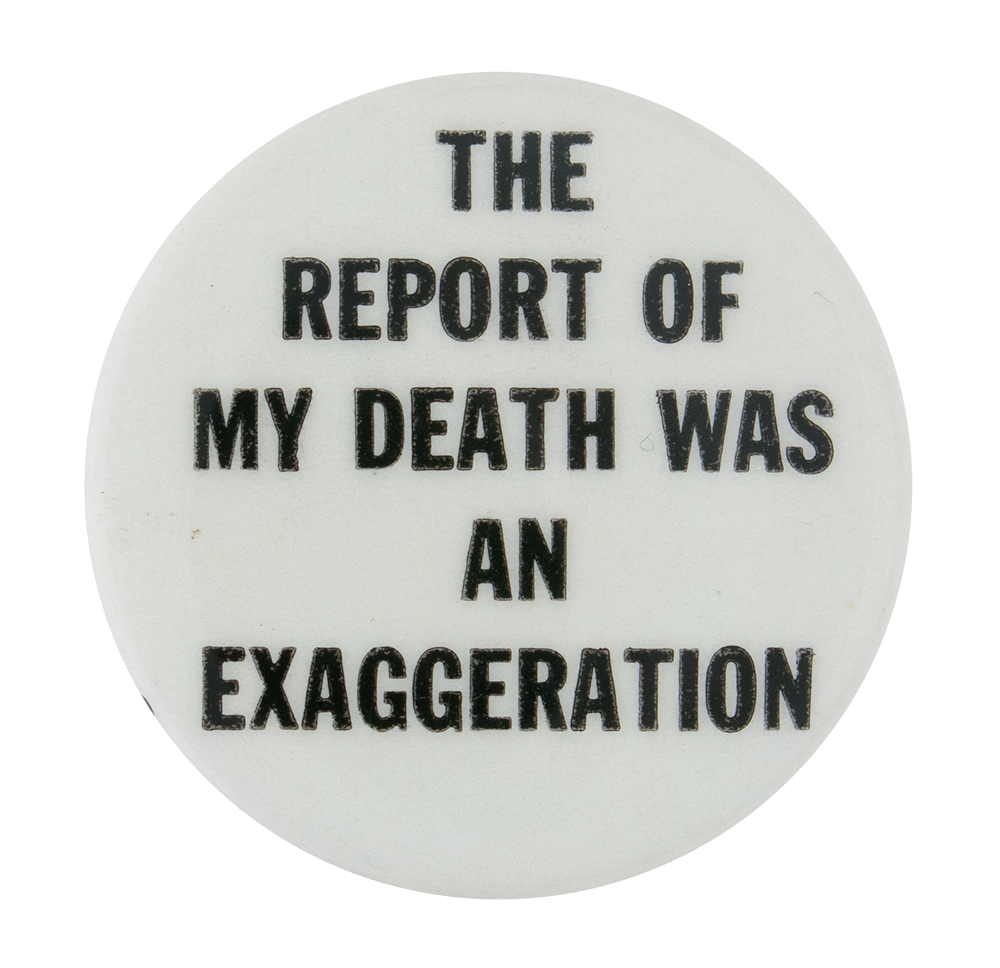
Text on Button THE REPORT OF MY DEATH WAS AN EXAGGERATION
Image Description

White background and black text

Curl Text Copyright UUU 28 ST. MARKS PL.. NYC 10003
Back Style
The Shape
The Size
The Manufacturer
Additional Information

"The report of my death was an exaggeration" was an expression derived from a statement by the American writer, Mark Twain, which appeared in the New York Journal of June 2 1897, in response to the newspapers's false account of Twain’s being ill or dead. It appeared that some reports confused Twain’s cousin James Ross Clemens, who was seriously ill in London at the time, with Mark Twain. The whole statement reads:

“I can understand perfectly how the report of my illness got about, I have even heard on good authority that I was dead. James Ross Clemens, a cousin of mine, was seriously ill two or three weeks ago in London, but is well now. The report of my illness grew out of his illness. The report of my death was an exaggeration.”

Catalog ID IB0413

Over the Hill

Category
Additional Images
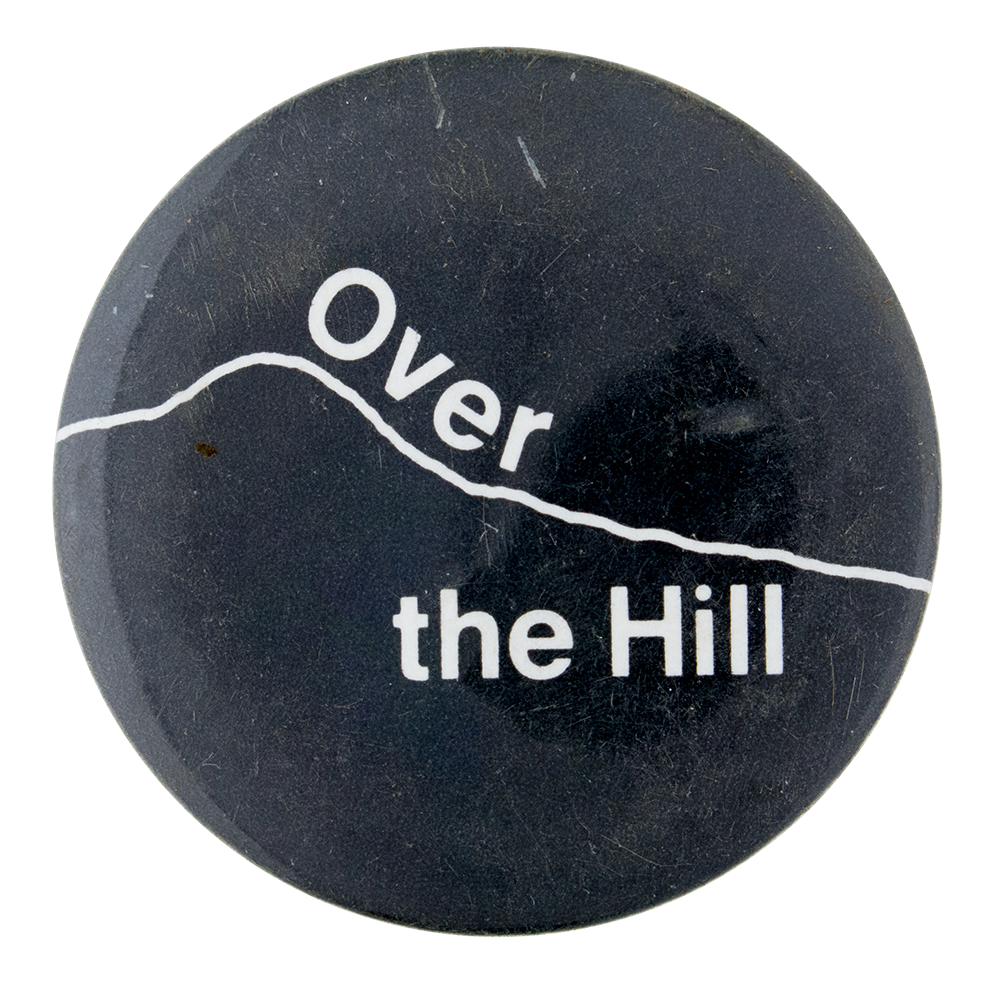
Text on Button Over the Hill
Image Description

Black background with white text with a white line resembling a mountain separating it

Back Paper / Back Info

Copyright Hallmark Cards Inc. 

Back Style
The Shape
The Size
Year / Decade Made
Additional Information

This button is used as a humorous and self-deprecating celebration of someone's birthday in middle age. The phrase "over the hill" means old and passed one's prime. Most people understand age of 50 to be the Over the Hill milestone. 

Catalog ID IB0129

My World

Category
Additional Images
Text on Button My World
Image Description

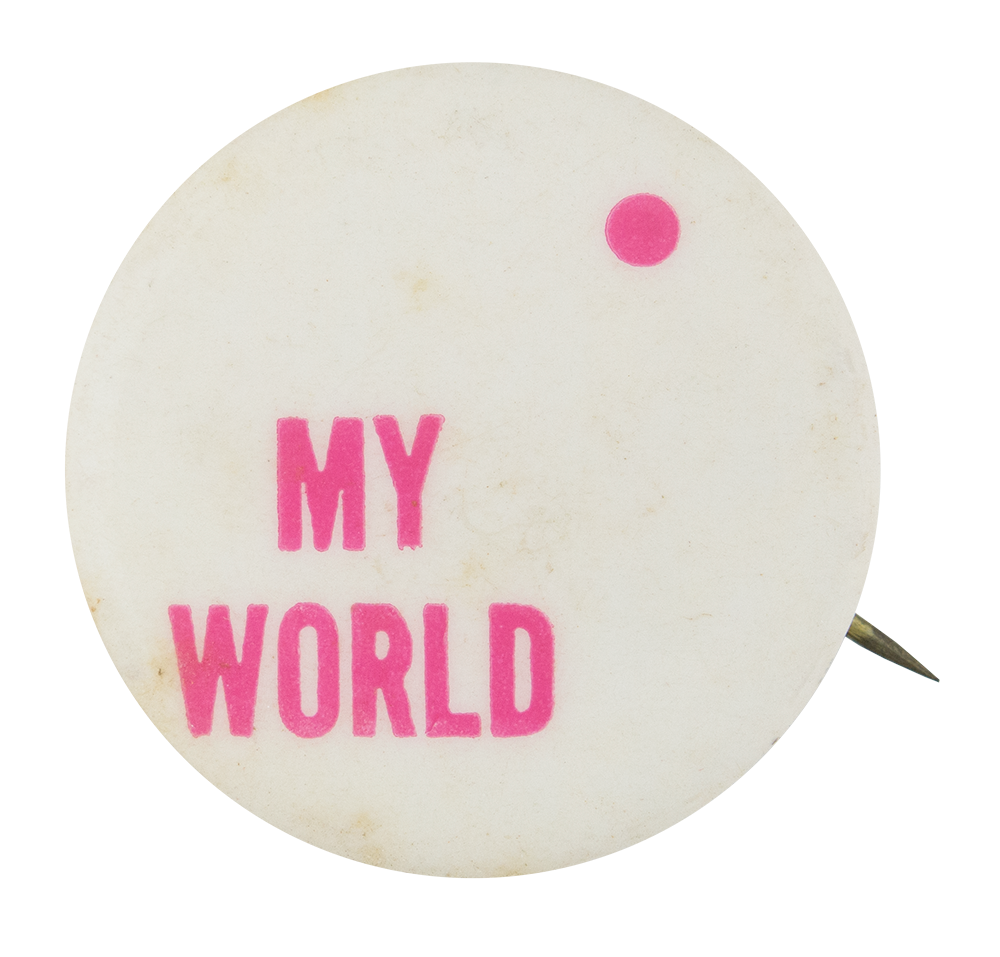
White background with pink text in the bottom left and a pink circle in the top right

Back Style
The Shape
The Size
Additional Information

Have info on this button? Contact us here.

Catalog ID IB0320

Men Are Wonderful

Category
Additional Images
Text on Button Men Are Wonderful... Not
Image Description

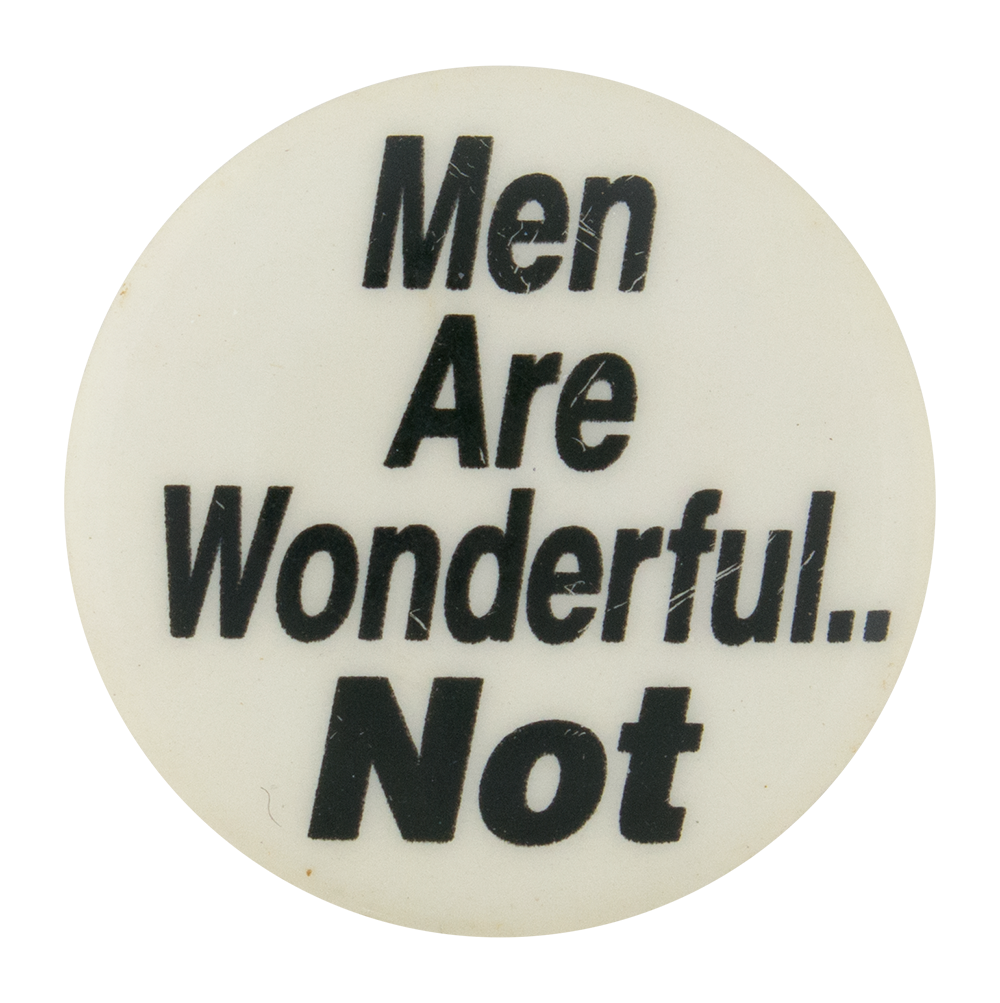
A white background with black text, with the last line being in bold

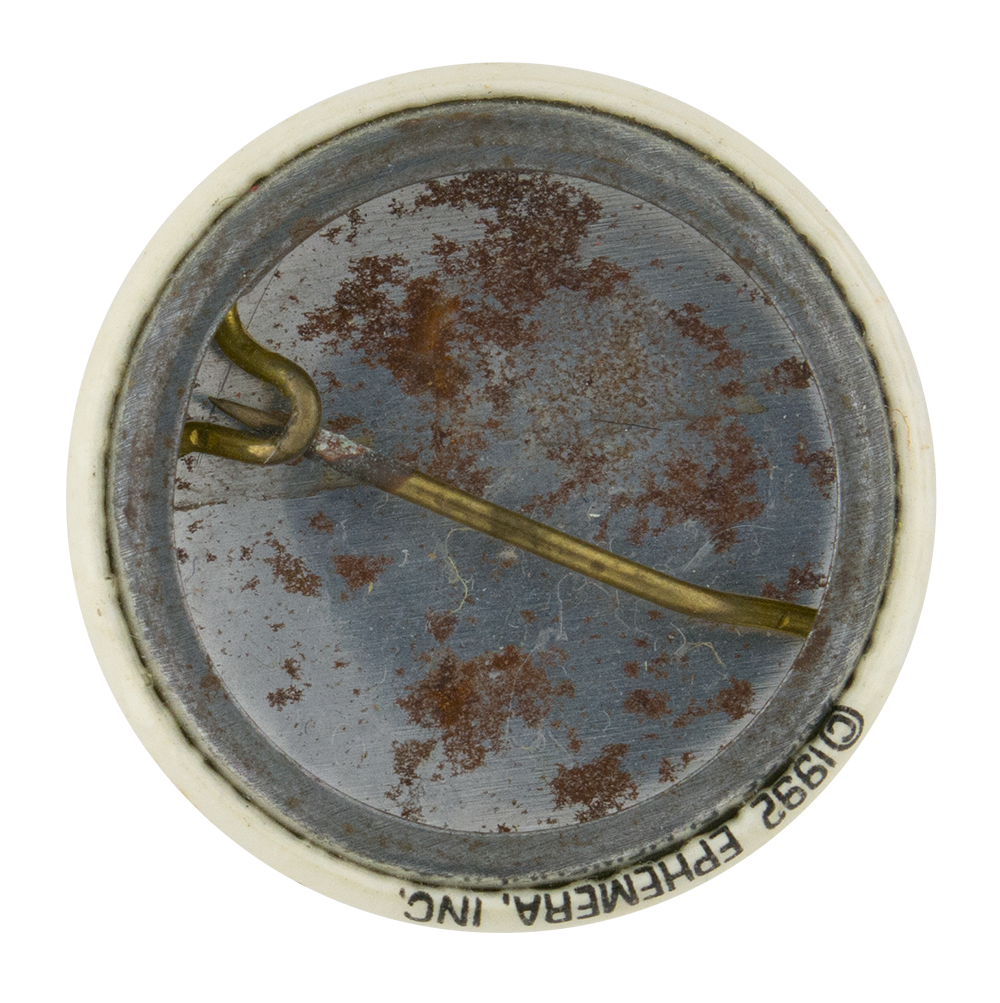
Curl Text Copyright 1992 EPHEMERA, INC.
Back Style
The Shape
The Size
Year / Decade Made
Additional Information Historically speaking, the assumption that men are unequivocally wonderful is what is known as sexism. This playful 'not' joke makes it clear that men are more complicated than we'd expect.
Sources
Bird, C. (1998). Sexism. In W. Mankiller, G. Mink, M. Navarro, B. Smith, & G. Steinem (Eds.), The Reader's Companion to U.S. Women's History. HarperCollins. https://link-gale-com.ezproxy3.library.arizona.edu/apps/doc/A176833663/…
Catalog ID IB0301

Meant to Sleep at Home

Category
Additional Images
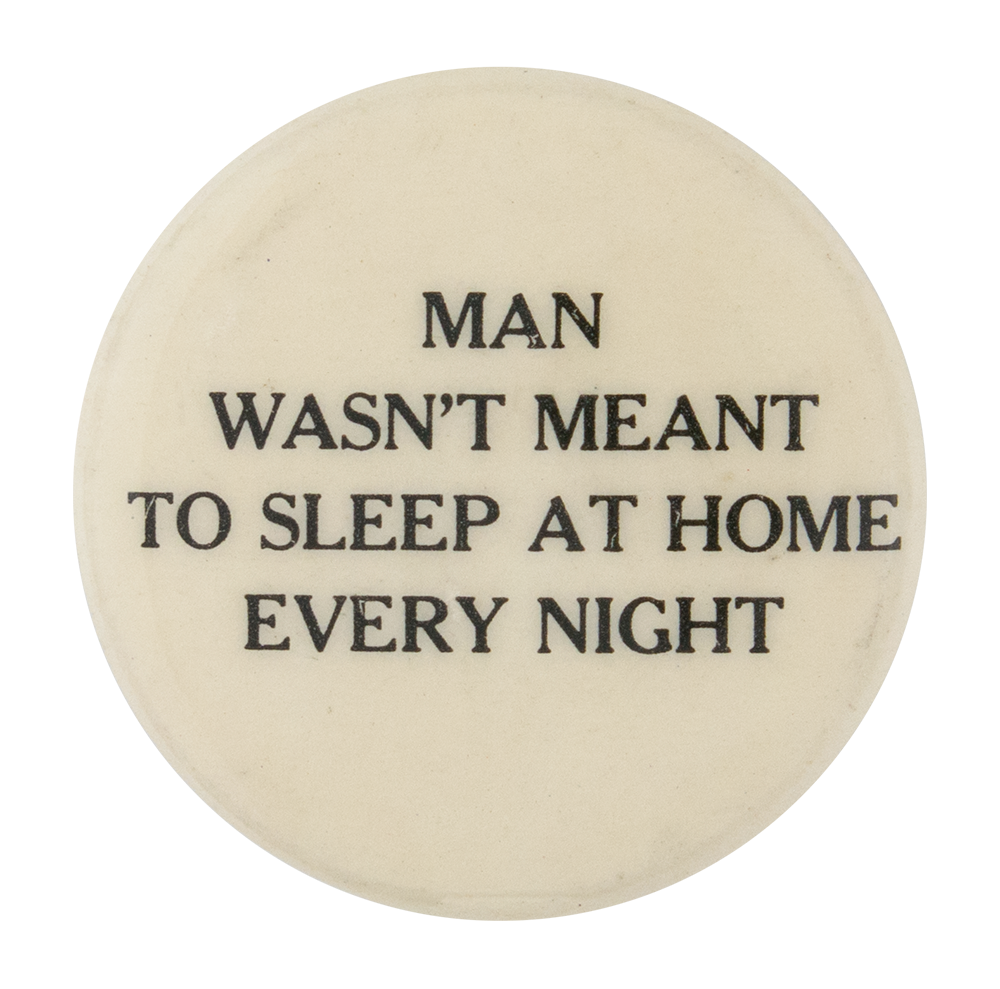
Text on Button MAN WASN'T MEANT TO SLEEP AT HOME EVERY NIGHT
Image Description

Cream background with black text

Back Style
The Shape
The Size
Additional Information

The phrase “Man Wasn’t Meant to Sleep at Home Every Night” can be examined through history, literature, and popular culture. Possibly inspired by Henry David Thoreau’s Walden, or Life in the Woods, though he did not say this explicitly, it echoes his call to live intentionally, seek adventure, and avoid “quiet desperation.” The phrase isn’t a direct quote from a known source but is often seen as expressing a romantic and adventurous worldview. It suggests that a person, often a man, has an inherent need for exploration, freedom, and experiencing life outside the boundaries of a predictable routine, like marriage or a long-term relationship. It can also convey a sense of restlessness, a desire to wander, and the feeling that a permanent residence isn’t the true essence of life. This theme is frequently found in literature and art, celebrating the nomadic spirit and a wanderlust outlook. 

Sources

Thoreau, H. D. (1854, August 9). Project Gutenberg, chap. 1, “Economy” (Shelter). Retrieved September 28, 2025, from https://www.thoreau-online.org/ 

Catalog ID IB0065

Marcel Proust is a Yenta

Category
Additional Images
Text on Button MARCEL PROUST IS A YENTA
Image Description

Yellow background with maroon text

Curl Text Copyright UUU 28 ST. MARKS PL.. NYC 10003
Back Style
The Shape
The Size
The Manufacturer
Additional Information

Marcel Proust was a French Novelist who wrote the novel Remembrance of Things Past and is considered to be one of the all-time greatest authors. The novel, which is known for its great length,  was published as seven volumes between 1913 and 1927. This button probably comes from a popular T-shirt slogan in the 1970s, “Proust Is a Yenta.” “Yenta” is Yiddish for female gossip

Catalog ID IB0347