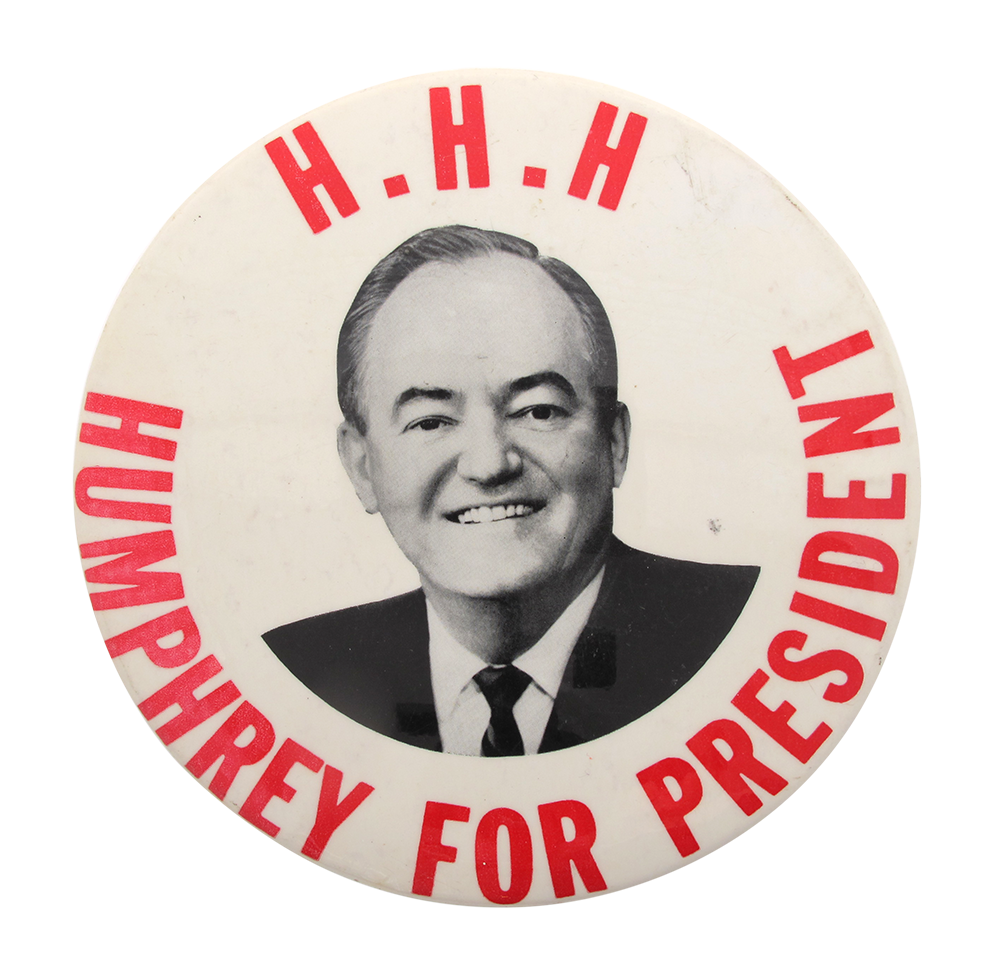
H.H.H Humphrey For President

Category
Additional Images
Sub Categories
Text on Button H.H.H HUMPHREY FOR PRESIDENT
Image Description

Black and white portrait of Hubert Humphrey encircled by red text over white background. 

Curl Text Union Bug
Back Style
The Shape
The Size
Year / Decade Made
Additional Information

Hubert Horatio Humphrey, Jr. was the Democratic party's nominee for US President in 1968. Humphrey was born in South Dakota but is often associated with Minnesota. He attended the University of Minnesota in Minneapolis, taught political science at Macalester College in Saint Paul, helped found Minnesota's Democratic party, and served as mayor of Minneapolis. He was also elected as one of Minnesota's US Senators before he became the Lyndon Johnson's Vice President in 1965. The 1968 presidential bid was Humphrey's third—the two previous attempts in 1952 and 1960 had failed to gather support. It's presumed by many that his 1968 bid was prompted by the fact that the incumbent President Lyndon B. Johnson did not seek reelection.

Humphrey and his running mate Edmund S. Muskie faced Richard M. Nixon and Spiro T. Agnew, the Republican candidates. The Nixon-Agnew ticket emerged victorious, winning 301 electoral votes—quite enough to defeat the Humphrey-Muskie ticket, who received 191.


Catalog ID PO0122

Hooper

Category
Additional Images
Text on Button HOOPER
Image Description

Gold text over blue banner encircled by blue border over yellowed background. 

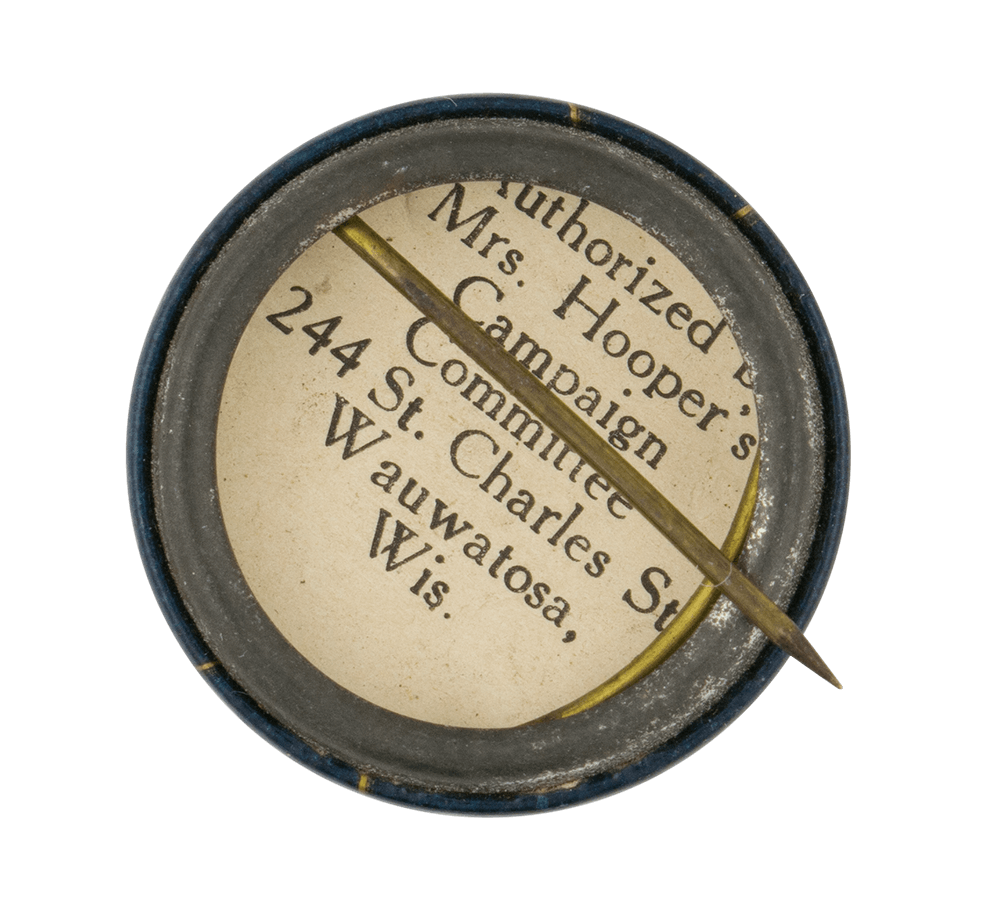
Back Paper / Back Info

Authorized by
Mrs. Hooper's 
Campaign Committee
244 St. Charles St.
Wauwatosa, Wis. 

Back Style
The Shape
The Size
Year / Decade Made
Additional Information

Jessie Annette Jack Hooper (1864-1935), a Wisconsin democratic nominee, ran for Senator in 1922. She was born on a farm in Iowa, was a notable suffragist and peace advocate. She joined the women's suffrage campaign in the 1910s and was elected as the first president of the Wisconsin League of Women Voters in 1920. She believed that it was a woman's civic duty to serve in office and therefore campaigned vigorously for the Senate seat against the incumbent Senator Robert La Follette in 1922. Although she lost in that election, Hooper was recognized in public as a great speaker and was asked to help Presidential candidate John W. Davis in the 1924 election. 

Catalog ID PO0167

Honest Abe of the West

Category
Additional Images
Sub Categories
Text on Button HONEST ABE OF THE WEST
Image Description

Black and white portrait of Abe Lincoln outlined by blue rope bookended by stars, shield, and wheat symbols. Black text above and below portrait over yellowed background. 

Curl Text ART FAIR 1967 NEW YORK, N.Y. 10002
Back Style
The Shape
The Size
Year / Decade Made
The Manufacturer
Additional Information

Abraham Lincoln was the 16th president of the United States. He served from March, 1861until his assassination in April, 1865. Lincoln led the United States through its Civil War—its bloodiest war and its greatest moral, constitutional and political crisis. In doing so, he preserved the Union, abolished slavery, strengthened the federal government, and modernized the economy. Abraham Lincoln was known as “Honest Abe” as a young man – before he became a lawyer or a politician—and the name stuck. In 1859 when he ran for president the nickname became his campaign slogan, and his writings show that he valued honesty.

Catalog ID PO0155

Grover Cleveland and Thomas Hendricks

Category
Additional Images
Sub Categories
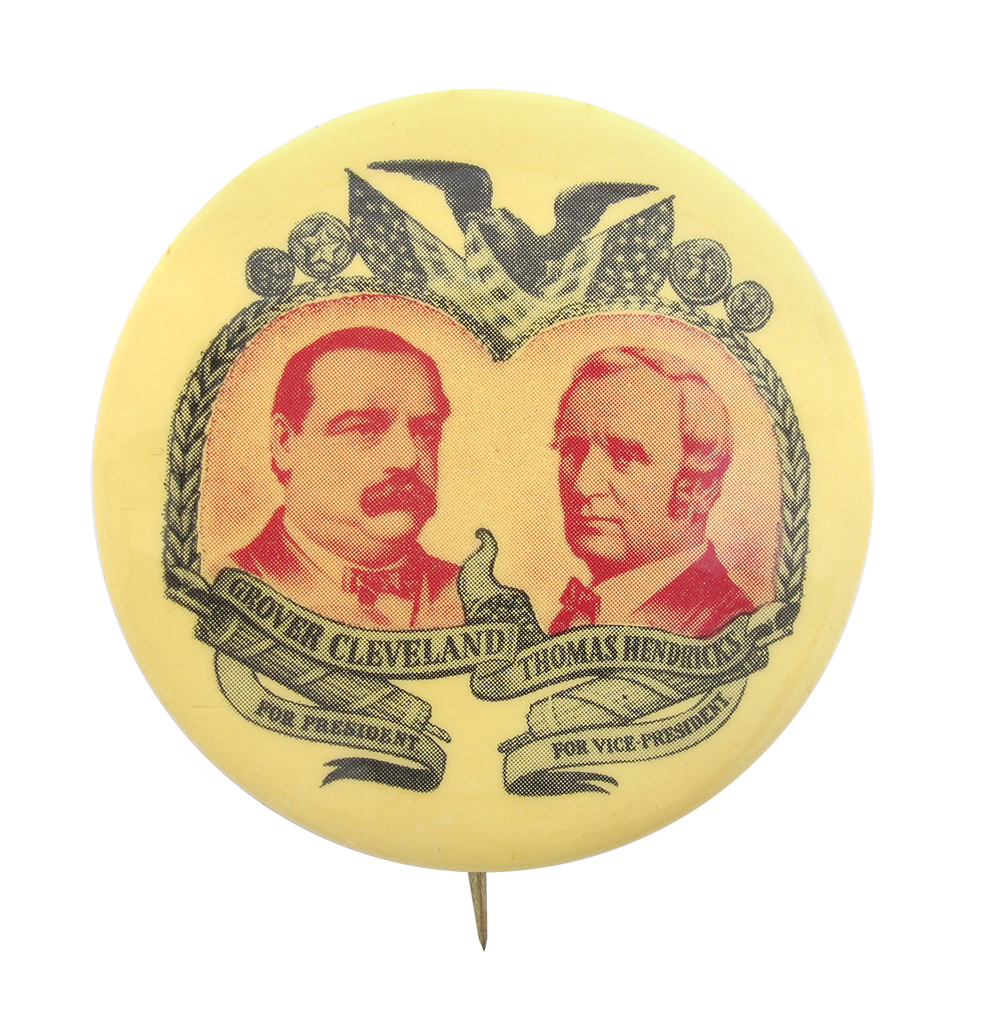
Text on Button GROVER CLEVELAND FOR PRESIDENT THOMAS HENDRICKS FOR VICE PRESIDENT
Image Description

A Tan button with American style accents featuring the faces of Grover Cleveland and Thomas Hendricks in red.

Curl Text ART FAIR 1967 NEW YORK, N.Y. 10002
Back Style
The Shape
The Size
Year / Decade Made
The Manufacturer
Additional Information

This button is in support of Grover Cleveland and Thomas Hendricks for the 1884 United States Presidential Election. Cleveland served a long Democratic career in government through the United States Progressive era. Cleveland served as the mayor of Buffalo, New York, the governor of New York, and as the 22nd and 24th President of the United States. Although largely forgotten in modern times he created the Interstate Commerce Commission, backed the gold standard, and was a staunch non-interventionist in a time of imperial  conquest. In his second term he presided over the Panic of 1893, the famous Pullman Strike, and the rise of American labor unions. Although the Cleveland years are forgotten in popular history they are critical times in American policy-making.

Hendricks served as a roughly 30 year Congress until his election as vice-president on the Cleveland ticket. He is the first democrat to win the Northern state's governorship after the Civil War having many moderate stances. He was chosen as a means of creating a more balanced ticket with Cleveland but due to poor health had to vacate the vice-presidency in 1885 leaving the office vacant until 1889. 

Catalog ID PO0115

Gore Lieberman

Category
Additional Images
Sub Categories
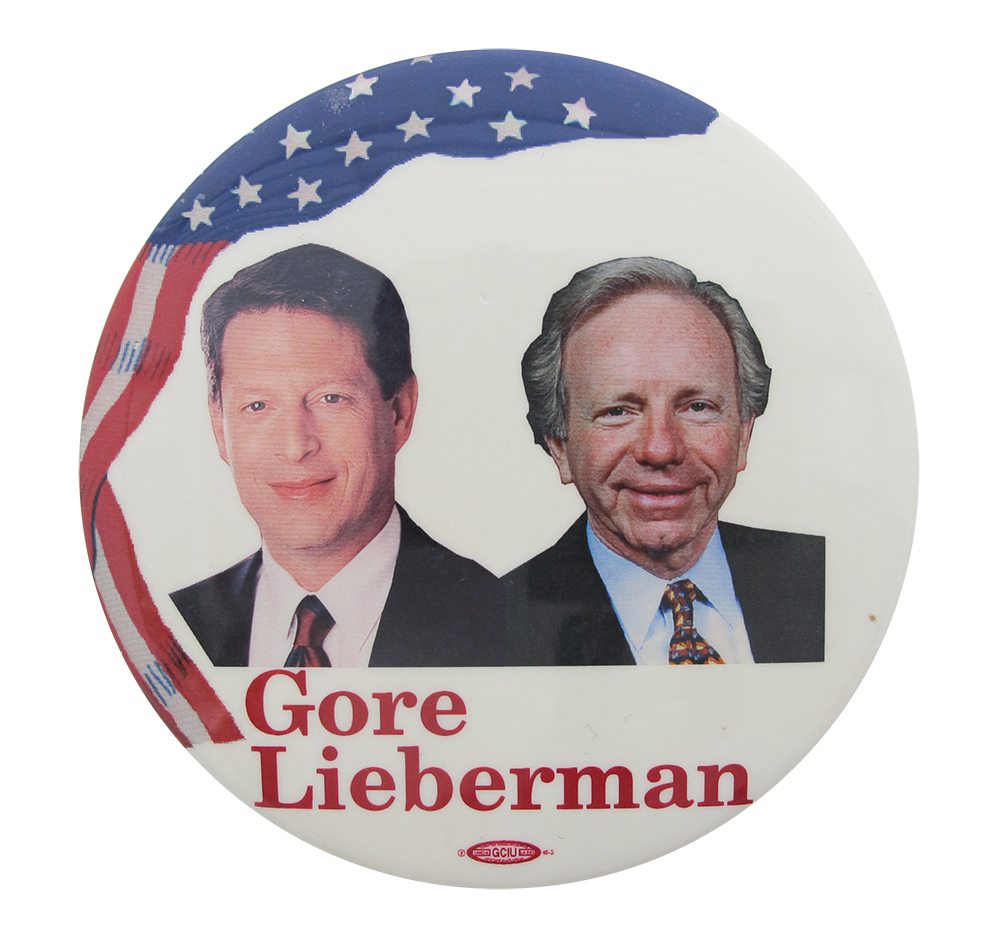
Text on Button Gore Lieberman
Image Description

A white background with portraits of Al Gore and Joe Lieberman bordered by part of the American flag on the left and red text at the buttom.

Curl Text T.K. ENTERPRISES 920-922-7439 tkent@josys.ney
Back Style
The Shape
The Size
The Manufacturer
Additional Information

The button promoted the Gore/Lieberman presidential campaign in the 2000 election. Al Gore was the Vice President during the Bill Clinton presidency, and Joe Lieberman was a Senator from Connecticut at the time of the election. They were candidates for the Democratic Party. Gore and Lieberman lost the election to Republican team of George W. Bush and Dick Cheney.

Catalog ID PO0104

Gore Lieberman 2000

Category
Additional Images
Sub Categories
Text on Button Gore Lieberman 2000
Image Description

White and red text over blue background. 

Curl Text BOLD CONCEPTS 212-764-6330 Union Bug
Back Style
The Shape
The Size
Year / Decade Made
The Manufacturer
Additional Information

In 1999, then US Vice President Al Gore announced his candidacy for US President. Gore served as a US Congressman for Tennessee from 1977 to 1993 before becoming Bill Clinton's Vice President in 1993. In August of 2000, Gore selected Joe Lieberman (1942- ), US Senator from Connecticut, as his running mate. When Lieberman accepted, he became the first Jewish-American candidate to nationally represent one of America's two major parties. Gore and Lieberman ran against the Republican candidates, George W. Bush and Dick Cheney. Bush was Governor of Texas at the time and Cheney was the CEO of Halliburton.

Gore and Lieberman lost the presidential election to Bush and Cheney by five Electoral College votes. The popular vote in Florida was so close—Bush beat Gore by just over 500 votes out of over 6 million—that the Florida election code called for a state-wide automated recount. In addition, the election season in Florida was fraught with so much controversy that Gore requested three counties' votes to be recounted by hand. The ballot controversy went all the way to the US Supreme Court, which decided 5-4 that due to recount time limits Bush's certification as winner would stand. 

Catalog ID PO0137

Goldwater in '64

Category
Additional Images
Sub Categories
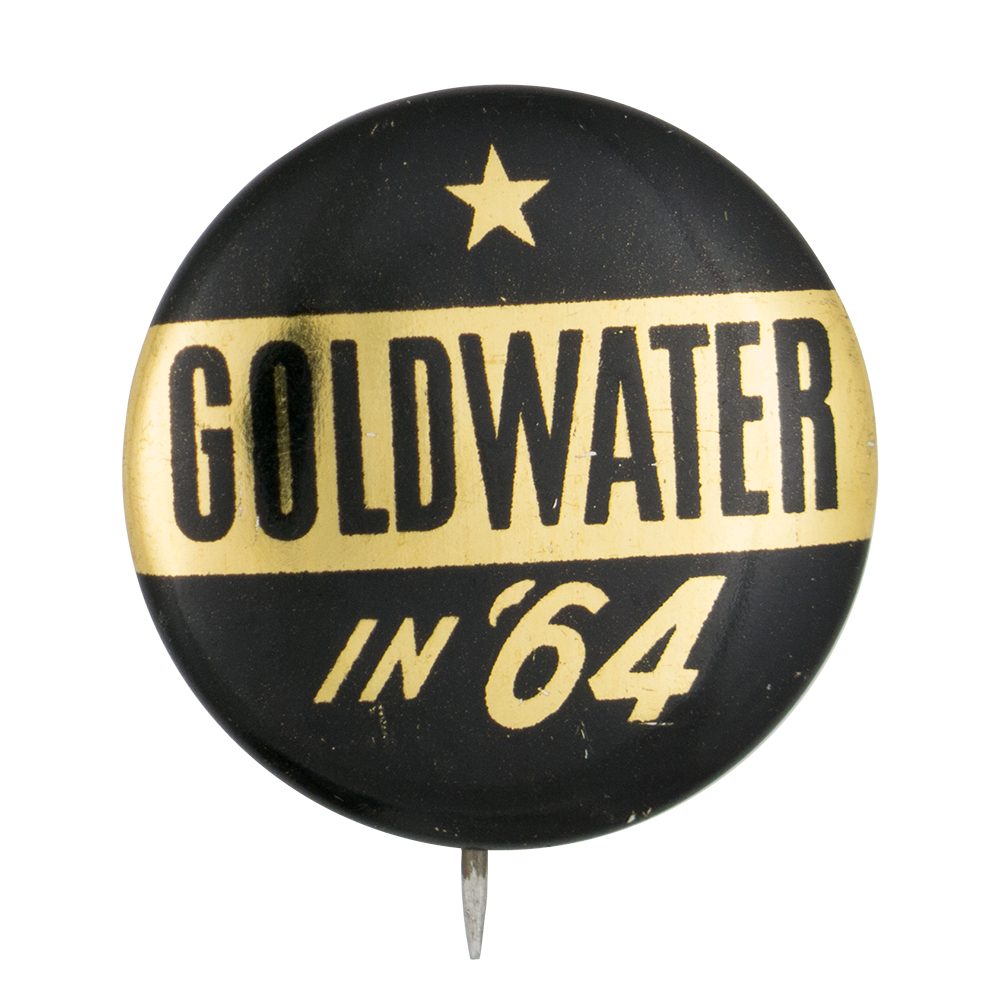
Text on Button Goldwater in '64
Image Description

Black background with a gold band across the center with black text. There is a gold star above the band and gold text below it.

Back Style
The Shape
The Size
Year / Decade Made
Additional Information

In 1964, US Senator from Arizona, Barry M. Goldwater (1909-1998) was the Republican Party's nominee for US President.  Goldwater's running mate was William E. Miller (1914 -1983) who at the time was Republican National Committee's chairman.  The two ran against Democrats, sitting US President Lyndon B. Johnson (1908-1973) and his Vice President, Hubert Horatio Humphrey, Jr. (1911-1978).  Johnson and Humphrey won the November election, receiving over 90 percent of the Electoral College votes.  Goldwater did win six states, his home state and five states in the Deep South.  

Goldwater's southern success was due to is disfavor for the Civil Rights Act of 1964.  He oppose the act not because he was for discrimination based on race, color, religion, sex, or national origin, but rather because he viewed it as a federal encroachment on state's and individual rights.  Goldwater had long supported of state's rights over federal rights.  When he first ran for US Senate in 1952, he ran in opposition to the New Deal.  Goldwater also greatly admired former US President Herbert Hoover's (1874-1964) approach during early years of the Great Depression and his focus on government inefficiency.

Catalog ID PO0129

Goldwaters Are Coming

Category
Additional Images
Sub Categories
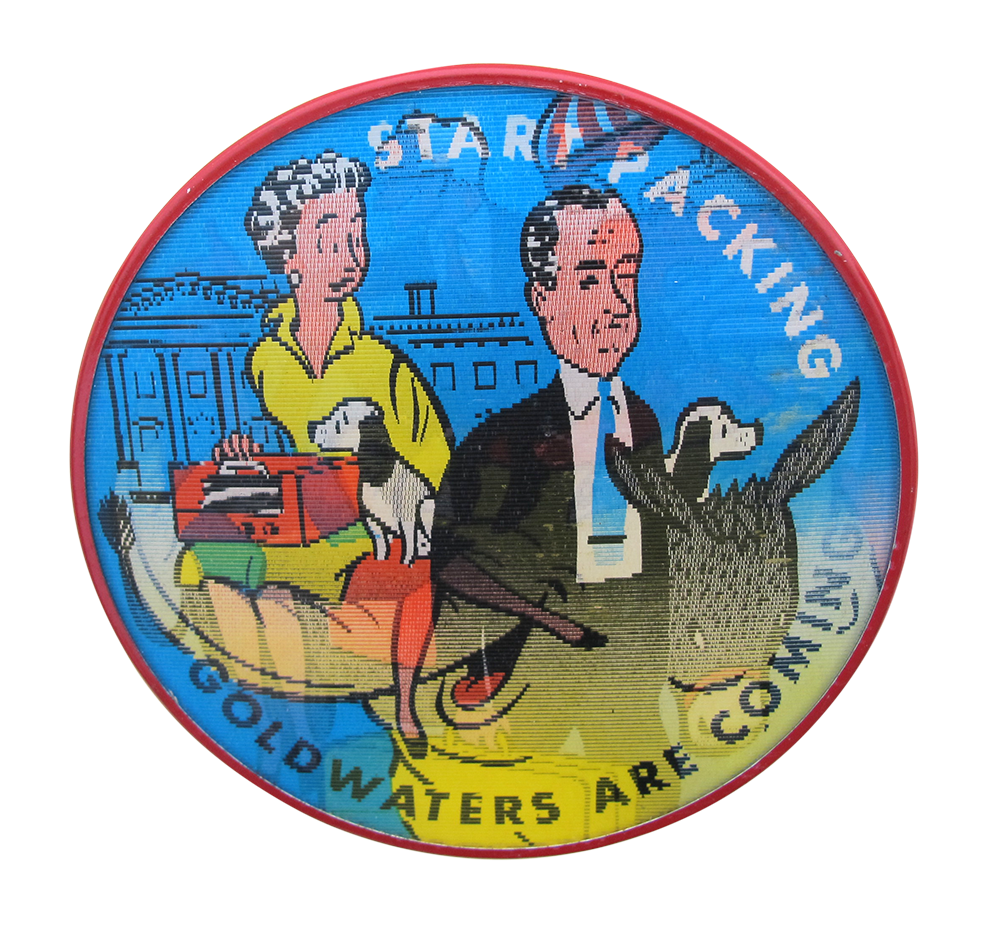
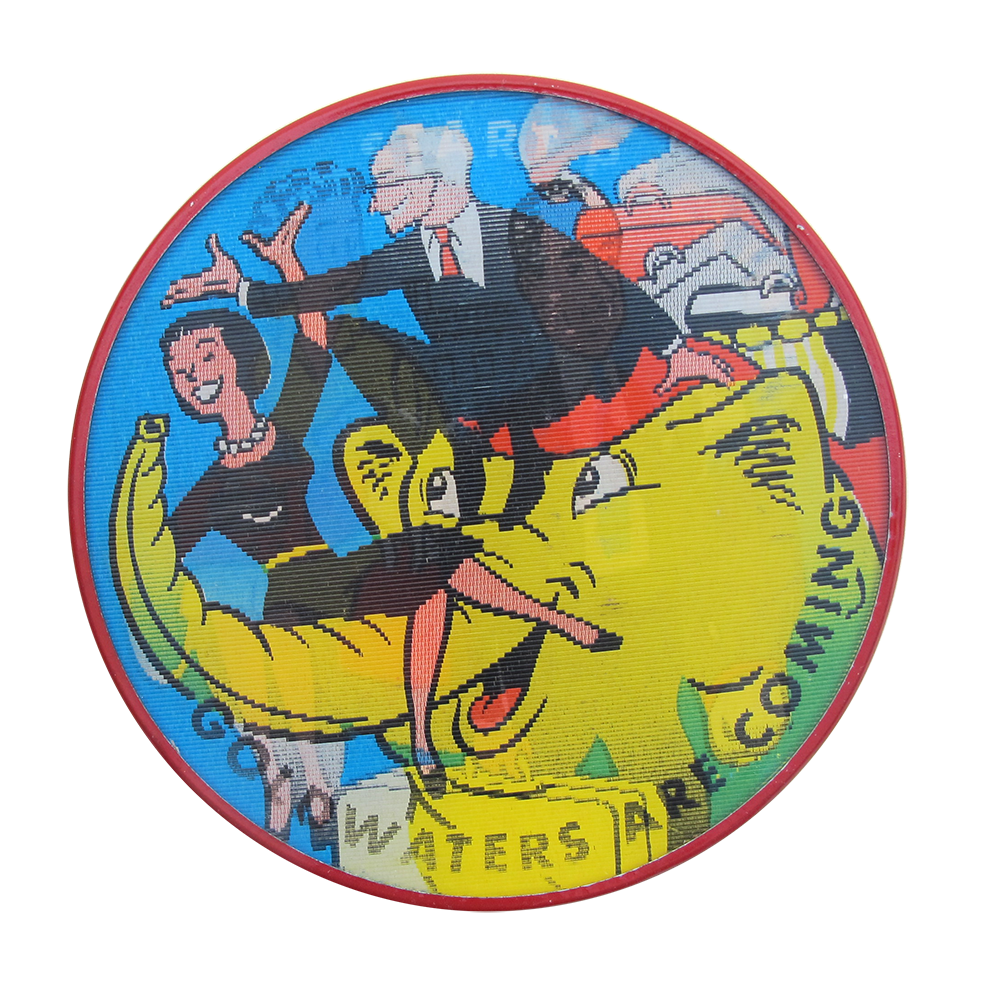
Text on Button START PACKING GOLDWATERS ARE COMING
Image Description

Alternating lenticular images of the first family leaving the White House with their two dogs and donkey and the Goldwaters arriving on an elephant with their luggage with white and black text on a bright blue background. 

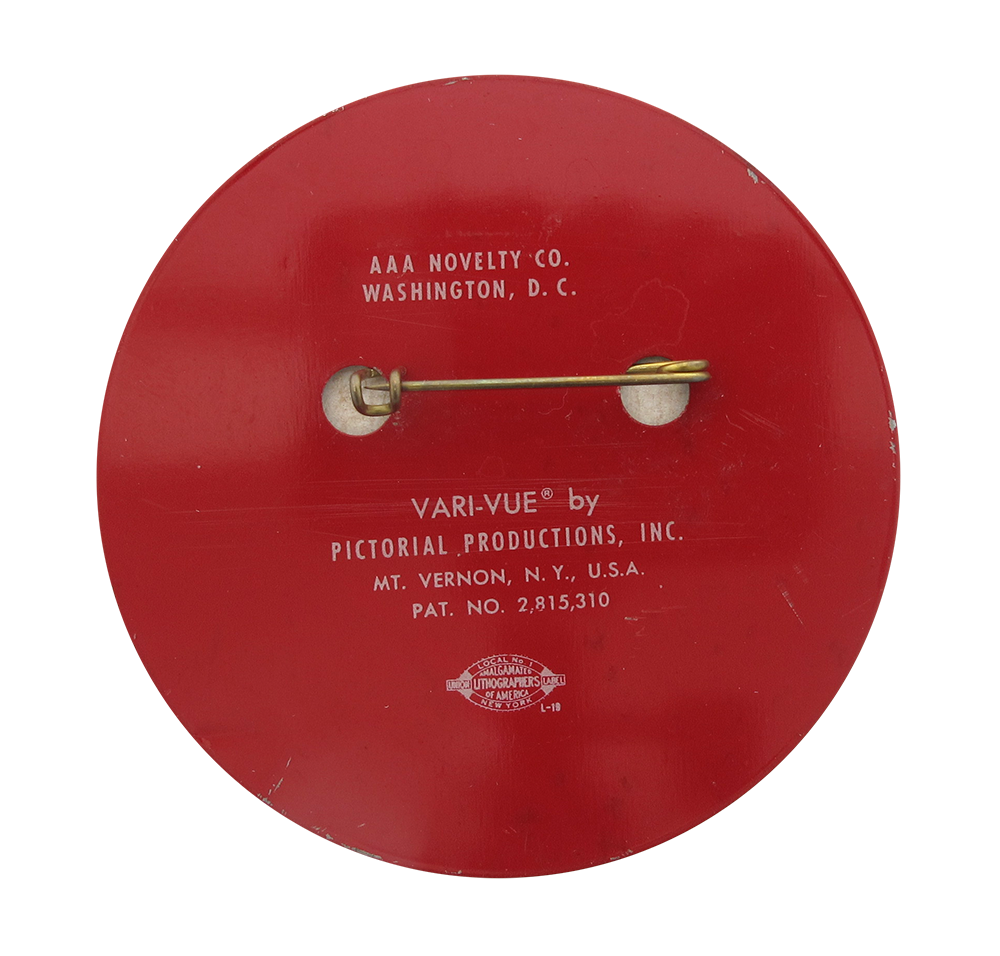
Back Paper / Back Info

AAA NOVELTY CO.
WASHINGTON, D.C.
VARI-VUE by
PICTORIAL PRODUCTIONS, INC.
MT. VERNON, N.Y., U.S.A.
PAT. NO. 2,815,310

Union bug

Back Style
The Shape
The Size
Year / Decade Made
The Manufacturer
Additional Information

Barry Goldwater was a U.S. Senator from Arizona and the Republican Party's nominee for president in the 1964 election. This button was made in anticipation of his winning the election but he lost in one of the biggest landslide victories in history by Lyndon B. Johnson.

Goldwater is the politician most often credited for sparking the resurgence of the American conservative political movement in the 1960s. He also had a substantial impact on the libertarian movement. In 1974, as an elder statesman of the party, Goldwater successfully urged President Richard Nixon to resign when evidence of a cover-up in the Watergate scandal became overwhelming and impeachment was imminent. The term "Goldwater moment" has subsequently been used to describe situations when influential members of Congress disagree so strongly with a president from their own party that they rise up and take a stand in opposition.

Catalog ID PO0148

Let's Go with Curtiss

Category
Additional Images
Sub Categories
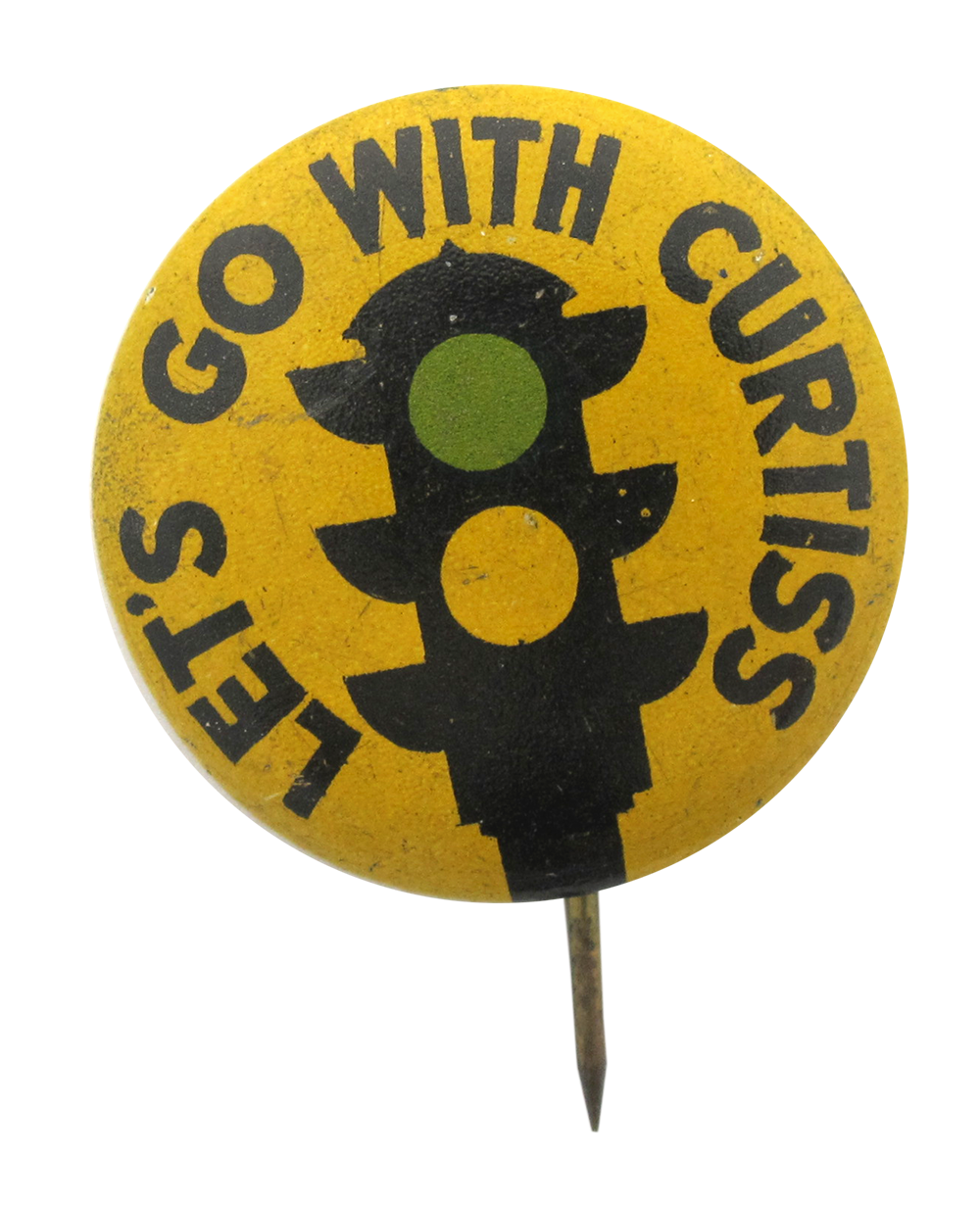
Text on Button LET'S GO WITH CURTISS
Image Description

Stoplight encircled by black text over yellow background. 

Back Paper / Back Info

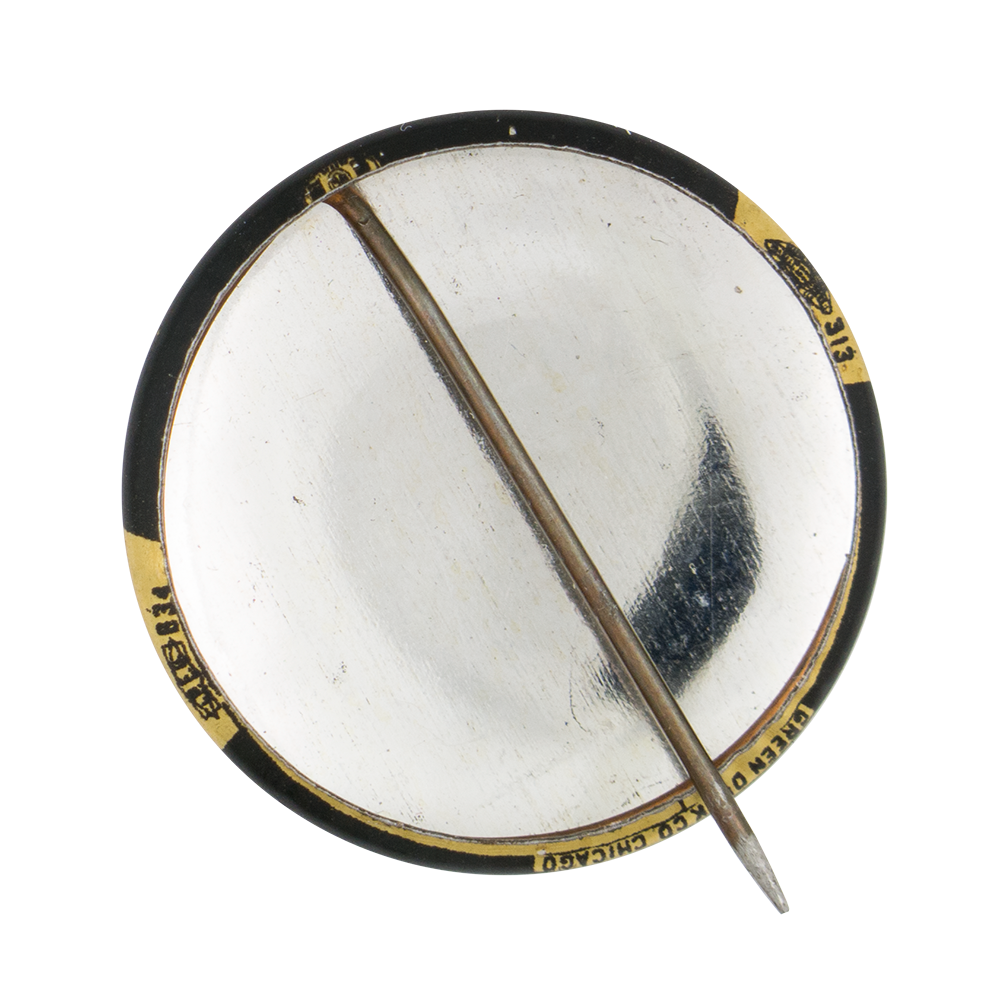
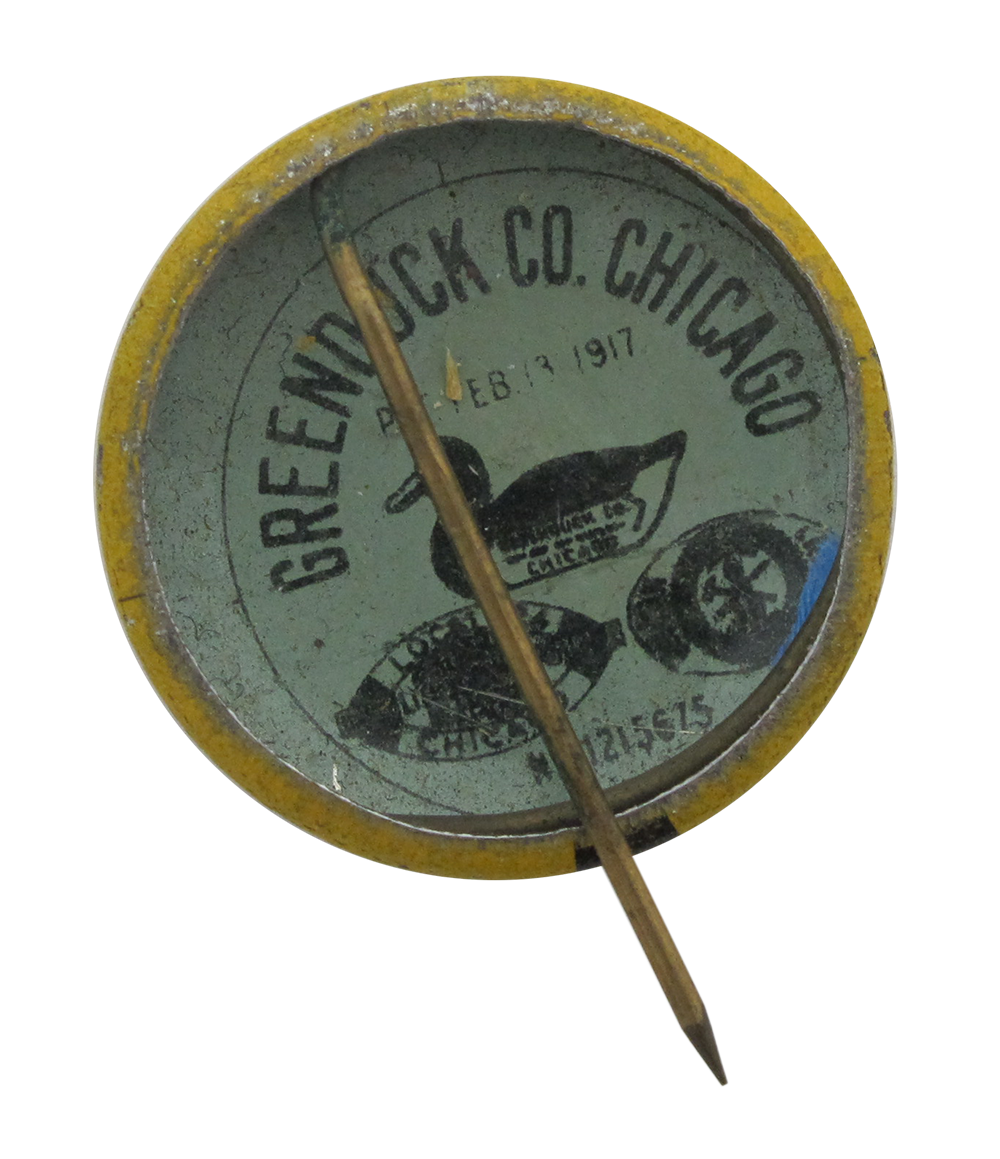
GREENDUCK CO. CHICAGO

Union bug

Back Style
The Shape
The Size
The Manufacturer
Additional Information

This button was a campaign button for William G. Curtiss, a Democrat running for a seat in the US House of Representatives from the 13th C.D. of Illinois in 1922. Curtiss lost to John C. McKenzie, the incumbent Representative who was first elected in 1910 and was lost again to Republican Willaim Richard Johnson in 1924 and 1928.

William G Curtiss was a farmer educated in University of Illinois. In his lifetime, he was a school director and trustee and acted as the Secretary of the Country Farmers Institute. He also served as a Representative in the lower house of the Illinois General Assembly.

Catalog ID PO0151

George Wharton Pepper

Category
Additional Images
Sub Categories
Text on Button For U.S Senator George Wharton Pepper
Image Description

Black and white portrait of George Wharton Pepper between white text over blue background. 

Back Paper / Back Info

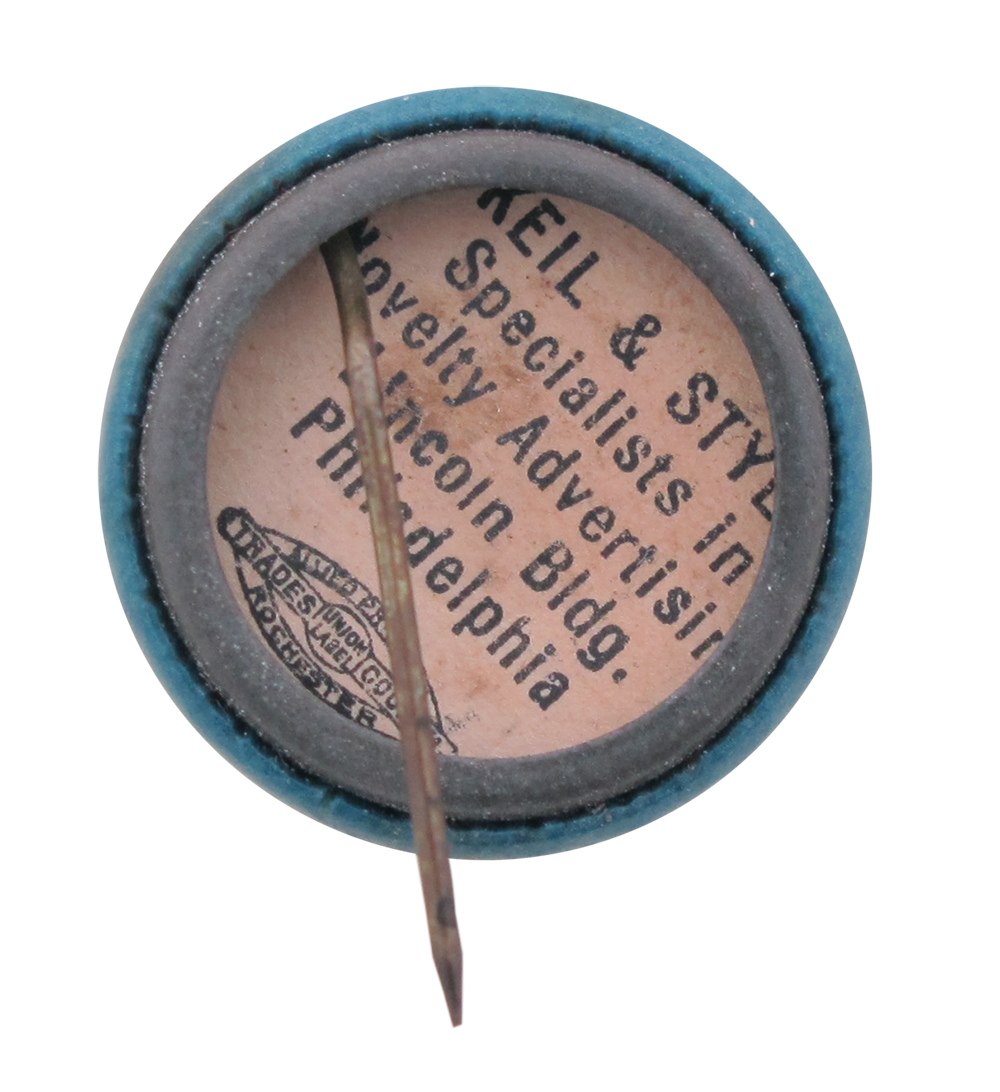
KEIL 7 STYEN

Specialists in 

Novalty Advertising

Lincoln Bldg. 

Piladelphia

Union Bug

Back Style
The Shape
The Size
Year / Decade Made
The Manufacturer
Additional Information

George Wharton Pepper (1867-1961) was appointed as a Republican US Senator for Pennsylvania in 1922 after the death of the incumbent and ran for the same seat in the November election. His experience as a lawyer helped him mediate a major labor dispute and he argued a case in front of the US Supreme Court while in office. He also served on the Banking and Currency, Foreign Relations, Library of Congress, Military Affairs, and Naval Affairs committees. Pepper served Pennsylvania until March 1927, after losing in the 1926 Republican primary.  His papers are housed at the University of Pennsylvania's University Archive's and Records Center.  

Sources

Penn Biographies. (2013). George Wharton Pepper (1867-1961), University of Pennsylvania University Archives. Retrieved September 11, 2014, from http://www.archives.upenn.edu/people/1800.

Catalog ID PO0130