Uncle Sam with a Gun

Category
Additional Images
Sub Categories
Image Description

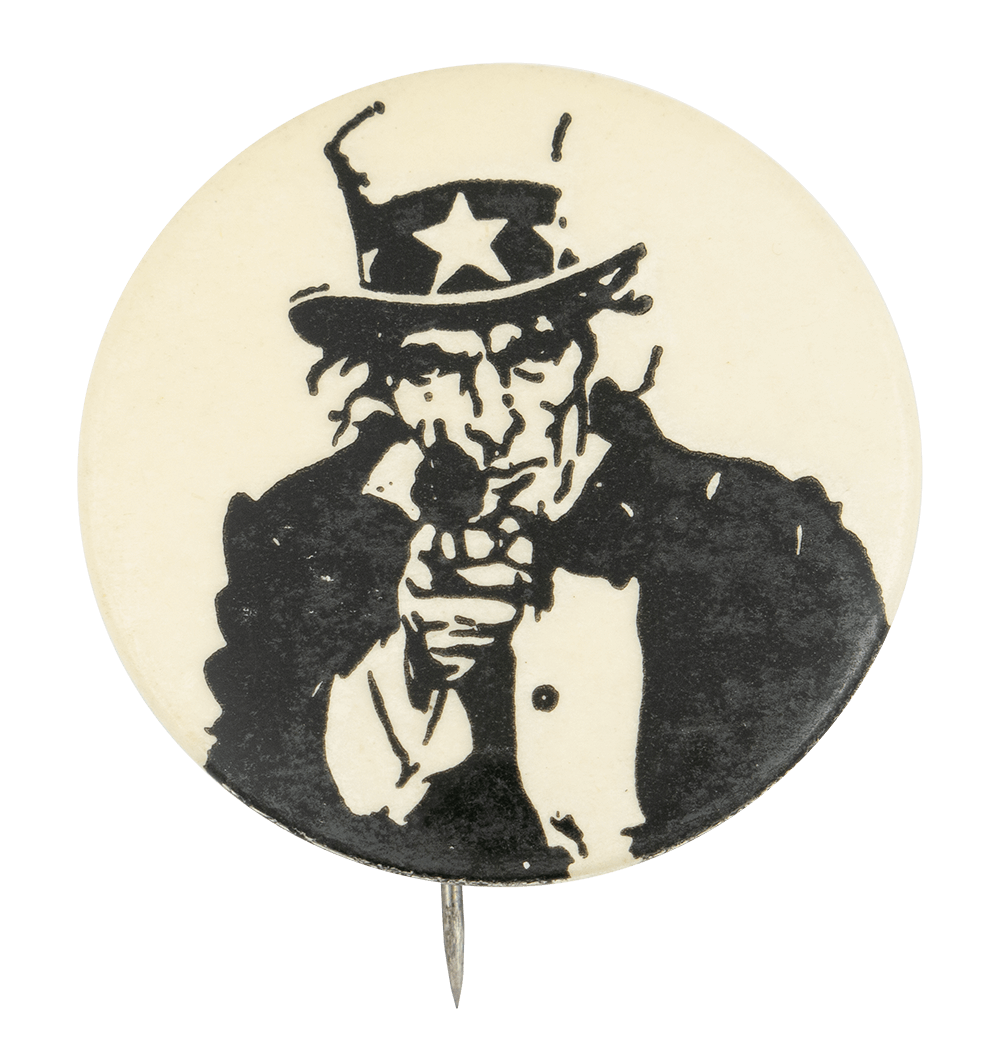
Illustration of Uncle Sam wearing a top hat and pointing a gun on a white background

Back Style
The Shape
The Size
Year / Decade Made
Additional Information

Uncle Sam is a fictional character who represents a personified version of the United States. While the character is fictional, many historians believe Uncle Sam was based on a New Jersey Merchant who supplied beef to American troops during the war of 1812, Samuel Wilson (or Uncle Sam Wilson). Since the 1800s, cartoonists created many versions of their perceptions of America personified. The Image we all know today was created by James Montgomery Flagg in 1917. Flagg's image was used in army recruitment posters for both of the World Wars. The posters featured a patriotic Uncle Sam, wearing patriotic colors, pointing at the audience, and stating “I Want You for U.S. Army”.

In contrast, the image we see here is darker (black and white), Uncle Sam is pointing a gun at the audience, and it was used to protest the Vietnam war. This image can be found on posters and advertisements created by Student Mobilization Committee to End the War in S.E. Asia. One poster features Uncle Sam with a gun, a grieving soldier, and a statement urging the government to bring all the troops home from “Vietnam, Laos, and all of Southeast Asia”. This poster is now housed in the Library of Congress.

Sources

National Geographic Society. (2023, October 19). Uncle Sam. National Geographic: Education. https://education.nationalgeographic.org/resource/uncle-sam/ 

Student Mobilization Committee To End The War In S.E. Asia, S. & Personality Posters, C. C. (1970) March and strike, April 15: U.S. out of Vietnam, Laos, all of Southeast Asia: bring all troops home now. , 1970. [Photograph] Retrieved from the Library of Congress, https://www.loc.gov/item/2016649366/.

Catalog ID PO1019

Save Your Job

Category
Additional Images
Sub Categories
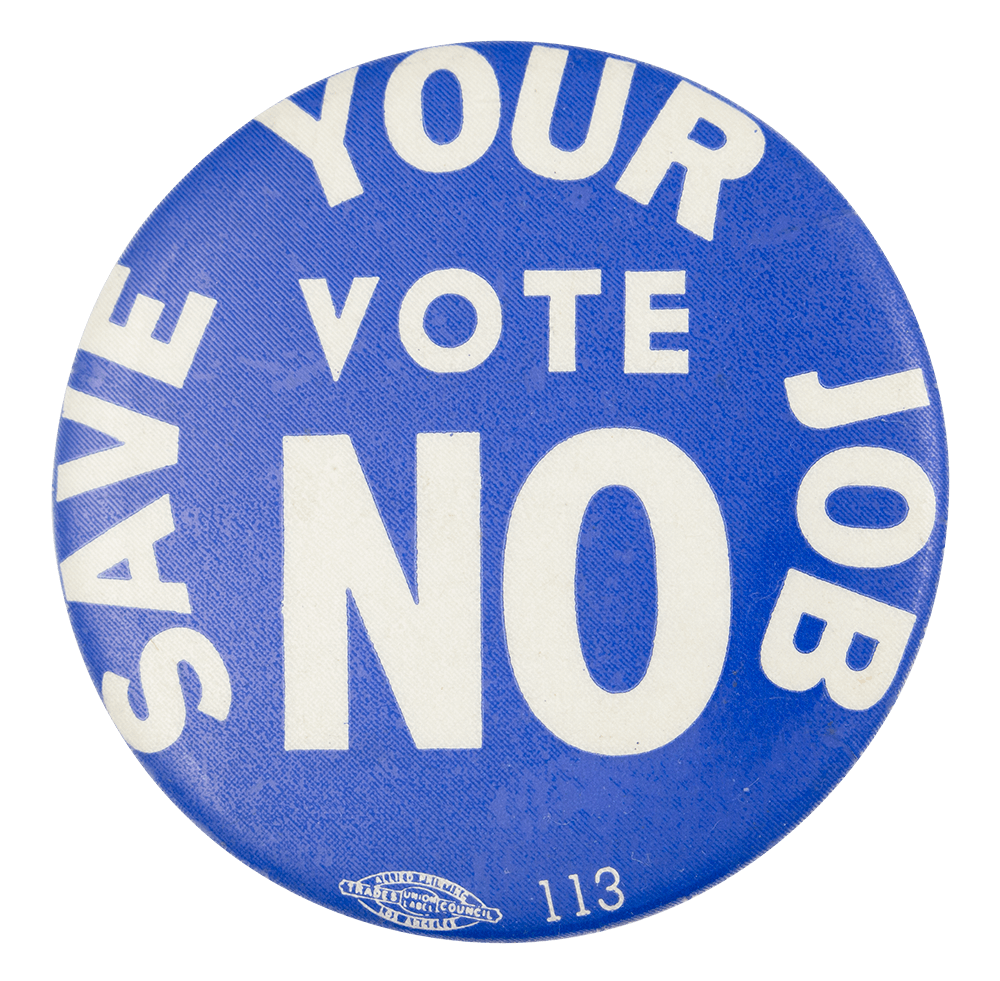
Text on Button SAVE YOUR JOB VOTE NO Union bug 113
Image Description

White text on a blue background

Back Style
The Shape
The Size
Additional Information

‘Vote No’ campaigns are often associated with anti-union sentiment, whether that be a call to vote against union formation or, alternatively, in defense of unionization through a call to vote against measures that seek to union-bust. 

Manufactured in the late 1970s or 1980s, during heightened union-busting under the Reagan administration, this particular button was either addressing anti-union propositions, by instructing fellow workers to save their jobs by voting no, or it may have been anti-union sentiment ironically commissioned from a unionized button manufacturer. 

Sources

Allied Label. (n.d.). Home: What is the Allied Label? Allied Printing. https://alliedlabel.org

Cushing, L. (2007). Proposal for inclusion of union label description in bibliographic and archival cataloging guidelines. Docs Populi. https://www.docspopuli.org/articles/UnionBug.html (Reprinted from “Proposal for inclusion of union label description in bibliographic and archival cataloging guidelines,” 2002, Progressive Librarian Journal, (21), 18-27, http://www.progressivelibrariansguild.org/PL/PL21.pdf )

Harvest Moon Emporium. (2025). Vintage SAVE YOUR JOB / VOTE NO political union campaign pin-back button [eBay listing]. eBay. https://www.ebay.com/itm/145628053757

National Labor Relations Board. (n.d.). Decertification election. NLRB. https://www.nlrb.gov/about-nlrb/rights-we-protect/the-law/employees/decertification-election

Catalog ID PO1022

President McCarthy Peace

Category
Additional Images
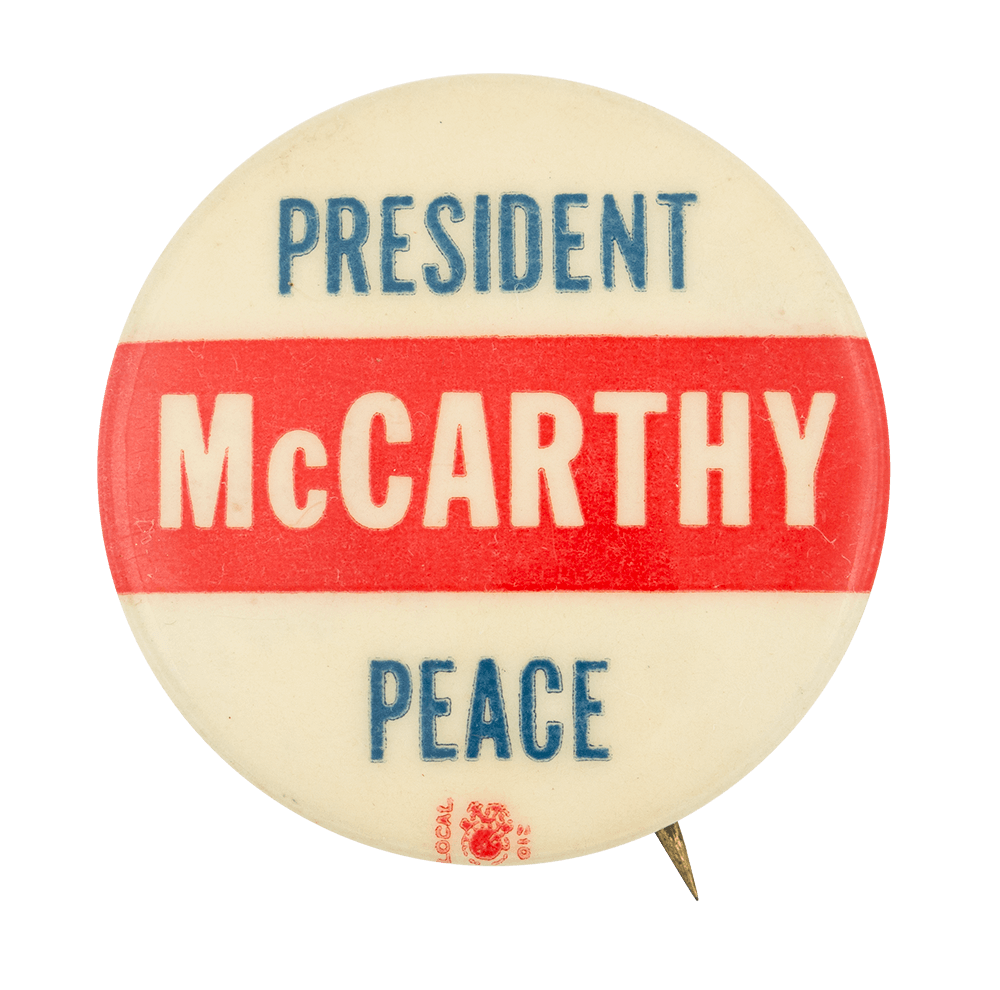
Text on Button PRESIDENT McCARTHY PEACE Union Bug
Image Description

Blue and white text on a white and red background

Back Style
The Shape
The Size
Additional Information

Eugene McCarthy was a U.S. politician, who served as a member of the U.S. House of Representatives for Minnesota and eventually went on to seek the 1968 Democratic nomination for the presidential election. McCarthy was approached by antiwar activists to be their peace candidate, despite his support for the Vietnam war initially. Originally, McCarthy was competing against Lyndon B. Johnson for the Democratic spot, but when early primaries showed favor to McCarthy, Johnson dropped out of the race. When Robert Kennedy decided to run for the Democratic nomination, McCarthy lost many supporters and after Kennedy was assassinated, the Democratic National Convention chose Vice President Hubert Humphrey to be the presidential nominee over McCarthy.

Sources

The Britannica Editors (2019). Eugene McCarthy. Retrieved from https://www.britannica.com/biography/Eugene-McCarthy

Catalog ID PO1004

Marshal

Category
Additional Images
Sub Categories
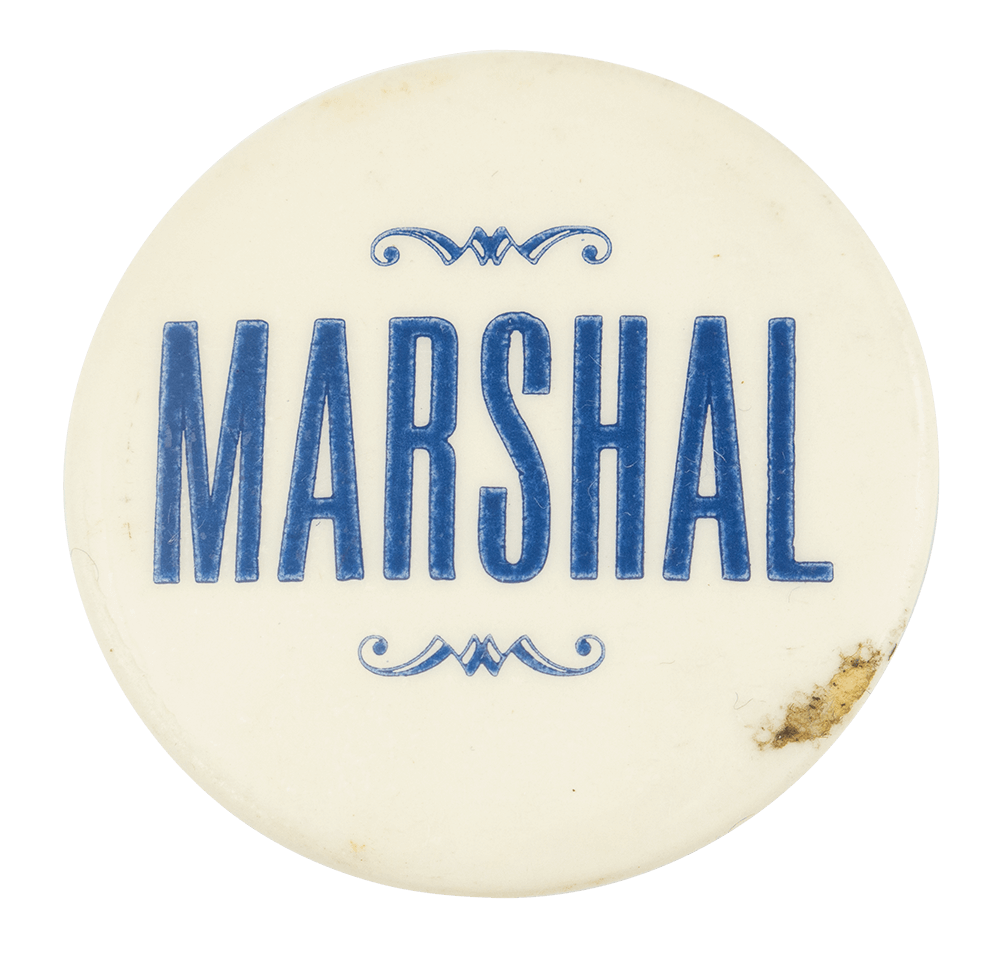
Text on Button MARSHAL
Image Description

Blue text on a white background

Back Style
The Shape
The Size
Additional Information

The word "marshal" originates from a Frankish term meaning "a person who tended horses." By the 11th century, it referred to a high-ranking position in royal and aristocratic households. Buttons like this were primarily used for practical identification rather than as fashion statements or political symbols. They usually served temporary official roles at events such as parades, school activities, fairs, labor union meetings, political rallies, or sports tournaments. Although the word "marshal" often conjures images of formal law enforcement or military roles, such as U.S. Marshals, Fire Marshals, or Field Marshals, this particular button was likely worn by a volunteer or event staff member responsible for maintaining order or assisting with coordination. Historically, the term “marshal” has had various meanings, ranging from high-ranking military officers to officials who enforce court orders or oversee ceremonial events. In the American West, figures like Bass Reeves, one of the first Black Deputy U.S. Marshals west of the Mississippi, helped shape the role through legendary law enforcement work. While this button probably wasn’t worn by someone in that capacity, it reflects a long-standing tradition of the term's association with authority, responsibility, and public service.

Sources

Bass Reeves. (2025, November 6). In Wikipedia. Retrieved November 12, 2025, from https://en.wikipedia.org/wiki/Bass_Reeves 

Grand marshal. (2025, June 17). In Wikipedia. Retrieved November 12, 2025, from https://en.wikipedia.org/wiki/Grand_marshal 

Marshal. (2025, October 25) In Wikipedia. Retrieved November 12, 2025, from https://en.wikipedia.org/wiki/Marshal 

U.S. Marshals Service. (n.d.). U.S. Marshals badgeshttps://www.usmarshals.gov/who-we-are/history/research-sources/us-marshals-badges#:~:text=This%20is%20the%20badge%20worn,as%20books%2C%20movies%20and%20software 

Catalog ID PO1016

Just Vote

Category
Additional Images
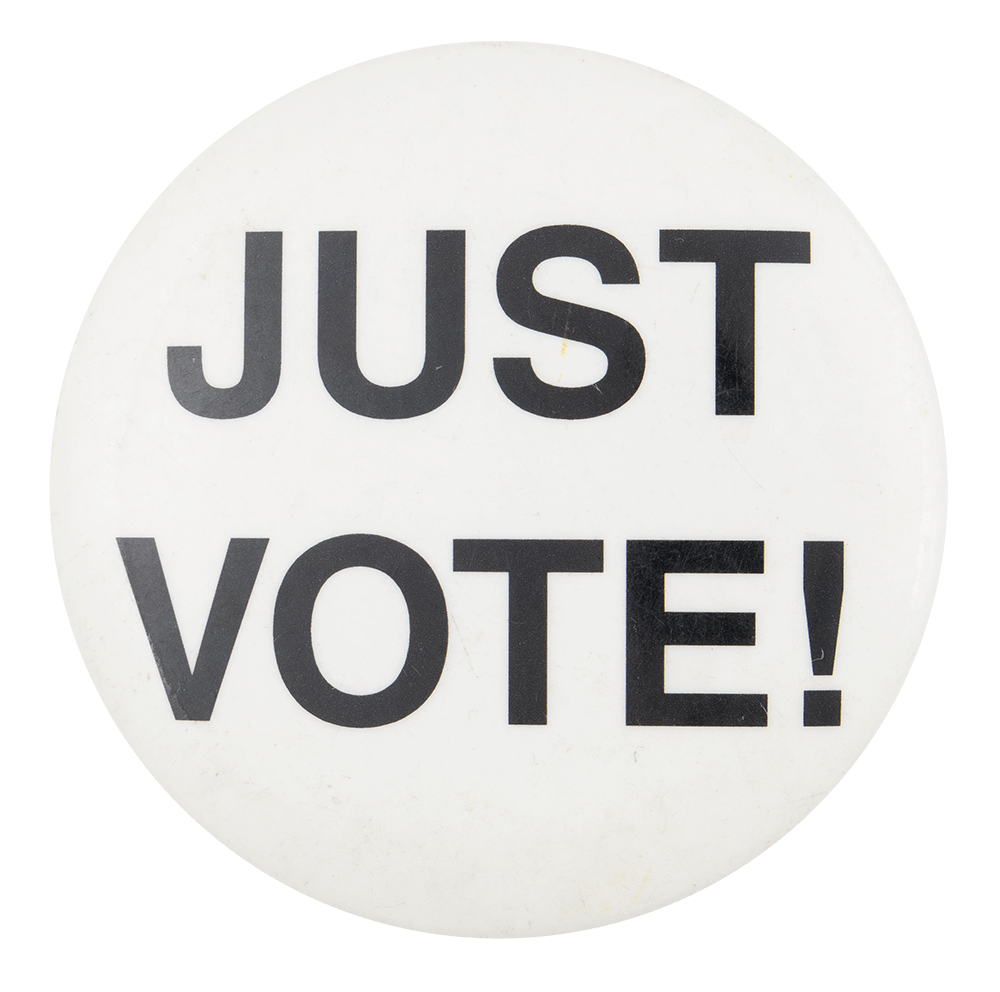
Text on Button JUST VOTE!
Image Description

Black text on a white background

Back Style
The Shape
The Size
Additional Information

“JUST VOTE!” stands out as a powerful example of non-partisan messaging used in Get Out the Vote (GOTV) campaigns. Featuring bold black lettering on a white background, its minimalist design amplifies a simple yet urgent call to action: take part in the democratic process. Rather than supporting any specific party or candidate, the button promotes civic engagement, the core mission of GOTV initiatives.

Such campaigns aim to increase voter turnout, especially among underrepresented groups like young people, first-time voters, and marginalized communities. Political leaders have long recognized the importance of energizing voters; for instance, during the 1992 election, Bill Clinton’s campaign prioritized youth engagement, leading to a notable rise in turnout among 18- to 24-year-olds compared to 1988. Building on this momentum, organizations such as Rock the Vote (established in 1990) joined forces with MTV and other pop-culture platforms to make voting appealing and accessible to young people. "JUST VOTE!" buttons capture the spirit and goals of these youth-oriented GOTV movements, serve as visual reminders and cultural prompts that encourage civic participation, and act as a rallying cry for civic involvement. 

Sources

Ballotpedia. (n.d.). What is GOTV? Retrieved November 16, from https://ballotpedia.org/What_is_GOTV 

Get out the vote. (2025, October 10). In Wikipedia. Retrieved November 16, 2025, from https://en.wikipedia.org/wiki/Get_out_the_vote 

Rock the vote. (2025, November 14). In Wikipedia. Retrieved November 16, 2025, from https://en.wikipedia.org/wiki/Rock_the_Vote

Rock the Vote. (n.d.). About Rock the Vote [About us page]. Retrieved November 16, 2025, from https://www.rockthevote.org/about-rock-the-vote/ 

Catalog ID PO1018

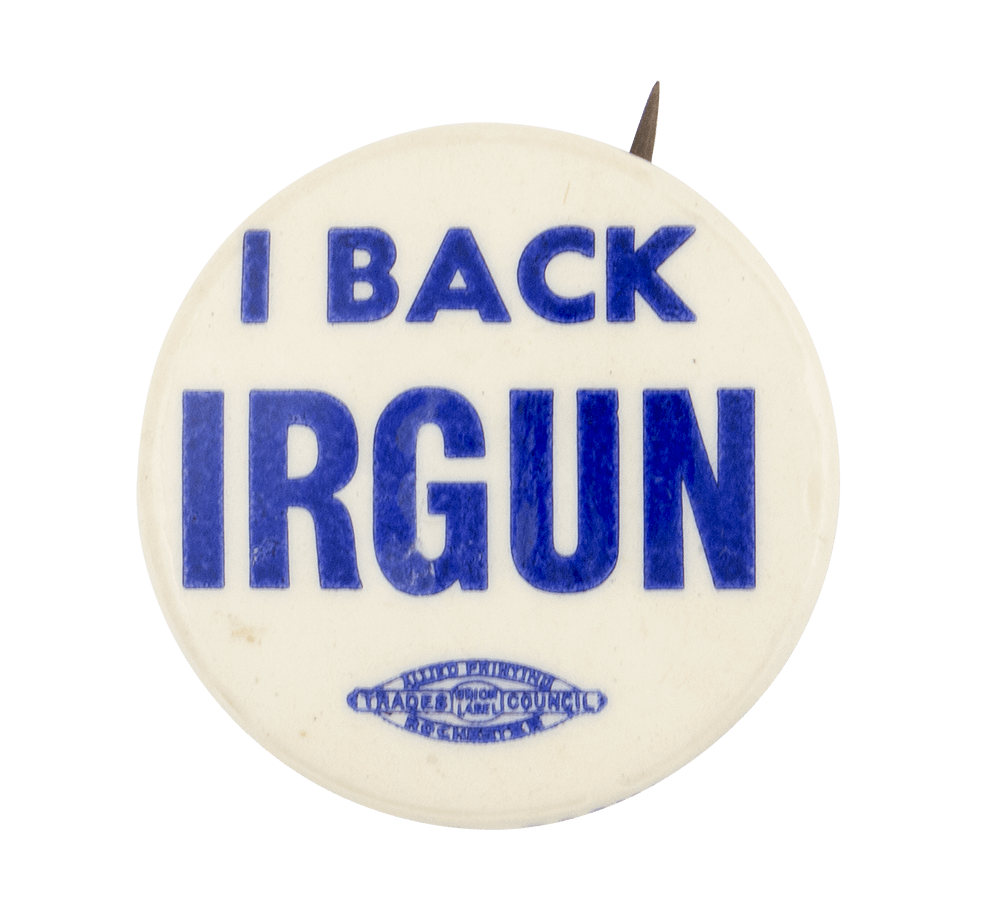
I Back Irgun

Category
Additional Images
Text on Button I BACK IRGUN
Image Description

Blue text over a union bug on a white background

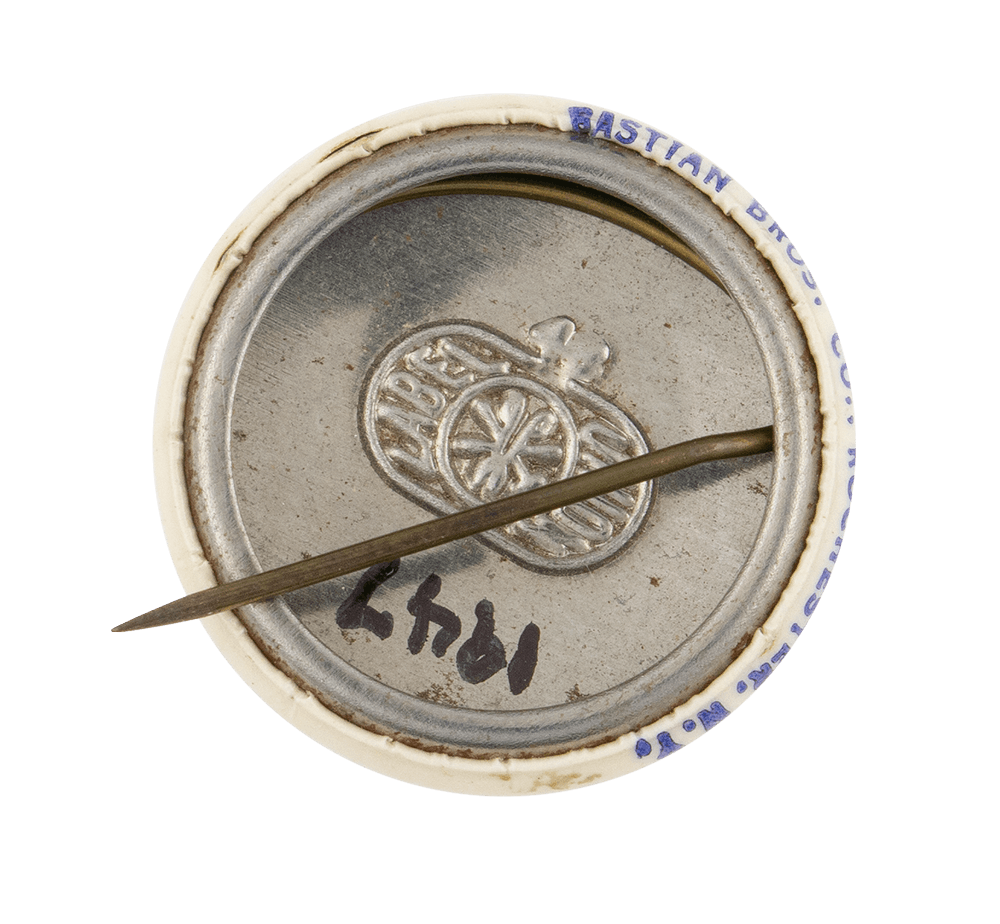
Back Paper / Back Info

Union bug stamp

Curl Text BASTIAN BROS. CO.. ROCHESTER.N.Y.
Back Style
The Shape
The Size
The Manufacturer
Additional Information

Irgun was a Jewish, right-wing Zionist organization that believed in the Revisionist Zionism. Founded in 1931, the Irgun held the belief that every Jewish person had the right to enter Palestine, that only active retaliation would deter the Arabs from preventing Jewish immigration, and only Jewish armed forces would ensure the Jewish state. For the next 17 years, the Irgun carried out attacks on opposing groups that threatened their beliefs. Specifically focusing their attacks on the British and Arabs, the organization gained the reputation of a terrorist group, carrying out many terrorist attacks, including a hotel bombing and a village massacre. The organization disbanded in 1948 after the creation of Israel.

Sources

Britannica, T. E. (2012). Irgun Zvai Leumi. Retrieved from https://www.britannica.com/topic/Irgun-Zvai-Leumi

Catalog ID PO1002

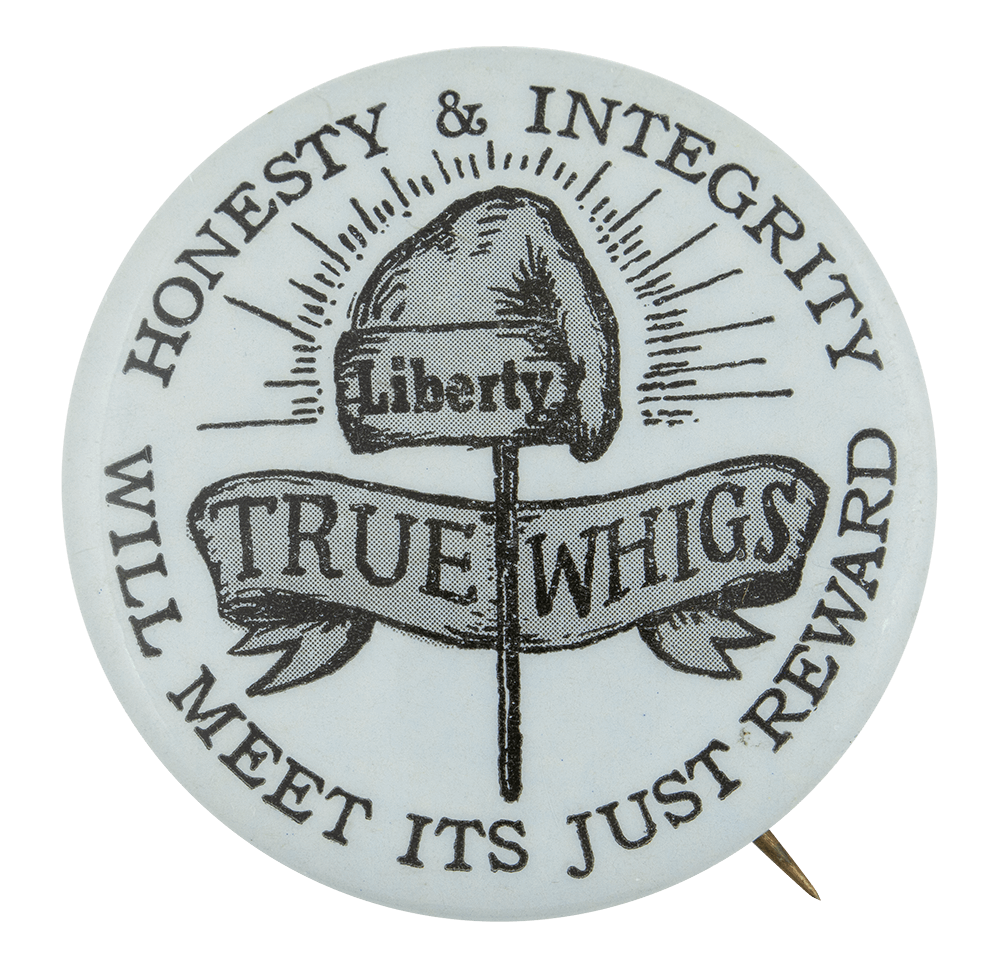
True Whig

Category
Additional Images
Sub Categories
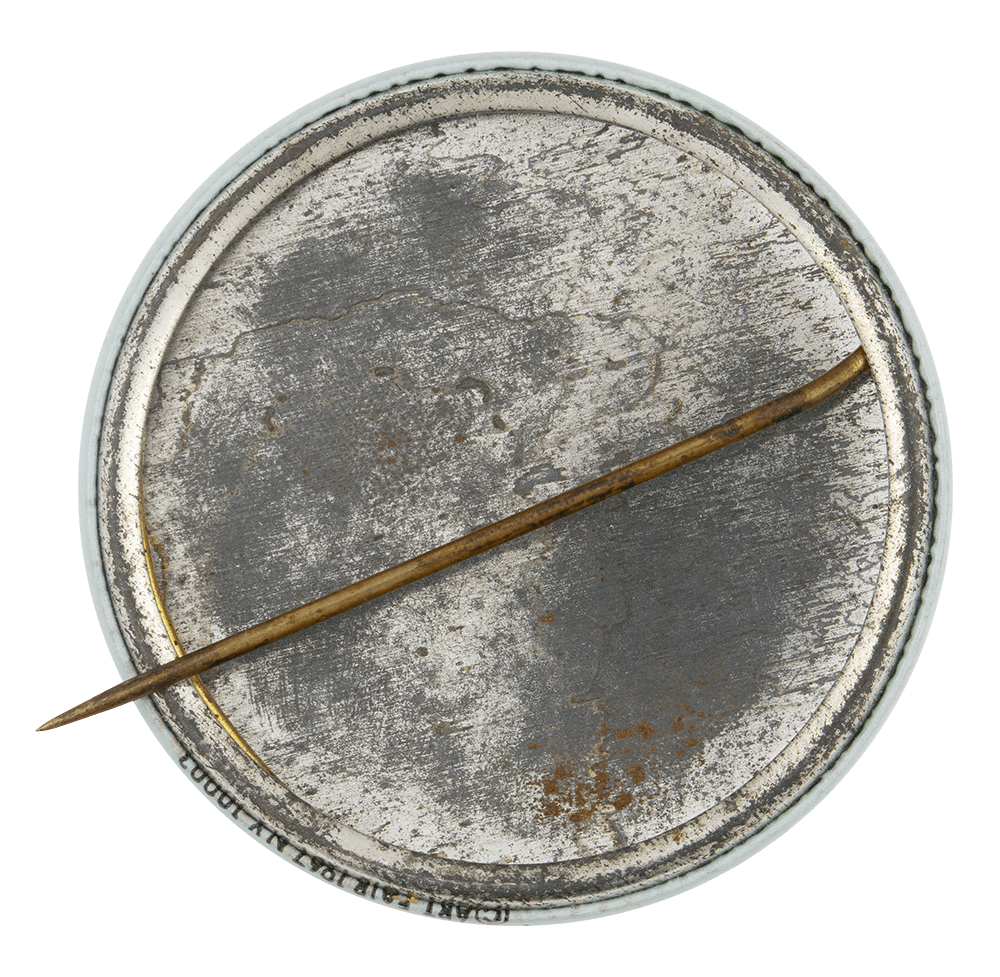
Text on Button HONESTY & INTEGRITY WILL MEET ITS JUST REWARD Liberty TRUE WHIGS
Image Description

Black text and an illustration of a cap on a vertical line with a banner behind it on a light blue background

Curl Text © ART FAIR1967 NY 10007
Back Style
The Shape
The Size
Year / Decade Made
Additional Information

The True Whig Party (TWP) is the oldest political party in Liberia. Founded in 1869 by black American settlers, the party had a conservative ideology. Endorsing systems of forced labor, in 1930, the TWP sent contract migrant laborers to what is now Equatorial Guinea under conditions paralleling slavery. Both the British and the U.S. opposed this, starting a five-year boycott of Liberia. Eventually the party lost power during a military coup in 1980 when the TWP’s leader was killed.  

Sources

International Commission of Inquiry into the Existence of Slavery and Forced Labor in the Republic of Liberia., Christy, C. (1931). Report of the International commission of inquiry into the existence of slavery and forced labor in the republic of Liberia. Monrovia, Liberia, September 8, 1930. Washington: U.S. Govt. print. off..

Catalog ID PO1015

Gillmor

Category
Additional Images
Sub Categories
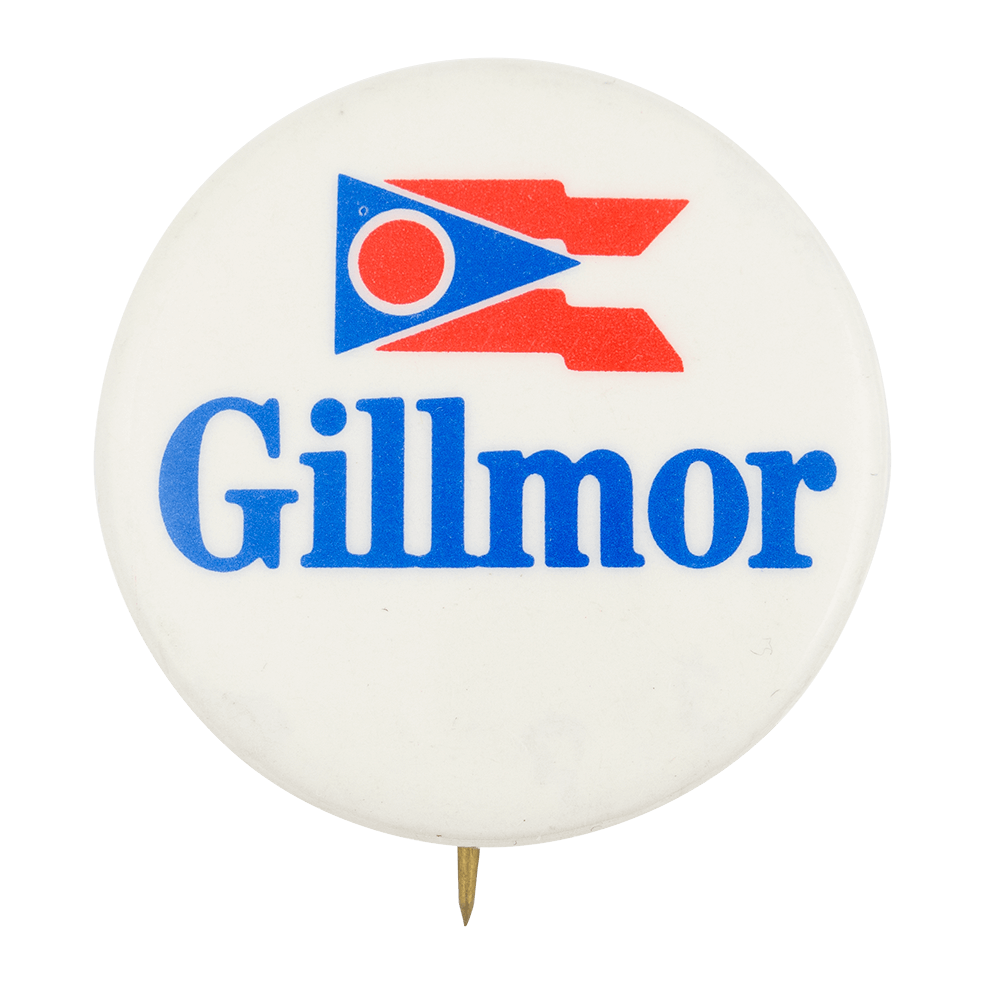
Text on Button Gillmor
Image Description

Blue text with a red, white and blue flag above it on a white background

Back Style
The Shape
The Size
Additional Information

For 22 years, Paul E. Gillmor served in the Ohio Senate, including five terms as the Republican State Senate Leader and the Senate president for three general assemblies. In January 1989, Gillmor was sworn into the U.S. House of Representatives to represent the Fifth Congressional District of Ohio. 

Sources
Catalog ID PO1017

Frost Red

Category
Additional Images
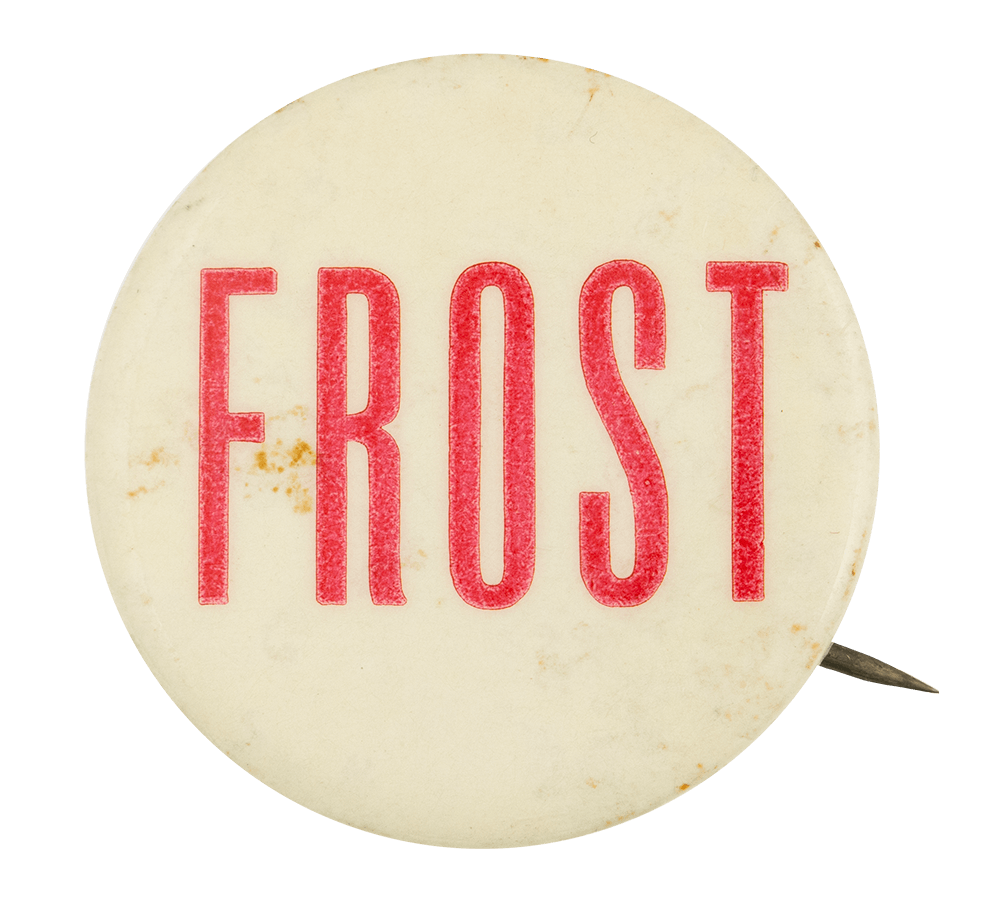
Text on Button FROST
Image Description

Red text on a white background

Back Style
The Shape
The Size
Additional Information

David Frost (1939-1013) is perhaps most well-known in the United States for a series of interviews he conducted of former president of the United States of America, Richard Nixon, in 1977. Through Frost's skillful questioning, Nixon elaborated on his involvement in the Watergate scandal. The interviews were dramatized in Frost/Nixon, a 2006 play by Peter Morgan which, in 2008, was adapted as a film.

David Frost studied at the University of Cambridge, hosted several BBC television series, was made OBE (Order of the British Empire) in 1970, and was knighted by the Queen Elizabeth II in 1993.

Sources

The Editors of Encyclopaedia Britannica. (2022, August 27). Sir David Frost | British talk show host and journalist. Encyclopedia Britannica. https://www.britannica.com/biography/David-Frost

Wikipedia contributors. (2022, October 14). David Frost. Wikipedia. https://en.wikipedia.org/wiki/David_Frost

Wikipedia contributors. (2022b, November 13). Order of the British Empire. Wikipedia. https://en.wikipedia.org/wiki/Order_of_the_British_Empire

Catalog ID PO1020

2012 Barack Obama

Category
Additional Images
Sub Categories
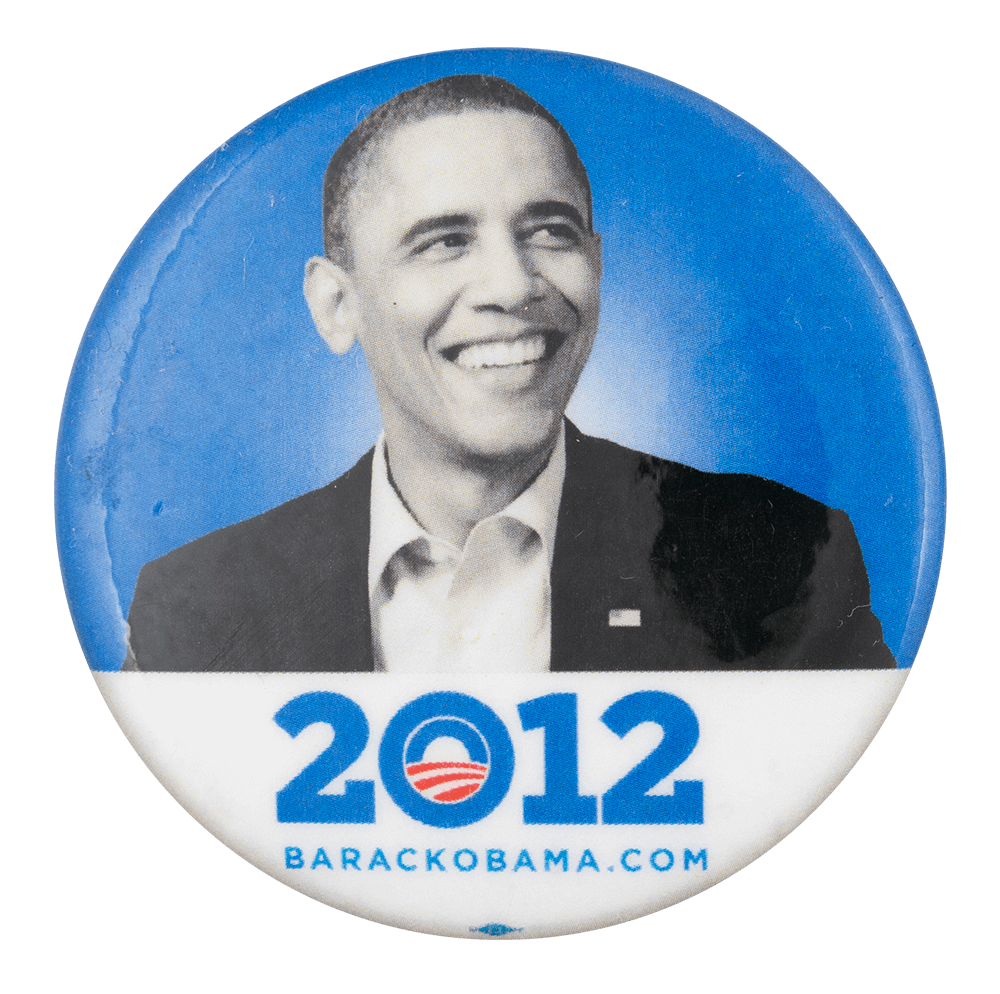
Text on Button 2012 BARACKOBAMA.COM
Image Description

Black and white photograph of Barack Obama on a blue background over white with blue text

Back Style
The Shape
The Size
Year / Decade Made
Additional Information

Barack Obama was the 44th President of the United States; he was first elected in 2008 when he won more votes than any other candidate in history. In 2012, Obama ran again as the Democratic candidate for Presidency used these buttons as part of his political campaign.  Obama won the 2012 presidential election again, winning both the popular vote and the electoral vote.

Sources
Catalog ID PO1003