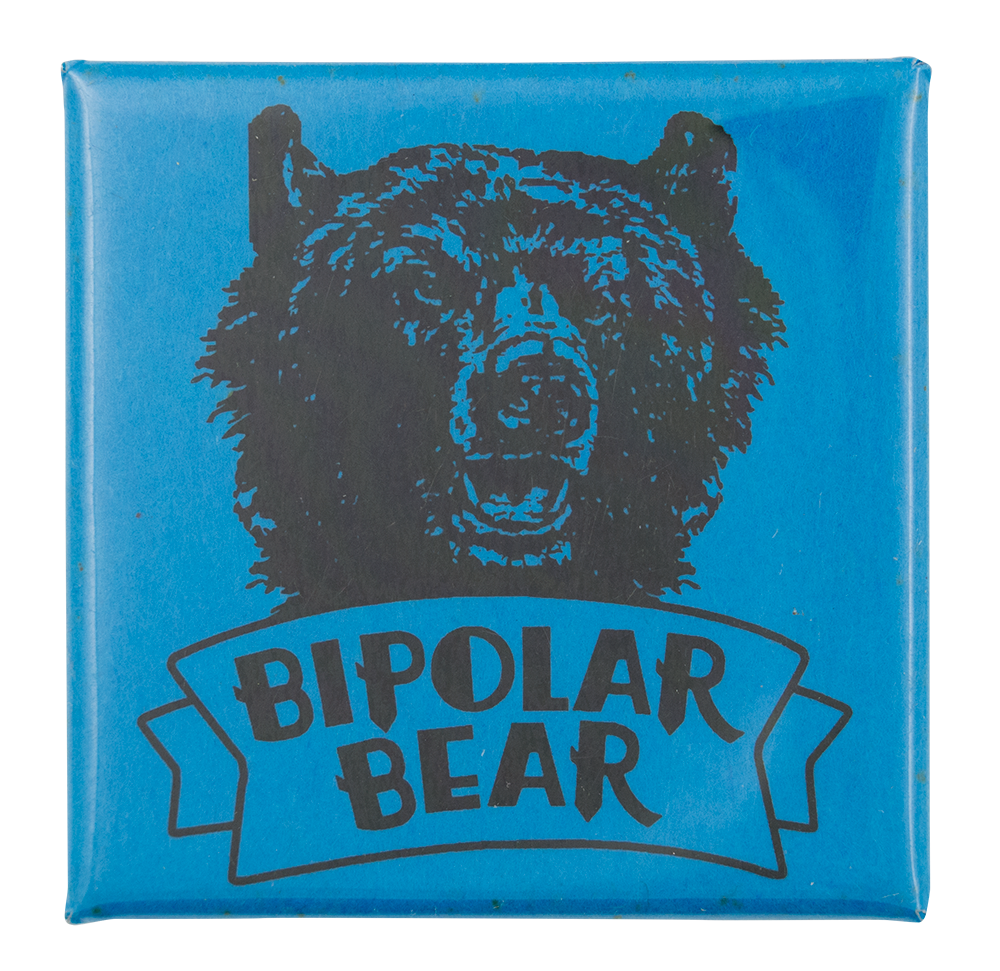
Bipolar Bear

Category
Additional Images
Sub Categories
Text on Button BIPOLAR BEAR
Image Description

Illustration of a bear's head over a banner with black text on a blue background

Back Style
The Shape
The Size
Additional Information

Bipolar disorder, sometimes referred to as manic depression, is a mental disorder in which a person's emotions cycle gradually or rapidly between extreme states of being (generally mania or euphoria and depression). Different types of bipolar disorder are recognized based on the illness's presentation. These include Bipolar I, Bipolar II, and Mixed Bipolar. Each year, Bipolar disorder affects 2-3% of the U.S. population. There is no cure for Bipolar disorder, but it can generally be managed with psychotherapy and medication.

Catalog ID AR0388

Ask Me Red and White

Category
Additional Images
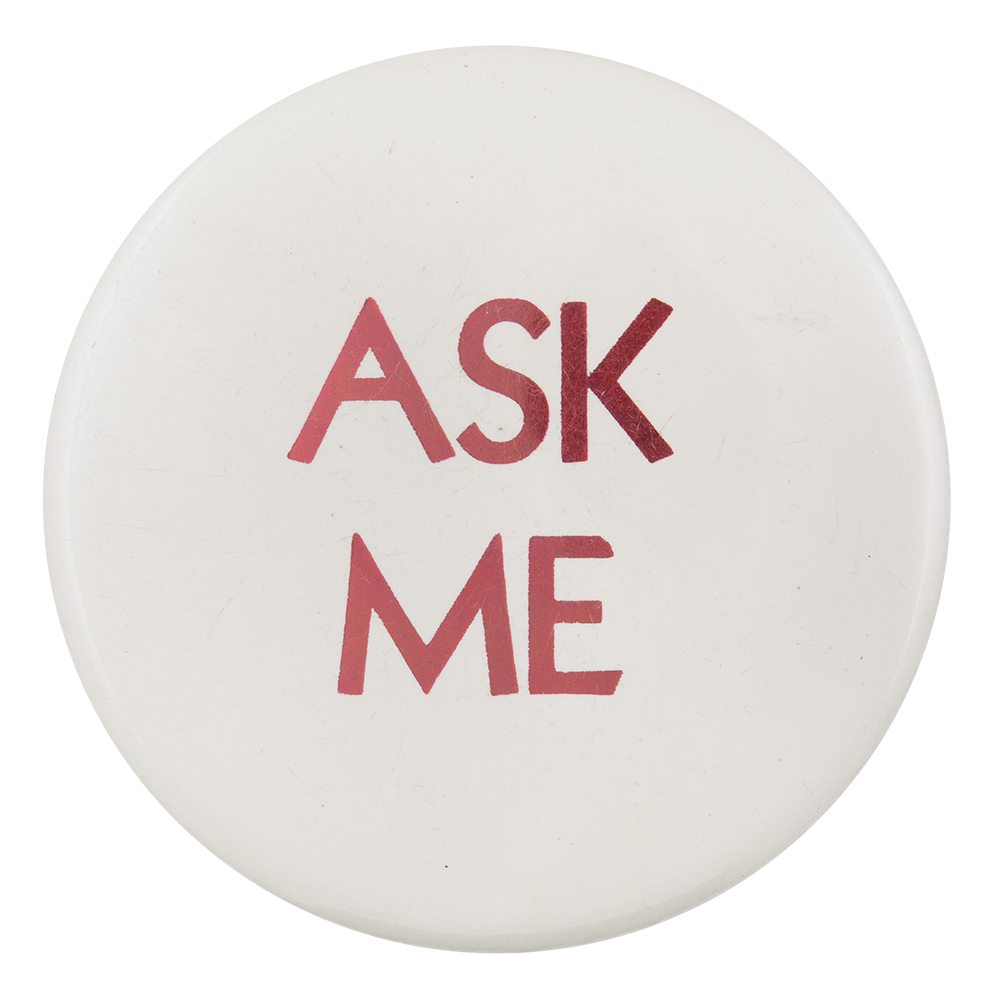
Text on Button ASK ME
Image Description

Red text on a white background

Back Style
The Shape
The Size
Additional Information

The 'Ask Me' slogan is used by a variety of organizations to prompt their customers to seek assistance for their needs. Individuals donning the Ask Me button are generally seen as a resource for their affiliation and a guide to their patrons.

Have info on this button? Contact us here.

Catalog ID AM0046

We're Not Giving In

Category
Additional Images
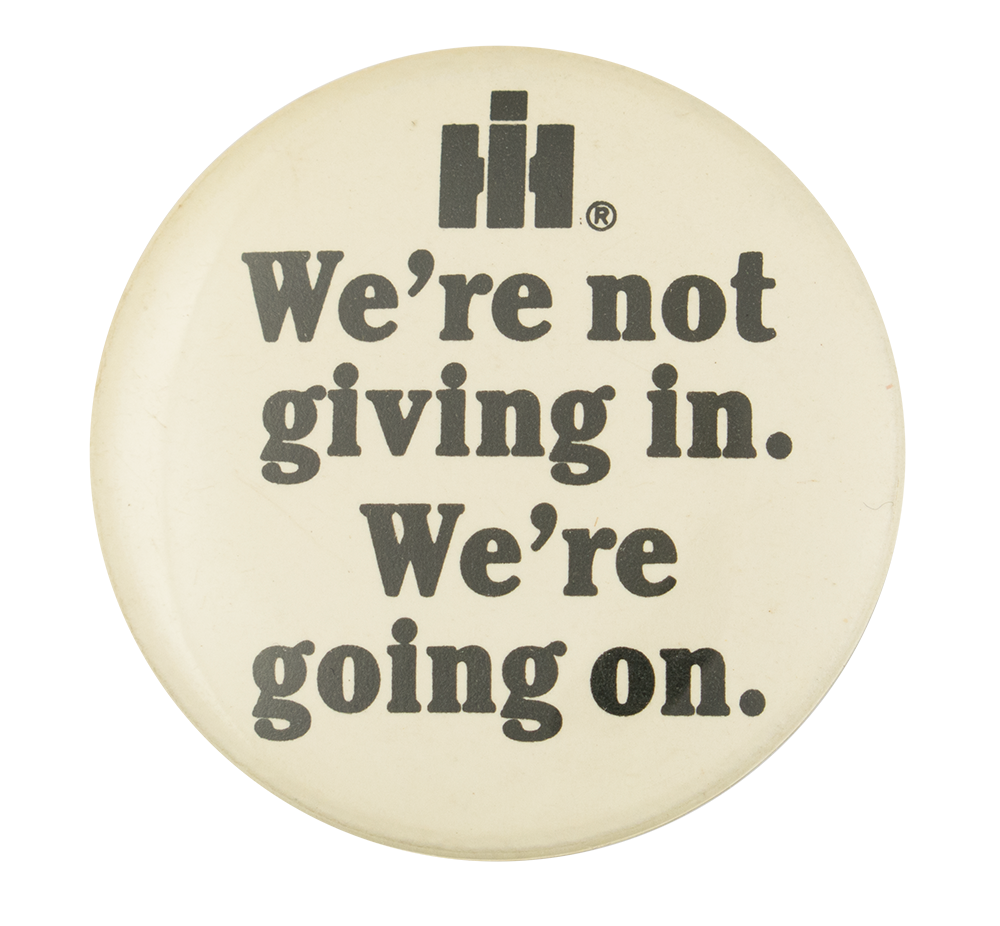
Text on Button We're not giving in. We're going on.
Image Description

Black text on a white background

Back Style
The Shape
The Size
Year / Decade Made
Additional Information

In the summer of 1982, rumors spread that International Harvester was about to go bankrupt. The farming and construction equipment manufacturer responded to these reports with a full-page ad in the Wall Street Journal assuring readers, "We're not giving in, we're going on". 

The phrase was actually the company's slogan for a corporate recovery campaign. The previous year, International Harvester (IH) had suffered a loss of nearly a billion dollars. The loss had forced IH to sell off almost a third of its manufacturing plants and to let go or transfer almost 8,000 employees. The recovery campaign was an effort to reassure investors and employees that the company was still viable.

The slogan and its shortened version ("We're going on") appeared in multiple newspaper ads and on pinback buttons and bumper stickers that were distributed to IH employees. In 1984 IH underwent further heavy losses and was forced to merge with J.I. Case. Two years later the reorganized company changed its name to Navistar International Corporation.

Sources

International Harvester. (n.d.). In Wikipedia. Retrieved July 10, 2018, from https://en.wikipedia.org/wiki/International_Harvester

McDonough, J. & Egolf, K. (Eds.). (2002) The advertising age encyclopedia of advertising. Chicago, IL: Fitzroy Dearborn.

Potts, M. (1982, July 30). Harvester sets survival plan, plants closing. Washington Post. Retrieved from https://www.washingtonpost.com

Catalog ID AD0834

United Air Lines

Category
Additional Images
Sub Categories
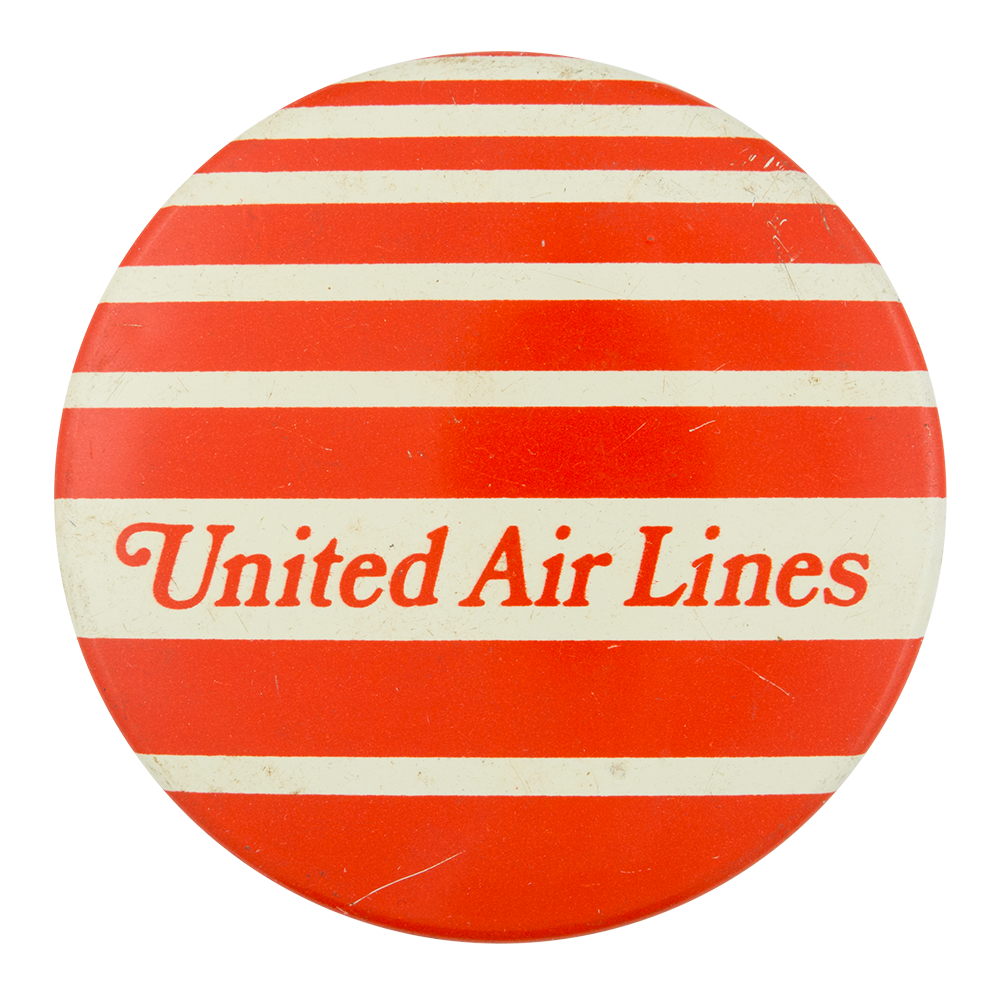
Text on Button United Air Lines
Image Description

Red and white stripes with red text on a white stripe

Back Style
The Shape
The Size
Additional Information

United Airlines is an American airline headquartered in Chicago, Illinois offering flights for North America, Asia, Central and South America, the Caribbean, and Europe. United Air Lines was established In 1931, gradually expanding from domestic flights in the early 1930’s to international destinations after World War II. United Air Lines changed its name to United Airlines after 1975.  A merger with Capital Airlines in 1961 followed by the acquiring of Pan American in 1986 allowed United Airlines to offer more destinations, becoming one of the largest airline carriers in the U.S.

Sources

Flying the Main Line: A History of United Airlines. (n.d). SFO Museum. Retrieved November 27, 2024, from https://www.sfomuseum.org/exhibitions/flying-main-line-history-united-airlines

Singht, S. (March 19, 2024). From Air Mail to Passenger Giant: The History of United Airlines. Simply Flying.  https://simpleflying.com/united-airlines-history-story/


Catalog ID AD0826

The Original Cheers Bar

Category
Additional Images
Sub Categories
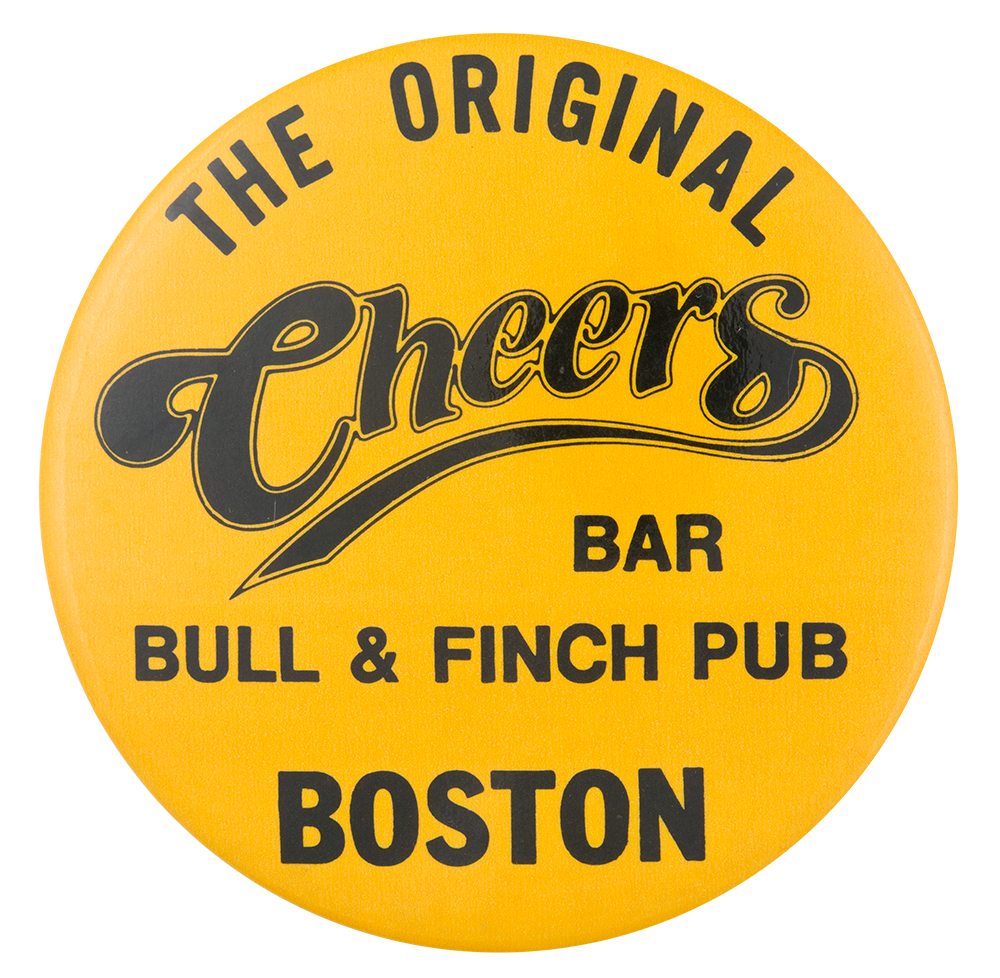
Text on Button THE ORIGINAL Cheers BAR BULL & FINCH PUB BOSTON
Image Description

Black text on a yellow background

Back Style
The Shape
The Size
Year / Decade Made
Additional Information

The NBC television sitcom Cheers enjoyed a lengthy eleven-year run from September, 1982 to May, 1993 producing 275 episodes of the hit show. The setting of the program was in a bar, so the producers used the front of The Bull & Finch Pub in Boston, Massachusetts to provide exterior shots of the show’s titular bar. The pub has become famous across the country spawning memorabilia and tourist trinkets that capture the nostalgia of Cheers. The show, initially, began with a rocky start leading to it almost being cancelled due to low ratings, but the writers and producers were able to turn it around and it became one of the most popular shows in the United States. Cheers received numerous accolades including 28 Primetime Emmy awards and received a nomination for each of its 11 seasons for Outstanding Comedy Series. 

Sources

The Original. (n.d.). Cheers Boston. Retrieved August 9, 2022, from https://cheersboston.com/locations/beacon

Wood, J. M. (2018, May 20). 30 Things You Might Not Know About Cheers. Mental Floss. https://www.mentalfloss.com/article/56133/30-things-you-might-not-know-…
 

Catalog ID AD0824

The Disney Channel

Category
Additional Images
Sub Categories
Text on Button THE DISNEY CHANNEL DTV
Image Description

Illustration of Mickey Mouse ears with a yellow, orange then red outline and red and blue text on top over black text on a white speckled background

Curl Text © MCMLXXXIII Walt Disney Productions
Back Style
The Shape
The Size
Year / Decade Made
Additional Information

Disney channel’s D-TV was a series of music videos featuring Disney’s top songs and animation footage. The music videos played as filler material because Disney channel did not air commercials. D-TV stopped airing in 2000. Disney Channel first launched in the 1980’s as a premium service but today consists of original television series, movies and select third party programs.  

Sources

Disney Channel. (n.d.). The Disney Wiki. Retrieved November 27, 2024, from https://disney.fandom.com/wiki/Disney_Channel


Catalog ID AD0814

TapRoot

Category
Additional Images
Text on Button FOR A BETTER SYSTEM USE TapRoot CALL (865)539-2139 www.taproot.com SPIN-A-CAUSE
Image Description

Blue dial with white text on a white background with black text with a black plastic arrow attached.

Curl Text MADE IN MEXICO
Back Style
The Shape
The Size
Year / Decade Made
Additional Information

The Spin-A-Cause is novelty system created by TapRoot, a company dedicated to the systematic process, software, and training for finding the real root causes of problems. With the Spin-A-Cause, users can simply spin the arrow to find a joke root cause for a problem, as well as a potential solution. 

Catalog ID AD0829

See Red and Get Mad

Category
Additional Images
Sub Categories
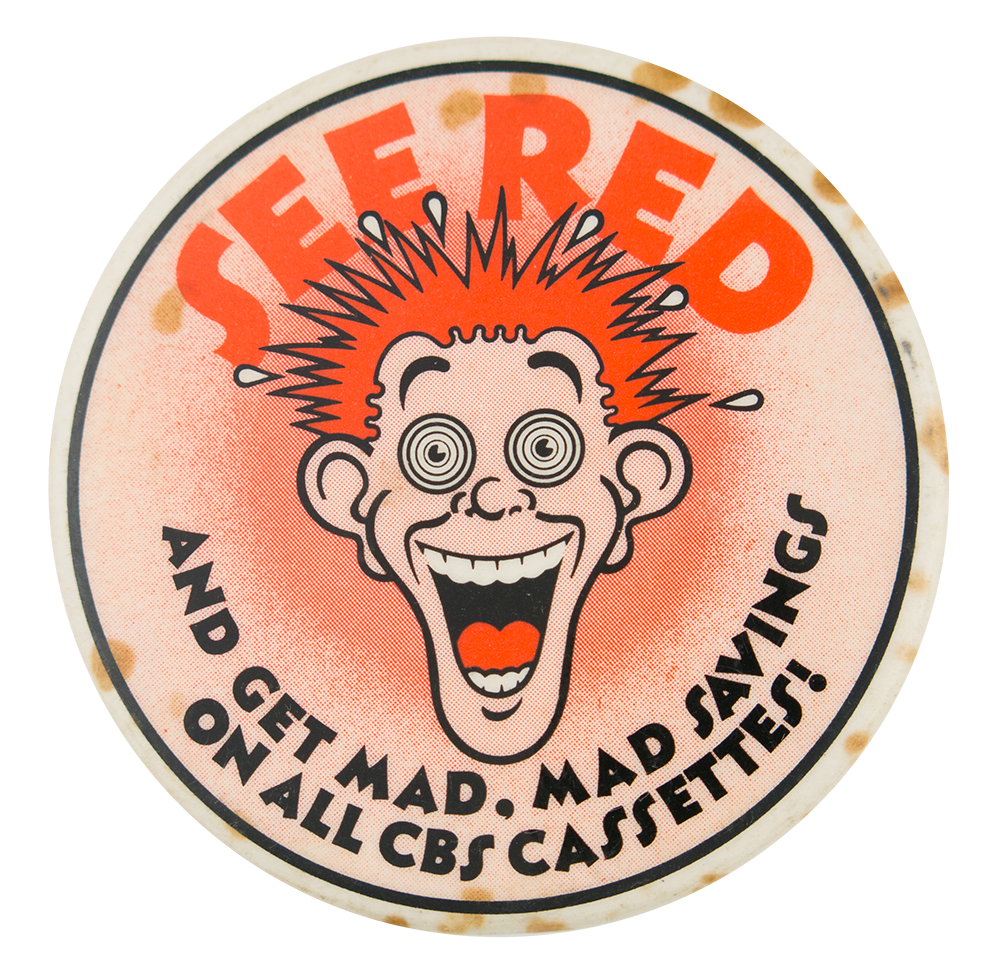
Text on Button SEE RED AND GET MAD MAD SAVINGS ON ALL CBS CASSETTES!
Image Description

Illustration of a face with a big open mouth spiral eyes and red-orange hair with red text above and black text below on a white background

Back Style
The Shape
The Size
Year / Decade Made
Additional Information

CBS Records ran a "red" advertising campaign in 1983 that included any of their cassettes with a spine title written in red to be marked down at participating retailers, such as Sam Goody and Discomat. National commercials aired on television, including such channels as MTV, and featured a red-headed cartoon man with swirly black and white eyes who would go from cartoon to live action while shouting a promotional phrase, “See red and get mad, mad savings!” CBS Records was purchased by the Sony Corporation and a legal name change was made in October, 1990.

Sources

Sony Corporation. (n.d.). Chapter22 CBS/Sony Records is Established in First Round of Capital Deregulation. Retrieved June 26, 2020, from https://www.sony.net/SonyInfo/CorporateInfo/History/SonyHistory/2-22.ht…

Wells, Russell. [rwells265]. (1983). CBS records - 1983 “red letter” sale. [Video].  YouTube. https://www.youtube.com/watch?v=pBukTzNFzLA

Catalog ID AD0833

Reddy Kilowatt Your Electric Servant

Category
Additional Images
Sub Categories
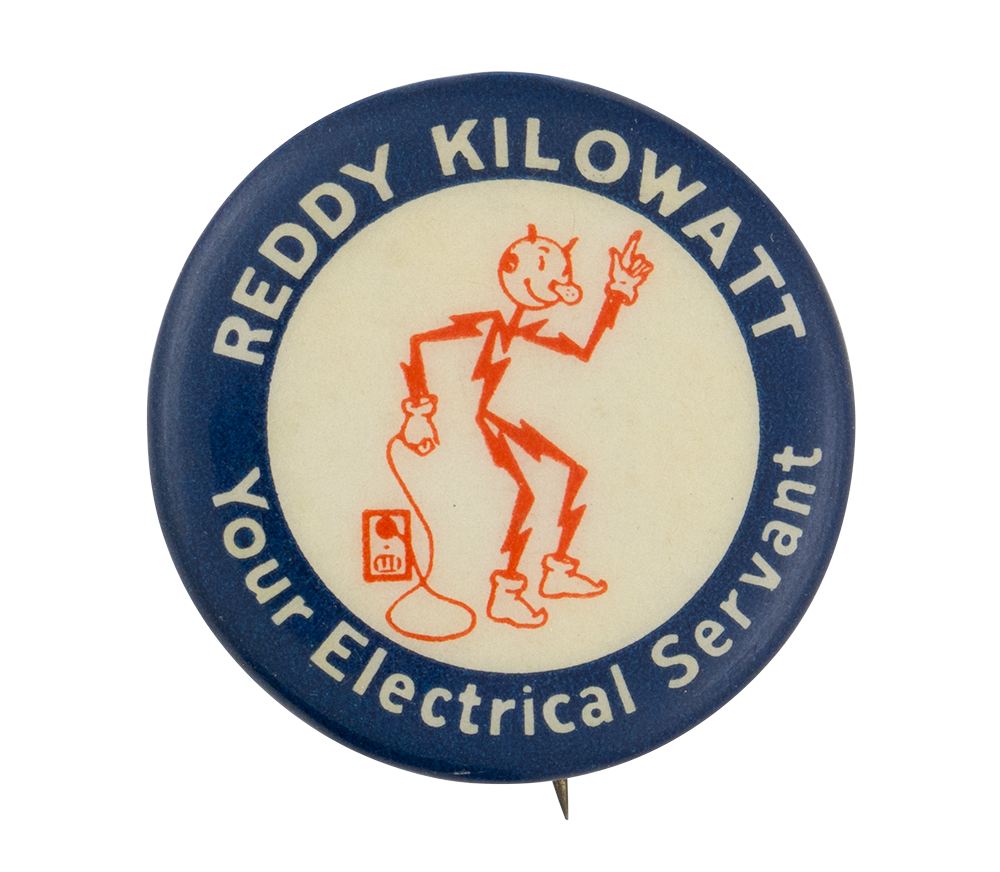
Text on Button REDDY KILOWATT Your Electrical Servant
Image Description

White text on an outer blue edge with a red illustration of Reddy Kilowatt on a white background

Back Style
The Shape
The Size
Additional Information

Created in 1926 by American inventor and marketer, Ashton B. Collins Sr., Reddy Kilowatt is a corporate mascot for power companies across the globe. Having a a torso and limbs made of lightning, a light bulb for a nose, and wall outlets for ears, Reddy was designed to represent electricity as a safe and necessary utility. Reddy made his first appearance in an advertisement for the Alabama Power Company (APC). At the time, Collins Sr. served with the company as their commercial manager. The character would go on to find rapid success. Not only did numerous power companies employ Reddy as their mascot, but the character would also be featured in coloring books, comics, and cartoons. Though Reddy has seen a definite decline in popularity as a mascot of electrical generation, the characters likeness in collectibles and memorabilia remains popular to collectors. 

Sources

Infanzon, V. (March 30, 2017). Whatever happened to Reddy Kilowatt? Duke Energy. https://illumination.duke-energy.com/articles/whatever-happened-to-reddy-kilowatt-5332515

Guide to Reddy Kilowatt. (n.d.). Smithsonian Online Virtual Archives. Smithsonian Institution. Retrieved November 25, 2024, from https://sova.si.edu/record/nmah.ac.0913

Catalog ID AD0802