I Love Me

Category
Additional Images
Sub Categories
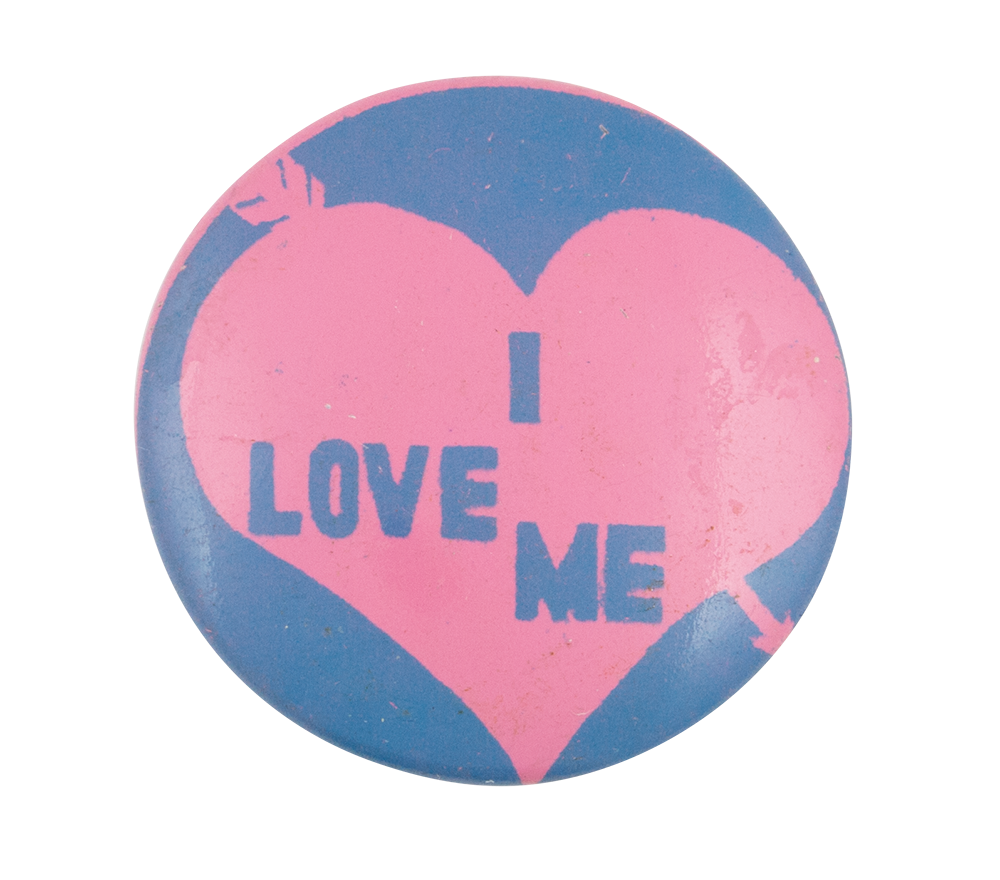
Text on Button I LOVE ME
Image Description

Blue text on a pink heart on a blue background

Back Style
The Shape
The Size
Additional Information

The original form of the "I heart" and "I love" logos was the I heart NY logo created in 1977 by Milton Glaser for an ad campaign created by advertising agency Wells Rich Greene. The marketing campaign was sought by then-Deputy Commissioner William S. Doyle to increase tourism in the state of New York. The campaign was a wild success. The original sketch of the logo is permanently on display at the MOMA.

The "I love" and "I heart" logos have become iconic in pop-culture and have been imitated in many forms around the world, like on this button promoting self-love.  

Have info on this button? Contact us here.

Catalog ID IL0109

I Love Davy

Category
Additional Images
Sub Categories
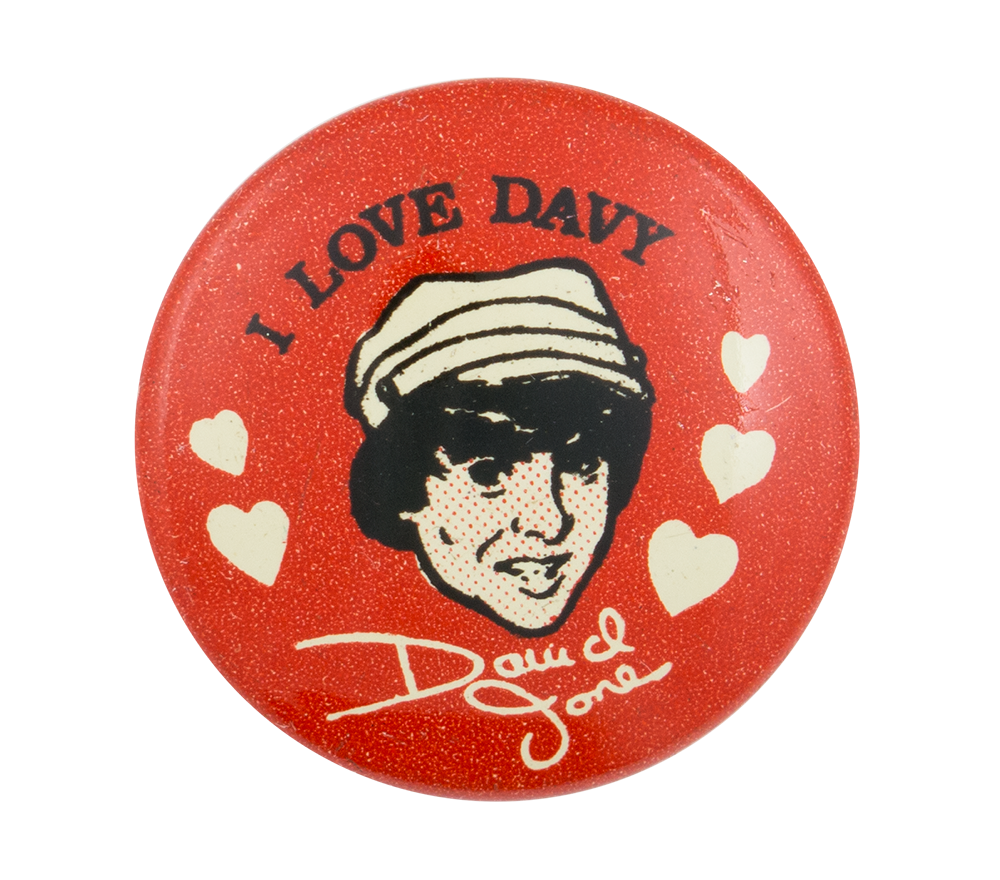
Text on Button I LOVE DAVY David Jones
Image Description

Black and white text on a red background with an illustration of a man's head with black hair and a hat

Curl Text illegible SCREEN GEMS INC.
Back Style
The Shape
The Size
Additional Information

Davy Jones was an English actor and musician popular in the 60's and 70's. He came to the United Sates and was part of the band The Monkees.  He appeared with his band members on the television show, The Monkees. The show was full of slap-stick comedy and music. Jones wrote and performed many songs on the show and his biggest hit was Daydream Believer. The band split in 1971, however Jones continued to perform, write songs and act until his death in 2012.

Catalog ID IL0108

Keep Youthful with Milk

Category
Additional Images
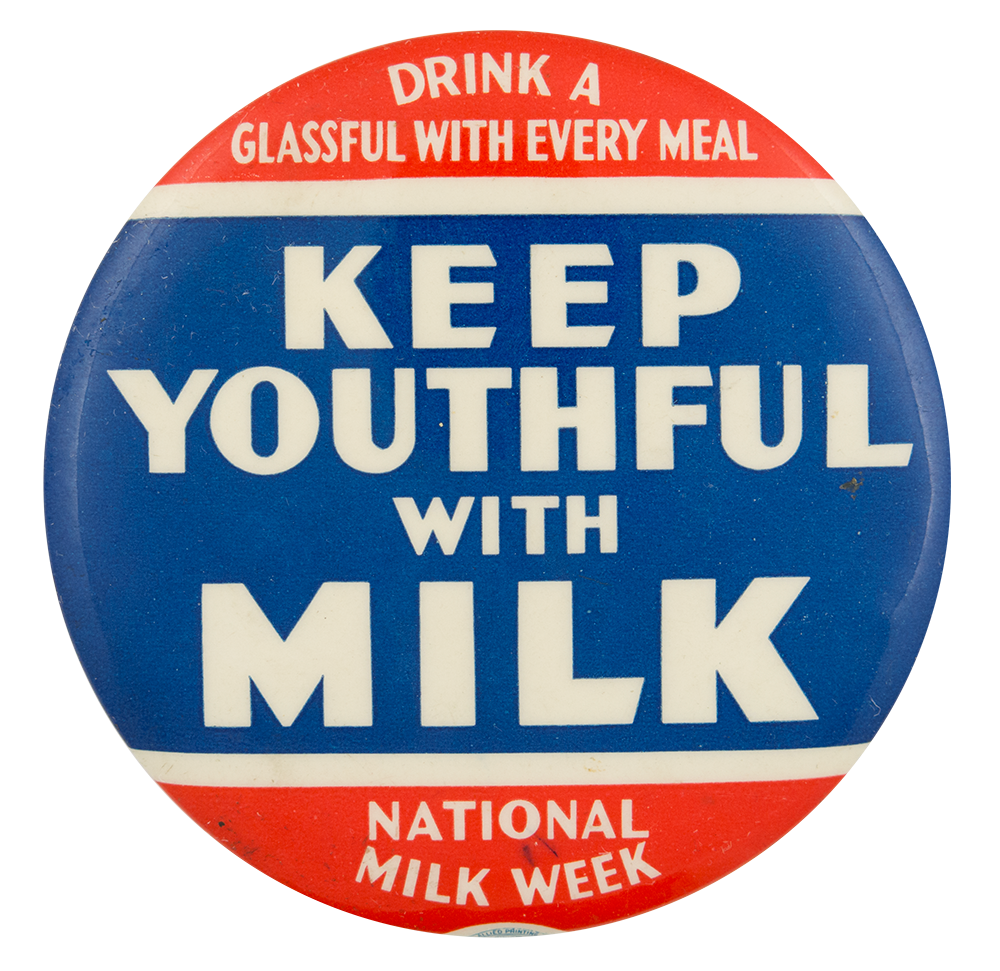
Text on Button DRINK A GLASSFUL WITH EVERY MEAL KEEP YOUTHFUL WITH MILK NATIONAL MILK WEEK
Image Description

White text over a red, white and blue background

Curl Text union bug
Back Style
The Shape
The Size
Additional Information

The first National Milk Week took place on November 14th through 20th, 1937. A joint project of the National Milk Producers Federation and the Milk Industry Foundation, the publicity campaign sought to increase milk consumption in the United States and to educate the public about the beverage's health benefits. 

Alongside the usual publicity buttons and print ads, the Milk Week campaign recruited newspaper columnists and government officials to tout the nutritional benefits of milk. Popular movie stars posed for posters while drinking the beverage. A train station in Boston honored the week by temporarily housing two cows in its outdoor concourse. The cows were milked twice a day in full view of commuters, to whom the milk was later sold.

In the years that followed, National Milk Week was eclipsed by June Milk Month, which was founded in the same year and which remains in place to this day.

Sources

B. & M.'s North Station to house dairy "farm". (1937, November 6). Railway Age, 103(19), p. 658. Retrieved from https://books.google.com

The Dairy Alliance. (n.d.). June Dairy Month. Retrieved from https://thedairyalliance.com/june-dairy-month/

Promotion milk drive. (1937, November). Crowley's Producers' Bulletin, 3(5), 11. Retrieved from https://books.google.com

Catalog ID EV0491

Boy Meets Girl Girl 2534

Category
Additional Images
Sub Categories
Text on Button BOY MEETS GIRL GIRL 2534 JAMES CAGNEY PAT O'BRIEN THE LAUGH HIT OF THE YEAR NOW ON SCREEN
Image Description

Blue text around a blue illustration of a man and a woman on an orangish background.

Back Paper / Back Info

BASTIAN BROS. CO. MFRS OF RIBBON, METAL AND CELLULOID NOVELTIES ROCHESTER, NY

Curl Text BASTIAN BROS. CO. ROCHESTER, NY union bug
Back Style
The Shape
The Size
Year / Decade Made
The Manufacturer
Additional Information

This button promoted the premiere of the 1938 movie Boy Meets Girl, an adaptation of the 1935 stage play with the same name. Produced by Warner Brothers Studios and directed by Lloyd Bacon, Boy Meets Girl starred James Cagney and Pat O'Brien. It tells the story of two Hollywood screenwriters who cast a pregnant studio waitress' baby in a Western movie. When the lead actor dislikes having a baby as a co-star, the screenwriters plot a scheme to have the waitress seduced and whisked away from show business. The phrase "Girl 2534" was most likely a serial or raffle number used in promotional activities.

Sources

Boy Meets Girl (1938) - Overview. (2018). Retrieved August 15, 2018, from http://www.tcm.com/tcmdb/title/61/Boy-Meets-Girl/

My Forever Treasures. (2017). VINTAGE “BOY MEETS GIRL” 1938 PROMOTIONAL FILM PINBACK WITH JAMES CAGNEY, MARIE WILSON AND PAT O’BRIEN. Retrieved August 17, 2018, from http://myforevertreasures.com/vintage-boy-meets-girl-1938-promotional-f…

Catalog ID EV0490

Sixteen Pages of Comics

Category
Additional Images
Sub Categories
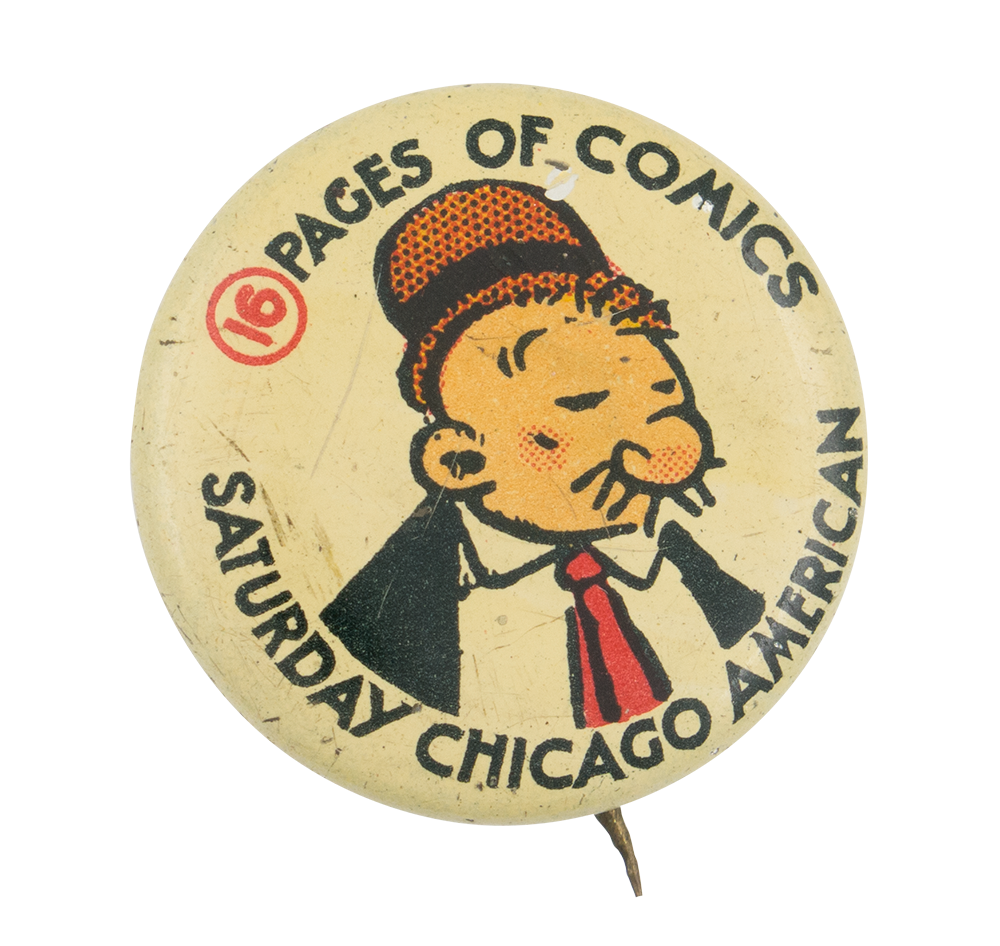
Text on Button 16 PAGES OF COMICS SATURDAY CHICAGO AMERICAN
Image Description

Blue text above and below an illustration of a man in a brown hat and a blue suit with a red tie on a white background

Back Paper / Back Info

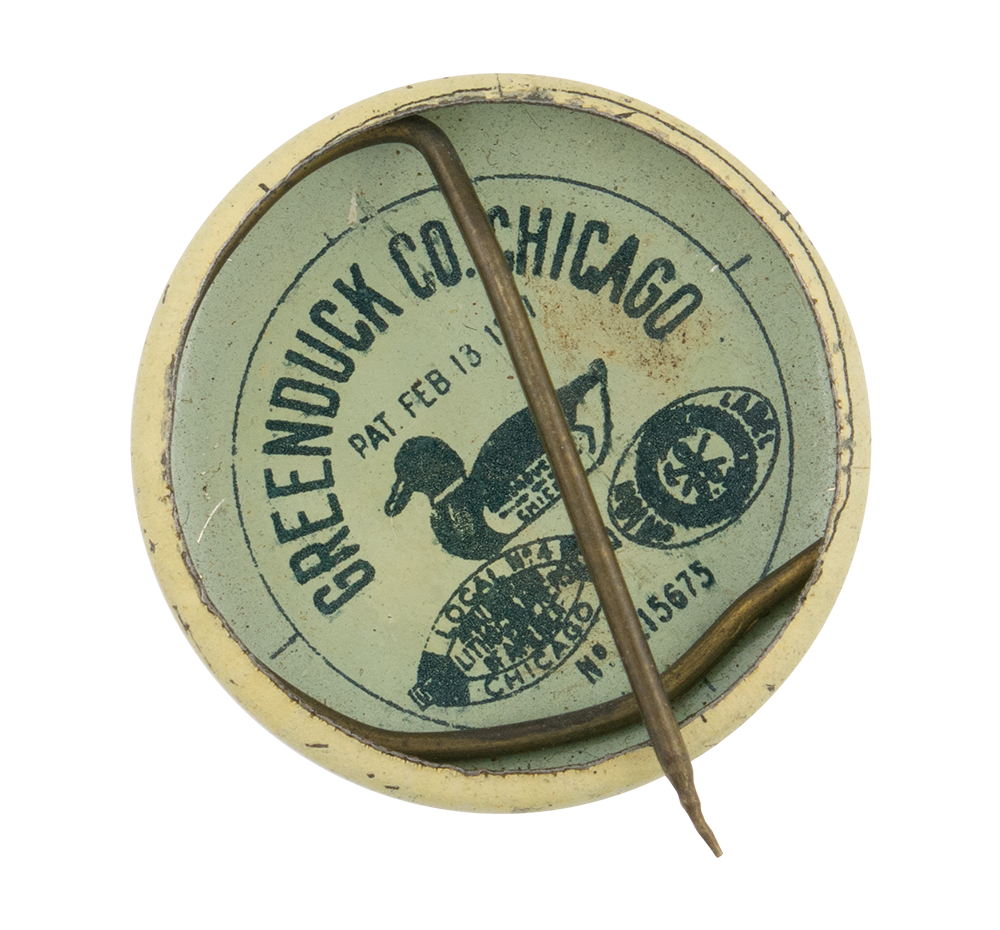
GREENDUCK CO. CHICAGO
PAT FEB 13 1817

Back Style
The Shape
The Size
Year / Decade Made
The Manufacturer
Additional Information

The Chicago American was an afternoon newspaper founded in 1900 under the title "Hearst's Chicago American", which ran until 1974 when the rising popularity of TV ran it out of business.

In the 1930s the newspaper ran a series of buttons advertising the Saturday comics, featuring characters from popular strips including Betty Boop, Popeye, Buck Rogers, and Popeye's companion Wimpy, pictured here. J. Wellington Wimpy was one of the main characters in the Popeye comic strip, playing the "straight man" to Popeye and best known for his irresponsible financial decisions and love of hamburgers. E. C. Segar, creator of the strip based Wimpy on his first boss William Schuchert, manager of the Chester Opera House.

Sources

Murray, George. (1965). The Madhouse on Madison Street (Chicago: Follett).

Grandinetti, Fred. (2003). Popeye: an Illustrated Cultural History. (Jefferson, NC: McFarland & Co). pp. 5–6.

Catalog ID EN0468

Saturday Daily News Dan Durin

Category
Additional Images
Sub Categories
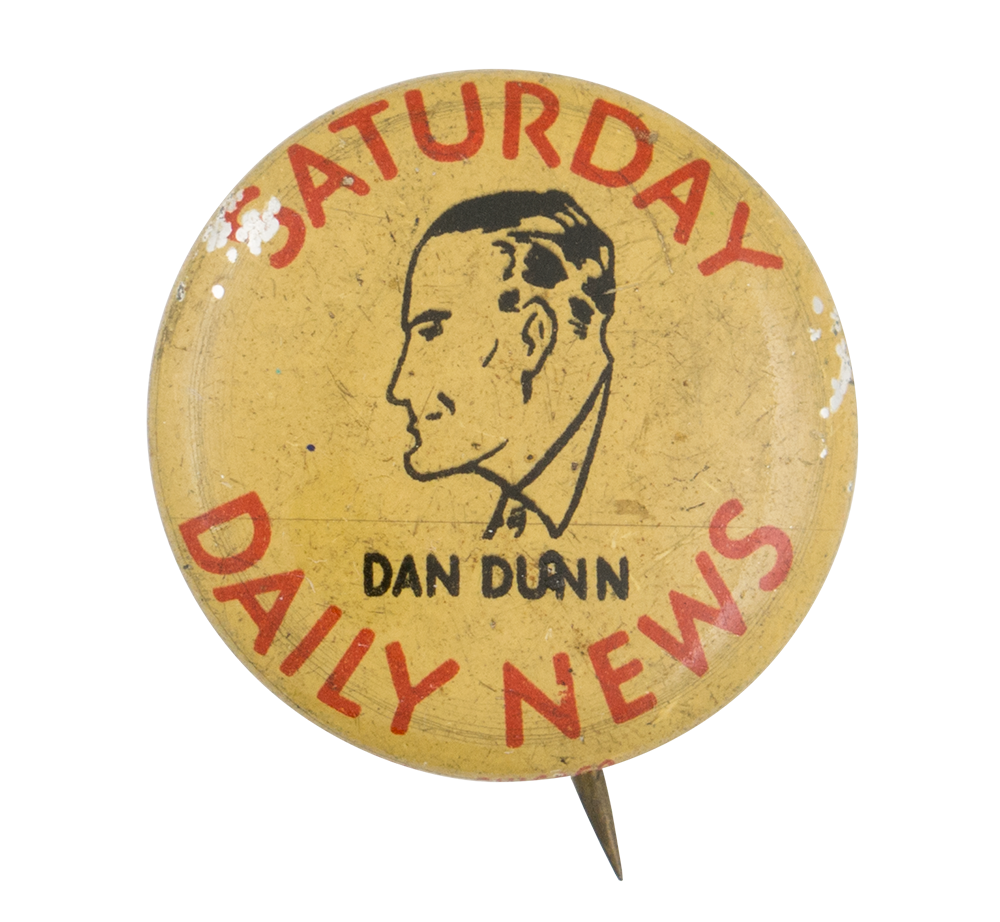
Text on Button SATURDAY DAILY NEWS DAN DURIN
Image Description

Red and blue text around an illustration of a man's head

Curl Text LOU FOX CHICAGO
Back Style
The Shape
The Size
The Manufacturer
Additional Information

Dan Dunn was a fictional detective created by Norman Marsh in the 1930s. The comic book Dan Dunn, Secret Operative 48 became a daily newspaper comic strip in 1933 and ran through 1943. "The Saturday Daily News" button set from the 1940s featured characters from their newspaper comic strips including Li'l Abner, Apple Mary, Mutt and Jeff, and Dan Dunn.

Sources

Dan Dunn. (2018). Retrieved from https://en.wikipedia.org/wiki/Dan_Dunn

Saturday Daily News Pinbacks (n.d.). Retrieved from http://www.marklansdown.com/pinbacks/pages/saturdaydailynews.html

Catalog ID EN0467

Textile Workers Union of America

Category
Additional Images
Sub Categories
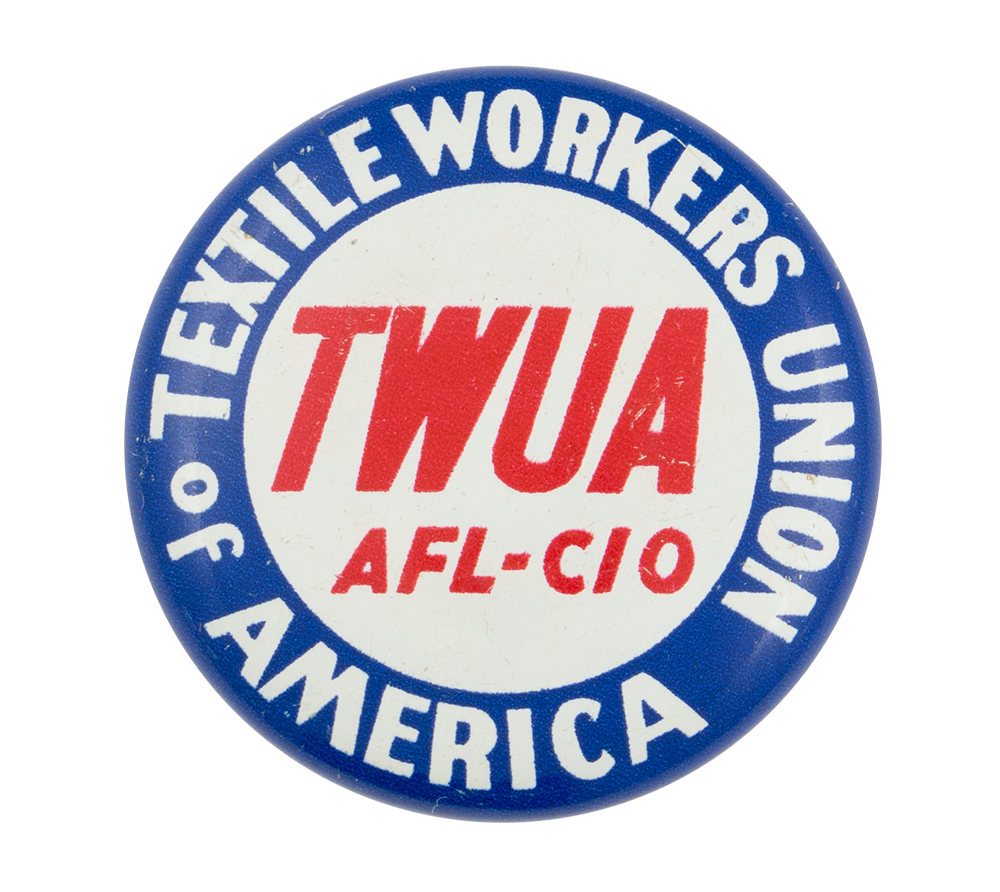
Text on Button TEXTILE WORKERS UNION of AMERICA TWUA AFL-CIO
Image Description

Red text on a white circle with an outer blue edge with white text on it

Back Paper / Back Info

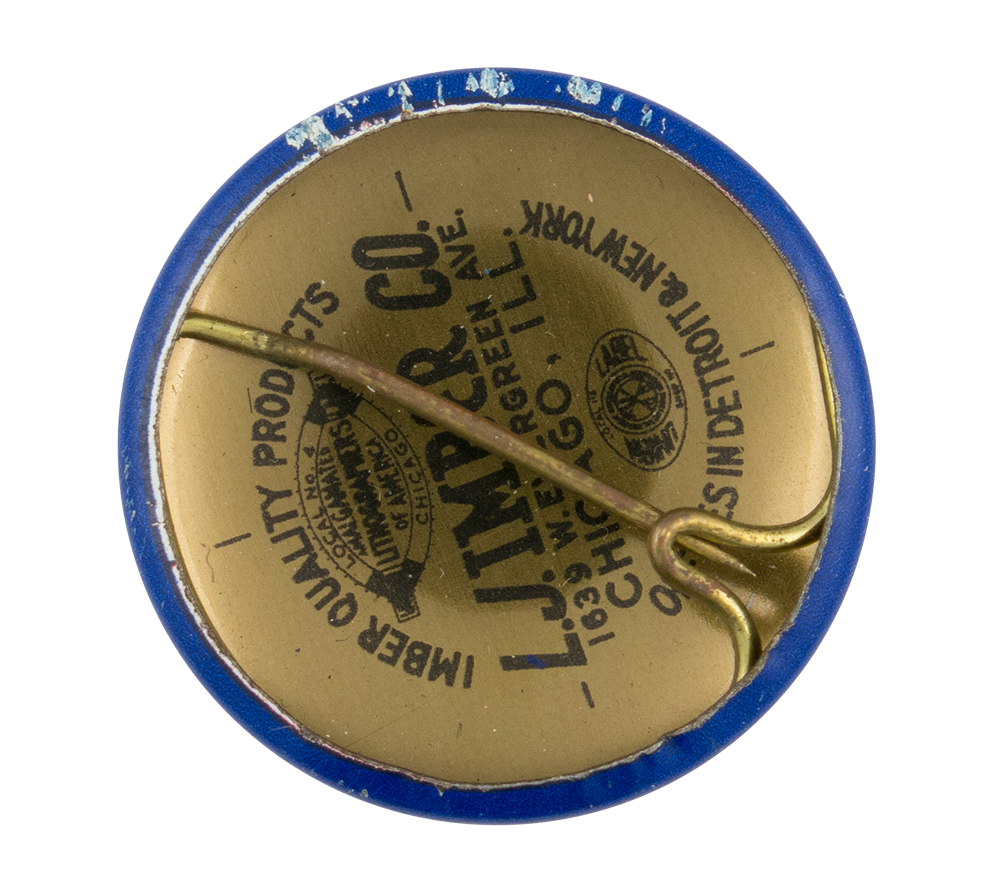
IMBER QUALITY PRODUCTS
L.J. IMBER CO.
1639 W. EVERGREEN AVE.
CHICAGO, ILL
OFFICES IN DETROIT & NEW YORK

Back Style
The Shape
The Size
The Manufacturer
Additional Information

The Textile Workers Union of America (TWUA) was founded in 1939 when the United Textile Workers of America (UTW) and the Textile Workers Organizing Committee (TWOC) merged. The TWUA campaigned for higher wages, safer working conditions, and better health insurance and benefits for textile workers working in southern America. They were a driving force behind Operation Dixie in 1946, a post-World War II campaign to unionize industry in the south that persisted until 1954, but was ultimately unsuccessful. TWUA officially dissolved in 1976, when they merged with the Amalgamated Clothing Workers of America to form the Amalgamated Clothing and Textile Workers Union (ACTWU).

Catalog ID CL0471

South Shore Improvement Association

Category
Additional Images
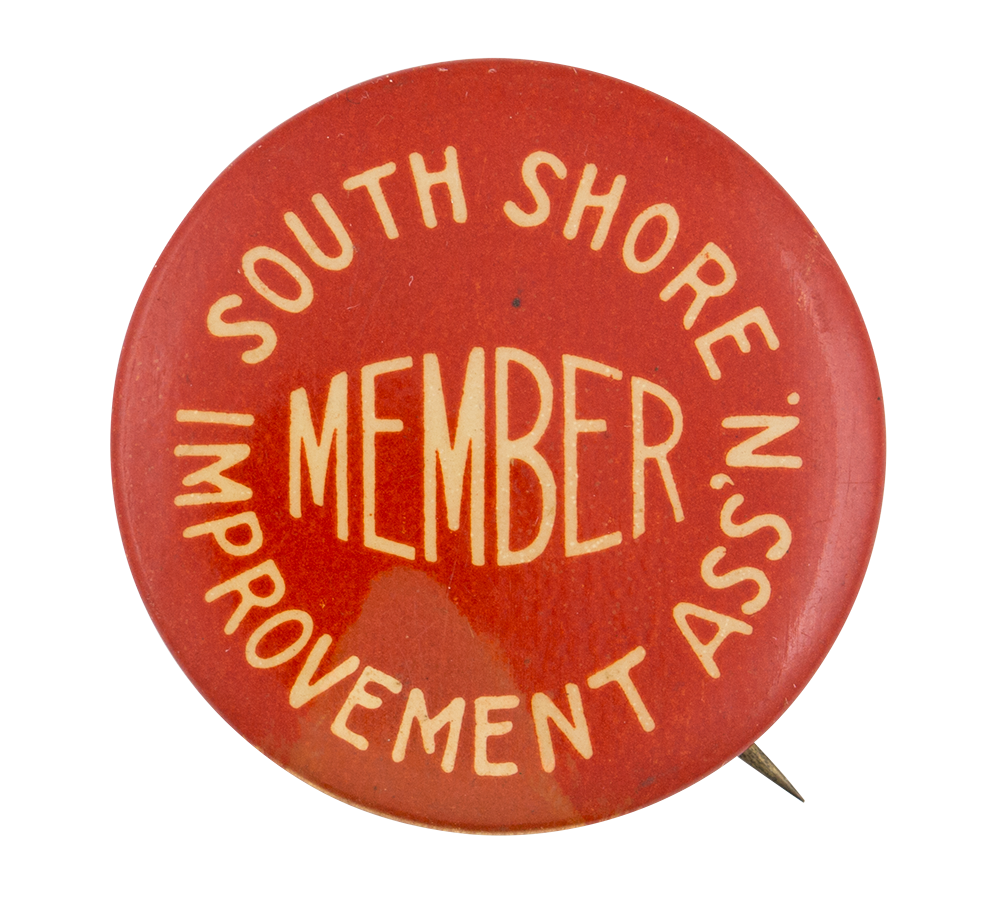
Text on Button SOUT SHORE IMPROVEMENT ASS'N. MEMBER
Image Description

White text on a red background

Back Style
The Shape
The Size
Additional Information

The South Shore Improvement Association was founded May 18, 1925, to oversee and improve the south shore beach of Lake Michigan and the South Shore Sub-division that boarders the beach in Lake County, Indiana. The beach offers swimming, sunning, boating, and hiking. The association maintains a children’s playground and park area.

Sources

South Shore Improvement Association (2020). Retrieved June 27, 2020, from http://southshoreia.org/

Catalog ID CL0470

Kellogg's Baseball School

Category
Additional Images
Sub Categories
Text on Button Kellogg's BASEBALL SCHOOL Kellogg's CORN FLAKES
Image Description

White button with illustrations of red stitches like a baseball with red text on top and green text in the middle and an illustration of a box of cereal

Curl Text PARISIAN NOVELTY CO. CHICAGO
Back Style
The Shape
The Size
Year / Decade Made
The Manufacturer
Additional Information

In the 1930s, in order to compete with General Mills’ Wheaties endorsement of major league players, Kellogg’s had begun to offer baseball tips on their Corn Flakes cereal. The tips offered advice on techniques and positions written by former Major League player and manager Lew Fonseca. In 1937 Kellogg’s copyrighted the term Kellogg’s Baseball School, and Fonseca was listed as the director of the school program. Kellogg’s provided, "bats, balls, and catcher’s equipment, but all candidates for other positions [were] urged to bring their own gloves."

In 1937, Kellogg’s ran their first trial of the school in Chicago, and over 40,000 children participating over a ten-week period across various playgrounds in the city. 20,000 people attended the championship game. In 1938, the schools expanded to include other cities, and the instructor roster also expanded to include the likes of former managers and players such as Connie Mack, Jack Coombs, John Barker, and Ira Thomas. Although the schools only ran between 1937 and 1938, the promotional stunt proved to be very successful, as evident in its popularity and attendance.

Sources

How the 1938 Lew Fonseca Kellogg’s Box Panels Helped Build a Baseball School. (2017, August 15). Pre-War Cards. Retrieved 21 March 2024 from https://prewarcards.com/2017/08/15/1938-lew-fonseca-kelloggs-box-panels…

School for Baseball Players Here Today. (1938, July 22). The Gazette and Daily (York, Pennsylvania), p. 8.

Catalog ID SC0042