I LIke Work

Category
Additional Images
Sub Categories
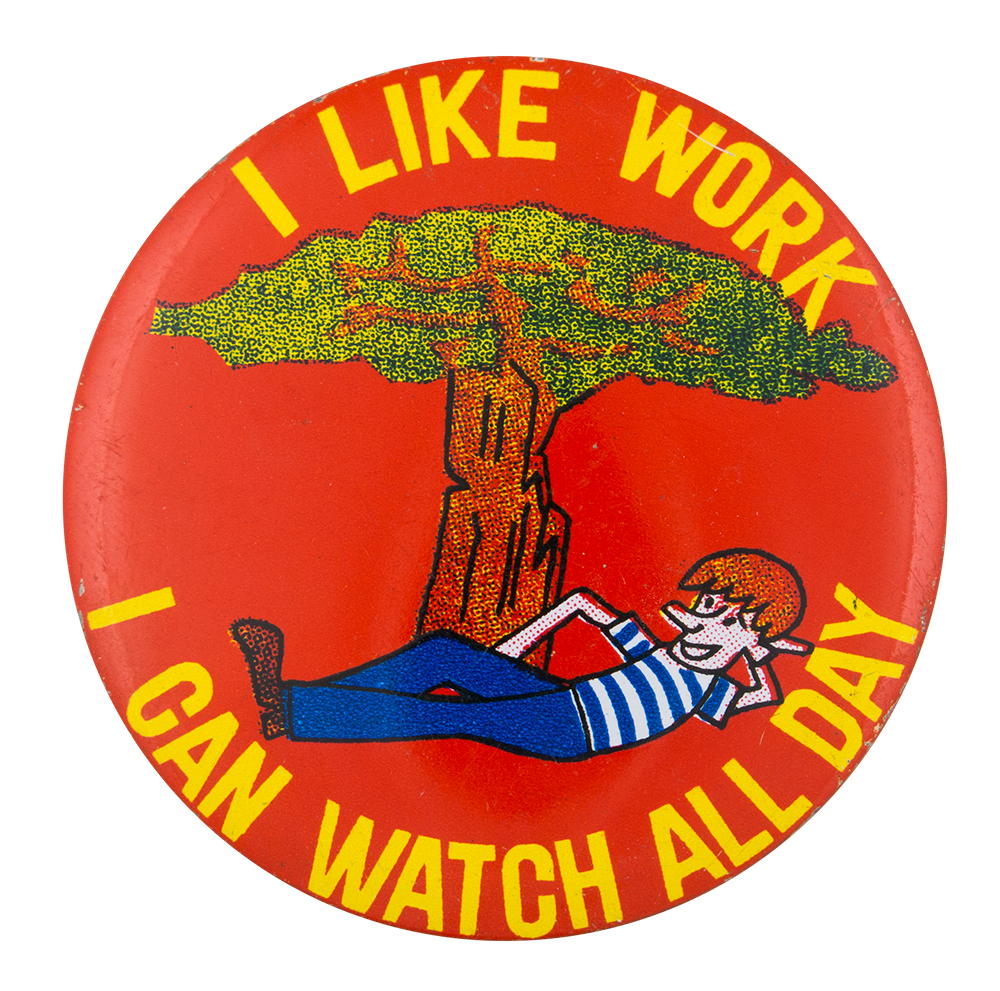
Text on Button I LIKE WORK I CAN WATCH ALL DAY
Image Description

Illustration of a person laying on the ground under a tree with yellow text on a red background

Back Style
The Shape
The Size
Additional Information

In 1889, Jerome K. Jerome, an English writer, published a humorous travelogue called Three Men in a Boat (To Say Nothing of the Dog) featuring characters based on himself and two friends. It depicted a fictional two-week boating vacation along the Thames River round-trip between Kingston and Oxford with Jerome's (fictional) dog, Montmorency. This book was so popular it inspired several theatrical and film adaptations, various retellings in print, and art. Jerome created a sequel, Three Men on a Bummel (1900), known as Three Men on Wheels, about cycling in Germany. 

Jerome wrote, “I like work: It fascinates me. I can sit and look at it for hours. I love to keep it by me: the idea of getting rid of it nearly breaks my heart.” This quote turned into an Australian catch phrase beginning in 1950. It was shortened to “I like work: I can watch it all day.” This saying was extremely popular during the 1970s and 1980s, and it became a part of British and American jargon, as well.

Sources

Partridge, E. (2003). A dictionary of catch phrases: British and American, from the sixteenth century to the present day. Ukraine: Taylor & Francis. https://www.google.com/books/edition/A_Dictionary_of_Catch_Phrases/YcWH…

Popik, B. (2016, September 16). "I love hard work. I could watch it all day". https://www.barrypopik.com/index.php/new_york_city/entry/i_love_hard_wo…

Three Men in a Boat. (2021, April 22). In Wikipedia. https://en.wikipedia.org/w/index.php?title=Three_Men_in_a_Boat&oldid=10…
 

Catalog ID HU0135

I Choose Booze

Category
Additional Images
Sub Categories
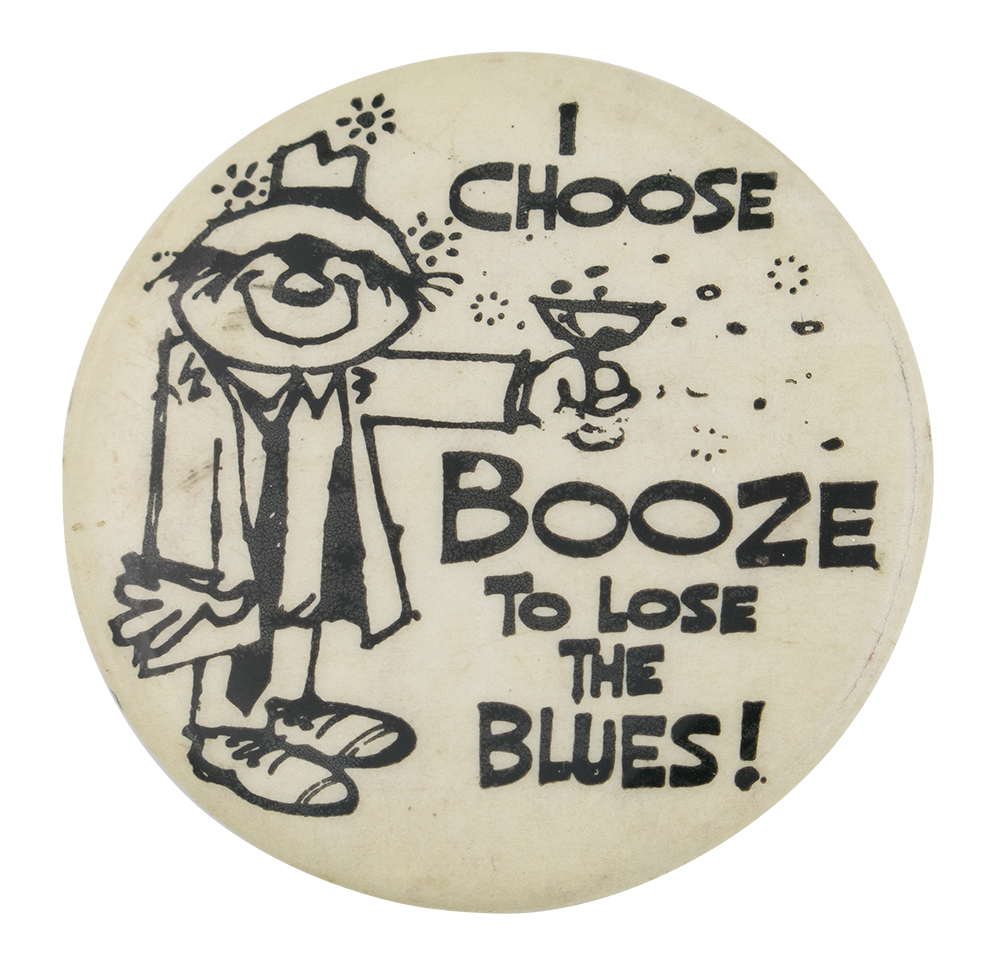
Text on Button I CHOOSE BOOZE TO LOSE THE BLUES!
Image Description

Illustration of a person wearing a hat and suit holding a drink with black text on a white background

Curl Text copyright Vagabond 2116 West Carrollton Ohio U.S.A.
Back Style
The Shape
The Size
Additional Information

Have info on this button? Contact us here. 

Catalog ID HU0133

I am so Smart

Category
Additional Images
Sub Categories
Text on Button I AM SO SMART I MAKE MYSELF SICK gardner copyright 1955
Image Description

Black illustration of a person sitting at a desk wearing glasses and a black hat over black text on a white background

Back Paper / Back Info

union bug

Back Style
The Shape
The Size
Year / Decade Made
Additional Information

Created by American cartoonist, playwright, and artist, Herb Gardner, The Nebbishes was a syndicated comic strip that was originally picked up by the Chicago Tribune and later syndicated to 60-75 major newspapers across the country. Running on Sundays from 1959-1961, the strip features characters called Nebbishes, which are small white blob-like creatures who often spoke with humorous self-deprecating mottos and sayings. Prior to the comic strip being picked up, the characters were already popular from their appearances on cards, napkins, and wall decorations. Gardner has mentioned in interviews that he used the name Nebbishes because in Yiddish, "nebbish" means an insignificant, pitiful person.

Catalog ID HU0134

Girls Athletic Supporter

Category
Additional Images
Sub Categories
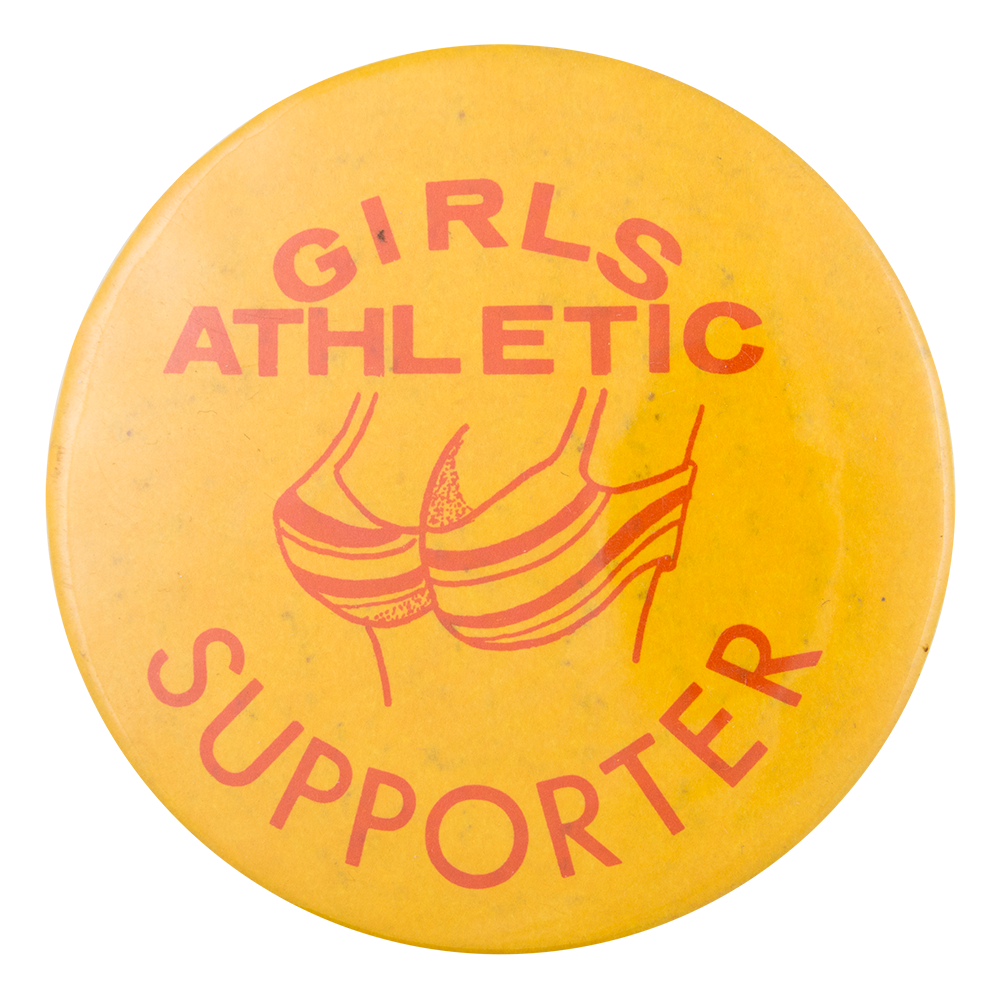
Text on Button GIRLS ATHLETIC SUPPORTER
Image Description

Red illustration of the upper torso of a woman wearing a bra with red text above and below on a yellow background

Back Paper / Back Info

BADGE-A-MINIT LASALLE ILL. 61801

Back Style
The Shape
The Size
The Manufacturer
Additional Information

The humor seen here relies on double entendre: traditionally, a “supporter” was an undergarment for male athletes—jockstraps, colloquially—but this button humorously applies it to women, suggesting a bra as the equivalent. Serving as a cheeky, playful, and occasionally raunchy pun about women from the mid-20th century (1950s–1980s), the image was especially popular as souvenirs, carnival prizes, or mail-order novelties. This was also a period when raising money or attention for girls’ sports teams or events could be difficult, since supporting women’s athletics was not as common. 

Two important events from the 1970s probably helped inspire this kind of joke. First, Title IX became law in 1972, banning sex discrimination in federally funded schools, which led to a boom in sports opportunities for girls and women. Then, in 1977, the first sports bra was invented by piecing together jockstraps, addressing a major need for female athletes. This invention, patented in 1979, paved the way for modern sports bras and appeared just as women’s sports participation took off in the years after Title IX. Both this legal change and the new sports bra fueled a dramatic increase in women’s involvement in sports at all levels, from high school competitions to the Olympics. 

Founded in 1971 by inventor Malcolm Roebuck, Badge-A-Minit was created to offer an affordable and easy way for people to design and produce pin-back buttons. Based in Oglesby, Illinois, this privately owned company helped to pioneer the button-making industry.

Sources

National Inventor Day. (2021, February 11). Home Badgeaminit. Facebook. Retrieved October 2, 2025, from https://www.facebook.com/photo.php?fbid=3502949976499706&id=351725691622166&set=a.352651204862948 

Bradley, E. (2018, October 23). Vintage pinback market remains vibrant. Kovels Antique Trader. Retrieved October 2, 2025, from https://www.antiquetrader.com/collectibles/pinback-buttons-market-remains-vibrant 

Freeman, J. (1974). Say it with buttons. Ms. Magazine. pp. 48-53, 75. Retrieved October 2, 2025, from https://www.jofreeman.com/buttons/saybuttons.htm?utm_ 

GAA - Girls Athletic Association. (2023). Vintage Kids Clubs Online Museum. Retrieved October 2, 2025, from https://www.vintagekidstuff.com/gga-girls-athletic-association 

Hennefeld, M. (2018, April 19). Comedy is part of feminist history—and we need it now more than ever. Ms. Magazine. Retrieved October 2, 2025, from https://msmagazine.com/2018/04/19/comedy-part-feminist-history-need-now-ever/ 

Women’s Sport Foundation. (2019, August 13). History of Title IX. Retrieved October 2, 2025, from https://www.womenssportsfoundation.org/advocacy/history-of-title-ix 

Leng, K. (2016). When politics were fun: Recovering a history of humour in U.S. feminism. 5, 1–21. Synoptique Blog. Retrieved October 2, 2025, from https://synoptiqueblog.wordpress.com/wp-content/uploads/2018/07/2-kirsten-leng-when-politics-were-fun-recovering-a-history-of-humour-in-u-s-feminism.pdf

National Museum of American History. (n.d.). JogBra. Retrieved October 2, 2025, from 

https://americanhistory.si.edu/collections/object/nmah_1461433 

Smithsonian Institution – Lemelson Center. (n.d.). Inventive minds: Inventors of the sports bra. Smithsonian Institution. Retrieved October 2, 2025, from https://invention.si.edu/invention-stories/inventive-minds-inventors-sports-bra 

Catalog ID HU0131

Fun to be a Nut

Category
Additional Images
Sub Categories
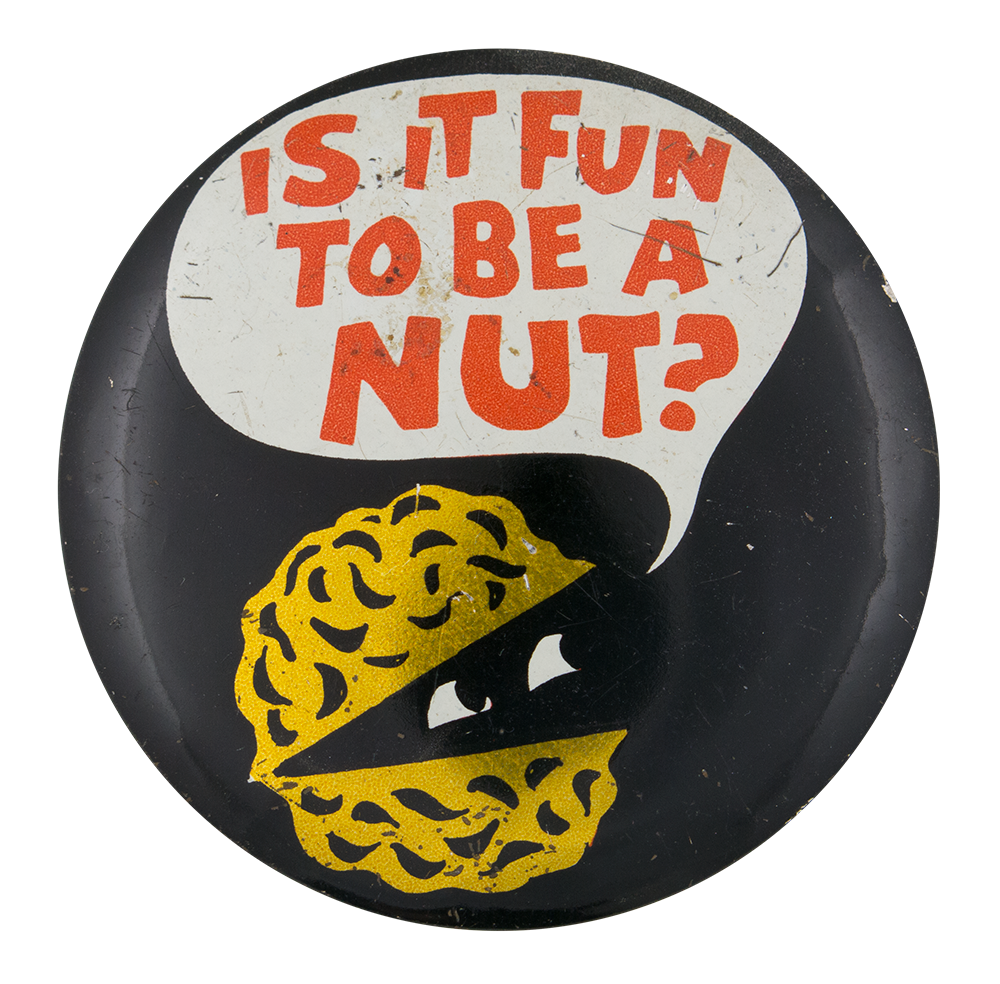
Text on Button IS IT FUN TO BE A NUT?
Image Description

Gold and black illustration of a walnut with eyes and a white speech bubble with red text on a black background

Back Style
The Shape
The Size
Additional Information

In 1938, the Topps company was born in Brooklyn, NY by Morris Shorin and his four sons. The family used Topps to distribute gum as a way to supplement their struggling tobacco business. The company quickly grew and in 1949, they entered the baseball card industry for which they are most known for. The company also manufactures other collectibles such as pinback buttons. Like other manufacturing companies, not every collectible will make it to full-scale production. Some of them will only run as test issues, making them rarer than the average collectible, and thus more desirable among collectors. 

Sources

Hake, T. (2017, March 17). "Smarty buttons" Topps file copy wrapper & button pair. Retrieved from https://www.hakes.com/Auction/ItemDetail/210918/SMARTY-BUTTONS-TOPPS-FI…

Topps. (n.d.). History. Retrieved February 16, 2020, from https://www.topps.com/history

Catalog ID HU0132

Democratic Women

Category
Additional Images
Sub Categories
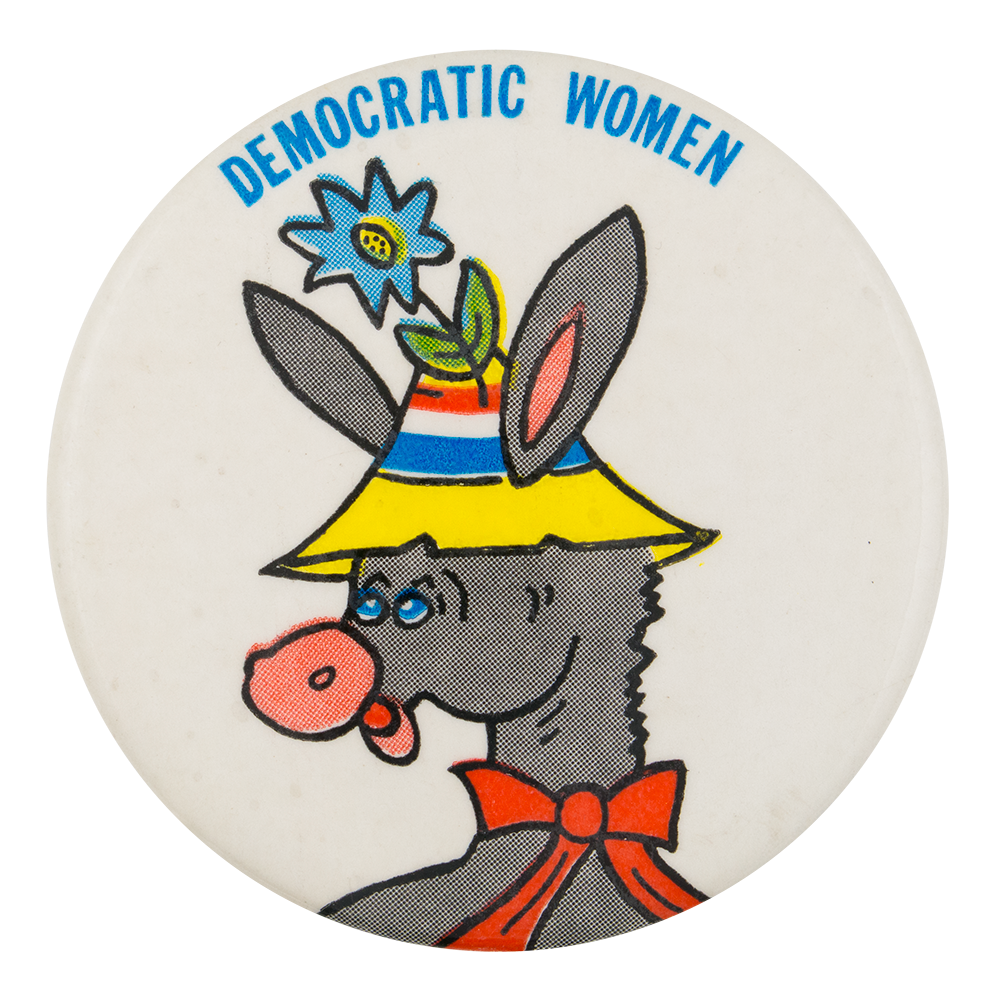
Text on Button DEMOCRATIC WOMEN
Image Description

Illustration of a grey donkey wearing a red ribbon around its neck and a yellow hat with a red, white and blue stripe and a blue flower with blue text on top on a white background

Back Style
The Shape
The Size
Additional Information

Created in support of Democratic Women, this style of illustration was typical during the 1960s and 70s.  The image of a donkey became associated with the Democratic party during the early 19th century. During this period of time, it was fashionable for women to wear hats to social functions.

In 1971, the National Federation of Democratic Women was formed. The organization's purpose is to unite Democratic women and encourage more political participation at every government level. From 1972-1977, the Federation was recognized by the Democratic National Committee as the official women's organization. The National Federation of Democratic Women received a seat on the DNC Executive Committee and three seats on the DNC.

Sources

National Federation of Democratic Women. (n.d.) History. https://www.nfdw.com/history

Catalog ID HU0124

Bullshit

Category
Additional Images
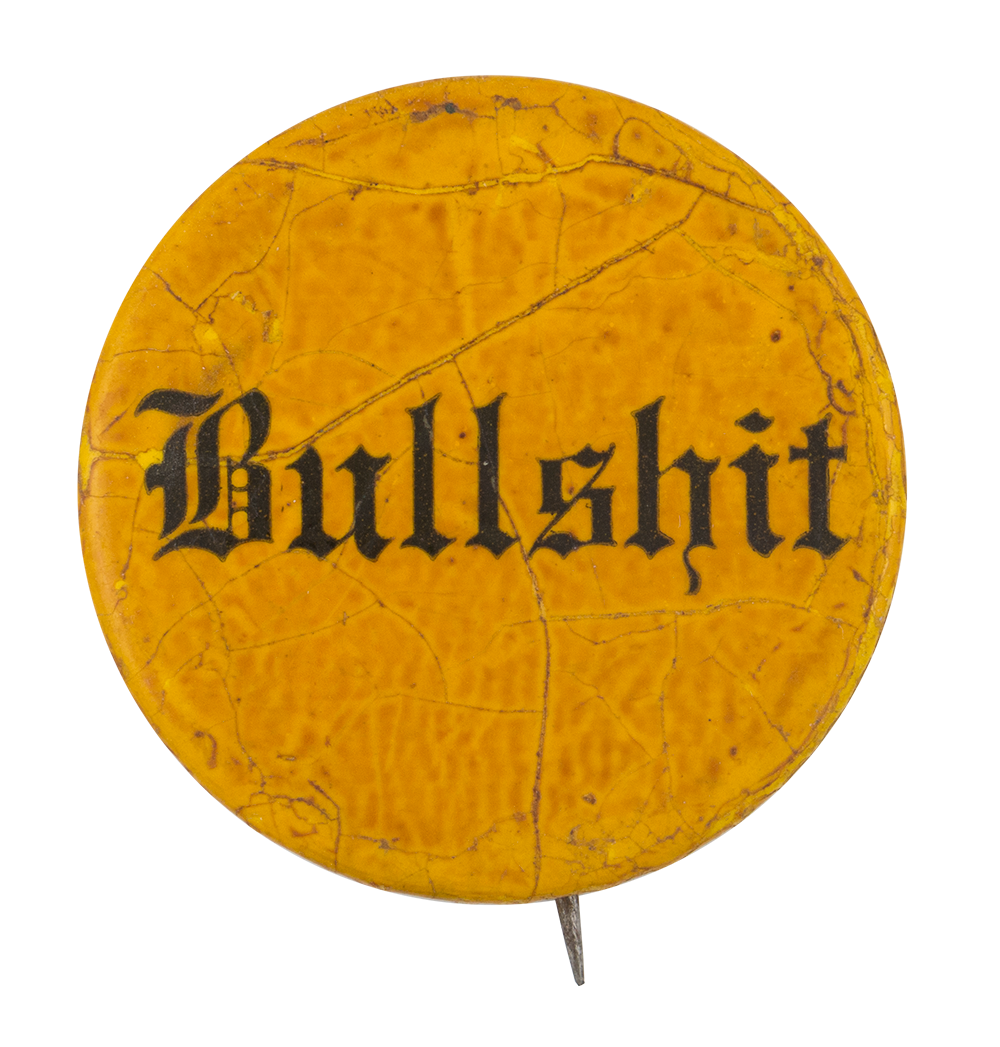
Text on Button Bullshit
Image Description

Black text on a yellow background

Back Style
The Shape
The Size
Additional Information

Bullshit is a curse word used to express disbelief in an event or piece of information presented as true when it is false. The first attested use of the term bullshit appears in a piece written by T.S. Eliot entitled, "The Triumph of Bullshit." It is a comic ballad in which Eliot preemptively criticizes himself and his works before his critics could. The term bullshit only appears in the title.

Sources
Catalog ID HU0011

Be Alert

Category
Additional Images
Sub Categories
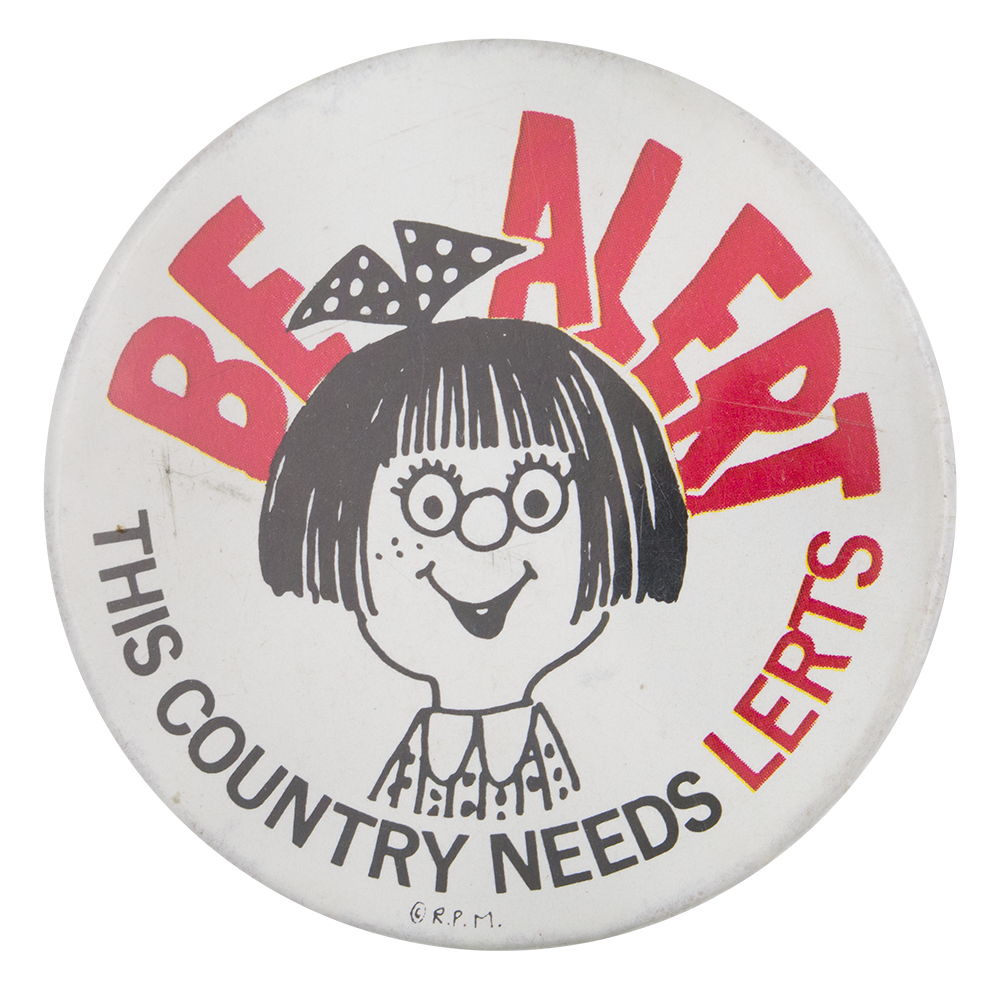
Text on Button BE ALERT THIS COUNTRY NEEDS LERTS copyright R.P.M.
Image Description

Black and white illustration of a child with big eyes, freckles and a black ribbon with polka dots in their hair with red text above an black text below on a white background

Back Style
The Shape
The Size
Additional Information

"Be Alert.  This Country Needs Lerts" is a play on words based on converting the adjective "alert" into the noun "lert" and the indefinite article "a."  The word "lert" has no meaning in English, and the wordplay was done for humorous effect.

The phrase may have origins from Great Britain during the Cold War, where posters in the London subway system warning citizens to "Be Alert" were allegedly defaced in a similar way.

Catalog ID HU0129

Small Red Heart

Category
Additional Images
Sub Categories
Image Description

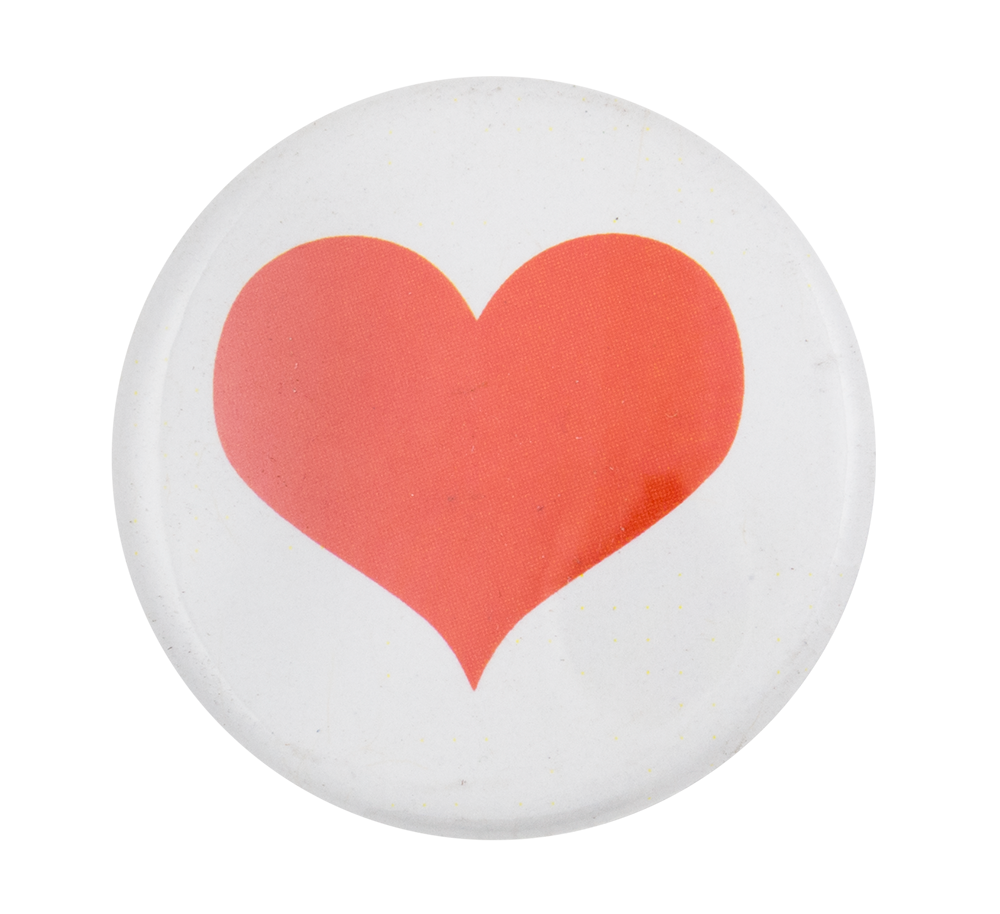
Illustration of a red heart on a white background

Back Style
The Shape
The Size
Additional Information

The heart shape is a graphic symbol representing an expression of love. The use of the heart shape originated in the Middle Ages, though it wasn’t used to symbolize love until the 15th century. Today, it is frequently used on romantic items and to  indicate a specific love of something.

Catalog ID IB0461