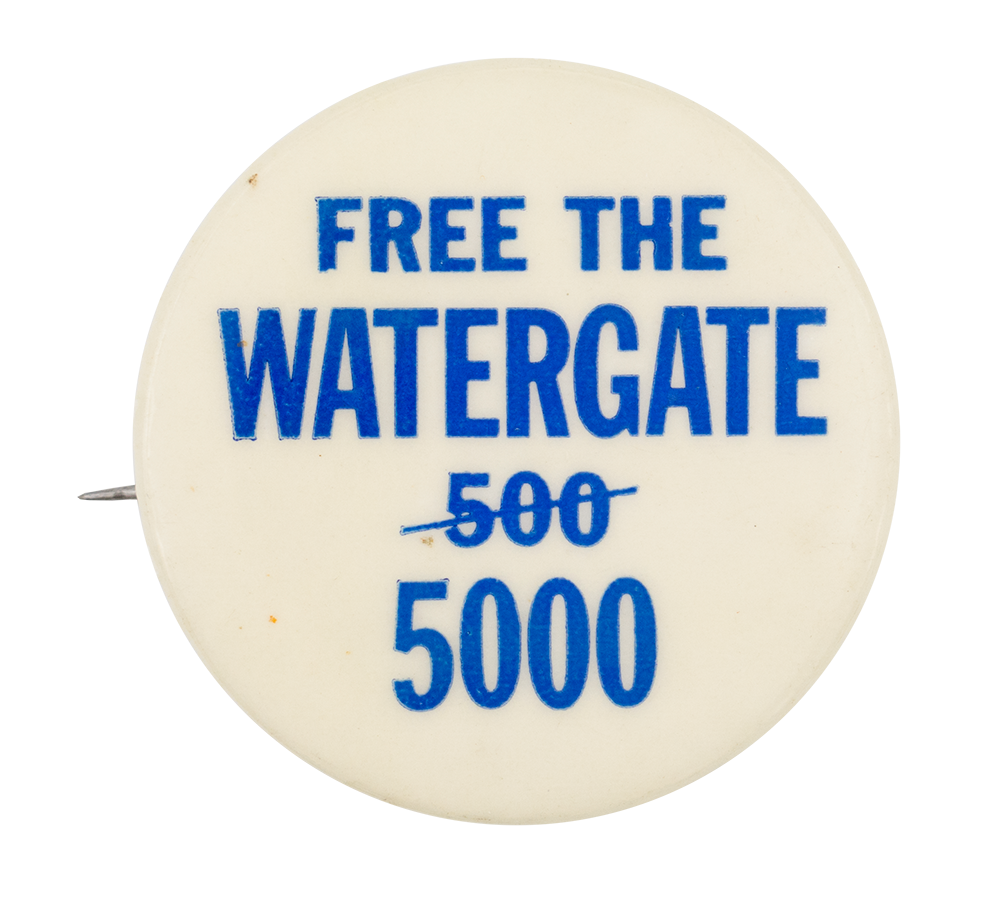
Free the Watergate 5000

Category
Additional Images
Text on Button FREE THE WATERGATE 500 5000
Image Description

Blue text on a white background

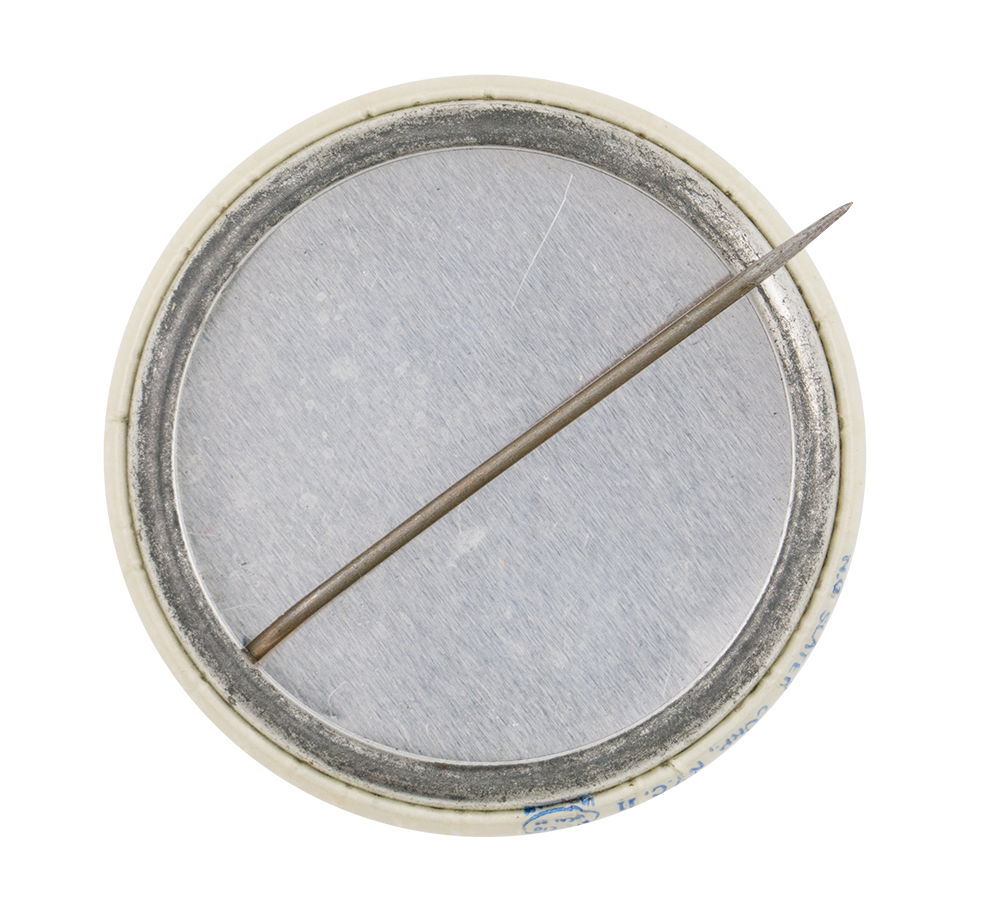
Curl Text N.G. SLATER CORP. N.Y.C. 11 union bug
Back Style
The Shape
The Size
The Manufacturer
Additional Information

In 1972, five men were caught breaking into the offices of the Democratic National Committee at the Watergate Complex in Washington, D.C.   The group was attempting to wire-tap phones and steal documents in order to assist the Republican party’s bid for re-election.  Organizers of this plan included G. Gordon Liddy, general counsel to the Committee for the Re-Election of the President (CRP).  The Watergate scandal and President Richard Nixon’s subsequent resignation was the result of an attempted cover-up these illegal activities. 

On January 5, 1974 President Nixon, claiming executive privilege, flatly refused to turn over more than 500 documents and tapes which were subpoenaed by the Senate Watergate Committee.  These included tape recordings made from conversations that took place in the oval office.  A host of pinback buttons and bumper stickers expressed the American public’s growing impatience with Nixon’s refusal to cooperate with the committee.  Buttons proclaiming “Free the Watergate 500” soon became “Free the Watergate 5000.”  Nixon was eventually forced by the Supreme Court to turn over the tapes, which proved so damaging that he was forced to resign on August 9, 1974, rather than face impeachment.

Catalog ID CA0459

Schreiber LaFollette

Category
Additional Images
Sub Categories
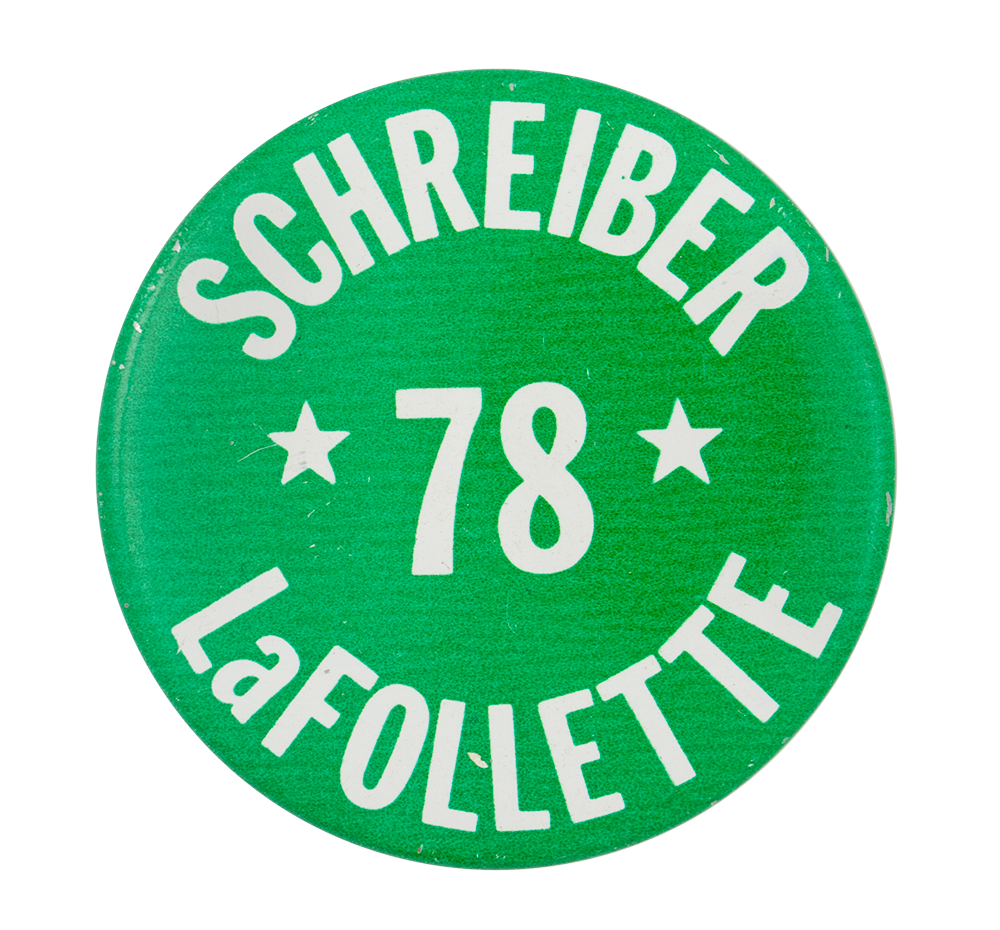
Text on Button Schreiber 78 LaFollette
Image Description

White text on a green background with two white stars in the middle on either side of text

Curl Text AUTHORIZED AND PD FOR BY WIS. U.A.W. CAP. M. O'BRIEN CHR MILW WISC
Back Style
The Shape
The Size
Year / Decade Made
Additional Information

Martin Schreiber's political career began with his service in the Wisconsin State Senate from 1963 to 1971. In 1970, Schreiber was chosen as the running mate of Patrick Lucey in his campaign for governor of Wisconsin. Lucey was elected and Schreiber became the lieutenant governor of Wisconsin. After Lucey resigned in 1977 to become the United States ambassador to Mexico, Schreiber succeeded him as governor for the remainder of their term. 

Schreiber ran with Wisconsin Secretary of State Doug La Follette against political outsider Lee Dreyfus in the 1978 gubernatorial election. Dreyfus successfully attacked the Lucey-Schreiber record on taxes and big government and was elected as the next governor of Wisconsin. Throughout his political career, Martin Schreiber focused on children's issues, the rights of workers and the elderly, and education. 

Catalog ID PO0500

Roosevelt Red White and Blue

Category
Additional Images
Sub Categories
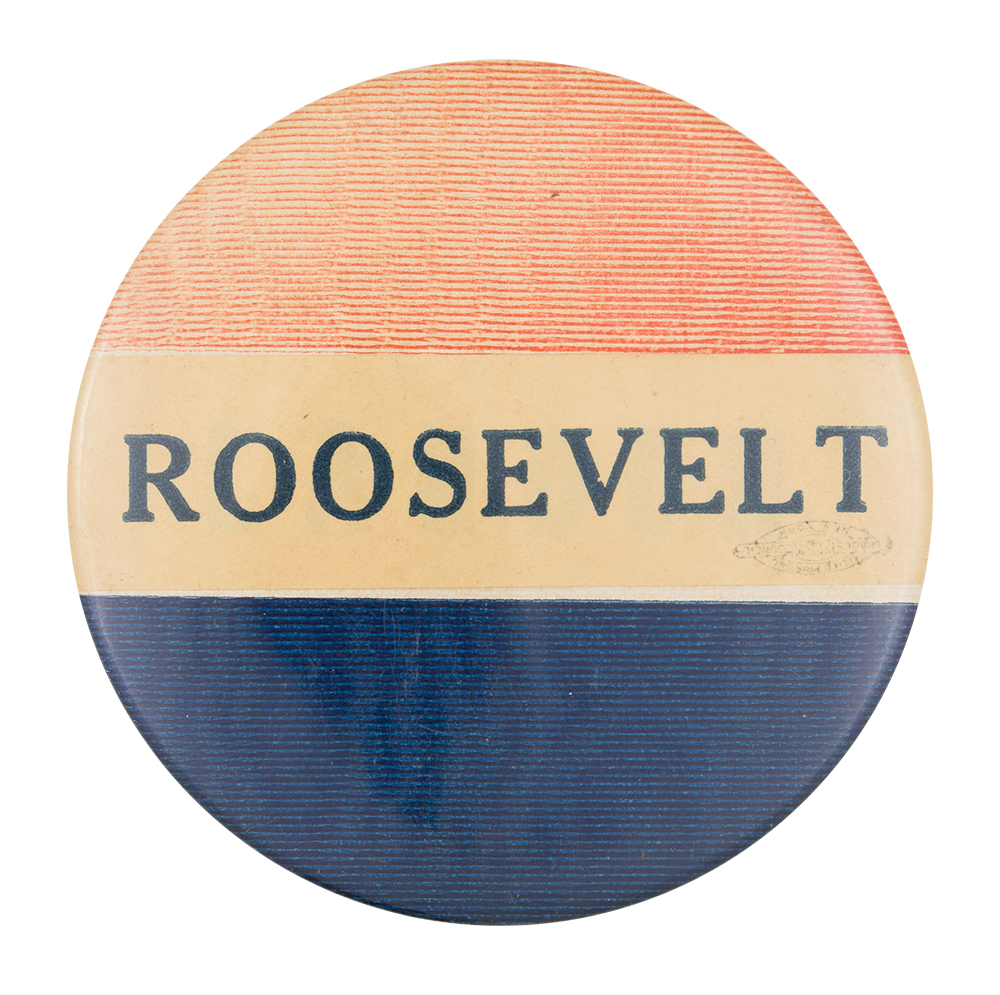
Text on Button ROOSEVELT
Image Description

Red white and blue striped background with blue text on the white stripe (faded to off white)

Back Style
The Shape
The Size
Additional Information

Roosevelt was the 32nd President of the United States and is the first U.S. president to win four presidential elections. He led the United States government through the majority of the Great Depression and World War II, as well as creating the New Deal Coalition. 

Catalog ID PO0504

Moe Bush

Category
Additional Images
Sub Categories
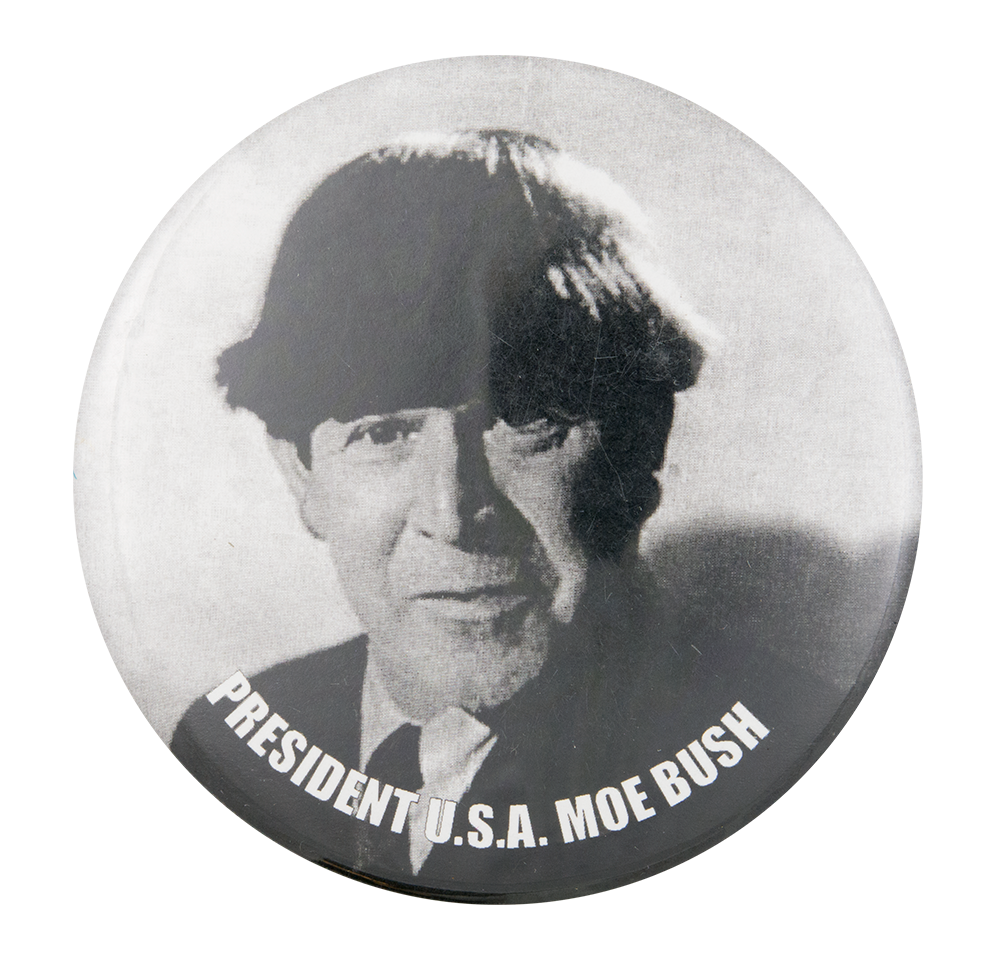
Text on Button PRESIDENT U.S.A. MOE BUSH
Image Description

Black and white photograph of George W. Bush with hair like Moe from the Three Stooges with white text along the bottom edge

Back Style
The Shape
The Size
Year / Decade Made
Additional Information

During his presidency, George W. Bush received much criticism about his public image. His tendency to make country-themed metaphors, speak in a Texas accent, and take vacations on his ranch led to the public having an “American cowboy image” of the president. Tied to this stereotype, and because he was acting so differently to other politicians, some believed that he was not smart.

As a parody to this, an image surfaced of Bush with bowl style haircut, called “Moe Bush.” This is a reference to Moe Howard, of Three Stooges fame. The Three Stooges was a comedy act known for physical slapstick and followed the antics of three less than intelligent characters. By transposing Bush with Moe’s haircut, the image sought to perpetuate the belief of Bush’s lack of intelligence.

Catalog ID PO0503

Humphrey Freeman

Category
Additional Images
Sub Categories
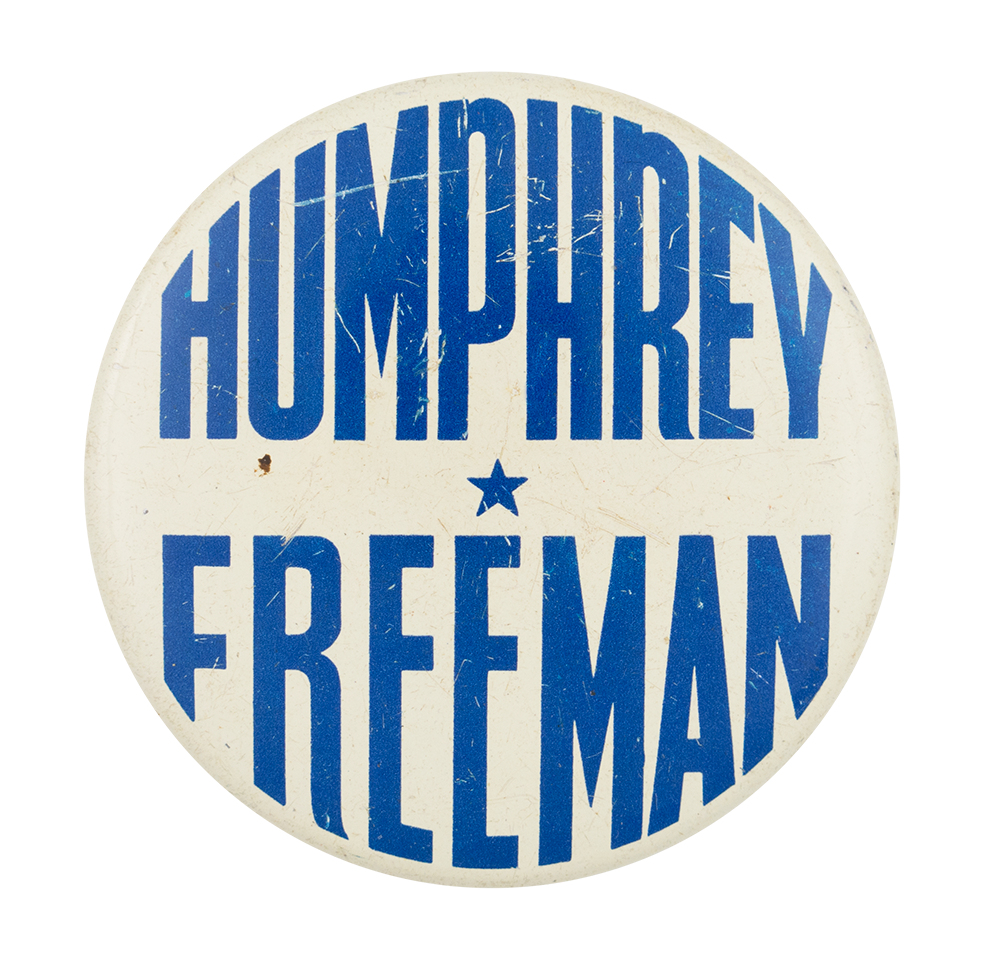
Text on Button HUMPHREY FREEMAN
Image Description

Blue text on a white background with a blue star in the center

Curl Text Union Bug
Back Style
The Shape
The Size
Additional Information

Orville Freeman and Hubert Humphrey met at the University of Minnesota in the 1930's and sharing an interest in politics, became good friends. When Humphrey was elected as mayor of Minneapolis in 1945, he named Freeman as a special assistant for veteran affairs. Freeman later managed Humphrey's successful United States Senate campaign in 1948. In 1954, with Humphrey leading the Democratic-Farmer-Labor ticket in his successful campaign for re-election, Freeman was elected as governor of Minnesota. In 1960, Freeman was defeated in his bid for re-election, and Humphrey was unsuccessful in securing the Democratic Party's nomination for U.S. President. Following his defeat for re-election as governor in 1960, Freeman was appointed as U.S. Secretary of Agriculture by the newly elected President John F. Kennedy, and was retained in that post by President Lyndon B. Johnson following Kennedy's assassination, serving until January 21, 1969. Humphrey was selected by Johnson as his running mate in 1964, and he served as U.S. Vice President from 1965 to 1969. 

Catalog ID PO0496

HHH Humphrey Red

Category
Additional Images
Sub Categories
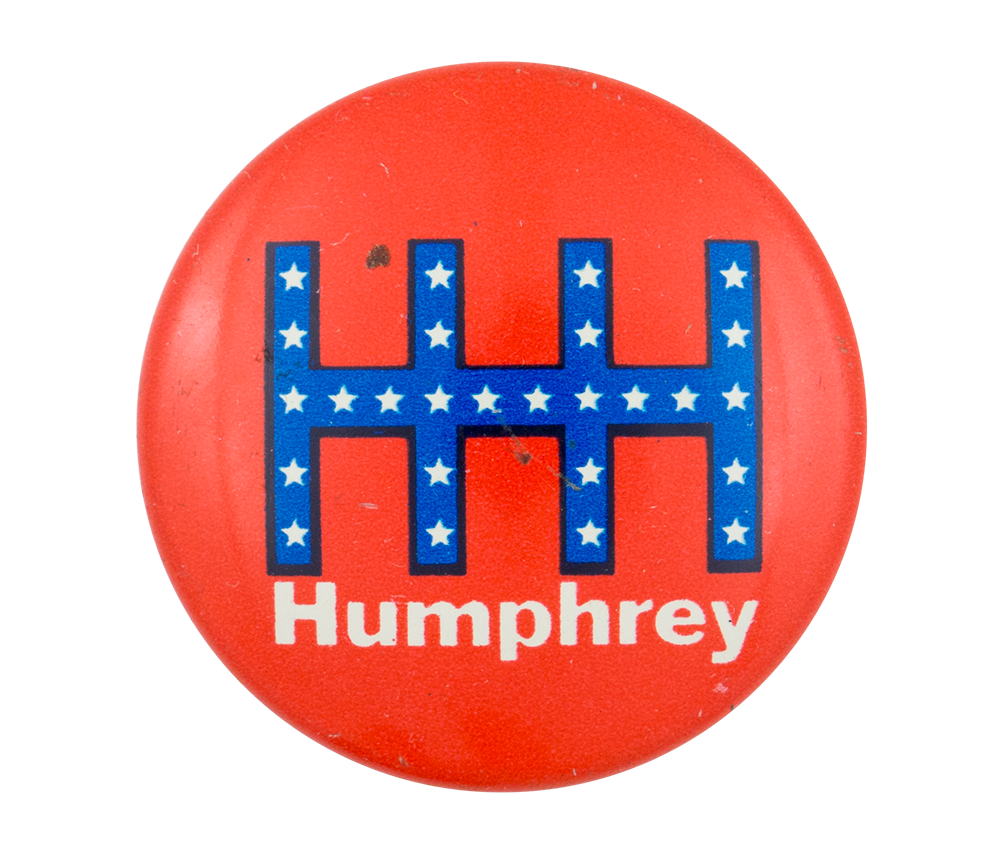
Text on Button HHH Humphrey
Image Description

Blue text with white stars on them over white text on a red background

Curl Text Union Bug
Back Style
The Shape
The Size
Year / Decade Made
Additional Information

Hubert H. Humphrey was a Democratic Senator from Minnesota and Vice President of the United States of America (under President Lyndon Johnson). This button from his unsuccessful presidential campaign against Republican Richard M. Nixon in 1968 shows his classic campaign logo with the three interlocking H’s (his middle name was Horatio). Though he would lose this campaign, he would regain his former seat in the Senate in the 1970 elections.

Catalog ID PO0520

Daley Fan

Category
Additional Images
Sub Categories
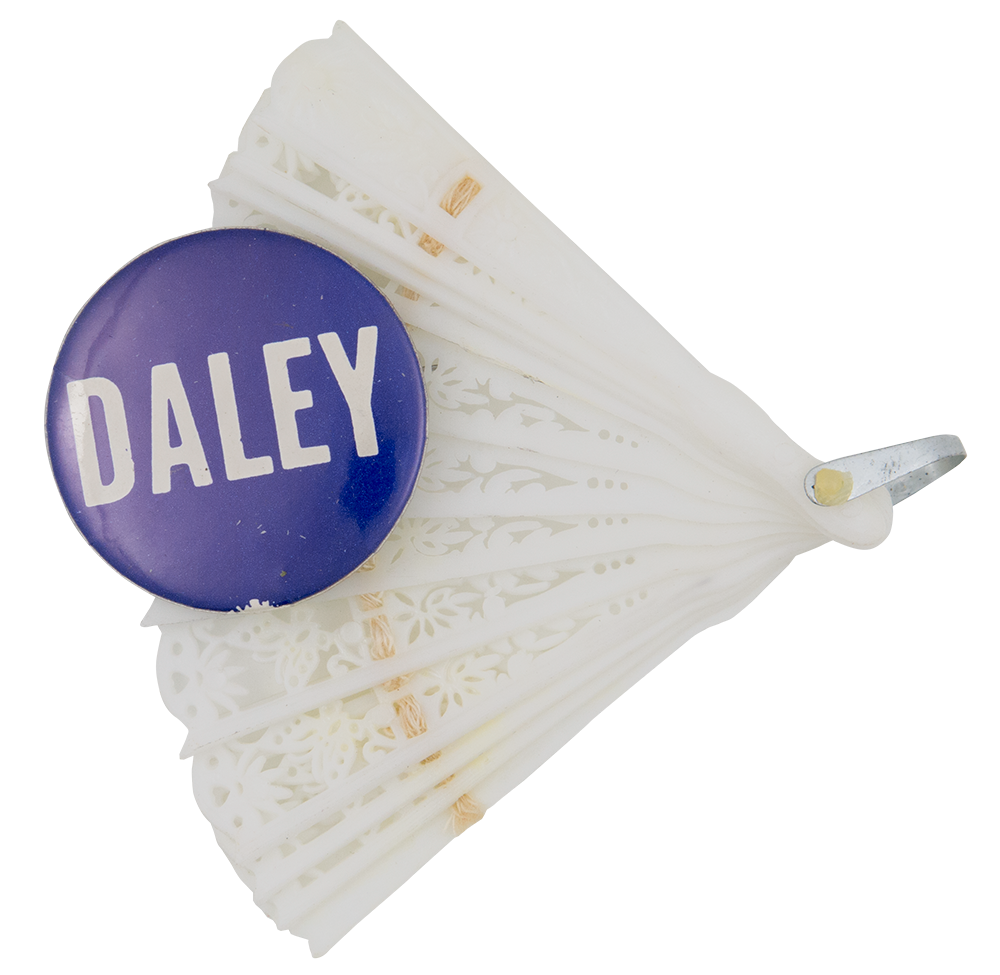
Text on Button DALEY
Image Description

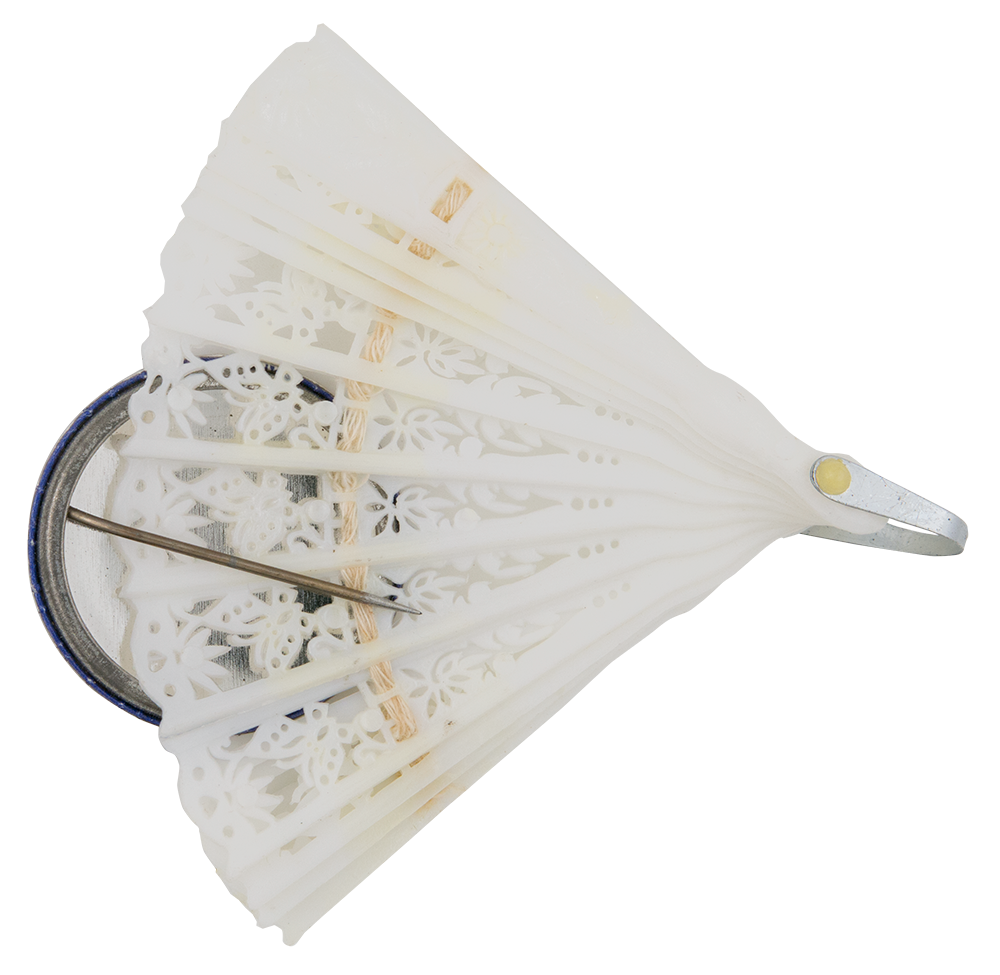
White text on a blue background and attached to a white plastic fan

Back Style
The Shape
The Size
Additional Information

Richard J. Daley was an American politician and mayor of Chicago for twenty-one years from 1955 until his death on December 20, 1976.  Daley, a native of Chicago and father of future mayor, Richard M. Daley, was a Democrat who was first elected to the Illinois House of Representatives as a Republican. However, soon after being elected, he quickly moved back to the Democratic side of the aisle. He also served as Cook County Clerk before his eventual election as Chicago mayor. O’Hare International Airport, the Sears Tower, and many other large construction projects occurred during Daley’s tenure.

Sources

Wikipedia. (2020, November 5). Richard J. Daley. https://en.wikipedia.org/wiki/Richard_J._Daley

Catalog ID PO0608

Anybody But Carter

Category
Additional Images
Sub Categories
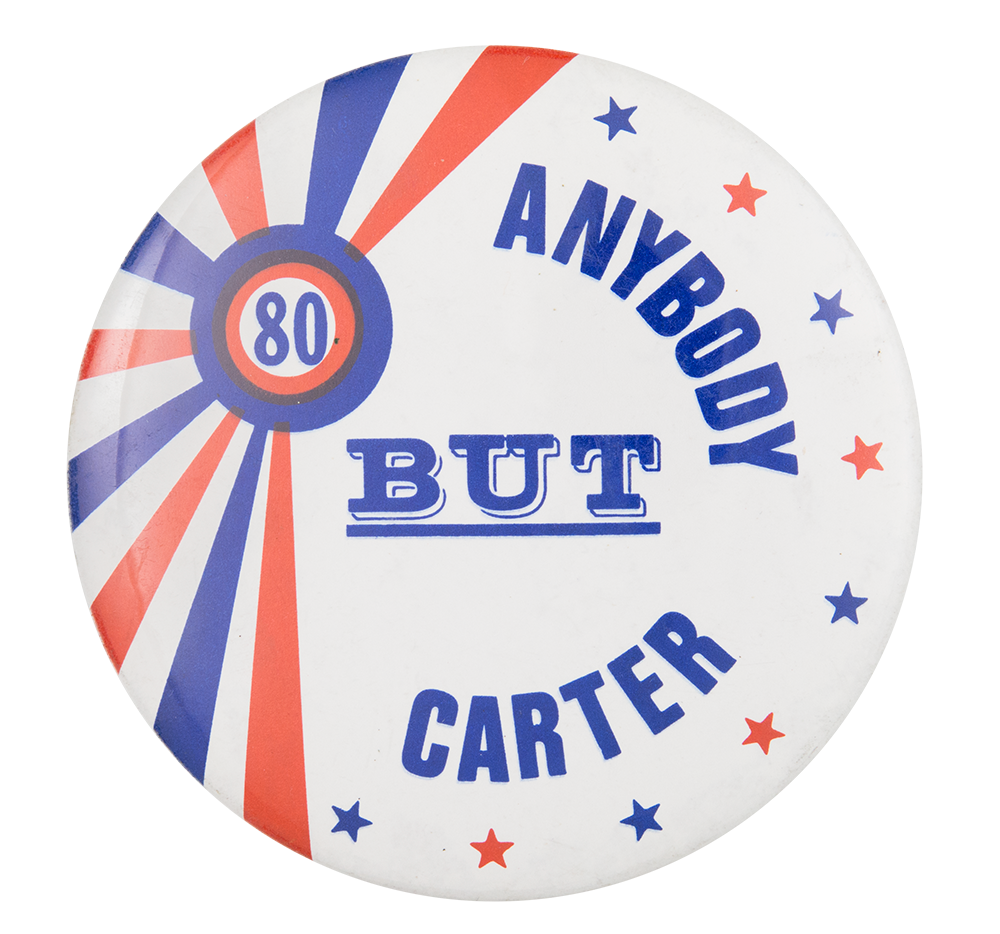
Text on Button 80 ANYBODY BUT CARTER
Image Description

Large blue text with a fan-shaped graphic on the left edge in red, white, and blue with a blue 80 in the center and red and blue stars lining the right edge all on a white background.

Curl Text copyright 1980 RECTOR union bug
Back Style
The Shape
The Size
Year / Decade Made
Additional Information

As the 1980 Democratic Convention drew closer, Democrats began to worry about their survival in the political world. Incumbent Jimmy Carter was considered to be a "ticking time bomb waiting to destroy the Democratic Party." Fear of Carter leading the Democrats to suffer a defeat as large as the 1932 election, members of the party began to push an "open convention." Officially called "The Committee of an Open Convention," they sought to open the selection of the Democratic nominee, hoping that Carter would not be selected. It became commonly known as: "Anybody But Carter." Ultimately, the movement's efforts failed, and their fears came true as Carter suffered a massive defeat by Ronald Reagan.

Sources

Wagman, R. (19 80, August 7). Open convention means ‘Anybody but Carter’. Gadsden Times, 4.

Catalog ID PO0017

American Independent Party

Category
Additional Images
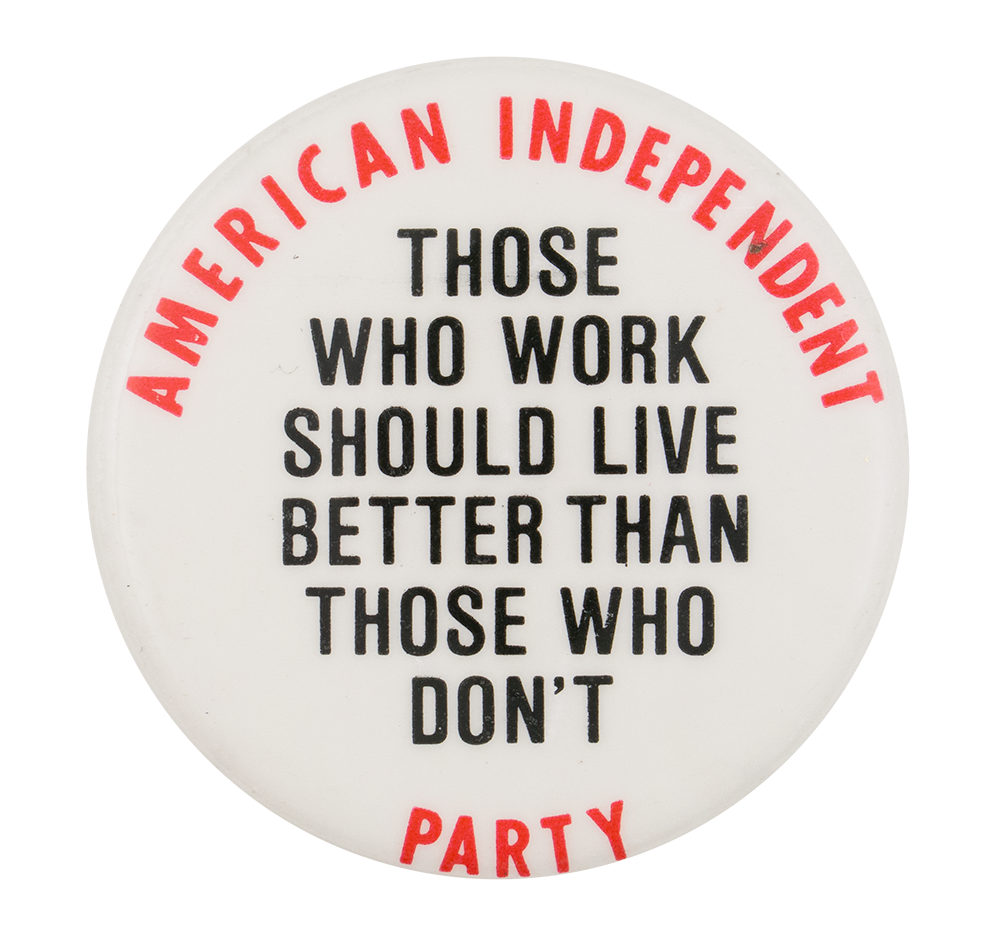
Text on Button AMERICAN INDEPENDENT THOSE WO WORK SHOULD LIVE BETTER THAN THOSE WHO DON'T PARTY
Image Description

Red and black text on a white background

Back Style
The Shape
The Size
Additional Information

The American Independent Party (AIP) was founded in 1967 by Bill Shearer and his wife, Eileen Knowland Shearer, a cousin of California Senator William F. Knowland. The AIP is considered a far-right party and is best known for its nomination of former Alabama Governor George Wallace as a candidate for United States President in 1968. Wallace carried the states of Arkansas, Louisiana, Mississippi, Georgia and Alabama on a segregationist platform against Democratic nominee Hubert Humphrey and Republican nominee Richard Nixon, winning 46 electoral votes, more than any other third-party candidate. 

In 1976, the AIP split into the more moderate American Party, which included more northern conservatives, and the American Independent Party, which focused on the Deep South. Bill Shearer later led the AIP into the Populist Party in the early 1980s. Since 1992, the AIP has been the California affiliate of the national Constitution party. Another split occurred during the 2008 presidential election, resulting in the newly-formed America's Party. As of 2016, approximately 3% of Californians are registered members of the AIP, but political analysts believe that some members mistakenly join the AIP, falsely believing that they are registering as independent voters. 

Catalog ID PO0497