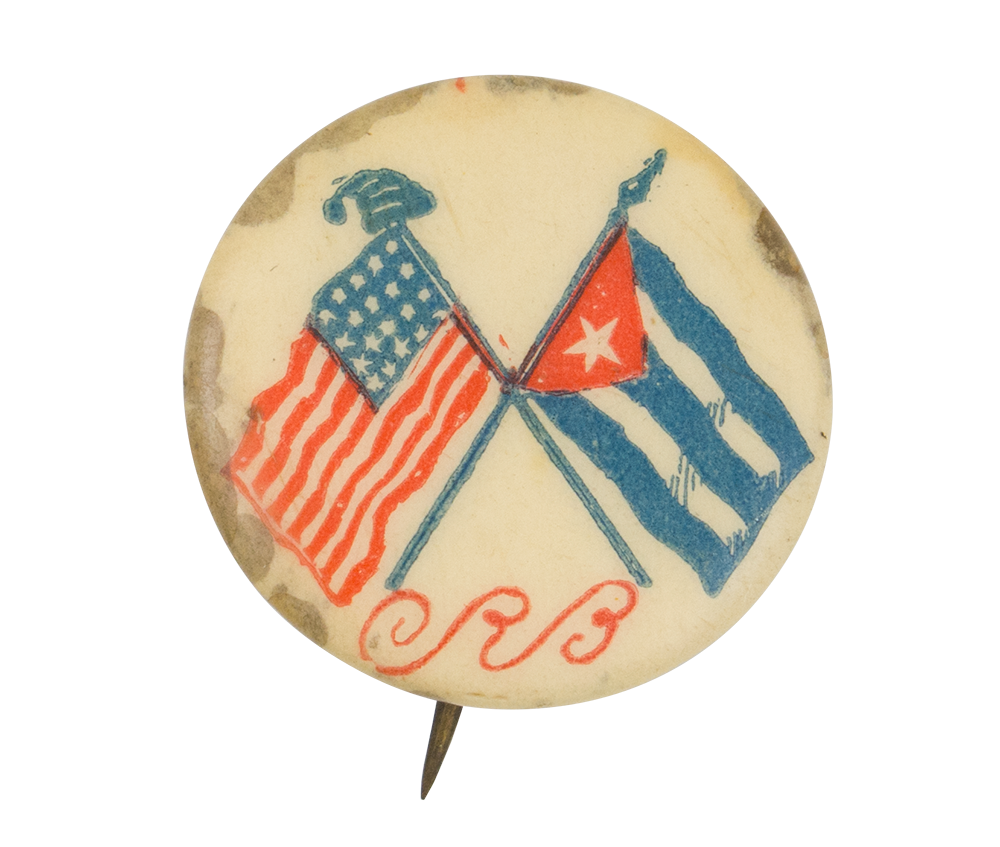
United States and Cuba Flags

Category
Additional Images
Sub Categories
Text on Button R B
Image Description

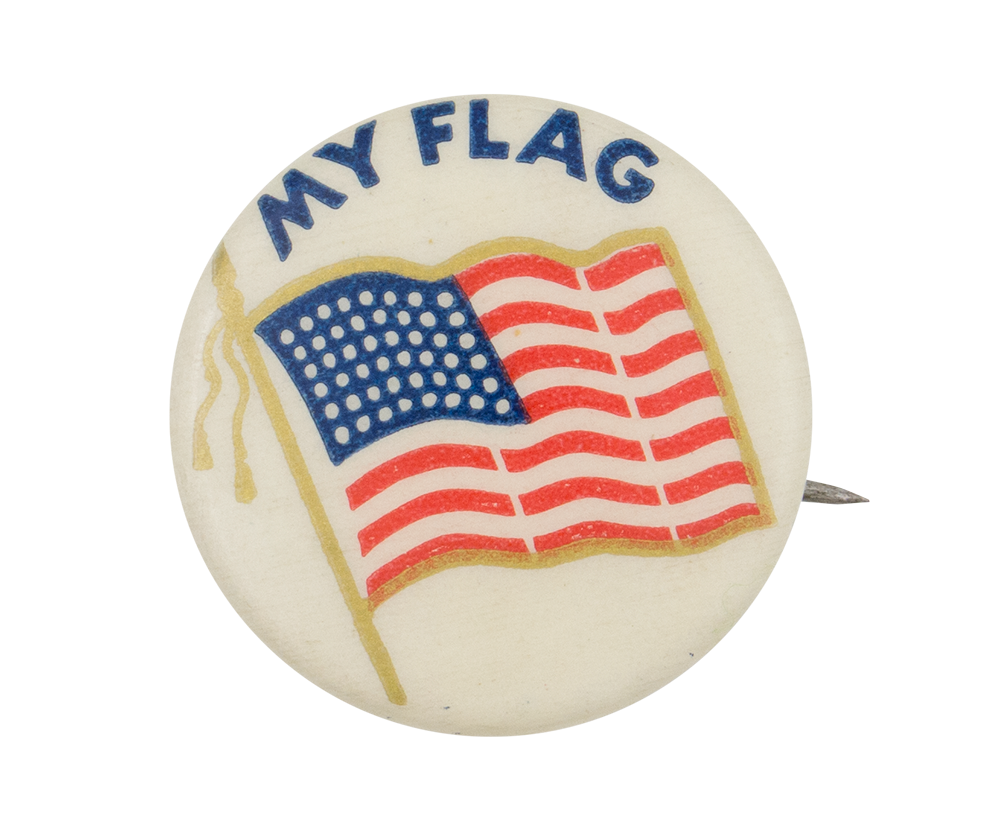
Illustration of crossed American and Cuban flags with red text on a white background.

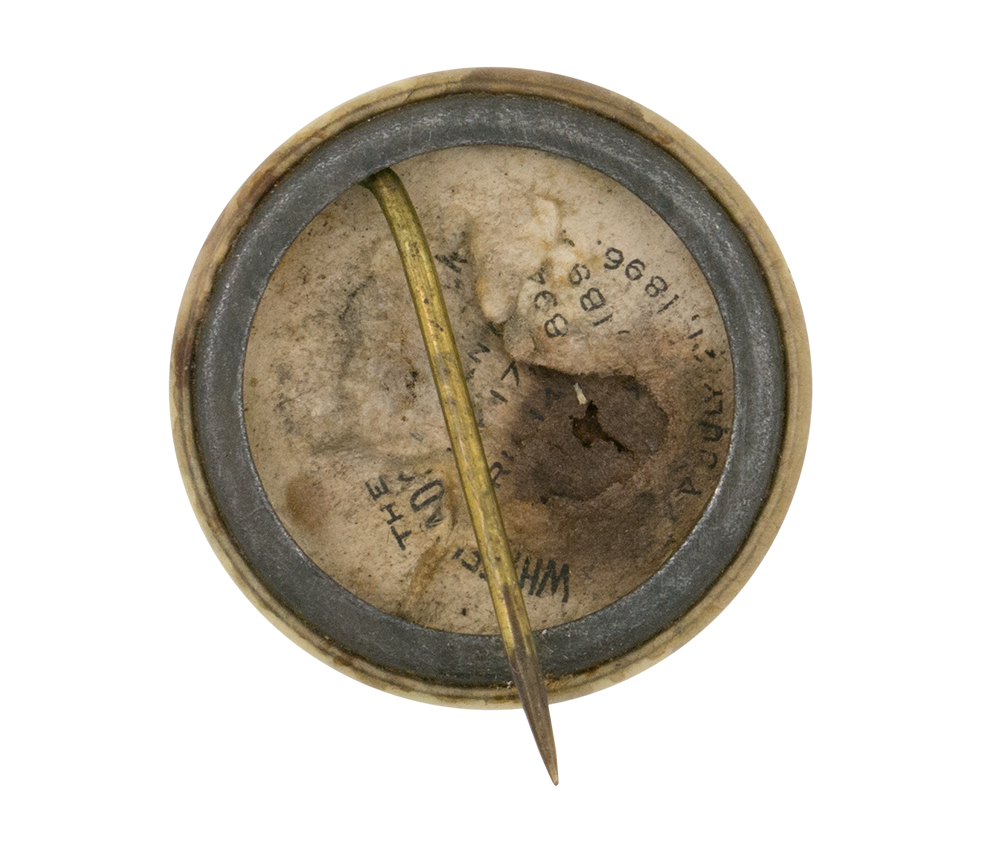
Back Paper / Back Info

The Whitehead & Hoag Co., Newark, N.J., U.S.A.
Patented
July 17, 1894
April 14, 1896
July 21, 1896

Back Style
The Shape
The Size
The Manufacturer
Additional Information

The international relationship and sovereignty of the United States and Cuba has a complicated history in continual development. In the 1890s, Cuba was a colony of Spain and were conflicting with the U.S. over tariffs. By the end of the decade, Cubans despised everything Spanish and began an era of anarchy and racial warfare. During their separation from the Spanish part of the colony, Cuba sought annexation to the United States to keep their wealth, which destroyed the rebel military, but left the country politically unstable again. Cuba and the U.S. reestablished a relationship in 2014 and succeeded in establishing a peace after 54 years. Among the top considerations are democracy promotion programs, modernizing popular sovereignty, and self-determination.

Sources

Crahan, M. E. & Castro, S. (2017). Cuba, the U.S., and the concept of sovereignty: Toward a common vocabulary? Cuba-US Relations: Normalization and Its Challenges. Retrieved from https://www.brookings.edu/research/cuba-the-u-s-and-the-concept-of-sove…

Hernandez, J. M. (2011). Cuba in 1898. Hispanic Library Division Library of Congress. Retrieved from https://www.loc.gov/rr/hispanic/1898/hernandez.html

Catalog ID PO0675

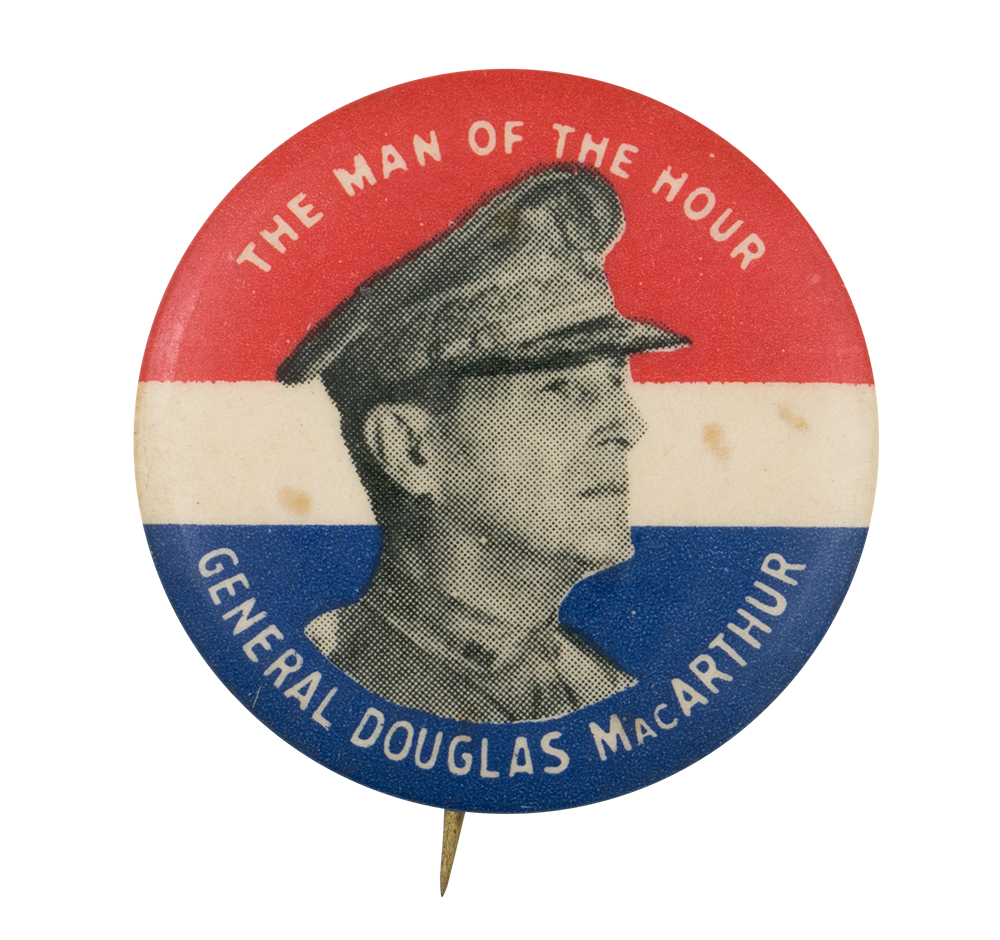
The Man of the Hour

Category
Additional Images
Sub Categories
Text on Button THE MAN OF THE HOUR GENERAL DOUGLAS MAC ARTHUR
Image Description

Photograph of Douglas MacArthur on a red, white and blue background encircled by white text.

Back Style
The Shape
The Size
Additional Information

General Douglas MacArthur is remembered for his successful command of the Southwest Pacific Theater during World War II, as well as leading other military operations, including the United Nations forces during the first part of the Korean War.  MacArthur was promoted to General of the Army in 1944, and in 1945 he was called on to command all of the U.S. Forces in the Pacific area.  

After being removed from commanding the army for insubordination by President Harry Truman during the Korean War, MacArthur was encouraged by conservatives to run for office. During the Presidential Election of 1948, MacArthur became part of the Republican Party's nominees. He even said he would accept the GOP nomination if he won. However, Thomas E. Dewey ended up becoming the nominee against Incumbant President Harry Truman, who ended up winning a second term.

Catalog ID PO0670

Stand with Carter

Category
Additional Images
Sub Categories
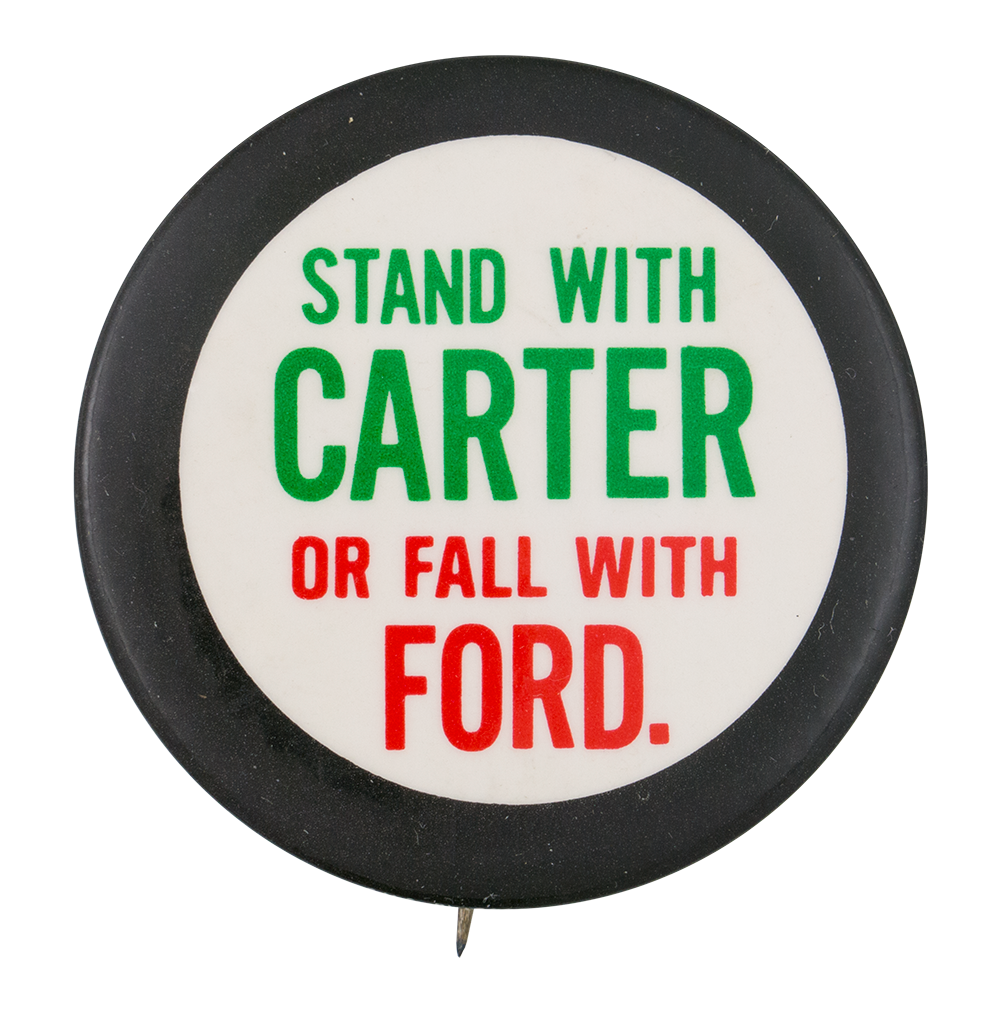
Text on Button STAND WITH CARTER OR FALL WITH FORD
Image Description

Green and red text on white background with black outer border. 

Back Style
The Shape
The Size
Year / Decade Made
Additional Information

The 1976 U.S. Presidential election was unique in that one candidate, incumbent President Gerald Ford, was the first person to be appointed to both the vice-presidency and later, presidency. Gerald Ford served as Vice-President following Spiro Agnew's resignation, from December 1973 to August 1974, and became President when Richard Nixon resigned on August 9, 1974. The Democratic Party nominated Jimmy Carter, a peanut farmer who served as Georgia State Senator, and Governor of Georgia, as their candidate to run against Ford. Following the Watergate scandal, Ford faced opposition even from within his own party, challenged for the Republican Party's nomination by former California Governor Ronald Reagan. 

Carter ran as an outsider in the general election, painting himself as untainted by recent political scandals. The electoral vote was the closest since 1916, but Carter ultimately prevailed, becoming the 39th President of the United States. 

Catalog ID PO0606

Richard M. Nixon Sepia

Category
Additional Images
Sub Categories
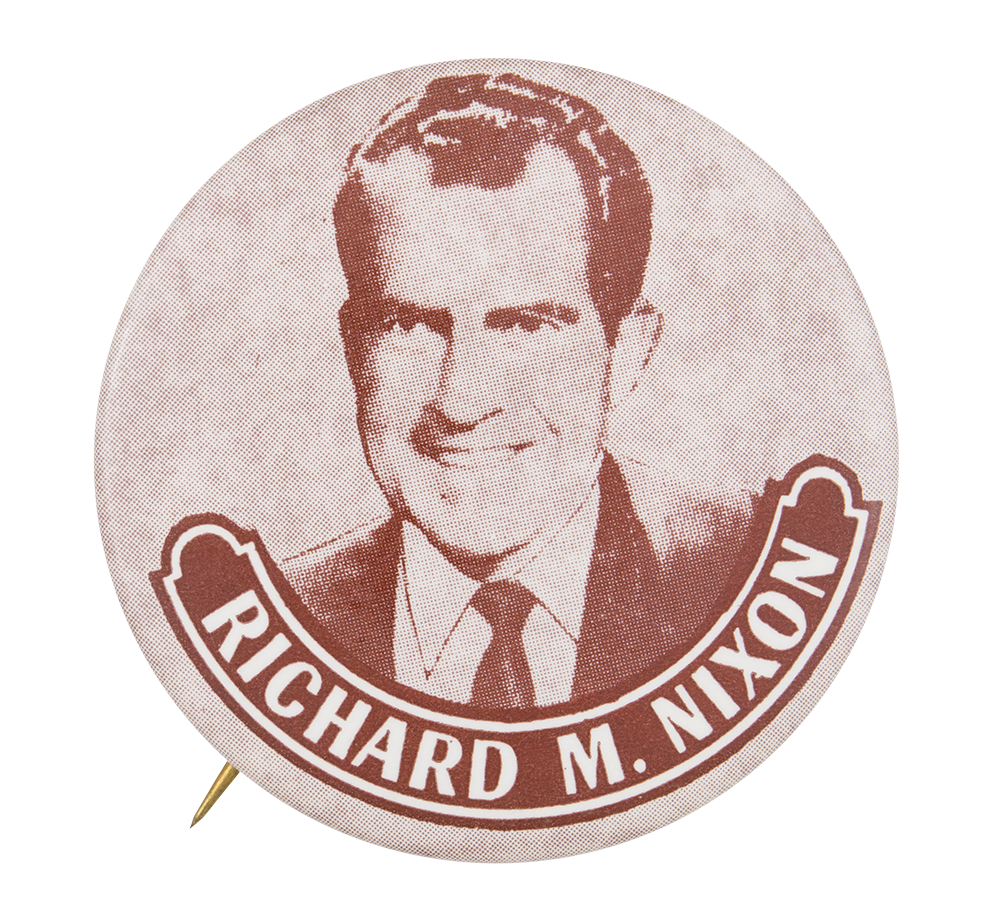
Text on Button RICHARD M. NIXON
Image Description

Sepia toned photograph of Nixon with a banner across the bottom with white text

Back Style
The Shape
The Size
Additional Information

Richard M. Nixon’s earliest use of campaign buttons and pins came in his unsuccessful run for President in 1960. Campaign buttons can also be found from his unsuccessful bid for Governor of California in 1962. In his political career, he won four national elections, twice for the vice presidency and twice for the presidency. He won his first political office in 1946 when he was elected as a U.S. Congressman for California. Nixon then became a Senator in 1950. Nixon served as Vice President during the Eisenhower administration from 1953- 1961. He was elected as the 37th President of the United States in 1968 and served in office from 1969 until his resignation in August 1974.

Catalog ID PO0615

Notre Dame for Kennedy

Category
Additional Images
Sub Categories
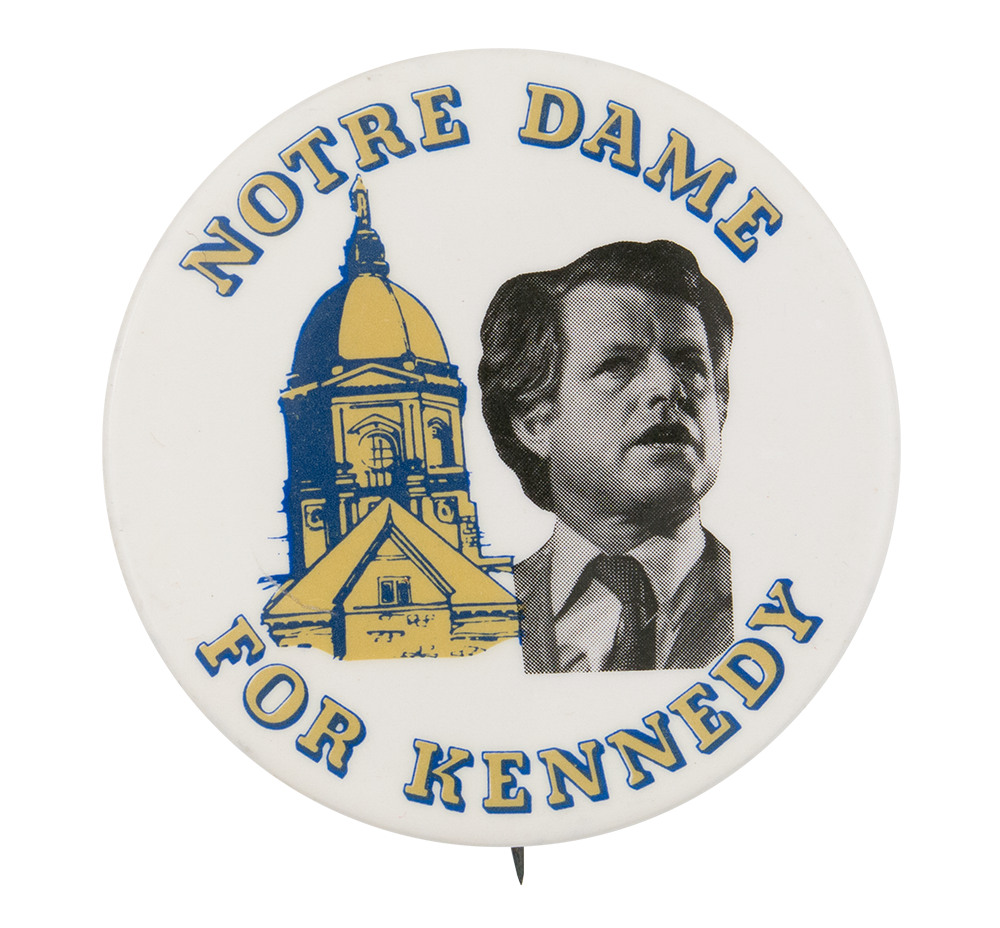
Text on Button Notre Dame for Kennedy
Image Description

Illustration of the top of a building next to a black and white photograph of a man's head and shoulders with gold and blue text above and below

Curl Text MILLENNIUM GRP. 924 CHERRY ST. PHILA..PA 19107
Back Style
The Shape
The Size
The Manufacturer
Additional Information

Notre Dame University, a private co-educational Catholic research college was founded in 1842 in South Bend, Indiana and is consistently ranked among the top 20 universities in America.  Founded by the Congregation of the Holy Cross as an all-male school, the university became co-educational in 1971.  The Kennedy family, whose members have held numerous political positions, have a history of Roman Catholic roots, and have been benefactors for numerous students to attend Notre Dame. 

Ted Kennedy Edward Moore “Ted” Kennedy (1932-2009), Massachusetts Senator and part of the famous Kennedy clan, ran against incumbent Jimmy Carter in the 1980 Presidential Primary for the Democratic ticket.  To date, this was the last primary in which an incumbent lost electoral states to another candidate in a presidential primary.  The victories were not enough to secure the nomination, and Carter went on to represent the Democratic Party.  Kennedy returned to his post as Senator, where he served out a 47 year term as the Senator from Massachusetts.

Catalog ID PO0561

No Third Term Red and White

Category
Additional Images
Sub Categories
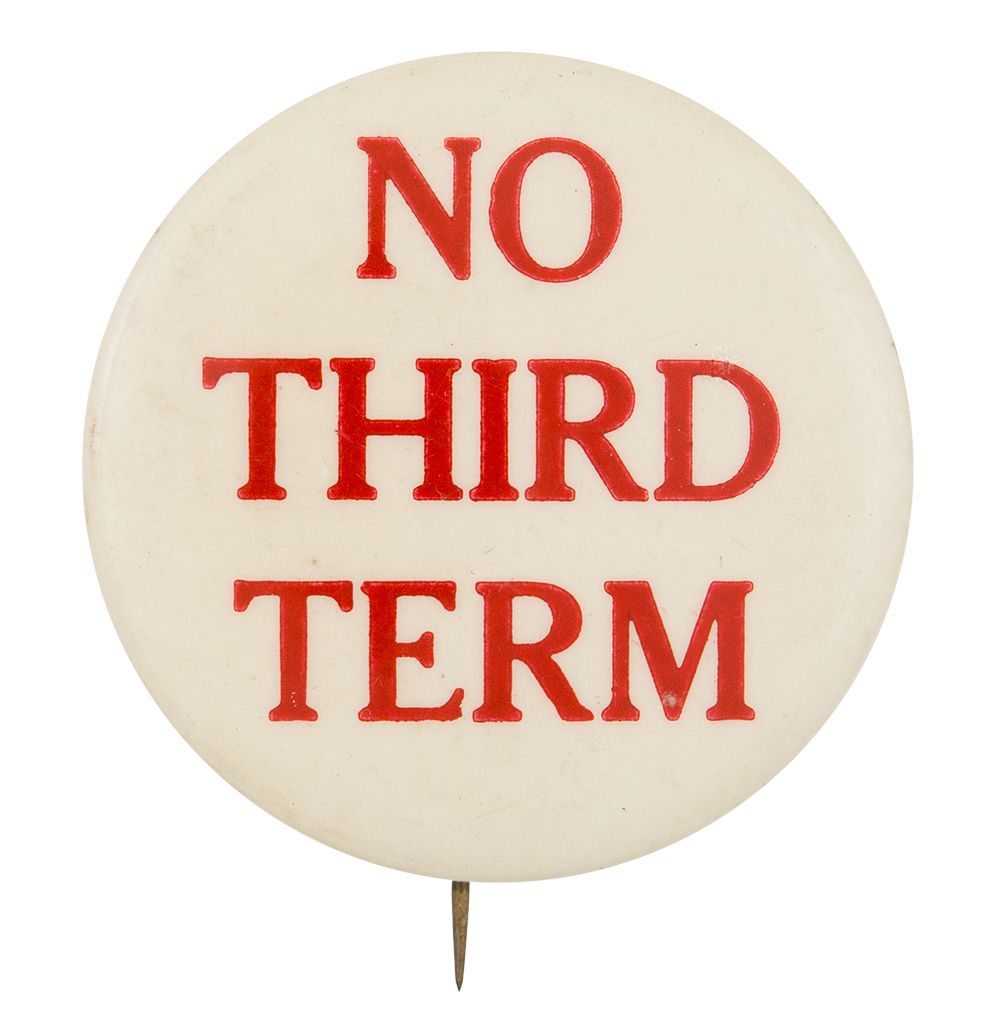
Text on Button NO THIRD TERM
Image Description

Red text on a white background

Back Style
The Shape
The Size
Year / Decade Made
Additional Information

In the 1940 presidential election, Republican candidate, Wendell Willkie, faced off against President Franklin D. Roosevelt, who was campaigning for a third term in office. While it was not yet written in the Constitution, a U.S. President customarily served only two terms in office, making President Roosevelt's reelection campaign controversial. Using the President's break from tradition as a platform for his own campaign, Willkie and his staff used the slogan, "No Third Term" as an attack on Roosevelt. Despite its irregular nature, Roosevelt went on to win the election, becoming the only President in American history to ever be elected for a third term. First passed by Congress in 1947 and later ratified by the States in 1951, the Twenty-Second Amendment specifically limits a president to only two terms in office.​

Catalog ID PO0618

Nixon X

Category
Additional Images
Sub Categories
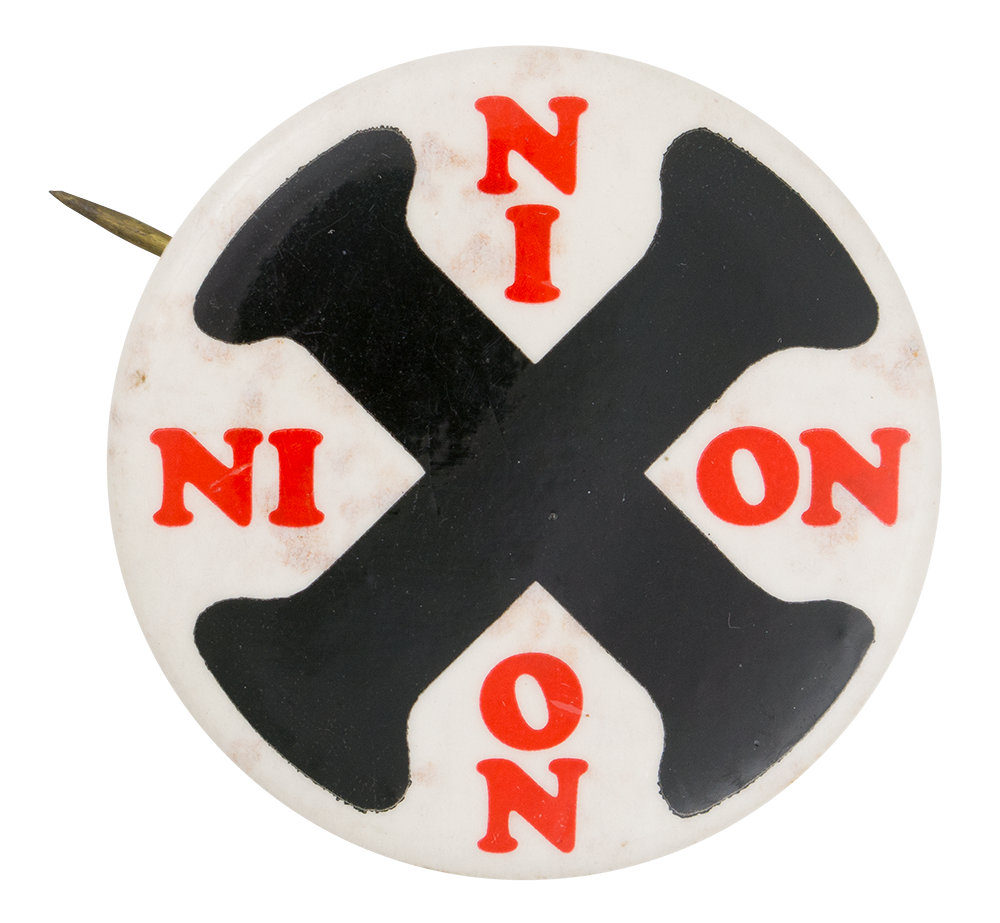
Text on Button NI NI X ON ON
Image Description

Large black 'X' in center of button, with 'NI's and 'ON's in red to form the name 'Nixon' twice on a white background.

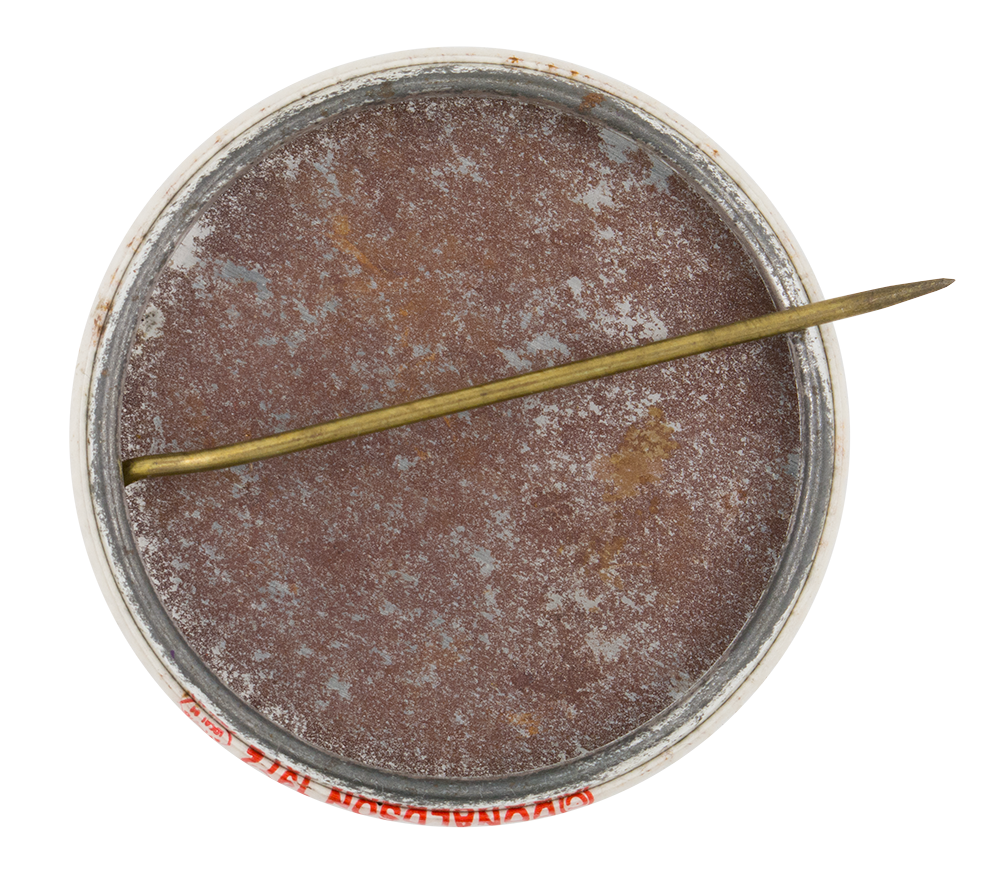
Curl Text © DONALDSON 1972 (union bug)
Back Style
The Shape
The Size
Year / Decade Made
Additional Information

Richard Nixon (R-CA) ran for re-election against U.S. Senator George McGovern (D-SD) in the 1972 Presidential election. Nixon won in a landslide victory, taking 49 states and 60% of the popular vote. He was also the first Republican to sweep the southern states. The 1972 election was the first time 18 year olds were allowed to vote because of the ratification of the 26th Amendment in 1971. By 1974, both President Nixon and Vice President Spiro Agnew would resign, Nixon due to the Watergate scandal and Agnew due to corruption charges during his time as governor of Maryland.

Sources

1972 United States presidential election. (2021). Retrieved 25 February 2021, from https://en.wikipedia.org/wiki/1972_United_States_presidential_election

Britannica, T. Editors of Encyclopedia (2020, September 29). Richard Nixon. Encyclopedia Britannica. https://www.britannica.com/biography/Richard-Nixon

Spiro Agnew. (2021). Retrieved 25 February 2021, from https://en.wikipedia.org/wiki/Spiro_Agnew#Criminal_investigation_and_re…

U.S. Constitution - Twenty-Sixth Amendment | Resources | Constitution Annotated | Congress.gov | Library of Congress. (2021). Retrieved 25 February 2021, from https://tinyurl.com/w5m978sc

Catalog ID PO0672

Join Rosalynn and Joan

Category
Additional Images
Sub Categories
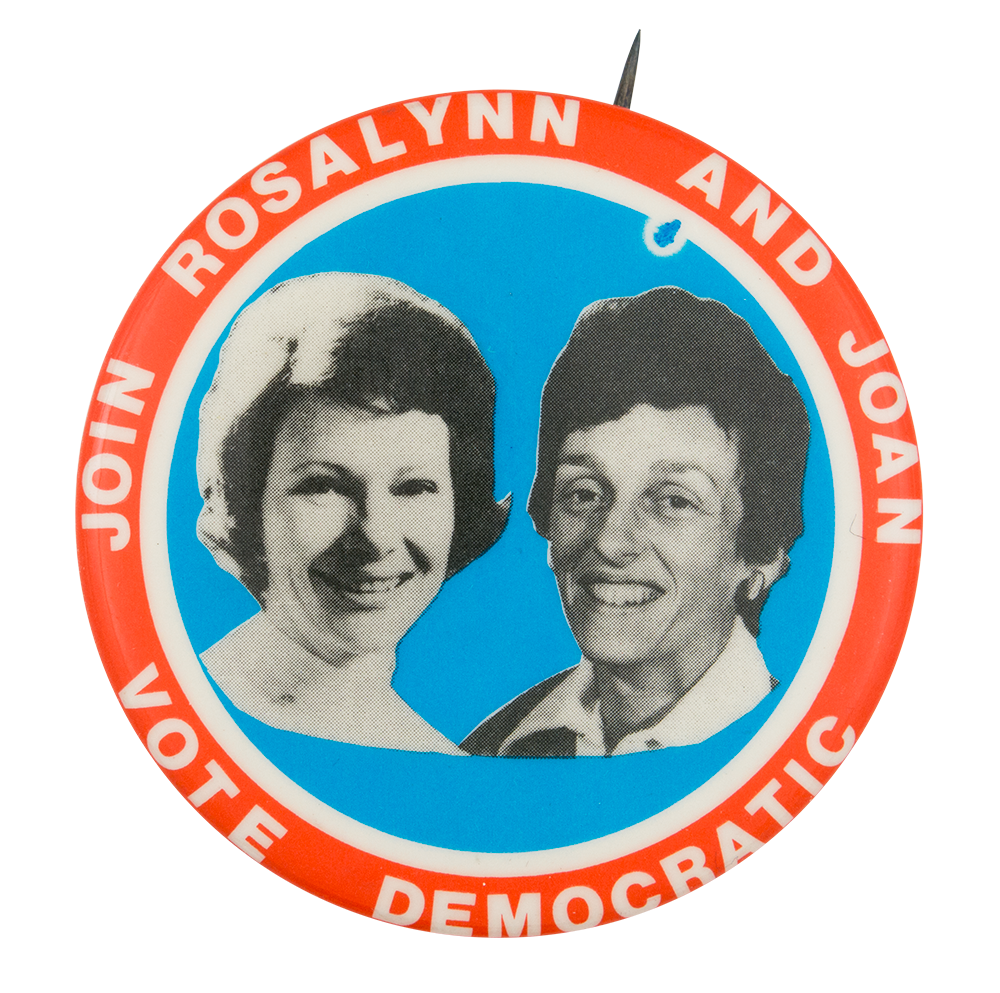
Text on Button Join Rosalynn and Joan Vote Democrat
Image Description

Black and white photographs of two women's head and shoulders on a blue background with a white and red outer edge with white text

Curl Text copyright 1976 MILLENNIUM GROUP 924 CHERRY ST. PHILA..PA 19107
Back Style
The Shape
The Size
Year / Decade Made
Additional Information

Rosalynn Carter, wife of President Jimmy Carter, took to the campaign trail in the 1980 presidential re-election campaign, making speeches and appearances for her husband who was preoccupied with foreign and domestic affairs.  Mrs. Carter embraced Ted Kennedy’s challenges during the primaries and endured allergic reactions, a hotel fire and mouth sores from constant public appearances and speeches.  Despite maintaining a grueling schedule in her husband’s place, as well as keeping up with her schedule as First Lady, Mrs. Carter was not asked to speak at the Democratic National Convention that year.  She was the last First Lady to not address a national Presidential convention.

Joan Mondale, wife of Vice-President Walter Mondale, is best known for her zeal during the Carter/Mondale administration to focus attention on arts and culture and was dubbed “Joan of Art” for her constant promotion of fine arts throughout her husband’s political career.  Mrs. Mondale was an avid potter, and while living at the American embassy in Tokyo, she often gave away the cups and bowls she made.  Like her cohort Rosalynn, she spent a great deal of time traveling and campaigning for her husband.

Rosalynn and Joan were both strong advocates of the Equal Rights Amendment and the push for equal pay for women, and heralded in a new era for presidential spouses who were not content with the traditional roles delegated to the First Lady, but charted their own path through their husbands' administrations.

Catalog ID PO0524

Jimmy Carter for President

Category
Additional Images
Sub Categories
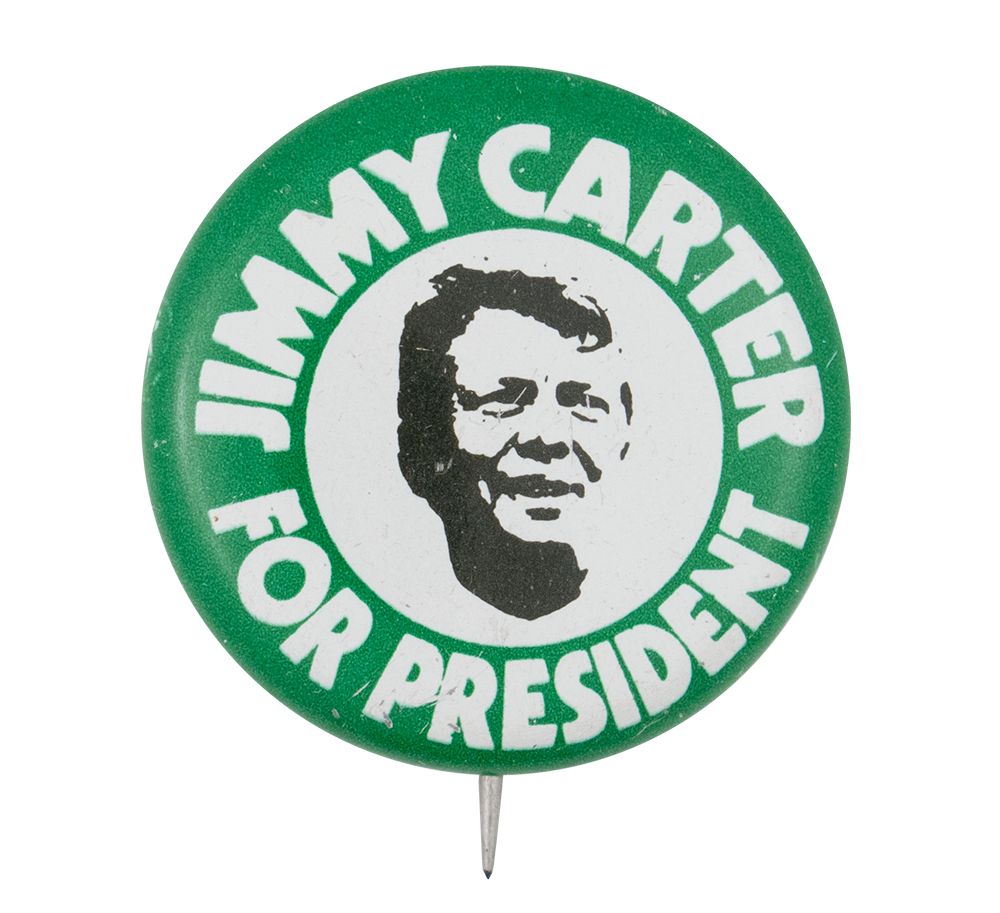
Text on Button JIMMY CARTER FOR PRESIDENT
Image Description

An illustration of Jimmy Carter is center in black and white surrounded by a green rim and white text. 

The Shape
The Size
Year / Decade Made
Additional Information

Jimmy Carter began his political career by serving on the Georgia State Senate from 1963-1967. After losing the bid for governor in 1966, he took a few years off to tend to his farming business. In 1970, he again ran for governor, this time successfully winning the Democratic nomination and the overall election. He served as governor until 1975. In 1976, he shocked the Democratic party leadership by winning the Iowa caucus in pursuit of the Democratic nomination for president. After that win, Carter's campaign released a series of green and white buttons, including this one. The green color was a departure from traditional red, white, and blue political buttons. It signified Carter's background as a peanut farmer. Carter eventually secured the nomination and won the 1976 election. 

In his 1980 reelection campaign, Carter reintroduced variations on his 1976 green buttons. However, he lost the election to Ronald Reagan.

Catalog ID PO0550