Good Teeth

Category
Additional Images
Sub Categories
Text on Button GOOD TEETH
Image Description

Illustration of a grey elephant's head wearing a black hat and tie and holding a large black toothbrush on a yellow background with red text along the bottom

Back Style
The Shape
The Size
Year / Decade Made
Additional Information

In the 1950s, the New Zealand Department of Health published a poster featuring a variation on this illustration along with the slogan “An Elephant Never Forgets. Clean your teeth after meals and before bed.” The poster was one of a series of which aimed to promote dental hygiene in children.

Sources

Archives New Zealand. (2012, June 27). An elephant never forgets. [Image scan]. Flickr. https://www.flickr.com/photos/archivesnz/15866594818

Catalog ID CA0279

Friends of the Free Library

Category
Additional Images
Sub Categories
Text on Button "I'M A HAPPY BOOKER" FRIENDS OF THE FREE LIBRARY
Image Description

Red text on a yellow background

Curl Text HORN CO PHILA. PA 19126
Back Style
The Shape
The Size
The Manufacturer
Additional Information

The "Friends of the Free Library" is a non-profit organization made up of a group of volunteers located in Philadelphia, Pennsylvania. The volunteers at the “Friends of the Free Library” keep libraries open, vital, and relevant by helping to pay for books and programs.  The organization was founded in 1973, and since then has been an independent, charitable organization supporting the 54-branch Free Library system in Philadelphia. The Free Library of Philadelphia is a public library system, and is the 13th largest public library system in the United States. 

Catalog ID CA0274

Dope is for Dopes

Category
Additional Images
Text on Button DOPE IS FOR DOPES
Image Description

Blue text on a white background

Curl Text B & C ADVERTISING-HEWLETT N.Y. FR-7714
Back Style
The Shape
The Size
Year / Decade Made
The Manufacturer
Additional Information

Dope is for dopes is a slogan created from a segment in the television series Fat Albert and The Cosby Kids Season 1, Episode 17. An excerpt from the episode description reads as follows: Franny Bates' brother Muggles gives him money and a number of material things that he shares with the gang, including a motorcycle that eventually gets wrecked by Fat Albert. He personally goes to Muggles to do what he can to pay for it. Muggles gives Albert a package to deliver, eventually learning it contains narcotic drugs after he gets apprehended by the police, who determine he didn't know about the drugs. Fat Albert agrees to help them catch Muggles and arrest him to stop his drug dealing. While Franny no longer acknowledges Fat Albert as a friend, the rest of the gang stick up for him, knowing he did the right thing to get illegal drugs off the streets.

Along with the popularity of the phrase, the show also provided a song with the same title, Dope is for Dopes.

Sources

Episode Summary [Web log post]. (n.d.). Retrieved July 8, 2020, from http://www.tv.com/shows/the-adventures-of-fat-albert-and-the-cosby-kids…

Catalog ID CA0297

Clean Up and Paint Up Keep It Up

Category
Additional Images
Sub Categories
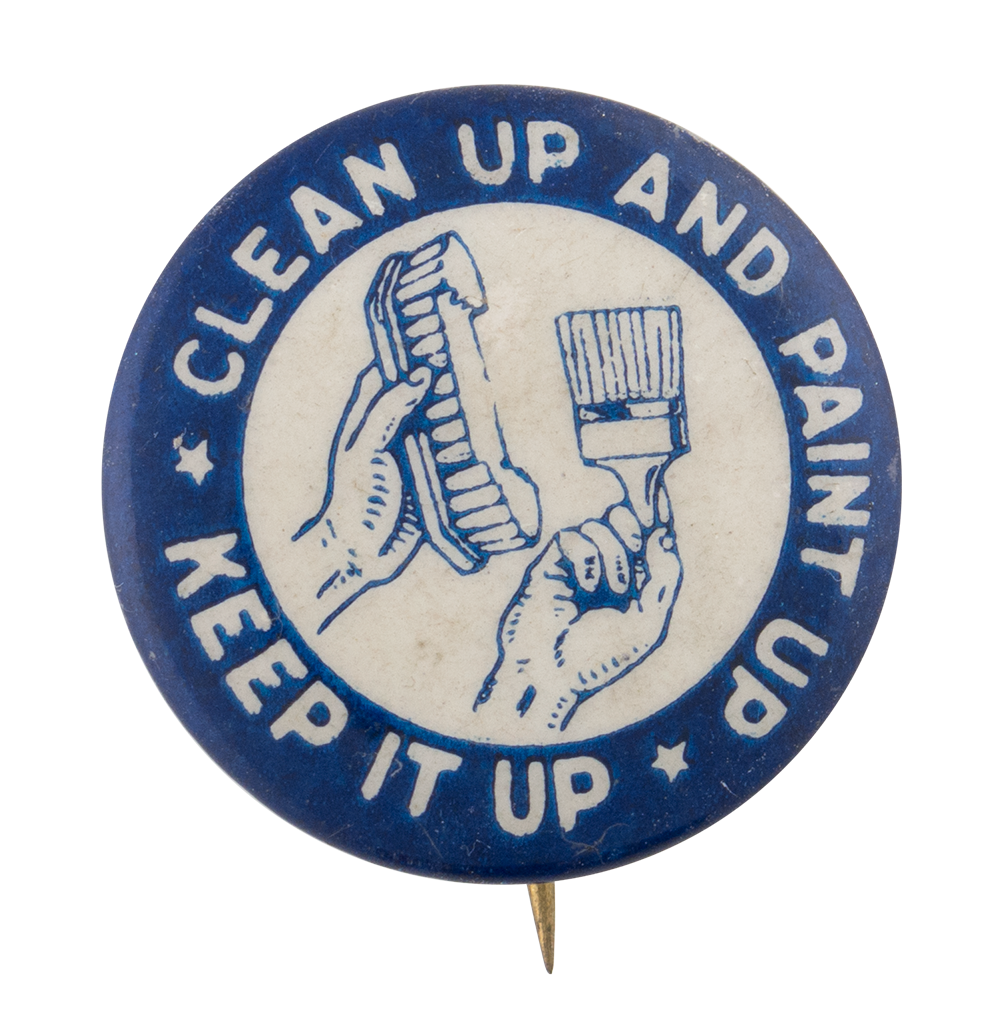
Text on Button CLEAN UP AND PAINT UP KEEP IT UP
Image Description

Illustration of hands holding a scrub brush and a paint bruch on a white inner circle surrounded by an outer blue edge with white text

Back Style
The Shape
The Size
Year / Decade Made
Additional Information

This button is most likely related to two documentary film shorts released in 1953 and 1954 called The House in the Middle, which showed the effects of a nuclear bomb test on three small houses. The houses on the left and right are run down and poorly maintained, but the house in the middle is clean, freshly-painted, and well-kept. The middle house survives the attack, while the more rundown houses do not. The 1953 version of the film was created by the Federal Civil Defense Administration (which created a nationwide plan for fallout shelters) to show that taking care of your house could help protect you from a nuclear bomb dropped by the Soviet Union.

The 1954 version of the film was released in color by the National Clean Up – Paint Up – Fix Up Bureau, which was created by the National Paint, Varnish and Lacquer Association. This version of the film was geared more toward marketing paint than protection against bombs. 

Sources

Chisolm, K. (2015, March 10). The cold war meets commerce: the house(s) in the middle [Web log post]. Retrieved from https://blogs.loc.gov/now-see-hear/2015/03/the-cold-war-meets-commerce-….

Catalog ID CA0308

California Marijuana Initiative 19

Category
Additional Images
Sub Categories
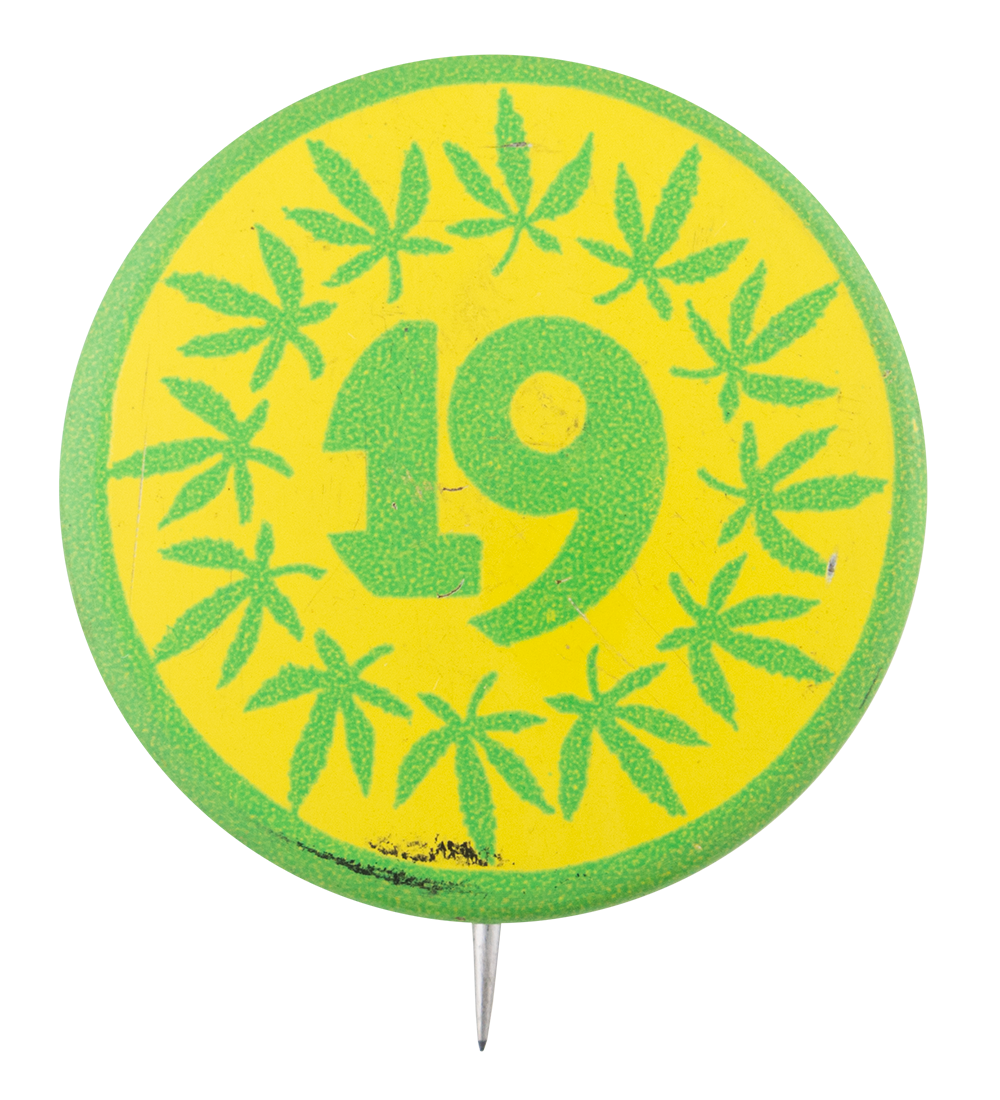
Text on Button 19
Image Description

Green text in the center surrounded by illustrations of marijuana leaves with an outer green edge on a yellow background

Back Style
The Shape
The Size
Year / Decade Made
Additional Information

Proposition 19, also known as the California Marijuana Initiative (CMI), was a ballot initiative on the November 7, 1972 statewide ballot. The official advocacy group for the initiative was “Yes on 19.” If passed, it would have revised California’s laws about marijuana, and would have made it so that no person 18 years of age or older could be punished in any way for growing, processing, transporting, or possessing marijuana. The initiative was defeated by 66.5%, with only 33.5% Yes votes. Supporters argued that the initiative would decriminalization personal use activities, but not legalize marijuana or encourage sales or use.  

Catalog ID CA0272

Best Age is the Age You Are

Category
Additional Images
Sub Categories
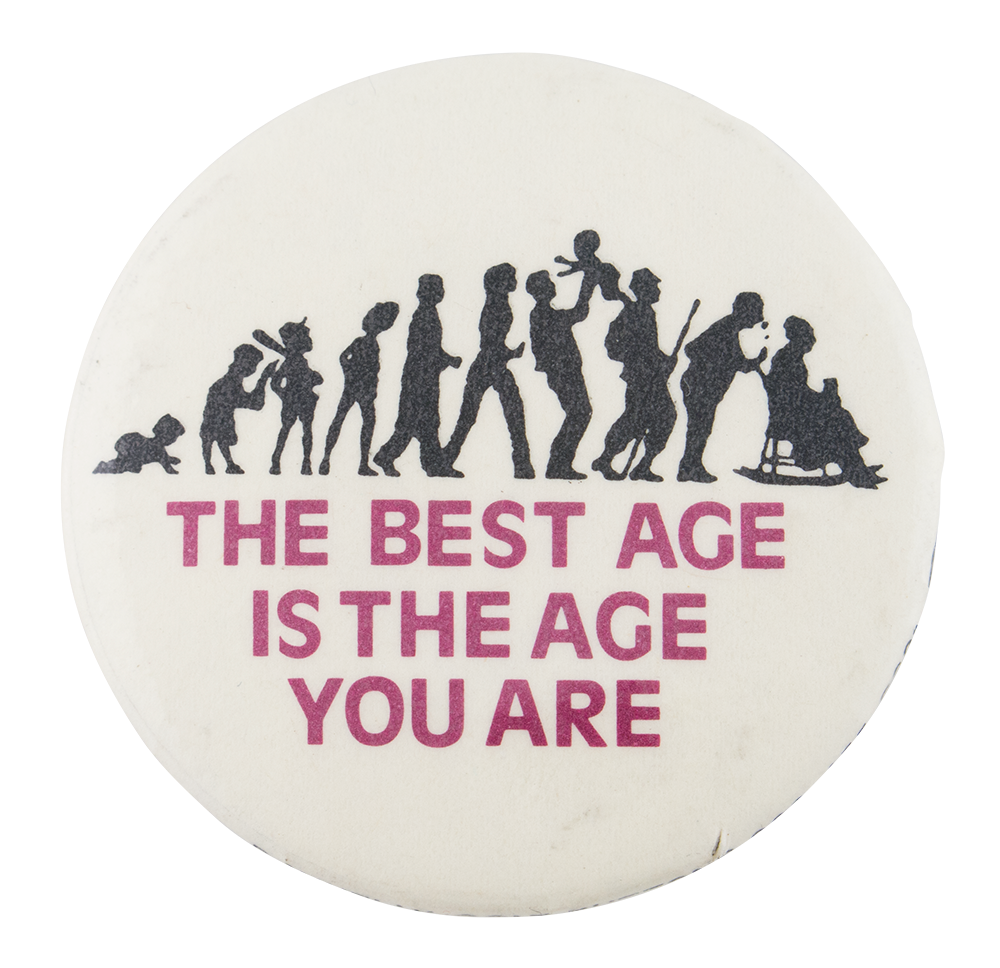
Text on Button THE BEST AGE IS THE AGE YOU ARE
Image Description

Illustration of silouettes of people from baby to old age over purple text on a white background

Curl Text DONNELLY/COLT BUTTONS 203-455-9621
Back Style
The Shape
The Size
The Manufacturer
Additional Information

Maggie Kuhn popularized the phrase " The best age is the age you are," while being an activist for age rights. Kuhn started a group known as the Gray Panthers, which was an advocacy group for the rights of the elderly. The group was founded after Kuhn was forced to retire at age 65 and met with other retirees to discuss injustices they faced. The original group name was Consultation of Older and Younger Adults for Social Change, but its current name was coined by a news anchor that compared them to the Black Panthers.

Sources

Editors of Encyclopaedia Britannica. (2019). Maggie Kuhn. Encyclopaedia Britannica. Retrieved from: https://www.britannica.com/biography/Maggie-Kuhn

Catalog ID CA0354

All Together

Category
Additional Images
Sub Categories
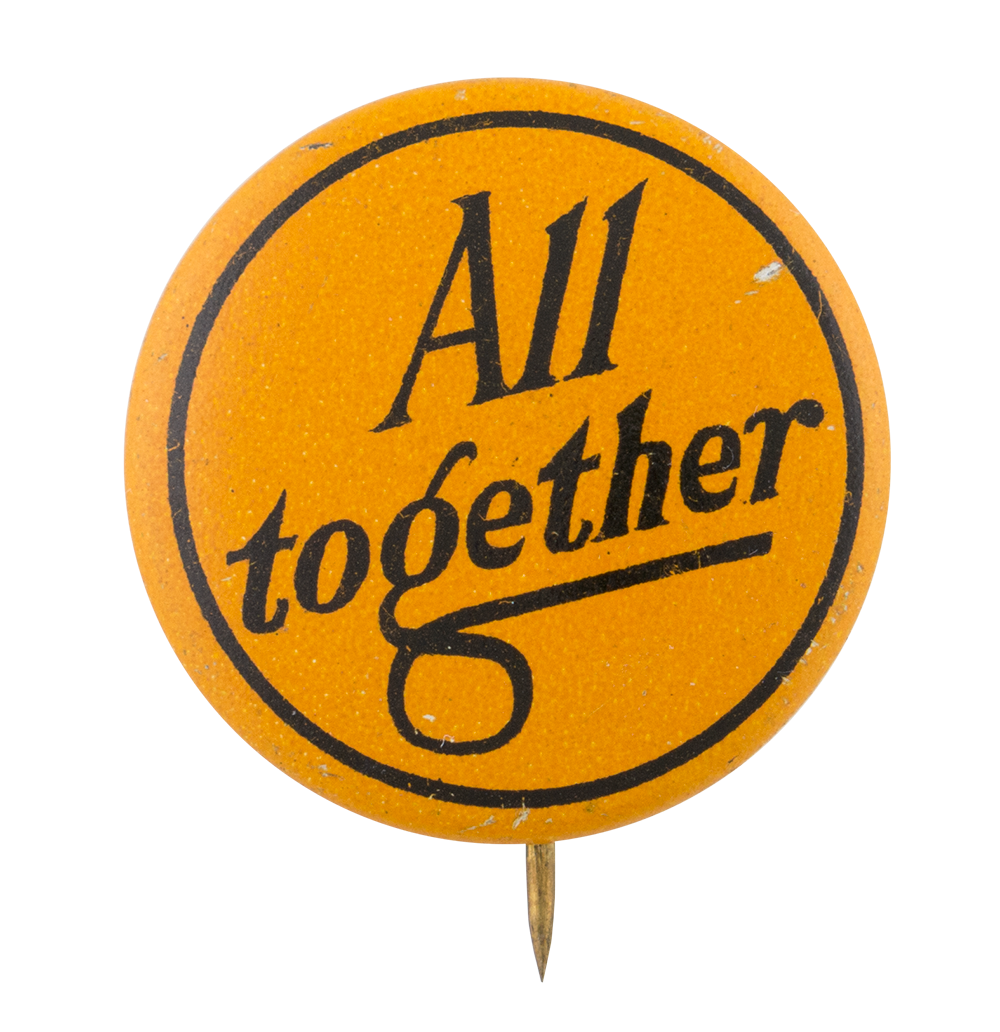
Text on Button All Together
Image Description

Black text on an orange backgroud

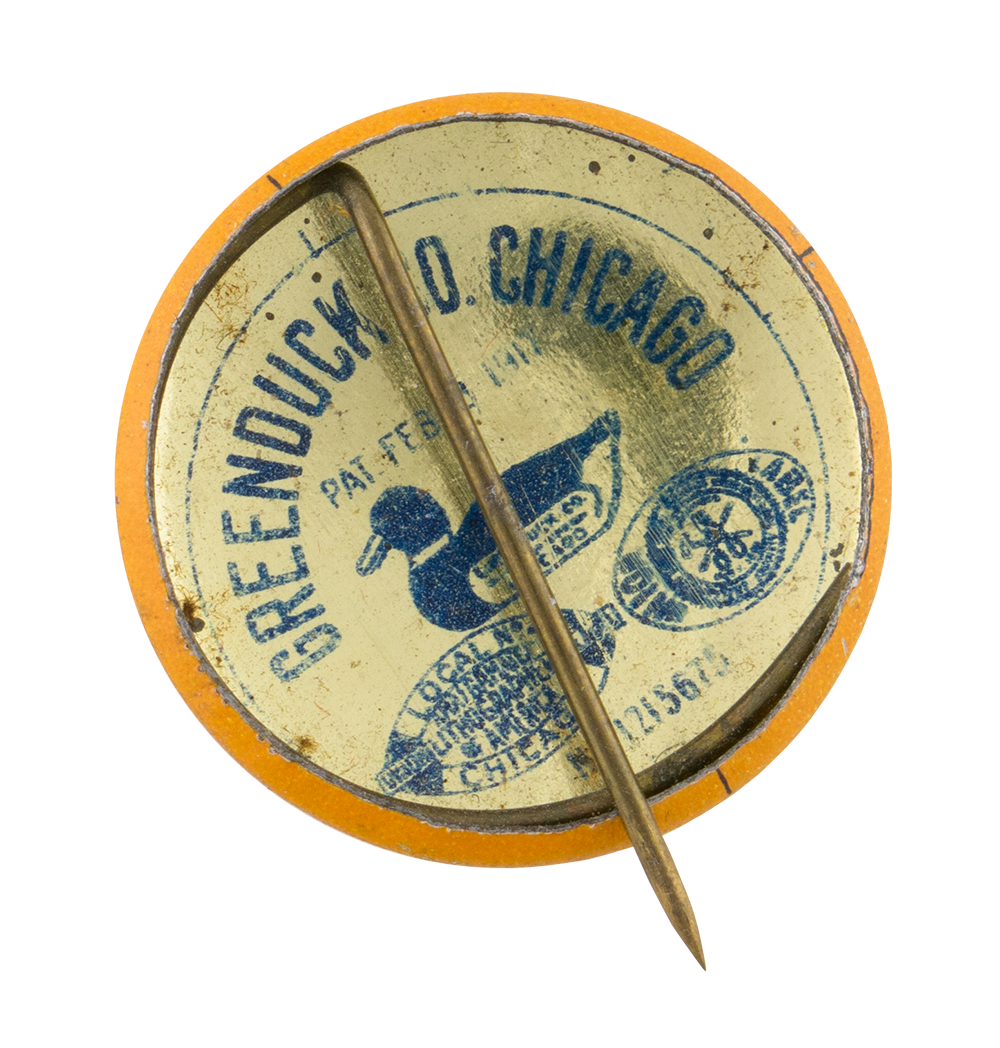
Back Paper / Back Info

GREENDUCK CO. CHICAGO
PAT FEB 13 1817

Back Style
The Shape
The Size
The Manufacturer
Additional Information

Have info on this button? Contact us here.

Catalog ID CA0301

A Woman's Place is in Her Union

Category
Additional Images
Sub Categories
Text on Button A WOMAN'S PLACE IS IN HER UNION
Image Description

Blue text, including the logo for the Coalition of Labor Union Women, on a white background

Back Style
The Shape
The Size
Additional Information

‘A Woman’s Place is in Her Union’ was the theme of the first biennial national conference of the Coalition of Labor Union Women, held in 1979. The Coalition of Labor Union Women was formed in March 1974 with the primary objective of developing programs within unions that addresses common challenges and concerns of working women. ‘A Woman’s Place is in Her Union’ continues to remain a popular slogan at labor rallies and conferences.

Sources

History of CLUW. (n.d.). Retrieved March 10, 2019, from http://www.cluw.org/?zone=/unionactive/view_article.cfm&HomeID=430444&p….

Catalog ID CA0275

Sock it to 'Em Teach

Category
Additional Images
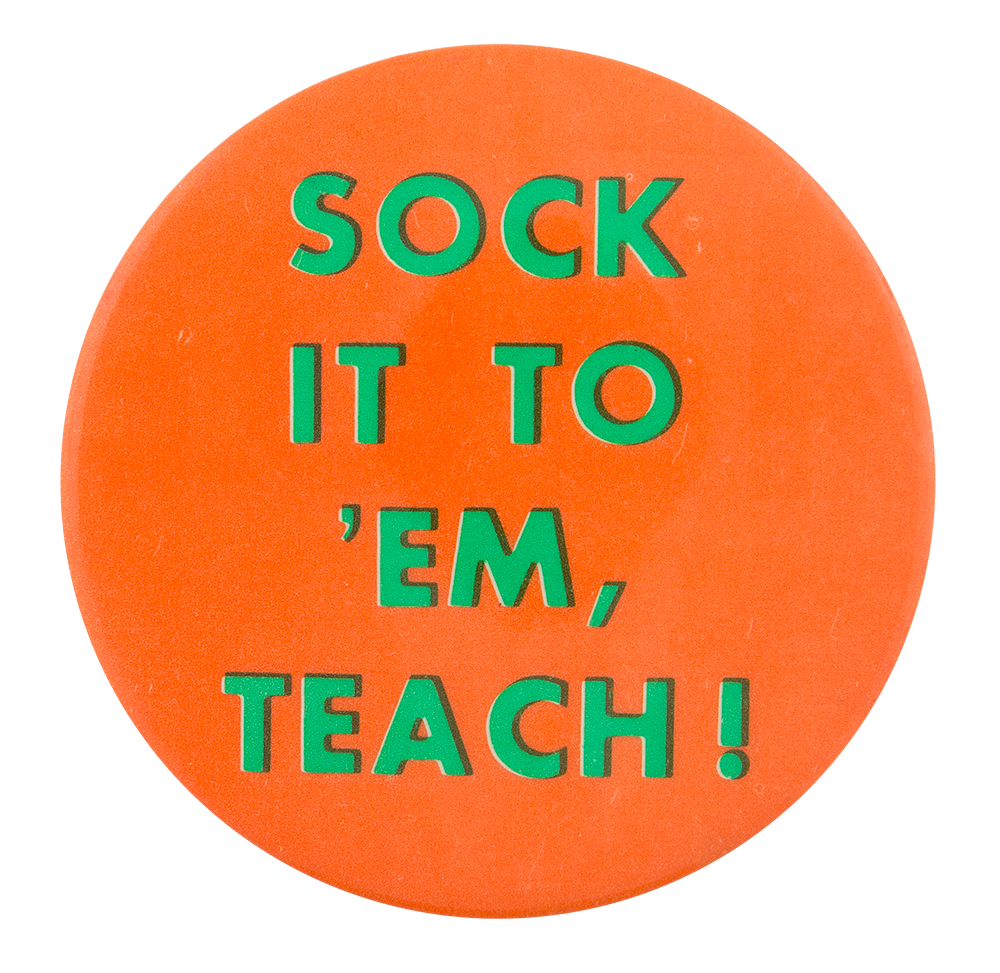
Text on Button SOCK IT TO 'EM, TEACH!
Image Description

Green text on a bright orange background

Curl Text HEWIG-MARVIC BROOKLYN NY 11222
Back Style
The Shape
The Size
The Manufacturer
Additional Information

“Sock it to me” conveys enthusiasm and a willingness to engage, often with a challenge. It gained popularity among Black musicians in the soul and jazz scenes of the late 1960s and early 1970s. In Aretha Franklin’s 1967 hit "Respect," background singers repeat the phrase to highlight eagerness for societal recognition and the demand for respect. The phrase also became a catchphrase on the TV show "Laugh In," signaling readiness for the next joke or story. The catchphrase was famously even said by Richard Nixon in 1968. In 1972, The Jimmy Castor Bunch used it in their song "Troglodyte" to suggest sexual advances. 

In 1960s slang, “teach” is used as a casual term for “teacher”—for example, “Hey, Teach.” It has been in use since at least the mid-20th century. Students say “Sure, teach” in the 1955 film Blackboard Jungle, illustrating the school slang of that era. The term can seem friendly or a bit cheeky depending on the tone. 

Hewig & Marvic (often stamped “HEWIG–MARVIC” on the curl) was a New York-based pin-back button manufacturer best documented in the 1960s–1970s, producing club, novelty, and political campaign buttons. 

Sources

Clip.Cafe. (2025, January 30). There will be no calling out. You have any questions to ask, just raise your hand. You... [Video clip]. https://clip.cafe/blackboard-jungle-1955/therll-be-no-calling-out-now/ 

Colonial House. (n.d.). 1960s slang. Thirteen/WNET New York. Educational Broadcasting Corporation. Retrieved October 20, 2025, from https://www.thirteen.org/wnet/colonialhouse/print/p-teach_lesson4_worksheet2.html 

Daughtery, G. (2018, May 16). Did Nixon’s ‘Laugh-In’ cameo help him win the 1968 election? History.com. Retrieved October 20, 2025, from https://www.history.com/articles/richard-nixon-laugh-in-cameo-1968 

Dun&Bradstreet. (n.d.). Hewig Marvic of New Jersey Inc. Retrieved October 20, 2025, from https://www.dandb.com/businessdirectory/hewigmarvicofnewjerseyinc-tenafly-nj-13951055.html 

O’Dell, C. (2002). “Respect”—Aretha Franklin (1967). The Library of Congress. https://www.loc.gov/static/programs/national-recording-preservation-board/documents/Respect.pdf

New Hampshire Historical Society. (n.d.). Button, campaign, Regan. Retrieved October 20, 2025, from https://www.nhhistory.org/Object?id=96ed41fc-8e49-47e5-bc54-b7e488bd580f&utm 

Quinion, M. (2002, October 26). Sock it to them. World Wide Words. Retrieved October 20, 2025, from https://worldwidewords.org/qa/qa-soc1.htm 

Catalog ID IB0500

Women's Liberation Purple

Category
Additional Images
Sub Categories
Image Description

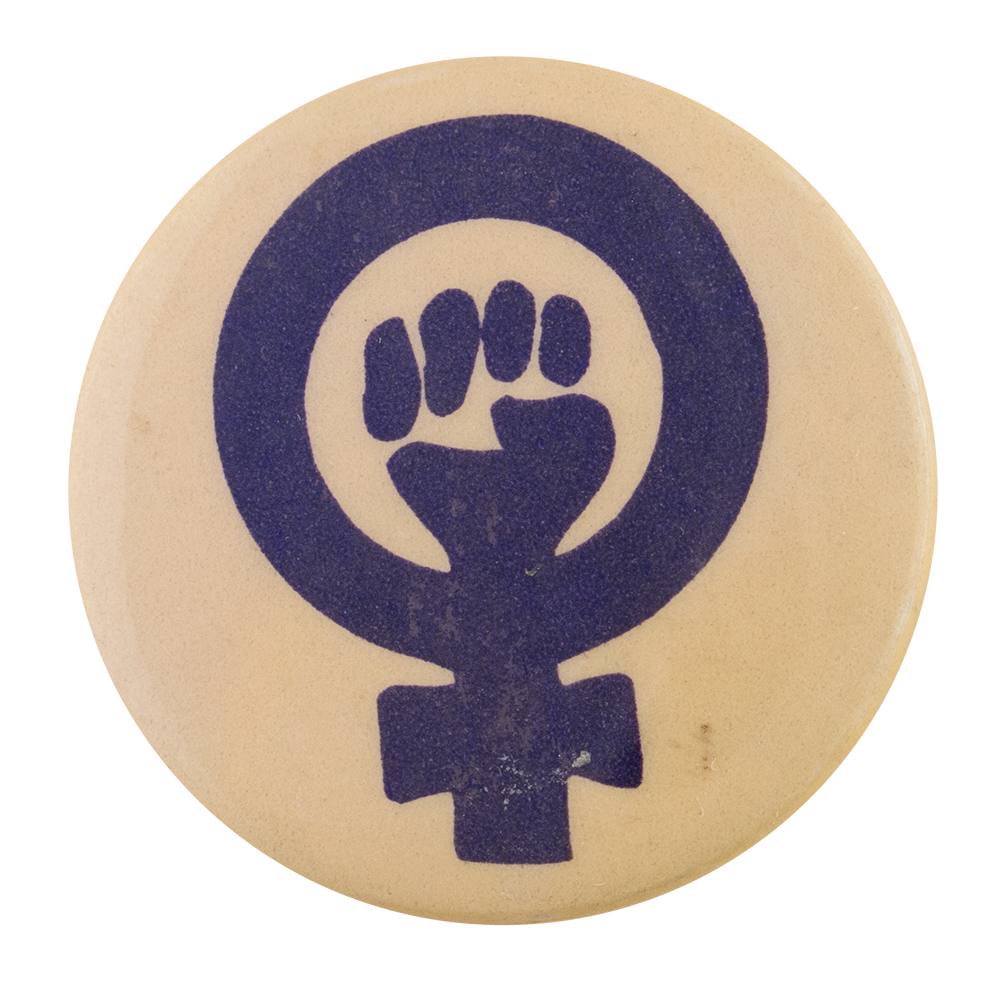
A purple illustration of the symbol for female with a fist in the middle on a white background

Curl Text DONNELT/COLT BUTTONS BOX 188 HAMPTON CT 06247 203-455-9621
Back Style
The Shape
The Size
The Manufacturer
Additional Information

The Women’s Liberation Movement, commonly referred to as feminism, is a series social and political reforms on issues like domestic violence, reproductive rights, equal pay, and women’s suffrage. The history of feminism has been divided into three waves: First-wave feminism focused on middle- and upper-class white women through suffrage and political equality. Second-wave feminism focused on other social and cultural inequalities. Third-wave feminism addresses financial, social, and cultural inequalities and campaigns for greater influence of women in politics and media. The symbol itself, which calls for inclusion of women of color, consists of the astrological symbol for Venus and a clenched fist that was used in the 1960s by the black power movement.

Catalog ID CA0268