Chicago Symphony for President

Category
Additional Images
Sub Categories
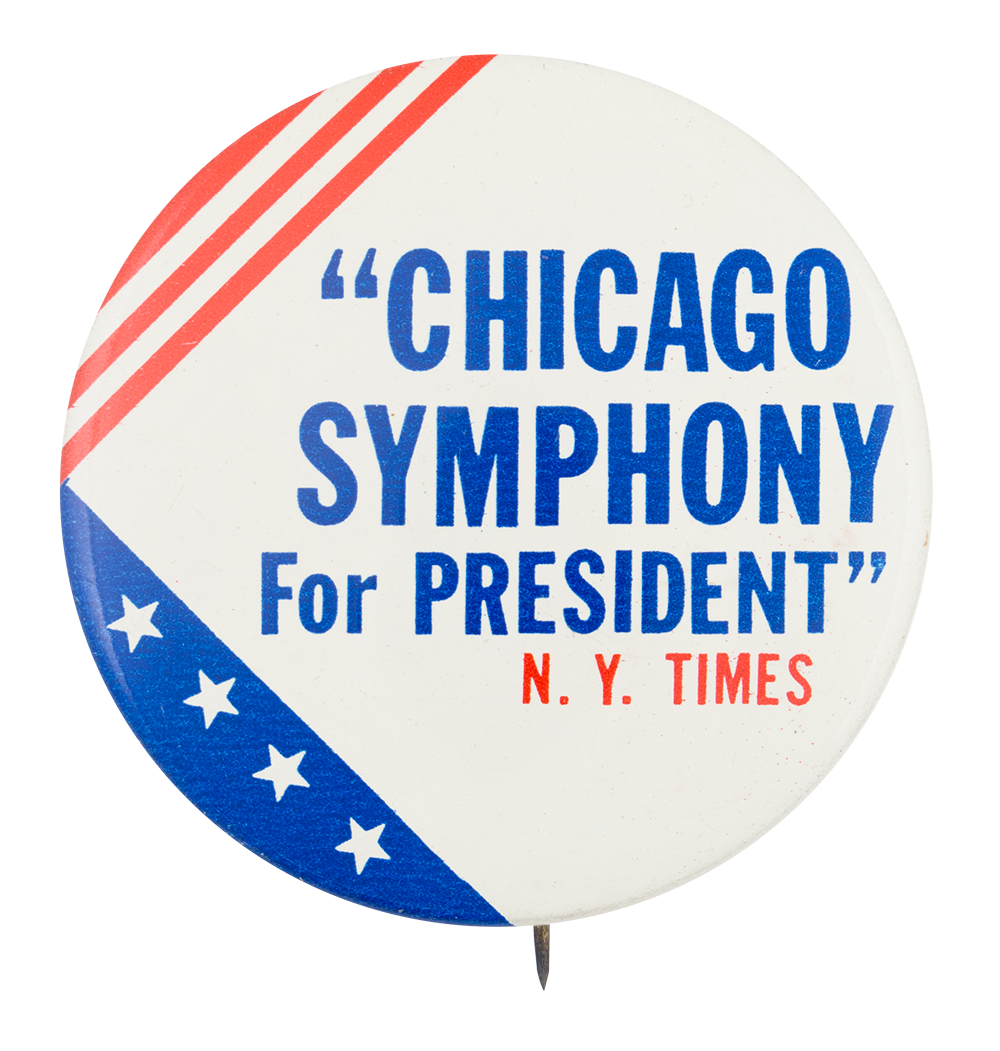
Text on Button "CHICAGO SYMPHONY For PRESIDENT" N.Y. TIMES
Image Description

Blue and red text on a white background with red stripes in the upper left and a blue area on the bottom left with white stars on it.

Curl Text SUPPORT CHICAGO SYMPHONY 220 S. MICHIGAN CHGO 60604
Back Style
The Shape
The Size
Year / Decade Made
Additional Information

This is a promotional button for the Chicago Symphony Orchestra (CSO) from the 1970s. The saying on the button is a reference to a New York Times article which called for the Chicago Symphony Orchestra to be nominated for President. This button may have been related to a larger promotional campaign for the CSO. In 1976, under the direction of conductor Sir Georg Solti, the orchestra was featured on a 39-week nationally syndicated radio program. The series, sponsored by Amoco and produced by Chicago radio station WFMT, aimed to fulfill an increasing demand for more classical music programming on the radio.

Catalog ID CH0196

Candid Button

Category
Additional Images
Sub Categories
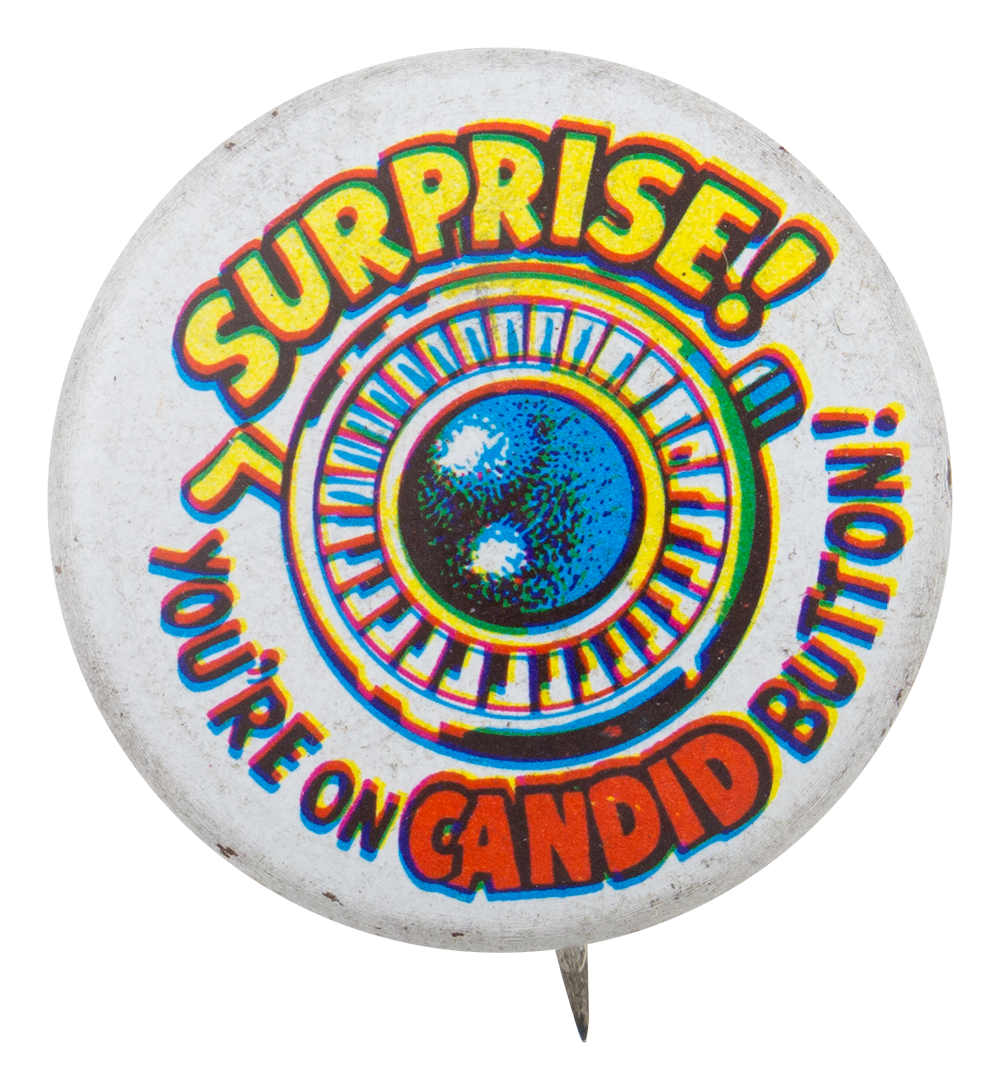
Text on Button Surprise! You’re on Candid Button!
Image Description

Yellow, black, and red text on a white background and a camera lens

Curl Text CREATIVE HOUSE 60641 MADE IN U.S.A.
Back Style
The Shape
The Size
Year / Decade Made
The Manufacturer
Additional Information

The phrase, "Surprise! You're on Candid Camera!" was the catchphrase of the show Candid Camera, which ran on television from 1948 until 2014 with various networks picking up the program. Prior to television, the program was a radio show called Candid Microphone. The premise was to catch people in practical jokes or unaware that they were being recorded. The image displayed here on the "candid button" appears to be both an eye and a camera borrowing on the common theme of hidden spyware for joking purposes.

Creative House Productions Inc. originated in 1964 and was a design and manufacturing company based in Chicago, Illinois. It was responsible for the creation of many promotional comic pins found in gumball machines and Cracker Jack boxes. Creative House eventually created the brand PinMart, which became the first website to sell lapel pins. PinMart eventually outgrew its parent company and bought Creative House in 2008.

Sources

PinMart. (2020). About us. https://www.pinmart.com/about/

Catalog ID SR0104

Nixon Button

Category
Additional Images
Sub Categories
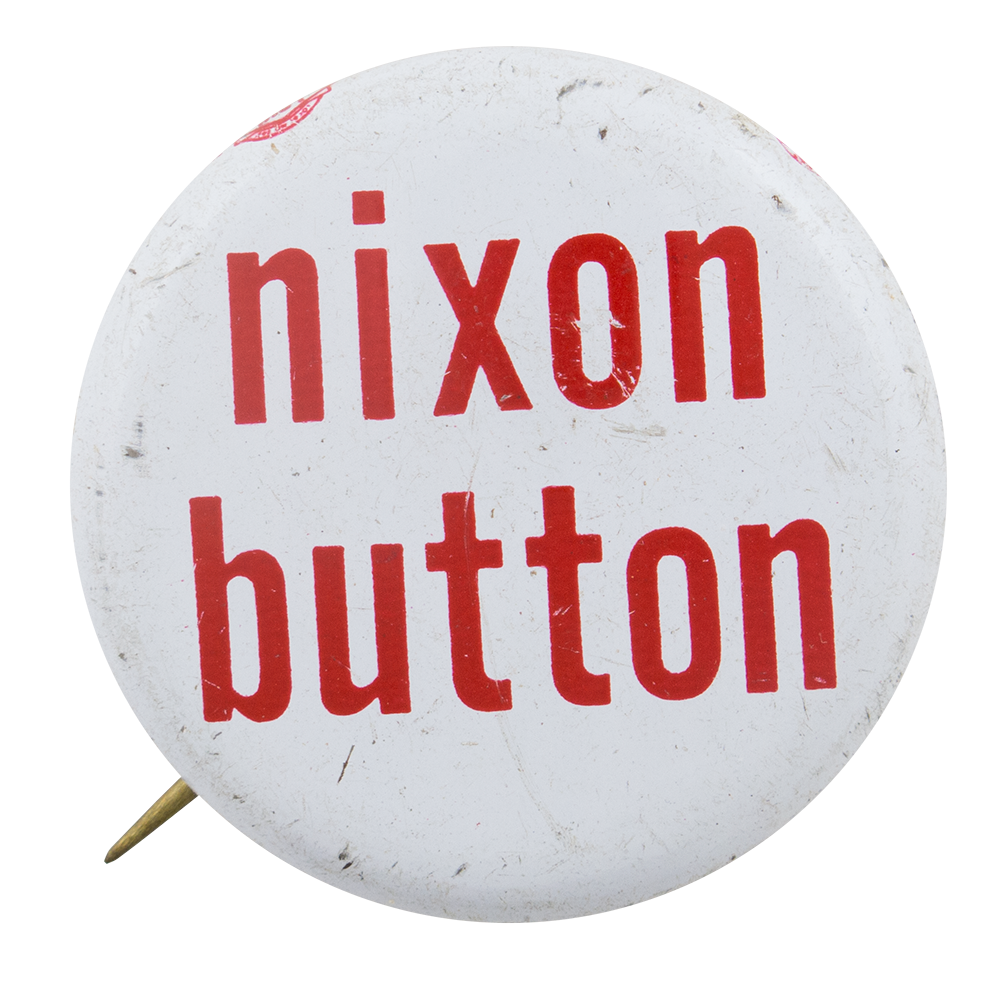
Text on Button nixon button
Image Description

Red text on a white background

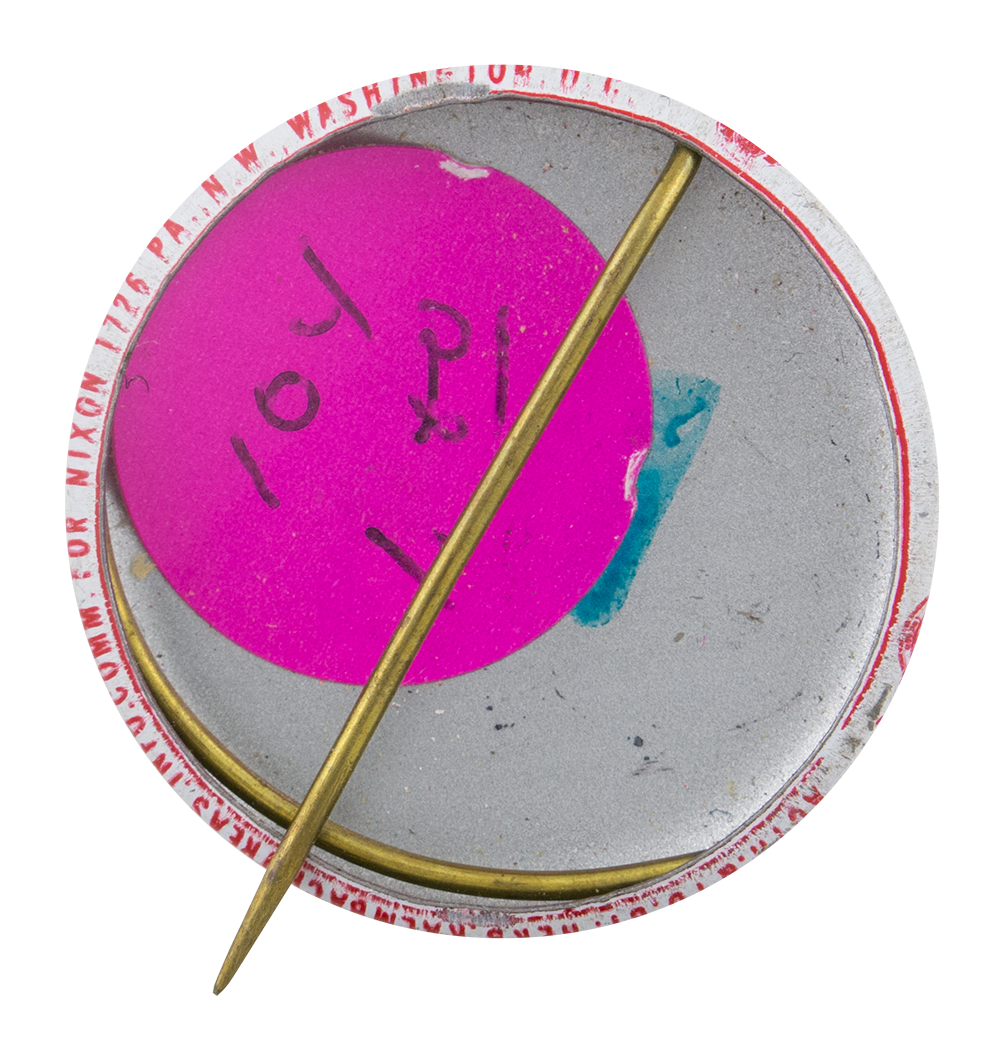
Curl Text AUTH. & PO, BY: HERB KALMBACH TREAS., INFO. COMM FOR NIXON 1726 PA., N.W. WASHINGTON, DC (union bug)
Back Style
The Shape
The Size
Additional Information

Richard Nixon was a politician from the state of California.  He served  first in the House of Representatives between 1947 and 1950 and then as a U.S. Senator from 1950-1953.  Nixon was selected by Dwight D. Eisenhower to be his Vice President running mate during Eisenhower's campaign for President.  He would later go on to serve two terms as Vice President during the Eisenhower Administration.

Nixon, himself, ran for President of the United States in 1960 election against Democratic nominee, John F. Kennedy, which Nixon lost by a narrow 0.2% of the popular vote.  By the 1968 election, Nixon had decided to run again as the Republican candidate against Democratic nominee, Hubert Humphrey, President Johnson's Vice President.  Nixon went on to win the election, becoming the 37th President of the United States.  In 1972, he ran for a second term as President, winning the election by a 60% margin of the popular vote, defeating Democratic candidate, George McGovern.  Due to the Watergate scandal that ensued during the following years, Nixon became the first President to resign from office, doing so in 1974.

Catalog ID SR0082

Wearing Badges Is Not Enough

Category
Additional Images
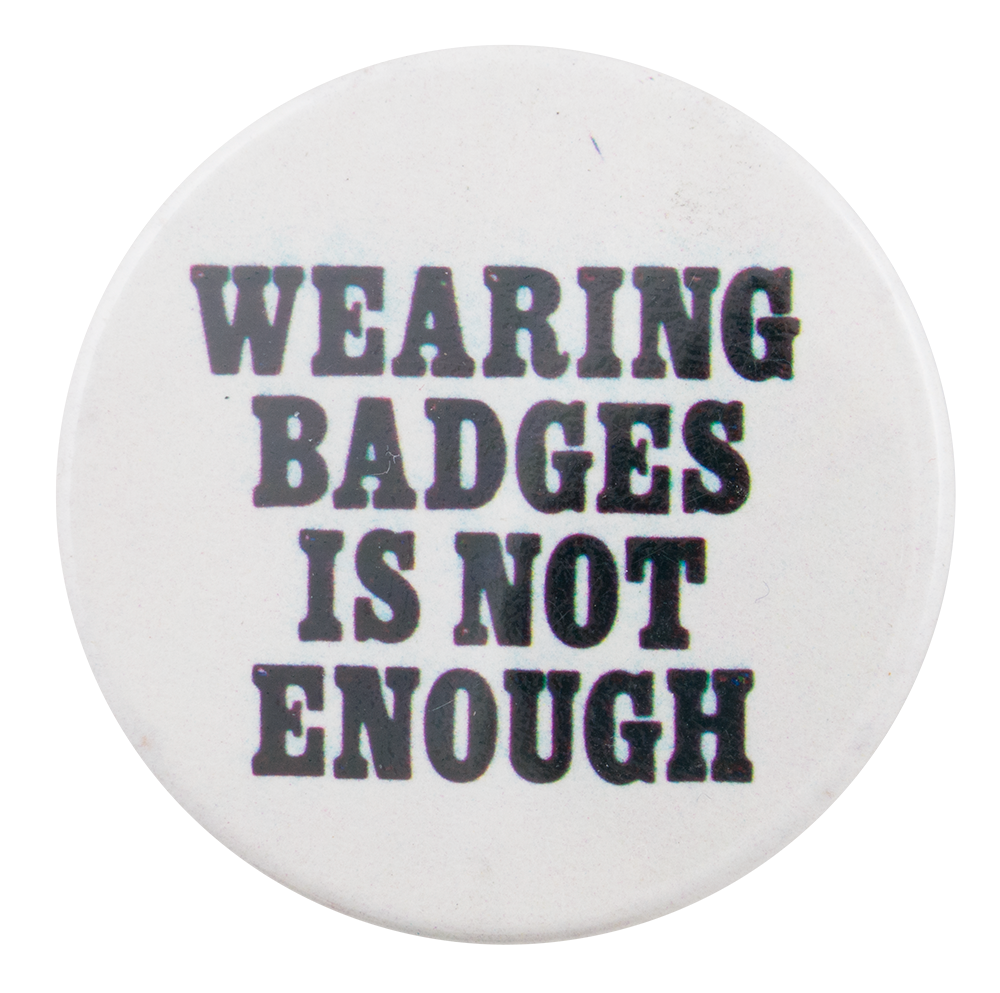
Text on Button Wearing Badges is Not Enough
Image Description

Black text on a white background

Back Style
The Shape
The Size
Additional Information

Wearing Badges is not Enough is the final line from the 1985 Billy Bragg single “Days Like These” that urges listeners to get involved with political activism rather than remaining on the sidelines. Born in 1957, Bragg is an English songwriter, guitarist, and throughout his musical career he has been a vocal supporter of progressive left-wing policies and grassroots movements.

Sources

Whitehead, A. (2017). 'Wearing Badges is Not Enough'. ANDREW WHITEHEAD. Retrieved 25 June 2021, from https://www.andrewwhitehead.net/blog/wearing-badges-is-not-enough.
Billy Bragg. Wikipedia. (2021). Retrieved 25 June 2021, from https://en.wikipedia.org/wiki/Billy_Bragg.

Catalog ID SR0103

Humphrey for President Ribbon

Category
Additional Images
Sub Categories
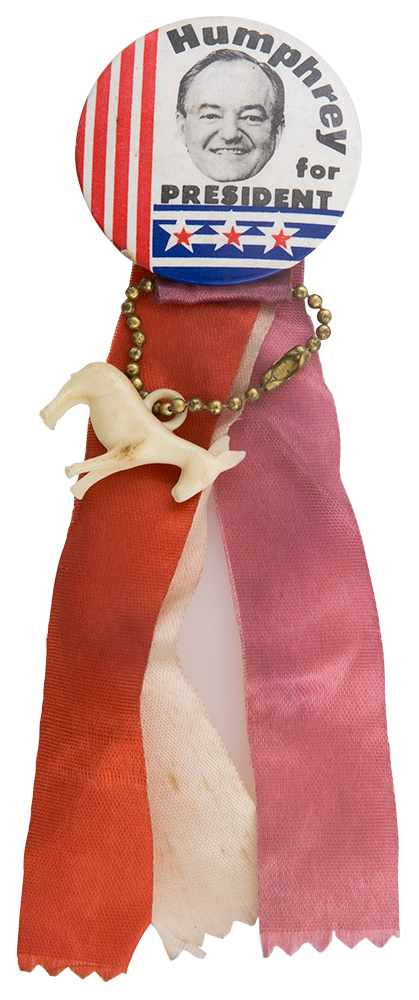
Text on Button Humphrey for PRESIDENT
Image Description

Red verticle stripes on the left with blue horizontal stripes at bottom with black text on a white background an a black and white photograph of a man's head in the center

Back Style
The Shape
The Size
Additional Information

Hubert Humphrey was a Democratic politician, who, in 1968, ran as the Democratic candidate in the U.S. Presidential election against Republican opponent, Richard Nixon.  Humphrey had served as Vice President under President Johnson's presidency.  After Johnson had announced that he would not run for a second term, Humphrey entered the race for the Democratic nomination.  He would go on to loose the race against Nixon, contributing factors to this defeat were the assassinations of Martin Luther King, Robert Kennedy and the general unpopularity of President Johnson.

Catalog ID PO0319

Jimmy Carter '76 the Best

Category
Additional Images
Sub Categories
Text on Button Jimmy Carter WHY NOT THE BEST '76
Image Description

Illustration of an eagle with a star over it and green leaves on either side over a red and yellow banner with red text on it and red text underneath it. Blue text on either side of the illustration on a white background

Back Style
The Shape
The Size
Year / Decade Made
Additional Information

This button comes from Jimmy Carter’s 1976 campaign for the presidency. Carter was originally a peanut farmer in Georgia, and served as the state’s senator in the 1960s and the state’s governor in the early 1970s. When he campaigned for the presidency against President Gerald Ford, Carter appealed to average voters by discussing his former job as a peanut farmer and being interviewed by popular magazines like Playboy. Carter won the election with 50.1% of the votes, and as president escalated the Cold War, pardoned Vietnam War draft evaders, witnessed the Camp David Accords which led to peace between Egypt and Israel. After his presidency, he began the Carter Center in 1982, a human rights advocacy organization, for which he was awarded the Nobel Peace Prize in 2002.

Jimmy Carter. (n.d.). Retrieved November 8, 2015 from: https://en.wikipedia.org/wiki/Jimmy_Carter.

Catalog ID PO0125

Clinton is the Best

Category
Additional Images
Sub Categories
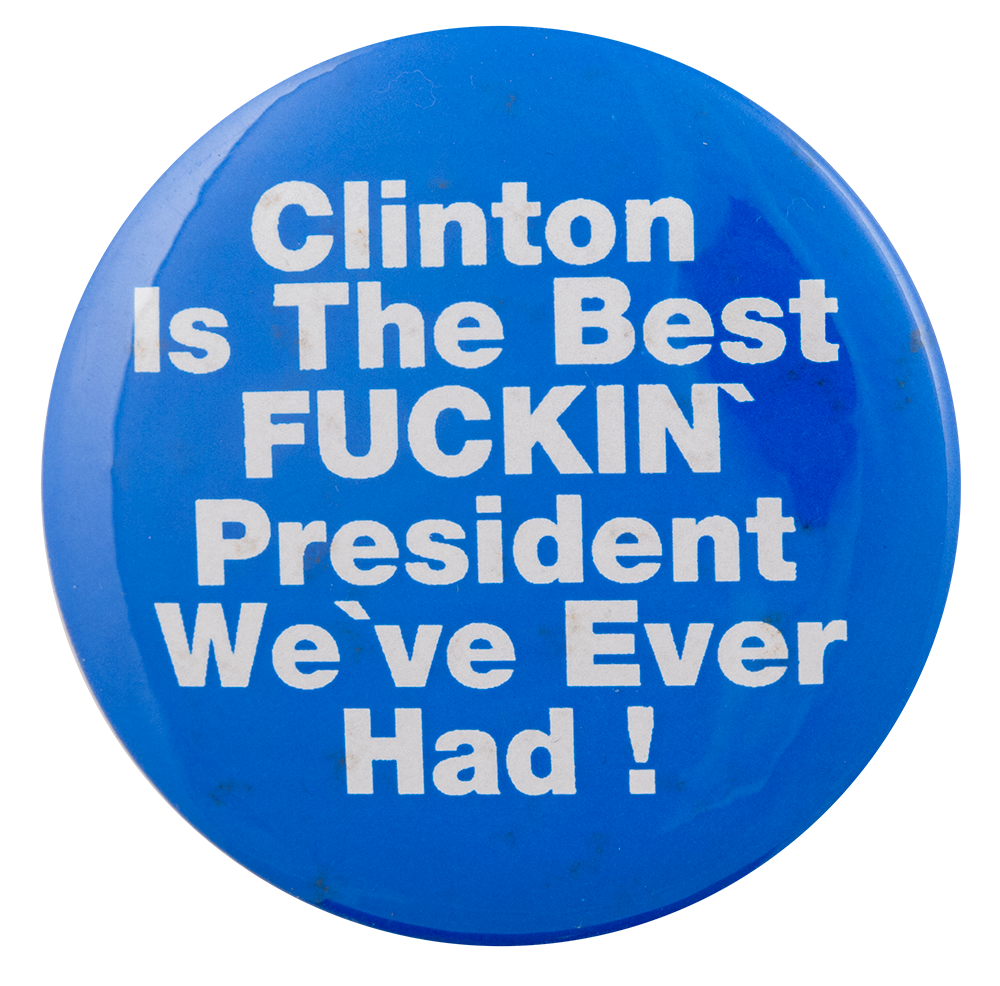
Text on Button Clinton Is The Best FUCKIN' President We've Ever Had!
Image Description

White text on a blue background

Back Style
The Shape
The Size
Additional Information

This is a satirical button about Bill Clinton, the 42nd President of the United States. While this button may be taken at face value as pro-Clinton, the textual emphasis may, in fact, be a critique of Clinton and a reference to his marital infidelities.

During Clinton's 1992 Presidential campaign, a controversy arose over accusations of an affair between Clinton and an Arkansas model and actress, Gennifer Flowers. Clinton denied the accusations at the time, but later admitted under oath that he had a sexual relationship with Flowers. In 1998, another scandal emerged regarding Clinton’s extramarital relationships, this time with a much younger White House employee, Monica Lewinsky. The investigation led to the impeachment of Clinton and charges of perjury and obstruction of justice. Following a senate impeachment hearing, Clinton was acquitted of all charges and he remained in office to finish his second term. 

Catalog ID PO0328

Howard Stern for Governor

Category
Additional Images
Sub Categories
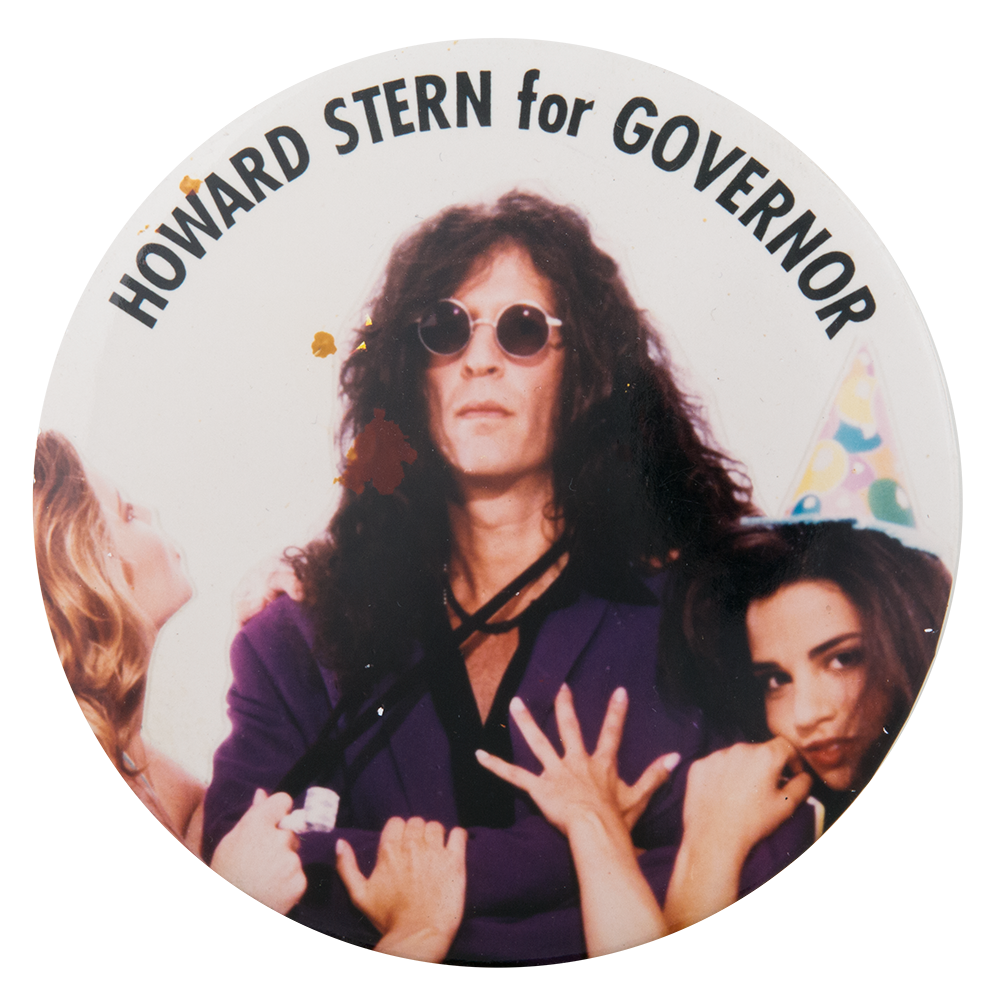
Text on Button HOWARD STERN for GOVERNOR
Image Description

Black text along the top edge with a color photograph underneath of a man with long hair and glasses with two women on either side of him.

Back Style
The Shape
The Size
Year / Decade Made
Additional Information

Radio personality and “shock jock” Howard Stern was the Libertarian candidate for Governor of New York in 1994. Stern's candidacy came at the height of his popularity: his nationally-syndicated radio show had over 20 million listeners, and he had just released his book Private Parts. Stern announced his candidacy on his radio show on March 22, 1994 and ran on a platform of reinstating the death penalty, staggering highway tolls in an effort to prevent traffic jams, and only allowing road construction at night. He also promised to resign from office as soon his campaign goals were accomplished. His campaign slogan was: “a volt for every vote.”

Stern’s run was cut short, however, after he refused to disclose financial documents legally required by any candidate running for public office in the state of New York. He ended his bid for Governor on August 4, 1994.

Catalog ID PO0330

I Didn't Vote for Reagan

Category
Additional Images
Sub Categories
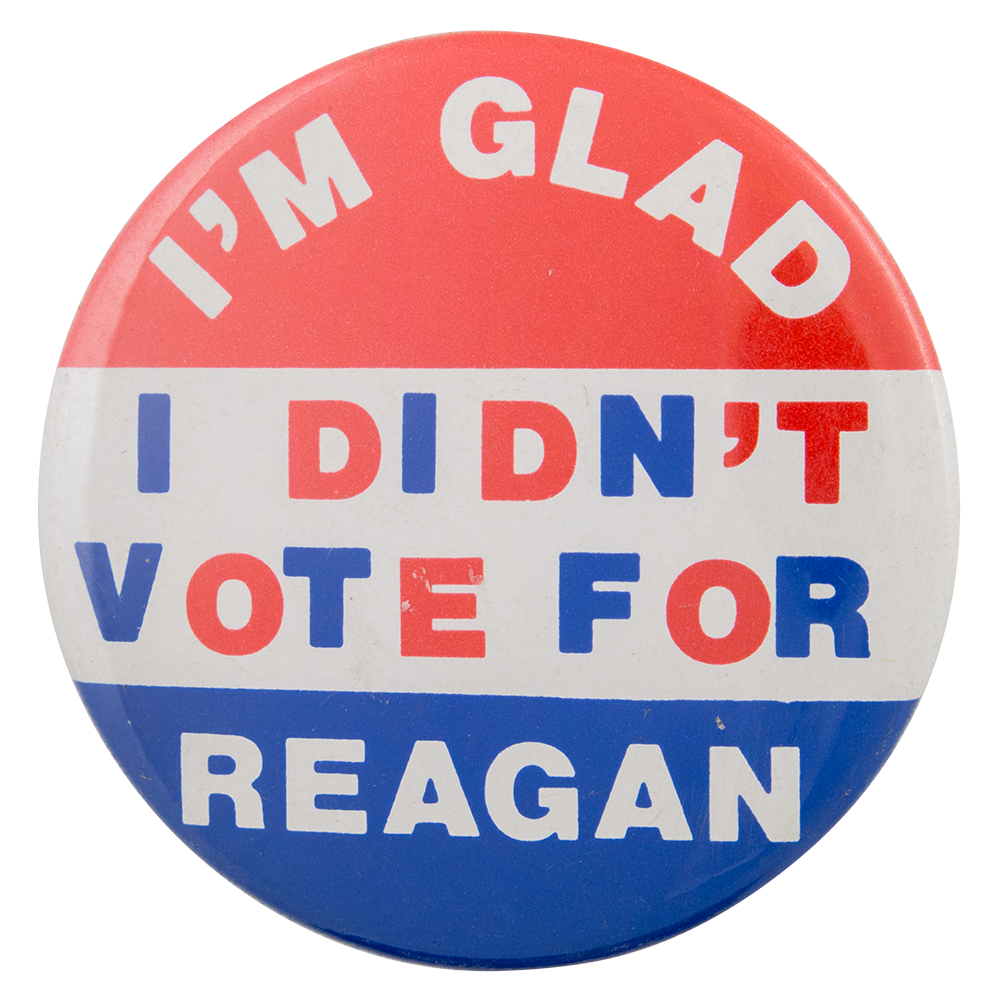
Text on Button I'M GLAD I DIDN'T VOTE FOR REAGAN
Image Description

Red white and blue striped background iwth white text on the red and blue stripes and red and blue text on the white stripe

Curl Text unlegible
Back Style
The Shape
The Size
Year / Decade Made
Additional Information

This is an anti-Ronald Reagan button, most likely from his second term. Ronald Reagan was the 40th president of the United States, serving two terms from 1981 to 1989. A former film star and Governor of California, Reagan made his political stance clear in his 1981 inaugural address with his statement, "government is not the solution to our problems: government is the problem." Key policies of the Reagan years include massive tax cuts, large withdraws of government oversight and regulation, an increase in military spending, and the escalation of the Cold War. 

Reagan is negatively associated with the Iran-Contra scandal, in which he negotiated the sale of arms to Iran in exchange for the release of the seven American hostages that were being held in Lebanon. The scandal severely damaged both Reagan’s approval rating and the United States’ reputation abroad. Though there were several investigations and indictments as a result of the scandal, George H. W. Bush, at the end of his presidency, ultimately pardoned all of those indicted or convicted.

Catalog ID PO0331

I Know He's Right

Category
Additional Images
Sub Categories
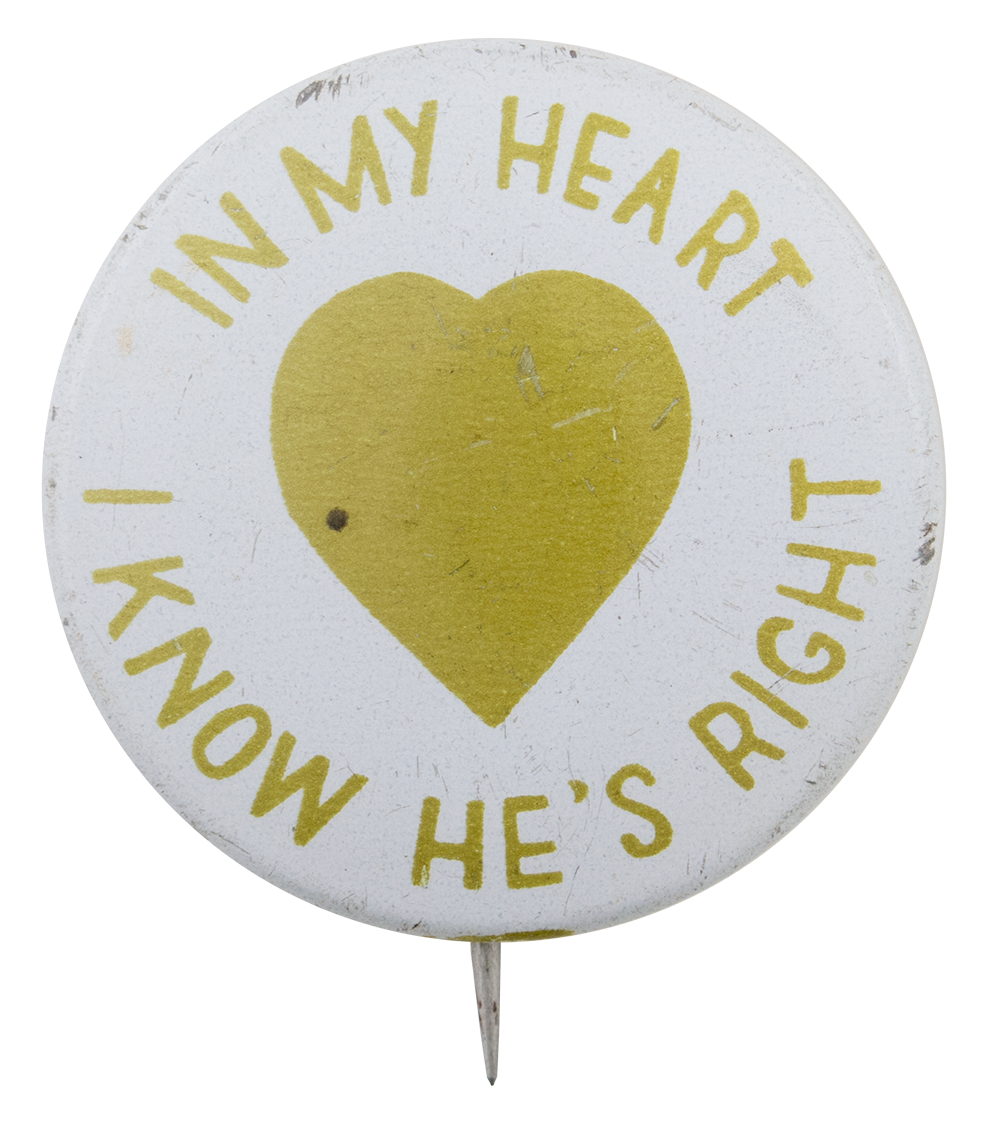
Text on Button IN MY HEART I KNOW HE'S RIGHT
Image Description

Gold text curled above and below a gold heart on a white background

Back Style
The Shape
The Size
Year / Decade Made
Additional Information

This button was issued for the 1964 presidential campaign of conservative Republican senator Barry Goldwater. One of his slogans was "In your heart, you know he's right." Some who opposed Goldwater mocked this by saying "In your guts, you know he's nuts." In his acceptance speech, he paraphrased the Roman orator Cicero by saying "Extremism in the defense of liberty is no vice. And let me remind you also that moderation in the pursuit of justice is no virtue," a phrase for which he is also remembered.

Goldwater and his running mate William E. Miller lost the election to incumbent president Lyndon Johnson and Hubert H. Humphrey. Johnson received 486 electoral votes, while Goldwater won only 52 and just six states. Goldwater served as U.S. Senator from Arizona from 1953-1965 and 1969-1987.

Catalog ID PO0314