Ouch
| Category | |
|---|---|
| Additional Images |
|
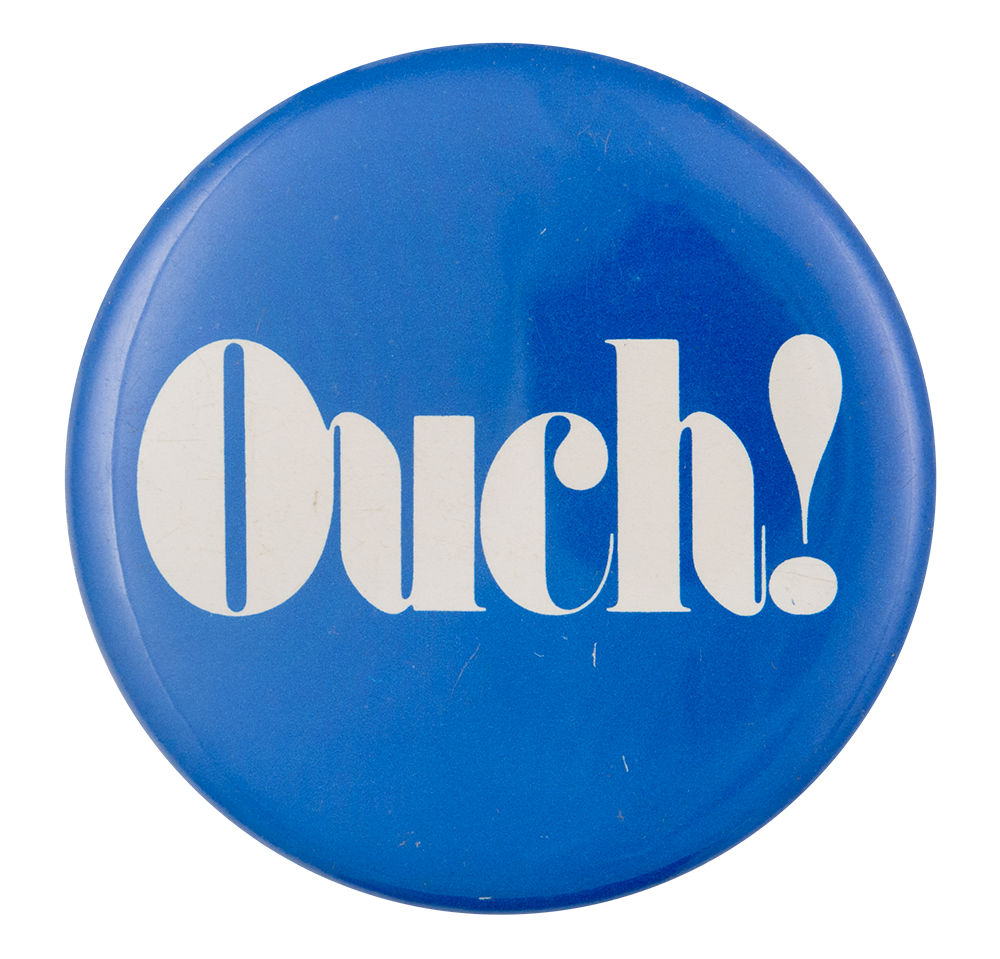
| Text on Button | Ouch! |
| Image Description | Blue button with white text. |
| Back Style | |
| The Shape | |
| The Size | |
| Additional Information | Have info on this button? Contact us here. |
| Catalog ID | IB0093 |

| Category | |
|---|---|
| Additional Images |
|
| Text on Button | Ouch! |
| Image Description | Blue button with white text. |
| Back Style | |
| The Shape | |
| The Size | |
| Additional Information | Have info on this button? Contact us here. |
| Catalog ID | IB0093 |
| Category | |
|---|---|
| Additional Images |
|
| Sub Categories | |
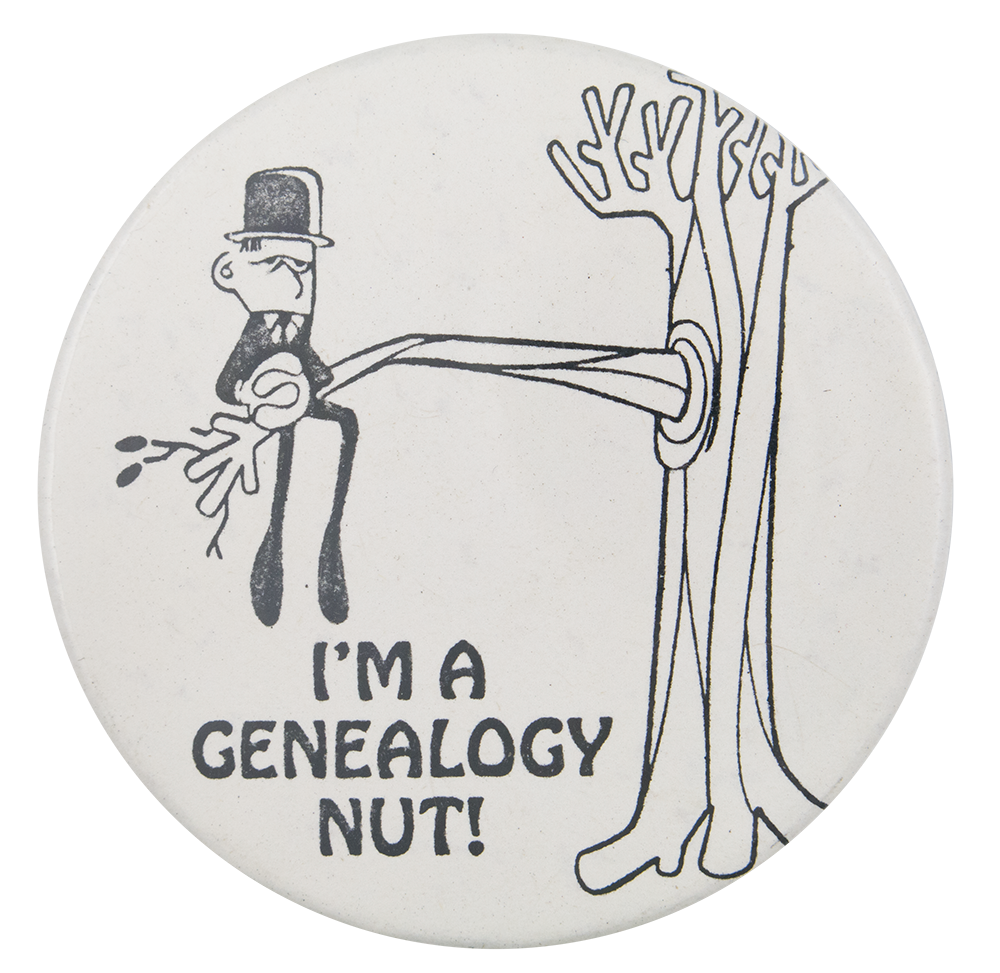
| Text on Button | I'M A GENEALOGY NUT! |
| Image Description | Cartoon illustration of a man in black and white suit with top hat sitting on a tree branch with hands folded. Black text on white background. |
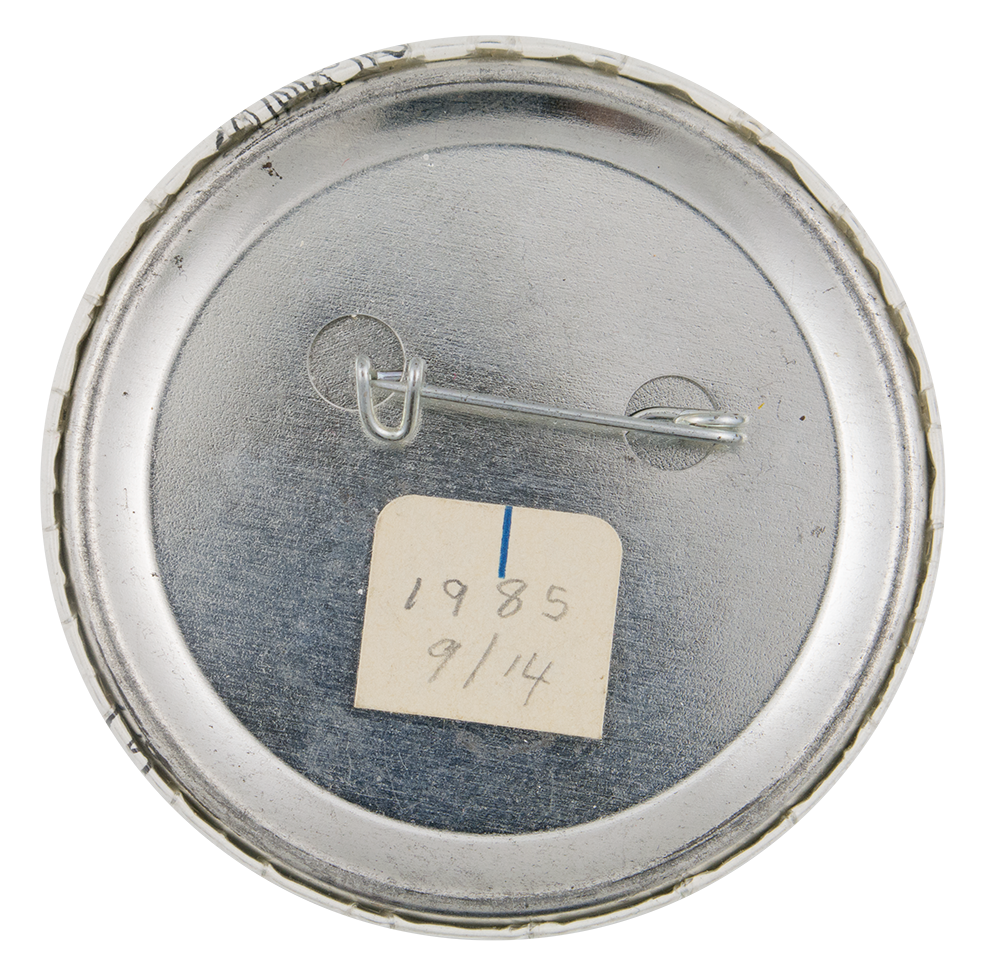
| Back Paper / Back Info |
1985 9/14 |
| Back Style | |
| The Shape | |
| The Size | |
| Additional Information | Genealogy is the study of family history. This image depicts a man, perhaps as a “nut” growing on the “family tree”. |
| Catalog ID | IB0150 |
| Category | |
|---|---|
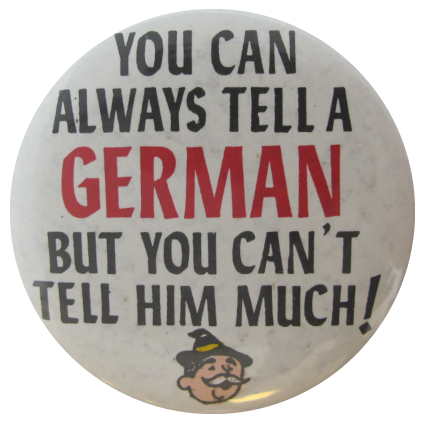
| Text on Button | YOU CAN ALWAYS TELL A GERMAN BUT YOU CAN'T TELL HIM MUCH! |
| Image Description | White button with black text, and some red text. At the bottem is an image of a man wearing a german style hat. |
| The Shape | |
| Additional Information | Have info on this button? Contact us here. |
| Catalog ID | IB0094 |
| Category | |
|---|---|
| Additional Images |
|
| Sub Categories | |
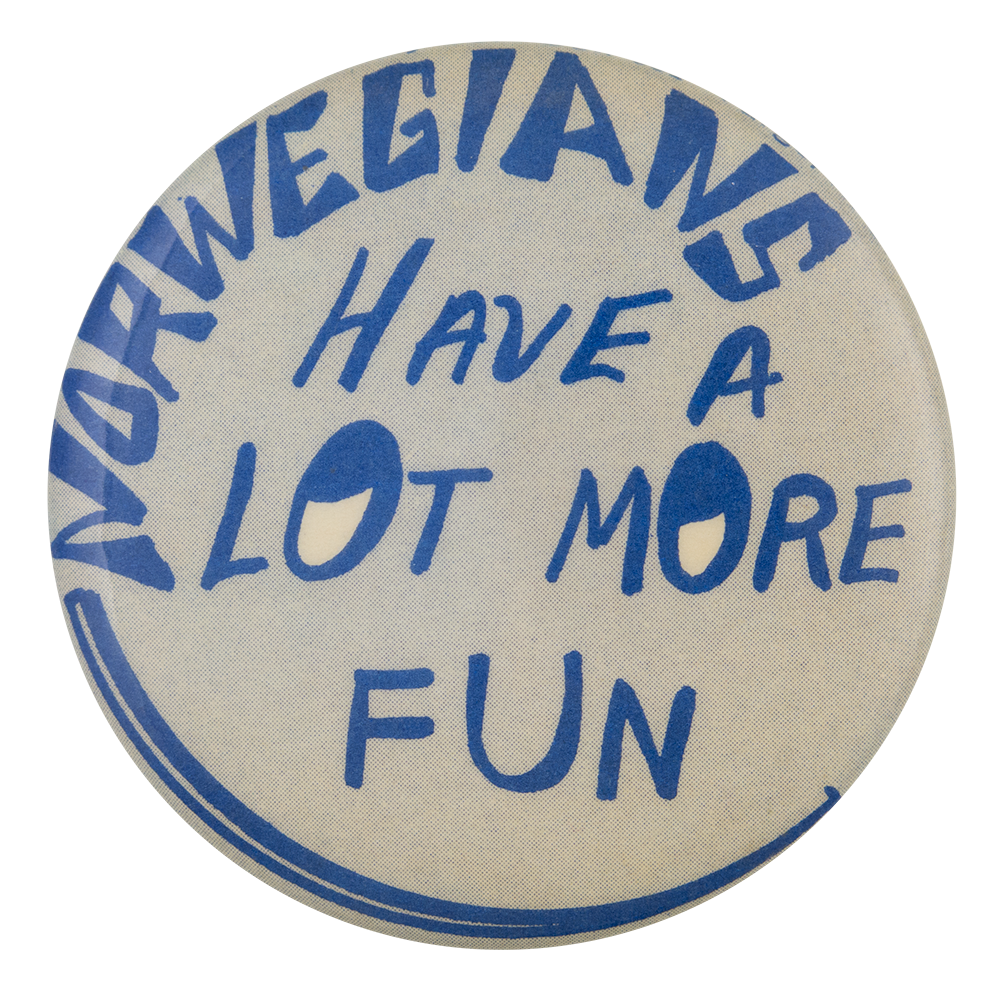
| Text on Button | NORWEGIANS HAVE A LOT MORE FUN |
| Image Description | Blue text positioned as a smiley face with the letter "O" in "Lot" and "More" as the eyes above a grin on a light blue background. |
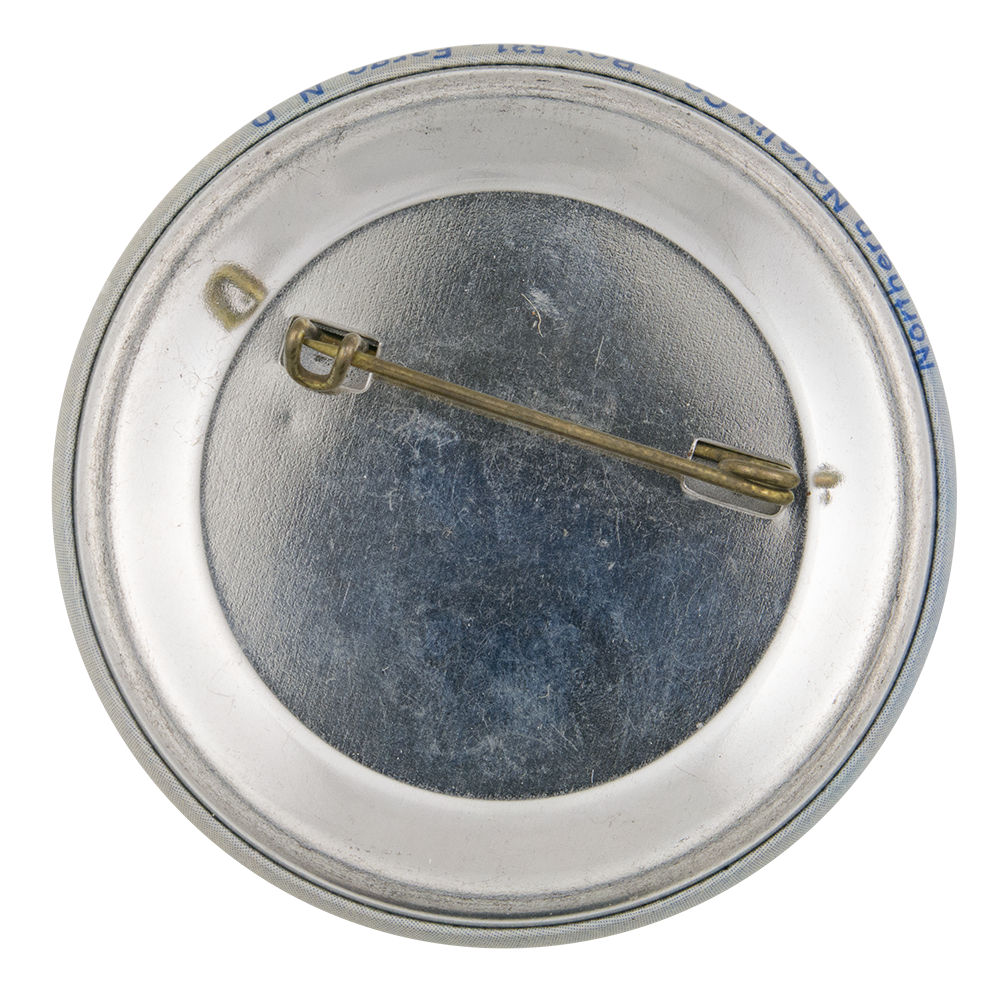
| Curl Text | Northern Novelty Co. Box 531 Fargo, N.D. |
| Back Style | |
| The Shape | |
| The Size | |
| The Manufacturer | |
| Additional Information | A Norwegian is a citizen of Norway. The country of Norway is part of the Scandinavian or Nordic countries which includes Sweden, Finland, Denmark, Iceland, Greenland and the Faroe Islands. The population of Norway is mostly centered around the southern part of the country near Oslo. Indo-European peoples settled in Oslo, Norway 6,000 years ago. The Norwegian people were dependent on fishing and farming. In the Viking Age, Norwegian pirates (known as Vikings) sailed to England to raid the country for their resources and sailed as far as North America. Modern day Norway is known for its fishing, lumber, and trade industries. Today, Norway, as well as other Nordic countries, have the highest standard of living and often make the list of happiest places to live due to their social welfare system. The slogan, "Norwegians Have More Fun," may be an allusion to the popular phrase, "Blondes Have More Fun," which originated from Lady Clairol ads in the late 1950s for hair dye. Since this ad, the phrase "have more fun" has been used for many other identifiers other than blondes. |
| Sources |
Bloom, L. (2020, May 20). Ranked: The 20 Happiest Countries In The World. Retrieved September 18, 2020, from https://www.forbes.com/sites/laurabegleybloom/2020/03/20/ranked-20-happ… Clairol. (2020, September 04). Retrieved September 2020, from https://en.wikipedia.org/wiki/Clairol Sandvik, G., & Christensen, J. (2020, September 18). Norway. Retrieved September 22, 2020, from https://www.britannica.com/place/Norway |
| Catalog ID | SM0043 |
| Category | |
|---|---|
| Additional Images |
|
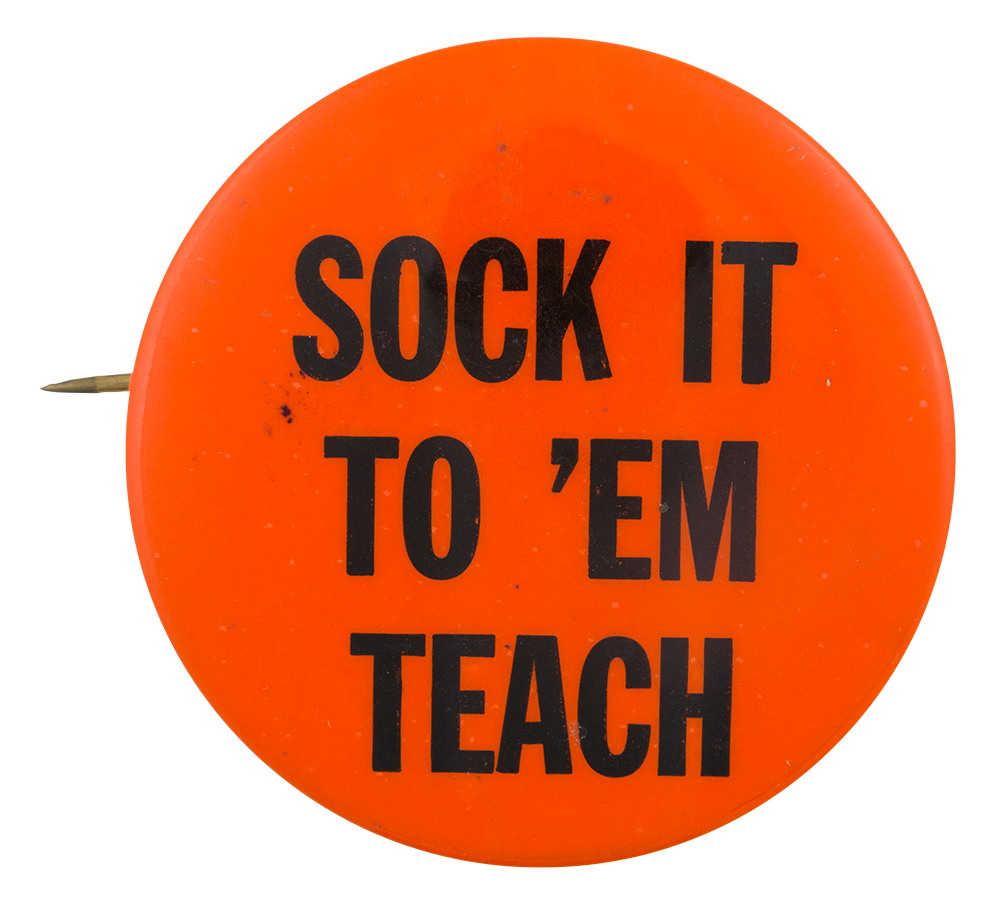
| Image Description | Large, bold text in the center of the button. Black text on a red background. |
| Back Style | |
| The Shape | |
| The Size | |
| Additional Information | “Sock it to me” conveys enthusiasm and a willingness to engage, often with a challenge. It gained popularity among Black musicians in the soul and jazz scenes of the late 1960s and early 1970s. In Aretha Franklin’s 1967 hit "Respect," background singers repeat the phrase to highlight eagerness for societal recognition and the demand for respect. The phrase also became a catchphrase on the TV show "Laugh In," signaling readiness for the next joke or story. The catchphrase was famously even said by Richard Nixon in 1968. In 1972, The Jimmy Castor Bunch used it in their song "Troglodyte" to suggest sexual advances. In 1960s slang, “teach” is used as a casual term for “teacher”—for example, “Hey, Teach.” It has been in use since at least the mid-20th century. Students say “Sure, teach” in the 1955 film Blackboard Jungle, illustrating the school slang of that era. The term can seem friendly or a bit cheeky depending on the tone. |
| Sources |
Clip.Cafe. (2025, January 30). There will be no calling out. You have any questions to ask, just raise your hand. You... [Video clip]. https://clip.cafe/blackboard-jungle-1955/therll-be-no-calling-out-now/ Colonial House. (n.d.). 1960s slang. Thirteen/WNET New York. Educational Broadcasting Corporation. Retrieved October 20, 2025, from https://www.thirteen.org/wnet/colonialhouse/print/p-teach_lesson4_worksheet2.html Daughtery, G. (2018, May 16). Did Nixon’s ‘Laugh-In’ cameo help him win the 1968 election? History.com. Retrieved October 20, 2025, from https://www.history.com/articles/richard-nixon-laugh-in-cameo-1968 O’Dell, C. (2002). “Respect”—Aretha Franklin (1967). The Library of Congress. https://www.loc.gov/static/programs/national-recording-preservation-board/documents/Respect.pdf Quinion, M. (2002, October 26). Sock it to them. World Wide Words. Retrieved October 20, 2025, from https://worldwidewords.org/qa/qa-soc1.htm |
| Catalog ID | IB0149 |
| Category | |
|---|---|
| Additional Images |
|
| Sub Categories | |
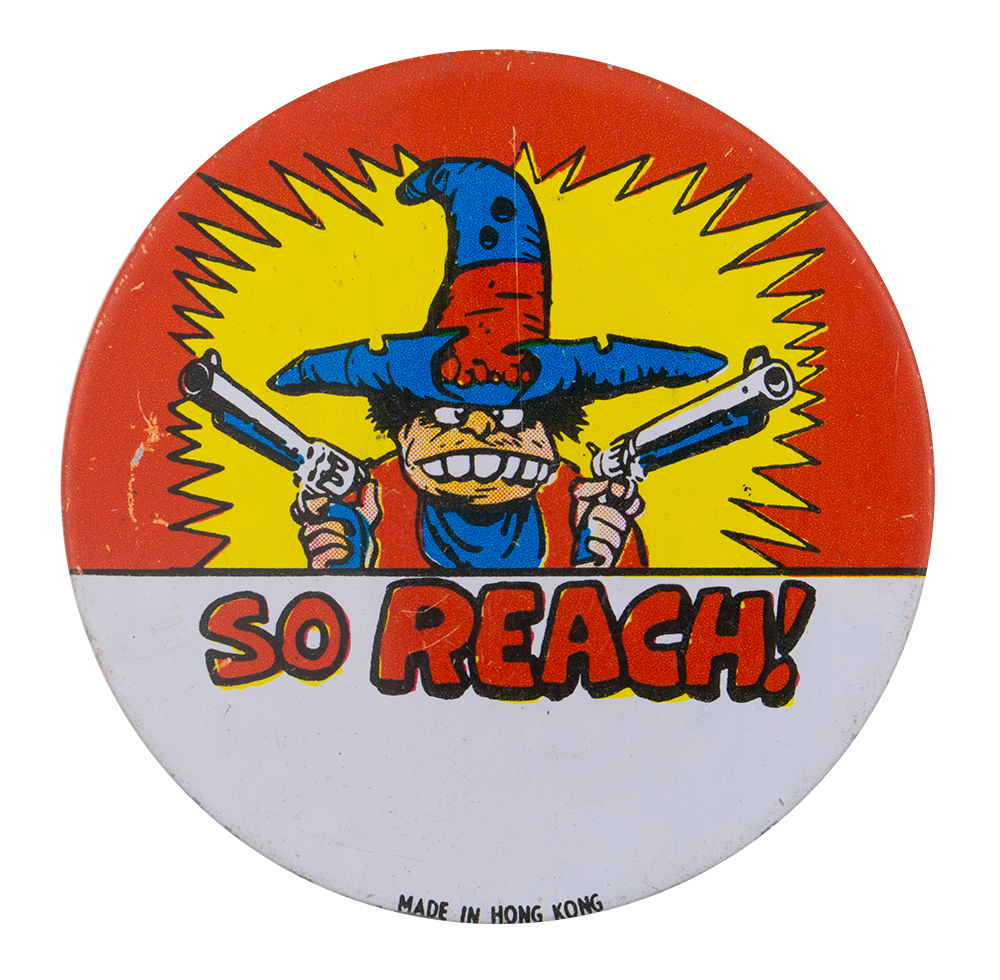
| Text on Button | So REACH! |
| Image Description | Illustration of an angry cartoon man holding a gun in each hand with a blue and red hat with bullet holes through it. There is a yellow ray surrounding him with a red background. Below the illustration are the words So REACH! in red bold letters on a white background. |
| Curl Text | Made in Hong Kong |
| Back Style | |
| The Shape | |
| The Size | |
| Additional Information | Have info on this button? Contact us here. |
| Catalog ID | IB0162 |
| Category | |
|---|---|
| Additional Images |
|
| Sub Categories | |
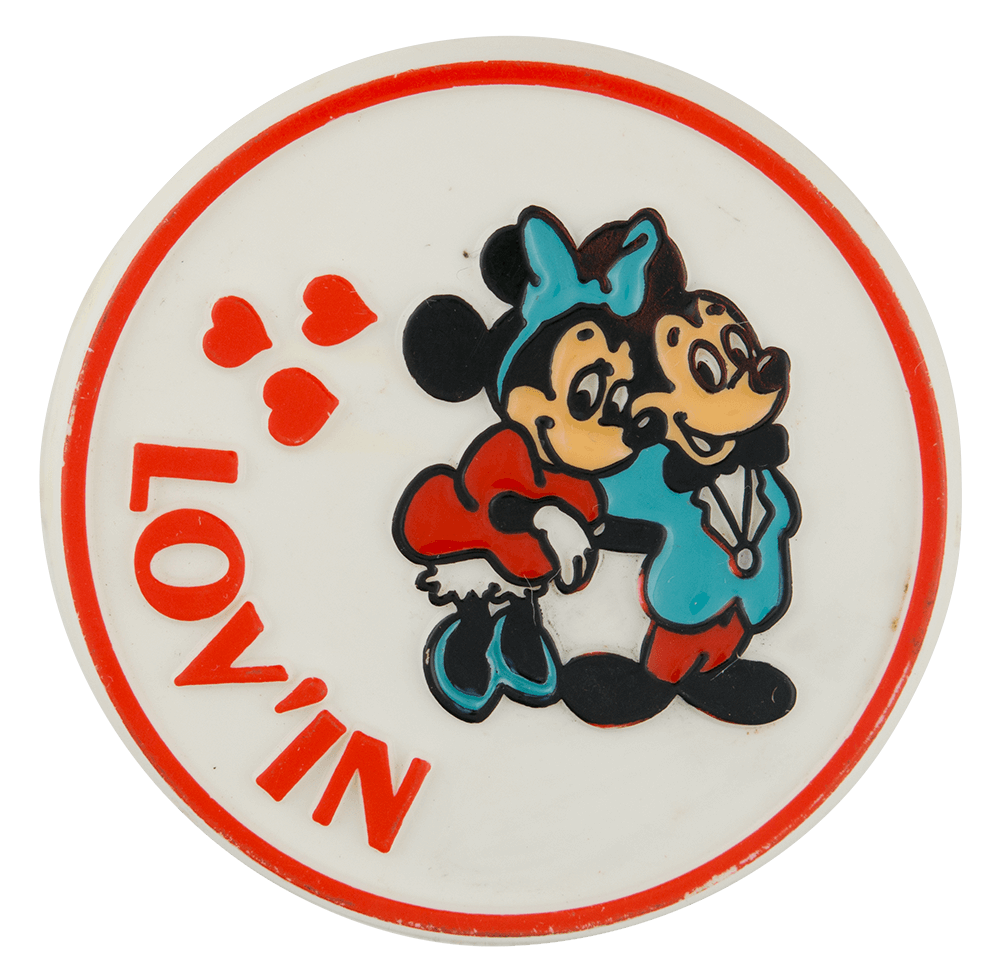
| Text on Button | LOV'IN |
| Image Description | Mickey and Minnie are smiling and holding each other. Minnie is wearing a red dress, a blue hair bow, and blue shoes. Mickey is wearing a blue jacket and red pants. To the left of them are three red hearts. Below the hearts, along the lower left side of the button, are the words "LOV'IN" written in red. The background is white with a red outline. |
| Back Paper / Back Info |
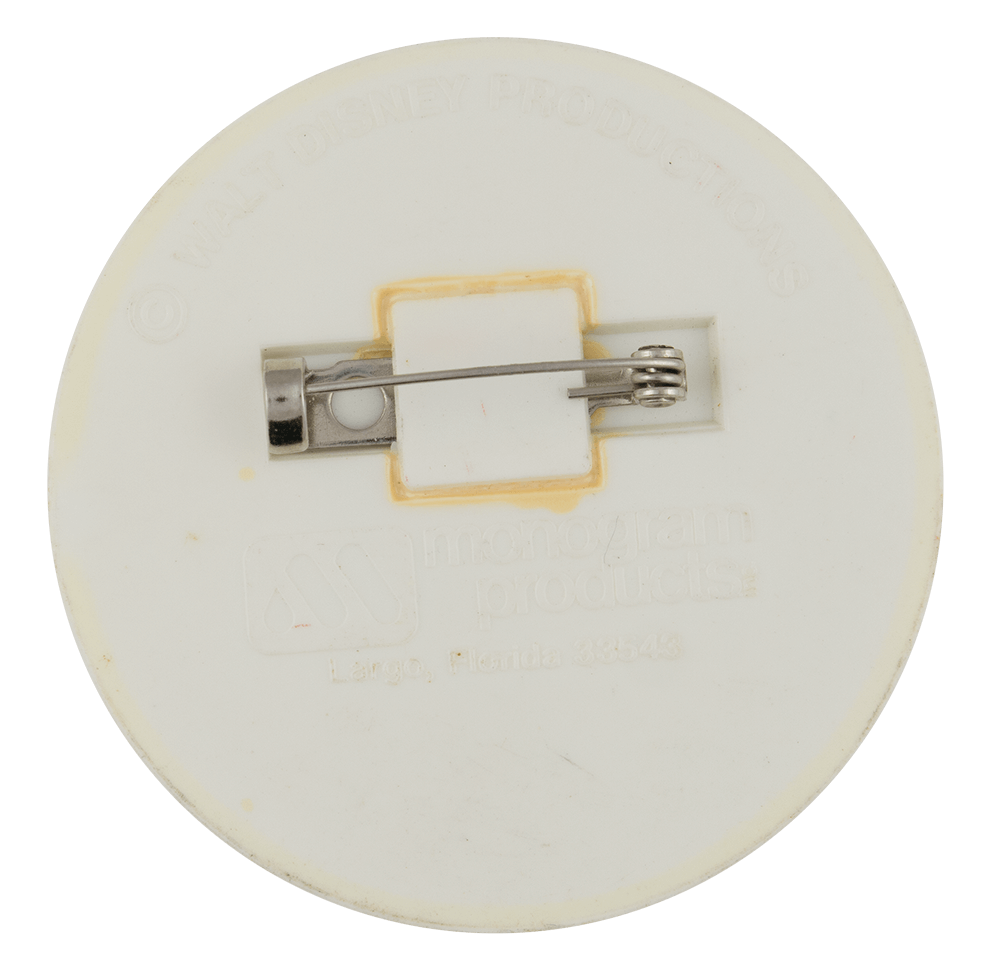
Copyright Walt Disney Productions |
| Back Style | |
| The Shape | |
| The Size | |
| Additional Information | Both Mickey and Minnie were created by Walt Disney in 1928 in order to replace Walt Disney's old character Oswald the Lucky Rabbit and his string of potential love interests. The placement of the text "Walt Disney Productions" on the back, the large size of the button, and the use of plastic are all characteristic of Disney pins during the 1970's and 80's. |
| Catalog ID | EN0163 |
| Category | |
|---|---|
| Additional Images |

|
| Sub Categories | |
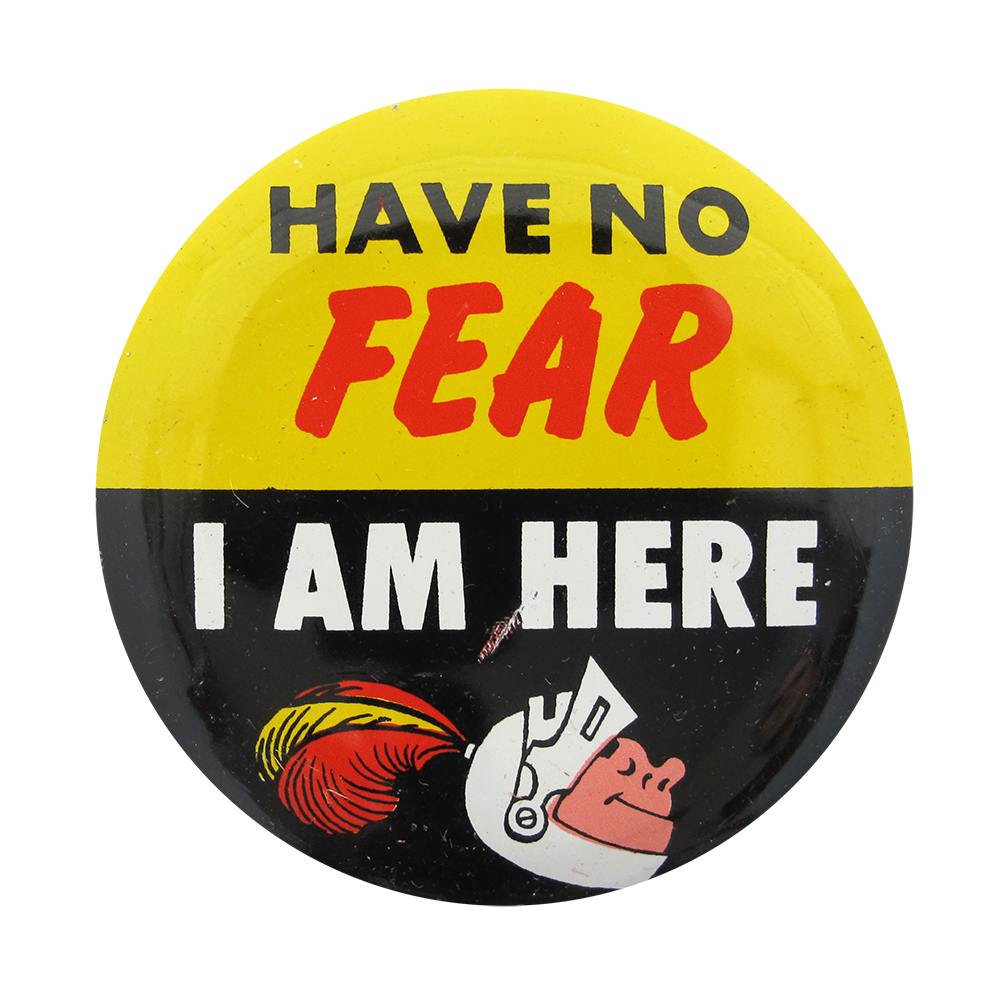
| Text on Button | HAVE NO FEAR I AM HERE |
| Image Description | Capitalized black and red text over a yellow background on the upper half, capitlaized white text and an illustration of the head of a knight in profile, wearing a white helmet with a plume of yellow and red feathers, over a black background on the lower half. |
| Curl Text | JAPAN |
| Back Style | |
| The Shape | |
| The Size | |
| Year / Decade Made | |
| The Manufacturer | |
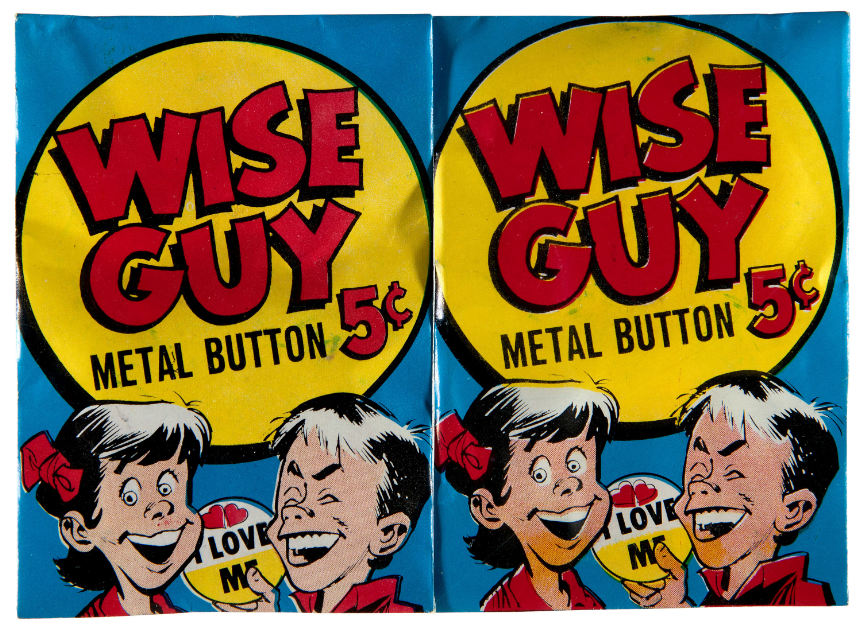
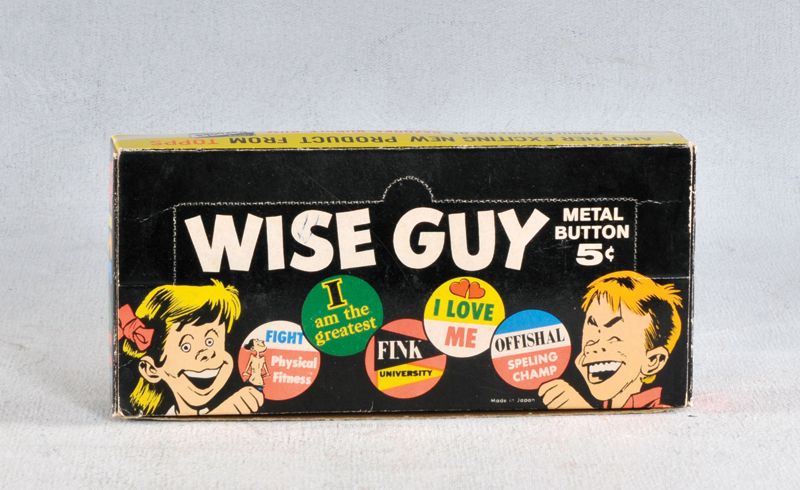
| Additional Information | Topps, a company that is best known for sports memorabilia, produced "Wise Guy" pins during the 1960s that featured satire/parody for novelty and humor. |
| Catalog ID | IB0451 |
| Category | |
|---|---|
| Additional Images |
|
| Sub Categories | |
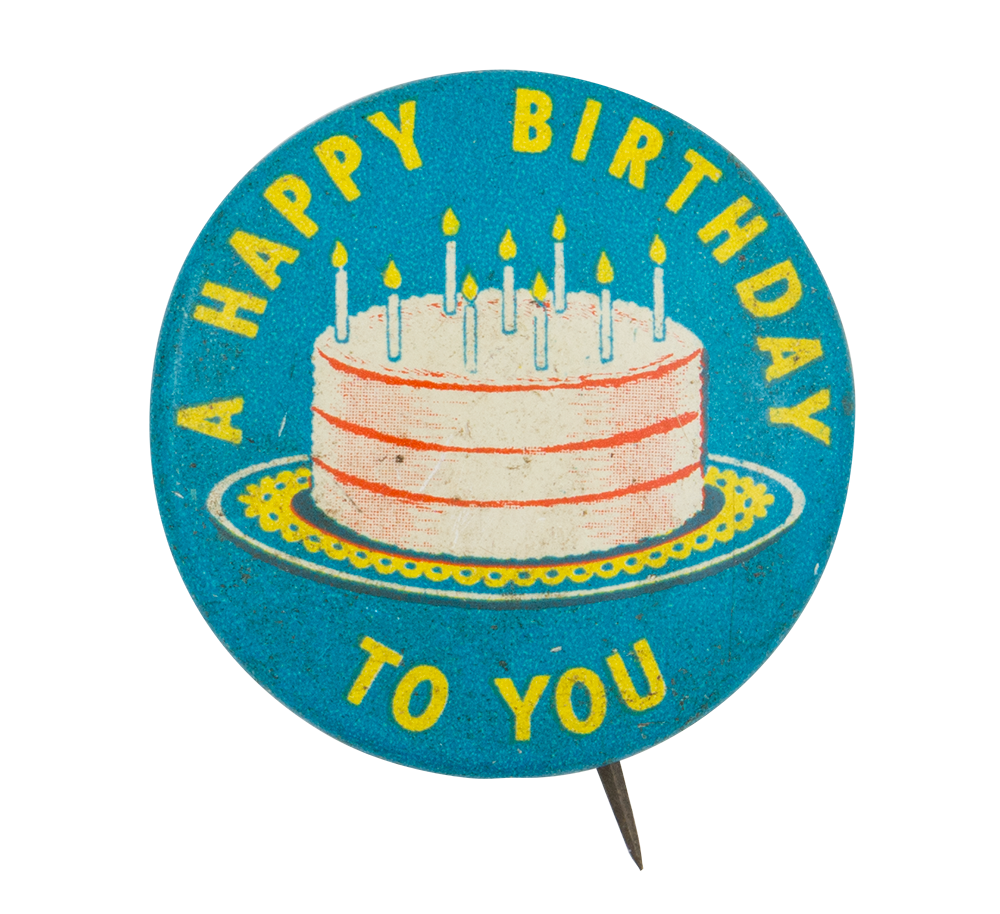
| Text on Button | A HAPPY BIRTHDAY TO YOU |
| Image Description | Image of a white layered birthday cake with nine lit candles. Yellow text surrounding the cake on blue background. |
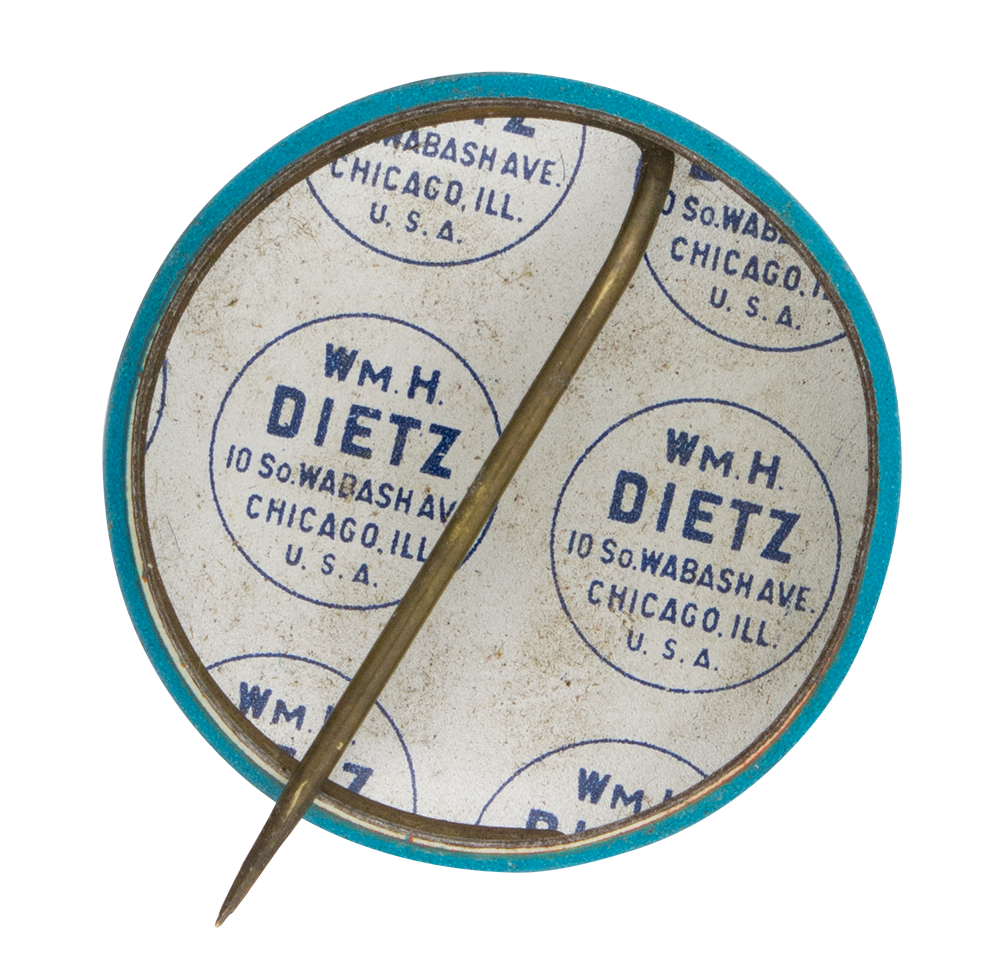
| Back Paper / Back Info |
WM.H. DEITZ 10 So. WABASH AVE. CHICAGO, ILL. U.S.A. |
| Back Style | |
| The Shape | |
| The Size | |
| Additional Information | Celebrating a birthday with a cake with lit candles is a practice that has evolved over hundreds of years across the globe. In Ancient Greece, there was a tradition of making moon-shaped cakes to bring to the temple of Artemis, goddess of the moon. The cakes had lit candles decorating them, meant to make them shine like the moon. In Roman times, cakes were made to celebrate some citizens’ 50th birthdays, although this was reserved for men of high social status. By the 18th century, Germans had a tradition of celebrating birthdays for children, called “Kinderfeste,” in which a cake would be topped with candles in the morning, and kept lit all day until the cake was eaten after dinner. It was not until the industrial revolution, however, that birthday cakes became a trend in the United States, when ingredients, baking tools, and even pre-made cakes cost less and were more accessible to the population. |
| Sources |
Sterling, J. (2017, May 23). A brief history of the birthday cake. Food & Wine. https://www.foodandwine.com/desserts/cake/brief-history-birthday-cake |
| Catalog ID | EV0084 |

| Category | |
|---|---|
| Text on Button | Is That Your Face Or Did Your Neck Throw Up? |
| Image Description | Black text on a yellow background |
| The Shape | |
| Additional Information | Have info on this button? Contact us here. |
| Catalog ID | IB0307 |