I Give a Damn

Category
Additional Images
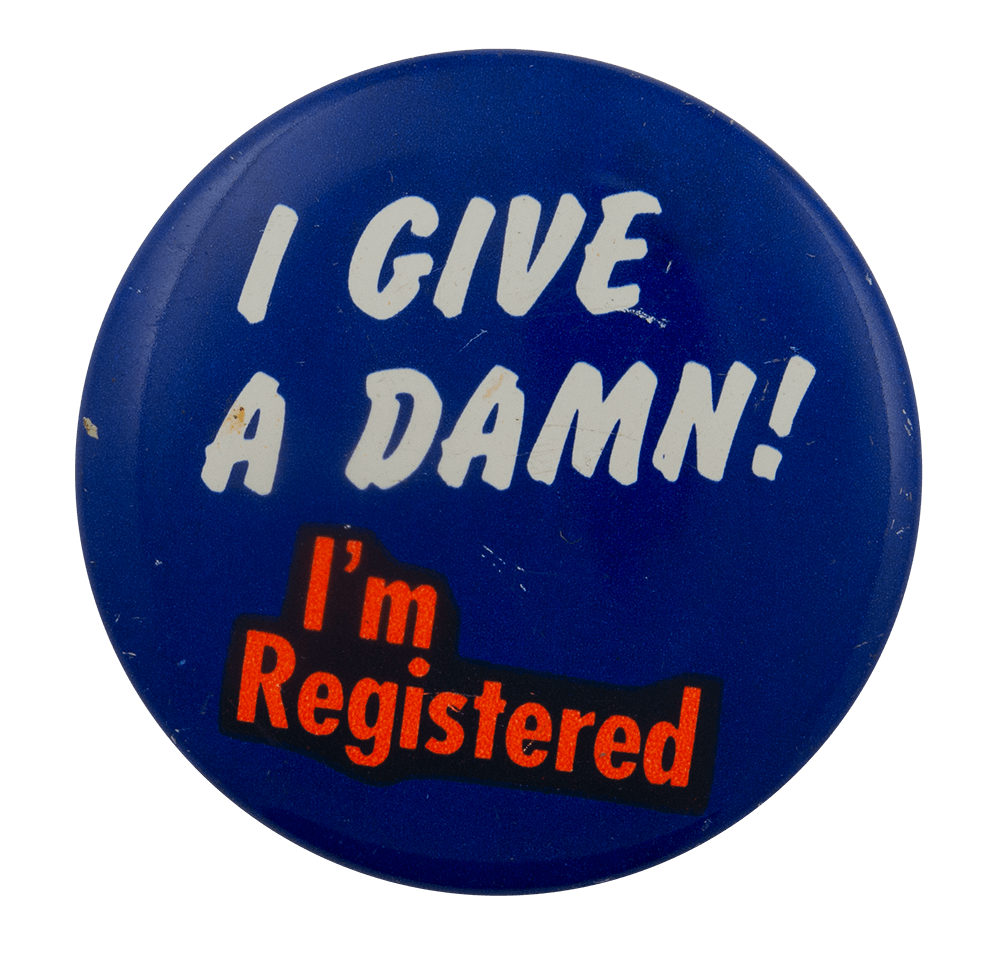
Text on Button I GIVE A DAMN! I'm Registered
Image Description

Dark blue background with white large text on top half of button at a slight angle. Medium sized red text with a black outline is on the bottom half of the button at an angle.

Back Style
The Shape
Additional Information

"I give a damn; I'm registered" used in this way is a phrase that conveys the importance of voting and being registered to vote. Voting is considered a civic duty and a privilege of democracy that many have fought for in the United States. The act of voting is used to determine the public's interest and preference for leaders at local, state, and federal levels. Voting also helps to decide what projects and regulations the public would like to see for the future, meaning the responses can dictate where the government's money is spent or who can be legally married in the state. Voter turnout also determines which political party affiliations will receive money for campaigning; which is given to parties with 5% or more of the vote.

As voting is optional in the United States and not mandatory, there are many campaigns including "Rock the Vote" and "Motor Voter Registration" to encourage citizens to register and turn up to elections. Wearable slogans may also be seen as a passive act to encourage others to vote.

Sources

Why registering to vote is important. Why registering to vote is important | News, Sports, Jobs - Adirondack Daily Enterprise. (n.d.). https://www.adirondackdailyenterprise.com/opinion/editorials/2017/10/wh…;

5 Reasons Why You Should Vote! AltaMed. (2020, September 10). https://www.altamed.org/articles/5-reasons-why-you-should-vote. 


Catalog ID IB0732

Multiple Myeloma Sucks

Category
Additional Images
Sub Categories
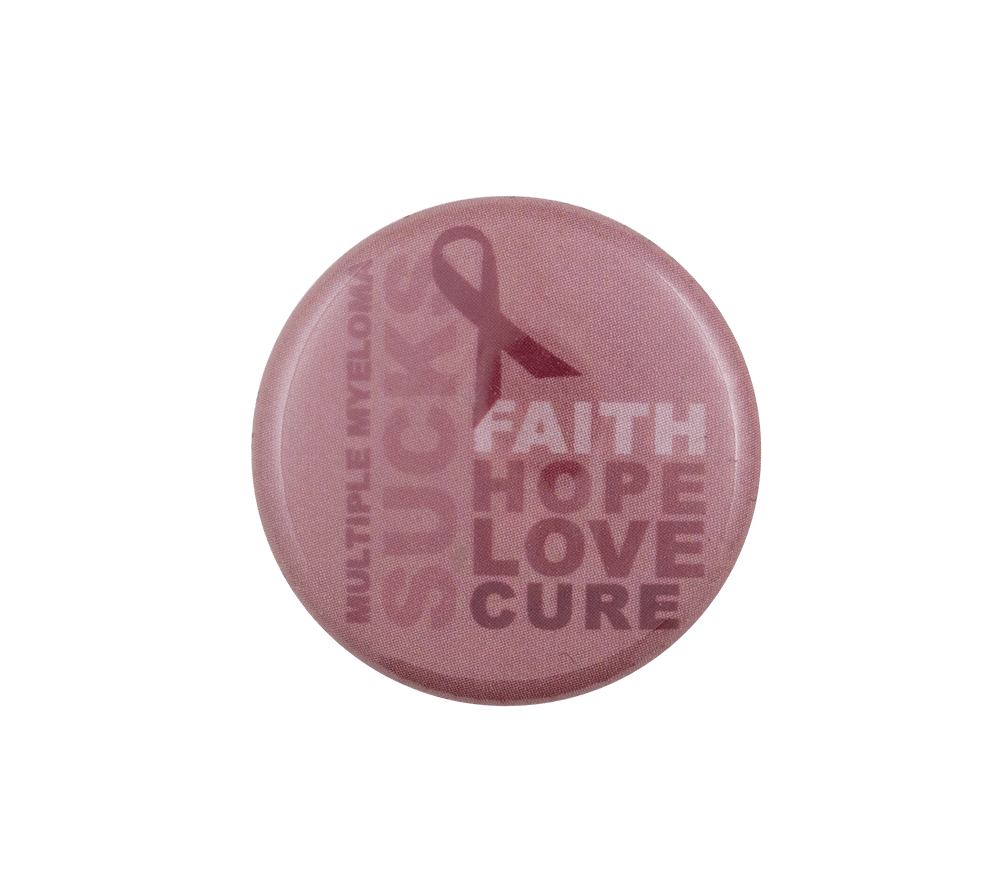
Text on Button MULTIPLE MYELOMA SUCKS FAITH HOPE LOVE CURE
Image Description

A dark blush pink color background with text of a similar blush pink color scheme. Small medium blush pink colored text with large light blush pink text covers the left middle side of the button vertically. A dark blush pink ribbon is at the top center, with light blush pink then very dark blush pink text covering the button horizontally below it.

Curl Text Multiple Myeloma Awareness · Believe · Courage · Faith · Hope · Love · Strength ·
Back Style
The Shape
The Size
Additional Information

The slogan “Cancer Sucks” was created by Lucy Sherak in 1995 after she was diagnosed with breast cancer. After a mastectomy, she chose to wear a button stating “Cancer Sucks” that she designed after her diagnosis. In 1992, Estée Lauder cosmetics distributed pink ribbons with their products to raise breast cancer awareness. A small ribbon worn on the lapel became a way to show support for a cause depending on the color of the ribbon. The burgundy ribbon combined with the text symbolizes support for those with multiple myeloma, a type of cancer that gathers in the bone marrow and crowds out healthy blood cells.

Sources

De Michele, G. (2016, July 11,). Radical objects: ‘Cancer sucks’. History Workshop. Retrieved from https://www.historyworkshop.org.uk/radical-objects-cancer-sucks/

Mayo Clinic. (2021). Multiple myeloma. https://www.mayoclinic.org/diseases-conditions/multiple-myeloma/symptom…

Catalog ID CA0837

Goomba Shoe

Category
Additional Images
Sub Categories
Image Description

Light blue checkered background with two rows of red brick on the bottom. On top of the red brick is a green boot wearing a red hat with a gold wind up key sticking out the back of the boot.

Curl Text fangamer.com PLUMBER'S SET +
Back Style
The Shape
The Size
Additional Information

A Goomba Shoe is worn by the Goomba mushroom shaped creature in Mario, a Nintendo video game franchise. The shoe has a wind-up metal handle. If knocked off the Goomba from below, the shoe can be worn and becomes a power up. The Goomba Shoe first appeared in Super Mario Bros. 3 during world 5 area 3, Sky World. While wearing the shoe, Mario is protected from spiny turtles and other obstacles. The power-up is lost after the level is completed or the player dies. It was first known as Kuribo’s shoe. Goombas are known as Kuribo in the original Japanese, but the name was later changed to the English Goomba. 

After its first appearance in Super Mario Bros. 3, this special power up was not seen for twenty-two years until the release of the Super Mario Maker series. The Super Mario Makers series was released in the United States on September 11, 2015. The green boot with a wind-up key was the same, but there was also a stiletto shoe version. If you add wings to the shoes in this game, you will be able to hover in the air when jumping. You hear a sound similar to a high-pitched woman's laugh when you hover in the winged stiletto shoe.

Sources

Goomba's Shoe. (2021). Retrieved 4 May 2021, from https://www.mariowiki.com/Goomba%27s_Shoe

Hackett, L. Super Mario Bros. 3 Full guide in Nintendo Power Vol. 13. Retrieved 4 May 2021, from http://www.superluigibros.com/super-mario-bros-3-full-guide-nintendo-po…

William, F., & Zack, D. (2018). Super Mario Bros. encyclopedia : the official guide to the first 30 years, 1985-2015 (1st ed.). Milwaukie: Dark Horse Books.

Catalog ID AR0464

Maybe Tomorrow

Category
Additional Images
Sub Categories
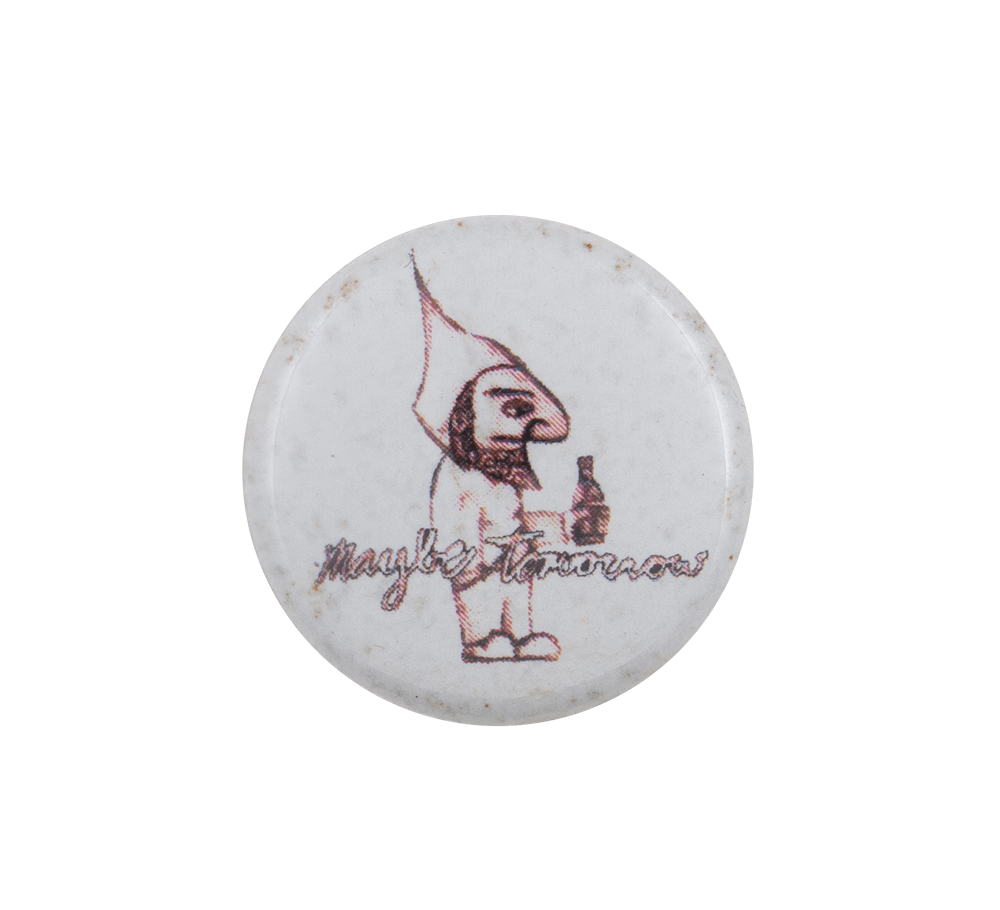
Text on Button Maybe Tomorrow
Image Description

White background with an image in the center of a gnome holding a bottle. Cursive text stretches across the button over the image of the gnome right beneath the bottle in his hand.

Back Style
The Shape
The Size
Additional Information

Have info on this button? Contact us here.

Catalog ID AD1019

Organs to Heaven

Category
Additional Images
Sub Categories
Text on Button Don't take your organs to heave-heaven knows, we need them here!
Image Description

Dark blue background with white text on bottom half of button. Dark blue mountain silhouette outlined in white across center of button with dark blue sky with white stars on upper half of button above the mountains.

Back Style
The Shape
Additional Information

Organ and tissue donation is a critical process for prolonging life. At the time of writing, there are nearly 118,000 individuals waiting for an organ transplant to live healthier, more productive lives. For some people with end-stage organ failure, it is a matter of life and death. Add to these numbers the thousands more whose lives will be improved through tissue and cornea donation and transplants that can help them move better, see better, and live better and the figure for organ and tissue donation will continue to rise.

Sources

Moritsugu, K. P. (2013, July). The power of organ donation to save lives through transplantation. Public health reports (Washington, D.C. : 1974). https://www.ncbi.nlm.nih.gov/pmc/articles/PMC3675206/.

Catalog ID CA0836

Mass Protest Unemployed

Category
Additional Images
Text on Button RAYMOND MINOR FOSTER AMTER MASS PROTEST WILL RELEASE THE FIGHTERS FOR THE UNEMPLOYED INTERNATIONAL LABOR DEFENSE ALLIED PRINTING TRADES UNION LABEL COUNCIL
Image Description

White background with red text in the center. There are four sections of red text alternating large and small sizes by section. Four small circular black and white photographs of men curl around the top of the button with small black text curling around the bottom of each photograph image.

Back Paper / Back Info

M. Pudl?n Co.Inc.
286 5th AVE.
N. Y. C.

ALLIED PRINTING
TRADES UNION LABEL COUNCIL
BALTIMORE
1

Back Style
The Shape
Year / Decade Made
Additional Information

In 1930, Communist ideology was gaining popularity: membership in the Communist Party rose from 6,822 in 1930 to 66,000 in 1939. This decade shift was sandwiched between the first red scare from 1917 to 1920, and the second red scare which took place from 1947 through the 1950s. During this epoch of the Great Depression, in March of 1930, the Communist Party organized a mass unemployment protest in Union Square of New York City. Around 35,000 people attended the demonstration, which turned from peaceful to violent. 

The group of protestors went to City Hall to “demand a hearing from Mayor Walker.” Around 1,000 police officers used batons to break up the crowd. A number of arrests were made, including four main leaders: William Z. Foster, Israel Amter, Robert Minor, and Harry Raymond. These four individuals, along with one other man, Joseph Lester, were arrested on the charge of unlawful assembly and inciting a riot. While the men were kept in the detention pen at the police station, violence broke out, leading the four to also be charged with felonious assault. 

Grover Whalen served as the New York City Police Commissioner during this time. Whalen claimed “police spies” had infiltrated the Communist organization in New York City. The International Labor Defense, which was the legal defense organization for the communist party in the United States, declared they would unearth Whalen’s spy system. The defense for Foster, Amter, Minor, and Raymond claimed that Whalen’s secret police hid among the protestors and were the ones to incite a riot. On August 8, 1930, the parole board set the terms for the four arrested men. Foster, Amter, and Minor served six months, while Raymond served ten due to a past criminal history which included “grand larceny and robbery while armed.”

Sources

Communist Party membership by Districts 1922-1950 - Mapping American Social Movements. Retrieved 6 April 2021, from https://depts.washington.edu/moves/CP_map-members.shtml 

The International Labor Defense | American Experience | PBS. Retrieved 6 April 2021, from https://www.pbs.org/wgbh/americanexperience/features/scottsboro-interna…;

Protests Then: Union Square | NYC Then/Now: Great Depression & Great Recession. (2012). Retrieved 6 April 2021, from https://eportfolios.macaulay.cuny.edu/brooks12/then-protests/ 

Red Scare. (2010). Retrieved 6 April 2021, from https://www.history.com/topics/cold-war/red-scare

Times Union. (1930). 4 'Red' Leaders Back in Jail Face Assault Charge, p. 23. Retrieved from https://newscomwc.newspapers.com/image/559591128/?terms=%22Internationa…;

Times Union. (1930). Red Riot Chiefs To Be Arraigned On New Charges, p. 3. Retrieved from https://newscomwc.newspapers.com/image/558679493/?terms=%22Whalen%22%20…

Times Union. (1930). Reds Start Rioting to Quit Jail Oct. 21, p. 52. Retrieved from https://newscomwc.newspapers.com/image/560364550/?terms=%22Internationa…

Unemployed protests 1930s - Mapping American Social Movements. Retrieved 6 April 2021, from http://depts.washington.edu/moves/unemployed_map.shtml

Catalog ID CA0835

Free Mooney and Billings

Category
Additional Images
Sub Categories
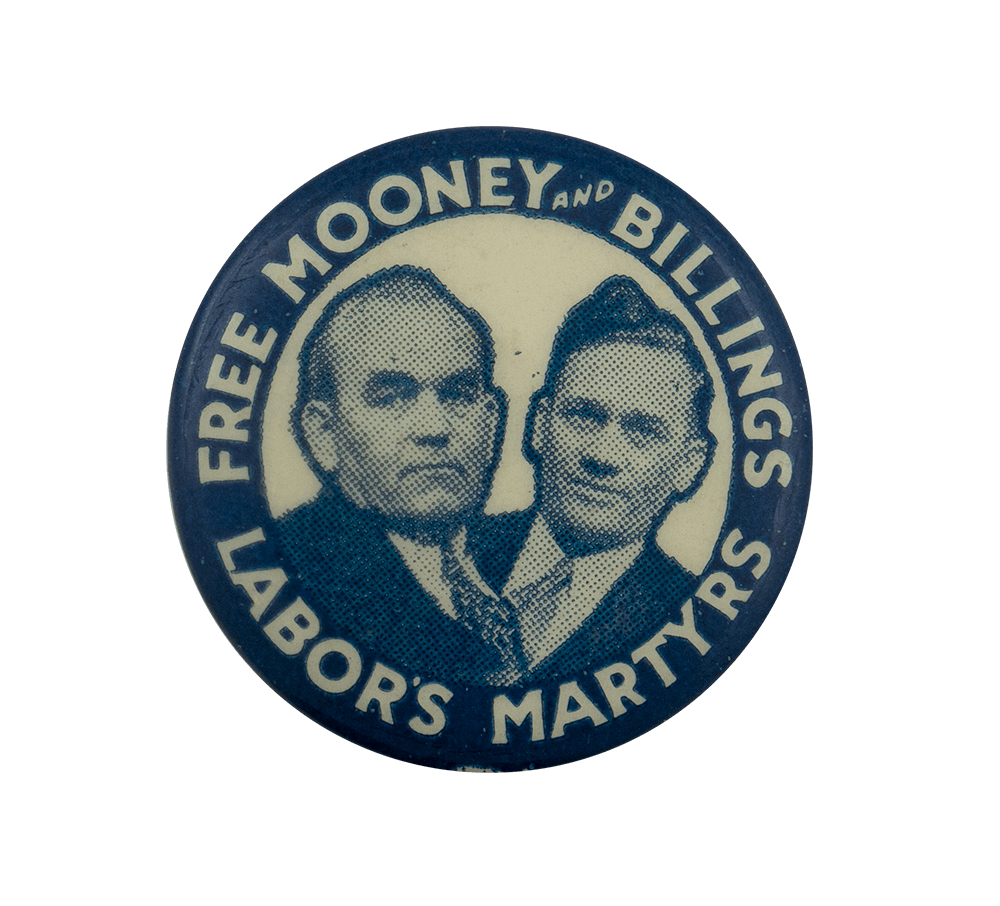
Text on Button FREE MOONEY AND BILLINGS LABOR'S MARTYRS
Image Description

Blue and white photograph of two men wearing suits in the center with white background. Thick blue circular border around edge with curling large white text over dark blue border.

Back Paper / Back Info

BADGES, BANNERS LARGE BUTTONS WALTER N. BRUNT ?11 SEVENTH ST. SAN FRANCISCO, CAL. U.S.A. PRINTING 

Back Style
The Shape
The Manufacturer
Additional Information

Tom Mooney and Warren Billings were two men framed as being the perpetrators in a deadly bombing in San Francisco in 1916. At the time, tension was high between labor unions and businesses. The United States was preparing for the possibility of joining World War I, and so they had a large “Preparedness Day” event with a parade through San Francisco’s streets. A suitcase bomb went off during the parade, killing ten and gravely injuring forty others. Detectives and the district attorney’s office were on the side of the chamber of commerce, and used a list of leftists “trouble-makers” who were in town to determine who to arrest for the bombing. Tom Mooney and Warren Billings were labor activists in town that day, and they were arrested. Tom Mooney was sentenced to death which was later commuted to life in prison, while Warren Billings was also sentenced to life in prison. 

In 1920, the confession of Detective Draper Hand, involved in the Mooney case, changed everything. He confessed the entire case framed Tom Mooney. He either bribed or intimidated all the witnesses so that they would lie on the stand, and he coached them on exactly what to say. Detective Hand even took the key witness, Mr. Oxman, to the police station and showed him a car so that he could testify to seeing the car driven on the day. Mooney and Billings asked for a retrial after this new evidence came to light. The evidence sparked protests and outrage, and probes into the trial lasted for over twenty years while Mooney and Billings were kept in prison. In 1939, both men were released with Mooney being pardoned and Billings being paroled. Billings was eventually pardoned in the 1960s. It was determined that there wasn’t sufficient evidence to convict either man, and it is still unknown who was responsible for the suitcase bomb in 1916.

Sources

Appeal to Reason. (1920). Mooney Exposure Shakes Frameup Gang Into Panic-Stricken Collapse, p. 1. Retrieved from https://newscomwc.newspapers.com/image/612855226/?terms=%22Mooney%22%20…;

Hearst, P. A., Rodiester, C., Rolph, J. & Afi/Post. (1916) San Francisco's future. [United States: s.n., ?] [Video] Retrieved from the Library of Congress, https://www.loc.gov/item/00694431/. 

Waxman, O. (2016). The Bomb That Rocked San Francisco 100 Years Ago. Retrieved 1 May 2021, from https://time.com/4411324/san-francisco-1916-bombing-preparedness-day-pa…;

Catalog ID CA0834

Logan's Day

Category
Additional Images
Sub Categories
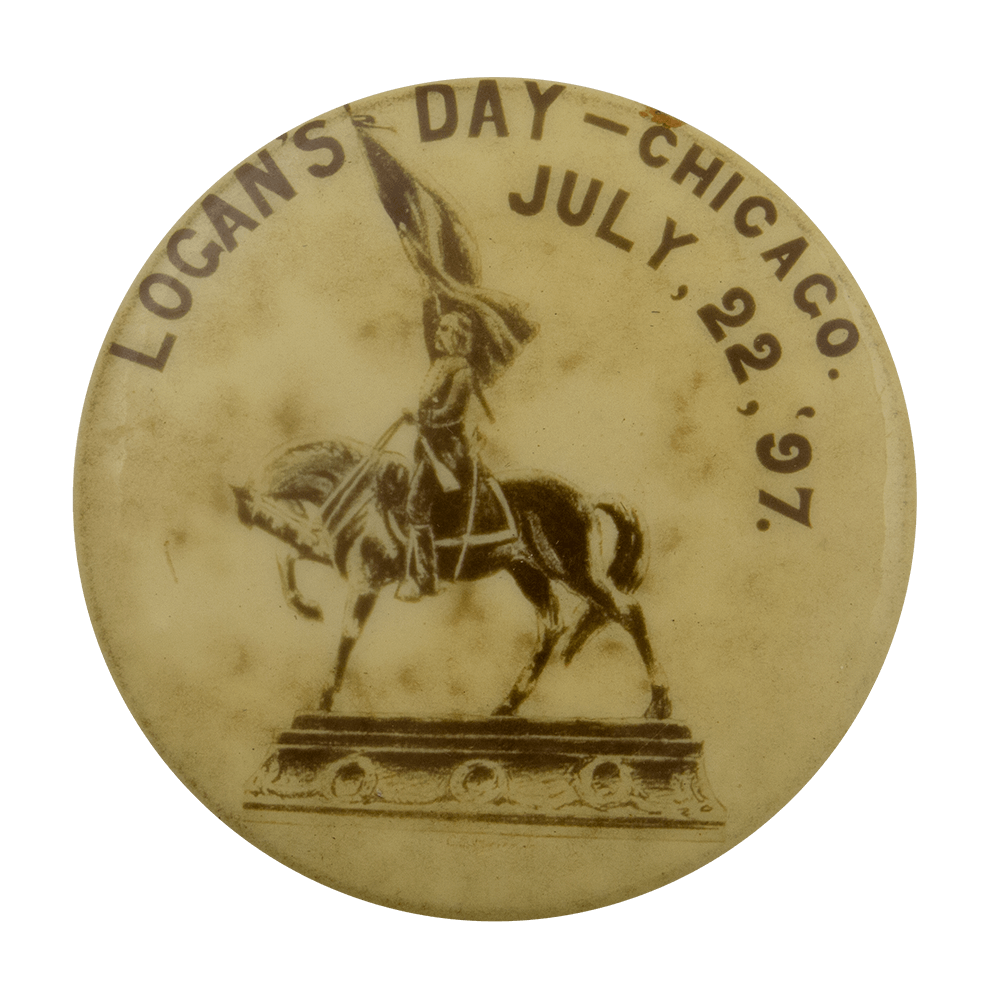
Text on Button LOGAN'S DAY - CHICAGO. JULY, 22, '97.
Image Description

Yellow background. There is an illustration of a statue of a soldier riding a horse in the center. The soldier carries a flag. Brown text curls around the top edge of the button.

Back Paper / Back Info

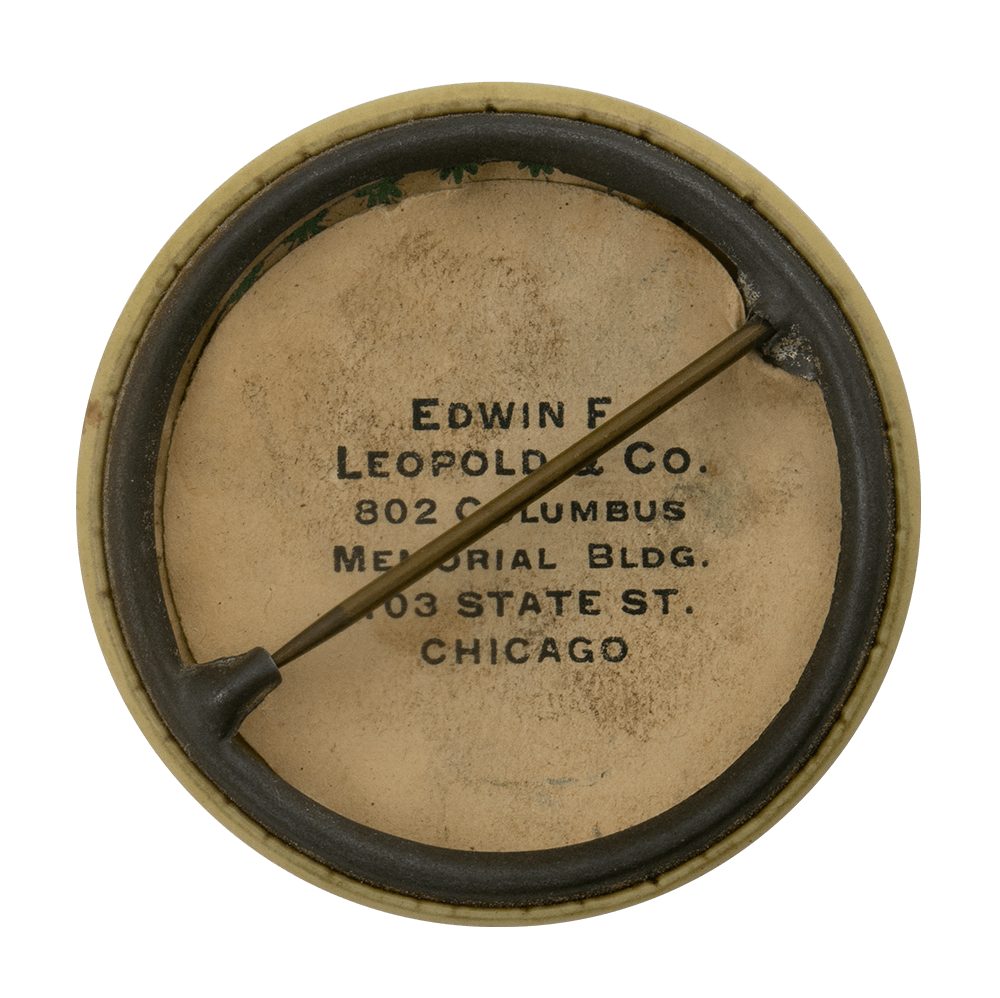
EDWIN F
LEOPOLD & CO.
802 COLUMBUS
MEMORIAL BLDG.
(?)03 STATE ST.
CHICAGO

The Shape
Additional Information

The statue of John Alexander Logan, installed July 22, 1897, is located in Grant (Ulysses) Park in Chicago, Illinois. The bronze figure of the general was created by the artist Augustus Saint-Gaudens, while the horse he rides was sculpted by Alexander Phimister Proctor. On the day the statue was instated, there was a two-hour dedication ceremony, gun salute, and a parade of ten thousand marchers. In the evening, the widowed Mrs. Logan was welcomed with a fireworks display followed by a band concert. Mrs. Logan planned to move her husband’s body to the tomb where the monumental sculpture is located, but the move never happened. The tomb stands empty to this day.

John Alexander Logan was a war hero and political figure who lived from 1826 to 1886. He, as the leader of the Grand Army of the Republic, an organization for Union Army veterans, was key in establishing Memorial Day as a federal holiday. Logan started his military service in the Mexican-American war before studying law and serving a number of terms as an Illinois State Representative for the Democratic party. He served as a United States Congressman, and then joined the Civil War as rank colonel. He reached the rank of general during his service. After the Civil War, Logan changed his party affiliation and became a Republican representative in both the United States House of Representatives and the Senate. Logan “became well known for supporting the rights of former slaves and of women.” In 1884, he was nominated for Vice President on John Blaine’s presidential ticket, but was not elected. A number of streets and towns were named in his honor after the Civil War, and the Logan Museum was established in his hometown in Illinois.

Sources

John A. Logan, founder of Memorial Day — Honorary Chicago. (2016). Retrieved 24 March 2021, from http://www.honorarychicago.com/blog/2016/5/19/zvopnixpc23jgq2b5wcxw1gjz…

John Alexander Logan Monument | Chicago Park District. Retrieved 24 March 2021, from https://www.chicagoparkdistrict.com/parks-facilities/john-alexander-log…

July 22, 1897 -- Logan Monument Dedicated in Grant Park | Connecting the Windy City. (2016). Retrieved 24 March 2021, from http://www.connectingthewindycity.com/2016/07/july-22-1897-logan-monume…

Catalog ID EV0926

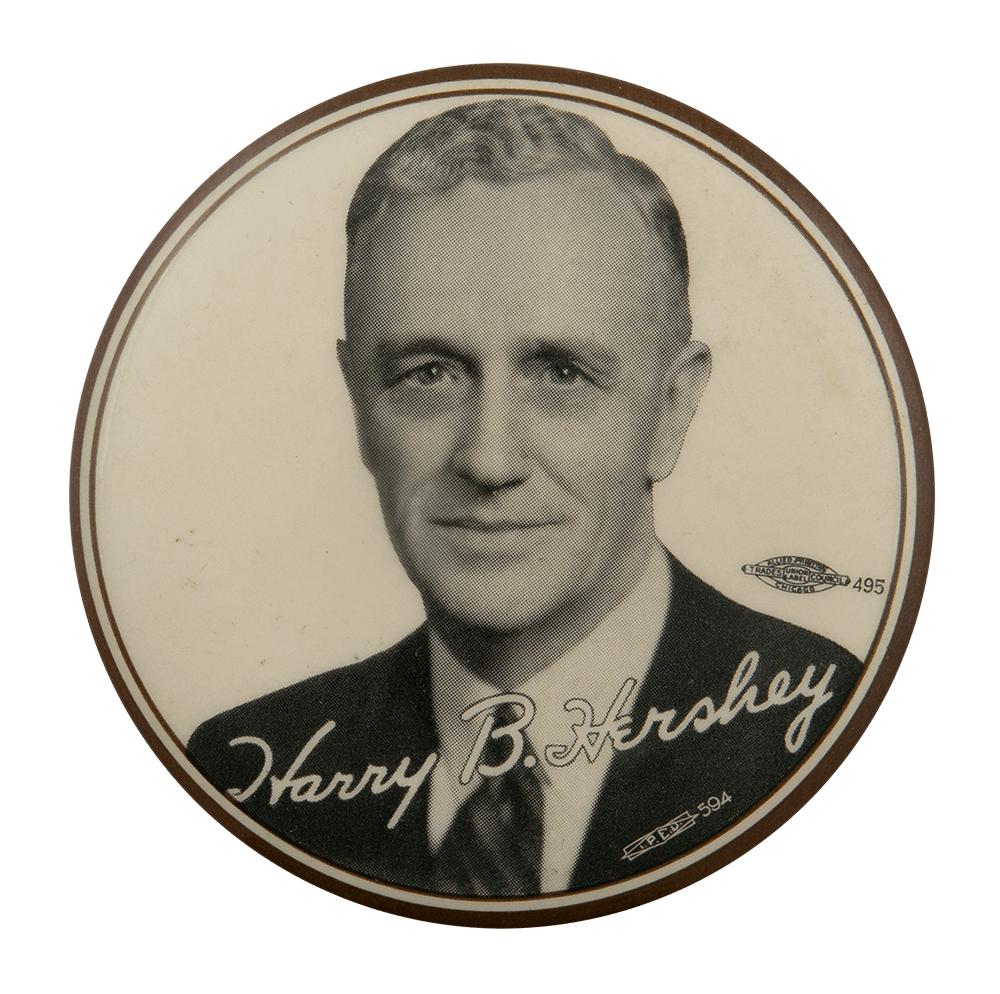
Harry B. Hershey

Category
Additional Images
Sub Categories
Text on Button Harry B. Hershey TRADES UNION LABEL COUNCIL ALUZO CHICAGO 495 I. P. E. U. 594
Image Description

Black and white photograph of a man in a suit. White cursive writing across the man's shoulders at the bottom. Cream colored background with double line circular brown border around the edge.

Back Style
The Shape
Additional Information

Harry B. Hershey was born in Mifflin, Ohio, and lived from 1885 to 1967. During his lifetime, he was an attorney, mayor, and Illinois Supreme Court Justice. In 1909, he earned his Applied Baccalaureate Degree, A.B. Degree, from the University of Illinois. Three years later, he graduated from the University of Chicago with his J.D. Degree. 

After passing his bar exam, the city of Taylorville elected him as the city attorney, followed by him serving two terms as Christian County’s state attorney. A couple of years later, he was elected the Taylorville Mayor. Taylorville is a small city in central Illinois with a little over 10,000 residents. Taylorville is the seat of Christian County, and is the only city in the county.

Hershey was well-known at the time while running for Governor of Illinois in 1940 as the Democratic candidate. He lost to Dwight H. Green, the Republican candidate. Hershey held several other state government positions in the following years before being appointed to the Illinois Supreme Court in 1951 as a justice. He served for sixteen years on the Illinois Supreme Court and served one term as the chief justice.

Sources

Applied Baccalaureate Degrees. Retrieved 1 April 2021, from https://occrl.illinois.edu/past/ab

Alton Evening Telegraph. (1941). Polls Will Open At 6 in Supreme Court Election, p. 1. Retrieved from https://newscomwc.newspapers.com/image/16347208/?terms=Harry%20B.%20Her…

Breeze Courier. (2014). Mary Chenault Hershey. Retrieved from https://breezecourier.com/main.asp?SectionID=1&SubsectionID=1&ArticleID…

Christian County, Illinois. Retrieved 1 April 2021, from https://christiancountyil.com/

Harry B. Hershey - Previous Illinois Supreme Court Justice. Retrieved 1 April 2021, from http://www.illinoiscourts.gov/SupremeCourt/JusticeArchive/Bio_Hershey.a…

QuickFacts: Taylorville city, Illinois. Retrieved 1 April 2021, from https://www.census.gov/quickfacts/taylorvillecityillinois

Taylorville, Illinois. Retrieved 1 April 2021, from https://taylorville.net/

Catalog ID PO1142

Flower of Scotland

Category
Additional Images
Sub Categories
Text on Button FLOWER OF SCOTLAND
Image Description

Dark blue background. The silhouette of a white flower is in the center with bold white text curling around above and below the flower.

Back Style
The Shape
Additional Information

Scotland's national flower is the thistle, a prickly weed with very long thorns and a light purple flower. Thistle was used as a royal symbol for the first time in the year 1470, when King James the Third issued silver coins imprinted with the plant's image. The Scottish royalty established The Order of the Thistle in the late 17th century, which is still the highest honor British royalty can bestow onto Scots. The plant also served as inspiration for the famous Scottish poem written by Hugh MacDiarmid, A Drunk Man Looks at the Thistle

Planning a trip to Scotland soon? Be on the lookout for this prickly wild flower growing everywhere!

Sources

Johnson, B. The Thistle - National Emblem of Scotland - Historic UK. Retrieved 30 March 2021, from https://www.historic-uk.com/HistoryUK/HistoryofScotland/The-Thistle-Nat…

Stevenson, J. (2019). Why The Thistle Is The National Flower Of Scotland. Retrieved 30 March 2021, from https://www.scotlandswild.com/scotlands-wild-blog/why-the-thistle-is-th…

Thistle - National Flower of Scotland. Retrieved 30 March 2021, from https://www.visitscotland.com/about/uniquely-scottish/thistle/

Catalog ID IB0558