Fight Infantile Paralysis

Category
Additional Images
Sub Categories
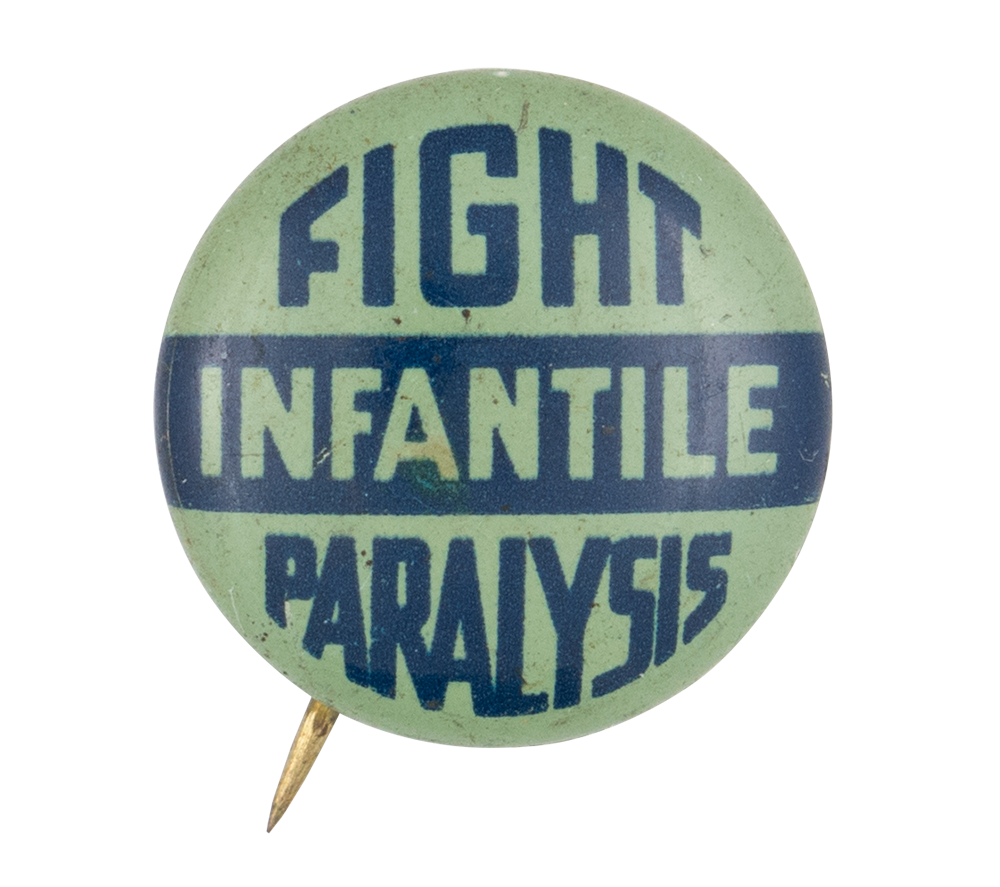
Text on Button FIGHT INFANTILE PARALYSIS
Image Description

Dark blue and light blue text on a dark and light blue background

Curl Text CRUVER - CHI
Back Style
The Shape
The Size
The Manufacturer
Additional Information

Infantile Paralysis, also know as Poliomyelitis or Polio, is a viral disease that was an epidemic in the United States from the 1890s through the 1950s. In 1938, President Franklin D. Roosevelt founded the National Foundation for Infantile Paralysis, to combat polio. This organization later became The March of Dimes and led the effort for the prevention and control of the disease.

Catalog ID CA0681

Bowl of Rice Party

Category
Additional Images
Sub Categories
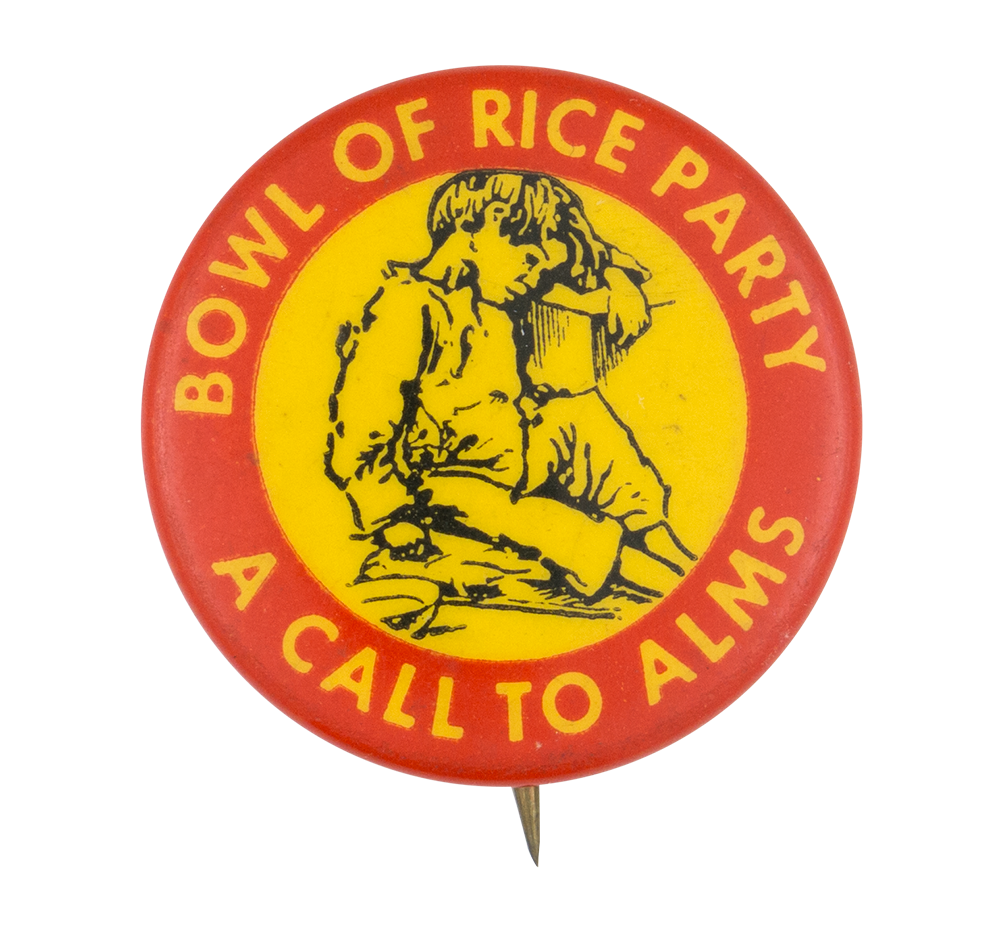
Text on Button BOWL OF RICE PARTY A CALL TO ALMS
Image Description

Blue and yellow illustration of a child on a yellow circle with an outer red edge with yellow text on it

Back Style
The Shape
The Size
Additional Information

Bowl of Rice parties were held throughout the United States between 1938 and 1941 in order to benefit Chinese civilians affected by the Second Sino-Japanese War. The fundraisers, which included dinners, concerts, and pageants, were held in 2000 cities, including New York City and San Francisco. Money raised at the events was used to provide food, medicine, and shelter for refugees in need. 

Catalog ID CA0682

Be One

Category
Additional Images
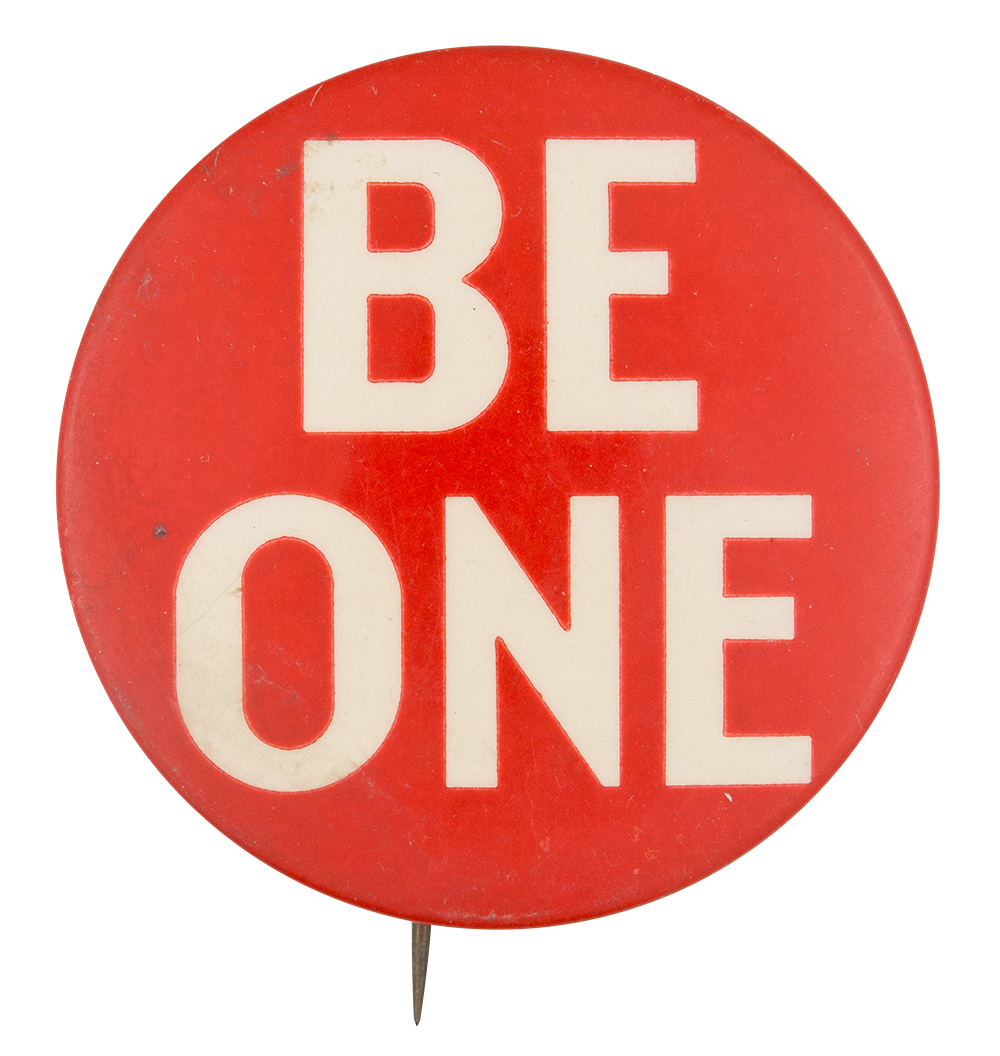
Text on Button BE ONE
Image Description

White text on a red background

Back Style
The Shape
The Size
Additional Information

The phrase "Be One" reflects a fundamental principle of the Bahá’í Faith, highlighting the spiritual unity of humanity and the oneness of God. It teaches that a single God creates all beings and belongs to one human family, encouraging the eradication of prejudice and the pursuit of universal peace. The Bahá’í Faith is an independent, worldwide religion established in the mid-1800s that stresses the unity of all people and religions.

The phrase “Be One” could have multiple meanings depending on its context. During the 1960s and 1970s, it was often associated with civil rights or peace movements that advocated for unity and equality, or used in anti-war and countercultural slogans calling for solidarity against conflict. Labor and activist organizations may have used it to emphasize collective strength, while companies from the same period often employed short, memorable slogans to promote brand identification or encourage participation. It could also serve as a motivational message about individuality and belonging, or function as a straightforward recruitment phrase in schools, clubs, and youth programs, encouraging involvement — “be one of us.”

Sources

Bahá’ís of Aurroa. (n.d.). What Bahá'ís believe. Retrieved September 14, 2025, from https://www.auroracoloradobahais.org/home/ 

Baháʼí Faith. (2025, September 13). In Wikipedia. Retrieved September 14, 2025, from  https://en.wikipedia.org/wiki/Bah%C3%A1%CA%BC%C3%AD_Faith  

Jones, P. (n.d.). Buttons. Roz Payne Sixties Archive. University of Nebraska-Lincoln. Retrieved September 14, 2025, from https://rozsixties.unl.edu/collections/show/2.html 

King, E. (2016, May 17). The long story behind presidential campaign buttons and pins. Time. Retrieved September 14, 2025, from https://time.com/4336931/campaign-buttons-history/ 

MBC. (2022, June 7). Why the 1960s was the start of the ‘Golden Age of Advertising’. Marketing Branding Creative. Retrieved September 14, 2025, from https://wearembc.com/why-the-1960s-was-the-start-of-the-golden-age-of-advertising/ 

Mitchell, S. (2016, March 24). Pinning their hopes on buttons: Political buttons trace political and social change. The Harvard Gazette. Retrieved September 14, 2025, from https://news.harvard.edu/gazette/story/2016/03/pinning-their-hopes-on-buttons/ 

Universal House of Justice. (2025). Universal house of justice. Retrieved September 14, 2025, from https://universalhouseofjustice.bahai.org/ 

Vafai, S. (2005). The universal house of justice: Significance, origin, authority, and election. Bahá’í Library Online. Palabra Publications. Retrieved September 14, 2025, from https://bahai-library.com/vafai_uhj_significance_origin 

Catalog ID CA0676

White Unicorn

Category
Additional Images
Sub Categories
Image Description

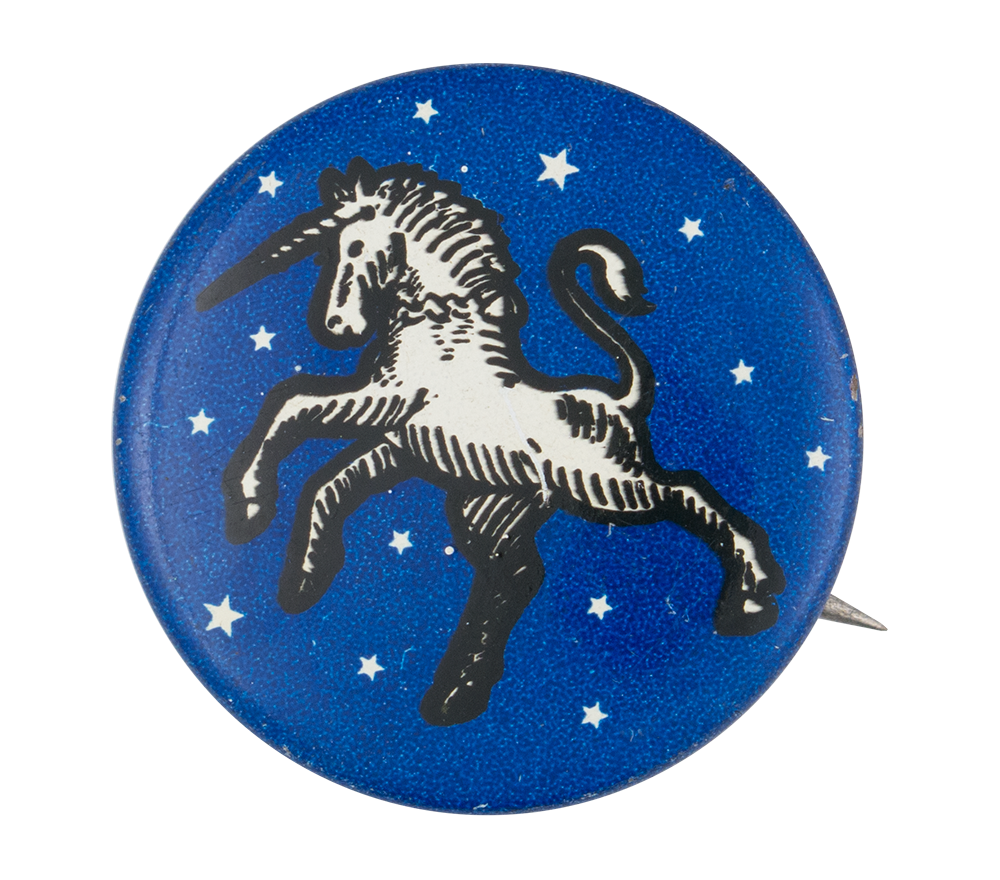
Illustration of a white unicorn on a blue background with white stars

Curl Text A&M ASSOC 59 MIDDLESEX TURNPIKE REDFORD, MASS. 01730
Back Style
The Shape
The Size
Additional Information

The unicorn is one of the most popular legendary creatures, appearing in myths from several different cultures since antiquity. They were featured in Greek accounts of natural history, countless European folktales, and even appear in Biblical texts. Usually depicted as wild and free, legends state that they can only be tamed by gentle maidens. Although there is no concrete evidence indicating unicorns have ever existed, there have been many fabricated recreations throughout the centuries. It was rumored that the horn of the unicorn held magical properties, leading to powdered narwhal horn being sold as magical cures. 

Catalog ID AR0372

Congo State

Category
Additional Images
Sub Categories
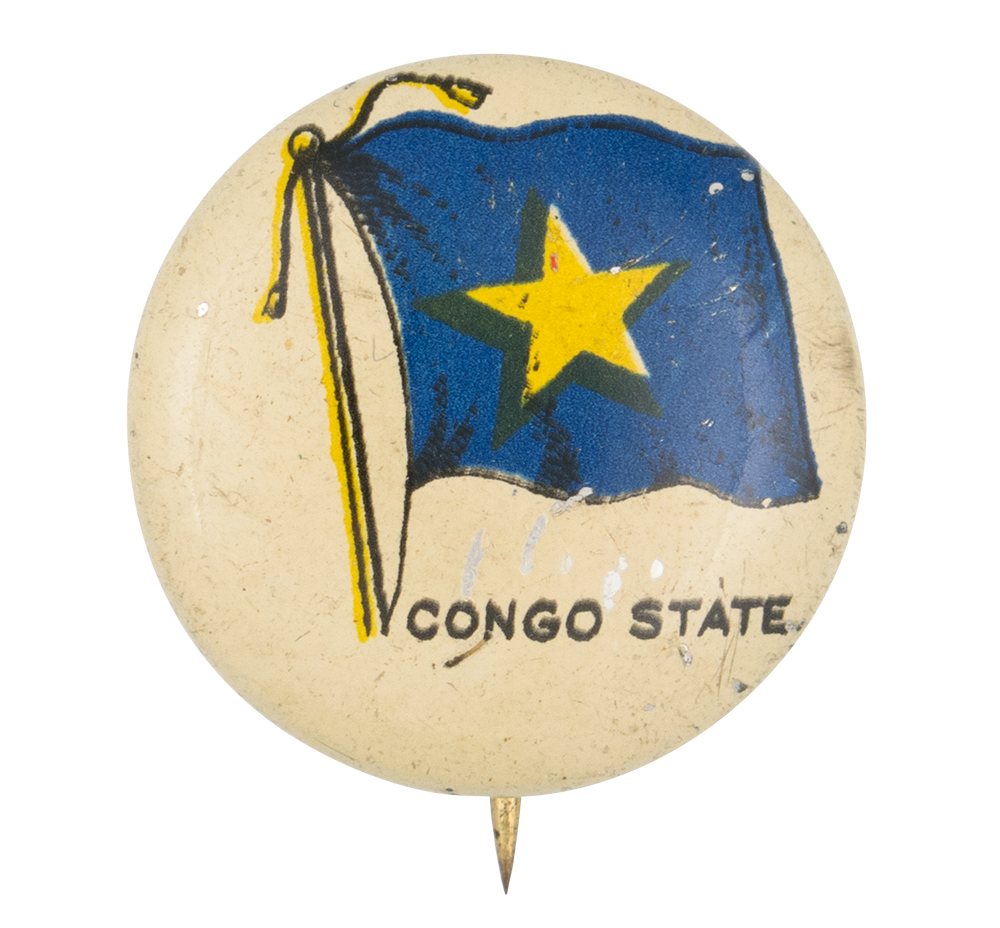
Text on Button CONGO STATE
Image Description

Illustration of a blue flag with a yellow star on it over blue text on a white background

Back Style
The Shape
The Size
Additional Information

The Congo Free State also known as the Independent State of the Congo was an African colony under the rule of King Leopold II of Belgium in 1885. In 1908 the Congo Free State was ceded to Belgium and later became independent in 1960 as the Democratic Republic of Congo. The flag’s design is a symbol of the state as a light or star of civilization shinning in the dark of Africa.

Catalog ID AR0335

Bearded Character

Category
Additional Images
Sub Categories
Image Description

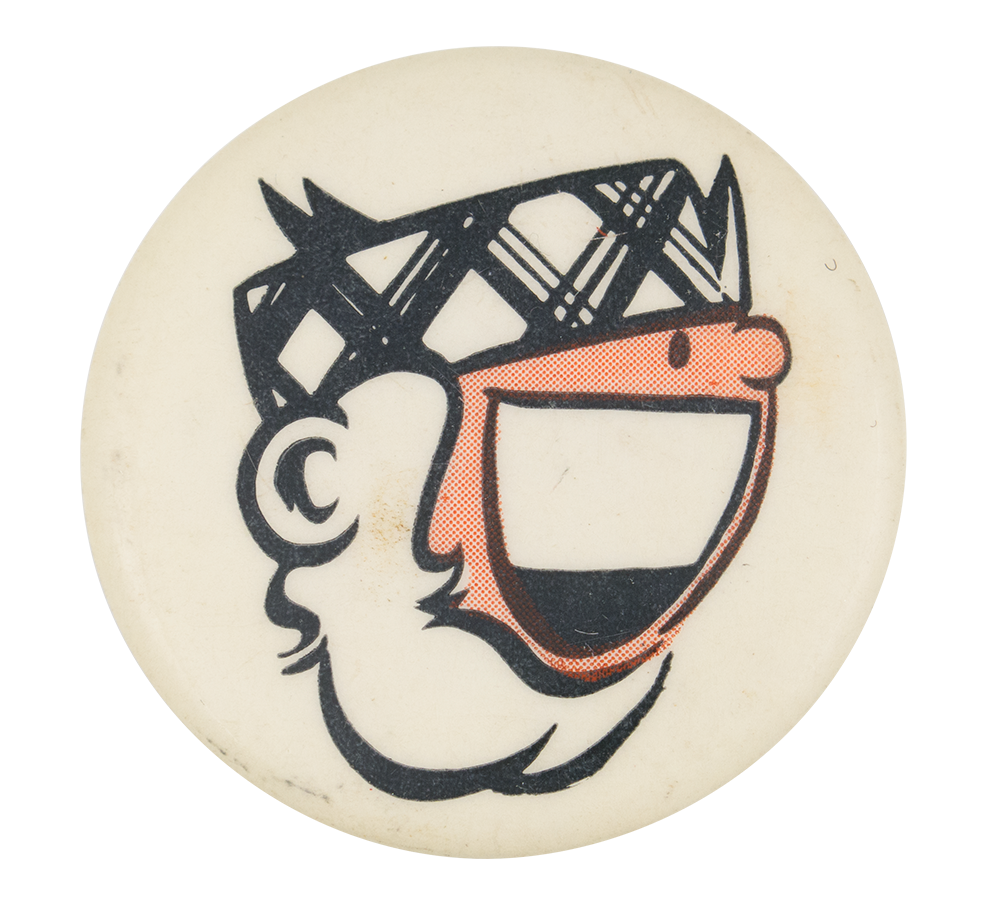
Illustration of a character's head with a big smile and large teeth and pink skin, white beard and a black and white hat on a white background

Back Style
The Shape
The Size
Additional Information

Have info on this button? Contact us here.

Catalog ID AR0360

Davy Crockett Sunbeam Bread

Category
Additional Images
Sub Categories
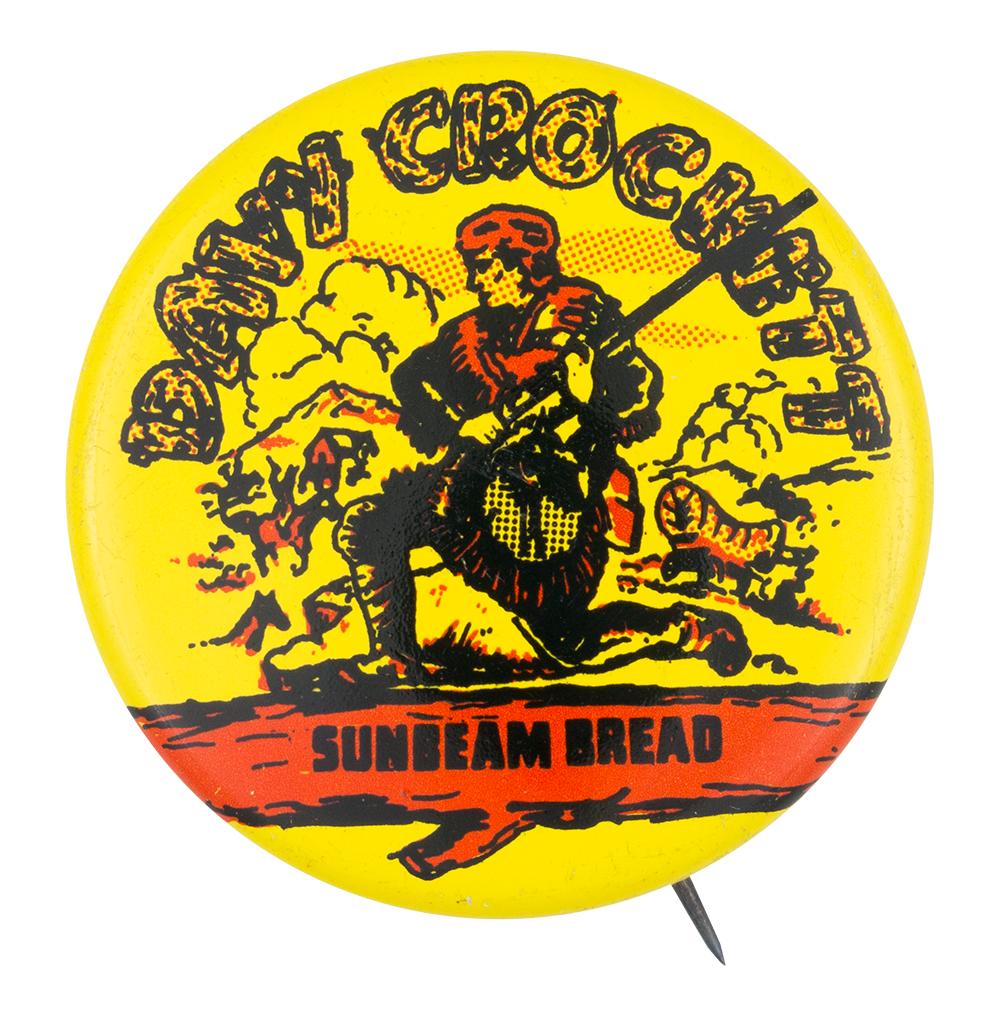
Text on Button DAVY CROCKETT SUNBEAM BREAD
Image Description

Illustration of Davy Crockett on his knee looking to the left while holding his gun. Yellow background

Back Style
The Shape
The Size
Year / Decade Made
Additional Information

Davy Crockett (1786-1836) was an American frontiersman, politician, and soldier whose larger-than-life exploits have been popularized in popular media. Commonly referred to as the "King of the Wild Frontier, Crockett held many attributes during his life. Crockett fought in the War of 1812 and later served in the U.S. House of Representatives. What Crockett is most well-known for, however, is his heroic death while fighting in the  Battle of the Alamo during the Texas War of Independence. Crockett's life has often been portrayed to mythical proportions, cementing him as an American folk hero. From 1954-1955, Disney released a five-part miniseries about Crockett. Starring actor, Fess Parker, the mini-series revitalized the story of Davy Crockett for a new generation. The series was popular at the time, which allowed Disney to sponsor spin-off merchandise. One example is from Sunbeam Bread, who began its own Davy Crockett bread line.

Sources

"Davy Crockett-Sunbeam Bread Button" Hakes Americana & Collectibles.  Retrieved from https://www.hakes.com/SaleList/ItemDetail/15835/DAVY-CROCKETT-SUNBEAM-B….

Catalog ID AD0741

Gimme Jimmy

Category
Additional Images
Sub Categories
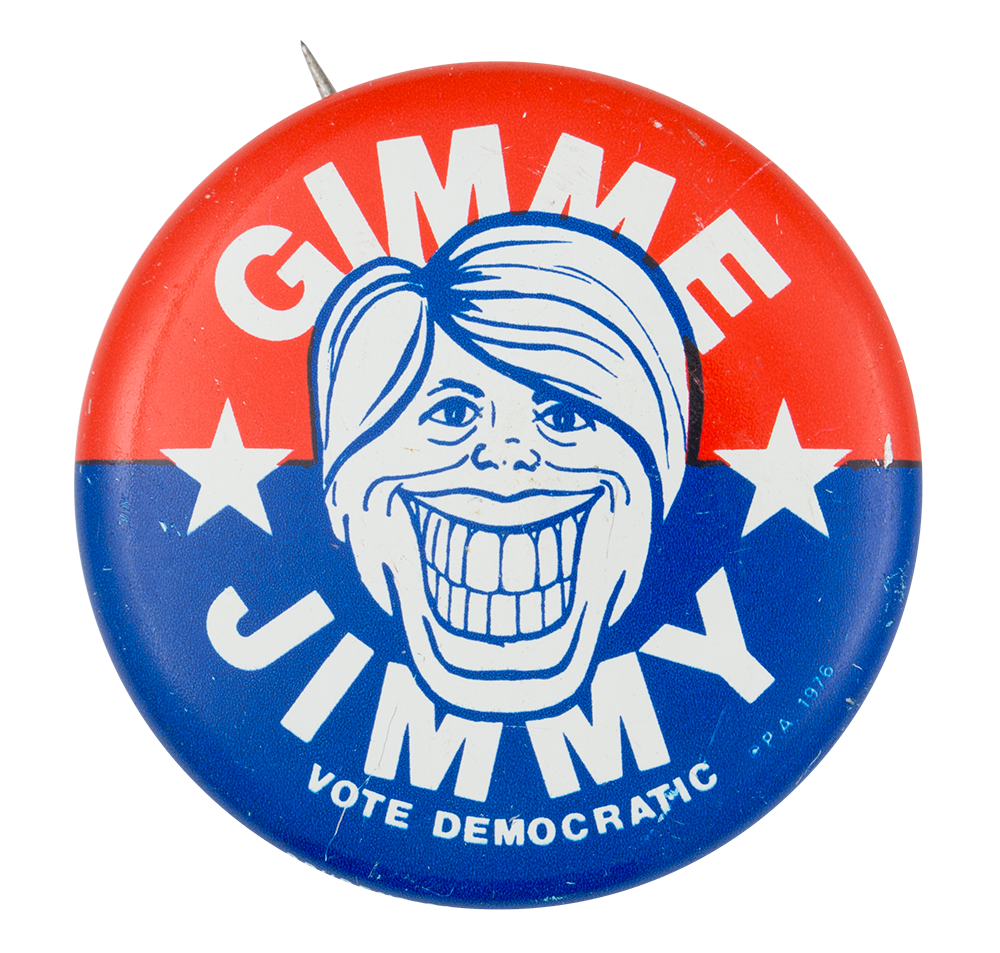
Text on Button GIMME JIMMY VOTE DEMOCRATIC
Image Description

Blue and white illustration of Jimmy Carter's head with white text above and below on a red and blue background

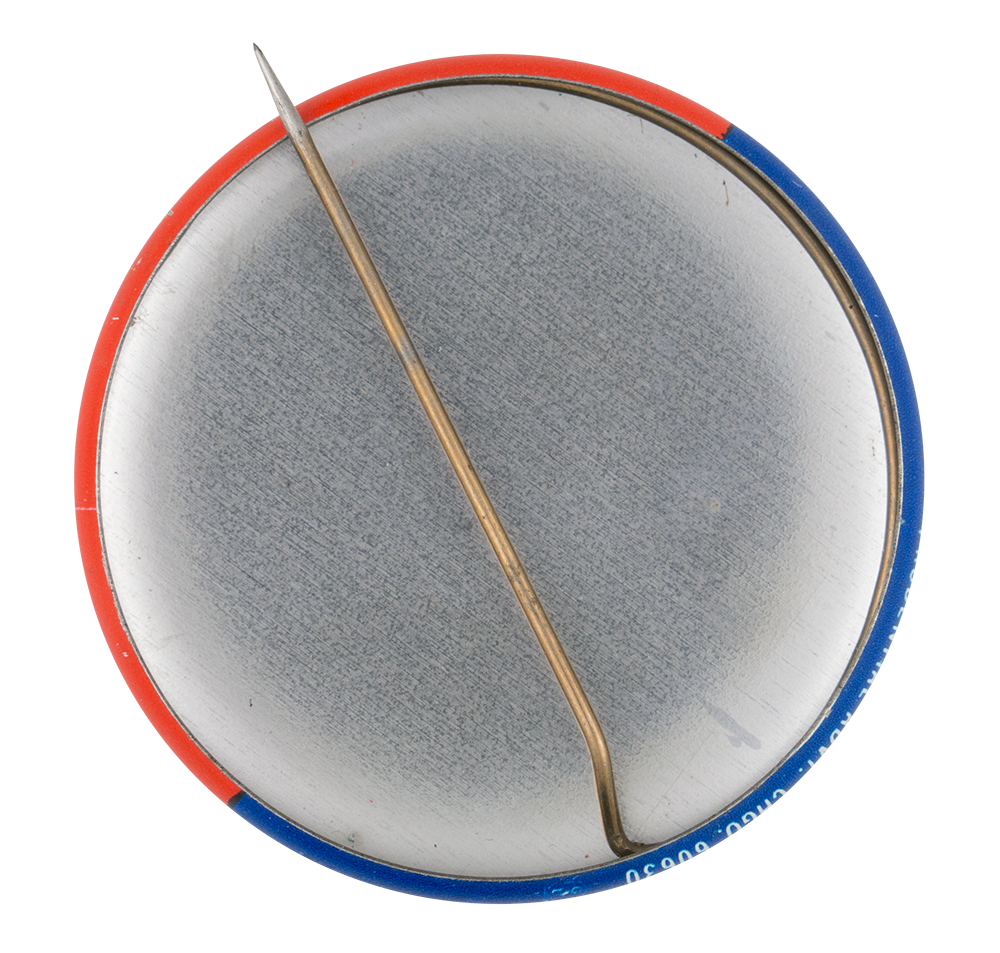
Curl Text PRUDENTIAL ADVT. CHGO. 60630
Back Style
The Shape
The Size
The Manufacturer
Additional Information

Jimmy Carter was the Democratic Party nominee for President of the United States in the 1976 presidential election. He faced incumbent Republican Gerald Ford who had become president due to Nixon’s resignation after the Watergate scandal. Carter won both the popular vote and the Electoral College in a very closely contested race with Ford. 

During his presidency, Jimmy Carter pardoned Vietnam War draft evaders, established both the Department of Energy and the Department of Education, and dealt with numerous foreign policy challenges including the Iran hostage crisis and the Soviet invasion of Afghanistan. He was subsequently defeated in the 1980 presidential election by Ronald Reagan.

Catalog ID PO0917

Keep 'em Fed

Category
Additional Images
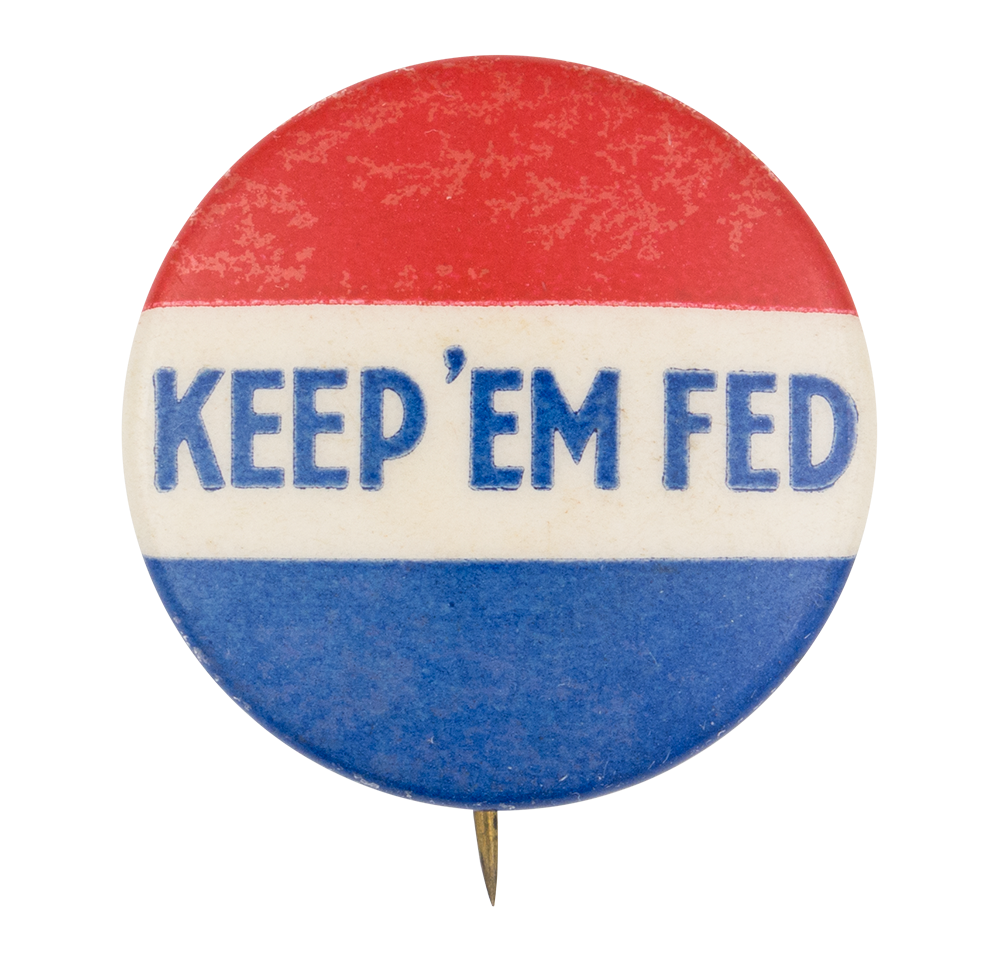
Text on Button KEEP 'EM FED
Image Description

Red, white and blue background with blue text over a white stripe

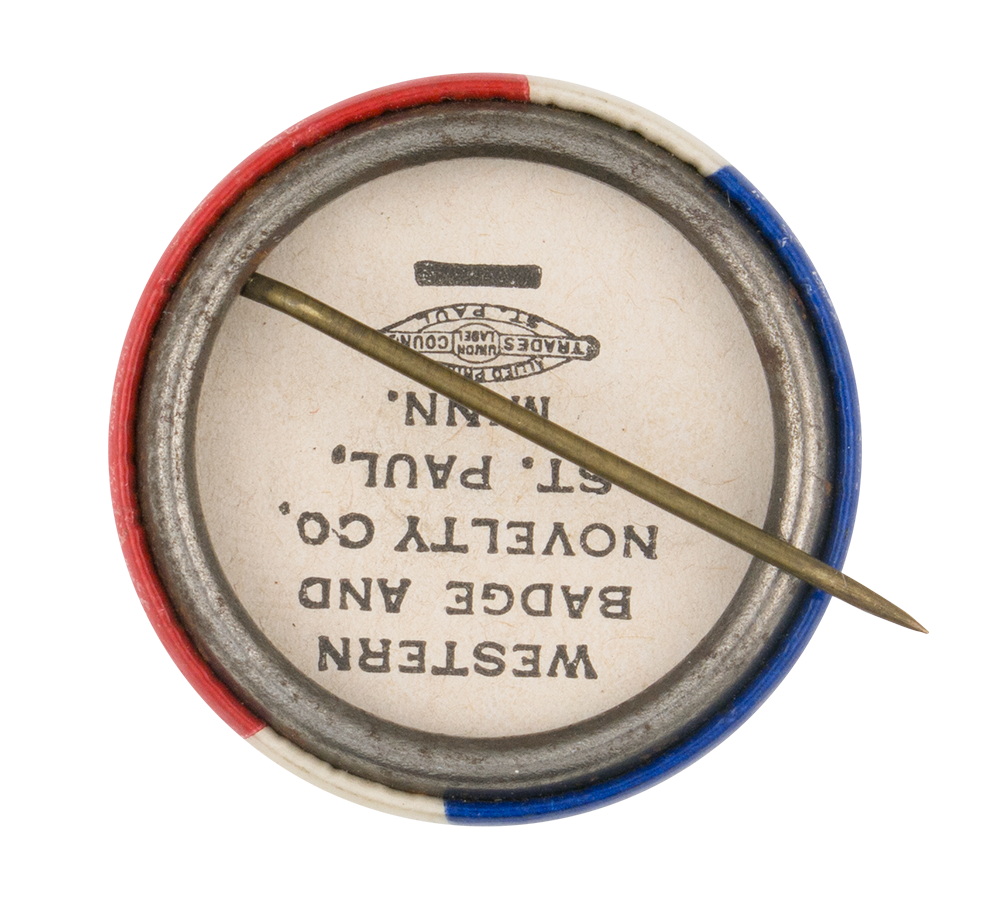
Back Paper / Back Info

WESTERN BADGE AND NOVELTY CO. ST. PAUL, MINN. union bug

Back Style
The Shape
The Size
Year / Decade Made
The Manufacturer
Additional Information

"Keep 'em [Blank]" was the format for a number of slogans surrounding the US armed forces fighting in World War II. In particular, "Keep 'em Flying" was both a motto in support of the Air Force and later the title of a 1941 film in which two circus performers join Army flight school. Other slogans included, "Keep 'em Sailing", "Keep 'em Rolling", "Keep 'em Smiling" (a letter writing campaign), and, of course, "Keep 'em Fed", which encouraged citizens to ration food in support of the war effort and was frequently used by trade companies to advertise their donations to the troops.

Sources

Chicago Hardware Foundry Co. Trade Catalog. Smithsonian Institute Library, Trade Literature Collections. Retrieved from https://www.si.edu/es/object/SILNMAHTL_10752?width=85%25&height=85%25&i….


Catalog ID CA0679