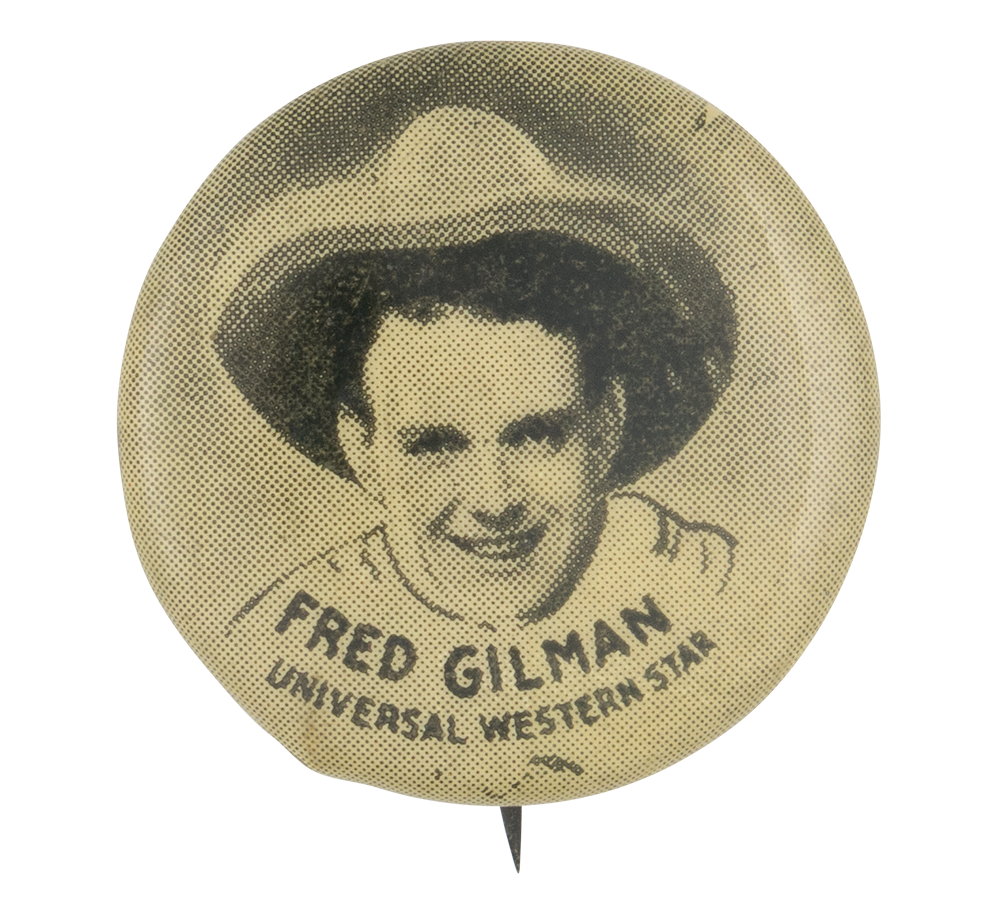
Fred Gilman

Category
Additional Images
Sub Categories
Text on Button FRED GILMAN UNIVERSAL WESTERN STAR
Image Description

Black and white photograph of a man's head and shoulders, wearing a hat over black text on a white background

Back Style
The Shape
The Size
Additional Information

Fred Gilman started his career in Hollywood as a stunt double for the famed western actor, Hoot Gibson. He earned starring roles in a number of Universal's William Wyler-directed two-reel westerns, which were 11-minute silent films. By the 1930s, however, the new popularity of sound films led the studio to focus on other types of projects, halting Gilman's career rise. Gibson kept Gilman employed throughout the 1930s in small parts, but his career quietly faded as an extra and horse trainer. The actor died in 1988.

Sources

Bommersbach, Jana. (2017, March 3). "Hoot Gibson." True West. Retrieved at https://truewestmagazine.com/hoot-gibson/.

"Fred Gilman." IMDb. Retrieved at http://www.imdb.com/name/nm0319432/bio?ref_=nm_ov_bio_sm.

"Fred Gilman." Rotten Tomatoes. Retrieved at https://www.rottentomatoes.com/celebrity/fred_gilman/. 

Catalog ID EN0457

Willkie Red and Blue Two

Category
Additional Images
Sub Categories
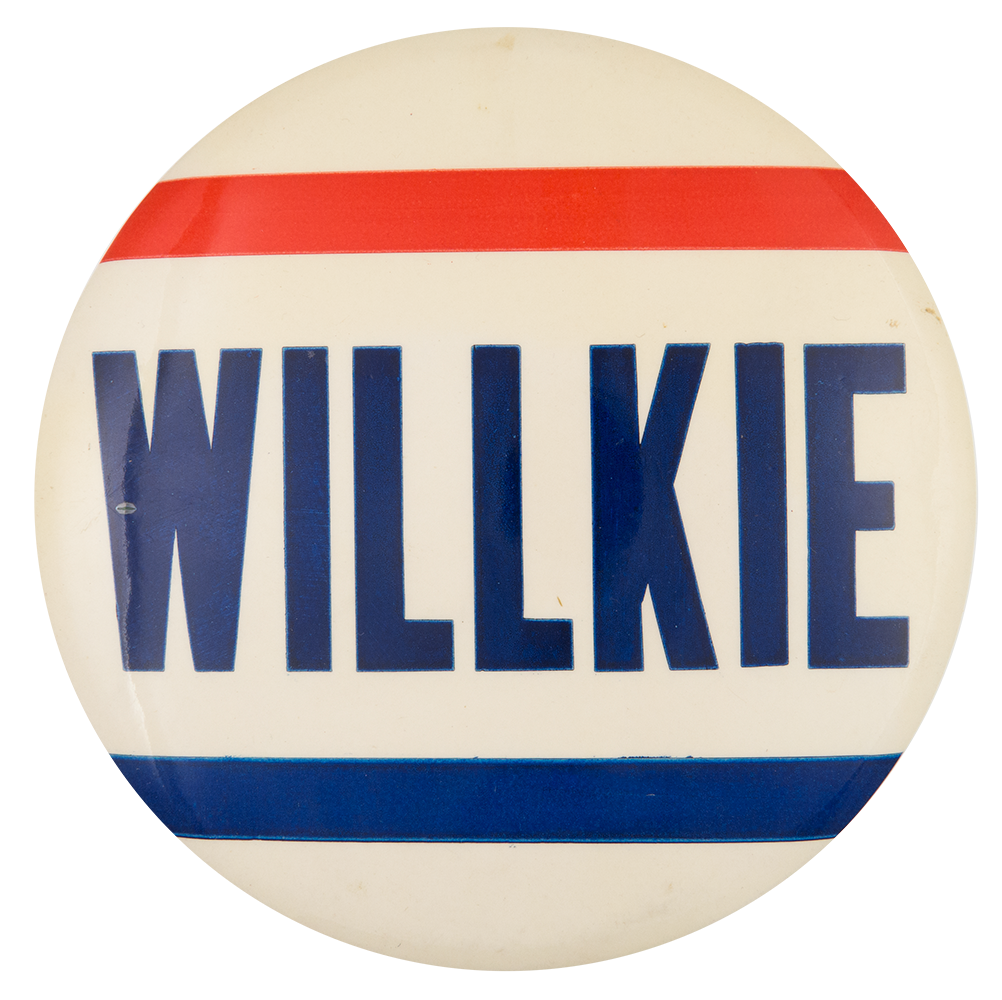
Text on Button WILLKIE
Image Description

Blue text with a red stripe above and a blue stripe below on a white background

Back Paper / Back Info

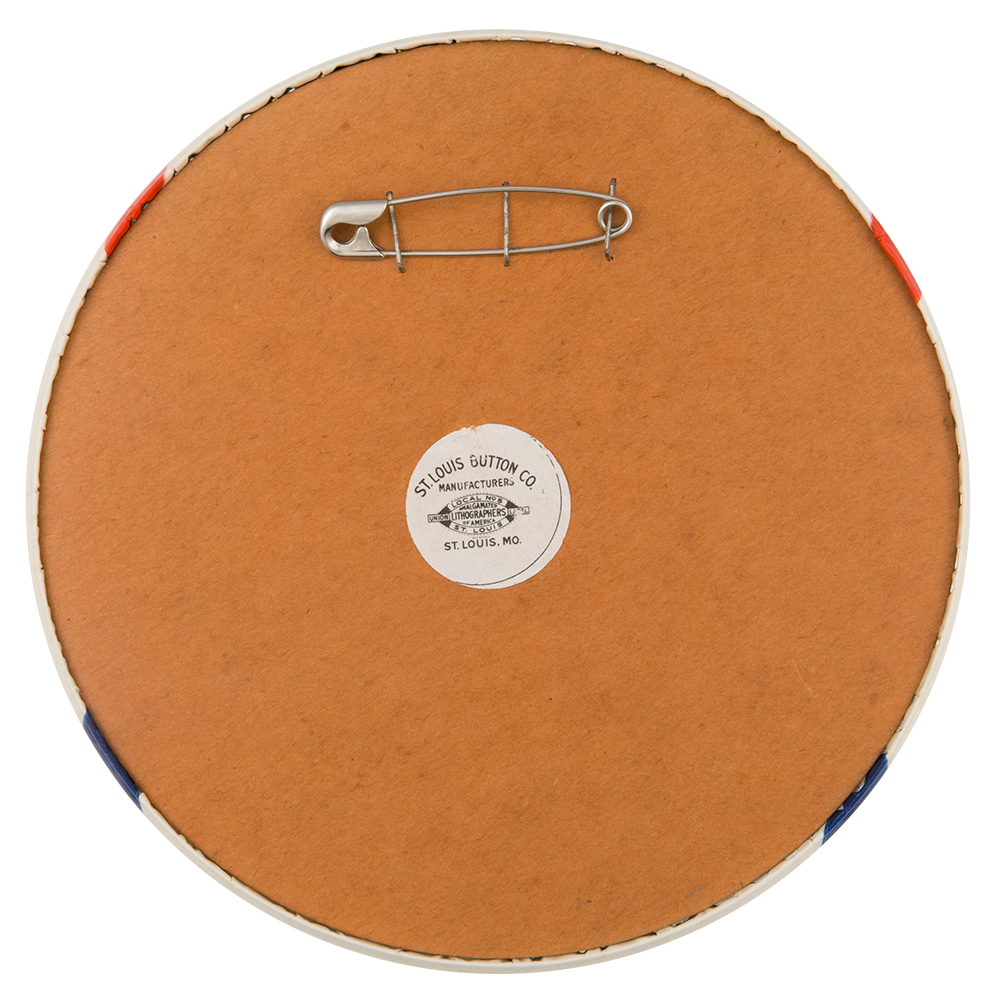
ST. LOUIS BUTTON CO. MANUFACTURERS ST. LOUIS, MO.

Back Style
The Shape
The Size
The Manufacturer
Additional Information

Wendell Lewis Willkie (1892-1944), was an American lawyer and the Republican nominee for President of the United States in 1940. Despite receiving the most popular votes for a Republican up to that point, Willkie lost the election to Franklin D. Roosevelt.  A long-time, active Democrat, Willkie joined the Republican party in response to government restrictions on business. Willkie was appointed as the Goodwill Ambassador to the Middle East, China, and the Soviet Union under President Roosevelt.

Catalog ID PO0908

Watch Will Key Win

Category
Additional Images
Sub Categories
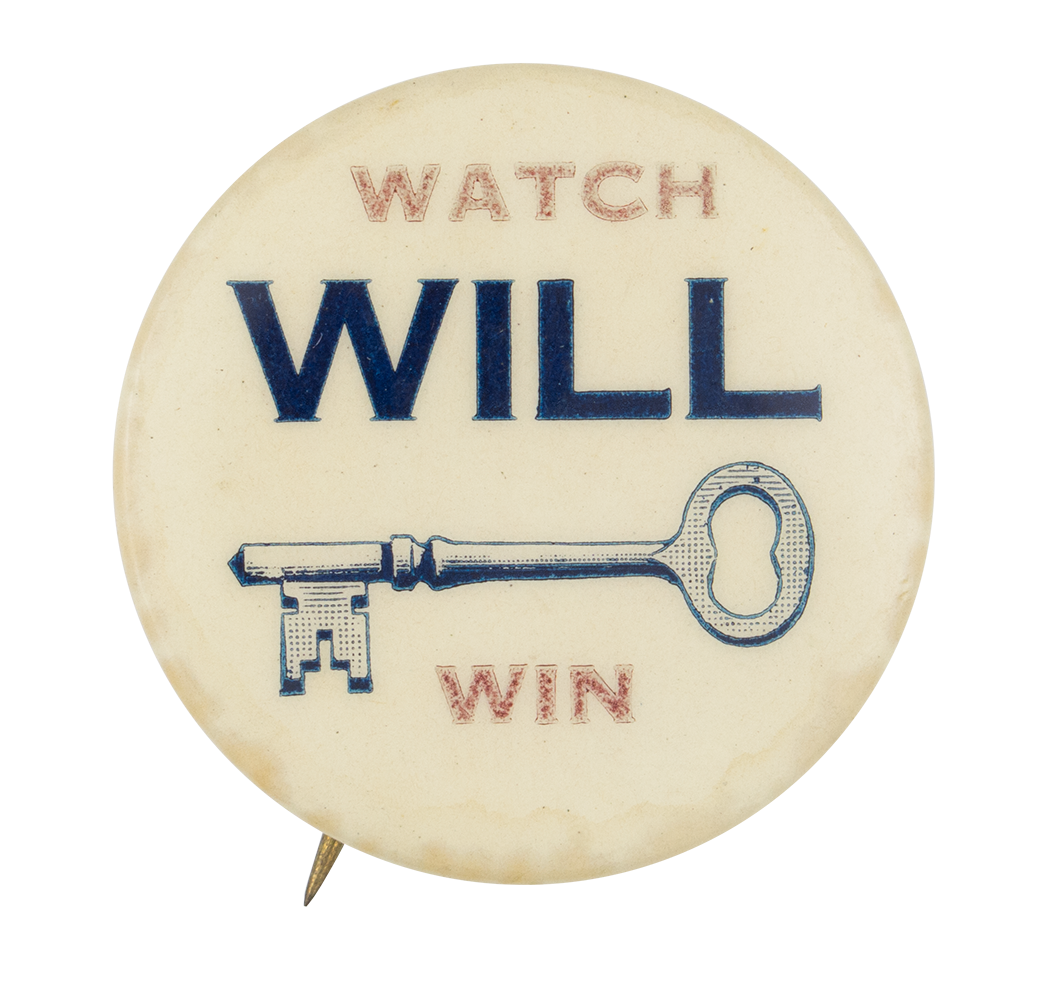
Text on Button WATCH WILL WIN
Image Description

Gold and blue text and an illustration of a key on a white background

Back Style
The Shape
The Size
Additional Information

Wendell Willkie was the Republican presidential candidate who ran against Franklin Delano Roosevelt in 1940. His campaign produced millions of buttons in response to items in the news about Roosevelt in an attempt to gain name recognition. 

Willkie was a lawyer from New York, who campaigned on issues such as international relations, which addressed the United States role in World War II.  He lost the election to Roosevelt, who had won 85% of the electoral college.  As a result, Roosevelt would go on to become the first president to be in office three terms, before the 22nd Amendment to the U.S. Constitution, ratified in 1951, would limit a president's time in office to two terms.

Catalog ID PO0922

Well Done Col. Glenn

Category
Additional Images
Sub Categories
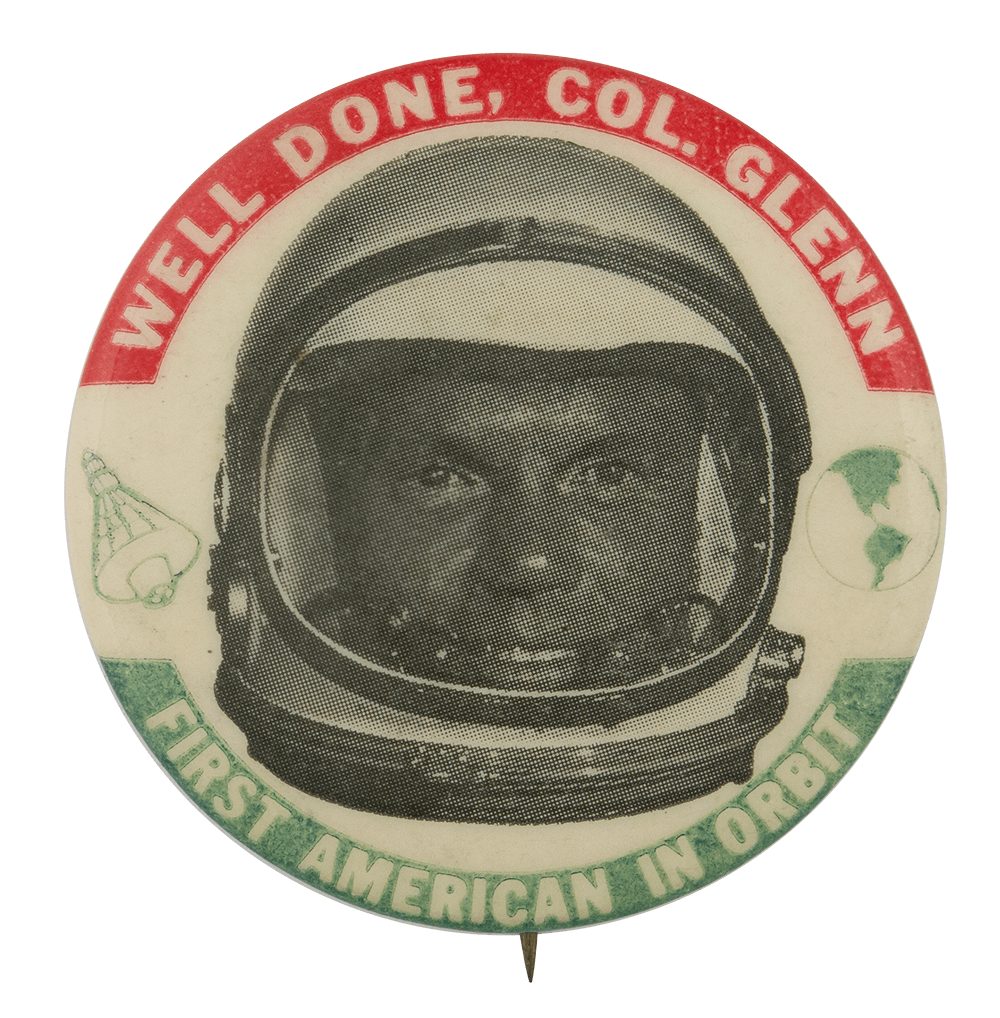
Text on Button WELL DONE, COL. GLENN FIRST AMERICAN IN ORBIT
Image Description

Red and blue circular framing with white text and center photo of Colonel John Glenn.

Back Style
The Shape
The Size
Year / Decade Made
Additional Information

Colonel John Glenn was an American astronaut who holds the distinction of being part of the first group of astronauts to have been selected by NASA. Announced by NASA on April 9, 1959, Glenn was part of the Mercury Seven, otherwise known as the Original Seven. Those selected were to take part in Project Mercury, an early example of the Space Race and whose goal was to put a man into orbit and return him safely to Earth before the Soviet Union could. Though NASA would fail in taking that distinction due to Soviet astronaut, Yuru Gagarin becoming the first person to journey into outer space and complete orbit, Glenn did became the first American to complete the task.

Conducted on February 20, 1962, the mission, known as Mercury-Atlas 6 (MA-6), was the third human spaceflight mission by the U.S.. Glenn was the pilot for the mission and successfully performed three orbits around the Earth. Glenn conducted the mission in the spacecraft, Friendship 7 . As a result of the mission, Glenn also became the the fifth person and third American in space. Upon resigning from NASA in 1964, Glenn became a Senator from Ohio and was also inducted into the U.S. Astronaut Hall of Fame in 1990.

Read more about the History of NASA buttons on the Busy Beaver blog.

Sources

"Space Exploration 15 buttons for seven flights from Glenn 1962 thru moon landing 1969. Hake's Americana & Collectibles. Retrieved from https://www.hakes.com/Auction/ItemDetail/214628/SPACE-EXPLORATION-15-BU…

Catalog ID EV0433

The Moon and Beyond

Category
Additional Images
Sub Categories
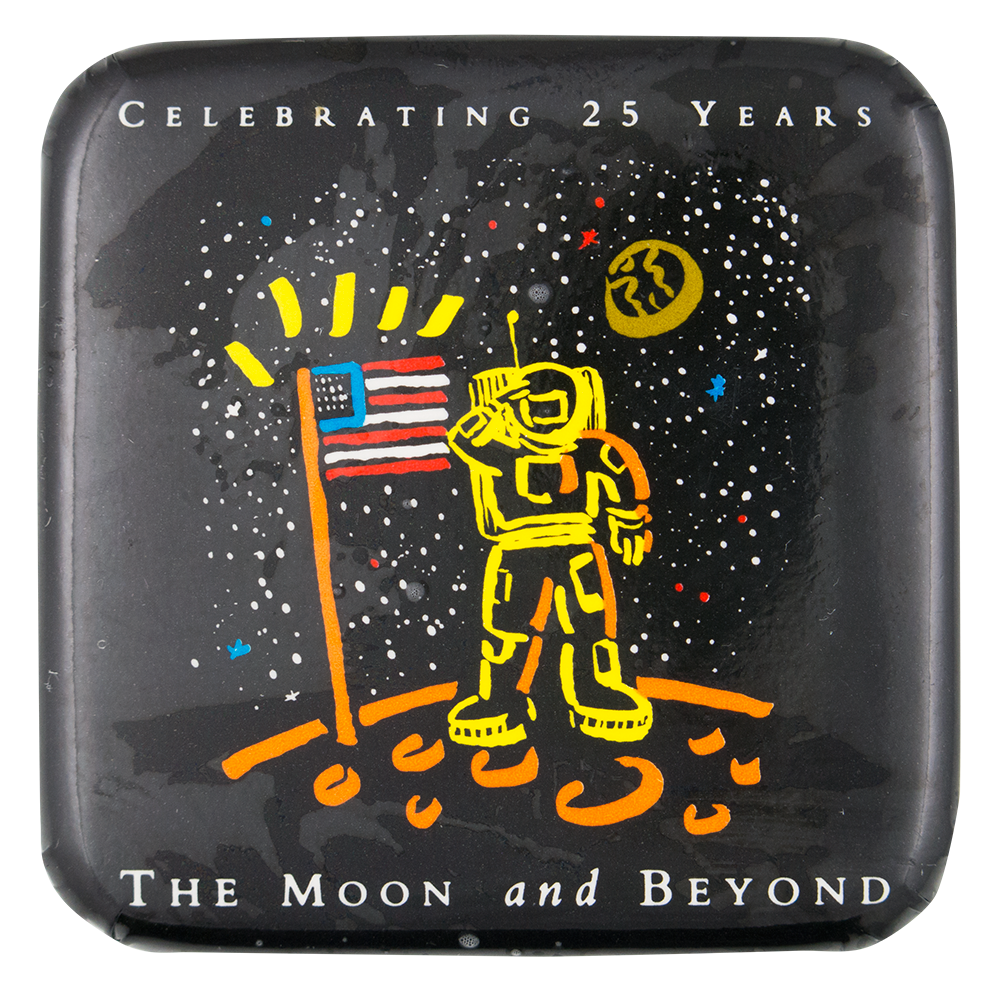
Text on Button CELEBRATING 25 YEARS THE MOON AND BEYOND
Image Description

Black background with an illustration of an astronaut saluting an American flag on the moon

Back Style
The Shape
The Size
Year / Decade Made
Additional Information

On July 20, 1969, American astronauts Edwin "Buzz" Aldrin and Neil Armstrong became the first individuals in history to ever land of the moon. Serving as two of the three member crew of the Apollo 11 spaceflight alongside Michael Collins, who only stayed in orbit around the moon, both Aldrin and Armstrong landed the lunar module, Eagle, on the moons surface. Armstrong holds the distinction of being the first on the moon, uttering the now famous phrase upon walking outside of the capsule  "one small step for man, one giant leap for mankind. Twenty minutes later, Aldrin joined him on the surface and both proceeded to spend around two hours walking on the surface. Broadcast on live TV to a worldwide audience, the event became a monumental part of the twentieth century. The mission was a complete success and completed President John F. Kennedy's ambition and goal to land a man on the moon by the end of the 1960s. 

Catalog ID EV0434

First MEN on the Moon July 21st 1969

Category
Additional Images
Sub Categories
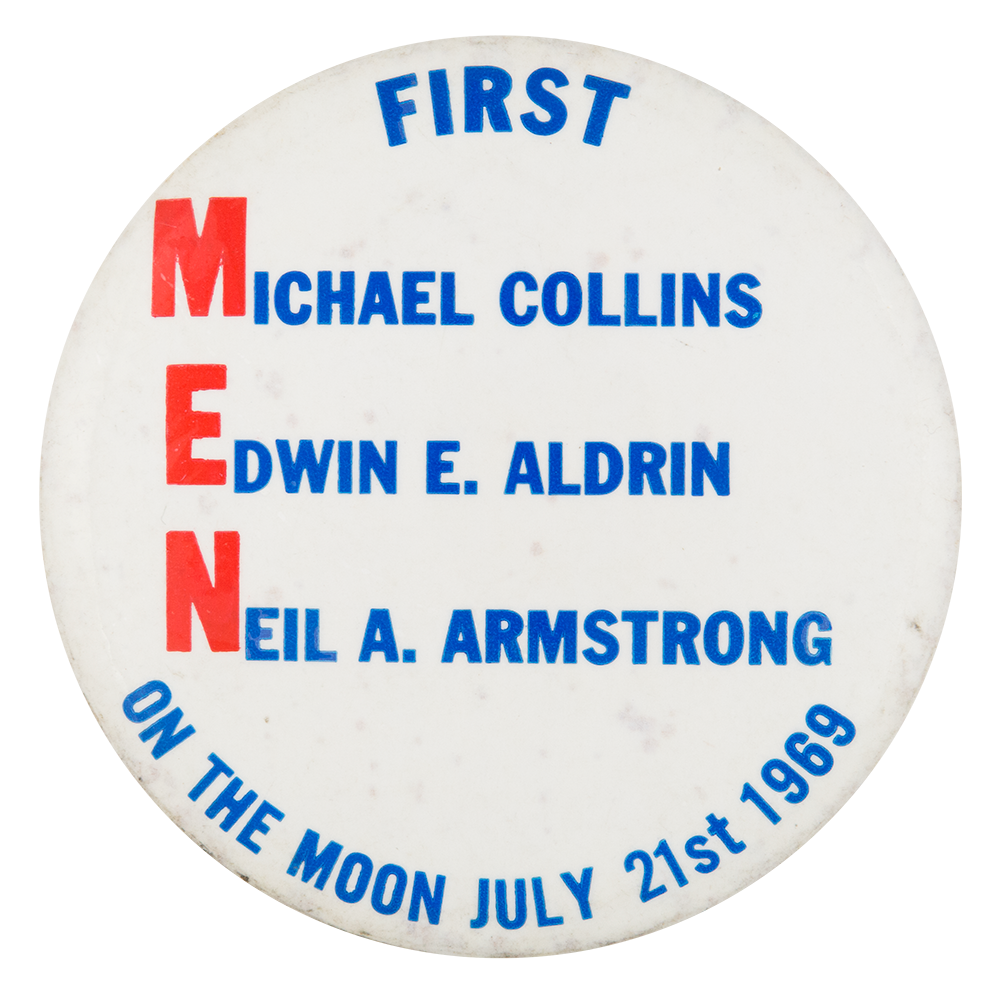
Text on Button FIRST MICHAEL COLLINS EDWIN E. ALDRIN NEIL A. ARMSTRONG ON THE MOON JULY 1ST, 1969
Image Description

Blue and red text with a white background

Back Style
The Shape
The Size
Year / Decade Made
Additional Information

On July 20, 1969, astronauts Neil Armstrong, Bull Aldrin, and Michael Collins made history as the crew of the legendary Apollo 11 spaceflight. The missions purpose was to successfully land a person on the moon before the Soviets could and bring them home to Earth without issue. While Michael Collins piloted the command module, Columbia, alone in the moon's orbit, both Neil Armstrong and Buzz Aldrin have the distinction of being the first and second human beings respectively to ever walk the moon's surface. Broadcast on live television, the Apollo 11 mission remains one of the most defining moments of the twentieth century. Effectively ending the Space Race, Apollo 11 stands as a moment of inspiration. While the concept of space travel had up to that point been considered nothing more than science fiction, Apollo 11 showed that humanities future was not limited to just Earth.​

Catalog ID EV0437

Apollo 11 with Ribbon

Category
Additional Images
Sub Categories
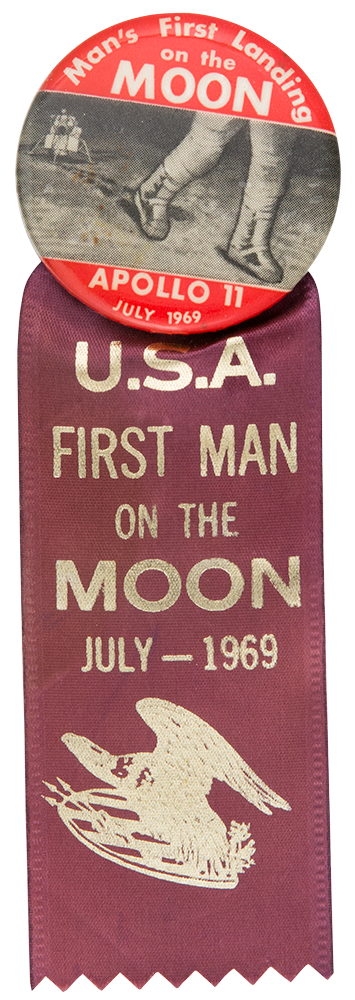
Text on Button Man's First Landing on the MOON APOLLO 11 JULY 1969
Image Description

White text on red panels that surround an illustration of an astronaut's legs walking on the moon 

Back Style
The Shape
The Size
Year / Decade Made
Additional Information

On July 20, 1969, astronauts Neil Armstrong, Bull Aldrin, and Michael Collins made history as the crew of the legendary Apollo 11 spaceflight. The missions purpose was to successfully land a person on the moon before the Soviets could and bring them home to Earth without issue. While Michael Collins piloted the command module, Columbia, alone in the moon's orbit, both Neil Armstrong and Buzz Aldrin have the distinction of being the first and second human beings respectively to ever walk the moon's surface. Broadcast on live television, the Apollo 11 mission remains one of the most defining moments of the twentieth century. Effectively ending the Space Race, Apollo 11 stands as a moment of inspiration. While the concept of space travel had up to that point been considered nothing more than science fiction, Apollo 11 showed that humanities future was not limited to just Earth.

Sources

"Man's first landing on the Moon" 1969 Button. Hake's Americana & Collectibles. Retrieved from https://www.hakes.com/SaleList/ItemDetail/8612/MANS-FIRST-LANDING-ON-TH….

Catalog ID EV0435

The Mocking of the President Carter

Category
Additional Images
Sub Categories
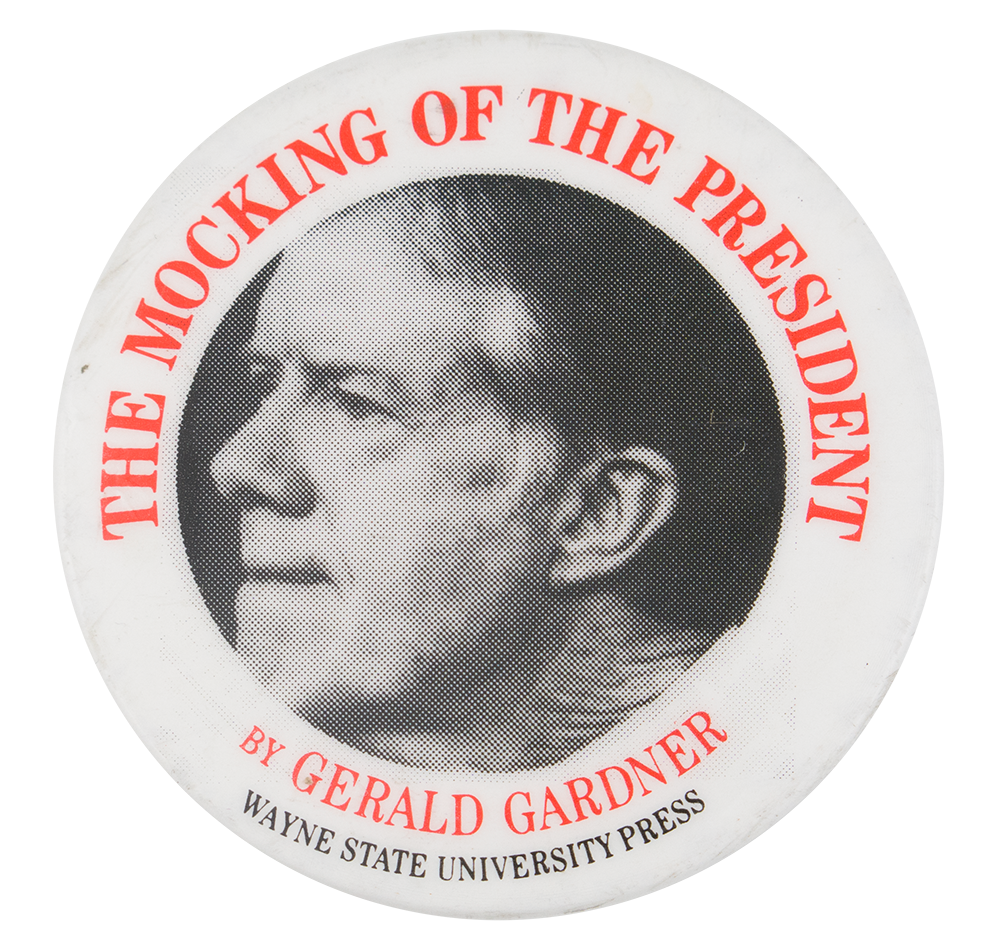
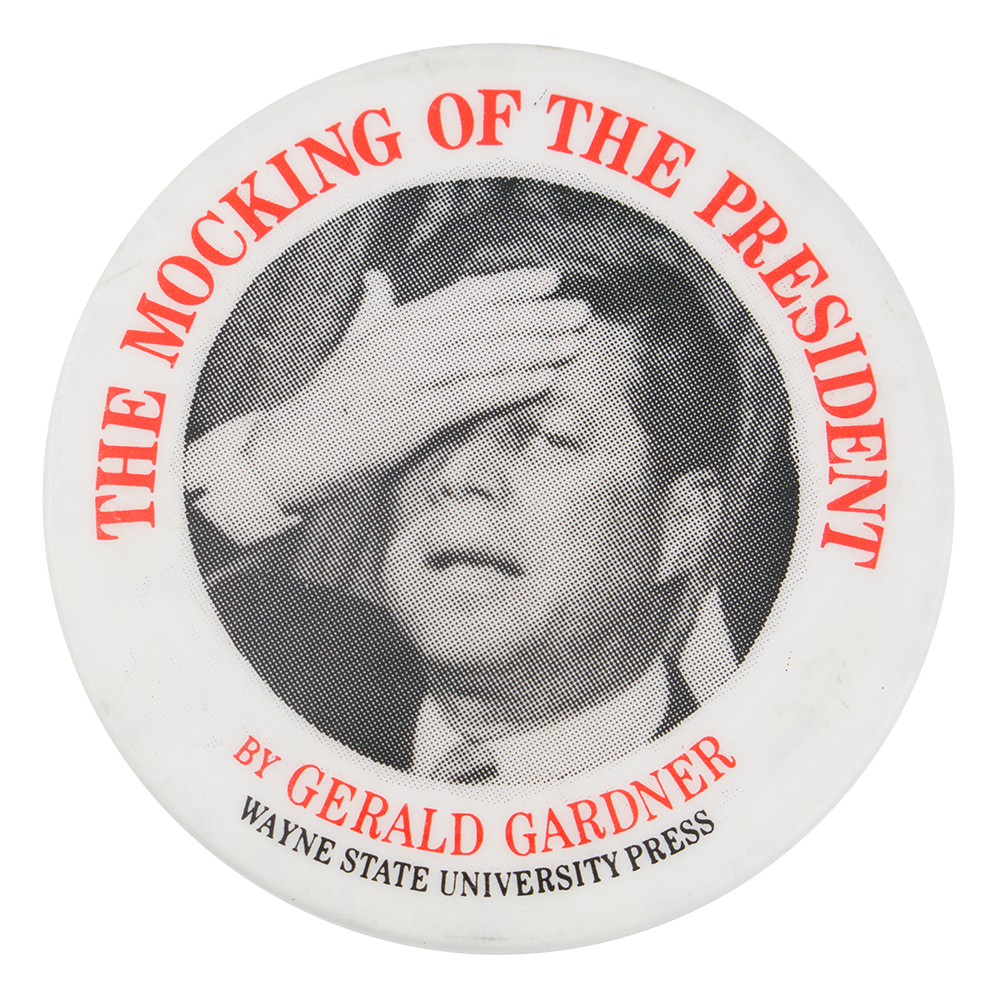
Text on Button THE MOCKING OF THE PRESIDENT BY GERALD GARDNER WAYNE STATE UNIVERSITY PRESS
Image Description

Red and black text on a white outer edge with a black and white photograph of Carter's head in profile

Back Style
The Shape
The Size
Year / Decade Made
Additional Information

The Mocking of a President: A History of Campaign Humor From Clinton to Kennedy was written in 1994 by comedy writer Gerald Gardner. This book was in a series from Gardner chronicling jokes made by and about political candidates, which includes President Jimmy Carter. Gardner wrote the popular political satire series Who’s in Charge Here, which added humorous captions to pictures of politicians.

Gardner also wrote for popular TV shows from the 60's, such as The Monkees and Get Smart. Episodes he worked on for Get Smart were nominated for Primetime Emmy Awards. He often worked with Dee Caruso on projects including comics, television shows, and movies.

Catalog ID EN0011

The Mocking of the President Kennedy

Category
Additional Images
Sub Categories
Text on Button THE MOCKING OF THE PRESIDENT BY GERALD GARDNER WAYNE STATE UNIVERSITY PRESS
Image Description

Red and black text on a white outer edge with a black and white photograph of Kennedy's head and shoulders

Back Style
The Shape
The Size
Additional Information

In 1988, comedy writer Gerald Gardner release the book, The Mocking of a President: A History of Campaign Humor From Ike to Ronnie. The book is the first in Gardner's series of works chronicling jokes made by, and about, political candidates, including President John F. Kennedy. 

Gardner began publishing political humor in 1966 with the release of the first book in his Who's In Charge Here? series. These works added humorous captions to pictures of politicians. Besides his political books, Gardner is best known for writing the successful 1960s television comedies, Get Smart and The Monkees, along with his writing partner, Dee Caruso.

Sources

Barnes, Mike. (2012, June 1). "Dee Caruso, a Writer on Classic 1960s Sitcoms, Dies at 83." The Hollywood Reporter. Retrieved at https://www.hollywoodreporter.com/news/dee-caruso-writer-sitcoms-332216.

Wolfe, Digby. (1988, September 11). "A Different Kind of Acid Reign : THE MOCKING OF THE PRESIDENT A History of Campaign Humor From Ike to Ronnie by Gerald Gardner." Los Angeles Times. Retrieved at http://articles.latimes.com/1988-09-11/books/bk-2881_1_gerald-gardner.

Catalog ID EN0294

The Washington Fringe

Category
Additional Images
Sub Categories
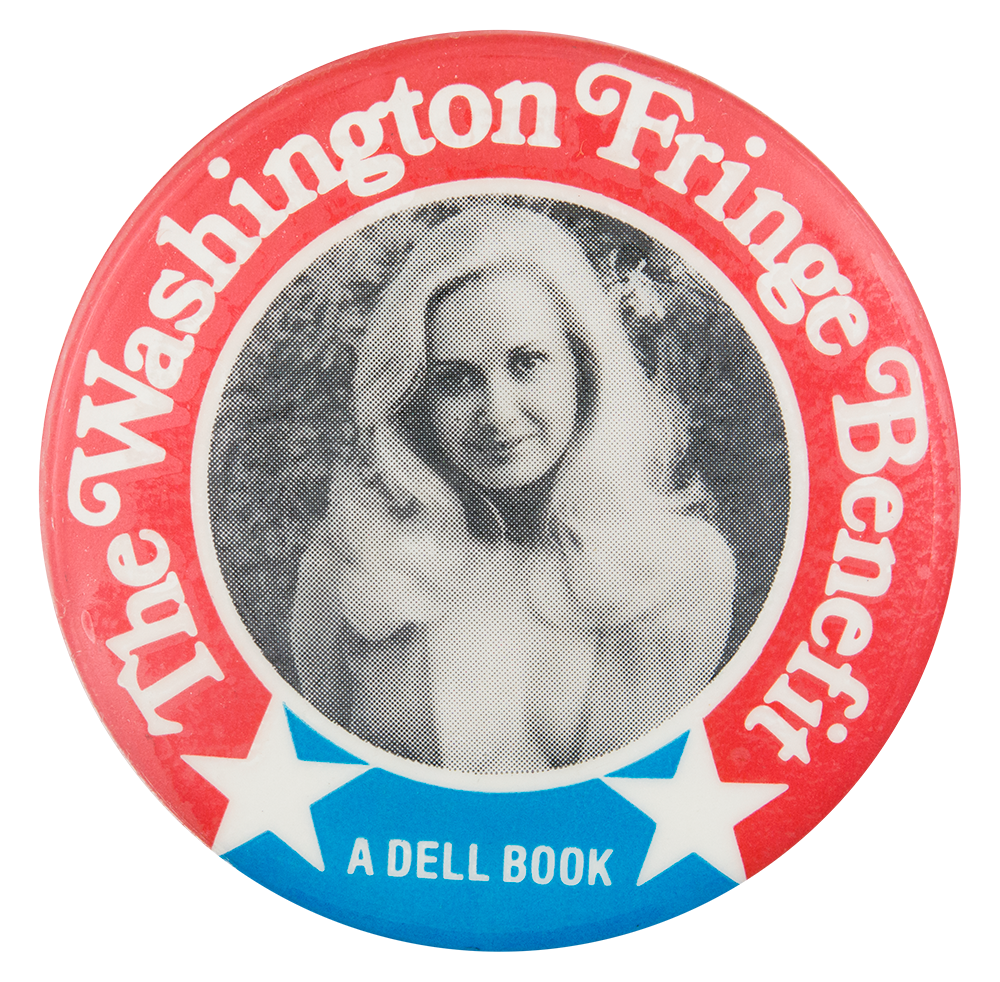
Text on Button The Washington Fringe Benefit A DELL BOOK
Image Description

Black and white photograph of a woman with long blonde hair with a white outer edge followed by a red outer edge with white text and two white stars at the bottom next to blue with white text

Back Style
The Shape
The Size
Year / Decade Made
Additional Information

In 1976, Elizabeth Ray effectively ended the career of Ohio Congressman Wayne Hays when she revealed she had been his mistress while employed as a "secretary" for a salary of $14,000 dollars a year. Ray claimed that since arriving at the Hill, she had not been asked to conduct any Congressional work, famously being quoted as admitting, "I can't type, I can't file, I can't even answer the phone." After Hays resigned, Ray published a book about her experience titled, The Washington Fringe Benefit though she failed to achieve further success outside of a photo shoot for Playboy. The Hays incident was one of the most prolific Congressional scandals of the 1970s, and marked the time when sex scandals began to appear more commonly in the media, culminating in the Monica Lewinsky case in 1998.

Sources

Clark, Marion & Maxa, Rudy. (1967, May 23). "Closed Session Romance on the Hill". The Washington Post. Retrieved from https://www.washingtonpost.com/wp-srv/local/longterm/tours/scandal/eliz….

Catalog ID EN0313