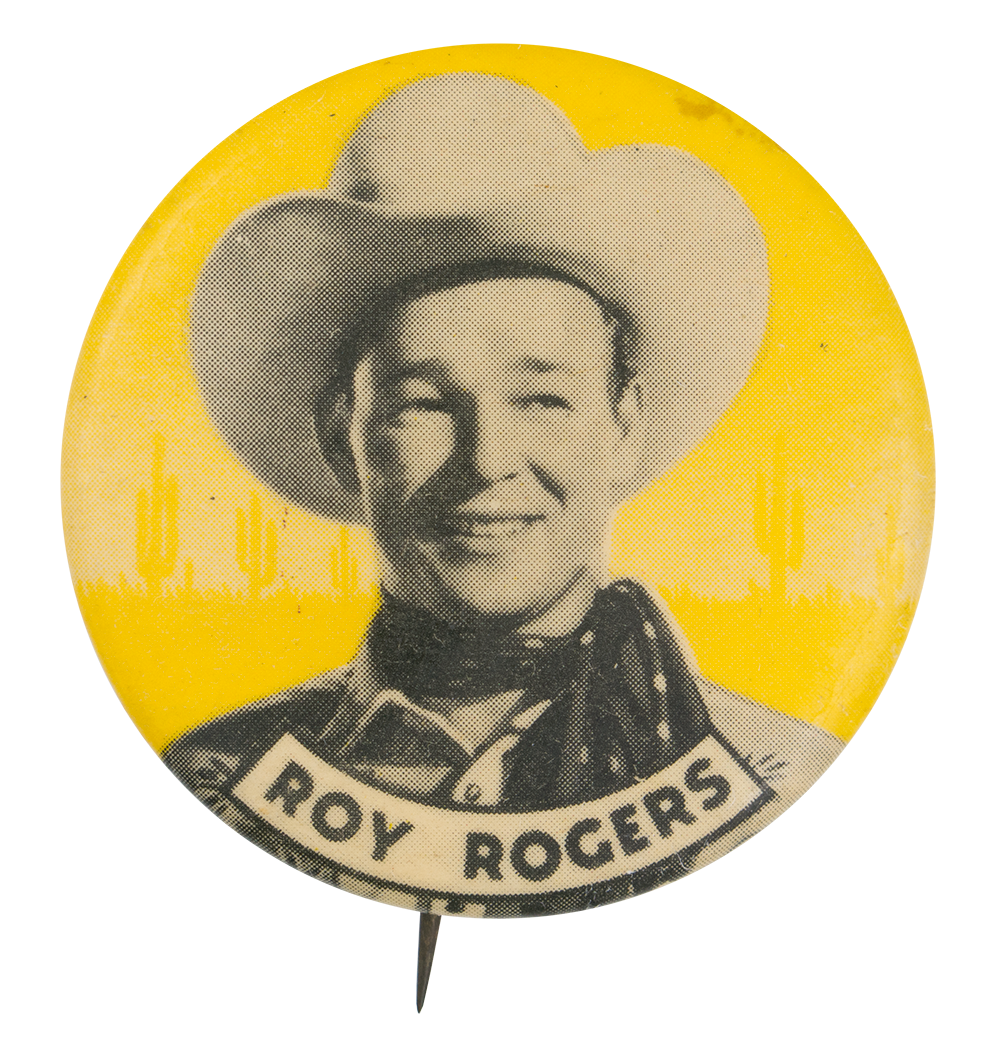
Roy Rogers

Category
Additional Images
Sub Categories
Text on Button ROY ROGERS
Image Description

Black and white photograph of a man in a cowboy hat with a scarf around his neck on a yellow background and black text

Back Style
The Shape
The Size
Additional Information

Actor and singer Roy Rogers, a Western star, appeared in more than 100 movies and in multiple radio and television shows in the 1940s and 1950s. Roy Rogers was born Leonard Franklin Slye in 1911 in Ohio. He began his music career in 1931 as a member of the Rocky Mountaineers in California. Four years later he started acting in movies, primarily Westerns. He won a contest to become a singing cowboy film star in 1938, and Republic Pictures gave him the performing name Roy Rogers. He played the supporting role in the movie Dark Command with John Wayne, and then went on to star in a number of Roy Rogers movies and The Roy Rogers Show. Roy Rogers had action figures, cowboy adventure books, and a comic strip created after his character. He was inducted into the Western Performers Hall of Fame at the National Cowboy & Western Heritage Museum and elected to the Country Music Hall of Fame, and has three stars on the Hollywood Walk of Fame. He died in California in 1998.

Catalog ID EN0443

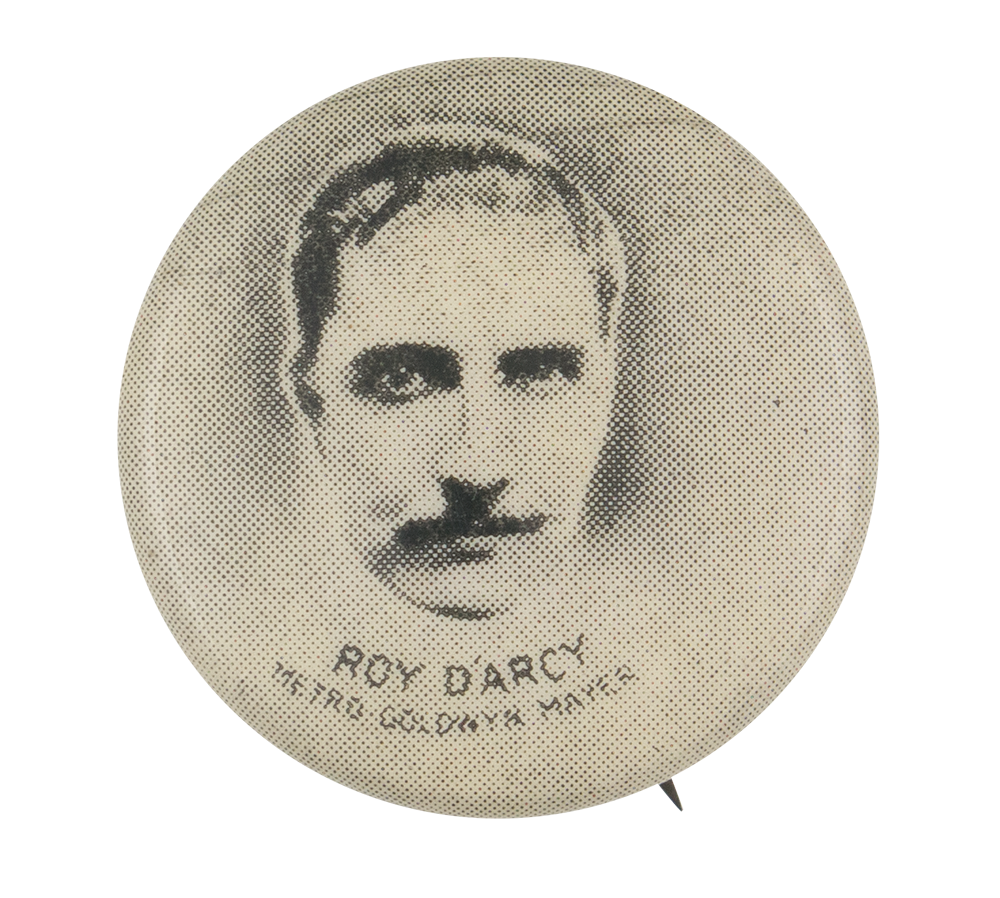
Roy D'arcy

Category
Additional Images
Sub Categories
Text on Button ROY D'ARCY METRO GOLDWYN MAYER
Image Description

Black and white photograph of a man's head over black text on a white background

Back Style
The Shape
The Size
Year / Decade Made
Additional Information

Roy D'arcy was born Roy Giusti in San Francisco, California on February 10, 1894. Shortly after his birth, Giusti's family moved to Europe, where the actor lived until the end of World War I. After returning to the United States, D'arcy spent his career on stage in both New York and Hollywood until 1925 when he appeared in MGM's silent feature, "The Merry Window." Concerned with pronunciation, MGM had D'arcy drop the name Giusti. Reviewers reacted positively to D'arcy's performance as a leering, flamboyant villain. As a result, he continued to be cast in similar roles for the remainder of his career.

Between 1925-1929, the actor married and divorced Laura Rhinock Duffy twice. The daughter of an MGM executive, Duffy reportedly flew to Hollywood to meet D'arcy after seeing him on screen. The couple had a tumultuous first divorce, with Duffy publicly condemning D'arcy's "excessive egotism." Their second marriage occurred after a brief, highly public romance between D'arcy and Charlie Chaplain's former wife, Lita Grey Chaplin. D'arcy's screen roles tapered off shortly after the demise of his second marriage to Duffy. His last film role was in 1939, after which he left Hollywood and became a real estate agent. He died in 1969.   

Sources

Harnisch, Larry. (Dec. 15, 2014). "Mary Mallory / Hollywood Heights: Roy D’Arcy: The Man With the Devilish Grin" The Daily Mirror. Retrieved at: https://ladailymirror.com/2014/12/15/mary-mallory-hollywood-heights-roy…;

Liebman, Roy. (1998). From Silents to Sound: A Biographical Encyclopedia of Performers who Made the Transition to Talking Pictures. Jefferson, North Carolina: McFarland. Retrieved at Google Books. 

Catalog ID EN0463

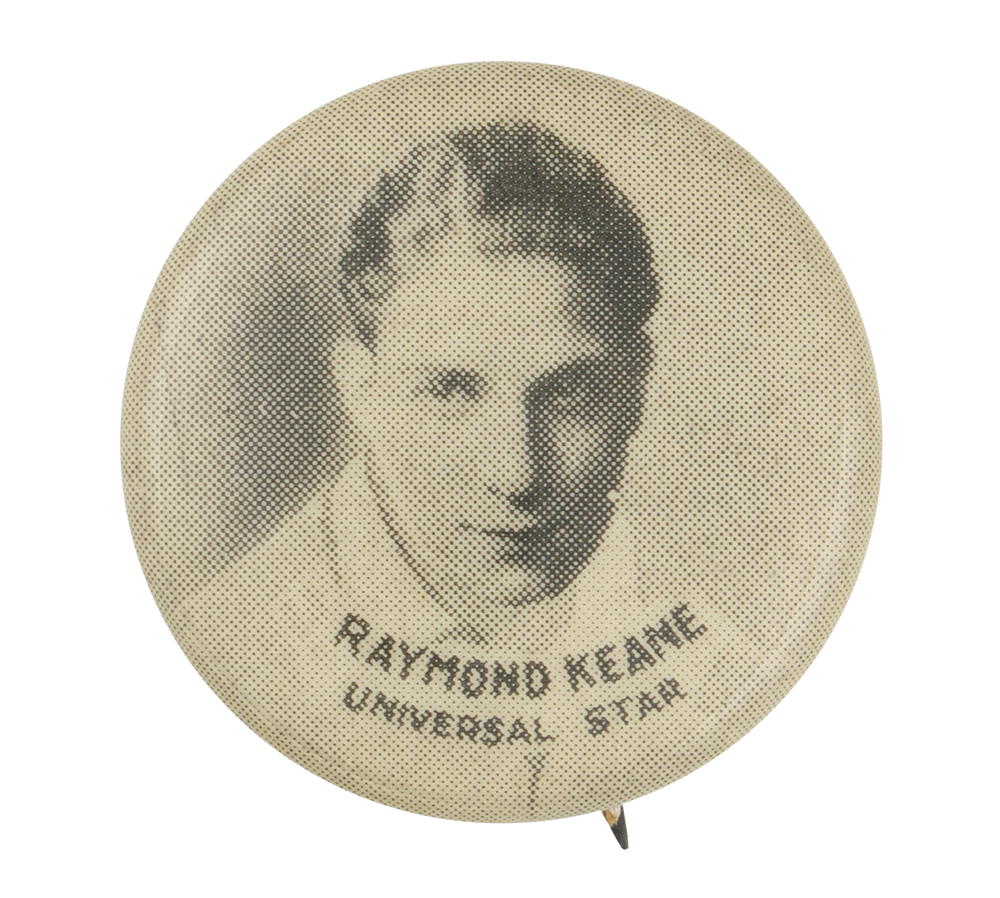
Raymond Keane

Category
Additional Images
Sub Categories
Text on Button RAYMOND KEANE UNIVERSAL STAR
Image Description

Black and white photograph of a man's head over black text on a white background

Back Style
The Shape
The Size
Year / Decade Made
Additional Information

Raymond Keane was an American silent film actor in the late 1920s. His film credits include The Midnight Sun (1926), The Lone Eagle (1927), and The Power of Silence (1928). Keane's acting career did not survive the industry's transition to talking pictures in the 1930s. The actor died in 1973 and is buried in his hometown of Denver, Colorado. 

Sources

"Raymond Keane." British Film Institute. Retrieved at http://www.bfi.org.uk/films-tv-people/4ce2ba171eee7.

"Raymond Keane Biography." IMDb. Retrieved at http://www.imdb.com/name/nm0443889/bio?ref_=nm_ov_bio_sm. 

Catalog ID EN0460

Norman Kerry

Category
Additional Images
Sub Categories
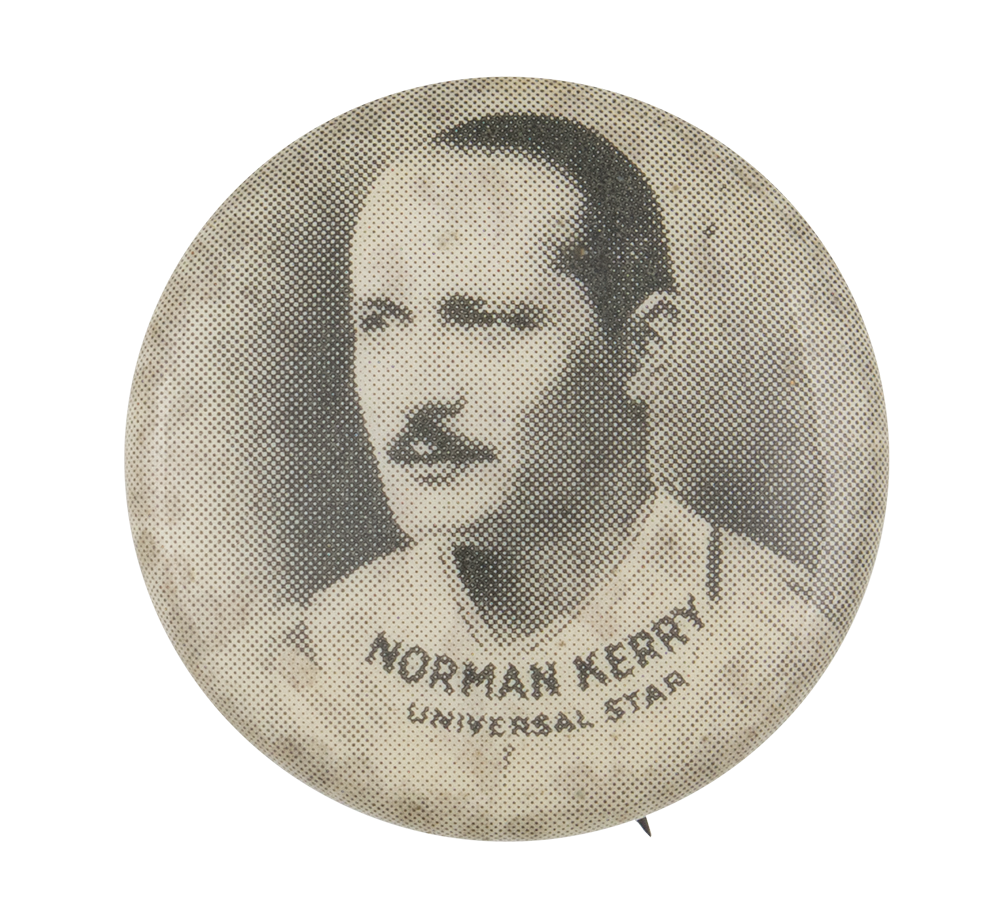
Text on Button NORMAN KERRY UNIVERSAL STAR
Image Description

Black and white photograph of a man's head over black text on a white background

Back Style
The Shape
The Size
Year / Decade Made
Additional Information

Norman Kerry was born Norman Kaiser in 1894. He allegedly changed his last name at the onset of World War I in order to distance himself from Germany's Kaiser Wilhelm II. While working as a theatrical agent in 1916, Kerry met future star Rudolph Valentino, who encouraged Kerry to act. That same year the actor obtained his first small film role in Manhattan Madness opposite Douglas Fairbanks. His stardom rose throughout the 1920s until the advent of talking pictures limited Kerry's opportunities. He received a star on the Hollywood Walk of Fame in 1956, the same year the actor died. 

Sources

Riley, David. (2014, Jan. 11). "Jan. 12: Silent film actor Norman Kerry dies." Democrat & Chronicle. Retrieved at https://www.democratandchronicle.com/story/history/2014/01/11/jan-12-si….

(1956, Jan. 13). "Norman Kerry." Los Angeles Times. Retrieved at http://projects.latimes.com/hollywood/star-walk/norman-kerry/.

Catalog ID EN0464

Lewis Stone

Category
Additional Images
Sub Categories
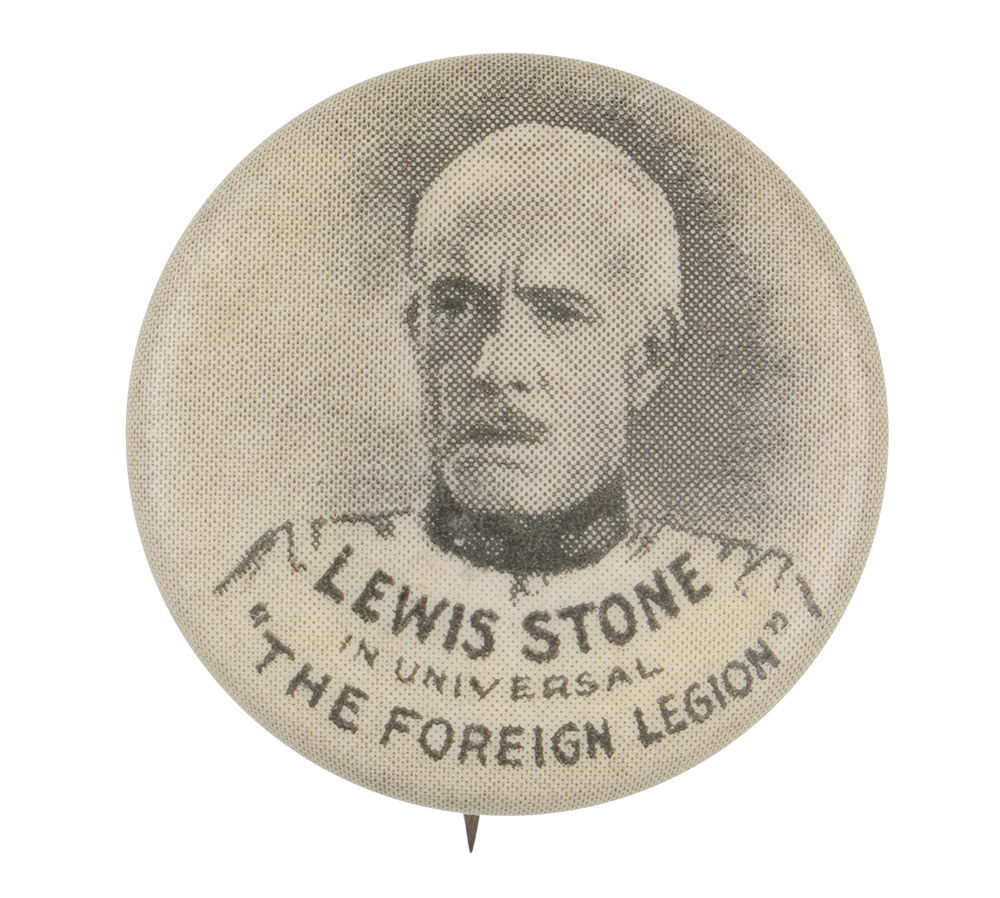
Text on Button LEWIS STONE IN UNIVERSAL "THE FOREIGN LEGION"
Image Description

Black and white photograph of a man's head over black text on a white background

Back Style
The Shape
The Size
Additional Information

Lewis Stone was an American actor who appeared in over 200 films between 1914-1953, including the 1928 silent film, The Foreign Legion. For his 1929 performance in The Patriot, Stone was nominated for the Academy Award for Best Actor. In addition to this accolade, Stone is best known for his role as Judge James Hardy in the Andy Hardy film series starring Mickey Rooney. Stone also appeared in a number of films with famed actress, Greta Garbo. 

Along with his acting, Stone was known for his hair having turned prematurely gray by age 20. He is also remembered for his unconventional death: Stone died of a heart attack in 1953 at age 73 while allegedly chasing teenage boys out of his yard.

Sources

Fleming, E.J. (2016). Hollywood Death and Scandal Sites: Seventeen Driving Tours with Directions and the Full Story, 2d ed. Jefferson, North Carolina: McFarland. Retrieved at https://books.google.com/books?id=hi-SCgAAQBAJ&dq=lewis+stone+death&sou….

Fontana, Tony. "Lewis Stone Biography." IMDb. Retrieved at http://www.imdb.com/name/nm0832011/bio.

Catalog ID EN0459

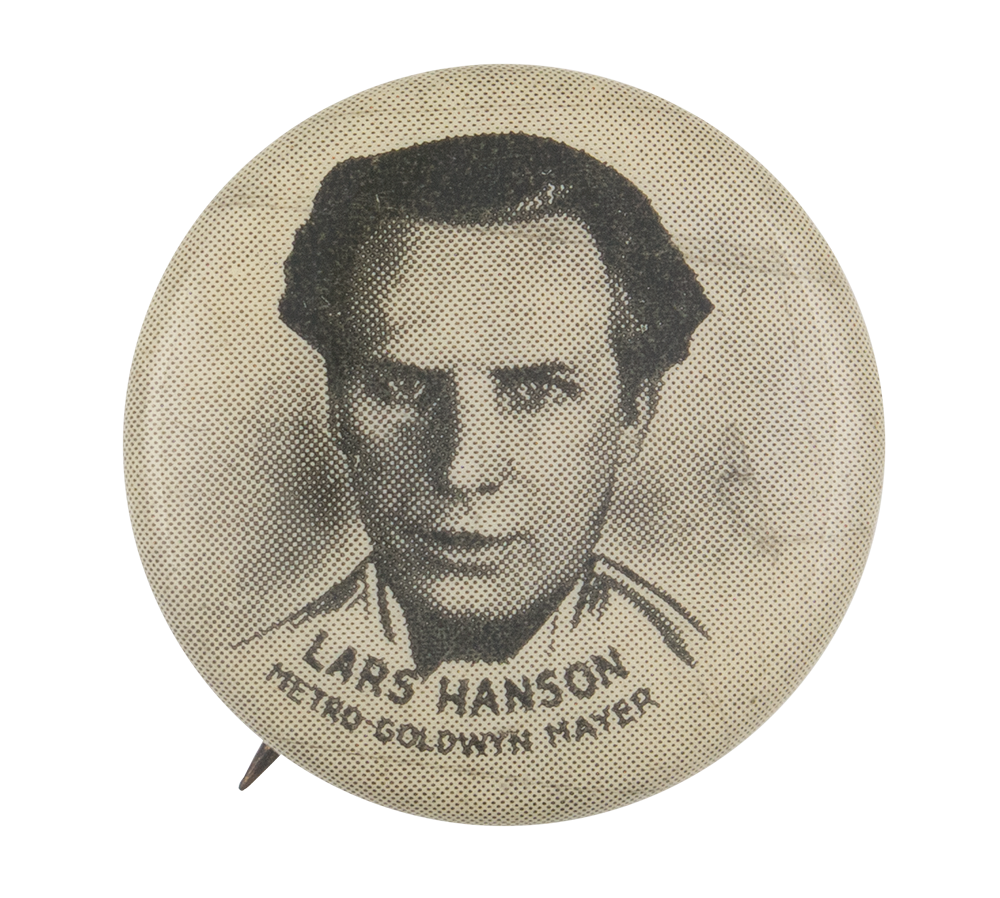
Lars Hanson

Category
Additional Images
Sub Categories
Text on Button LARS HANSON METRO-GOLDWYN MAYER
Image Description

Black and white photograph of a man's head over black text on a white background

Back Style
The Shape
The Size
Year / Decade Made
Additional Information

Lars Hanson was born in Sweden in 1886. He established a successful film and stage career in his home country before moving to Hollywood in the 1920s. Hanson first caught the attention of American filmmakers with his role in the Swedish film, The Saga of Gosta Berling (1924). The film is also considered the breakout performance for Greta Garbo, one of the most successful actresses of all time. Hanson made his American film debut two years later in The Scarlet Letter (1926). The actor subsequently appeared in numerous American silent films, including two more with Garbo. With the advent of sound in film, however, concern over Hanson's thick Swedish accent led him to leave Hollywood and return to his stage career in Sweden. He died in Stockholm in 1965.  

Sources

Wollstein, Hans J. (1994). Strangers in Hollywood: the history of Scandinavian actors in American films from 1910 to World War II. Lanham, MD: Scarecrow Press. Courtesy of Google Books. 

(2005). "Lars Hanson." Garbo Forever. Retrieved at http://www.garboforever.com/Lars_Hanson.htm.

"Lars Hanson Biography." IMDb. Retrieved at http://www.imdb.com/name/nm0361319/bio?ref_=nm_ov_bio_sm.

Catalog ID EN0462

Karl Dane

Category
Additional Images
Sub Categories
Text on Button KARL DANE METRO-GOLDWYN MAYER
Image Description

Black and white photograph of a man's head over black text on a white background

Back Style
The Shape
The Size
Year / Decade Made
Additional Information

Karl Dane was a Danish-born comedic actor known for his performances during the American silent film era. His breakout film role was in The Big Parade (1926). The performance brought Dane to stardom almost overnight. Just a few years later, however, Dane's career ended when his thick accent prevented him from being cast in the new sound films. 

Dane was apparently never able to recover from his career's rapid end. While he worked various jobs around Hollywood including car mechanic, carpenter, and hot dog stand operator, Dane maintained a scrapbook commemorating his days of fame. The book was open on a table next to him when the actor shot himself at his Hollywood apartment in 1934. 

Sources

(1934, Apr. 16). "Body of Dane is Unclaimed." Schenectady Gazette. Courtesy of Google News. 

(1934, Apr. 17). "Karl Dane Ends Life; Once Star in Movie World." Tuscaloosa News. Courtesy of Google News.

(1934, Apr. 19). "Karl Dane." Los Angeles Times. Retrieved at http://projects.latimes.com/hollywood/star-walk/karl-dane/.

Catalog ID EN0465

Jean Hershot

Category
Additional Images
Sub Categories
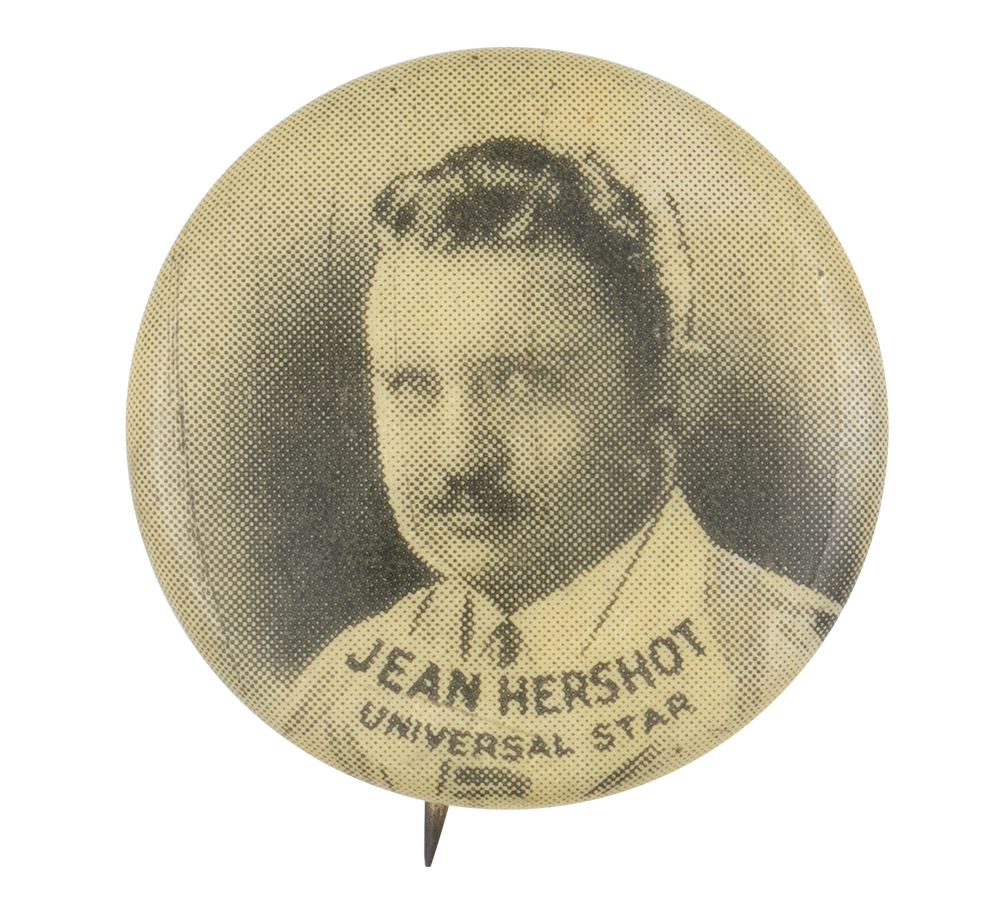
Text on Button JEAN HERSHOT UNIVERSAL STAR
Image Description

Black and white photograph of a man's head over black text on a white background

Back Style
The Shape
The Size
Year / Decade Made
Additional Information

Jean Hershot's last name was actually Hersholt. A Danish-born actor, Hersholt appeared in a total of 140 films. His most famous film was arguably the 1924 silent epic, Greed, which, in its original form, was nine hours long. Two months of filming took place in California's Death Valley. The heat on location placed many on set, including Hersholt, in the hospital. 

Despite his numerous performances, Hersholt is best remembered for his humanitarian work within the film industry. The actor served an 18-year tenure as president of the Motion Picture Relief Fund, which provided aid to industry members struggling financially. He also helped to establish the Motion Picture Country House and Hospital. As a result of these efforts, in 1956, the Academy of Motion Pictures Arts & Sciences created the Jean Hersholt Humanitarian Award. The Award gives an honorary Oscar to “an individual in the motion picture industry whose humanitarian efforts have brought credit to the industry.” Hersholt is also remembered for writing an English translation of over 160 fairy tales by Danish author, Hans Christian Anderson. He died of cancer in 1956.

Sources

Smith, Richard Harland. "Jean Hersholt Biography." Turner Classic Movies. Retrieved at http://www.tcm.com/tcmdb/person/85600%7C80357/Jean-Hersholt/.

"Jean Hersholt Humanitarian Award." Academy of Motion Pictures Arts & Sciences. Retrieved at http://www.oscars.org/governors/hersholt.

Catalog ID EN0458

Jack Perrin

Category
Additional Images
Sub Categories
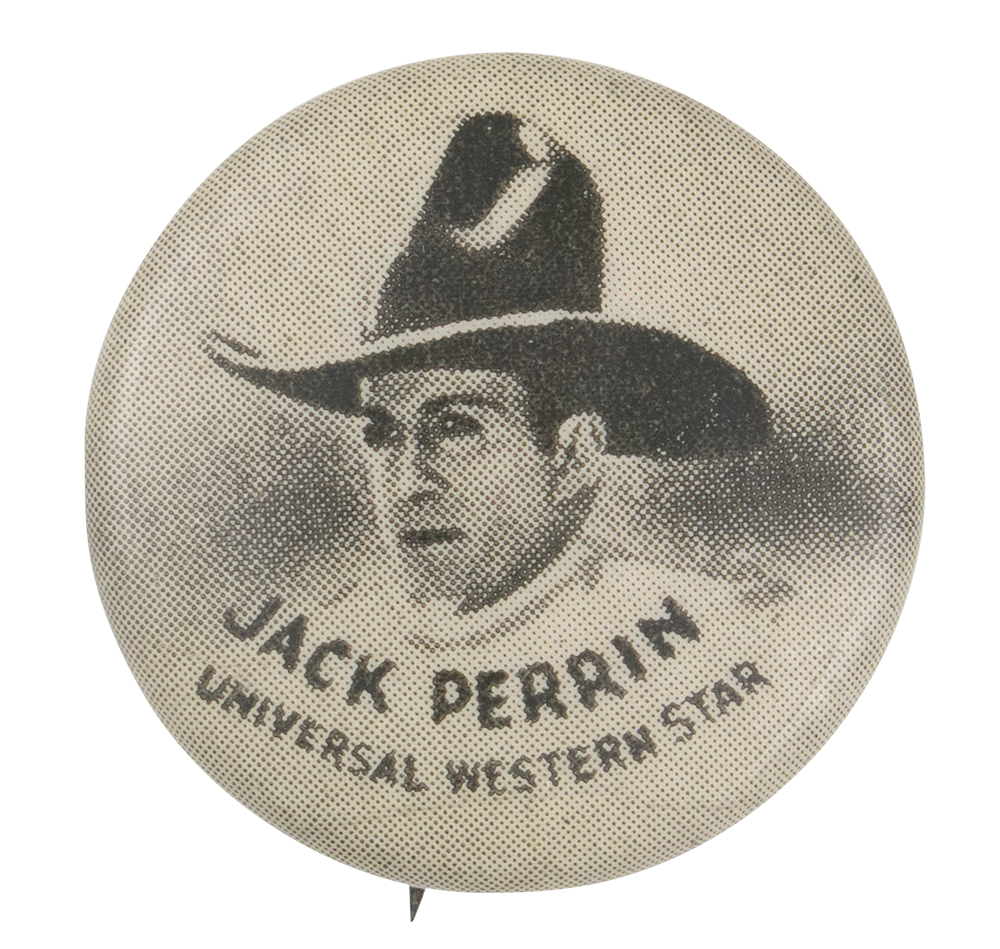
Text on Button JACK PERRIN UNIVERSAL WESTERN STAR
Image Description

Black and white photograph of a man's head in a black hat over black text on a white background

Back Style
The Shape
The Size
Additional Information

Jack Perrin was an American actor who began acting in 1915 at age 19. He is best known for appearing in low-budget Western films throughout the 1930s. Though Perrin once seemed to be on the way to stardom, he was held back by various career woes. For example, in 1932, Perrin sued film producer Robert J. Horner who owed Perrin $1475 for the actor's work in five different films. Despite such setbacks, Perrin continued to appear in small film and television roles until he retired in 1961. He died six years later in Los Angeles.

Sources

Backstreet, Jack. "Jack Perrin Mini-Bio." IMDb. Retrieved at http://www.imdb.com/name/nm0674741/bio?ref_=nm_ov_bio_sm.

Moore, Maloy. (2010, July 24). "Jack Perrin." LA Times. Retrieved at http://projects.latimes.com/hollywood/star-walk/jack-perrin/.

Catalog ID EN0456

George Lewis

Category
Additional Images
Sub Categories
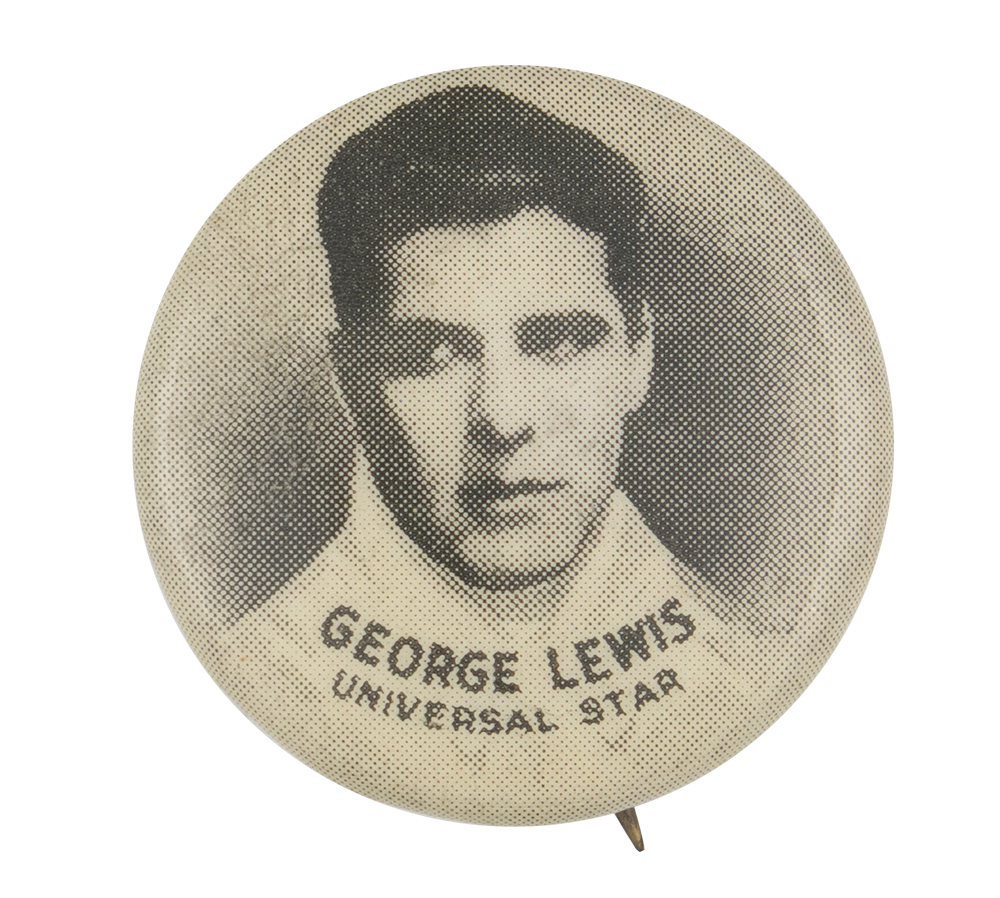
Text on Button GEORGE LEWIS UNIVERSAL STAR
Image Description

Black and white photograph of a man's head over black text on a white background

Back Style
The Shape
The Size
Year / Decade Made
Additional Information

Actor George J. Lewis was born in Guadalajara, Mexico in 1903. He attended high school in California, where he was allegedly discovered in a school play by a Hollywood screenwriter. Lewis relocated to Hollywood after he graduated, making his screen debut in the 1923 feature, The Spanish Dancer. After an acclaimed performance as a prizefighter in the 1925 film, His People, Lewis's professional success became less consistent. Personally, however, Lewis experienced a success that is especially rare in Hollywood: his 1928 marriage to Mary Louise Lohman endured until the actor's death in 1995.

Years of career ups and downs led Lewis to leave Hollywood in 1936 for stage acting in New York. When he returned to Hollywood in 1939, Lewis started getting casted in mid-sized character acting roles in television and film westerns. The actor most notably appeared as Zorro's father in the Disney television series, Zorro. Though Lewis reportedly enjoyed these parts, he had trouble attracting different types of roles. He eventually left Hollywood in 1972 to open a real estate business.

Sources

Aaker, Everett. (2007). Television Western Players of the Fifties: A Biographical Encyclopedia of All Regular Cast Members in Western Series, 1949-1959. Jefferson, North Carolina: McFarland.   

Neyer, Daniel. (Unknown). "George J. Lewis." The Files of Jerry Blake. Retrieved at: https://filesofjerryblake.com/serial-character-actors-2/george-j-lewis/.

Catalog ID EN0461