Welcome Back To Earth

Category
Additional Images
Sub Categories
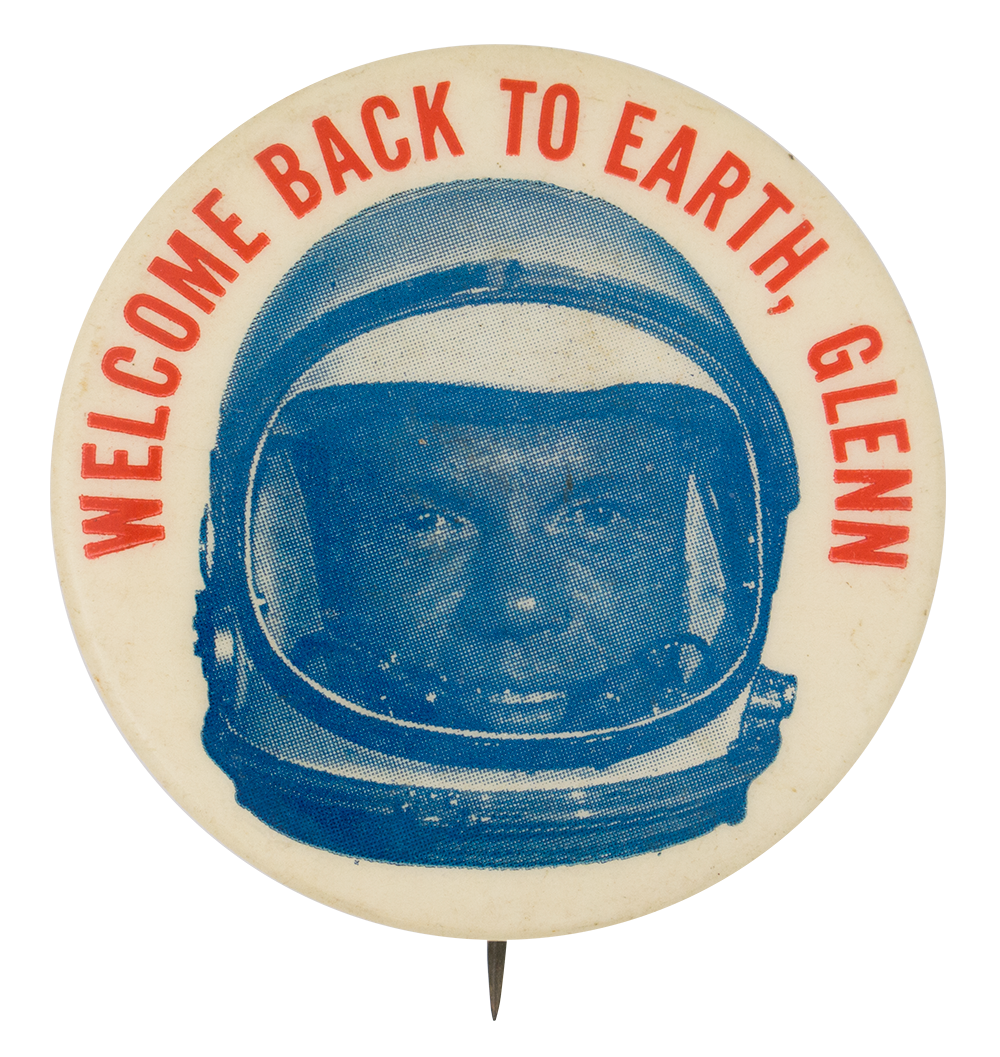
Text on Button WELCOME BACK TO EARTH, GLENN
Image Description

Blue and white photograph of a man's head in a space suit with red text along the top outer edge on a white background.

Back Paper / Back Info

union bug stamped in red

Back Style
The Shape
The Size
Year / Decade Made
Additional Information

On February 20, 1962, as part of Project Mercury, John Glenn became the first American to orbit the Earth and the fifth man in space. The intent of Glenn’s mission was to not only to put a man into orbit but also to observe his reactions to the environment of space and most importantly return him safely to Earth. With Glenn’s safe return he instantly became a national hero. His flight was commemorated with numerous souvenir items including buttons like this.

Catalog ID EV0116

Astronaut John Glenn

Category
Additional Images
Sub Categories
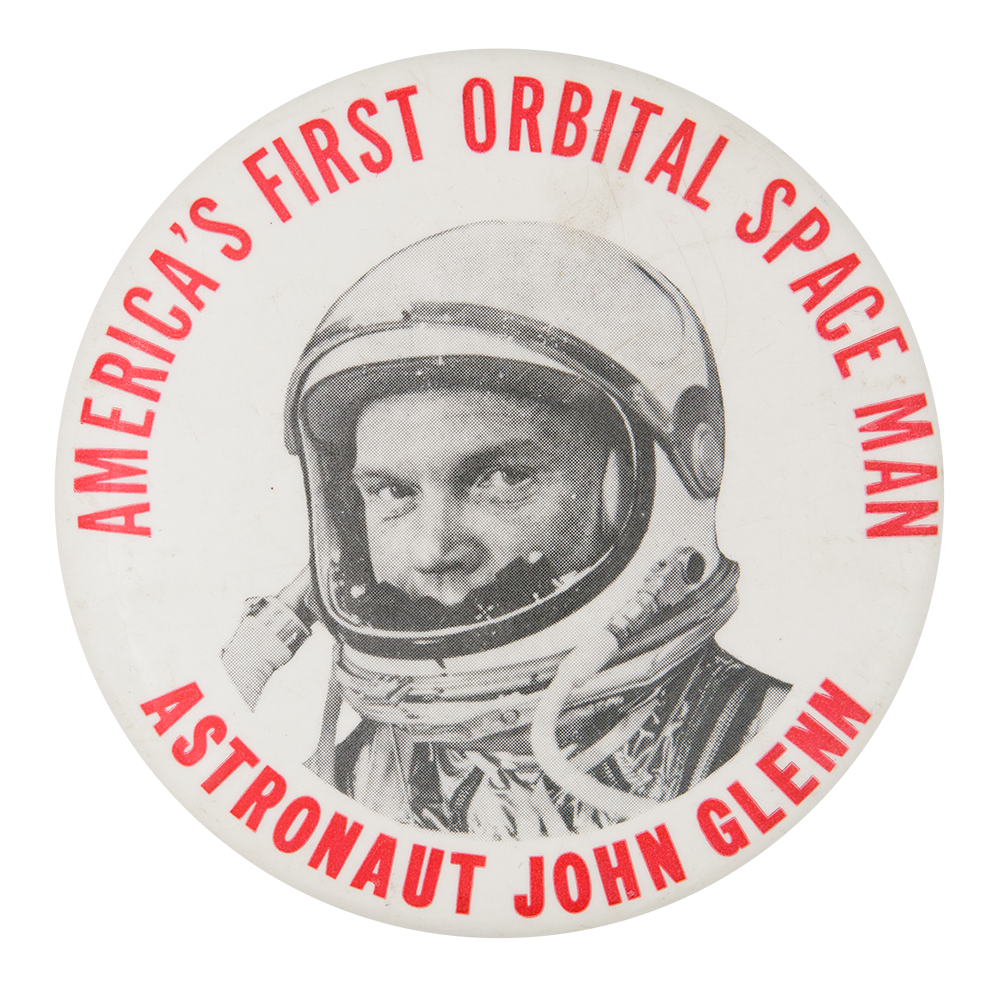
Text on Button AMERICA'S FIRST ORBITAL SPACE MAN ASTRONAUT JOHN GLENN
Image Description

Black and white photograph of a man's head and shoulders wearing a space suite in the center of the button with red text along the outer edge on a white background.

Back Style
The Shape
The Size
Year / Decade Made
Additional Information

John H. Glenn Jr. is a retired American astronaut, naval pilot, and politician. Glenn is best known for being the first person to orbit the earth. On February 20, 1962, Glenn's space capsule, the Friendship 7 orbited the Earth three times at an average speed of more than 17,000 miles per hour. He then landed in the Atlantic Ocean near Bermuda. Glenn and his spacecraft were recovered by a United States Navy destroyer called the Noa.

Catalog ID EV0120

Challenger 6

Category
Additional Images
Sub Categories
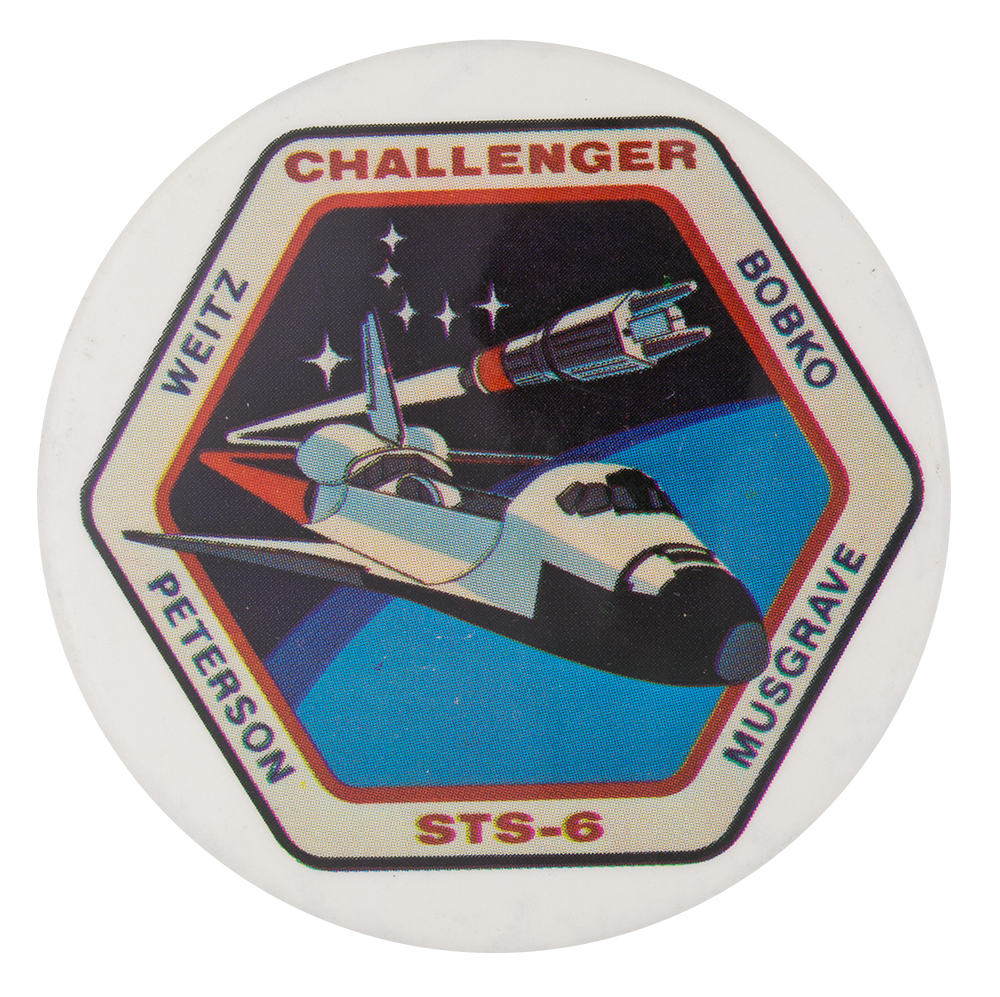
Text on Button WEITZ CHALLENGER BOBKO MUSGRAVE STS-6 PETERSON
Image Description

Illustration of a white, black and red space shuttle flying in black space with stars over a blue planet inside a hexagon with a thin red outline then a grey outline with red and purple text, then a thin purple outline surrounded by a white background.

Back Paper / Back Info

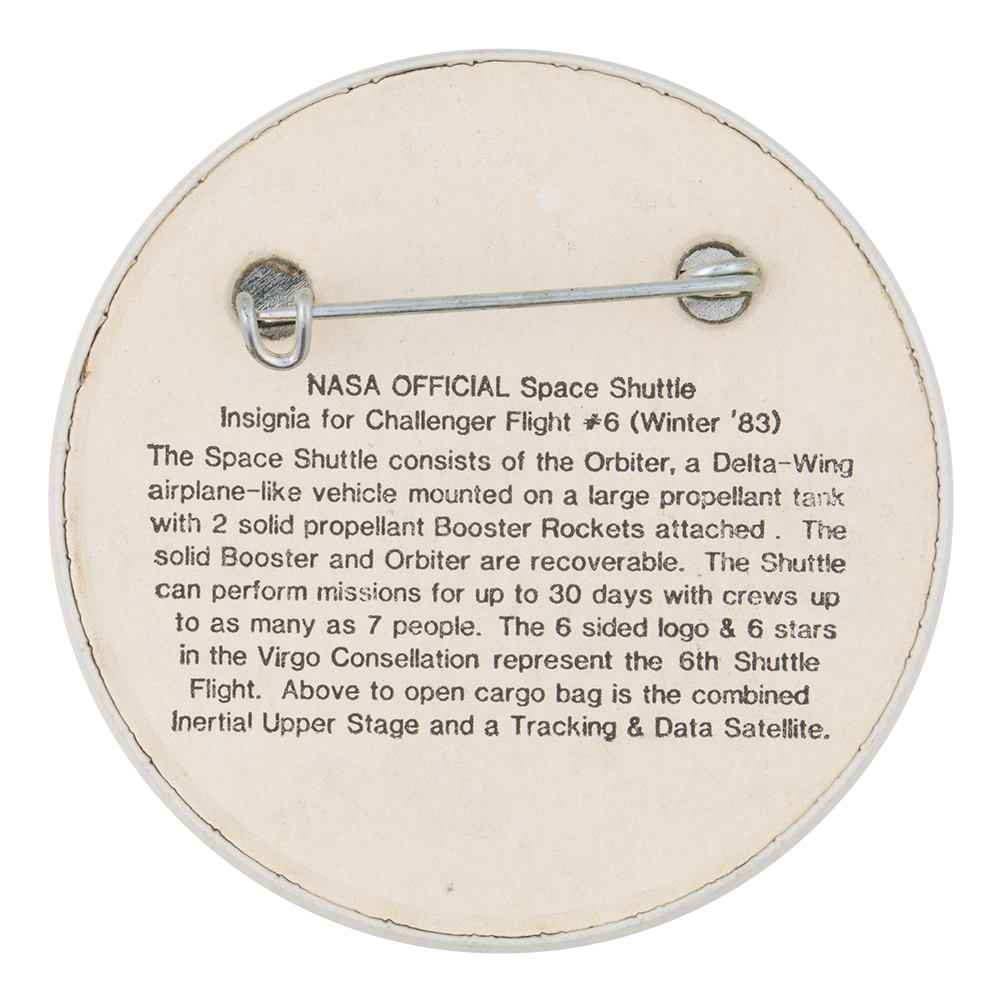
Cardboard with the text:

NASA OFFICIAL Space Shuttle
Insignia for Challenger Flight #6 (Winter '83)
The Space Shuttle consists of the Orbiter, a Delta-Wing airplane-like vehicle mounted on a large propellant tank with 2 solid propellant Booster Rockets attached. The solid Booster and Orbiter are recoverable. The Shuttle can perform missions for up to 30 days with crews up to as many as 7 people. The 6 sided logo & 6 stars in the Virgo Consellation represent the 6th Shuttle Flight. Above to open cargo bag is the combined Intertia Upper Stage and a Tracking & Data Satellite.

Back Style
The Shape
The Size
Year / Decade Made
Additional Information

Challenger STS-6, more commonly referred to as "Challenger 6", refers to a mission undertaken by NASA between April 4- April 9, 1983. Challenger was the name of the space shuttle utilized during the mission, while the number 6 refers to the fact that it was the sixth mission undertaken by the NASA space program. Challenger 6 featured the first spacewalk undertaken as part of the NASA space shuttle program. It also featured the first deployment of a Tracking and Data Relay Satellite.The names of the Astronauts that took part in the mission were: Paul J. Weitz, Karol J. Bobko, Donald H. Peterson, and F. Story Musgrave.

Catalog ID EV0125

Columbia Engle-Truly

Category
Additional Images
Sub Categories
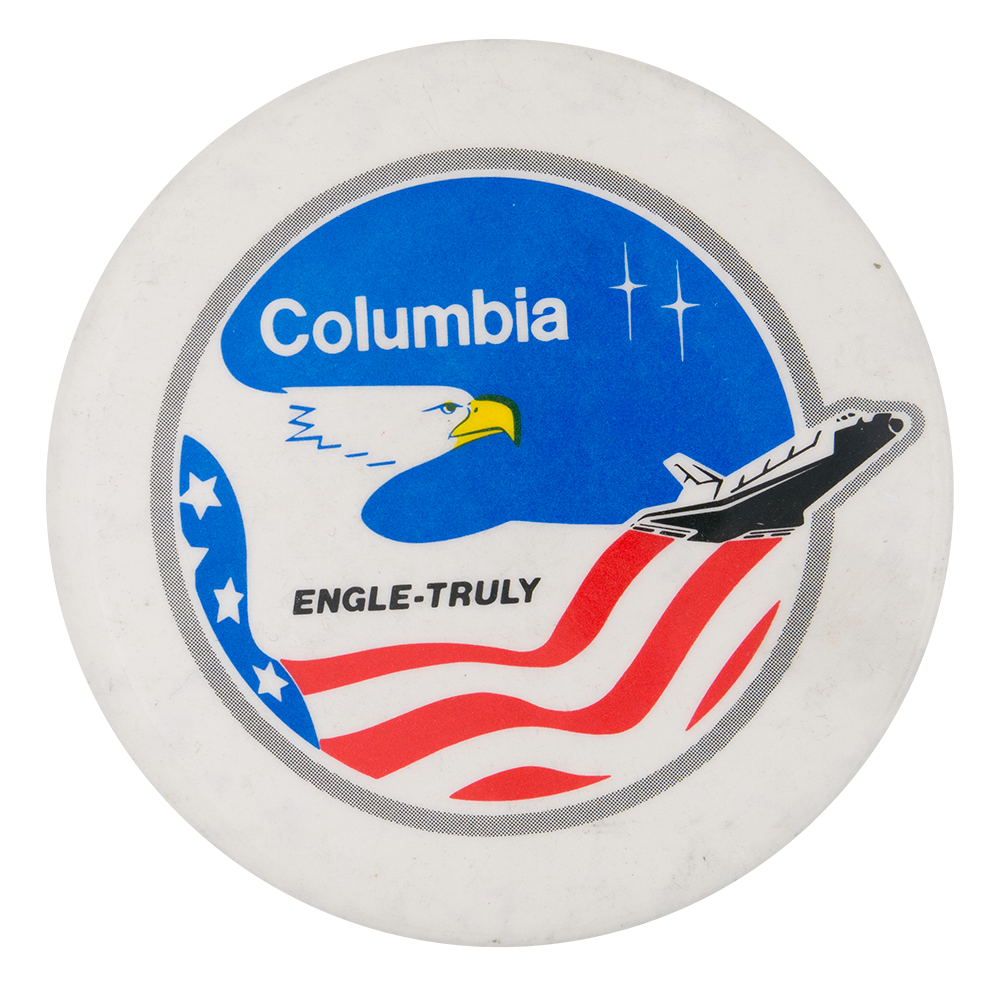
Text on Button Columbia ENGLE-TRULY
Image Description

Illustration of a white eagle flying across the inner circle of the button with a wing depicted as the American flag on a blue sky background with two stars and an illustartion of a space shuttle. This is in the center of the button with a thin white ring around it followed by a thicker grey ring and a thicker white outer ring.

Back Style
The Shape
The Size
Year / Decade Made
Additional Information

Columbia STS-2 was the official name of the second mission attempted by NASA's space shuttle program as well as the second voyage of the Columbia space shuttle. The operation began on November 12, 1981 and ended on November 14, 1981.The mission was originally supposed to last 5 days, but was shortened to 2 days due to the failure of a fuel cell. The name of the commander of the mission was Joseph H. Engle, while the Pilot was Richard H. Truly. The space shuttle orbited the earth approximately 37 times during which the astronauts conducted scientific experiments.

Catalog ID EV0126

Voyager 2

Category
Additional Images
Sub Categories
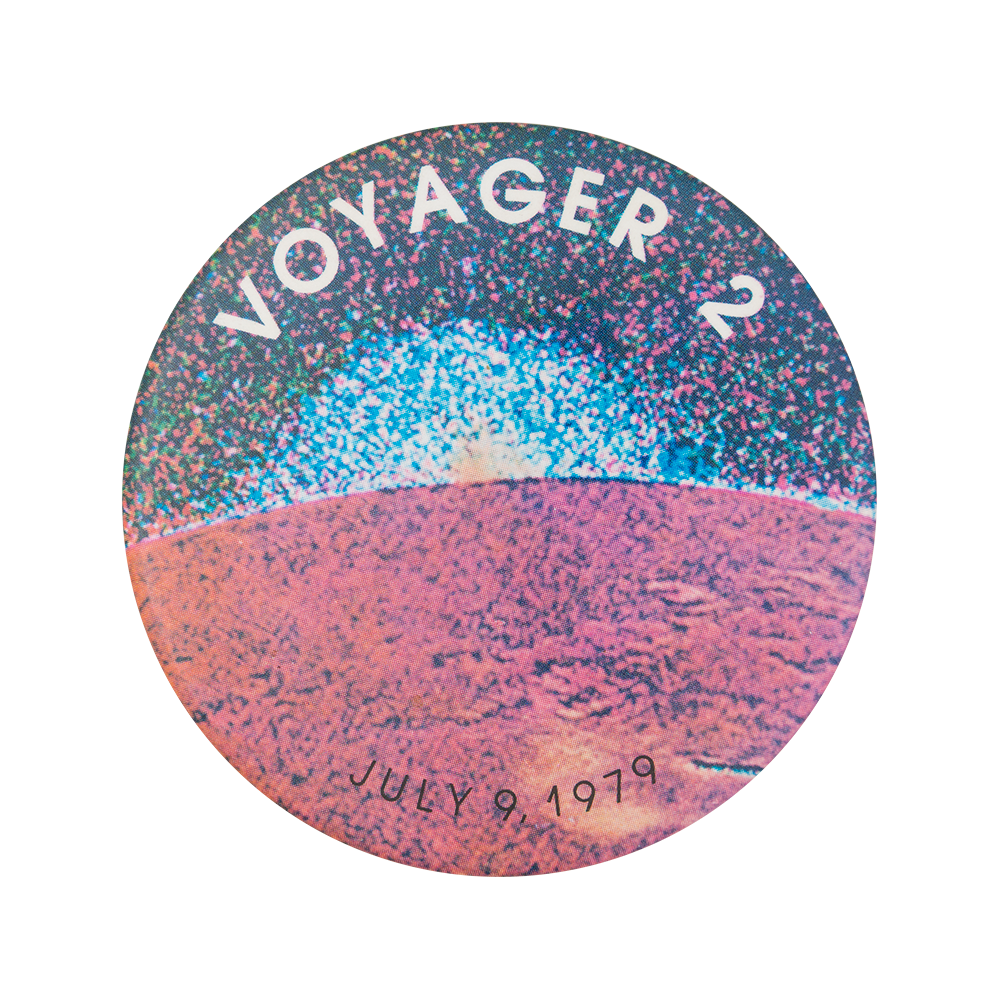
Text on Button VOYAGER 2 JULY 9, 1979
Image Description

White text on a backgound of speckled blue, pink, dark blue, and green over a curved pink bottom with black text on top.

Back Style
The Shape
The Size
Year / Decade Made
Additional Information

Voyager 2 is the name of an unmanned spacecraft that was launched on August 20, 1977. The vessel contains a golden phonographic record that contains greetings in 55 languages, sounds, and images meant to portray life on earth if it were to meet extraterrestrial life forms. The spacecraft's primary mission was to transmit data related to Jupiter and Saturn.Later on the mission was extended to provide data on Uranus and Neptune and eventually extended to provide data on the edge of the solar system and beyond. Voyager 2 reached Jupiter in 1979 and Saturn in 1981. By 1986 Voyager 2 had reached Uranus, while in 1989 it had reached Neptune. The spacecraft is currently in the outer reaches of the solar system.

Read more about the History of NASA buttons on the Busy Beaver blog.

Catalog ID EV0126

No More Fireside Chats

Category
Additional Images
Sub Categories
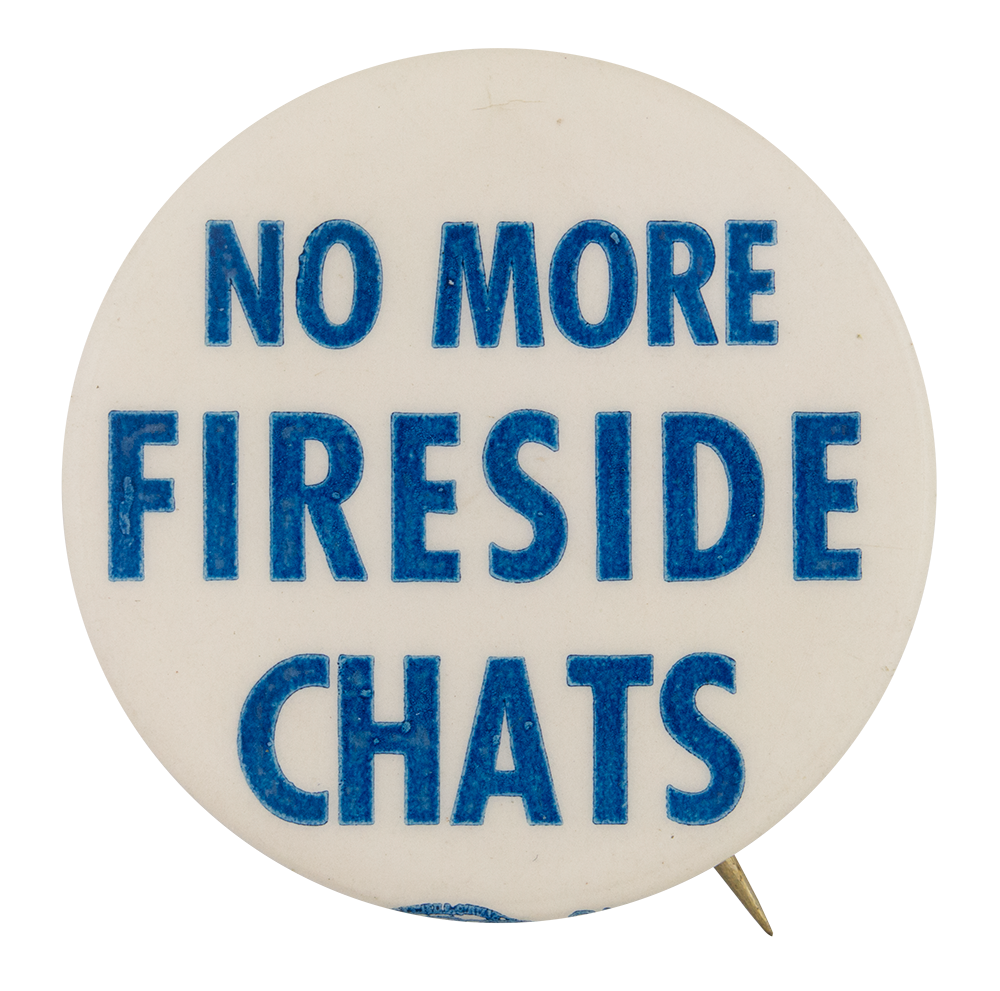
Text on Button NO MORE FIRESIDE CHATS
Image Description

Blue text on a white background

Curl Text union bug
Back Style
The Shape
The Size
Year / Decade Made
Additional Information

This button is opposing Franklin Roosevelt for President in 1940. The 'Fireside Chats" were the series of evening addresses on national radio delivered by then President Roosevelt between 1933 and 1944. These chats enabled Roosevelt to speak directly to the American people in their homes and promoted his New Deal programs and later war effort. Millions of people found comfort and renewed confidence in these speeches, especially during the Depression and war time. In 1940, the opposition put out this button to stall his campaign for a third term. 

Sources

Evjen, Henry O and Henry G. Evjen. (1946). An Analysis of Some of the Propaganda Features of the Campaign of 1940. The Southwestern Social Science Quarterly, 27(3), 235-261.

Catalog ID PO0199

Theodore Roosevelt

Category
Additional Images
Sub Categories
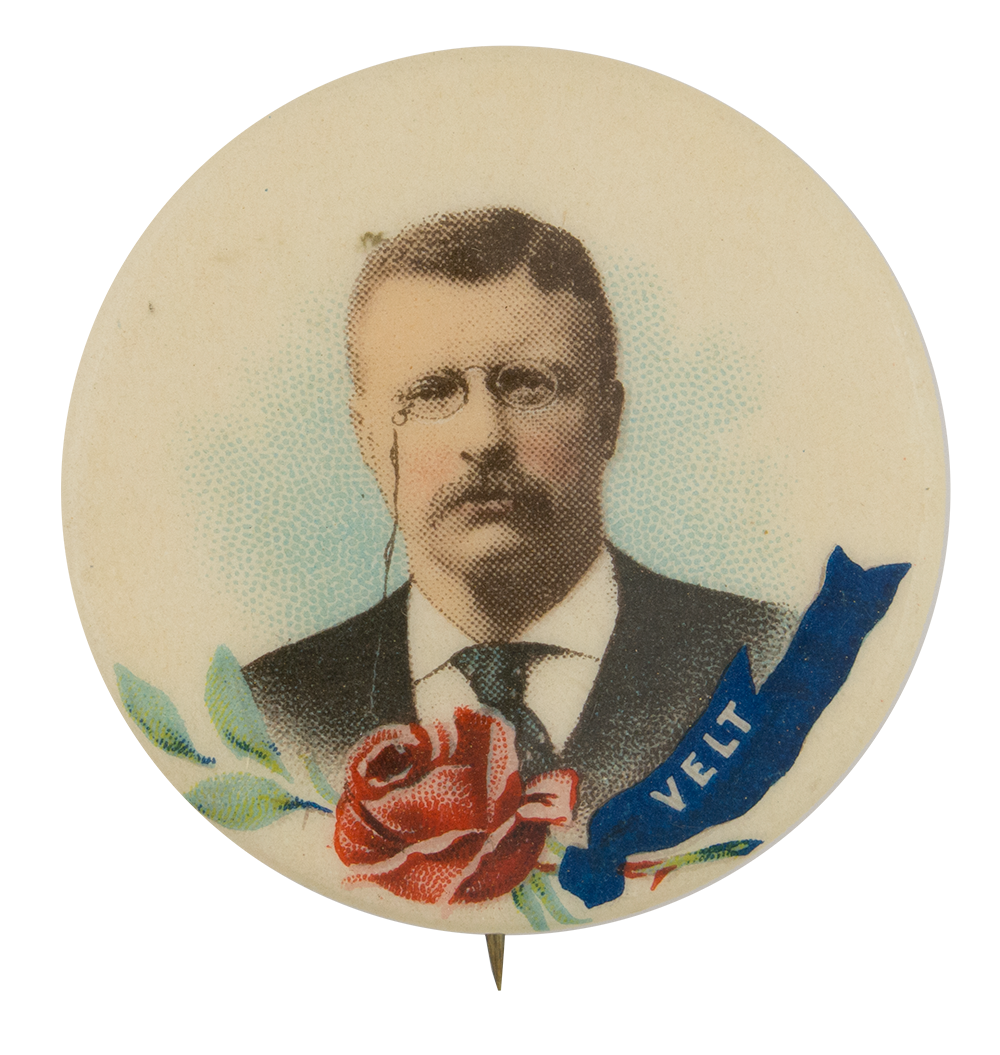
Text on Button Velt
Image Description

A photograph of a man with a mustache wearing a black suit in front of a blue and white background. Below is a red rose; attached to the rose's stem is a blue ribbon with white text.

Back Paper / Back Info

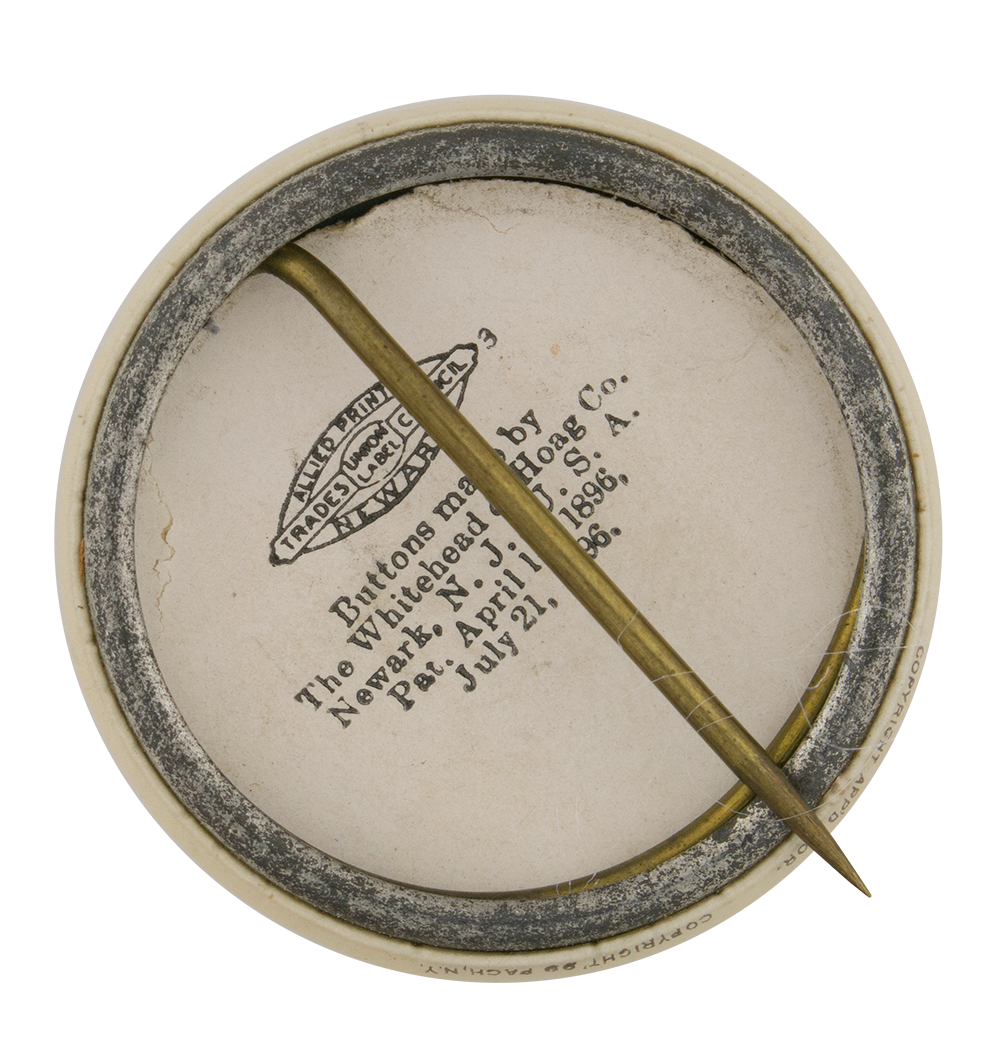
Buttons made by The Whitehead & Hoag Co. Neward, N.J. U.S.A. Pat. April 14 1896, July 21, 1896

Back Style
The Shape
The Size
The Manufacturer
Additional Information

Theodore Roosevelt (1858-1919) was the 26th President of the United States, from 1901 to 1909. He began the 1901-1905 term as Vice-President to William McKinley but rose to the presidency on March 4, 1901 when the latter was assassinated. Roosevelt then ran for president for a second term and won the election of 1904. This button promoted him as a candidate during that campaign and is an example of a rebus, an allusional device that uses pictures or images to represent words or parts of words, in this case a rose. 

Catalog ID PO0183

Watergate Bug

Category
Additional Images
Sub Categories
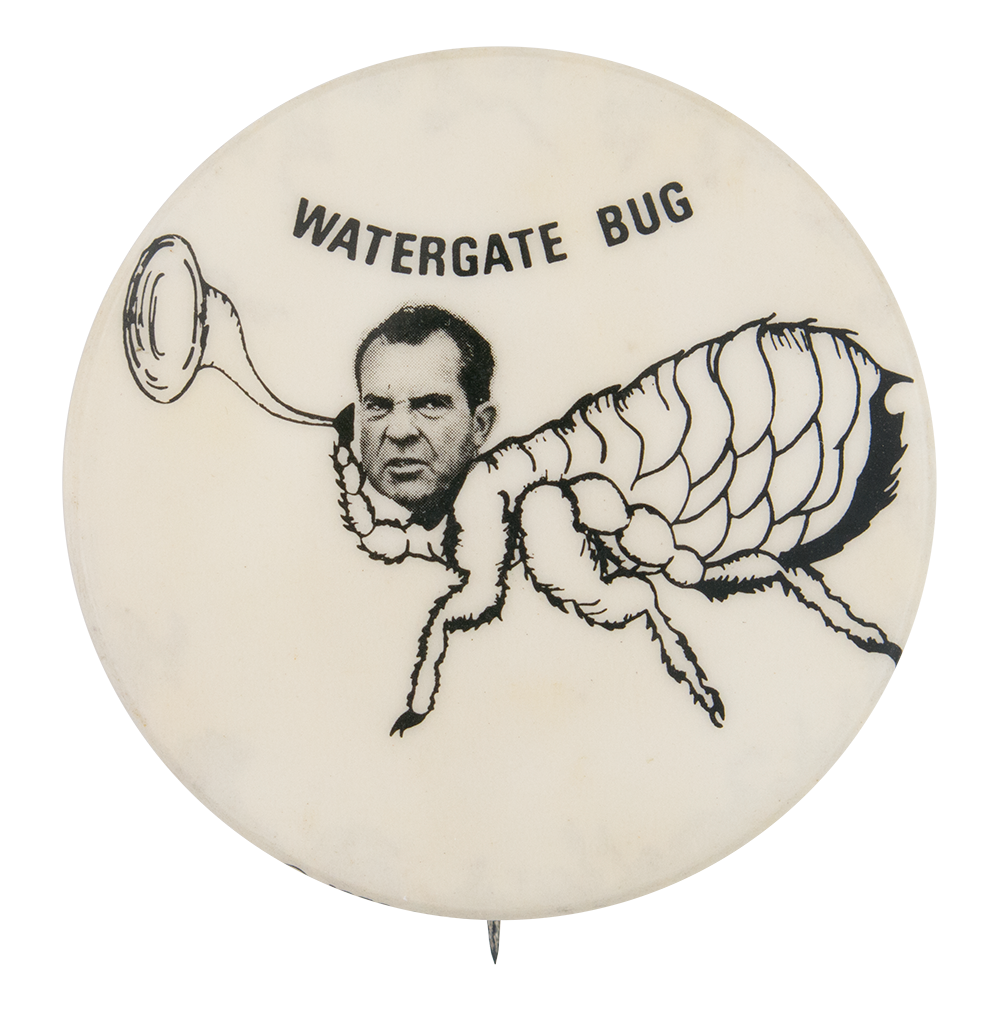
Text on Button WATERGATE BUG
Image Description

A black line drawing of an insect's body with a photograph of the head of a man holds up an ear trumpet; above it is black text. All on a white background.

Curl Text Copyright 1973 WATERBUG ENTERPRISES
Back Style
The Shape
The Size
Additional Information

Richard M. Nixon (1913-1994) was the 37th President of the United States, from 1969 until 1974. He was halfway through his second term when he was impeached and then resigned from the presidency. On June 17, 1972, burglars broke into the offices of the Democratic National Committee at the Watergate office complex in Washington, D.C. About a year later, it was discovered that the five intruders were agents of the Committee for the Re-Election of the President (CRP), the official organization of Richard Nixon's reelection campaign. It was found that wiretapping of the offices had also occurred. The ensuing "Watergate scandal" led to to Nixon's impeachment and then resignation. Nixon was the first and only U.S. president to ever resign.

Catalog ID PO0184

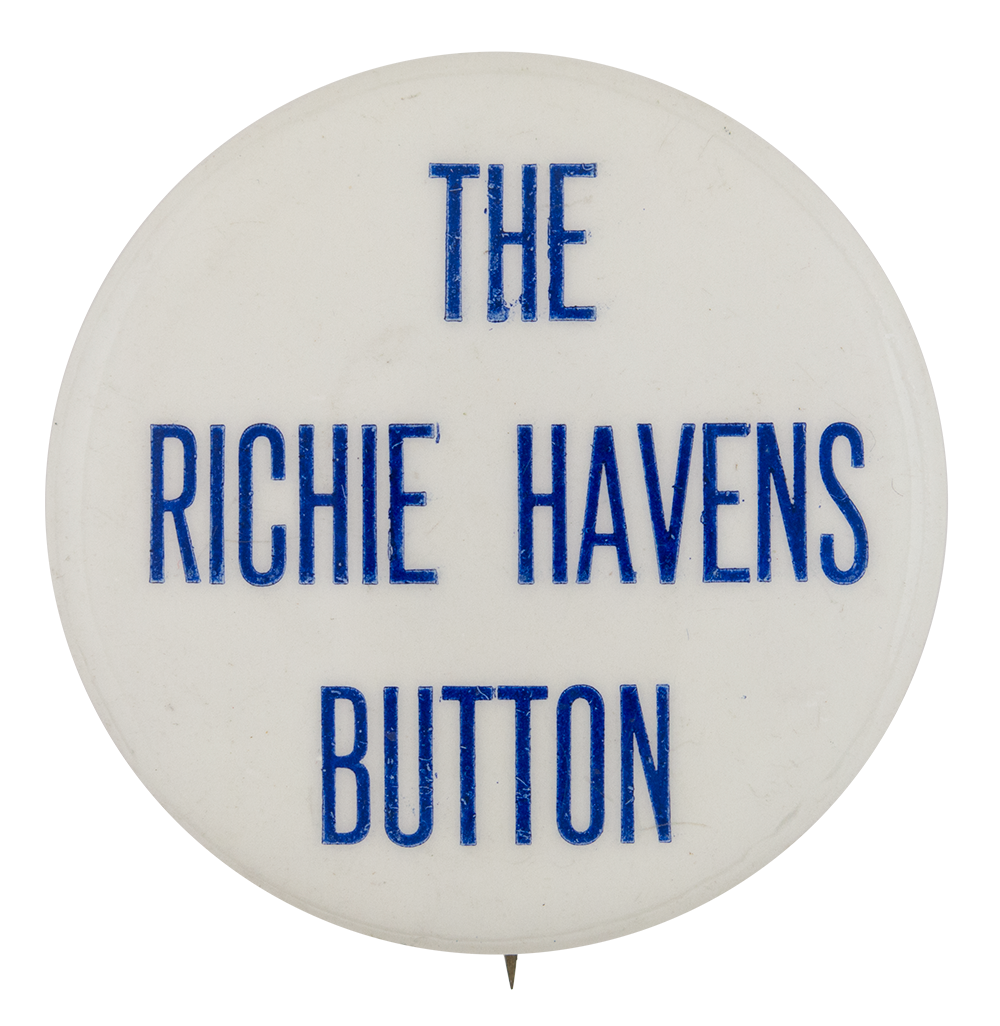
The Richie Havens Button

Category
Additional Images
Text on Button The Richie Havens Button
Image Description

Blue text on a white background.

Back Style
The Shape
The Size
Year / Decade Made
Additional Information

Richie Havens (1941-2013) was an American singer-songwriter and guitarist. As a performer, he straddled the genres of folk, soul, and rhythm & blues. Born Richard Pierce Havens in Brooklyn, he was known for his intense strumming and singing styles and rose to fame in the late 1960s. In 1969, he performed at the Woodstock Festival in upstate New York, which greatly increased his popularity. His most notable songs include "Freedom" and a cover of the Beatles' "Here Comes the Sun". He was also an activist and especially supported the causes of Native American rights and ecological/environmental issues.

Catalog ID SR0105

Submitted to the Fan Museum by detbob_52


Information

The Detroit Convention and Tourist Bureau used the phrase "Detroit-Where Life is Worth Living" as the city's unofficial motto. It appears in the DCTB brochure as early as 1915. The motto comes from the first line of Edgar A. Guests' poem "In Detroit" (1913). The button features the silhouette of the Detroit skyline as seen from the Detroit River. This celluloid oval open pin badge was produced by Bastian Brothers Company of Rochester, NY.

Button Image