Jumpin Jigowatts Back to the Future

Category
Additional Images
Sub Categories
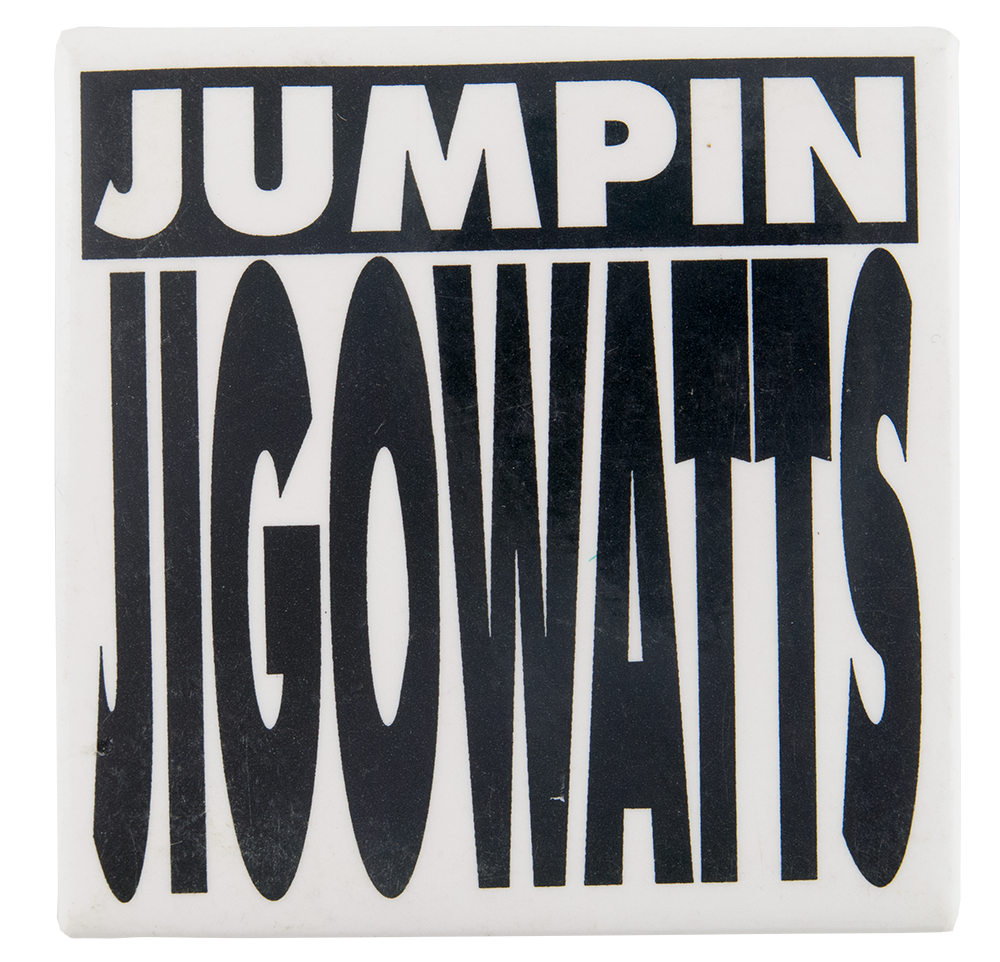
Text on Button JUMPIN JIGOWATTS
Image Description

Black and white text on a black and white backgroundART 

Curl Text ART EXPRESS CO. 708-769-9800 Back To The Future copyright UCS
Back Style
The Shape
The Size
The Manufacturer
Additional Information

“Jumpin' jigowatts” was an exclamation used by Doc Emmett Brown in the Back to the Future animated series in 1991-1992. Doc Brown was portrayed by Christopher Lloyd in the Back to the Future movie trilogy, where he tells Marty (Michael J. Fox) that he needs “1.21 jigowatts" to power their time machine. “Jigowatt” was actually a misspelling of “gigawatt” by the producers of the films, and became the way it was spelled and pronounced throughout the series. A gigawatt (or “jigowatt”) is a large amount of electricity, equal to one billion watts, and is what was needed to power the DeLorean time machine through the flux capacitor. 

Catalog ID EN0159

Jean Luc Picard Star Trek

Category
Additional Images
Sub Categories
Text on Button STAR TREK ® THE NEXT GENERATION
Image Description

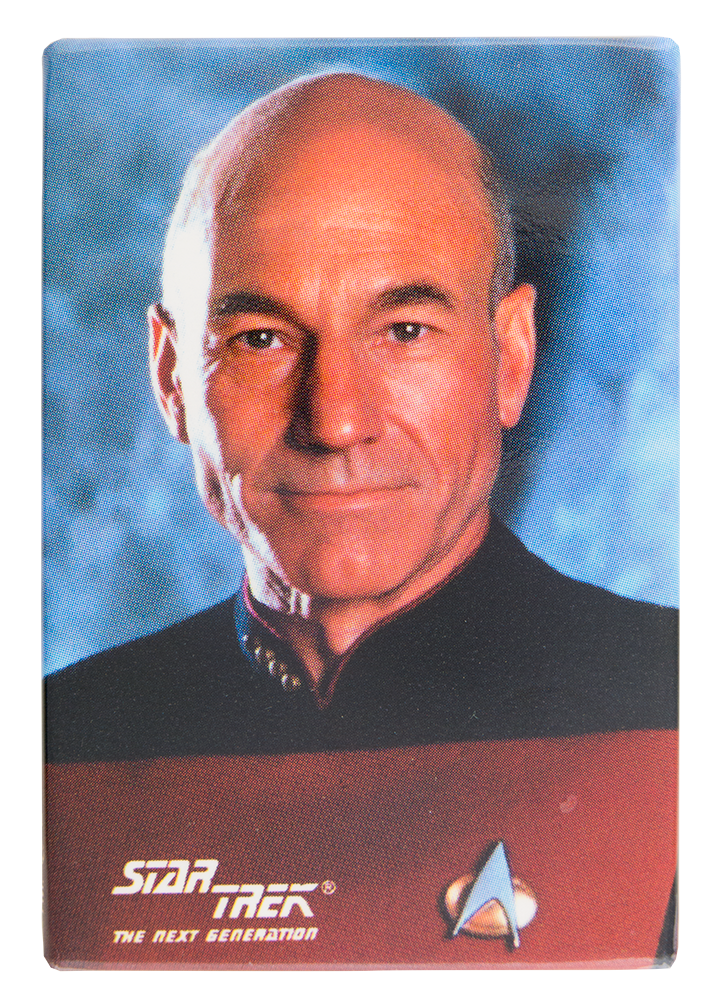
Photograph of a man in a red and black commander uniform in front of a blue background. With white text in the bottom left corner of button.

Back Paper / Back Info

Patrick Stewart 

Curl Text Creation Conventions Authorized User. TM. ® & © 1991 Paramount Pictures. All Rights Reserved.
Back Style
The Shape
The Size
Year / Decade Made
Additional Information

Star Trek: The Next Generation first aired in 1987, and is still the only syndicated television show to be nominated for a Primetime Emmy for Outstanding Drama Series. The Next Generation was announced in 1986, 20 years after the original Star Trek series aired. British actor Patrick Stewart played Starship Enterprise Captain Jean-Luc Picard, and was a cast member for all seven seasons of the show. Gene Roddenberry, the series creator, did not initially approve of the casting of Stewart—whose background included work as an actor with Britain’s Royal Shakespeare Company—but was eventually persuaded, in part due to the actor's resonant and powerful voice.

Catalog ID EN0094

Alfred E. Neuman for President

Category
Additional Images
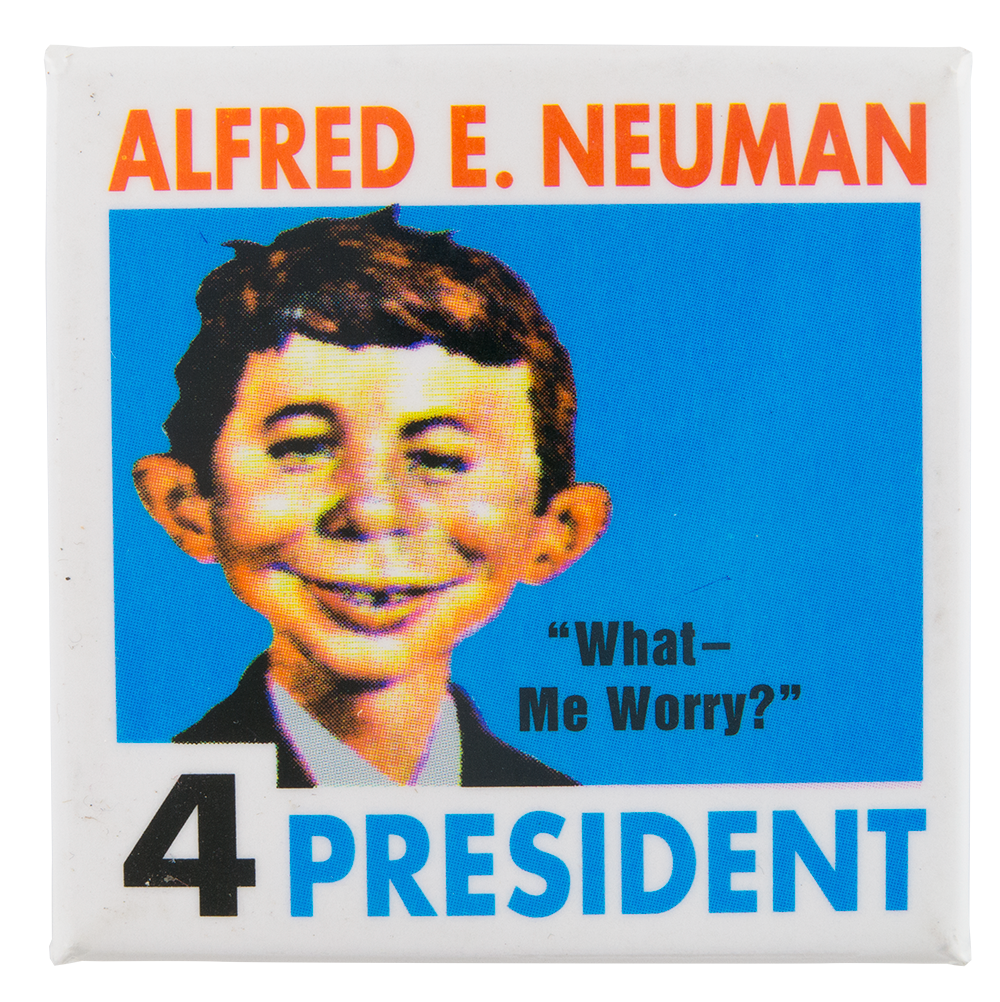
Text on Button ALFRED E. NEUMAN 4 PRESIDENT "What- Me Worry?"
Image Description

Illustration of Alfred E. Neuman on blue background with the words "What- Me Worry?" in black letters on the right side of illustration. Red text on the upper portion of button and black and blue text on bottom portion of button. Entire illustration and text on white background. 

Back Style
The Shape
The Size
Additional Information

Alfred E. Neuman is the name of the familiar fictional character who is the red-headed, goofy-eared mascot for MAD Magazine. First making his appearance on MAD issue #21, in 1955, Alfred wasn’t yet a sensation. When MAD switched to a magazine format with issue #24, Alfred’s face again appeared on the cover with his familiar catch phrase, “What, me worry?” Alfred’s defining moment as MAD cover boy was in 1956 on issue #30 when he was offered as a candidate for president. Since issue #30, Alfred has appeared on all but a few of MAD’s covers and has been re-offered as a presidential candidate with the slogan, “You could do worse…  and always have!” Alfred was often depicted as other people or characters over the years, including George W. Bush, Gollum, Darth Vader, and Barbara Streisand. 

Catalog ID EN0097

Harris-Polk Hat Company

Category
Additional Images
Sub Categories
Text on Button WORTH HATS HARRIS-POLK HAT CO
Image Description

Photograph of a nude baby laying on its stomach and wearing a large hat on a dark background surrounded by a red outer edge with white text

Back Style
The Shape
The Size
Additional Information

Harris-Polk Hat Company was based in St. Louis, Missouri, and was a leading hat company in the early 1900s. Their most popular and best-selling hats were the “Thoroughbred” and “Worth”, the latter depicted here in this button. Harris-Polk Hats began in 1903, and was at one time run by J.W. Harris, who was also president of the American Association of Wholesale Hatters.

Catalog ID AD0144

Fleischmanns Yeast

Category
Additional Images
Sub Categories
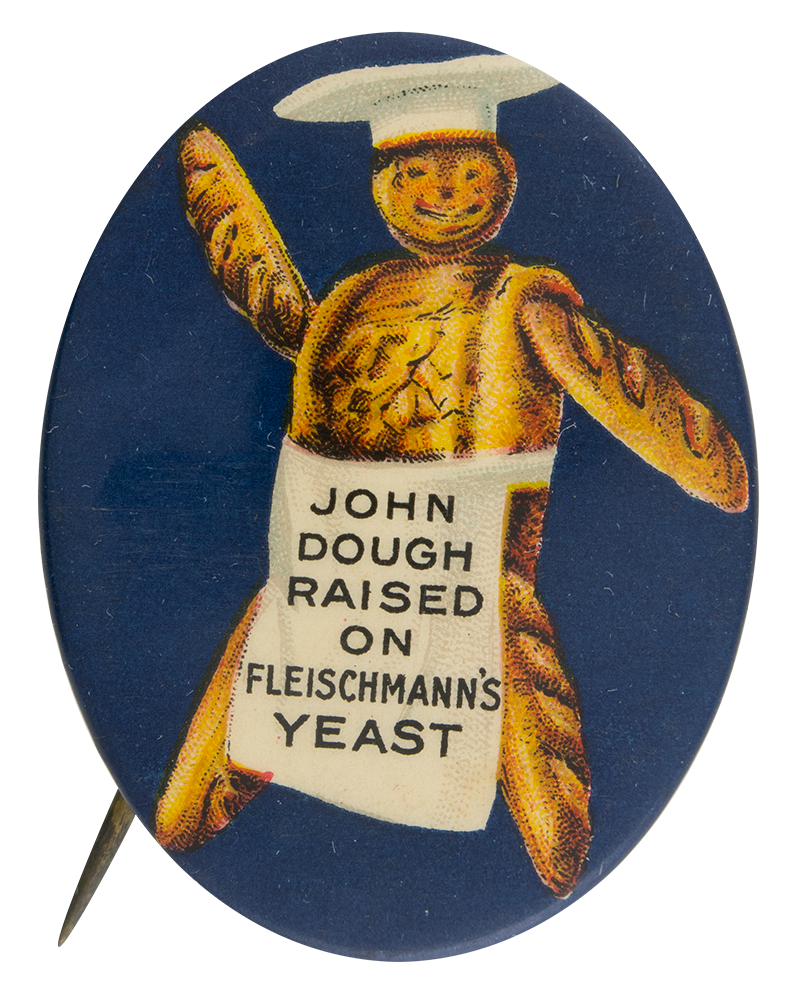
Text on Button JOHN DOUGH RAISED ON FLEISCHMANN'S YEAST
Image Description

Illustration of a person made of bread wearing a bakers hat and a white apron with black text on it, all on a blue background

Back Paper / Back Info

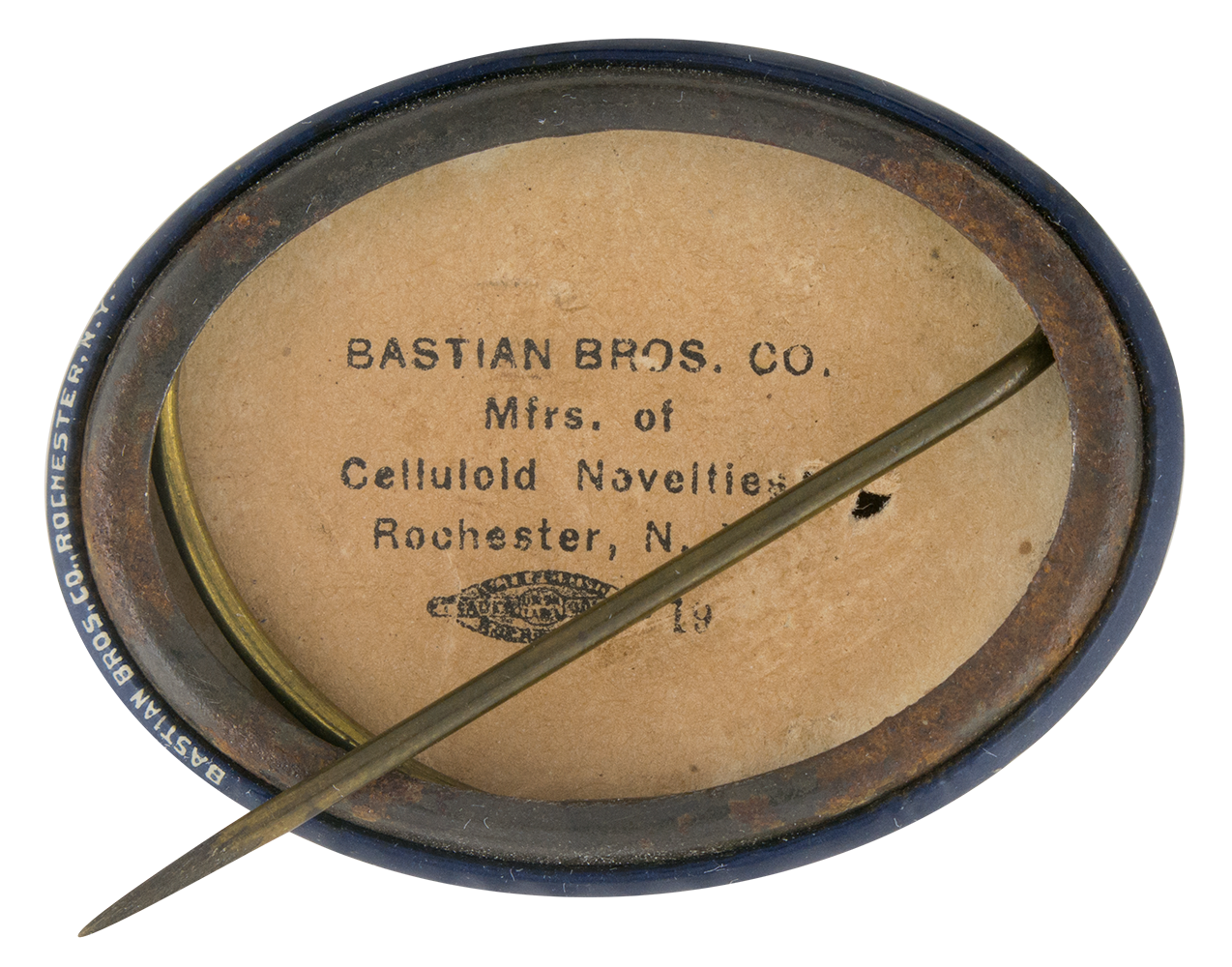
BASTIAN BROS. CO. Mfrs. of Cellulois Novelties Rochester, NY

Curl Text BASTIAN BROS CO ROCHESTER NY.
Back Style
The Shape
The Size
The Manufacturer
Additional Information

Fleishmann's Yeast is a brand of yeast sold to both consumer and industrial markets in the United States and Canada. The company was founded by Charles Louis Fleischmann, his brother Maximillian, and James Gaff in 1868. It is currently owned by Associated British Foods.

Since yeast is a common ingredient in breads, this button plays on the word "dough." John Dough is alluding to the placeholder name John Doe which is commonly used for a man whose true identity is unknown or must be withheld in a legal action, case, or discussion. It can also be used to refer to a corpse or hospital patient whose identity is unknown.

Catalog ID AD0404

Uncle Wips Kiddie Club

Category
Additional Images
Sub Categories
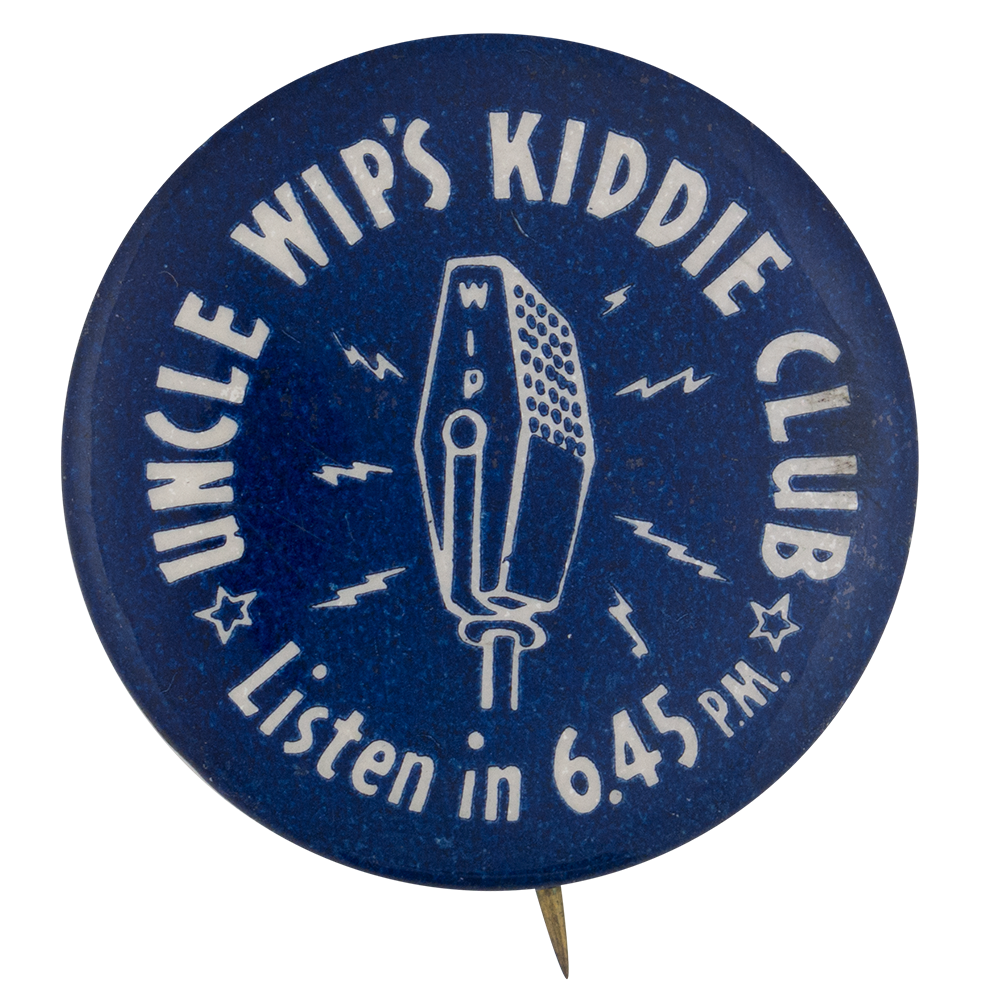
Text on Button UNCLE WIP'S KIDDIE CLUB listen in 6.45 P.M.
Image Description

Blue background with white text and a white illustration of a radio microphone.

Curl Text PHILA. BADGE CO. PHILA. PA.
Back Style
The Shape
The Size
Year / Decade Made
The Manufacturer
Additional Information

Uncle WIP’s Kiddie Club was a tremendously popular radio program for children. WIP was Philadelphia’s first commercial radio station owned by the Gimbel Brothers Department Store, and the first broadcast occurred on March 18, 1922. Uncle WIP, hosted by Christopher Graham, read bedtime stories and was an instant success. The kiddie club was born and members were given buttons to wear. In 1930, Wayne Cody took over as Uncle WIP and by 1933 the kiddie club boasted over 500,000 members.

Catalog ID CL0294

Uncle Jacks Club

Category
Additional Images
Sub Categories
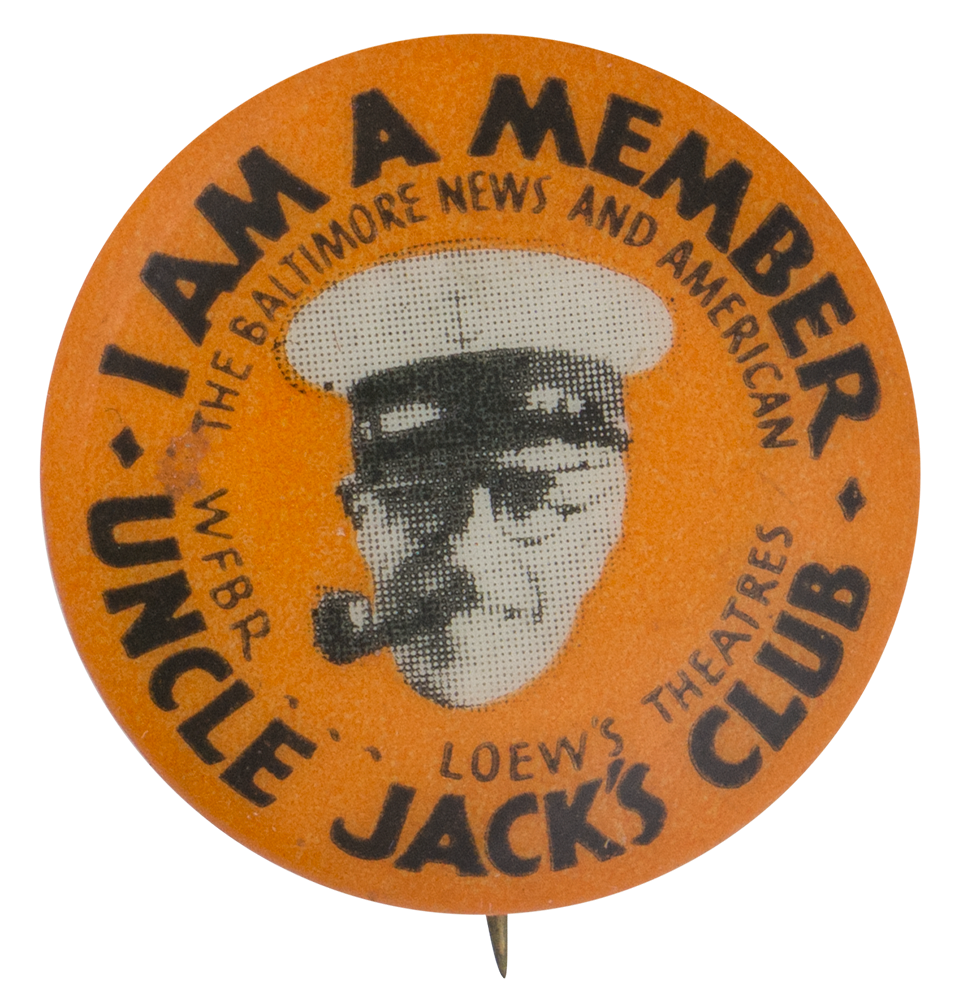
Text on Button I AM A MEMBER UNCLE JACK'S CLUB THE BALTIMORE NEWS AND AMERICAN WFBR...LOEW'S THEATERS
Image Description

Orange button with black text around the top and bottom edges and in the middle there is a halftone photograph of a man in a captain's hat, wearing glasses and smoking a pipe.

Back Paper / Back Info

LUCKE BADGE & BUTTON CO BADGES, BUTTONS NOVELTIES BALTIMORE, MD

Back Style
The Shape
The Size
Year / Decade Made
The Manufacturer
Additional Information

Uncle Jack’s club was a kiddie club on radio station WFBR located in Baltimore, Maryland in the 1930s and 1940s. The club provided children an opportunity to participate in a talent show at the Hippodrome Theatre every Saturday morning. It was co-sponsored by Loew’s Theatre and a local newspaper, The Baltimore News and American.

Catalog ID CL0318

Uncle Genes Kiddie Club

Category
Additional Images
Sub Categories
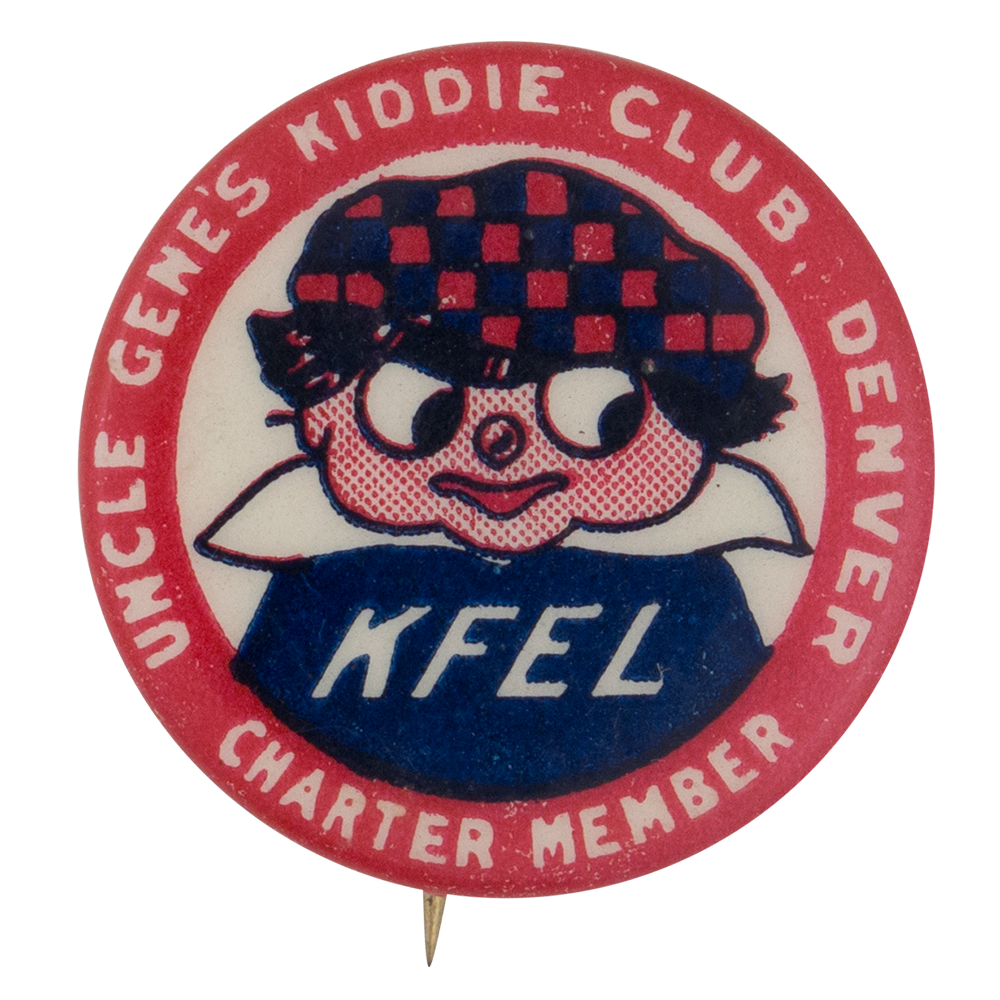
Text on Button UNCLE GENE'S KIDDIE CLUB DENVER CHARTER MEMBER KFEL
Image Description

Red border around the outer edge of the button with white text in it and an illustration of a young pink faced character in a blue and red checkered hat, and a blue shirt with a large white color and white text on top.

Back Style
The Shape
The Size
Additional Information

Uncle Gene’s Kiddie Club was a promotional effort put forth by Denver’s second oldest radio station, KFEL. The station was founded by in 1923 by Gene O’Fallon, who became the station manager.

Catalog ID CL0308

Uncle Daves Radio Pal Club

Category
Additional Images
Sub Categories
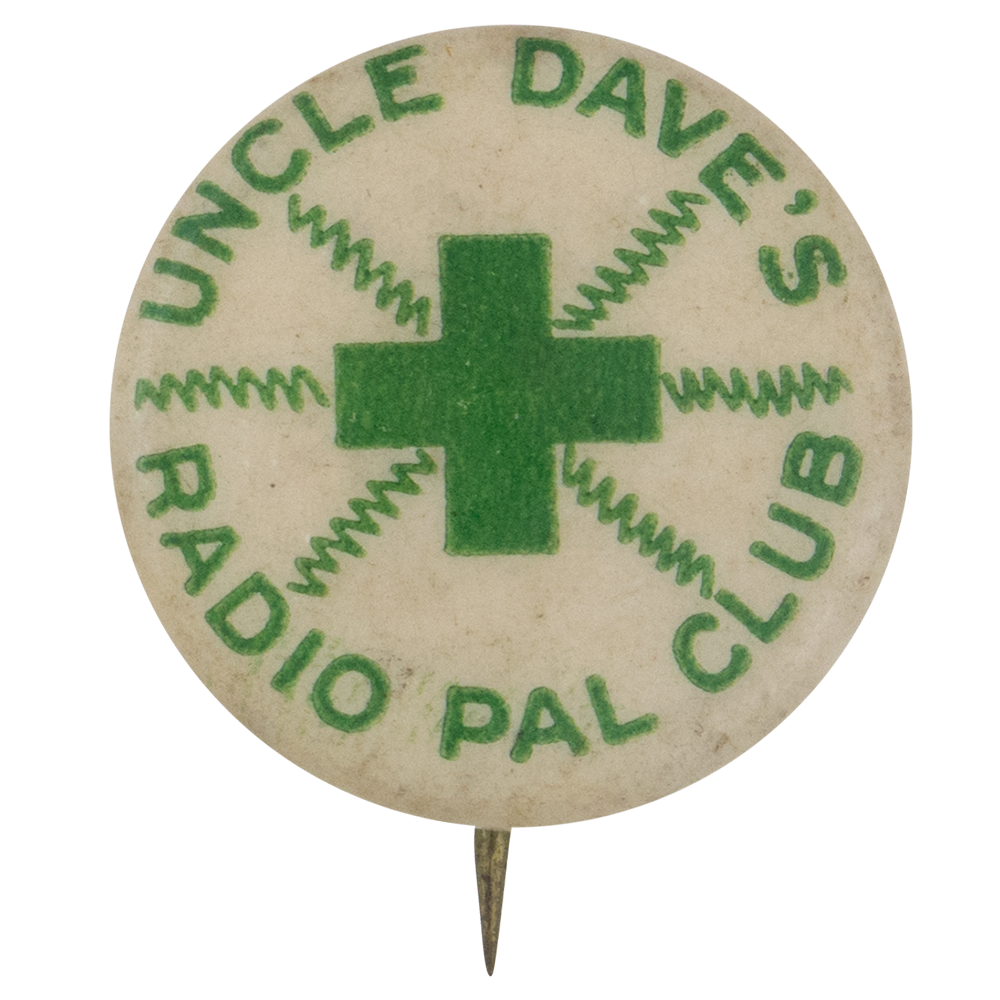
Text on Button UNCLE DAVE'S RADIO PAL CLUB
Image Description

White background with green text along the top and the bottom edges and a green illustration of a plus sign with squiggly lines radiating out of it.

Back Style
The Shape
The Size
Additional Information

Have info on this button? Contact us here.

Catalog ID CL0316

The Pizza Corps

Category
Additional Images
Sub Categories
Text on Button Join the Pizza Corps
Image Description

Red text on a yellow background

Curl Text union bug
Back Style
The Shape
The Size
Additional Information

Pizza delivery first gained popularity in the United States in the 1950s with the advent of television. Americans figured they would rather eat in front of the tube than go out to a restaurant. Businesses quickly adjusted their models to accommodate this new trend. “Pizza Corps” refers to a fleet of delivery drivers hired to deliver pizza. By encouraging people to join the “Pizza Corps”, a business could ensure that they could hire more delivery drivers to handle the demand.

Catalog ID CL0422