Russian Military Sphinx

Category
Additional Images
Sub Categories
Image Description

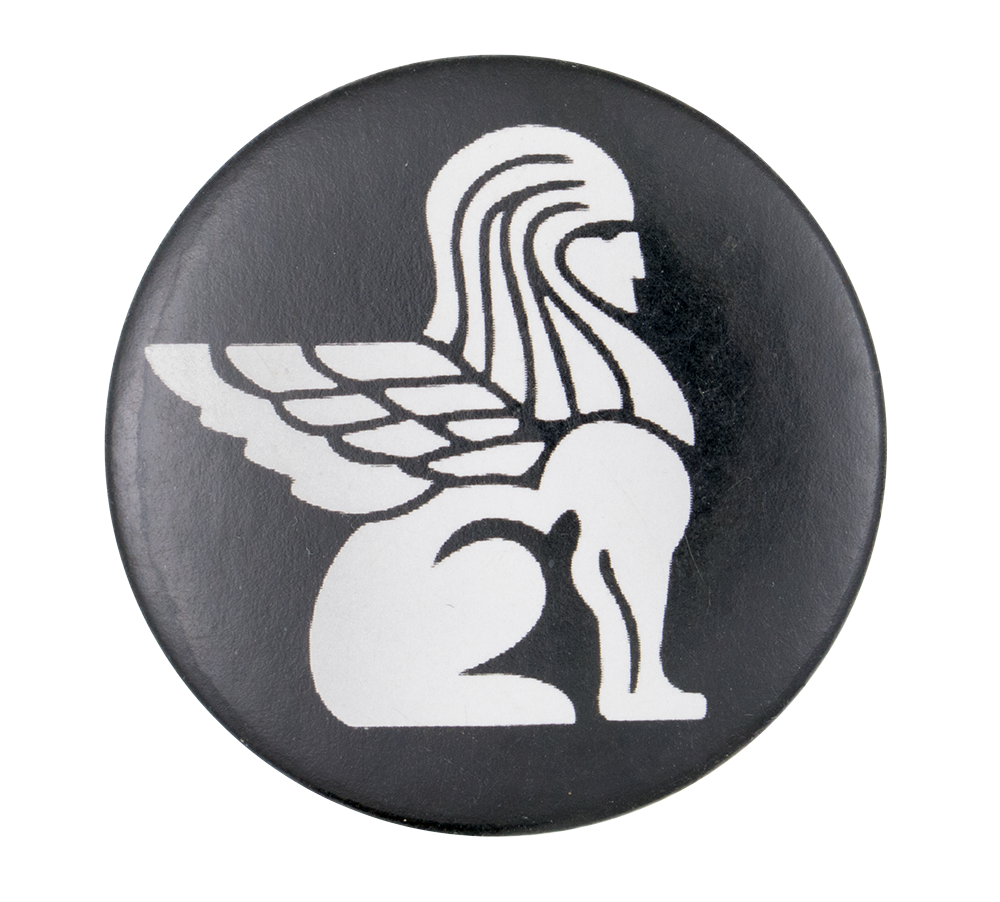
Image of a white sphinx on a black background.

Back Style
The Shape
The Size
Additional Information

The button is a pictorial of the Russian Internal Troops arm badge. The White Sphinx represents the Northwest District of Russia, which includes the city of St. Petersburg. The duties of the Internal Troops of the Ministry for the Internal Affairs (MVD) is to support the military and combat terrorism. One of its major tasks is combat activity in the North Caucasus region of Chechnya. 

Catalog ID CL0162

Stick It In Their Ear

Category
Additional Images
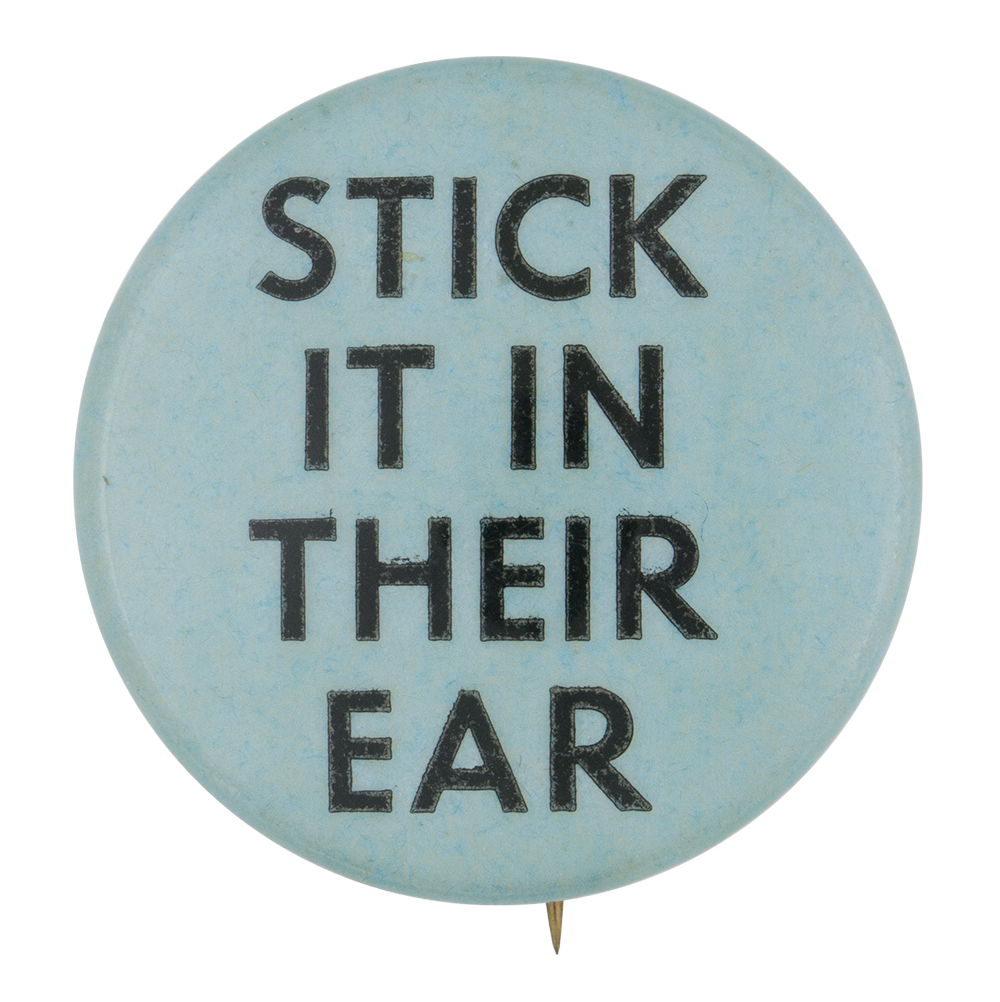
Text on Button STICK IT IN THEIR EAR
Image Description

Black text on a blue background. 

Back Paper / Back Info

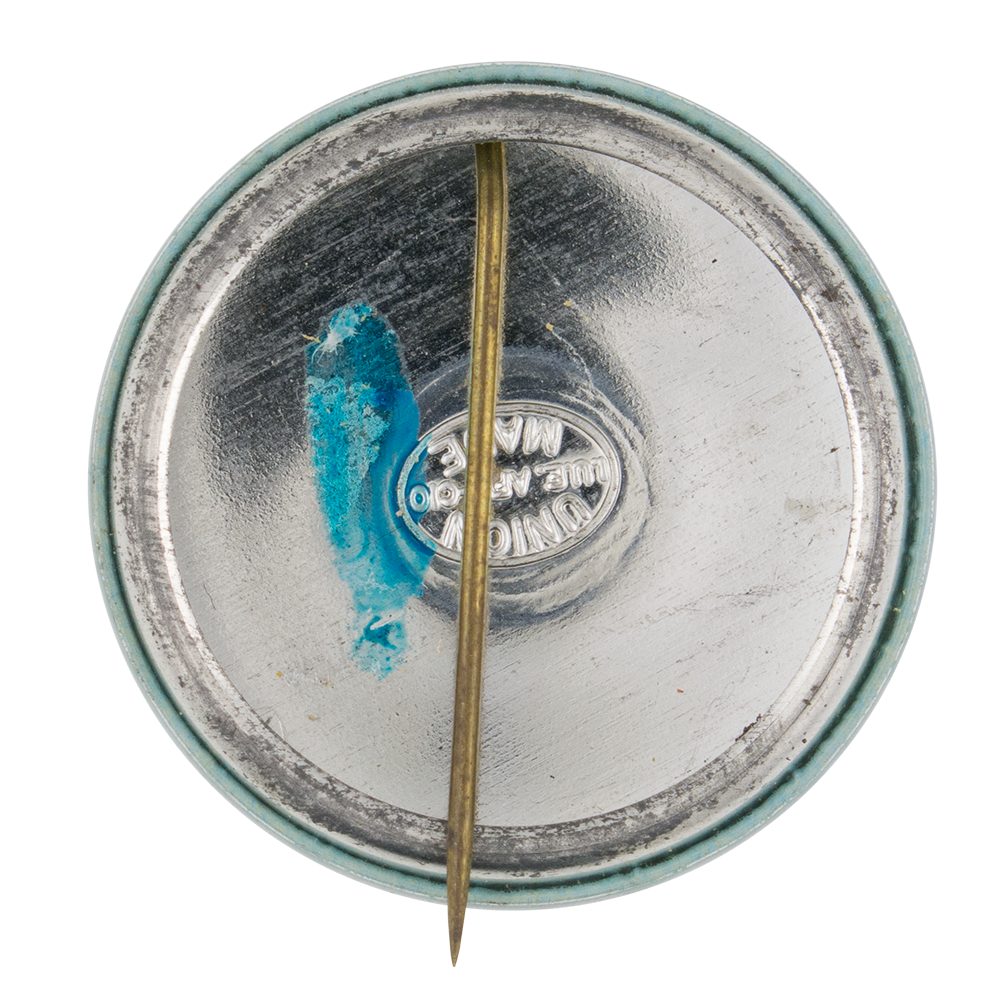
Embossed Union Bug

Back Style
The Shape
The Size
Additional Information This is an expression of disdain, similar to “screw them.” Its origin is unknown, but it probably developed as a euphemism for more vulgar expressions. It is not particularly popular in modern conversational English, and it may have never been compared to similar expressions. However, a movie released in 1970 titled Stick it in your Ear suggests that it may have been much more common around that time.
Sources
Writing Explained (n.d.). What does stick it in your ear mean? https://writingexplained.org/idiom-dictionary/stick-it-in-your-ear
Catalog ID IB0045

Variety Club Barker

Category
Additional Images
Sub Categories
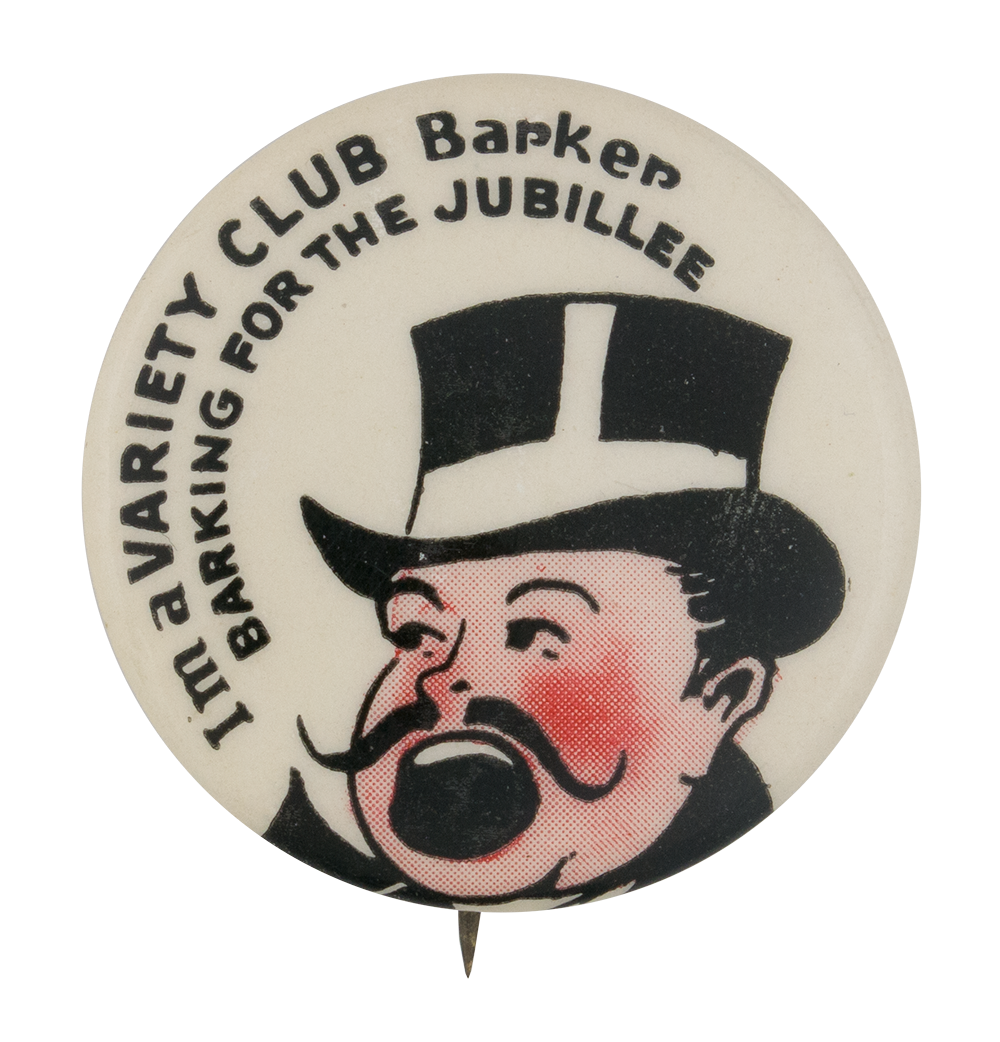
Text on Button Im a VARIETY CLUB Barker BARKING FOR THE JUBILLEE
Image Description

Illustration of a pink faced man with a mustache and a wide open mouth in a top hat in slight profile with black text on the upper left side of the button on a white background.

Back Style
The Shape
The Size
Additional Information

The Variety Club came about in 1927 and is a children’s charity that still continues today to support disadvantaged children with chapters worldwide. It was formed by people in show business as a social club but its identity began to change when a woman dropped her child off in front of a theater on Christmas Eve in 1928 saying she could not care for it. The Variety Club took the child under their wing and subsequently this led to the mission of the club being to help children as it does today.     
 

With the club’s origins stemming from show business, it has used some occupational terms to describe those in the club. One of those terms is “barker”.  This was the occupation of a man in show business who would presumably “bark” to gather customers at a fairground to come to shows at a carnival or circus. The members in the club are called barkers and Chief Barker is the title given to the chairman of the board. 

Catalog ID CL0194

Used Car

Category
Additional Images
Sub Categories
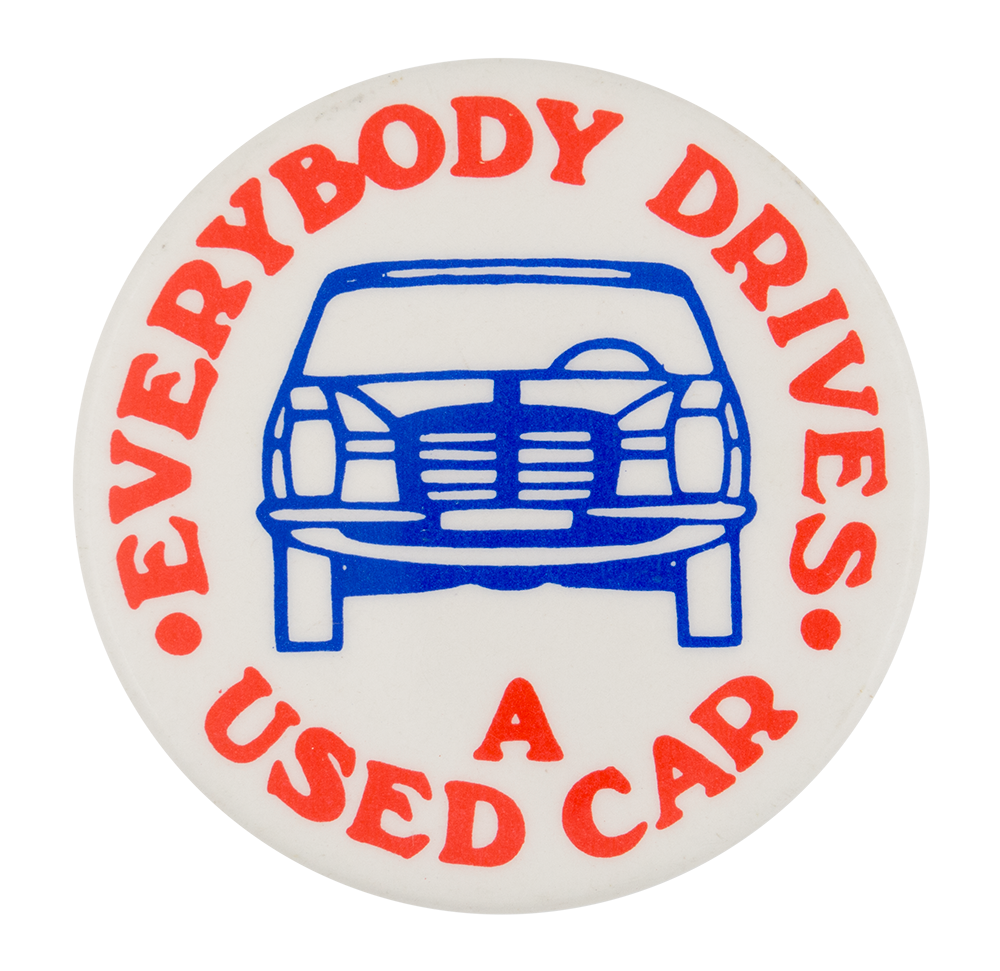
Text on Button EVERYBODY DRIVES A USED CAR
Image Description

An illustration of a blue car is in the center of the button. The text is red and surrounds the car image on a white background.

Back Style
The Shape
The Size
Additional Information

The origin of the advertising slogan, “Everybody Drives a Used Car,” is unknown. The slogan has been spotted in several mid-20th century advertisements with the earliest being in 1921 Motor Age, where it is attributed to Lozier Auto Co. out of Des Moines, IA. In a 1949 publication, the origin of the slogan is attributed to L. F. Jacob & Co.

Sources

Motor Age. (1921). United States: Class Journal Company. 34.

Sunners, W. (1949). American Slogans: The World's Greatest Collection of Slogans and Phrases (13,000) Intended to Aid Advertisers and Advertising Agencies to Determine the Existence of Slogans Already in Use; to Assist in Complying with the Lanham Act; to Help the Copywriter, Radio Continuity Writer, Commercial Artist, Teacher, Student, and Contestant .... United States: Paebar Company. 20.

Catalog ID AD0304

Ten Year Buyer

Category
Additional Images
Sub Categories
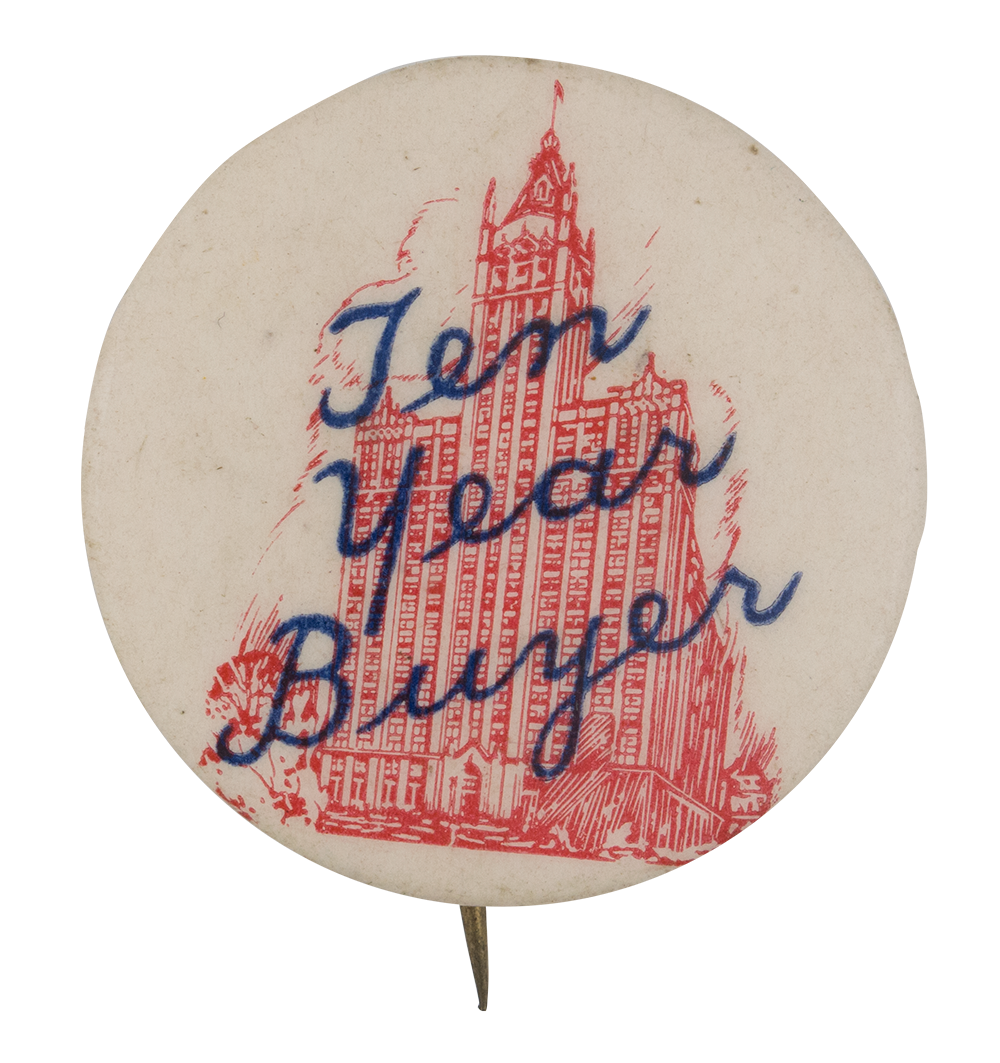
Text on Button Ten Year Buyer
Image Description

Illustration of a red building with blue text crossing over the top on a white background. 

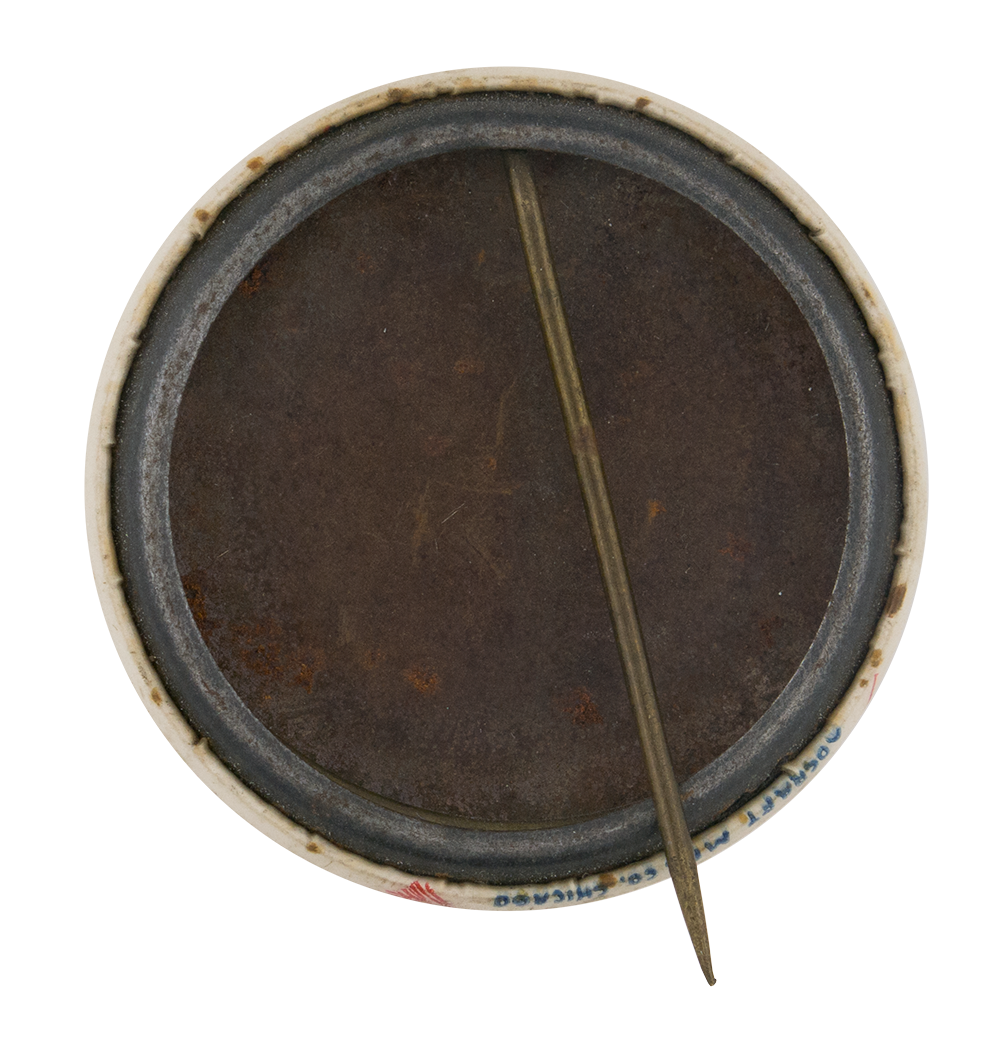
Curl Text ADCRAFT MFG. CO. CHICAGO
Back Style
The Shape
The Size
The Manufacturer
Additional Information

The building illustrated on this button is the Montgomery Ward Tower Building at 6 N. Michigan avenue in Chicago. It was known as the Montgomery Ward & Co. building and was built in 1899 by architect Richard E. Schmidt. The original 12-story tower building, at 394 feet high, was once the tallest building in Chicago at the time of its completion. 

Ward (Montgomery) & Co. was the world's first great mail-order retail company founded in Chicago in 1872 by Aaron Montgomery Ward, a New Jersey native who came to Chicago in 1866. The company opened its retail store in 1926 to compete with its main rivals Sears and Roebuck & Co.

Sources

Montgomery Ward Tower. (n.d.). In Chicagology. Retrieved from: https://chicagology.com/goldenage/goldenage015/.

Ward (Montgomery) & Co., (n.d.). In Encyclopedia of Chicago. Retrieved from: http://encyclopedia.chicagohistory.org/pages/2895.html.

Catalog ID CL0198

Soviet Youth

Category
Additional Images
Sub Categories
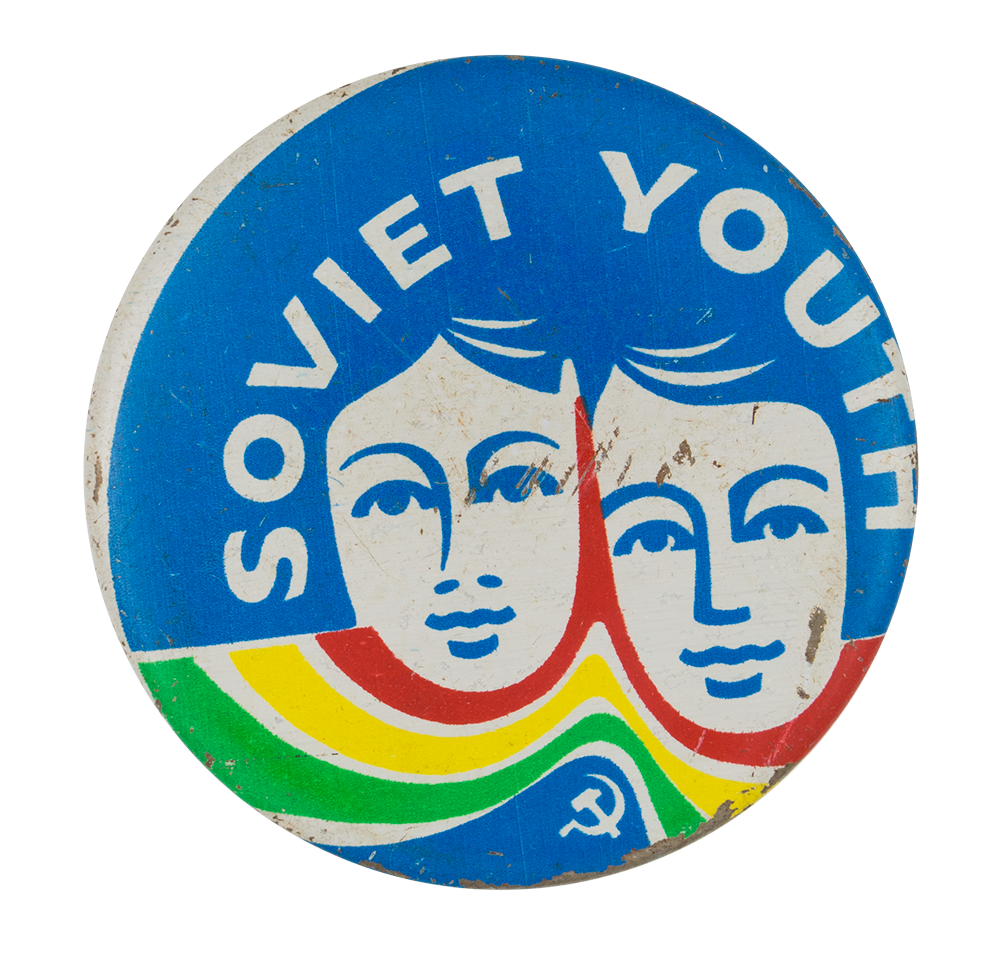
Text on Button SOVIET YOUTH
Image Description

An illustration of two faces outlined in blue looking forward and smiling. There is a white hammer and sickle symbol below the faces on a blue hill line at the bottom of the button. The text arches above the faces in a blue arch on the top of the button. There are three green, yellow, and red waves that are separated by white stripes below the two faces.

Back Style
The Shape
The Size
Additional Information

Organized in 1918, various youth organizations involved in the Russian Revolution banded together to create Komsomol.  Later children were recruited to join Komsomol (ages 14-28) and its counterparts, Young Pioneers (9-14) and Little Octobrists (9 and under), where they were taught to prioritize Communism above all else.  These groups provided politically driven education and recreation, conditioning children to be loyal and remain loyal to the socialist party while engaging members in healthy activities, sports, education, and various services and industrial projects in an effort to rebuild post-war Soviet Russia.  Under the direction of Stalin this vision shifted toward becoming an auxiliary arm of the Soviet State.  At its largest, during the 1970s, Komsomol had about 40 million members; about two-thirds of the present population of Russia is believed to have once been a member.  Following the collapse of communism in the Soviet Union, the Komsomol disbanded in 1991.

Catalog ID CA0087

Rock Read

Category
Additional Images
Sub Categories
Text on Button ROCK READ
Image Description

A black book with a guitar neck coming out of the top. The text is in white on the front of the book. The background is white.

Back Style
The Shape
The Size
Additional Information

Have info on this button? Contact us here.

Catalog ID CA0129

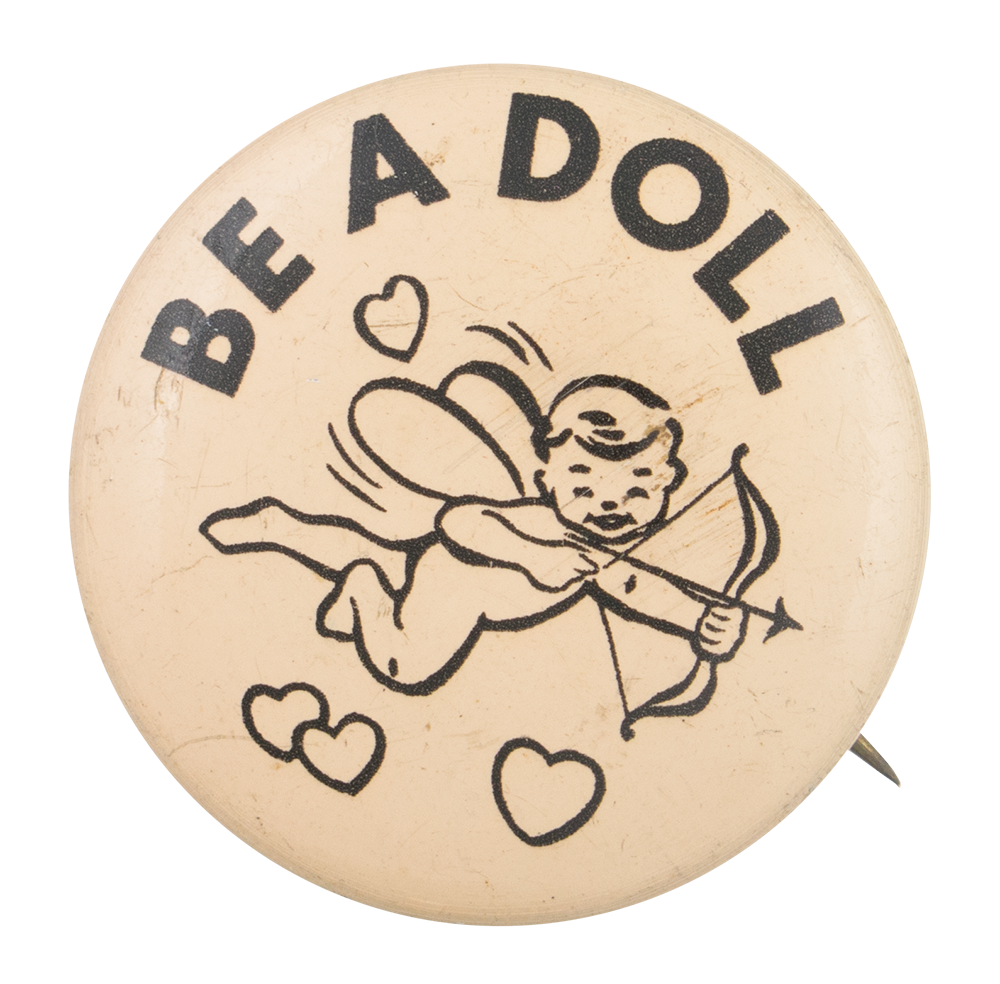
Be A Doll

Category
Additional Images
Sub Categories
Text on Button BE A DOLL
Image Description

A black illustration of Cupid and some hearts below black text on a creme background. 

Back Paper / Back Info

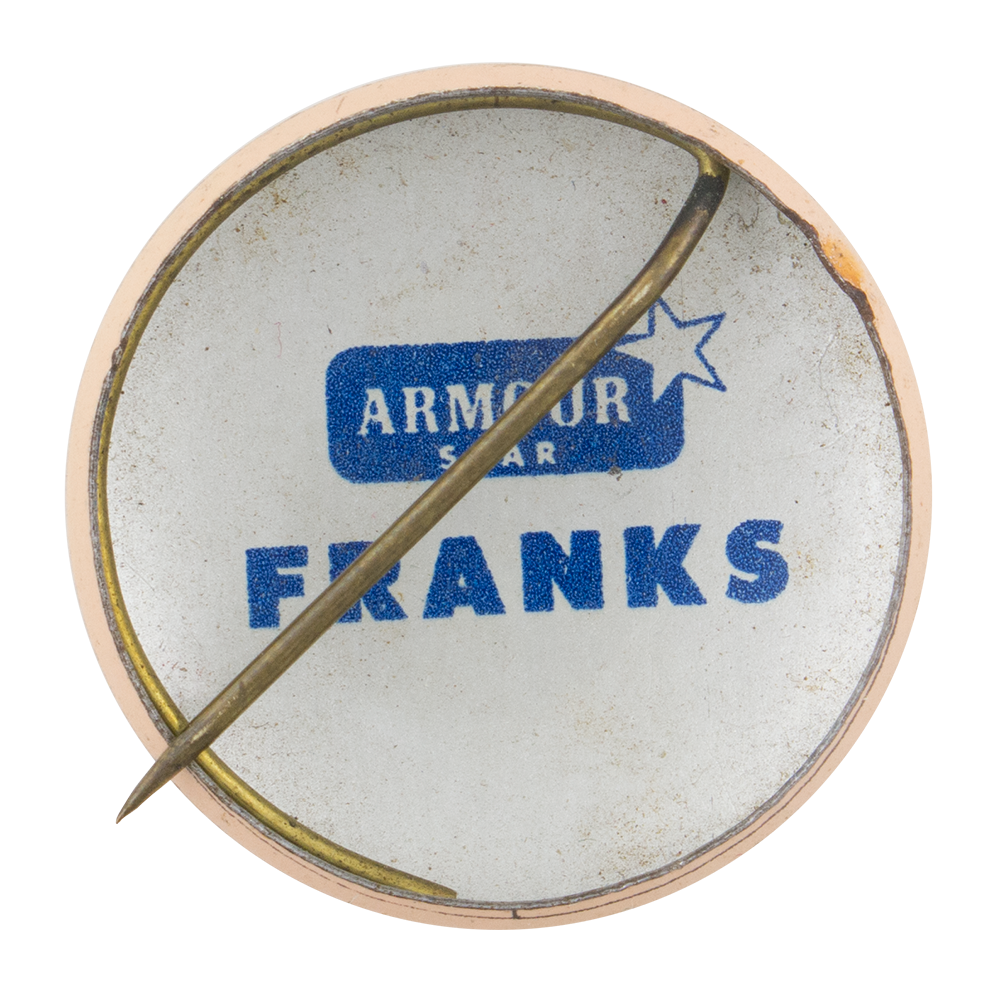
ARMOUR STAR 

FRANKS

Back Style
The Shape
The Size
Year / Decade Made
Additional Information

Armour and Company was founded in Chicago in 1867 by Philip Danforth Armour. It's success made Chicago a central meat packing location for the country, helping the city grow in prominence. 

This button is from the "breezy button" collection from Armour Star meat packing company. The buttons were included as a free gift in every package of Armour franks (hot dogs) during the 1950s. The collection had 24 buttons, each with a catchy, "breezy" slogan.

Sources

Armour Star. (1955, August 14). Collect these...breezy buttons you get one free in every package of new Armour Star franks [Advertisement]. Chicago Daily Tribune, G10.

Armour Star (2013). About us. Armour Star. http://www.armour-star.com/about.asp

Catalog ID AD0190

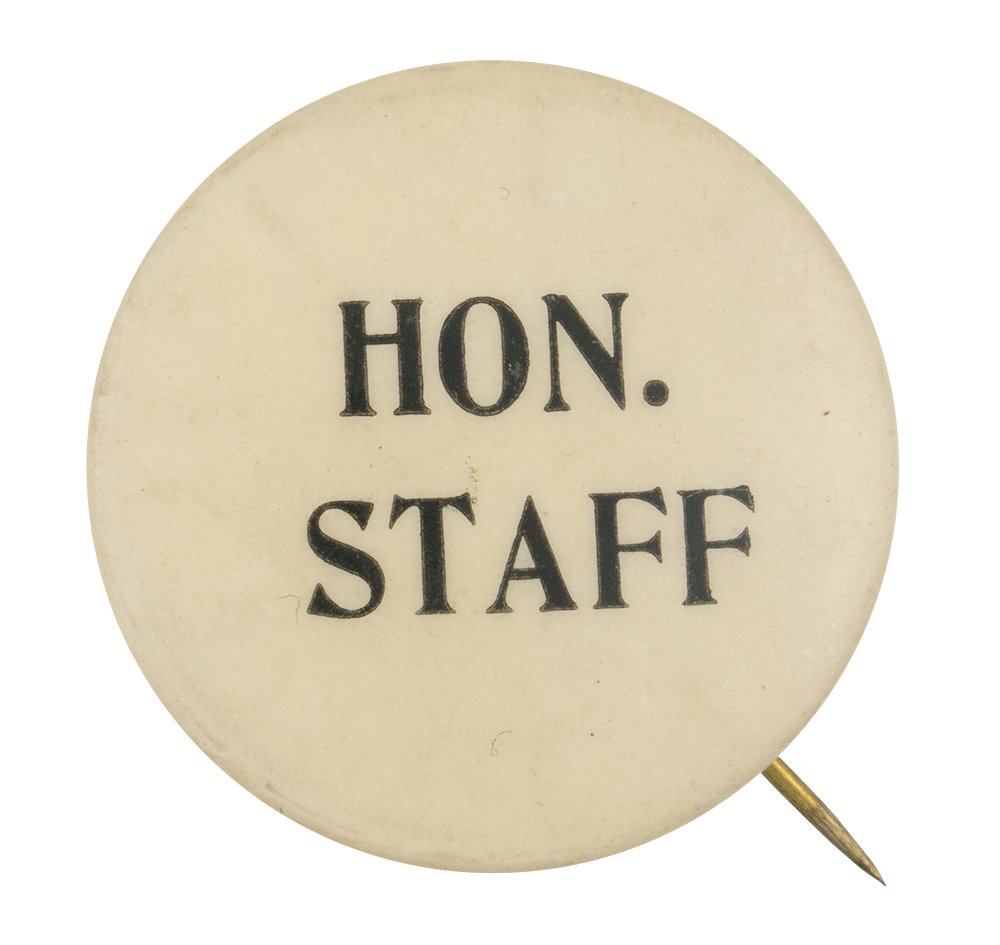
Hon. Staff

Category
Additional Images
Text on Button Hon. Staff
Image Description

Black text on white background

Back Style
The Shape
The Size
Additional Information

An Honorary Staff member, or Hon. Staff, refers to someone given a special role within an organization, event, or institution. This designation, often used historically for identification, recognition, or affiliation, was common at conventions, political events, parades, community gatherings, and fairs. It marked volunteers, aides, or individuals with honorary duties who were not part of the regular paid team, helping organizers quickly identify their helpers.

Sources

National Museum of American History. (n.d.). Pin-back democracy. American Democracy. Retrieved September 11, 2025, from https://americanhistory.si.edu/explore/exhibitions/american-democracy/online/machinery-democracy/democratic-outfitting/pin-back-democracy?utm_source=chatgpt.com 

Catalog ID CL0137