Richter's Wieners

Category
Additional Images
Sub Categories
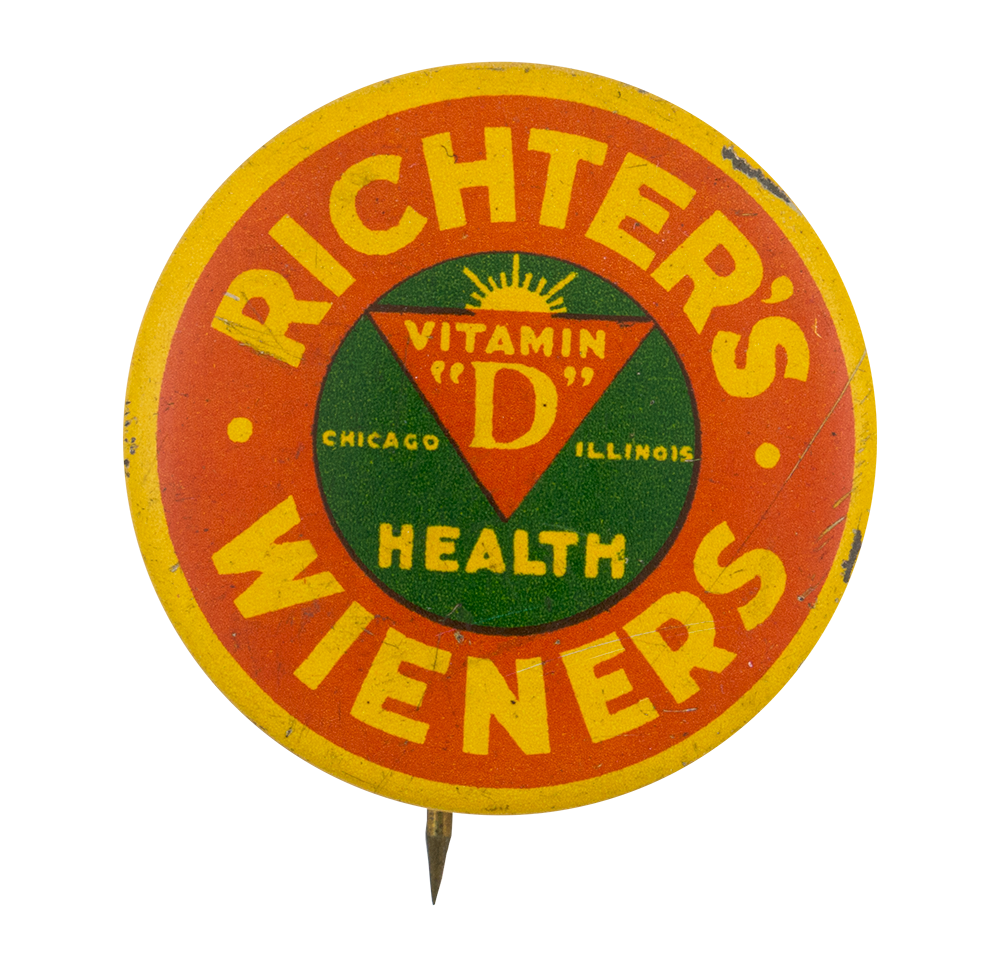
Text on Button RICHTER'S WIENERS VITAMIN D CHICAGO ILLINOIS HEALTH
Image Description

Yellow text on a red triangle on a green background and red outer edge and yellow outer edge.

Back Style
The Shape
The Size
Additional Information

Annie and Bruno Richter immigrated to the U.S. from Germany and began making sausages in their basement in the 1920s. As their efforts grew, they founded Richter’s Food Products in the Jefferson Park community in Chicago, IL. The goal for Bruno Richter was to use extensive advertising to market a healthier sausage. Advertising for “Richter’s Healthy Weiners” or “Richter’s Health Sausage” adorned buttons and matchbooks throughout the Chicago area. The Richter’s Food Products building, finished in 1932, was designed in a lavish art deco style by architect H. Peter Henschien.

Sources

Chicagogeek. (2009, July 8). Richter's Food Products (1933). Retrieved from https://www.flickr.com/photos/chicagogeek/3699321223

Kaplan, J. (2009, August 12). Richter's Food Products – Forgotten Chicago: History, Architecture, and Infrastructure. Retrieved from https://forgottenchicago.com/columns/postcards/richters-food-products/

Catalog ID AD0679

Relay

Category
Additional Images
Sub Categories
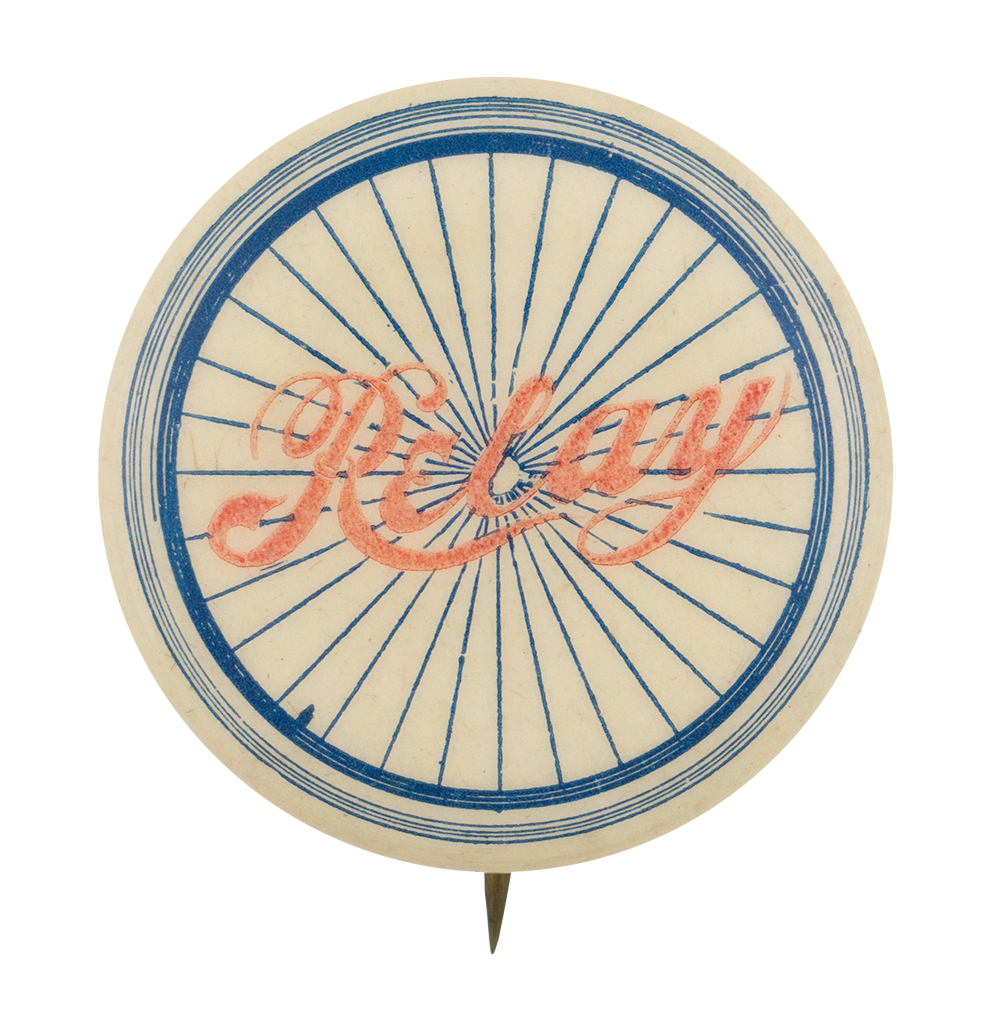
Text on Button Relay
Image Description

Red script text on top of an illustration of a blue bicycle tire on a white background.

Back Paper / Back Info

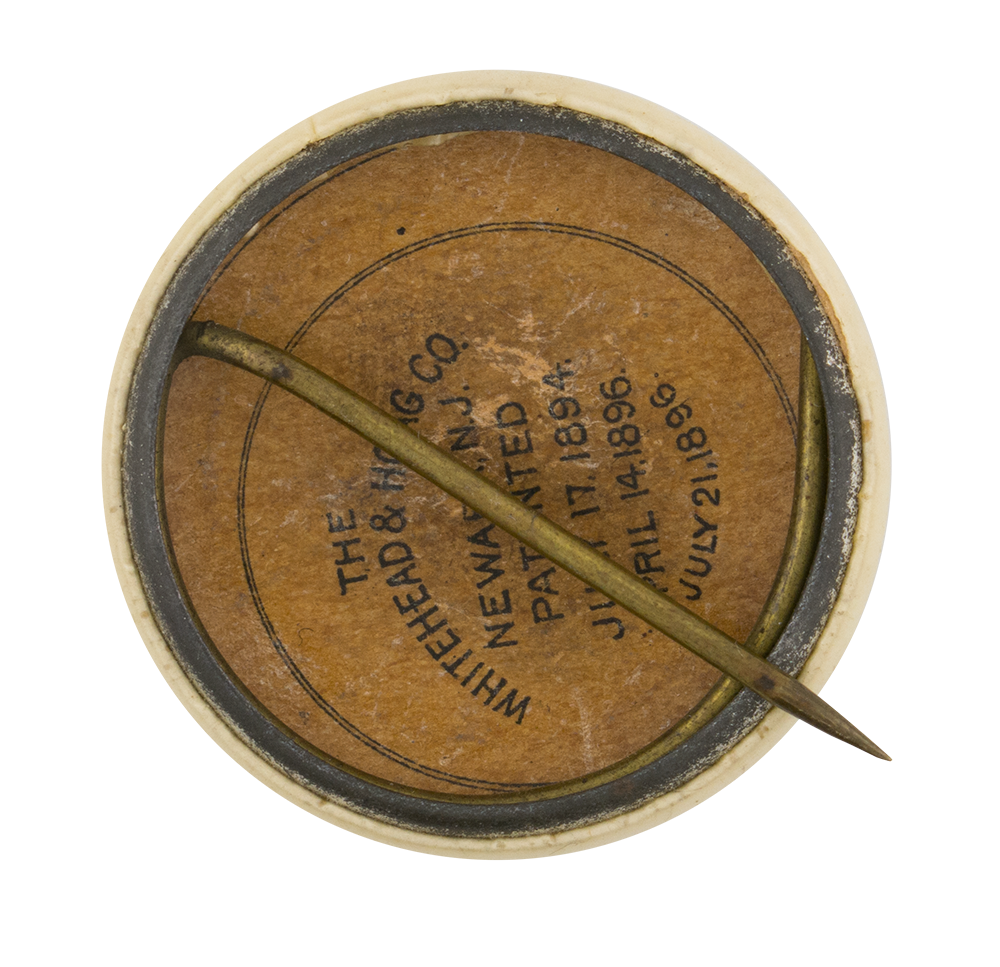
(union bug) Buttons made by The Whitehead & Hoag Co., Newark, N.J., Patented. July 17, 1894, April 14th, 1886, July 21, 1896.

Back Style
The Shape
The Size
The Manufacturer
Additional Information

Relay Mfg. Company was a bicycle manufacturer out of Reading, Pennsylvania, in the 1890s. The Relay Racer was sold in 1892 for $125 and weighed only 32 lbs. J. Geo Ziegler, an inventor, headed both the Relay Mfg. Company and the Tinkham Cycle Company. Together, the two companies produced one of the first passenger tricycles or pedaled rickshaws. The Relay Mfg. Company discontinued making bicycles in 1899 and was renamed the Relay Motor Company.

Sources

Historical and Biographical Annals of Berks County, Pennsylvania, Embracing a Concise History of the County and a Genealogical and Biographical Record of Representative Families, Comp. by Morton L. Montgomery .... (1909). United States: J. H. Beers & Company.

Iron Trade Review. (1895). United States: (n.p.).

The Online Bicycle Museum. (2020). 1895 Tinkham Passenger Tricycle. Retrieved from https://onlinebicyclemuseum.co.uk/1897-tinkham-tricycle-rickshaw/

The Wheel and Cycling Trade Review. (1892, Feb 10). Retrieved from https://www.google.com/books/edition/_/PvlYAAAAYAAJ?hl=en&gbpv=1&dq=rel… bicycle company reading pennsylvania.

Ziegler, J. G., & Meigs, G. W. (1892, May 3). US474327A - Bicycle. Retrieved from https://patents.google.com/patent/US474327

Catalog ID AD0685

Prince Spaghetti

Category
Additional Images
Sub Categories
Text on Button Prince Spaghetti HIGH PROTEIN LOW CALORIE
Image Description

Yellow and red text on a blue and white background with a red and white striped outer edge

Back Paper / Back Info

(union bug)

Curl Text EMRESS SPEC CO 23 (illegible)
Back Style
The Shape
The Size
The Manufacturer
Additional Information

Prince began as a small spaghetti manufacturing company in Boston’s North End. In 1912, three immigrants from the same village in Sicily, Italy, started the company and opened a storefront at 92 Prince Street. Prince is now part of New World Pasta, which is the leading dry pasta manufacturer in the United States. Today, the brand is sold regionally in the Northeast, and the biggest market for Prince remains in Boston.

Sources

Luna, T. (2013). Hey, Anthony! Prince spaghetti marks 100 years. The Boston Globe. Retrieved from https://www.bostonglobe.com/business/2013/09/03/prince-pasta-brand-cele….

Catalog ID AD0673

Arthur McGonigle Pretzel

Category
Additional Images
Sub Categories
Image Description

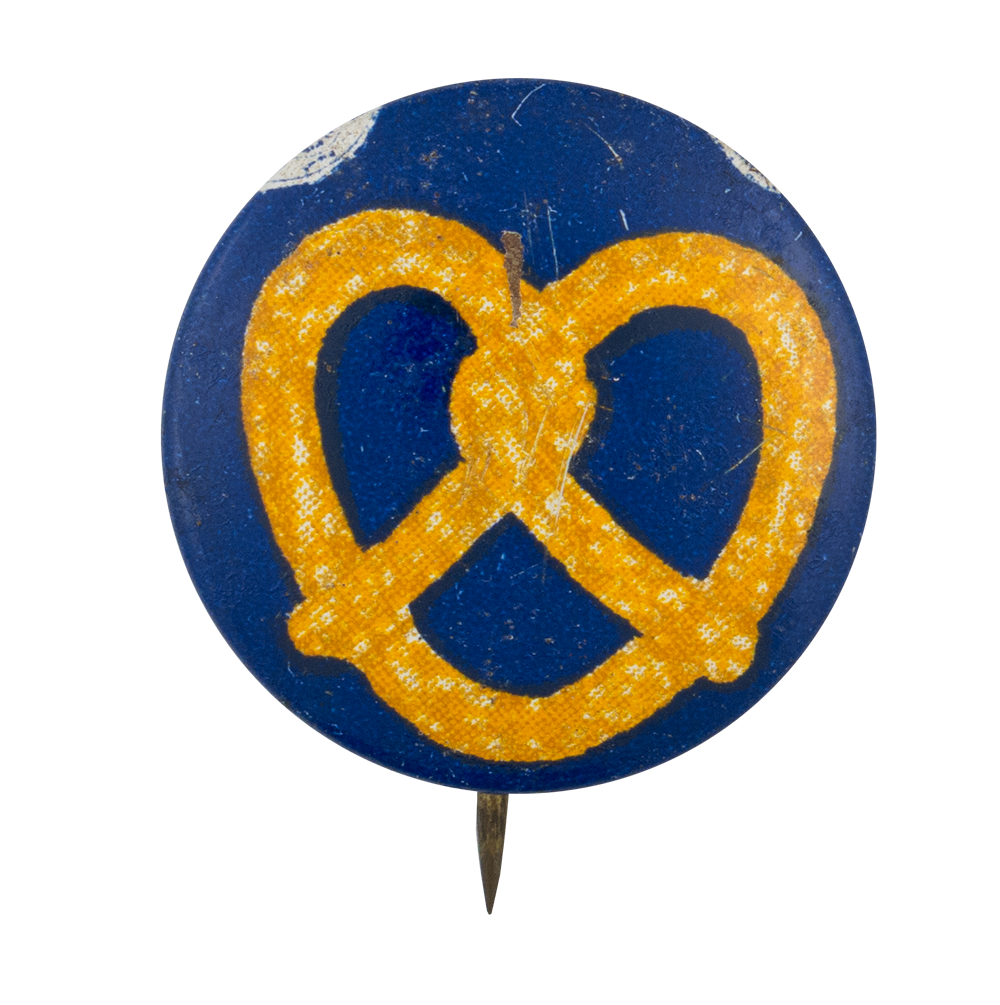
Illustration of a brown pretzel on a blue background

Curl Text union bug
Back Style
The Shape
The Size
Additional Information

This is a campaign pin for Arthur McGonigle, a Pennsylvania businessman who ran for state governor in 1958, though he was defeated by David Lawrence. McGonigle was famous for turning a small pretzel factory into what was considered at the time to be the largest pretzel factory in the United States, resulting in many “twist” puns during his political campaign. 

Catalog ID PO0502

PlayStation

Category
Additional Images
Sub Categories
Text on Button Play Station
Image Description

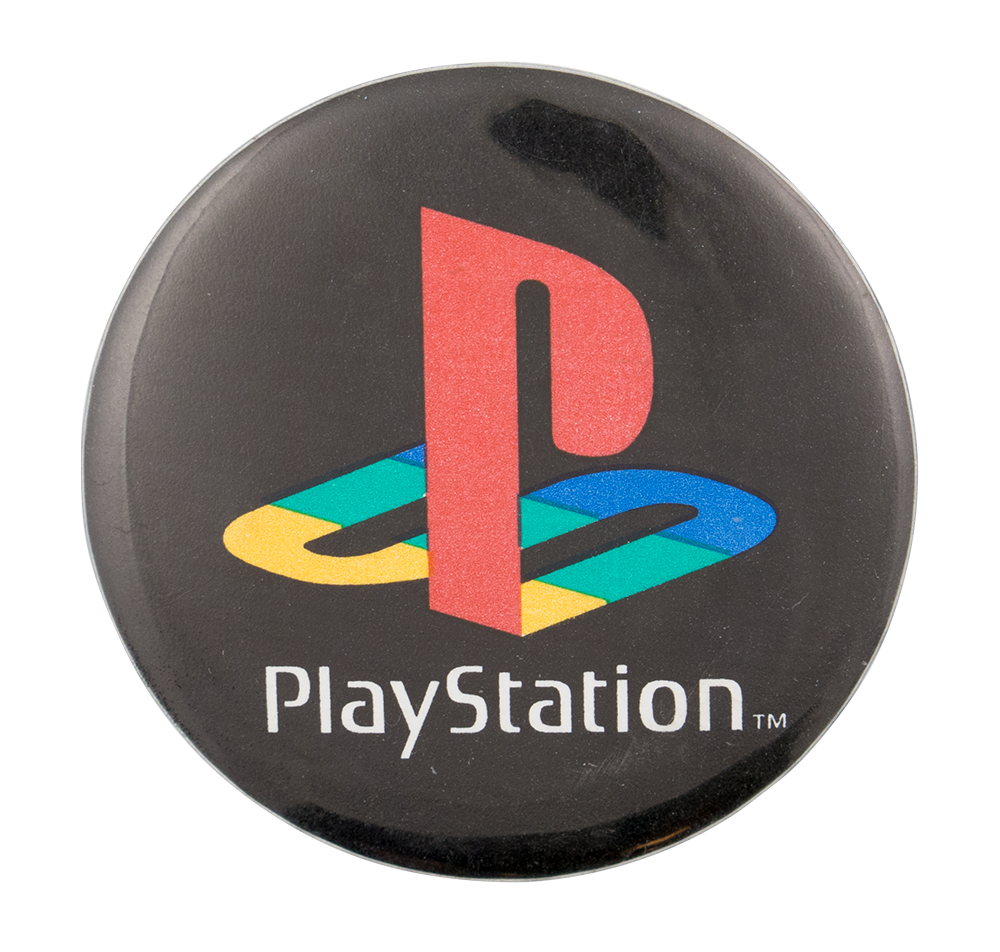
Red, blue, green and yellow logo and white text on a black background

Back Style
The Shape
The Size
Additional Information

The PlayStation series of video game consoles was introduced by Sony on December 3, 1994, in Japan. The original PlayStation was simply called "PlayStation," and the term can refer to that specific console or the brand, which now includes the PlayStation 2 (released in 2000), PlayStation 3 (released in 2006), and PlayStation 4 (released in 2013), along with their handheld Playstation Portable (PSP) consoles.

The inception of the PlayStation began with a joint project between Nintendo and Sony to incorporate CD-ROM technology into Nintendo's gaming consoles, which primarily used cartridges. Nintendo broke the deal after they could not compromise on the specifics of sharing revenue, and Sony tasked executive Ken Kutaragi with developing the PlayStation into a rival for Nintendo. The resulting PlayStation was hugely successful, becoming the first video game console to sell 120 million units. The success has continued for the series ever since, and the PlayStation 2 is the highest-selling home game console to date, having sold over 155 million units.

Catalog ID AD0620

Palmer Method

Category
Additional Images
Sub Categories
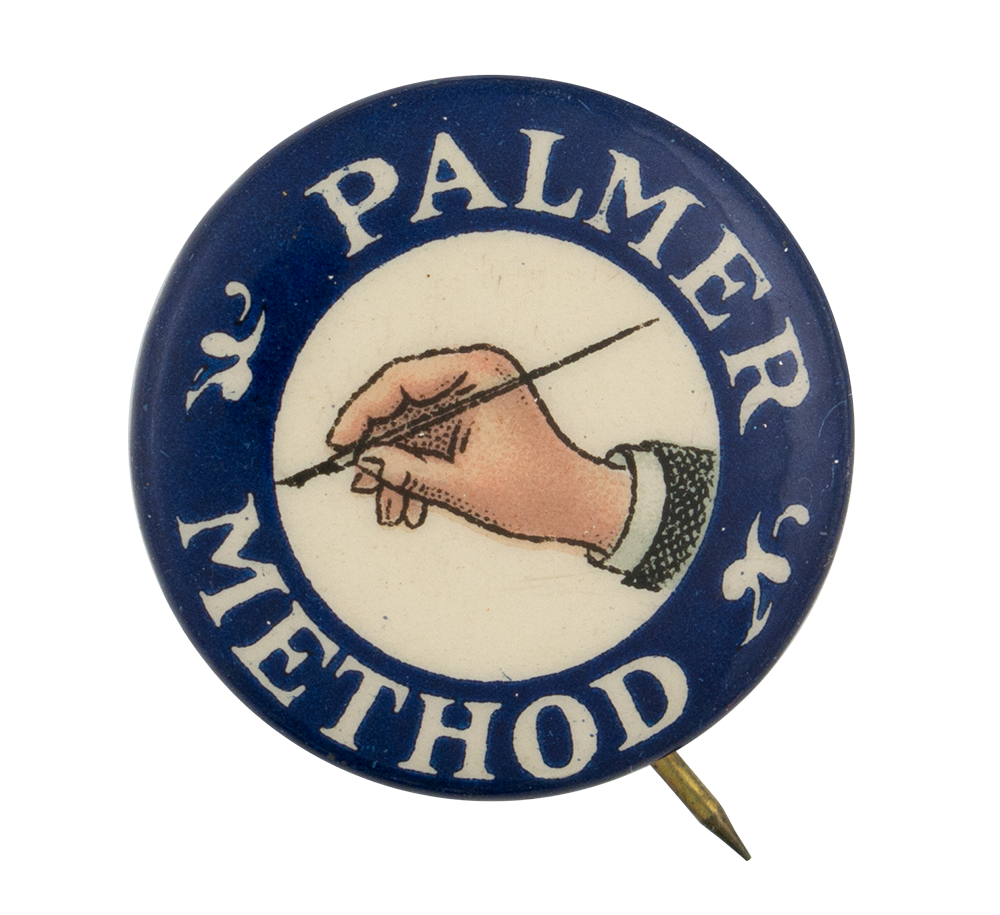
Text on Button PALMER METHOD
Image Description

Illustration of a hand holding a pen on a white background with a navy blue outer edge with white text.

Back Paper / Back Info

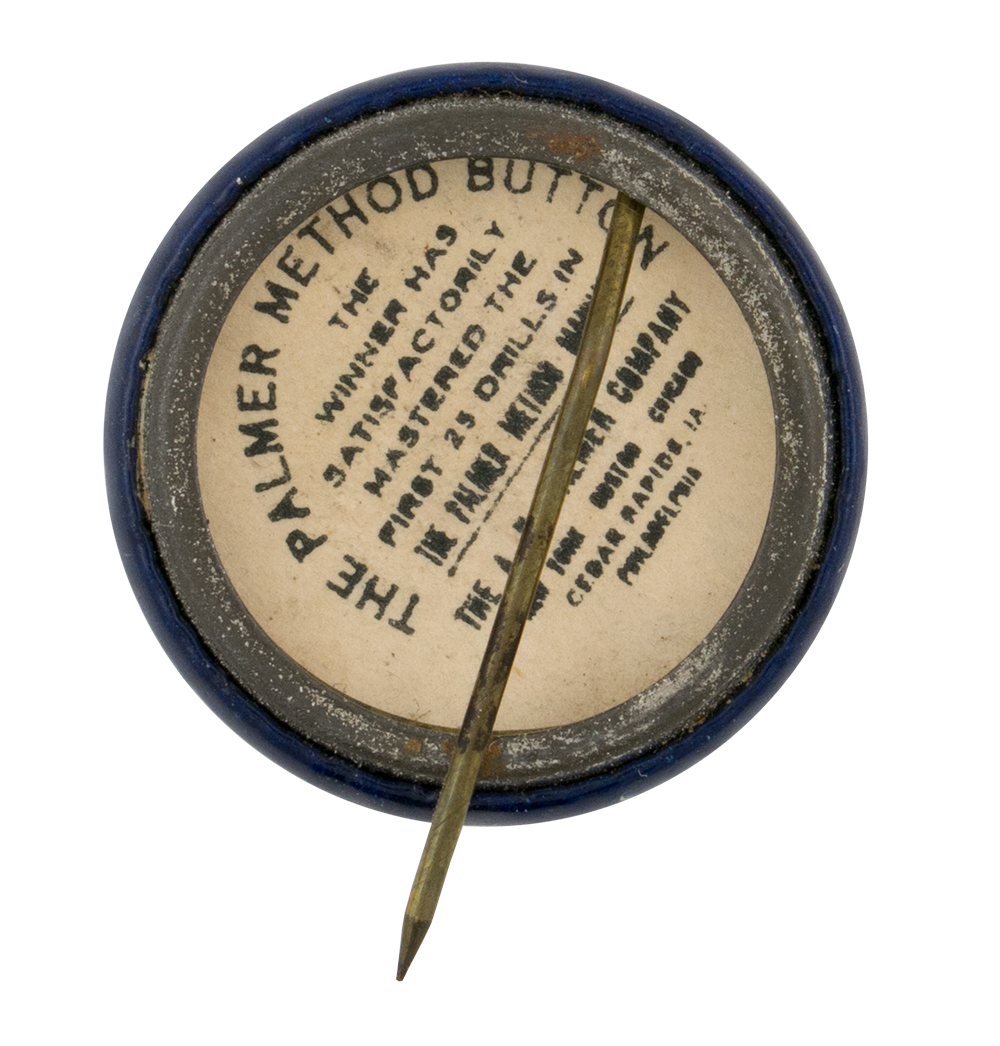
The Palmer Method Button The Winner has Satisfactorily Mastered the First 25 Drills in The Palmer Method Manual The A.N. Palmer Company New York Boston Chicago Cedar Rapids IA Philadelphia

Back Style
The Shape
The Size
The Manufacturer
Additional Information

The Palmer Method of penmanship instruction was developed around 1888 by Austin Palmer. The cursive handwriting system was simpler than previous popular systems and was meant to allow the writer to compete with the speed of the typewriter. The Palmer Method maintained popularity from its inception until the 1950s. This button indicates that the bearer has mastered the first 25 drills in the Palmer Method Manual.

Catalog ID AD0682

New Idea Manure Spreader

Category
Additional Images
Sub Categories
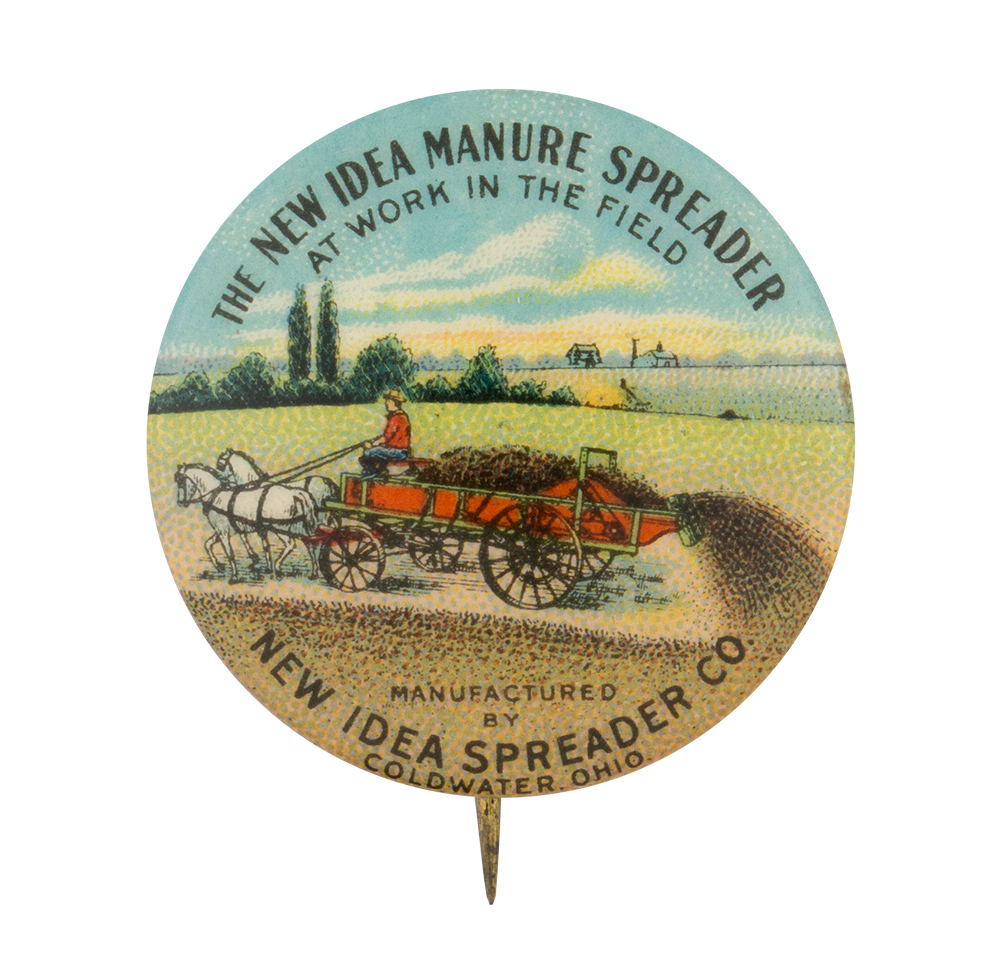
Text on Button THE NEW IDEA MANURE SPREADER AT WORK IN THE FIELD MANUFACTURED BY NEW IDEA SPREADER CO. COLDWATER, OHIO
Image Description

Color illustration of a wagon pulled by two white horses on a farm with black text.

Back Paper / Back Info

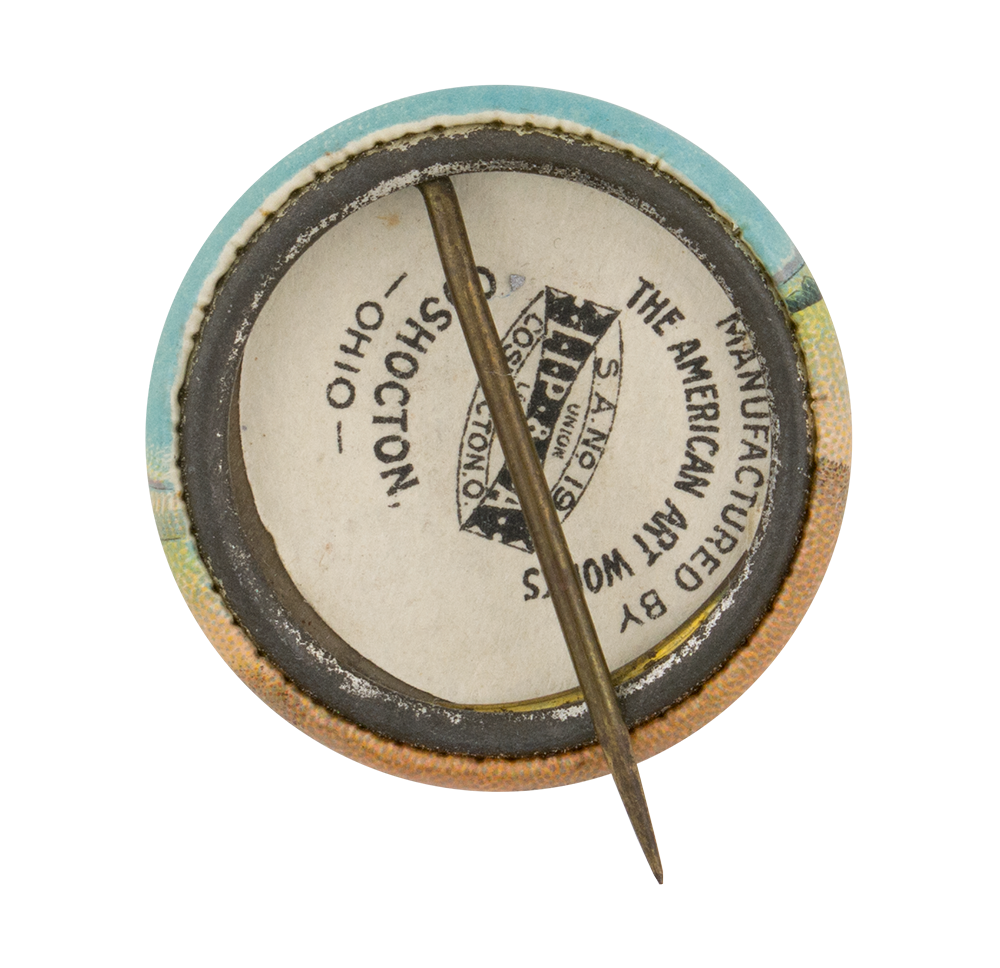
Manufactured by The American Art Works (union bug) Coshocton -Ohio-

Back Style
The Shape
The Size
Year / Decade Made
The Manufacturer
Additional Information

The New Idea Spreader Company, formerly known as New Idea Spreader Works, was founded by Joseph Oppenheim in 1899, with the help of his son B.C. Oppenheim. The senior Oppenheim was a schoolmaster and came up with the idea to modify the manure spreaders after watching his students play tom ball. During the game, he noticed that the person handling the bat could control which direction the ball went by angling the bat differently. He felt the same could be done with the spreaders. After trial runs with the help of his son, their idea worked, and they were able to sell some of their early models to neighbors. Later, they expanded the New Idea Manure Spreaders and produced them in a factory, which produced a machine about every three minutes. In 1930, New Idea purchased the Sandwich Company, which provided them with new farming designs like fine corn shellers and hay loaders. After being sold several times, New Idea was closed and liquidated in 1999. 

Sources

Albert, S. (2018). New Idea May Be Gone but the Memories Still Alive for Many. The Daily Standard. Retrieved from: https://dailystandard.com/archive/2018-06-14/stories/35192/new-idea-may…

Mangen, M. (1982). Rebuilding the New Idea Manure Spreader. Small Farmer's Journal. Retrieved from: https://smallfarmersjournal.com/rebuilding-the-new-idea-manure-spreader/

Catalog ID AD0643

My Hero

Category
Additional Images
Sub Categories
Text on Button MY HERO
Image Description

Illustration of a hero sandwich and brown text on a white background.

Back Style
The Shape
The Size
Additional Information

A deli sandwich served on a long bun with hot or cold meat and veggies, cheese, or toppings is known by several names, each with its own distinctions: submarine/sub, grinder, hoagie, and hero. In 1936, New York Herald columnist Clementine Paddleworth described thick sandwiches in New York City as "hero sandwiches" because "you had to be a hero to eat it," which is likely the origin of the moniker. A hero sandwich could be a hot or a cold sandwich, including cold cuts, meatballs, or chicken parmesan, unlike the sub, which is traditionally cold. Hoagies, or hoggies, were distinguished by their piles of meat, which are often also a trait of hero sandwiches. A grinder is a New England term for a hero sandwich, likely derived from having to grind your teeth to eat it and more commonly eaten by dockworkers where the slang term gets its origin.

My Hero Submarine Sandwich Shoppes, established in 1964, was located in Chicago on Western Avenue. Only cold sandwiches were served, and, without seating in the shop, customers took their sandwiches to go. One family owned the shop for several generations before being bought by Denise Mitchell. Denise bought the shop because her mother worked there for twenty-five years. The place held a lot of nostalgia for both Denise and the many locals who frequented the shop. My Hero Submarine Sandwich Shoppes closed in 2017.

Sources

Hero’s Submarine Sandwich Shop - CLOSED. Retrieved 20 February 2021, from https://www.yelp.com/biz/heros-submarine-sandwich-shop-chicago

My Hero Submarine. Retrieved 20 February 2021, from https://web.archive.org/web/20191020145227/http://www.myherosub.com/ind…

Warshaw, B. (2019). What’s the Difference Between a Hero, Sub, Grinder, and Hoagie?. Retrieved 17 February 2021, from https://www.eater.com/2019/9/15/20866864/whats-the-difference-between-h…

Catalog ID AD0681

Mobile Home

Category
Additional Images
Sub Categories
Text on Button Livin's Easier in a Mobile Home
Image Description

Green text on a white background.

Back Style
The Shape
The Size
Additional Information

The first examples of mobile homes can be traced to roaming bands of Roma who traveled the countryside in horse-drawn homes as far back as the 1500s. The modern version of the mobile home became popular in America before the Depression as an inexpensive way to travel. However, in the 1930s, these traveling homes became a more permanent solution for many who had lost jobs.  Although they were never originally intended as a permanent dwelling, manufacturers picked up on the trend.  Mobile homes became increasingly popular during WWII when hundreds of war industries needed housing for workers, and portable trailers were seen as a convenient and economical answer. 

After the war, mobile homes became popular due to limited housing for returning soldiers and their families.  Over time, average square footage and amenities in mobile homes increased, and mobile home parks sprouted up all over the country.  Miss South Carolina shocked audiences when she introduced herself at the Miss America Pageant in 2013 by proclaiming, "From the state where 20% of our homes are mobile 'cause that's how we roll, I'm Brooke Mosteller, Miss South Carolina." The Recreational Vehicle/Manufactured Housing (RV/MH) Hall of Fame is located in Elkhart, Indiana.

Catalog ID AD0670